“YOU’RE… SPECTRE?” My Mom Told a Four-Star General I’d Never Amounted to Much…
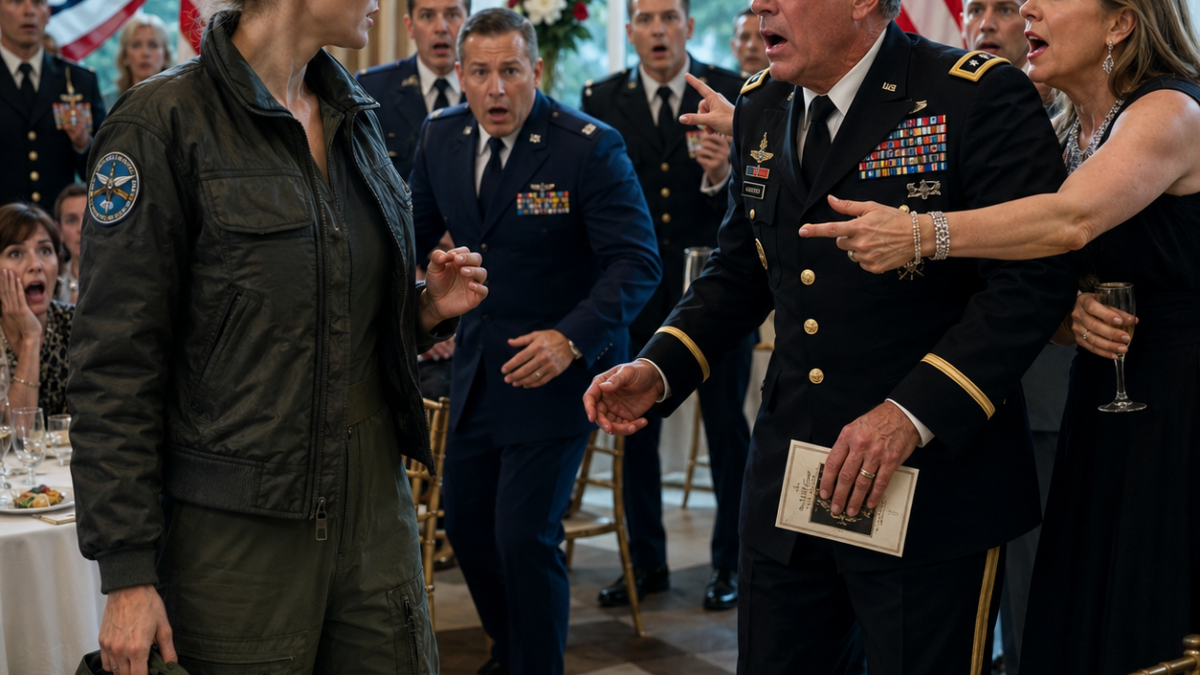
“She’s Never Really Settled. No Roots, No Family — Never Amounted To Much,” Mom Told The General About Me. Then He Turned, Looked Me In The Eye, And Went Completely Still, Trembling: “You’re… Spectre? The Pilot Who Brought My Son Home?”
### Part 1
The night my mother told a retired four-star general that I had “never really amounted to much,” I was standing less than fifteen feet away with a half-finished cup of coffee in my hand.
She didn’t know I could hear her.
What she also didn’t know was that before the night was over, that same general would hear one word associated with me, set his coffee down, stare at me as though he had seen a ghost, and ask a question that would change the way my mother looked at me forever.
“You’re… Spectre?”
But I’m getting ahead of myself.
My name is Mara Bennett. I was thirty-seven that fall, the younger of two daughters raised in Fayetteville, North Carolina, in a brick colonial house with white shutters, polished silver at Thanksgiving, and a mother who could detect a flaw in almost anything.
My mother, Elaine, believed life was something you arranged properly.
The napkins matched the dishes.
Christmas cards went out before December tenth.
Children went to respectable colleges, married stable people, bought houses near their parents, and produced grandchildren who smiled nicely in framed photographs.
My older sister, Claire, understood that system perfectly.
She married Gavin Whitaker, an orthodontist with a successful practice outside Raleigh. They bought a five-bedroom house twelve minutes from my mother. Their daughters took ballet, played soccer, and wore matching navy dresses every Easter.
Claire gave my mother a life she knew how to explain.
Then there was me.
I never got arrested. Never ran away. Never dropped out of school.
I simply wanted the wrong things.
When I was twelve, my father took us to an air show outside Fayetteville.
I can still remember the smell of sunscreen and cut grass, the paper cup of lemonade sweating in my hand, and the sound of jet engines rolling across the field so hard I felt it in my ribs.
Six aircraft crossed overhead in formation.
Everyone around me covered their ears.
I stared straight up.
Something inside me clicked into place.
That evening, while my mother spooned green beans onto our plates, I said, “I want to fly for the Air Force.”
She stopped.
Then she laughed.
Not cruelly. Not yet.
“You hate heights.”
“I hate ladders.”
My sister snorted.
I looked at my mother. “Flying is different.”
She glanced at my father as though expecting him to explain reality to me.
My father, Thomas Bennett, cut another piece of chicken and chewed thoughtfully.
Then he looked at me.
“Then figure out what it takes.”
My mother’s fork touched her plate with a sharp little sound.
“Thomas.”
“What?”
“She’s twelve.”
“So?”
“She’ll change her mind.”
Dad looked back at me.
“Maybe. But if she doesn’t, she should know how to get there.”
That was my father.
He worked as a county civil engineer for more than thirty years. He wasn’t flashy. He wore the same brown leather belt until the buckle nearly gave out, changed his own oil, coached youth baseball, and wrote reminders on yellow legal pads scattered around his desk.
His love never felt like something I had to qualify for.
My mother’s did.
I didn’t understand that yet.
Not completely.
So I spent the next six years trying to prove that wanting something different didn’t mean there was something wrong with me.
I ran track.
I kept my grades high.
I avoided trouble so completely that my friends joked I would apologize to a stop sign if I bumped into it.
And during my senior year, without telling my mother, I started an application to the Air Force Academy.
I filled out forms in the school library during lunch.
I rewrote my essays until the custodian started turning the lights off around me.
I asked my track coach for a recommendation.
My father knew something was happening, but he never pushed.
Then one cold afternoon in March, I came home and found a thick envelope waiting on the kitchen counter.
The return address was from Colorado Springs.
My hands started shaking before I even opened it.
I read the first line.
Then I read it again.
I had been accepted.
That evening I placed the letter in front of my mother.
She adjusted her reading glasses and read every word.
Her face showed nothing.
Finally, she folded the letter, slid it back into the envelope, and pushed it across the table toward me.
“That’s what you want?”
“Yes.”
She looked at my father.
He didn’t look away.
“It’s her choice,” she said.
But the way she said it made “choice” sound like “mistake.”
That night, my father knocked on my bedroom door.
He sat beside me and rubbed his palms together.
“She’s scared,” he said.
“I know.”
“That doesn’t excuse everything.”
That surprised me.
Dad stared at the floor for a second before continuing.
“But there’s something I need you to hear from me before you leave this house someday.”
I looked at him.
His eyes were wet.
“I am proud of you, Mara. More proud than I know how to explain.”
I swallowed hard.
He smiled.
“And if flying is where you belong, then go fly.”
Years later, after medals, deployments, funerals, promotions, classified missions, and a call sign almost nobody in my family had ever heard, those words would still be the ones I remembered.
Because my father had known who I was before I had done anything worth knowing.
My mother, on the other hand, would spend the next nineteen years proving she had never really tried.
And one night in Chapel Hill, she would finally say that part out loud to the wrong man.
### Part 2
Colorado Springs nearly broke me.
That is not dramatic language. It’s simply true.
The first months at the Academy felt like being stripped down to individual pieces and being asked whether those pieces belonged together strongly enough to build anything useful.
Everything was measured.
Time.
Discipline.
Endurance.
Judgment.
How I reacted when tired.
How I treated people when frustrated.
How clearly I could think when somebody was shouting three feet from my face.
There were mornings when my legs burned before sunrise and nights when I fell asleep with textbooks open across my chest.
I loved it.
Not every second. Nobody loves every second.
But for the first time in my life, being intense wasn’t considered a personality defect.
Being serious had value.
Staying calm had value.
Wanting to understand how everything worked had value.
I stopped feeling like the strange piece in my mother’s carefully assembled family photograph.
I felt useful.
Dad called every Sunday he could.
Mom usually picked up first.
“How’s Colorado?” she would ask.
“Cold.”
“Are you eating enough?”
“Yes.”
“Claire and Gavin are looking at houses.”
And just like that, the conversation would move east.
When I graduated, my parents came.
Dad looked like he might explode from pride.
Mom wore a cream suit and kept smoothing the front of it.
Afterward, while Dad hugged me hard enough to wrinkle my uniform, Mom kissed my cheek and said, “Well, you certainly committed to it.”
That was her version of congratulations.
I learned to stop expecting different.
Flight training came next.
Then assignments.
Then more training.
Then places I couldn’t describe over the phone even if my mother had asked.
By thirty-two, I had made captain.
When I told Dad, he laughed so loudly I had to pull the phone away from my ear.
“I knew it.”
“You knew what?”
“That they’d eventually figure out what I knew when you were twelve.”
Mom’s reaction came three days later.
“That’s nice, honey.”
Then she told me Claire’s oldest daughter had been moved to the advanced ballet group.
I wish I could say those things stopped hurting.
They didn’t.
I simply got better at carrying them.
My father never asked for classified details. He knew better.
Instead, he asked questions around the edges.
“What kind of people are you working with?”
“What does leadership look like where you are?”
“What’s the hardest part that you’re allowed to tell me?”
He kept a yellow legal pad beside the phone.
I discovered that one Christmas when I came home and walked into his study.
There were pages filled with notes.
“Mara—new squadron.”
“Ask about Nevada exercise.”
“Friend named Rachel? Mechanic?”
“Promotion board spring?”
I stood there holding the pad while he came through the doorway behind me.
“You take notes about me?”
He looked embarrassed.
“My memory isn’t what it used to be.”
“You’re sixty-four.”
“Exactly. Ancient.”
I laughed, but something tightened in my chest.
He cared enough to prepare for our conversations.
My mother barely remembered what state I lived in.
Four years later, Dad was diagnosed with heart failure.
I was overseas when my sister called.
I got emergency leave and reached the hospital the following evening.
He looked smaller in that bed.
That frightened me more than the machines.
My father had always seemed built from something dependable—oak, concrete, iron.
Now his wrists looked thin against the white blanket.
We spent a week talking about almost nothing.
The neighbor’s new fence.
College football.
Whether the hospital coffee qualified as coffee.
The night before I had to leave, I sat beside his bed while rain tapped against the window.
He reached for my hand.
“I probably won’t see all of it.”
“Dad.”
“Don’t.”
His grip tightened.
“Let me finish.”
I looked down.
He took a slow breath.
“Whatever comes next for you. Whatever rank. Whatever place. Whatever you’re not allowed to tell an old county engineer.”
I smiled through the ache in my throat.
“I won’t see all of it.”
He looked directly at me.
“But I already know how your story ends.”
I tried to laugh. “You do?”
“You become exactly who you’re supposed to become.”
That did it.
I had to look toward the window.
He squeezed my hand.
“I already know you’re something special, Mara. You don’t have to prove the rest to me.”
I cried on the flight back.
Eighteen months later, he died while I was deployed.
I got home too late.
The kitchen light was on when I entered my childhood home just before dawn.
My mother sat at the table wearing her robe, both hands around a mug.
I put my bag down.
For one second, she looked relieved to see me.
Then grief hardened her expression.
“You should have been here.”
Four words.
That was all.
I stood there in the kitchen where my father had once told me to figure out how to fly.
I could have defended myself.
I could have told her how hard I had tried to get back.
Instead, I pulled out a chair.
Because my father was dead.
Because she was grieving.
Because somebody in that room had to choose mercy.
For years afterward, I wondered whether that had been my biggest mistake.
### Part 3
My father’s funeral taught me something about him I somehow hadn’t known while he was alive.
He talked about me constantly.
The church was packed.
County employees came. Former neighbors came. Men he had coached decades earlier came with gray hair and children of their own.
At the reception, people kept touching my elbow and saying variations of the same thing.
“Your dad was so proud of you.”
“He told us you were a pilot.”
“He kept that photograph of you in uniform in his office.”
“He said you were doing important work.”
One retired engineer I had never met shook my hand and said, “Thomas used to light up whenever somebody asked about his daughters.”
Daughters.
Plural.
That mattered to me.
Dad had never needed to diminish Claire to be proud of me.
There had always been room for both of us.
My mother behaved differently.
At the reception, she introduced Claire as “our daughter who lives nearby with the girls.”
She introduced me as “Mara, who’s still traveling around with the Air Force.”
Still traveling around.
As if I had spent fifteen years backpacking impulsively instead of building a career.
I didn’t correct her.
I was exhausted.
After the funeral, I returned to duty.
My mother and I settled into a pattern that required very little honesty from either of us.
A phone call every few weeks.
Weather.
Family news.
Birthdays.
Nothing deeper.
Eventually, I was assigned to Nellis Air Force Base in Nevada.
By then I was a lieutenant colonel, working with a joint operations advisory group whose work crossed branches and agencies.
Explaining it to civilians was difficult even without classification restrictions, so I usually didn’t try.
When strangers asked what I did, I said, “I’m in the Air Force.”
When they pressed, I said, “Aviation and operations.”
My mother rarely pressed.
Somewhere during those years, I acquired the call sign Spectre.
Call signs usually sound cooler after the story has been cleaned up.
Mine started with a miserable night, bad weather, terrible visibility, a rapidly changing situation on the ground, and a mission most people had good reason to avoid.
Nobody behaved recklessly.
Nobody was chasing glory.
People were simply in trouble, circumstances narrowed, and I happened to be in a position to help.
We got them out.
Afterward, somebody called me Spectre because the ground team said they couldn’t see us, only hear us, and yet somehow we seemed to be exactly where they needed us.
The name stuck.
Then it traveled.
Years passed.
I heard it from pilots I hadn’t met, officers from other branches, people who knew the story but didn’t know my real name.
To me, it was simply part of work.
I never told my mother.
Why would I?
She had once changed the subject halfway through my explanation of a promotion because Claire had ordered new countertops.
That fall, my cousin Evan called.
He was getting married outside Chapel Hill to a woman named Lila Monroe.
“You’re coming,” he said.
“That sounded less like a question.”
“It wasn’t.”
I liked Evan, so I promised.
The rehearsal dinner was held at The Lantern on Franklin Street.
I arrived ten minutes late after traffic backed up outside Durham.
The restaurant smelled like roasted garlic, coffee, and polished wood. Candlelight flickered against old brick walls while servers moved quietly between white-covered tables.
Evan spotted me first.
“Mara!”
He grabbed me in a hug and immediately started steering me toward the back.
“You remember Aunt June.”
“I do.”
“And that’s your mom.”
“Unfortunately, I remember her too.”
He laughed.
My mother did not.
She was seated beside Aunt June and a tall silver-haired man in a charcoal jacket.
He had the posture.
Anybody who has spent enough years around military people notices it.
The man was technically relaxed, but nothing about him slouched.
My mother stood.
“Mara. You made it.”
“I said I would.”
Her hug was brief.
Evan gestured toward the man.
“This is General Raymond Mercer. Retired Army. He’s an old friend of Lila’s family.”
Four stars.
I knew the name.
Anyone in my line of work would have.
His career had stretched through commands and conflicts I had studied in professional military courses.
I shook his hand.
“General.”
“Just Ray tonight.”
His eyes were sharp and calm.
“And what do you do, Mara?”
I opened my mouth.
My mother answered first.
“Oh, Mara’s Air Force.”
She put two fingers lightly against General Mercer’s sleeve as if sharing a harmless family anecdote.
“She flies planes.”
Then came the little laugh.
“She’s always been our adventurous one.”
I saw Mercer glance at me.
Before he could ask anything else, my sister appeared.
My mother lit up.
“Claire! Come here. Tell Ray about Gavin’s new office.”
Within seconds, I had vanished from my own introduction.
White oak cabinets.
New examination rooms.
A charity fundraiser.
A renovation budget.
I watched my mother perform the familiar magic trick of turning Claire into an achievement and me into an eccentric footnote.
For once, however, I noticed General Mercer wasn’t completely following her.
He looked past my mother once.
Directly at me.
Not recognition.
Not yet.
Just curiosity.
I should have known then that the evening had already begun changing.
### Part 4
Dinner lasted nearly two hours.
Seven courses.
Too many forks.
Enough wine to make relatives who normally disliked one another suddenly exchange promises to “get together more often.”
I was seated three chairs away from my mother.
General Mercer sat beside her.
For most of dinner, I concentrated on Evan and Lila, because it was their night and I genuinely liked them.
But my mother’s voice carried.
It always had.
She told Mercer about Claire’s daughters.
She described Gavin’s practice.
She mentioned their remodeled kitchen, their vacation in South Carolina, and a charity gala Claire had chaired.
Then somebody across the table asked whether both of Elaine Bennett’s daughters lived nearby.
My mother laughed.
“Oh, no. Mara has never been one for staying put.”
I looked down at my plate.
“She goes from place to place,” Mom continued. “I’ve given up trying to remember where she is.”
Aunt June smiled uncomfortably.
“Isn’t she stationed somewhere out west?”
“Nevada, I think.”
I lifted my wine glass.
“Nevada,” I confirmed.
Mom waved one hand.
“See? She keeps me guessing.”
Several people laughed.
Then she added, “I always say I have one daughter who gave me grandchildren and another who gave me gray hair.”
The laughter this time was thinner.
Claire looked at me.
There was an apology in her eyes, which irritated me almost as much as the joke.
Claire had never treated me badly.
But she had spent years accepting the pedestal my mother built for her without asking what materials had been used underneath it.
I smiled faintly.
“Happy to contribute.”
General Mercer watched me.
Later, when dessert was moved into a private room, I escaped to the restroom.
I stayed longer than necessary.
I washed my hands slowly and stared at myself beneath the unforgiving bathroom lights.
Thirty-seven.
Silver beginning at one temple.
A tiny scar under my chin from training years earlier.
Eyes that looked more tired than I felt.
“You’re here for Evan,” I told the mirror.
Not Mom.
Not history.
Evan.
I went back out.
A waiter passed carrying coffee.
I took a cup and entered the private room through a side hallway.
Voices drifted around the corner.
My mother’s was unmistakable.
“She never really settled. That’s the truth.”
I stopped.
Aunt June said something too softly for me to hear.
Mom continued.
“Thirty-seven years old. No husband. No children. No real roots.”
My fingers tightened around the coffee cup.
“She moves from base to base and does God knows what and calls it a career.”
A pause.
Then General Mercer’s voice.
“She’s an officer?”
“Oh, yes.”
Mom sounded almost dismissive.
“She’s always been very capable when she decides to be. I just…”
Another pause.
“I suppose I expected more.”
Something cold moved through my chest.
Not because the sentence was new.
It wasn’t.
I had heard it without hearing it my entire life.
Every redirected conversation.
Every half-congratulation.
Every comparison with Claire.
Every achievement treated like an inconvenient hobby.
This was simply the first time she had condensed nineteen years of judgment into one clean sentence.
I expected more.
She continued.
“I love her. Obviously I love her. But she never really amounted to what I thought she would.”
I stood there staring at the steam rising from my coffee.
Then my father’s voice appeared in my memory as clearly as if he were standing beside me.
You don’t have to prove the rest to me.
I almost laughed.
The strange thing was, I wasn’t furious.
That surprised me.
I had imagined moments like this before. In those imaginary versions, I confronted her. Asked questions. Forced her to account for every year.
Instead, I felt tired.
Not defeated.
Finished.
There’s a difference.
I rounded the corner.
My mother saw me immediately.
Her expression changed for perhaps half a heartbeat.
Then the familiar social smile slid into place.
“Mara. There you are. I was just telling Ray—”
“What base are you stationed at?”
General Mercer’s voice cut across hers.
He wasn’t looking at my mother.
He was looking directly at me.
“Nellis.”
His eyebrows moved slightly.
“What command?”
“Joint operations advisory.”
My mother made a tiny impatient sound.
Mercer ignored it.
“What role?”
“Operations support and interagency advisory. I’ve led the same team for roughly three years.”
He stopped moving.
Something in his face changed.
The room suddenly felt smaller.
“How long have you been flying?”
“Most of my career.”
“What platforms?”
I gave him the broad answer I was allowed to give.
He nodded once.
Then he asked a question that felt strangely specific.
“Were you ever assigned to operations in the Euphrates region?”
The cup in my hand suddenly felt heavier.
“Yes.”
“What year?”
I told him.
His eyes sharpened.
My mother looked between us.
“Ray?”
He didn’t respond.
Instead, he asked me one final question.
“What was your call sign?”
Mom laughed lightly.
“Oh, those silly little nicknames.”
I looked at General Mercer.
For the first time that evening, I noticed that his face had lost all casual warmth.
He was waiting.
“Spectre,” I said.
The room seemed to stop breathing.
General Raymond Mercer stared at me.
His coffee cup lowered slowly from his mouth.
“You’re…”
His voice almost failed him.
Then he said it again.
“Spectre?”
And suddenly, I knew this wasn’t about military trivia.
This man knew exactly who Spectre was.
### Part 5
“Yes, sir.”
General Mercer didn’t blink.
“Euphrates Valley?”
My stomach tightened.
“Yes.”
“Support mission. Heavy weather.”
“Yes.”
He set his coffee down.
Carefully.
Too carefully.
My mother looked irritated now, mostly because she didn’t understand why the conversation had escaped her control.
“What is this?”
Mercer still didn’t look at her.
“Captain Luke Mercer.”
The name hit me.
Not instantly.
First came fragments.
A voice over a radio.
A unit designation.
A night filled with information arriving faster than anyone wanted it.
A ground team trying to get out before conditions closed completely.
Then it came together.
“Second Ranger Battalion,” I said.
Mercer’s jaw tightened.
“My son.”
Everything around me became distant.
The dessert plates.
The low conversations.
The clinking silverware.
Even my mother.
I remembered Luke Mercer now.
Not his face. I hadn’t seen it then.
His voice.
Steady.
Too steady.
The kind of calm people use when panic would cost somebody else dearly.
“He made it out,” I said.
General Mercer inhaled.
“He made it home.”
I nodded.
“I’m glad.”
The general gave a strange, short laugh with no humor in it.
“Glad?”
People nearby had begun listening.
He stepped closer.
“My son came home because someone went into conditions other people had already decided were beyond acceptable.”
I shook my head.
“There were a lot of people involved.”
“Yes.”
His voice was firm now.
“There were.”
I knew what he was doing.
Military people are often uncomfortable with the mythology civilians attach to individual actions. Nothing important happens because of one person.
Teams matter.
Ground crews matter.
Maintenance matters.
Controllers matter.
Command decisions matter.
Timing matters.
Luck matters more often than anybody wants to admit.
So I said, “General, I did my job.”
His eyes hardened.
“So did everyone else that night. But my son has told that story for years, and every version ends the same way.”
I didn’t respond.
“He said they were told support might not reach them.”
I stared at him.
“He said visibility was collapsing. Extraction was compromised. Then somebody came over the radio.”
Mercer swallowed.
“Spectre.”
My mother had gone silent.
Completely silent.
That might have been the first time in my life I saw her with no available social response.
General Mercer continued more quietly.
“Luke told me he never saw the aircraft. He said he only knew someone was there because every time circumstances changed, that voice was still above them.”
I looked toward the floor.
Memories don’t always come back like movies.
Sometimes they return as sensations.
Pressure in your chest.
A headset digging into your ear.
Instrument lights.
The metallic taste of stale coffee.
The exhaustion afterward when your hands finally begin shaking because they weren’t allowed to shake earlier.
Mercer’s voice pulled me back.
“My son has two children now.”
I looked up.
“A boy and a girl.”
His eyes were wet.
“He coaches his daughter’s soccer team. Complains about his lawn. Calls me too often when he’s working on something in his garage because he thinks retirement made me an expert on tools.”
A few people laughed softly.
Mercer didn’t.
“All that ordinary life exists because he came home.”
My throat tightened.
“General—”
“No.”
He shook his head.
“I have wanted to thank the person behind that call sign for years.”
“You don’t owe me anything.”
“I disagree.”
Then the retired four-star general did something I never expected.
He stepped back.
His heels came together.
His shoulders squared.
The room became completely silent.
General Raymond Mercer, wearing civilian clothes at a rehearsal dinner in Chapel Hill, came to attention.
Then he saluted me.
Nobody moved.
I felt heat rush into my face.
The gesture wasn’t technically necessary.
That was exactly why it mattered.
It wasn’t about rank.
It wasn’t even about service.
It was one father acknowledging the person he believed had helped bring his son home.
I straightened.
Returned the salute.
For several seconds neither of us spoke.
Then I lowered my hand.
“Tell Luke I’m glad he made it.”
Mercer’s voice broke slightly.
“I will.”
Behind him, I saw Claire covering her mouth.
Aunt June was crying.
Evan stood near the doorway looking stunned.
And my mother…
My mother looked at me as though someone had taken the daughter she had known for thirty-seven years and replaced her with a stranger.
Not because I had changed.
Because, for the first time, a person she respected had forced her to see the parts of me she had spent decades refusing to examine.
General Mercer turned slightly.
His gaze settled on her.
Nobody needed to repeat what she had said about me.
Her face told me she remembered every word.
She looked from the four-star general back to me.
“Mara…”
I put my coffee down.
“I need some air.”
Then I walked past her before she could decide what version of the truth she wanted to tell.
### Part 6
Outside, Chapel Hill felt almost absurdly peaceful.
October air.
Dry leaves scraping softly along the sidewalk.
Warm light from the restaurant windows spilling onto the pavement.
I stood under an old tree and breathed.
My hands were steady.
That surprised me.
I thought I would feel vindicated.
For years, some small, embarrassing part of me had imagined a moment when my mother finally understood.
A promotion ceremony.
A medal.
Someone important praising me in front of her.
Some cinematic reversal where she suddenly realized she had underestimated the wrong daughter.
Now it had happened.
And it didn’t feel good.
It felt sad.
Because a stranger’s respect had accomplished in ten minutes what my own life had failed to accomplish in nearly four decades.
The restaurant door opened.
I didn’t turn around.
I knew the footsteps.
My mother stopped beside me.
For a while, neither of us spoke.
Then she said, “I didn’t know.”
I watched a leaf tumble along the curb.
“I know.”
“You never told me.”
That sentence almost made me laugh.
I turned.
She looked genuinely lost.
“You never asked.”
She flinched.
“Mara—”
“No. Don’t.”
My voice was quiet.
“I’m not yelling at you. I’m not trying to embarrass you. But don’t make this about what I failed to tell you.”
“I didn’t mean—”
“When I made captain, what did you ask me?”
She stared.
“When I moved to Nevada?”
Silence.
“When I came home after Dad died, what was the first thing you said?”
Her face tightened.
“That isn’t fair.”
“It happened.”
“You know what I was going through.”
“I do.”
“And I apologized for that.”
“No.”
I shook my head.
“You didn’t.”
She looked away.
I could see her searching memory and realizing I was right.
The silence stretched.
Finally, she said, “I was scared.”
I hadn’t expected that.
“Of what?”
“You.”
I almost stepped back.
She hurried to explain.
“Not you. Your life.”
Her hands twisted together.
“Every time you talked about flying, deployments, overseas assignments… I pictured something happening to you.”
“Mom, every parent worries.”
“I know.”
Her voice cracked.
“But your father could handle it. He could ask questions. He could talk about aircraft and missions and whatever pieces you were allowed to share.”
She swallowed.
“I couldn’t.”
“So you ignored it?”
“Yes.”
The honesty startled me.
She looked ashamed.
“I think I convinced myself it wasn’t important because that made it easier.”
A cold ache opened in my chest.
“That explains why you didn’t ask.”
“I know.”
“It doesn’t explain why you spent years making me sound like a disappointment.”
Her mouth opened.
Nothing came.
I continued.
“You told a man you had just met that I had never amounted to much.”
“I didn’t say exactly—”
“You said you expected more.”
She looked down.
“You said I had no roots and called my career something I do while moving from place to place.”
“I was wrong.”
“You were cruel.”
Her eyes filled.
“I’m sorry.”
There it was.
The apology I had probably wanted when I was twenty-two.
Or twenty-eight.
Or thirty-four.
At thirty-seven, it arrived too late to repair the years behind it.
“I believe you.”
Her face lifted slightly.
Then I added, “But believing you’re sorry doesn’t erase what happened.”
The hope disappeared.
I hated that I noticed.
Maybe an older version of me would have comforted her.
Tonight I didn’t.
“I loved you,” she whispered.
“I know.”
“I still do.”
“I know that too.”
“Then what do you want from me?”
It was such an Elaine question.
A problem had appeared.
She wanted the correct action.
The right utensil for this emotional course.
“There isn’t a thing you can do tonight.”
She frowned.
“You can’t fix thirty years in a parking lot.”
“I don’t expect to.”
“Good.”
I looked back through the window.
Inside, people were laughing again. Evan had one arm around Lila. Claire was speaking with General Mercer.
Mom followed my gaze.
“I’m proud of you.”
I closed my eyes for a second.
There were the words.
The words Dad had given me freely when I had done nothing but dream.
From her, they came only after a four-star general had supplied evidence.
When I looked at her again, I didn’t feel angry.
That was almost worse.
“I don’t need that from you anymore.”
Her face crumpled slightly.
I meant it.
And saying it out loud felt like putting down a suitcase I had forgotten I was carrying.
### Part 7
We went back inside separately.
I entered first.
Nobody asked questions.
That was one of the things I appreciated about military people and emotionally intelligent relatives: they knew when curiosity was less important than dignity.
Evan handed me a glass of water.
“You okay?”
“Yeah.”
“You sure?”
“I will be.”
He nodded.
“Then I’m not asking anything else.”
Lila hugged me.
Aunt June squeezed my hand.
Claire approached last.
For several seconds, we simply stared at each other.
Then she said, “I should have said something years ago.”
I sighed.
“Claire.”
“No. I should have.”
Her eyes were red.
“Every time Mom compared us, I knew she was doing it. Maybe I told myself it wasn’t my responsibility because I wasn’t the one saying it.”
I leaned against the wall.
“You were a kid for some of it.”
“I wasn’t a kid at thirty-five.”
Fair.
She continued.
“I liked being the easy daughter.”
That was probably the most honest thing Claire had ever said to me.
“I liked that Mom approved of my choices. I didn’t ask what that approval cost you.”
I studied my sister.
For once, there was no orthodontist husband, no daughters, no polished family photograph between us.
Just two women raised by the same parents in completely different emotional households.
“I don’t blame you for living your life,” I said.
“I know.”
“But I’m not going to pretend none of it mattered.”
“I’m not asking you to.”
That distinction mattered.
I hugged her.
Not because everything was fixed.
Because Claire had apologized without asking me to relieve her guilt.
There’s a difference.
General Mercer found me before I left.
He handed me a business card.
On the back, he had written a phone number.
“Luke’s.”
I stared at it.
“He’d want to know.”
“You told him about tonight?”
“Not yet.”
His expression softened.
“I think you should decide whether he gets that call from his father or from Spectre.”
Three weeks later, I called.
A man answered on the fourth ring.
“Hello?”
“Is this Luke Mercer?”
“Yes.”
“My name is Mara Bennett.”
A pause.
Then, “Okay.”
I looked out the window of my Nevada house.
Dusk was settling over the desert.
“You probably know me by another name.”
Silence.
“Spectre.”
Nothing.
For so long I thought the call had dropped that I checked the screen.
Then I heard him breathe.
“No way.”
I laughed softly.
“Your father gave me your number.”
Luke sat down somewhere. I could hear a chair scrape.
For the next hour and a half, we talked.
Not about heroism.
Not really.
We talked about confusion.
Weather.
The strange details people remember from terrible nights.
He told me he had been twenty-nine.
I told him I had thought his radio discipline was irritatingly good.
He laughed so hard he had to stop talking.
Then he told me about his children.
His daughter was eight.
His son was six.
He sent me a picture afterward of the four of them at a pumpkin patch.
Ordinary life.
Exactly what his father had described.
Before hanging up, Luke went quiet.
“I’ve wanted to say this for years.”
“You don’t have to.”
“I know.”
His voice caught.
“That’s why I’m saying it.”
I waited.
“Thank you for helping us get home.”
I stared out at the Nevada mountains until they blurred.
“You’re welcome.”
We both cried a little.
Neither of us mentioned it.
My mother started calling more often after the wedding.
The first time, she asked about Nellis.
The second time, she asked what leading my team involved.
The third time, she asked whether I was flying much.
I answered politely.
But something had changed.
Not in the way she probably hoped.
For years I had treated every small sign of interest from her like a starving person receiving crumbs.
Now I could see them for what they were.
Effort.
Late effort.
Possibly sincere effort.
But effort did not automatically earn access.
When Christmas came, she assumed I would stay at her house for a week.
I booked a hotel instead.
She sounded wounded.
“You’ve always stayed here.”
“Not always.”
“Well, since your father…”
Her voice faded.
I waited.
“Is this punishment?”
“No.”
“Then why?”
“Because I like having my own space.”
“Mara.”
“Mom.”
Another silence.
“I’m trying.”
“I know.”
“Does that count for anything?”
“Yes.”
I looked at the old business card from General Mercer sitting near my desk.
“It just doesn’t count for everything.”
She had no answer to that.
For the first time in my life, I realized I didn’t need her to have one.
### Part 8
A year after Evan’s wedding, I received another promotion.
The ceremony was small.
Nothing dramatic.
A room on base.
Flags at the front.
Rows of folding chairs.
People I had worked beside for years standing in dress uniforms while a commander said flattering things that made me want to disappear through the floor.
I invited Claire.
I did not invite my mother.
That was deliberate.
Claire called when she received the invitation.
“Are you sure?”
“Yes.”
“Mom is going to find out.”
“I know.”
“She’ll be hurt.”
“I know that too.”
Claire stayed silent.
I appreciated that she didn’t try to change my mind.
Mom called two days later.
“So it’s true.”
I knew immediately what she meant.
“Yes.”
“You’re being promoted.”
“Yes.”
“And Claire is invited.”
“Yes.”
“But I’m not.”
I looked across my kitchen at the shoebox sitting on the counter.
Dad’s letters were inside.
I had taken them out that morning for reasons I couldn’t quite explain.
“No.”
Her breath caught.
“Mara, I thought we were doing better.”
“We are.”
“Then I don’t understand.”
I sat down.
“I spent most of my career wishing you would show up for it.”
“I know.”
“Now I don’t.”
“That’s cruel.”
“No.”
I kept my voice calm.
“It’s a boundary.”
“I’m your mother.”
“Yes.”
“You can’t exclude me forever because I made mistakes.”
“I’m not excluding you forever.”
“Then invite me.”
“No.”
Silence.
When she spoke again, she was crying.
In another period of my life, that sound would have destroyed my resolve.
Now I simply felt sad.
“I’ve apologized.”
“I know.”
“What else am I supposed to do?”
“Nothing.”
“That makes no sense.”
“You keep treating this like there’s a combination of words that unlocks the old relationship.”
I ran one finger over the edge of Dad’s shoebox.
“There isn’t.”
She didn’t speak.
“I accept that you regret what you did. I accept that fear was part of it. I’m not carrying anger around every day.”
“Then you forgive me?”
I thought carefully.
“I forgive enough that I don’t want revenge.”
She inhaled sharply.
“But forgiveness doesn’t mean I have to trust you with the parts of my life you spent decades belittling.”
“Mara…”
“This ceremony matters to me.”
“So I shouldn’t be there?”
“No.”
For once, I didn’t soften the answer.
She cried quietly.
I loved my mother.
That fact remained complicated and inconvenient.
But love and access are not the same thing.
Eventually she said, “I understand.”
I knew she didn’t.
Maybe someday she would.
Maybe she wouldn’t.
“I’ll call you afterward,” I said.
“Okay.”
And I did.
Claire attended the ceremony.
So did Luke Mercer.
That surprised me.
We had stayed in touch over the year, mostly occasional messages, holiday photos, and jokes about how terrible his garage projects were.
He flew out with his wife.
General Raymond Mercer came too.
When I spotted him in the second row, I walked over.
“You didn’t have to come.”
He smiled.
“Neither did you that night.”
I shook my head.
“We’re never going to agree about that, are we?”
“Absolutely not.”
After the ceremony, while people were taking photographs, Claire came toward me holding something yellow.
“What’s that?”
She handed it over.
A legal pad.
Not Dad’s original one.
A new one.
On the first page she had written:
Things Dad would have asked Mara.
1. What changes with the new position?
2. What are you most excited about?
3. What part are you allowed to tell us?
4. Are you happy?
I laughed.
Then I cried.
Claire cried too.
Luke pretended to become fascinated by the ceiling.
That night, back home, I opened Dad’s shoebox.
The rubber band around his letters had dried out and snapped months earlier, so I had replaced it with a ribbon.
I unfolded one letter from when I had been stationed overseas.
Dad had written four pages about absolutely nothing.
A cardinal nesting in the holly bush.
Azaleas blooming late.
The Hendersons repainting their shutters.
Then, near the bottom of the last page:
I hope wherever you are tonight, you know this house still has a place where somebody is thinking about you.
I read that sentence several times.
My father never saw me become Spectre.
He never saw a general salute me.
He never saw my later promotions or met the people whose lives crossed mine because of decisions I made thousands of miles from Fayetteville.
He didn’t need any of it.
He had already decided I mattered when I was twelve years old staring at airplanes.
My mother needed proof.
Rank.
Recognition.
A four-star general saying my call sign like it meant something.
For most of my life, I thought her inability to see me meant I had failed to make myself visible.
I know better now.
Sometimes people don’t overlook you because you’re difficult to see.
Sometimes they overlook you because truly seeing you would require them to rewrite the story they have been telling themselves.
My mother and I still speak.
We see each other on holidays occasionally.
She asks about my work now.
Sometimes I answer.
Sometimes I say, “Nothing interesting I can talk about.”
We are kinder than we used to be.
But we are not close.
I stopped waiting for closeness.
I stopped waiting for the mother I wanted to emerge from the mother I actually had.
And strangely, once I stopped needing her approval, I became more capable of loving her without lying to myself about what that love meant.
General Mercer once asked whether that night at the rehearsal dinner changed my life.
I told him no.
The salute didn’t change who I was.
His recognition didn’t make my career more real.
My mother’s shock didn’t suddenly validate decades of work.
What changed my life was realizing none of those things could give me something my father had already given me long ago.
Certainty.
He knew.
Before the rank.
Before the missions.
Before anyone called me Spectre.
He knew who his daughter was.
And after thirty-seven years of trying to convince someone else, I finally understood that I knew too.
THE END!
Disclaimer: Our stories are inspired by real-life events but are carefully rewritten for entertainment. Any resemblance to actual people or situations is purely coincidental.








