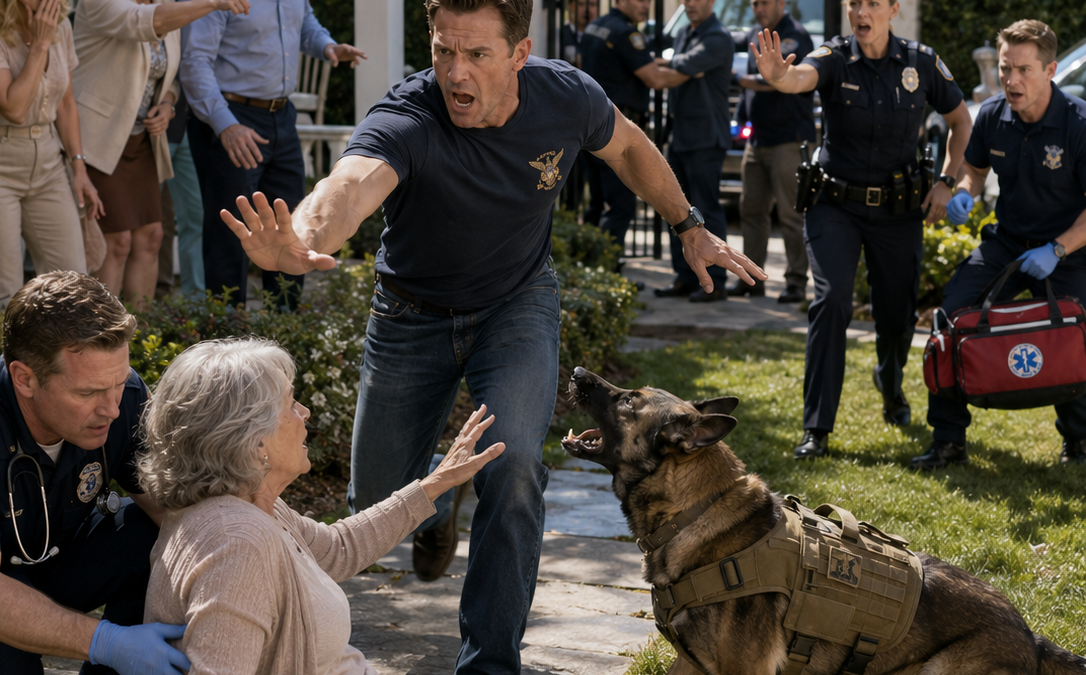
“Who Did This?!” Navy SEAL Roared as His K9 Found His Mother Bleeding — What Happened Next…
### Part 1
The front door of my mother’s house hung open like a broken jaw.
That was the first thing I saw when I pulled into the gravel driveway on Elmwood Drive. Not the yellow leaves stuck to the windshield. Not the wet newspaper lying in the grass. Not the curtains drawn shut in the middle of a bright October afternoon.
The door.
The old oak door my father had refinished twice before he died. The door my mother decorated with a wreath every season. The door that had survived storms, teenage parties, and my father’s temper when the Braves lost in extra innings.
Now the lock was splintered out of the frame, and strips of wood lay across the porch like broken teeth.
Kaiser stiffened in the passenger seat before I even killed the engine.
He was ninety pounds of retired military German Shepherd, black and tan, scar across one ear, eyes the color of old whiskey. In Afghanistan, he had found bombs buried under trash heaps. In Syria, he had warned me about a tripwire I never saw. He had slept beside me in places where sleep was a luxury and breathing too loud could get a man killed.
Now his nose pointed at my mother’s house, and a low growl rolled through his chest.
“Stay,” I said.
He didn’t like it. I didn’t either.
The neighborhood was quiet in that strange suburban way, sprinklers clicking, a lawn mower whining two blocks over, wind pushing dry leaves along the curb. Mr. Henderson stood across the street with a garden hose in his hand, staring at me like he wanted to ask a question but had forgotten how.
I opened my truck door carefully, not slamming it. My fingers went to the pistol locked under the seat before my brain finished forming the thought.
I had just driven twelve hours from Virginia. I was supposed to surprise Mom. I had pictured her standing in the kitchen with flour on her hands, pretending she hadn’t made my favorite pot roast because she knew I hated being fussed over. I had pictured Kaiser knocking over one of her houseplants with his tail. I had pictured peace.
Instead, the air smelled wrong before I reached the porch.
Pepper spray. Dust. Blood.
I pushed the door inward with the barrel of my pistol.
The hallway looked like a fight had ripped through it. My boot crunched on broken glass. Family photos were scattered across the floor. One frame held a picture of me in dress whites, standing beside my father before the cancer hollowed him out. The glass had cracked across my face.
“Kaiser,” I whispered. “Search.”
He slipped past me like smoke.
I moved behind him, slow and tight, clearing corners out of habit. My mother’s home had become a place with angles and shadows. The grandfather clock lay on its side, its pendulum still, as if even time had decided not to breathe.
Then Kaiser barked.
Not his warning bark. Not his attack bark.
His distress bark.
I ran.
I found her in the living room beside the fireplace, curled on the hardwood floor like she had tried to protect herself from the cold. Her floral blouse was soaked dark red. One hand was stretched toward the coffee table. Her wedding ring flashed under the afternoon light leaking through a torn curtain.
“Mom.”
My voice didn’t sound like mine.
I dropped to my knees. My pistol hit the floor somewhere beside me. Kaiser paced in frantic circles, whining, nudging her fingers with his nose.
Her face was bruised. Blood matted her silver hair. A cast-iron fire poker lay near the hearth, smeared dark at the tip. But the wound that mattered was under her ribs, bleeding through her blouse in steady pulses.
I pressed both hands down.
She gasped.
“Mom, look at me. It’s Lucas. I’m here.”
Her eyelids fluttered. Her lips moved. I leaned so close I could feel her breath, thin and wet against my cheek.
“He was…” she whispered.
“Who? Who did this?”
Her fingers clawed weakly at my sleeve. Her eyes, usually sharp enough to catch any lie I told, drifted past me toward the hallway.
“The lockbox,” she breathed.
Then her hand went limp.
Outside, sirens began to rise through the quiet street. I held pressure on the wound until my arms shook, until her blood warmed my palms, until the living room narrowed to the sound of Kaiser crying and my mother fighting for one more breath.
And in that ruined house, with blood under my fingernails and rage closing around my throat, I knew one thing with absolute certainty.
Whoever had done this hadn’t come for money.
So what was in the lockbox, and why had someone nearly killed my mother to find it?
### Part 2
The paramedics pushed me out of the way with the kind of gentleness people use around broken glass.
I let them because I knew their hands mattered more than mine. A woman named Sarah cut open Mom’s blouse. A man with rain on his jacket slid an IV into her arm. They spoke in clipped words, pressure, pulse, transport, while I stood there useless, looking at the smear of my mother’s blood across my palms.
Kaiser stayed pressed against my leg. His whole body vibrated.
“She’s got a pulse,” Sarah said.
That sentence should have saved me. It didn’t. Not completely.
They rushed her out through the shattered door, the stretcher wheels bumping over the porch boards. I followed until a hand caught my shoulder.
“Lucas.”
Detective Arthur Callahan stood behind me, gray mustache wet from the drizzle, tired eyes cutting through the mess with old-cop patience. I’d known him since I was seventeen and stupid enough to race my motorcycle down Riverside Drive. He’d been the officer who drove my mother home after my father collapsed at the grocery store.
“Get your hand off me,” I said.
He didn’t.
“I know you want to go with her. But you can’t help in surgery. You can help here.”
The ambulance doors slammed shut. Its lights painted the whole street red, then blue, then red again.
I wanted to break his wrist. I wanted to run after her. I wanted to rewind the day to the highway, to the gas station coffee, to Kaiser sleeping with his head against the window.
Instead, I breathed in for four seconds, held it, breathed out.
“What do you need?” I asked.
Callahan nodded once. “Start with what she said.”
“The lockbox.”
His pen paused over the notebook. “Martha had a safe?”
“In her bedroom closet. Fireproof. Passports, insurance papers, Dad’s medals.”
“She mention anything else?”
I looked back at the living room. The TV was still mounted on the wall. Mom’s purse lay open on the floor, cash and credit cards visible. Her jewelry cabinet stood untouched in the corner, its little brass knobs shining in the dust.
“No,” I said. “But this wasn’t a robbery.”
Callahan followed my gaze. “I figured that.”
Two crime scene techs moved through the hallway in paper booties. One photographed the fire poker. Another took swabs from the broken doorframe. Their camera flashes lit the ruined room in sharp white bursts.
Then Kaiser growled.
Not at the strangers. Not at the blood.
At the kitchen.
He walked away from me, nose low, ears forward. His paws made soft clicking sounds over broken plates and scattered flour. The back door stood wide open, rain misting through the broken glass pane.
“Kaiser,” I said. “Show me.”
He stopped at the doorframe and sat.
Something dark hung from a jagged shard of glass.
I crouched. The scrap was small, no bigger than two fingers. Olive drab. Tough weave. Not denim. Not cotton.
Ripstop nylon.
My stomach tightened.
Callahan leaned over my shoulder. “Mean something to you?”
“Maybe.”
The truth was, I knew exactly what it meant. High-end tactical fabric. The kind guys wore when they weren’t worried about cost because someone else was paying for war.
Kaiser wasn’t done.
He pushed through the back door into the yard, nose skimming the wet patio. Rain had begun to fall harder, tapping on leaves and dripping from the gutters. Callahan cursed under his breath.
“Lucas, wait for crime scene.”
“Rain’s washing it out.”
I followed Kaiser across the grass to the wooden privacy fence at the back of the yard. He stopped near a muddy patch and sat again.
There were boot prints.
Deep. Fresh. Facing the fence.
The attacker had gone over.
I studied the tread, and my chest turned cold. Salomon tactical boots. Same aggressive pattern I had worn on more missions than I could count.
Then my flashlight caught metal half buried beside one print.
I should have waited. I should have let Callahan bag it.
I didn’t.
I picked it up and wiped mud away with my thumb.
A steel Zippo lighter.
Engraved on the front was a trident. Beneath it, three letters and a year.
ORF 2018.
Operation Red Falcon.
I stopped breathing.
Only twelve men had been on that raid in Syria. Only twelve had been given those lighters afterward, a private joke dressed up like brotherhood. Two were dead. One was me.
Callahan watched my face change.
“Lucas,” he said slowly. “What is that?”
I closed my fist around the lighter until the edges bit my palm.
A stranger had not done this. A junkie had not done this. Someone from the darkest, most classified corner of my life had walked into my mother’s home and left her bleeding on the floor.
I looked at the black line of woods beyond the fence and felt every soft part of me go still.
The question wasn’t whether I knew the man who had done it.
The question was which brother had decided my mother deserved to die.
### Part 3
Hospitals always smell like lies.
Bleach tries to cover fear. Coffee tries to cover exhaustion. Plastic flowers try to cover the fact that people walk into those buildings whole and come out changed, if they come out at all.
I sat in the surgical waiting room at Asheville General with Kaiser stretched across my boots. A nurse had tried to tell me dogs weren’t allowed. Kaiser looked at her once. She found something else to do.
My hands were clean, technically. I had scrubbed them in the men’s room until the skin around my knuckles split, but Mom’s blood still lived in the lines of my palms. I kept seeing it every time I blinked.
Callahan came down the hall carrying two paper cups. He gave me one. I didn’t drink it.
“She made it through surgery,” he said.
My heart kicked once.
“But it’s bad,” he added.
There it was. The other boot dropping.
“The knife nicked something major. They removed her spleen. She lost a lot of blood. They’re keeping her sedated. Next forty-eight hours matter.”
I stared at the coffee cup. The lid trembled slightly in my hand.
“My mother is sixty-eight,” I said. “She teaches Sunday school kids how to plant tomatoes. Who stabs a woman like that?”
Callahan lowered himself into the chair beside me. “Someone who wanted something.”
I turned the Zippo over in my jacket pocket with my thumb.
He didn’t know I had it. Or maybe he did and had chosen not to push. Callahan had survived too many years in homicide by understanding when a man was lying and when the truth was too dangerous to say out loud.
“Crime scene found the safe in her closet,” he said. “Open. Empty. No signs it was forced.”
I looked at him. “Empty?”
“Passports on the bed. Insurance papers dumped out. Whoever opened it didn’t care about any of that.”
The lockbox again.
But Mom’s little bedroom safe wasn’t what she meant. I knew it with a certainty that sat heavy under my ribs.
Dad.
That was the thought that came next, unwanted and sharp.
My father, William Hayes, had been a logistics auditor for a defense contractor out of Virginia. Numbers man. Quiet man. The kind of man who labeled extension cords and kept warranty papers in alphabetical order. In his last year, when cancer had hollowed his cheeks and turned his hands into twigs, he had started saying strange things.
Ghost money.
Bloody ledgers.
Men who smiled in uniforms.
We thought it was the morphine. Mom cried in the kitchen after he forgot my name. I held her and told her the disease was talking, not him.
Now I wasn’t sure.
My satellite phone buzzed. I stepped away from Callahan and answered in a quiet corner near a vending machine that hummed like an insect.
“Wyatt,” I said.
Wyatt Mercer had once been an NSA analyst. I had once carried him three miles through enemy ground after shrapnel turned his femur into gravel. We didn’t send Christmas cards, but we both knew the debt existed.
“You sound like hell,” he said.
“Operation Red Falcon. I need current locations for everyone still alive.”
There was a pause. “That’s not a friendly ask.”
“My mother is in a coma.”
The line went silent.
Then keys began clicking.
“Give me thirty minutes.”
“I need it in twenty.”
“You’ll get what I can steal.”
I ended the call and returned to the waiting room. Callahan watched me with narrow eyes.
“You’re not thinking like a son right now,” he said. “You’re thinking like something else.”
“I’m thinking like the person who can find him.”
“That’s exactly what worries me.”
I stood. Kaiser rose instantly.
“I’m going to Mom’s house.”
“No, you’re not. It’s an active crime scene.”
“I won’t touch your evidence.”
That was also a lie.
Callahan stood too, slower, heavier. “Lucas, listen to me. If this is military, if this is tied to classified operations, you bring me in now or you’ll drown alone.”
I almost told him. I wanted to. But there were rules in my world older than trust and colder than friendship.
The men who had left that lighter knew police procedure. They knew response times. They knew me.
If I moved through official channels, they would vanish.
“I’ll call you if I find something,” I said.
Outside, the rain had turned the parking lot into a mirror of broken lights. Kaiser jumped into the truck and watched me with those amber eyes, calm and severe.
I drove away from the hospital with the Zippo in my pocket, my mother between life and death, and my father’s dying words echoing in my head.
If Dad hadn’t been delirious, then what had he hidden before cancer took his voice?
### Part 4
I parked two blocks from Elmwood Drive and went in through the back.
There was still a patrol car out front, a rookie inside it glowing blue from his phone. He didn’t look up when Kaiser and I crossed the neighbor’s yard, slipped through the wet hedge, and reached Mom’s fence.
The house itself hurt to look at.
Yellow crime scene tape fluttered around the porch. A lamp burned in the living room, throwing light over overturned furniture and the dark stain on the hardwood. My childhood home had become evidence.
But I didn’t go inside.
Mom had said lockbox. Not safe. Not papers. Lockbox.
My father’s garage sat behind the house, squat and white, with ivy curling around one corner. Rain dripped from the gutters in steady beats. The place smelled the same when I slipped through the side window: motor oil, sawdust, old coffee, and the faint metallic tang of tools.
Dad had loved this garage more than any room in the house. He repaired radios no one needed. Built birdhouses too sturdy for birds. Sharpened mower blades for neighbors who never paid him back.
I clicked on my red-lens flashlight.
“Kaiser,” I whispered. “Find it.”
He moved slowly along the concrete, nose sweeping left and right. I followed his path, touching shelves, old paint cans, labeled coffee tins full of screws. My father’s handwriting covered everything in black marker.
HINGES.
WIRE NUTS.
DO NOT TOUCH, LUCAS.
That one nearly broke me.
Kaiser stopped beside the bolted drill press in the far corner. He scratched twice at the floor.
At first, I saw nothing. Just concrete dust and saw marks. Then I brushed away a layer of gray powder and found a seam.
Perfect rectangle. Too clean to be a crack.
I wedged my knife into it and pried. The slab lifted with a low scrape that sounded too loud in the dark.
Underneath sat an olive-drab ammunition can wrapped in plastic.
A lockbox.
My mouth went dry.
Inside was a black journal, a thumb drive, and one photograph sealed in a freezer bag.
The photograph showed my father standing beside Captain Jonathan Hayes at a Navy charity event. Hayes had been my commanding officer, the man who pinned my trident on my chest. He had one hand on my father’s shoulder, smiling like family.
I didn’t understand why Dad had hidden that photo.
Not yet.
I opened the journal.
His handwriting filled every page in neat block letters. Dates. Account numbers. Initials. Shipping manifests. The words were dry and careful, but what they described was not.
October 2018. Operation Red Falcon. Official seized assets: zero.
Actual recovered assets: 14.2 million dollars in bearer bonds, diamonds, and foreign currency.
My flashlight beam shook.
Red Falcon had been a classified raid in Syria. We hit a compound before dawn. I remembered dust. Dogs barking. A child crying behind a wall. I remembered Holden shouting over comms that the vault was empty. I remembered Barrett laughing afterward, saying we had risked our necks for paperwork and dead men.
According to my father, the vault had not been empty.
Someone had stolen the money.
Someone on my team.
The satellite phone vibrated.
Wyatt.
“Talk,” I said.
“I found one,” he said. “Logan Barrett rented a black Chevy Tahoe yesterday morning at Charlotte Douglas under an alias. Vehicle telemetry puts him near Asheville this afternoon.”
Barrett.
Heavy breacher. Six foot four. Hands like cinder blocks. Mean in a way that made other hard men get quiet. He had always hated me because I refused to laugh when he hurt people who didn’t need hurting.
“Where is he now?” I asked.
“Remote cabin in Pisgah National Forest. Sending coordinates.”
The garage felt suddenly colder.
“What about the others?”
“Still checking. Lucas, don’t go alone.”
I looked at the journal. Then at the photo of my father and Captain Hayes. Then at Kaiser, waiting by the door, ready because he had never understood hesitation.
“Wyatt,” I said, “if Barrett touched my mother, alone is merciful.”
I ended the call before he could answer.
In my pocket, the Zippo felt heavier than steel. In my hand, my father’s journal had just turned my whole life into a crime scene.
And somewhere in the mountains, the first man on the list was waiting.
### Part 5
The rain in the Blue Ridge Mountains didn’t fall. It came sideways, cold and mean, slapping the windshield like handfuls of gravel.
I drove without headlights for the last two miles, using night vision and memory. The forest road was narrow, muddy, and edged by drops steep enough to kill a careless man. Kaiser sat beside me in his tactical vest, silent, ears forward.
The truck smelled like wet gear and gun oil.
I stopped under a stand of pines half a mile from the coordinates. I changed fast. Plate carrier. Rifle. Extra magazines. Mud-dark jacket. No patches. No name. No Lucas Hayes, son of Martha Hayes, who used to cut apple slices for him after school.
Only the part of me the Navy had built and the war had sharpened.
“Work,” I whispered.
Kaiser jumped down soundlessly.
We moved through the trees with the rain covering our steps. My boots sank into mud. Branches dragged cold fingers across my sleeves. Through my night vision, the world became green and silver, every wet leaf shining like glass.
The cabin appeared in a clearing, yellow light leaking through one front window. A black Tahoe sat outside.
I dropped to one knee.
At first, the place looked quiet. Too quiet.
Kaiser froze.
His head turned, not toward the cabin, but toward the trees to the right.
I raised my thermal optic.
A man stood under a pine with a rifle across his chest.
Sentry.
Barrett wasn’t alone.
That should have slowed me down. Instead it confirmed what I already knew: this wasn’t panic. This was planning.
I handled the sentry quickly and moved to the cabin door. The man wasn’t Barrett. Cheap beard. Cheap tactical gear. Local muscle, bought and disposable.
The door was unlocked.
Arrogance had a smell. It smelled like stale beer and wet wool when I stepped inside behind a flashbang and Kaiser launched through the smoke.
A man screamed from the living room. Kaiser had him by the arm before he could bring up his shotgun. I swept left, then right, rifle steady, heart calm in the old familiar way.
“Where’s Barrett?” I said.
The man on the floor cried hard enough to choke. “Back room! Back room! I don’t know anything, man!”
“Kaiser. Guard.”
Kaiser planted one paw on the man’s chest and growled low.
I moved down the hallway. The cabin creaked around me. A refrigerator hummed in the kitchen. Somewhere water dripped into a metal sink.
The bedroom door at the end of the hall was closed.
I kicked it open.
Logan Barrett sat in a wooden chair under a bare bulb.
His wrists were zip-tied behind him. His head hung forward. A neat bullet hole marked the center of his forehead.
For three seconds, I didn’t move.
I had come to that cabin full of certainty. Certainty is useful in combat and dangerous in everything else. It narrows the world until you stop seeing what doesn’t fit.
Barrett had not stabbed my mother.
Barrett had been staged.
A burner phone buzzed on the bedside table.
I approached it carefully. The screen lit with a message.
Target one failed. Hospital remains vulnerable. Let Hayes take the fall.
I read it twice before the meaning settled.
Let Hayes take the fall.
Not Captain Hayes. Me.
From outside came a faint sound under the rain.
Sirens.
Many of them.
My pulse stayed low, but the room tilted around me. Whoever had killed Barrett had called the police. They had left a dead teammate, a digital trail, and enough weapons in that cabin to bury me under charges until Mom died unattended in the ICU.
The trap wasn’t meant to kill me.
It was meant to remove me.
“Kaiser, here.”
He came instantly, leaving the hired man sobbing on the floor.
I smashed the back window with my rifle stock and climbed into the rain. Police lights flashed blue through the trees at the front of the cabin. Voices shouted. Tires skidded in mud.
We ran into the woods.
Branches tore at my face. Mud swallowed my boots. Behind me, men yelled my name like they already knew the story they wanted to tell.
The real attacker was still loose, my mother was still helpless, and every cop in Asheville was about to start hunting me.
I had gone into the mountains looking for a killer.
I came out as the perfect suspect.
### Part 6
By the time I reached the truck, my lungs felt lined with sandpaper.
Kaiser leaped into the passenger seat, splattering mud across the dashboard. I threw my rifle under a blanket, peeled off the plate carrier, and shoved it behind the seats. If a patrol car caught me looking like a war movie extra, the night would end in cuffs or bullets.
The satellite phone rang before I hit the county road.
Wyatt didn’t wait for hello.
“Police scanners are melting down. Homicide at a cabin. Armed suspect fled with a military dog. Tell me that isn’t you.”
“It isn’t me,” I said.
“Lucas.”
“Barrett was dead when I got there. Someone set him up. Someone set me up.”
The line filled with frantic typing.
“Then I missed something,” Wyatt said. “Hold on.”
The truck fishtailed around a curve. I corrected hard, tires chewing wet pavement. My wipers slapped back and forth, barely keeping up.
“I need the others,” I said.
“I screened commercial flights, rentals, known aliases.”
“Screen private aviation.”
He went quiet.
That was answer enough.
“Wyatt.”
“I’ve got a Gulfstream that landed in Knoxville three hours ago. Tail number buried under a corporate shell. Apex Global Logistics.”
Logistics.
The word crawled up my spine.
My father had worked logistics. My father had found missing money where everyone else saw paperwork.
“Who owns it?” I asked.
“Layers. Offshore. Defense contracting. Final beneficial control points to Trenchline Strategic.”
I almost missed the curve.
“Say that again.”
“Trenchline Strategic. CEO, Lieutenant Commander Richard Holden.”
Holden.
He had been officer in charge on Red Falcon. Polished, smooth, the kind of man who never sweated even in full kit under desert sun. He didn’t kick doors. He decided which doors needed kicking and who would carry the consequences afterward.
He had also visited my father twice during the last months of his illness.
I remembered him sitting in Mom’s kitchen, drinking coffee from the mug that said Best Teacher Ever. He had told her the Navy family took care of its own. He had brought flowers.
White lilies.
I had hated the smell without knowing why.
“He’s going to the hospital,” I said.
“How do you know?”
“Because Barrett is dead, and Mom is the only one left who knows where the lockbox was.”
Wyatt cursed.
I called Callahan next. He answered on the second ring, breathless.
“Lucas, every unit in the county is looking for you.”
“Good. Then they’re looking in the wrong place. Lock down the ICU.”
“What?”
“Now. No one gets near my mother. Not doctors, not federal agents, not God with a badge.”
“Lucas—”
“The man who attacked her is coming to finish it. He’ll look official. He’ll have credentials. He may say he’s DOD.”
Callahan’s voice changed. The irritation drained out, replaced by something older and sharper.
“I’m two minutes away,” he said.
“Put officers inside the room.”
“I’ll do what I can.”
“Art,” I said, and my voice cracked despite everything I had done to hold it steady. “Please.”
A pause.
“I’ve got her.”
I drove faster.
At Asheville General, the emergency entrance glowed white against the rain. Ambulances idled. Families huddled under the awning. A security guard smoked near a trash can, collar turned up against the cold.
I parked illegally and slipped a red service-dog vest over Kaiser’s armor.
“Quiet,” I told him. “No show.”
He leaned against my leg once. Then we walked through the sliding doors like we belonged.
That was the trick to most secure places. Don’t sneak. Don’t hurry. Look tired. Look annoyed. Look like everyone else is in your way.
We crossed the lobby under fluorescent lights that turned every face pale. I kept my right hand loose near my jacket. Kaiser trotted at heel, angelic and dangerous.
The elevator ride to the fourth floor lasted forever.
When the doors opened, I saw two uniformed officers outside Room 412.
Relief hit me so hard I nearly stumbled.
Then one of them said, “Detective Callahan just went in with the federal guy.”
My skin went cold.
“What federal guy?”
“DOD investigator. Gold badge. Said—”
I was already moving.
I shoved past them and hit the door with my shoulder.
Room 412 smelled of antiseptic, plastic tubing, and something coppery and fresh.
Callahan lay facedown on the floor, blood spreading from his neck.
A tall man in a dark suit stood beside my mother’s bed with a syringe in one hand and a suppressed pistol in the other.
Richard Holden looked at me and smiled.
“You’re late, Lucas,” he said.
And the needle in his hand hovered inches from my mother’s IV line.
### Part 7
Everything in the room became too clear.
The green number pulsing on Mom’s heart monitor. The clear fluid dripping through her IV tube. The wet shine of blood under Callahan’s cheek. The black muzzle of Holden’s pistol angled toward my mother’s head.
The syringe was filled with something colorless.
Something that would leave no dramatic wound. No struggle. Just an old woman, already weak from trauma, whose heart suddenly stopped.
“Step away from her,” I said.
My pistol was in my hand before the last word left my mouth.
Holden’s smile never moved. “You always had excellent speed. Poor judgment, but excellent speed.”
He lifted the pistol a little higher, not at me, at Mom.
The room seemed to shrink.
If I shot him in the chest, his finger might twitch. If I shot him in the head, the angle was bad. Oxygen tank behind him. IV pole half blocking his shoulder. My mother inches away.
He knew it. He had chosen the position carefully.
“Drop the gun,” Holden said. “Let’s behave like professionals.”
“You professionals stabbed a retired schoolteacher.”
“A regrettable escalation.”
My vision went red at the edges.
Holden watched my trigger finger. Men like him always watched hands. They forgot that violence could come from places without fingers.
I kept my eyes locked on his.
“Barrett didn’t do it,” I said.
“No,” Holden admitted. “But Logan had become inconvenient. Gambling debts. Loose talk. Predictable temper. He made a useful corpse.”
“You killed him.”
“I cleaned up a liability.”
Callahan groaned weakly on the floor. Blood bubbled under his fingers.
“You poisoned my father,” I said.
That was the sentence I had not meant to say yet. It came out low, almost calm.
For the first time, Holden’s face changed. Only a little.
“He was dying anyway.”
The world stopped.
I heard Mom’s monitor. Beep. Beep. Beep.
“My father had cancer.”
“Yes.”
“You gave it to him?”
Holden sighed, like I was a slow student. “Your father was exposed to compounds over time. Nothing dramatic. Nothing traceable. He was a decent man, Lucas. Too decent. He found numbers he should have ignored.”
The rage inside me became a clean white flame.
I thought of Dad in his recliner, too weak to lift a glass. Dad apologizing because he couldn’t stand at my last homecoming. Dad squeezing my hand and whispering about bloody ledgers while I told him it was the medicine talking.
I had dismissed the last warning he ever tried to give me.
Holden saw the pain land. He enjoyed it.
“Your mother was never supposed to be involved,” he said. “But she found the garage compartment yesterday. Called a lawyer from the kitchen phone. We monitored the line.”
“Who’s we?”
He smiled again. “You still think too small.”
That was the clue. Not the answer. Not yet.
There was someone above him, or beside him, or behind him. The man with the polished shoes was not standing at the top of the staircase. He was just one step higher than I had been able to see.
“Drop the gun,” he said.
I lowered my pistol slowly.
Holden’s eyes followed it.
That was when I whispered, “Kaiser. Fass.”
The dog moved from the shadow by the door like a fired weapon.
No bark. No warning. Ninety pounds of muscle and loyalty launched across the room and hit Holden’s gun arm with bone-breaking force. The suppressed pistol coughed once, sending a round into the ceiling.
I crossed the distance in two strides.
The butt of my pistol cracked against Holden’s temple. He dropped hard. Kaiser released, stepped back, then planted both paws on Holden’s chest and bared his teeth so close to the man’s face that one twitch would have ended him.
I kicked the pistol away and fell beside Callahan.
“Stay with me, Art.”
His eyes rolled toward mine. “You… always… trouble…”
“Save your breath.”
I pressed a sterile towel from the cart against his neck. Blood soaked through instantly.
“Help!” I shouted toward the hallway. “Officer down! I need a trauma team!”
The two cops rushed in, faces white. Nurses followed, then doctors, then security. The room exploded into motion.
Through the chaos, Mom’s monitor kept beeping.
Alive.
Still alive.
My phone buzzed in my pocket.
I backed into the corner, breathing hard, watching Holden unconscious under Kaiser’s paws. The message on the screen came from an unknown number.
Holden was only the accountant. Check the drive, Lucas. Then come find the man who signed the orders.
My hand tightened around the phone.
The man who had poisoned my father and nearly killed my mother was lying on the floor.
And somehow, the real monster had just introduced himself.
### Part 8
I left the hospital through a fire stairwell while federal agents were still arguing in the hallway.
That sounds worse than it was. Or maybe exactly as bad as it was.
Callahan had been rushed into surgery. Holden was zip-tied to a gurney with four armed officers around him. Mom had been moved to another ICU room with guards at both ends of the corridor. For the first time since I found her on the living room floor, she was not alone.
So I disappeared.
Kaiser and I crossed two blocks in the rain and reached my truck in an underground garage that smelled of oil, damp concrete, and stale cigarettes. I climbed into the back seat and pulled the Toughbook from a hidden compartment under the floor mat.
The thumb drive sat in my palm.
Dad’s drive.
Small. Black. Ordinary. Heavy as a confession.
Wyatt answered on the first ring.
“Tell me your mother is alive.”
“She is. Holden’s down. Callahan got stabbed but made it to surgery.”
“Holden stabbed a detective in an ICU?”
“He was trying to inject Mom with something.”
Wyatt exhaled hard. “Jesus.”
“I’m plugging in the drive.”
“Air-gapped?”
“Yes.”
“Good. Your dad used cascading encryption on the journal references. I saw enough from the photos you sent. Give me remote visual through the clean camera only, no network bridge.”
“You sound nervous.”
“I am nervous. Men like Holden don’t hide files with birthday passwords.”
The drive took thirty seconds to mount. Thirty seconds where rain ticked against the truck roof and Kaiser watched the garage entrance without blinking.
Then the folder opened.
Rows of files appeared.
Not one ledger. Hundreds.
Spreadsheets. Scanned contracts. Bank routes. Shipping manifests. Photos. Names. Acronyms. Some I knew. Most I didn’t.
Wyatt went silent as I paged through them.
“This isn’t just stolen money,” he said at last.
I already knew.
The 14.2 million from Red Falcon had been seed money. It had moved through charities, logistics firms, private security contractors, shell corporations with names so bland they sounded invented by a sleepy lawyer. The money had bought warehouses, weapons, pilots, satellite bandwidth, politicians, and silence.
My father had not uncovered a theft.
He had uncovered a private army growing inside the ribs of the country.
“Holden is listed as CFO,” Wyatt said.
“Accountant,” I said, remembering the text.
“Then the chairman is…”
He stopped.
The pause told me before the name did.
“Wyatt.”
“Lucas, I’m sorry.”
“Say it.”
“Captain Jonathan Hayes.”
The garage became very quiet.
Jonathan Hayes had been my commanding officer. My mentor. The man who made me believe discipline could be a form of mercy. He had stood beside my mother at Dad’s funeral, one gloved hand on her shoulder, telling her William had raised a fine son.
He had taught me how to read a battlefield.
He had taught me how to stop trusting coincidence.
“Show me,” I said.
Wyatt brought up a scanned authorization sheet. There it was. Hayes’s signature. Clean, confident strokes.
More files followed. His name wasn’t everywhere. It didn’t need to be. He was the man who appeared only where power changed hands.
The burner phone buzzed.
I looked down.
French Broad railyard. Bring the drive. Come alone. Twenty minutes. If not, the ICU loses power first. Then men go in.
I showed Wyatt the message.
“There may not be an assault team,” he said. “It could be leverage.”
“It could be real.”
“If you go there, he kills you.”
“If I don’t, he might kill everyone around my mother.”
Wyatt’s voice hardened. “I’m sending the files now. DOJ, DNI, two reporters I trust, and one I hate but who publishes fast. Once it’s out, Hayes loses his shield.”
“Do it.”
“Lucas, listen to me. You don’t have to be the bullet.”
I looked at Kaiser. Rainwater had dried in his fur in stiff ridges. His eyes were steady, patient, loyal in a way no uniform had ever been.
“Yes,” I said. “Tonight I do.”
I loaded the rifle again. Checked my pistol. Took the original thumb drive and put it in my jacket pocket even though the data was already being burned across the world.
At the garage exit, I paused long enough to look back toward the hospital glowing against the wet night.
My mother was four floors up, breathing because a dog had moved faster than a traitor’s hand.
Now the man who had ordered it all wanted to look me in the eye.
And I knew, as I drove toward the river, that mentors are the most dangerous enemies because they already know where you hurt.
### Part 9
The old railyard along the French Broad River looked like a place the world had given up on.
Rusted boxcars sat crooked on weed-choked tracks. Broken windows stared from the switching station. Fog drifted low over the river, carrying the smell of mud, oil, and wet iron.
I left the truck half a mile away and came in from the river side.
Hayes would expect me from the road. He had trained me, after all. He knew I preferred direct pressure when time mattered. He knew I would be angry. He knew I would be tired.
He knew everything except what grief had burned out of me.
Anger rushes. Grief waits.
I moved slowly.
Kaiser disappeared beneath the railcars, nothing but a shadow between shadows. I watched the yard through night vision. Four men patrolled near a black Mercedes G-Wagon. Not local muscle this time. These men moved correctly. Muzzles low but ready. Sectors clean. Communication minimal.
Professional.
Under the awning of the switching station, Captain Jonathan Hayes smoked a cigar.
He had aged, but not softened. Tall, silver hair, trench coat buttoned against the cold. He looked like a statue built for memorials, the kind of man politicians loved to stand beside while flags snapped in the wind.
My father’s killer.
My mother’s executioner, by proxy.
My teacher.
I could have fired from the dark.
The thought came and went.
But the guards had radios. If Hayes had even one real man near the hospital, panic could spill blood. I needed control before I needed revenge.
I tapped the transmitter clipped under my collar.
Wyatt whispered, “Your leak is live. First outlet just posted. Federal channels are lighting up.”
“Any sign of hospital breach?”
“None on police chatter. ICU still guarded. Backup generators normal.”
So the threat might have been a lie.
Might.
The first guard stopped near a boxcar and turned to warm his hands under his arms. I dropped him before he keyed his radio. The second heard the body fall. Kaiser hit him from below, dragging him into the mud with a muffled grunt. I moved before the third understood the pattern.
Fifteen seconds later, the yard went quiet again.
Hayes did not run.
He dropped his cigar, stepped into the open, and raised his empty hands.
“Impressive,” he called. “You always were my sharpest blade.”
I walked out from between two freight cars with my rifle leveled at his chest. Kaiser came to my left, muzzle dark, body low.
“Call off anyone near the hospital,” I said.
Hayes laughed softly. “Still protecting the village. Still noble.”
“Do it.”
“There is no team at the hospital. There never was. I needed urgency. You respond beautifully to urgency.”
Something inside me hardened further.
He had threatened patients, doctors, my unconscious mother, just to make me obey his schedule.
“You poisoned my father.”
“Yes.”
No hesitation. No shame.
“You sent Holden after my mother.”
“I sent Holden to recover property. Your mother complicated the task.”
“She was stabbed in her own living room.”
“Then Holden lacked finesse.”
My rifle sight rested over his heart.
“Why?” I asked.
It was the stupidest question and the only one left.
Hayes looked toward the river. Rain shone on his face like sweat.
“Because men like us win wars while cowards spend the peace pretending they understand sacrifice,” he said. “Fourteen million dollars was nothing. A beginning. We were building capability without committees, without elections, without children in suits deciding when evil should be confronted.”
“You built a criminal army.”
“I built an answer.”
“You murdered my father.”
“He would have ruined the answer.”
The old part of me waited for a speech that made him human. Regret. Fear. A confession shaped like pain.
There was none.
Only arrogance wearing patriotism as a clean shirt.
“Give me the drive,” he said. “You can walk away. Your mother lives. Your record stays clean. I can still protect you.”
That almost made me laugh.
“You think there’s still something between us to protect?”
His eyes narrowed.
“I made you.”
“No,” I said. “You trained me. My parents made me.”
For the first time, anger broke through his mask.
His hand moved toward his coat.
I fired twice.
The shots hit center mass and knocked him backward into the mud. His pistol slid from his hand before he could aim it. He lay under the gray sky, gasping, one hand pressed uselessly to his chest.
I walked closer, but not close enough for him to reach me.
“You sent the files?” he whispered.
“All of them.”
“You’ve destroyed careers. Operations. Men who kept you alive.”
“No,” I said. “I exposed thieves who hid behind flags.”
His mouth filled with blood. “You’ll regret this.”
I thought of my father whispering warnings no one believed. I thought of my mother on the floor. I thought of Callahan bleeding because he trusted me enough to stand guard.
“No,” I said. “I won’t.”
I turned away before he died.
Behind me, Hayes tried to say my name one last time, not as a commander, not as a mentor, but as a man who had finally lost control of the room.
I did not look back.
### Part 10
By sunrise, the whole country knew the name Operation Red Falcon.
News vans crowded the hospital parking lot. Helicopters thumped overhead. Men in dark suits moved through the halls with earpieces and tense faces. Every television in every waiting room showed the same loop: defense contractor raids, frozen offshore accounts, blurred documents, Captain Jonathan Hayes smiling beside senators who suddenly claimed they barely knew him.
I sat beside my mother’s bed and watched none of it.
She was still unconscious.
A ventilator helped her breathe. Clear tubes ran from bags into her arms. Her hands looked small against the white blanket. Too small for the woman who used to carry grocery bags, laundry baskets, and the weight of everyone else’s problems without complaint.
Kaiser lay under the bed, head on his paws. Any time a nurse came in, his eyes opened.
A doctor named Patel spoke gently. He had kind hands and tired shoulders.
“Her labs are improving,” he said. “That’s good. Brain swelling has not worsened. Also good. But waking is not a switch, Mr. Hayes. It can take time.”
Time.
People say that word like it’s harmless.
After he left, Wyatt called.
“You’re famous,” he said.
“I don’t care.”
“I figured. Holden’s alive, by the way. Under guard. Screaming for lawyers.”
“He can scream.”
“Hayes is dead.”
I looked at Mom’s face. “Good.”
No guilt came. I waited for it. Nothing.
“I need you to know something,” Wyatt said. “More names are coming from the drive. Politicians. Contractors. A retired general. This won’t be clean.”
“It never is.”
“Also, the Navy is going to come at you sideways. They’ll call you unstable, then heroic, then inconvenient. Maybe all in the same sentence.”
“I’m done with them.”
“You sure?”
I watched Kaiser breathe under the bed.
For twelve years, my life had been orders and maps and men telling me which doors mattered. I had believed the chain of command was imperfect but necessary, like a scar that held skin together.
Now I had seen what rot could do when everyone saluted it.
“I’m sure,” I said.
Callahan woke two days later.
He demanded black coffee before he could sit upright. His voice sounded like gravel in a blender, and there was a bandage along his neck thick enough to make him look half-mummified.
“You look terrible,” I told him.
He squinted at me. “You’re wanted in three jurisdictions, involved in multiple shootings, and have the nerve to criticize my complexion?”
“They cleared me.”
“Federal immunity isn’t the same as being cleared.”
“Close enough.”
He tried to laugh and winced. Then his eyes softened.
“Your mother?”
“Not awake yet.”
“She will be,” he said.
“You don’t know that.”
“No,” he admitted. “But Martha Hayes once made the mayor apologize publicly for cutting school library funding. Death is going to have a hard time getting the last word.”
That was the first thing in days that made me almost smile.
On the fifth morning, I was peeling an apple beside Mom’s bed because doing something with my hands kept me from breaking apart.
The knife slipped under the skin in one long red curl. My father had taught me that. Mom always said I peeled too thick and wasted the best part.
A raspy voice said, “You’re doing it wrong.”
The knife stopped.
Kaiser lifted his head.
I looked at my mother.
Her eyes were open.
Pale. Tired. But sharp.
“Mom?”
She swallowed. Winced. “Water.”
I moved too fast, knocked over the chair, and nearly dropped the cup. A nurse came in, then another, then Dr. Patel, everyone speaking at once.
Mom ignored them and looked at Kaiser.
“Is he hurt?”
I laughed. It came out broken.
“No, ma’am,” I said. “He’s fine.”
Her fingers shifted weakly over the blanket. Kaiser stood and placed his head beside her hand. She touched his ear, barely strong enough to move.
“Good dog,” she whispered.
Then her eyes found mine again.
“The man,” she said. “The one in my house. He kept asking where William put it.”
“I found it.”
She closed her eyes.
“Your father tried to tell us.”
“I know.”
A tear slid from the corner of her eye into her hair.
I took her hand carefully, afraid of hurting her.
“Mom,” I said, “Hayes is gone. Holden’s in custody. The files are public.”
She looked at me for a long moment, reading the parts I didn’t say.
“Don’t you dare apologize for surviving what they made you do,” she whispered.
That sentence hit harder than any bullet ever had.
I bowed my head over her hand.
For the first time since I found the door open, I cried.
And when the tears finally came, I realized the war was over, but the reckoning had only begun.
### Part 11
Recovery is not cinematic.
It is not swelling music and sunlight and one brave walk down a hospital hallway while everyone claps.
It is my mother cursing at lime Jell-O. It is nurses waking her every two hours. It is her hand trembling when she tries to sign forms. It is pain that makes her close her eyes mid-sentence and pretend she is only tired.
Two weeks after she woke, I brought her home.
Not to Elmwood Drive.
She refused to step inside the house again. She said it plainly while sitting in the passenger seat of my truck, a blanket over her knees, Kaiser’s head resting gently against her lap from the back seat.
“That house held thirty-two years of love,” she said. “I won’t let the last thing it holds be blood.”
So we rented a small cottage outside Asheville with a porch facing the mountains. It smelled like cedar and rain. The kitchen cabinets didn’t close right. The water heater made a sound like an old man clearing his throat. Mom loved it immediately because there were bluebirds in the yard.
The trial machinery began without us, though it kept trying to drag us back.
Holden’s lawyers claimed coercion. Then conspiracy. Then that my father had fabricated documents because cancer had affected his mind. That one nearly made me break a courthouse bench with my hands.
Mom squeezed my wrist.
“Don’t give them your temper,” she said. “Make them choke on the truth.”
So I testified.
I wore a dark suit that felt like someone else’s skin. The courtroom smelled of polished wood, paper, and expensive fear. Holden sat at the defense table with a scar at his temple and his left arm in a brace where Kaiser had crushed it.
He looked at me only once.
There was no apology in his face. No recognition of my mother as human. Men like Holden don’t see victims. They see obstacles that refused to disappear neatly.
The prosecutor showed the jury my father’s journal. The thumb drive. The money trails. The medical consultant who explained the compounds used to accelerate Dad’s cancer. The phone records proving Mom had called a lawyer the day before the attack.
Then came the audio.
Wyatt had recovered fragments from Holden’s burner backup. His voice filled the courtroom, calm as weather.
Recover the ledger. If Martha resists, apply pressure. Avoid unnecessary mess.
My mother sat beside me, her spine straight, her hands folded in her lap.
When the jury heard those words, she did not cry.
I did.
Quietly. Angrily. Without wiping my face.
Holden was sentenced to life without parole, plus enough extra years to satisfy a god who liked paperwork. Several others followed him down. Contractors. Officers. A senator’s chief of staff. A retired general who had once been on television every Sunday explaining honor to civilians.
Captain Hayes was buried at Arlington before the full truth broke. Later, his name came off two buildings. His portrait disappeared from a training hall. Men who had praised him learned to say they had always had concerns.
I did not attend any ceremony.
The Navy sent a delegation to the cottage one cold morning. Two officers in dress uniforms stood on the porch holding a folder and wearing expressions polished flat.
They offered reinstatement. Promotion. A classified commendation. A new role shaping ethics training for special warfare.
Mom listened from her chair by the window, knitting something crooked and blue.
I asked them one question.
“Would you have believed my father if he came to you alive?”
Neither officer answered.
That was enough.
I handed the folder back.
“Then I’m not yours anymore.”
After they left, Mom said nothing for a while. Needles clicked in her lap. Kaiser snored near the fireplace.
Finally she said, “Your father would be proud.”
I looked out at the mountains, where fog moved between the trees like smoke leaving a battlefield.
“I wish I’d believed him sooner.”
She stopped knitting.
“Lucas, love doesn’t mean knowing everything in time. Sometimes it means carrying the truth after someone else can’t.”
That night, while washing dishes, I found the old photograph of Dad and Hayes tucked inside the journal. I had kept it because some part of me still wanted to understand how a murderer could stand so close to my family and smile.
On the back, in Dad’s handwriting, were four words I had missed before.
He knows I know.
My hands went cold all over again.
Because beneath those words was a date.
Three months before my father was diagnosed.
### Part 12
The last clue did not lead to another gunfight.
That almost disappointed the broken part of me.
Instead, it led to a storage facility in Roanoke, Virginia, where my father had rented Unit 19 under my mother’s maiden name. The bill had been paid automatically from an account he set up before he got sick. No one had opened it in six years.
Mom wanted to come.
I told her no.
She looked at me over the top of her reading glasses. “I wasn’t asking permission.”
So we drove north together, Kaiser stretched across the back seat, the mountains rolling by under a hard winter sky.
The unit smelled like cardboard, dust, and old secrets.
Inside were filing cabinets, three banker’s boxes, and a small cassette recorder wrapped in a towel. My father had been many things, but modern was not one of them.
The tape label read: For Martha and Lucas, if needed.
Mom sat on an overturned crate. I pressed play.
Dad’s voice filled the storage unit, thin but steady.
“If you’re hearing this, I was right to be afraid.”
Mom covered her mouth.
He explained everything he had known before the cancer. The missing assets. Hayes’s signature hidden behind cutouts. Holden’s visits. The first symptoms after a private dinner where he had drunk from a glass no one else touched.
Then his voice broke.
“I didn’t tell you because I thought I could fix it quietly. That was pride. Martha, forgive me for that. Lucas, if this reaches you, do not confuse revenge with duty. Duty protects the living. Revenge worships the dead.”
I stopped the tape.
The silence afterward felt enormous.
Mom nodded toward the recorder. “Play it.”
I did.
The last minutes were not about money or murder. They were about us. He told Mom where he had hidden certain bonds for her security. He told me he had watched me become a man better than the institutions that claimed me. He told us the lockbox in the garage was the public weapon, but the Roanoke unit was the final insurance.
“If Hayes is exposed,” Dad said, “there will be people who claim the system corrected itself. Don’t let them. People corrected it. People who refused to stay quiet.”
The tape clicked off.
I stood there with my hands on my hips, unable to move.
For years, I had remembered my father as fading. Confused. Half lost to pain. But this voice was clear. He had not been weak. He had been alone.
Mom reached for my hand.
“We’re not letting them bury this,” she said.
So we didn’t.
The Roanoke files became the spine of a public inquiry. Not the fake kind with stern faces and soft conclusions, but the ugly kind that made people resign before breakfast. Wyatt testified remotely and somehow wore a Hawaiian shirt. Callahan sat in the front row of one hearing with a scar on his neck and a grin that suggested he had annoyed three federal marshals already.
Mom spoke last.
She walked slowly to the microphone, thinner than before, silver hair pinned back, one hand resting on a cane. Kaiser stood beside her in his red vest, though everyone in that room knew he was no ordinary service dog.
“My husband believed in this country,” she said. “My son fought for it. I taught its children. So do not tell me patriotism requires silence when powerful men commit crimes. Silence is what they purchased. Truth is what we owe.”
No one interrupted her.
Not once.
When it was over, reporters shouted questions. Cameras flashed. Mom ignored them all and asked me if there was a decent diner nearby because hospital food had ruined her faith in soup.
We found one off the highway. The coffee was burnt, the pie was excellent, and Kaiser slept under the booth with his head on my boot.
Mom looked across the table at me.
“What now?” she asked.
For the first time in months, the question did not feel like a threat.
I thought of the Navy. The house on Elmwood. The men I had lost. The men I had trusted. The father I had misunderstood. The mother who had refused to become a victim in her own story.
“I don’t know,” I said.
She smiled. “Good. That means it’s yours.”
Outside, snow began to fall, soft and quiet over the parking lot.
For once, nothing was chasing us.
And for once, I did not feel the need to chase anything back.
### Part 13
Spring came slowly to the mountains.
It arrived first in the mud, then in the birds, then in the stubborn green shoots my mother planted in pots along the cottage porch. She said flowers were proof that dirt could keep secrets all winter and still give something beautiful back.
I didn’t argue with her. I had learned better.
Elmwood Drive sold to a young couple from Charlotte who wanted a fixer-upper. Before closing, Mom and I walked through the house one last time. The blood was gone. The door had been replaced. The living room smelled of fresh paint instead of fear.
But houses remember.
Mom stood by the fireplace for a long moment, one hand pressed flat against the mantel.
“You ready?” I asked.
She nodded. “I loved this place. That’s why I’m leaving it before hate gets a vote.”
On the porch, she took the old brass key off her ring and handed it to the realtor. She did not look back.
I loved her fiercely for that.
The government tried several times to wrap the story in language clean enough for plaques. Misappropriated assets. Unauthorized operations. Command failure. Ethical breach.
Mom called it murder.
So did I.
Holden appealed from prison. I ignored every headline with his name in it. Men like him wanted attention the way fires wanted oxygen. I gave him none. Captain Hayes’s defenders wrote editorials about complexity, sacrifice, and impossible choices. I read one paragraph, then used the paper to start a fire.
There are betrayals that do not deserve understanding. Only distance.
I bought a small property outside town with enough land for Kaiser to run and enough quiet for me to hear myself think. The barn became a training space. Not for war, not exactly. For search-and-rescue dogs. For handlers who wanted to learn patience before control. For veterans who missed having a mission but did not want to keep confusing danger with purpose.
Kaiser became the boss immediately.
He judged everyone.
He liked a paramedic named Emily who volunteered on Saturdays and smelled faintly of lavender soap and coffee. She had steady hands, a dry sense of humor, and no patience for heroic nonsense.
The first time she met my mother, Mom looked her over and said, “You seem too smart for my son.”
Emily said, “I’m hoping the dog is the brains of the operation.”
Mom laughed until she had to sit down.
I did not fall in love all at once. Life is not that generous after trauma. It came in small things. Emily bringing extra biscuits for Kaiser. Her standing beside me during a thunderstorm without asking why my shoulders had gone tight. The way she listened to Mom’s stories like they mattered, because they did.
One evening, almost a year after the attack, we gathered on the porch of the new house. Mom sat wrapped in a quilt, stronger now, though still thinner than before. Kaiser lay at her feet, muzzle gray around the edges. Emily leaned against the railing, watching fireflies blink over the field.
The air smelled of cut grass and rain coming later.
Mom held a glass of sweet tea and looked at the sunset.
“Your father would have liked this,” she said.
I swallowed. “You think so?”
“I know so.”
For a while, none of us spoke.
Then Mom reached down and scratched Kaiser behind the ear.
“He found me,” she said softly.
I looked at the dog. At the scarred ear, the watchful eyes, the body that had crossed deserts, mountains, hospital floors, and every dark place between my old life and this one.
“He found all of us,” I said.
That night, after Mom went inside and Emily left with a quiet promise to come by in the morning, I stayed on the porch with Kaiser.
The stars were bright above the black ridgeline. Somewhere down the hill, frogs called from the creek. My phone sat on the table, silent. No encrypted messages. No unknown numbers. No orders.
Just quiet.
I thought about forgiveness.
People like to talk about it as if it is a door everyone must eventually open. Maybe sometimes it is. Maybe for small wounds. Maybe for people who come back with empty hands and honest eyes.
But Hayes had not wanted forgiveness. Holden had not wanted mercy. They had wanted obedience, silence, and the right to call their greed sacrifice.
I owed them nothing.
Not understanding. Not peace. Not a single soft memory.
My father had deserved belief. My mother had deserved safety. I deserved a life not commanded by men who mistook power for honor.
So I kept the lesson and let the men rot.
Kaiser shifted beside me, pressing his warm shoulder against my leg. I rested my hand on his head.
“Good boy,” I whispered.
His tail thumped once against the porch boards.
In the darkness beyond the yard, the woods moved with harmless night sounds, leaves whispering, insects singing, the world continuing without permission from grief.
For the first time in years, I didn’t scan the shadows for threats.
I watched the fireflies instead.
THE END!
Disclaimer: Our stories are inspired by real-life events but are carefully rewritten for entertainment. Any resemblance to actual people or situations is purely coincidental.








