Shut Up, My Dad Barked As Pain Shot Through My Ribs—My Brother Laughed, Then The Doctor Appeared
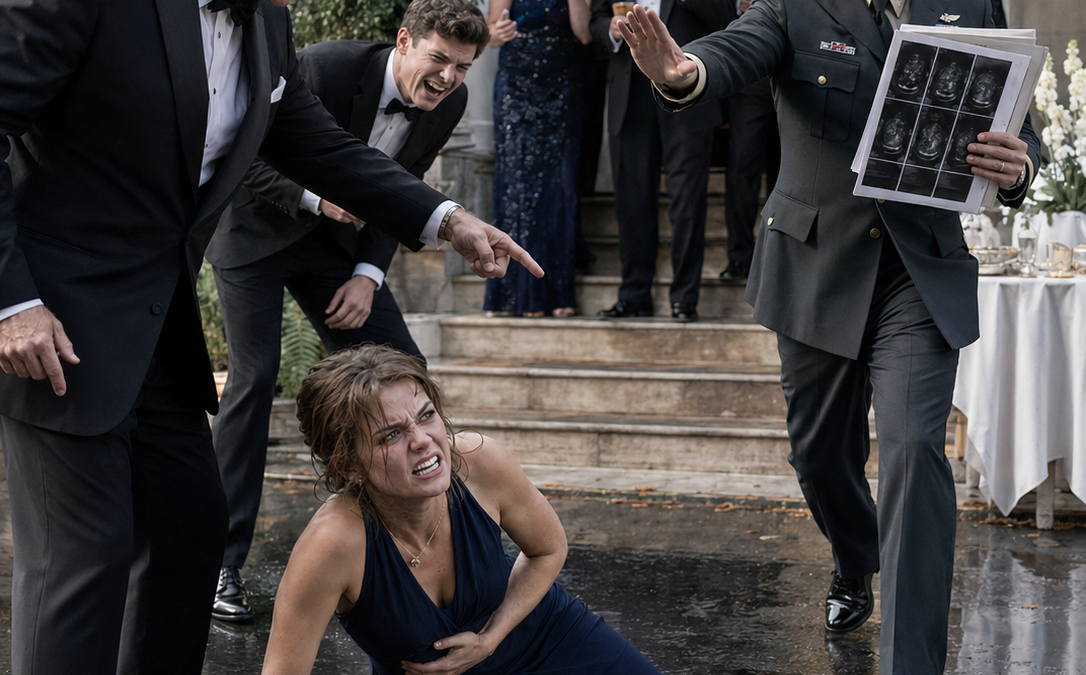
“Shut up,” Dad barked as pain tore through my fractured ribs and my brother laughed while I struggled to breathe. Then Dad stood over me, forcing me through push-ups even though I insisted I wasn’t medically cleared, until I collapsed on the wet driveway with black spots swimming across my vision. Hours later, Army doctor Owen Mercer appeared at the house carrying my corrected scans and revealed the restrictions Dad had secretly hidden: no lifting, no push-ups, no prolonged standing. Dad thought he could silence me before his prestigious dinner. He had no idea those medical records were only the beginning.
### Part 1
The kitchen smelled like burned onions, old bacon grease, and the kind of silence people mistake for peace when they are not the ones trapped inside it.
I stood at the sink with my sleeves rolled past my elbows, scrubbing a white dinner plate until my fingers wrinkled under the hot water. Outside the window, the backyard was all North Carolina pine shadows and wet grass, the last strip of daylight fading behind the fence. Somewhere beyond the trees, from the direction of Fort Liberty, a distant thud rolled through the air. Artillery practice. Low, familiar, almost comforting.
My name was Mara Whitlock. Lieutenant Mara Whitlock, United States Army.
And at thirty-two years old, with a service record my father never bothered to read and a medical leave form he called “paperwork for quitters,” I was back in the house where I had learned pain only counted if someone important said it did.
The first stab hit under my right ribs.
It came sharp and sudden, like a hand had reached inside me and twisted. I bent forward before I could stop myself. My breath broke in half. Soap slid over my knuckles. The plate struck the side of the sink with a hard clack that made my father’s fork pause against his dinner plate.
“Shut up,” he barked.
Two words. No concern. No question.
Just command.
My father, Grant Whitlock, sat at the kitchen table beneath the yellow light, shoulders squared as if he were still addressing a platoon. His gray hair was cut short. His jaw had that locked look it always got when he smelled weakness. He did not rise. He did not ask what was wrong.
“Soldiers don’t whimper over dishes,” he said.
Across the kitchen, my younger brother Cole leaned against the refrigerator with a beer in his hand and that lazy golden-boy grin on his face. He had come home on leave two days earlier and had already filled the house with his laugh, his boots, his stories, his easy claim on my father’s approval.
“Look at her,” Cole said, chuckling. “Army tough, huh? Lieutenant Whitlock defeated by Grandma’s dinner plates.”
I gripped the counter. My wet fingers slipped once before I caught myself again.
The pain pulsed deeper.
I tried to straighten, but my body refused the order. Sweat prickled along my hairline. The faucet hissed. The overhead light buzzed faintly. I stared at the drain like it was a fixed point on a firing range.
Breathe in. Hold. Breathe out.
Only I couldn’t get a full breath.
My father’s chair scraped backward.
I felt him behind me before I saw him in the dull reflection of the kitchen window. Tall, rigid, broad even in old age. The man who had raised me with inspection sheets taped to the fridge and punishments written in black marker.
“You think because you came back from overseas with a doctor’s note, the rest of us are supposed to carry you?” he asked.
“I’m not asking anyone to carry me,” I said.
My voice came out thin. That made Cole laugh harder.
“You hear that? She’s not asking. She just sighs loud enough for the whole house to notice.”
My father stepped closer. I could smell coffee on his breath and the sharp aftershave he had worn every day since I was a kid.
“You were always like this,” he said quietly. “Always waiting for someone to feel sorry for you.”
Something inside me shifted then, not just pain, but memory.
I was eight years old again, standing in this same kitchen with my left arm hanging wrong after falling from a rope in the backyard. My father had pointed to the sink. Wash first, cry later. Four hours after that, an X-ray showed a clean break. He told the doctor I had always been dramatic.
Now, decades later, here I was again. Older. Decorated. Trained.
Still standing at his sink, swallowing pain for a man who called it character.
Cole opened the fridge and took out another beer. The cold air spilled around him, carrying the smell of metal shelves and leftover meatloaf.
“You better toughen up before Saturday,” he said. “Can’t have you collapsing in front of General Voss.”
My father’s eyes flicked to him, warning and proud at the same time.
Saturday.
The dinner.
General Alina Voss, my father’s old mentor, was coming to our house for her eightieth birthday. Retired brass, family friends, local military people, all gathered under my father’s roof so he could prove the Whitlock name still meant something.
And I had been assigned everything.
Cooking. Cleaning. Serving. Smiling.
The room swayed slightly. I pressed my palm harder into my side.
Then the doorbell rang.
All three of us froze.
It was too late for neighbors. Too early for guests. My father’s face tightened with irritation, but underneath it I saw something else.
Nerves.
Cole saw it too, and for once, he stopped smiling.
My father turned toward the front hall, his voice low.
“Not one word about this,” he said.
But as the bell rang a second time, colder and louder through the house, I realized my father was not angry someone had come.
He was afraid of who might be standing on the porch.
### Part 2
My father opened the front door only halfway, like a man expecting trouble but refusing to admit he had done anything to earn it.
From the kitchen, I could not see the visitor. I could only hear the murmur of a woman’s voice and the quick change in my father’s tone. It dropped from command to performance, the polite baritone he used at ceremonies, funerals, and anywhere witnesses were present.
“Linda,” he said. “This is a bad time.”
That name tightened something in my chest.
Linda wasn’t family. Not exactly. She was my mother’s oldest friend, a retired school librarian who lived two streets over and still sent me birthday cards with pressed flowers inside. When Mom died, Linda had brought casseroles for six weeks until my father told her the children needed discipline, not pity.
I had not seen her in years.
Cole pushed off the fridge. “What’s she doing here?”
I shook my head, but the movement made my side flare. I hid it by reaching for a towel.
Their voices drifted down the hall.
“I saw Mara carrying boxes off the porch this morning,” Linda said. “She looked unwell.”
“She’s recovering,” my father replied. “And she’s stubborn. You know how soldiers are.”
“I know how injured people look, Grant.”
Silence.
Then my father said, “Good night, Linda.”
The door closed with more force than necessary.
When he returned, his expression had hardened into something polished and dangerous.
“You’re putting on a show for the neighbors now?” he asked me.
“I didn’t call her.”
“No,” Cole said, dragging out the word. “You just limp around outside until some old lady comes running.”
I wanted to tell them what the doctors had told me after the convoy accident overseas. I wanted to say that ribs were tricky, that healing could reverse if pushed too hard, that the tightness beneath my bones had been getting worse since Dad started his dawn “reconditioning.” I wanted to say I had served enough to know the difference between discomfort and danger.
But words had never worked in this house.
My father stepped to the counter and picked up the towel I had dropped.
“There will be no embarrassment Saturday,” he said. “General Voss gave me my first command recommendation. Half the people at that table still respect her opinion. This dinner matters.”
There it was.
Not my health. Not my pain.
His reputation.
“I understand,” I said.
“No, you don’t.” He leaned closer. “You think putting on a uniform makes you equal to people who earned their place. You left, came back broken, and now you want the house to bend around you.”
Cole’s grin returned. “Careful, Dad. She’ll file a complaint against the dishwasher.”
I turned back to the sink because if I kept looking at them, something in my face might betray me. Anger, maybe. Or worse, grief.
The plate in my hand had a thin blue ring around the edge. It belonged to my mother’s set, the only pretty thing my father had kept after she died. I remembered her standing barefoot in this kitchen, humming along to country radio, letting me lick cake batter from a spoon. She used to tell me that strong people noticed pain, not ignored it.
My father called that softness.
After the kitchen was done, he handed me Saturday’s task list. Three pages, typed, numbered, and clipped together.
Polish silver. Wash windows. Clean guest bath. Move patio furniture. Prepare side dishes. Iron tablecloth. Inventory serving ware. Pick up birthday cake.
I stared at the final item.
“How am I supposed to pick up the cake?” I asked. “You still have my car keys.”
Cole snorted.
My father’s mouth barely moved. “You can use the truck when I decide you need it.”
“It’s already paid for.”
“With whose insurance address? Under whose roof?”
My keys sat on the hook beside the back door. I had seen them there every morning, just out of reach, like a test.
My phone buzzed in my pocket.
Dad’s eyes dropped immediately. “Who is that?”
I pulled it out before I could think better of it.
Unknown number.
A text preview glowed on the screen.
Mara, this is Dr. Owen Mercer. We served at Bagram together. I’m in Fayetteville this week for Voss’s dinner. Please call me. It’s important.
I locked the phone, but not fast enough.
My father read the name. His face changed so quickly most people might have missed it.
I didn’t.
Cole didn’t either.
“Who’s Owen Mercer?” Cole asked.
My father answered before I could.
“No one she needs to call.”
And for the first time since I came home, I wondered whether my father knew something about my injury that I didn’t.
### Part 3
The next morning began at 5:30 with my father pounding on my bedroom door.
Not knocking. Pounding.
“Yard. Five minutes.”
I lay stiff under the thin quilt, staring at the ceiling fan turning slow circles above me. The room still looked like my teenage self had been packed away and forgotten. A faded track ribbon hung beside the closet. The desk had dents from where Cole used to drum pencils while making fun of my homework. My duffel bag sat half-unpacked against the wall because part of me refused to believe I was staying.
My ribs throbbed before I even moved.
Outside, the air was damp and cool, smelling of pine straw and cut grass. The sky had that pale gray North Carolina morning look, the kind that promised heat later. My father stood beside the driveway in sweatpants and an old Army hoodie, stopwatch in hand.
Cole sat on the porch steps drinking coffee.
“Morning, sunshine,” he called. “Try not to die before breakfast.”
I ignored him.
My goal was simple: get through whatever Dad demanded, then find a way to call Dr. Mercer without anyone hearing.
“Push-ups,” my father said.
My body went cold.
“I’m not cleared for that.”
He looked at me like I had spoken a foreign language.
“You’re cleared to stand in my kitchen for hours. You’re cleared to eat my food. You’re cleared to sleep under my roof. Get down.”
Cole leaned back on his elbows. “Come on, Lieutenant. Show us that warrior spirit.”
I lowered myself carefully, palms on the damp concrete. The first push-up sent pain slicing through my side. The second stole my breath. By the fifth, black dots swam at the edges of my vision.
My father’s stopwatch clicked.
“Pathetic.”
My arms trembled. Sweat dripped from my nose to the driveway.
I wanted to stop. More than that, I wanted to stand up and tell him no. One clean word. No. But the child in me still lived somewhere under my ribs, terrified of the silence after disobedience.
“Ten more,” he said.
“I can’t.”
Cole laughed. “There it is.”
My father crouched near my face. “You can’t, or you won’t?”
The driveway smelled like wet stone. My cheek hovered inches above it. I could hear a lawn mower starting two houses down. Normal life, close enough to hear, impossible to reach.
I did one more.
Something pulled deep inside my chest.
I collapsed onto my side.
The pain was so bright I couldn’t speak. For a few seconds, I could only make a small, ugly sound through my teeth.
My father stood over me.
“Get up.”
Cole’s laugh faded. Not out of concern, exactly. More like even he sensed something had shifted.
“I said get up,” Dad repeated.
I rolled slowly to my knees. My T-shirt clung cold to my back. My right hand pressed against my ribs, useless against the fire under them.
Then Linda’s front door opened across the street.
She stepped onto her porch in a blue robe, newspaper in hand, and looked directly at us.
My father noticed. Instantly, his voice changed.
“That’s enough for today,” he said loudly. “Good effort, Mara.”
Good effort.
As if this had been training. As if I had agreed.
Inside, he made breakfast like nothing had happened. Eggs, toast, black coffee. Cole told a story about a Marine buddy who had passed out during a ruck march and woke up with a nickname too crude to repeat. Dad laughed harder than the story deserved.
I sat at the table and held my mug with both hands so they wouldn’t see them shaking.
When Dad left to take a call in his study and Cole went upstairs to shower, I moved.
My phone was charging on the kitchen counter because Dad had made that a rule. Phones charged in common areas. Nothing private. Nothing hidden.
I grabbed it and slipped into the laundry room, wedging myself between the dryer and shelves of detergent.
The smell of bleach and fabric softener pressed around me.
I called the unknown number.
Dr. Mercer answered on the second ring.
“Mara?”
His voice was older than I remembered, lower, but it carried the same alertness. During deployment, Owen Mercer had been the kind of doctor who noticed when a soldier said “I’m fine” too quickly.
“It’s me,” I whispered.
A pause.
“Are you alone?”
The question made my stomach tighten.
“For now.”
“I tried reaching you through your command. Your medical restriction packet was flagged. Something is missing from your file.”
I closed my eyes.
“What do you mean missing?”
“Your post-evac scan. The one from Germany. It showed more damage than the summary states.”
My grip tightened around the phone.
From the hallway came the soft creak of a floorboard.
Dr. Mercer kept speaking.
“Mara, listen carefully. You should not be doing physical labor. No lifting, no push-ups, no prolonged standing. If your ribs shift again, you could puncture a lung.”
The laundry room door opened.
Cole stood there with wet hair and a towel around his neck.
His eyes dropped to the phone in my hand.
Then he smiled.
### Part 4
Cole did not grab the phone right away.
That would have been too honest.
Instead, he leaned against the laundry room doorframe and tilted his head, pretending amusement while his eyes sharpened.
“Secret boyfriend?” he asked.
I ended the call.
The silence afterward rang louder than the dryer ever had.
“Move,” I said.
“Not very friendly.”
“Move, Cole.”
He glanced toward the hall. “Dad know you’re making private calls?”
I tried to step past him. He shifted just enough to block me without touching me, the way he used to when we were kids, trapping me between the kitchen island and the fridge until I shoved him and got punished for being aggressive.
Some games grow up with people.
“Who was it?” he asked.
“No one.”
“That’s funny. Dad said the same thing last night.”
My ribs pulsed. The laundry room felt smaller by the second, crowded with detergent bottles, wire hangers, and the sour warmth of clothes left too long in the washer.
“Then ask Dad.”
His smile slipped.
There it was. A crack.
Cole liked being my father’s favorite, but he hated being left out of secrets.
Before he could answer, Dad’s voice cut from the hall.
“What’s going on?”
Cole turned just enough for my father to see the phone in my hand.
I expected rage. I expected another lecture.
Instead, Dad went still.
That scared me more.
“Give it to me,” he said.
“No.”
The word left my mouth before fear could stop it.
Cole’s eyebrows rose. My father stared as if I had slapped him.
“What did you say?”
“I said no.”
My pulse hammered in my ears. The room seemed to hold its breath with me. For years, no had been the locked door I never reached. Now that I had said it, I felt both terrified and strangely taller.
My father extended his hand.
“Mara. Give me the phone.”
“No.”
Cole let out a low whistle. “This should be good.”
Dad stepped closer. “Under my roof, you don’t hide things.”
“I’m an adult.”
“You’re a dependent in my house.”
“I’m a lieutenant in the Army.”
“You’re on leave because you’re damaged.”
The word hit harder than I expected.
Damaged.
Not injured. Not recovering. Damaged.
A red flush crept up my father’s neck. For a second I saw not the retired officer, not the strict parent, but an old man panicking because the thing he controlled was moving outside his reach.
Then the phone buzzed again.
All three of us looked down.
A new message appeared from Dr. Mercer.
Do not ignore this. If Grant has your restriction packet, get out of that house.
My father read it upside down.
His face emptied.
Cole’s amusement vanished. “Dad?”
My father snatched for the phone.
I twisted away on instinct, but the movement lit my ribs like a match. I gasped, stumbled into the washing machine, and dropped the phone. It skidded across the tile.
Cole picked it up first.
For half a second, I thought he might hand it to me. Something uncertain crossed his face, a flicker so quick I almost imagined it.
Then he tossed it to Dad.
My father unlocked it. He knew my passcode because he had watched me type it days earlier and I had been too tired to care.
He read the messages. His jaw worked once.
“You’ve been talking to outsiders about family business.”
“That’s not family business,” I said. “That’s my medical care.”
“It becomes family business when you use it to humiliate me.”
“Humiliate you?” I laughed once, short and breathless. “I can barely stand.”
Cole looked away.
That was new.
My father noticed it and turned on him. “Go finish the patio.”
Cole straightened. “But—”
“Now.”
He left, though not before glancing back at me. For the first time, his expression was not a smirk. It was something closer to confusion.
Dad waited until his footsteps faded.
Then he opened the kitchen junk drawer and removed a folded brown envelope.
My name was written across the front in black ink.
Mara Whitlock Medical Restrictions.
My stomach dropped.
“You had it,” I whispered.
He held it between two fingers like it was dirty.
“It came the week after you moved back.”
“You told me command never sent it.”
“I told you what you needed to hear.”
The overhead light buzzed above us. Somewhere outside, a truck passed, tires hissing on the damp road.
My father slipped the envelope into his back pocket.
“You were becoming soft before you ever deployed,” he said. “I wasn’t going to let a doctor finish the job.”
In that moment, the pain under my ribs became something else.
Proof.
And my father had just admitted he buried it.
### Part 5
For the rest of the day, my father treated me with the chilly politeness of a commander documenting a problem soldier.
He did not yell. He did not threaten. He gave orders in a calm, steady tone, which was worse. Anger had edges I could push against. Calm meant he had already decided what story he would tell if anyone asked.
I spent the afternoon ironing table linens in the dining room while rain tapped against the windows. The house smelled of starch, lemon polish, and the stew simmering on the stove. Every time I lifted the iron, my ribs objected. Every time I paused, my father appeared in the doorway as if summoned by weakness.
“Wrinkles show laziness,” he said once.
I pressed harder and burned my finger on the steam.
By evening, the dining room had transformed. My mother’s blue-rimmed china sat stacked beside crystal glasses. Silver candlesticks stood at attention. The long walnut table gleamed so brightly I could see the chandelier reflected in it.
It looked beautiful.
It felt like a trap.
My goal had changed. I no longer wanted to survive Saturday. I wanted the envelope.
The problem was my father.
He had spent his life making rooms into battlefields and people into positions on a map. His study was his command post. He kept it locked when he was not inside. The medical packet had gone in with him after lunch and had not come back out.
Cole drifted through the house, quieter than usual. He moved patio chairs. He carried cases of soda from the garage. He watched me when he thought I wasn’t looking.
At dinner, Dad talked about General Voss.
“She values discipline,” he said, cutting his pork chop into identical pieces. “Not excuses. Not emotional displays. Discipline.”
Cole nodded automatically, but his eyes kept moving toward me.
I ate three bites and stopped. The meat tasted like salt and metal. My appetite had disappeared days ago.
“You’ll serve the main course from the left,” Dad continued. “Clear from the right. Do not linger near the guests. Do not discuss your medical leave. If asked, you are grateful for rest and eager to return to duty.”
I looked up. “And if they ask why I’m limping?”
“You won’t limp.”
Cole’s fork paused.
My father saw it. “Problem?”
Cole shook his head. “No, sir.”
After dinner, I washed dishes again. My father went to his study. The lock clicked.
Cole dried plates beside me, a towel thrown over his shoulder. We worked in silence for almost ten minutes, which for us was practically a peace treaty.
Finally he said, “Is it true?”
I kept my eyes on the sink. “Is what true?”
“The doctor thing. Lung stuff.”
I almost laughed. Not because it was funny, but because Cole sounded twelve years old, asking whether monsters were real after making fun of someone for being afraid of the dark.
“You read the message,” I said.
“Doctors exaggerate.”
“Dad says people exaggerate when he doesn’t like what they’re saying.”
Cole dried a plate too hard, making it squeak.
“I didn’t know about the envelope.”
I turned then. He looked uncomfortable, jaw tight, towel twisted in his hands.
“You didn’t ask.”
His face hardened at that. “Don’t put this on me.”
“I’m not. You’ve been doing that fine by yourself.”
The old Cole would have fired back instantly. This Cole looked toward the study door.
“I just thought you were milking it,” he muttered.
“That was convenient.”
His eyes flashed. “You think I had it easy?”
“No,” I said. “I think you had Dad.”
That shut him up.
The grandfather clock in the hall ticked heavily into the silence.
Then the study door opened.
Dad stepped out holding a manila folder, not the brown envelope, but something close enough to make my heart jump.
“Cole,” he said. “Garage.”
Cole left the towel on the counter and followed him.
I waited until the garage door closed behind them.
Then I moved.
The study lock had always been old. As kids, Cole and I used to open it with a butter knife when we wanted to sneak Dad’s weather radio during hurricane warnings. My hands shook as I slid a thin knife from the block and crossed the hall.
The house groaned softly around me.
Rain ticked harder against the windows.
The knife slipped once. Twice.
Then the lock gave.
The study smelled like leather, dust, and my father’s aftershave. Framed certificates lined the walls. Medals in shadow boxes. Photos of him shaking hands with men whose names mattered in rooms I was never invited into.
On the desk sat a stack of folders.
Not my envelope.
I pulled open the top drawer. Pens. Stamps. A key ring. Old dog tags.
Second drawer.
Receipts. A flashlight. A bottle of antacids.
Third drawer stuck.
I tugged.
It opened with a wooden scrape.
Inside was the brown envelope.
My name in black ink.
My breath caught.
Then headlights swept across the study window.
The garage door rumbled open.
And from the hallway, my father called my name.
### Part 6
I shoved the envelope under my shirt, flat against my stomach, and closed the drawer with a soft click.
The pain from bending almost knocked me sideways. I grabbed the desk and bit the inside of my cheek until the room steadied. Blood bloomed warm and coppery in my mouth.
“Mara.”
My father’s voice was closer now.
I turned toward the shelves, pretending to study a framed photo of him at some ceremony in 1998. My reflection in the glass looked pale, hair coming loose from its bun, eyes too wide.
When Dad appeared in the doorway, Cole stood behind him.
“What are you doing in here?” Dad asked.
The butter knife lay on the desk.
Plain as evidence.
I had one second to decide.
“I was looking for Mom’s recipe card,” I said.
My father’s eyes flicked to the knife. “In my study?”
“She used to keep holiday recipes in the old filing cabinet.”
Cole stared at me.
I stared back, willing him to stay silent.
My father entered the room slowly. His gaze moved over the desktop, the drawers, my face, my hands. He was trained to notice disorder. So was I. That was the curse of being raised by someone like him; he taught me the skills I would one day need to survive him.
“There are no recipes in here,” he said.
“I know that now.”
“Empty your pockets.”
My heart kicked.
“I don’t have your papers.”
“I didn’t say you did.”
Cole shifted in the doorway. “Dad, come on.”
My father turned his head just enough. “Not another word.”
Cole’s mouth closed.
I emptied my pockets. A tissue. Lip balm. My phone, which Dad had returned only after deleting Dr. Mercer’s messages. Three quarters.
The envelope stayed hidden under my shirt, pressed against skin already hot with pain.
Dad looked dissatisfied.
“Lift your arms,” he said.
I felt the blood leave my face.
“No.”
His eyes sharpened. “What did you say?”
“I said no.”
Cole whispered, “Mara…”
Dad stepped toward me.
And then the doorbell rang.
Again.
For the second time in two days, that sound cut through the house like outside world breaking in.
No one moved.
The bell rang twice more, impatient.
My father pointed at me. “Stay here.”
He walked out, Cole following after a brief hesitation. The second they disappeared, I pulled the envelope free, opened the study window, and dropped it into the wet hydrangea bushes below.
Then I leaned against the wall, shaking.
Voices rose at the front door.
A man this time.
“Grant. I know she’s here.”
My breath stopped.
Owen Mercer.
I edged down the hallway, keeping one hand against the wall. From the top of the stairs I could see him standing on the porch in a dark coat, rain shining on his shoulders. He looked older than he had overseas, with faint lines at his eyes and a short beard, but his posture was the same: alert, calm, refusing to be moved by another man’s temper.
My father blocked the doorway.
“She’s resting,” he said.
“I need to speak with her.”
“She doesn’t need you.”
“That isn’t your decision.”
Cole stood behind Dad, arms crossed, but his eyes darted upstairs.
Owen noticed.
For a heartbeat, his gaze lifted and found me in the shadows.
He saw enough.
Doctors like him always did.
“Mara,” he called, voice steady. “Are you safe?”
The question cracked something open in the house.
My father turned slowly and looked up at me.
His face was no longer controlled.
It was furious.
“I’m fine,” I said automatically.
Owen’s expression changed. Not disappointment. Recognition.
He had heard that answer from wounded soldiers, battered spouses, frightened kids, and people trained to protect their abusers by instinct.
“No,” he said. “That’s not what I asked.”
Rain dripped from the porch roof. The hall clock ticked. My father’s hand tightened on the doorframe.
I tried to answer.
But before I could, my ribs spasmed so hard I folded against the banister.
Cole moved first.
Not Dad.
Cole.
He ran up three steps before stopping, as if shocked by his own body’s choice.
That was when my father realized the room had shifted.
And that was when Owen stepped over the threshold without being invited.
### Part 7
My father put one hand against Owen’s chest.
It was not a shove. Not quite. But it was contact, and everyone in the foyer knew what it meant.
“This is my house,” Dad said.
Owen looked down at the hand, then back at him.
“And she is my patient.”
The word patient landed harder than daughter ever had.
I stood halfway up the staircase, bent over the railing, fighting for air. Cole hovered below me, one foot on the step, caught between old loyalty and the thing unfolding in front of his eyes.
My father smiled thinly.
“She’s not under your care.”
“She was under my care in theater,” Owen said. “And her case was referred to me after the evacuation records were reviewed.”
Dad’s jaw tightened.
I caught it. So did Owen.
There were secrets in that twitch.
“You’ve been digging through records,” Dad said.
“I’ve been correcting an omission.”
Cole looked at him. “What omission?”
“No one asked you,” Dad snapped.
The sharpness made Cole flinch. He tried to cover it by straightening his shoulders.
Owen’s eyes stayed on me. “Mara, I need you to sit down.”
“I can stand.”
“I know you can. Sit down anyway.”
There was no mockery in it. No challenge. Just care disguised as instruction because he knew that was the language I could still accept.
I lowered myself onto the stair. The wood was cold through my jeans. My breath came shallow and hot.
Owen opened a medical bag I had not noticed beside his feet.
My father gave a humorless laugh. “You brought props?”
“I brought equipment.”
“You came here to embarrass me before Saturday.”
Owen looked at him then. Really looked.
“Grant, this isn’t about your dinner.”
But of course it was.
Everything in this house was about what my father could display and what he could hide.
Owen checked my pulse, then my oxygen with a small fingertip monitor. The little device beeped softly. The sound seemed too delicate for the room.
His expression darkened.
“What?” I asked.
“Your oxygen is lower than I like.”
My father waved a hand. “She’s anxious.”
Owen ignored him. “Have you been doing physical exertion?”
I said nothing.
Cole swallowed.
Dad answered. “Light exercise. Necessary conditioning.”
Owen’s eyes flashed. “She has documented rib fractures and a lung risk.”
“Had,” Dad said.
“Has.”
That one word stripped the room down to bone.
Cole turned to me. “You said Germany scan. Was that real?”
I looked at him. “Yes.”
He looked at Dad. “You told me she was cleared.”
Dad’s face reddened. “I told you what this family needed.”
“What does that mean?”
“It means your sister has always needed pressure or she collapses into self-pity.”
Owen stood. His calm was gone now, replaced by something colder.
“If you force her through one more drill, one more lift, one more hour of kitchen labor, you could kill her.”
The foyer went silent.
Not metaphorically. Not dramatically.
Literally silent.
Even the rain seemed to thin.
Cole’s face changed in stages: disbelief, anger, shame, then resistance to shame because shame meant admitting he had helped.
My father said, “That’s absurd.”
Owen reached into his coat and pulled out a folded document.
“I have the corrected report.”
My father’s eyes dropped to it.
There it was again.
Fear.
Not for me.
For the paper.
Owen handed it to Cole, not Dad.
Cole opened it. His eyes moved over the page. The color drained from his face.
“Mara,” he said quietly.
I hated the way my name sounded in his mouth then. Soft. Too late.
My father lunged for the document.
Cole stepped back.
It was small, that movement, but in our family it was an earthquake.
Dad froze.
“You will hand that to me,” he said.
Cole stared at him. “You knew.”
“I knew doctors make soldiers weak.”
“You knew.”
My father’s voice dropped. “Boy, remember who you are.”
Cole’s hand trembled around the paper.
And for the first time in my life, I saw my brother realize being the favorite had never made him safe.
It had only made him useful.
Then my phone buzzed in my pocket.
A message from an unknown number appeared on the cracked screen.
Found the envelope in the bushes. Linda.
And beneath it:
I called your aunt.
### Part 8
My Aunt Evelyn arrived twenty minutes later in a red pickup truck that sounded like it had survived three wars and had no plans to surrender.
She did not knock.
She walked in carrying a raincoat over one arm, gray hair pinned tight, eyes sharp behind square glasses. My mother’s older sister had been an Army nurse for twenty-four years. She had patched up soldiers in field hospitals, stared down colonels, and once, according to family legend, made a general apologize to a nineteen-year-old private in front of an entire medical tent.
My father hated her.
That alone had always made me trust her.
“Mara,” she said, crossing straight to me.
For one embarrassing second, I wanted to cry just because she used my name like it belonged to me.
“I’m okay,” I said.
“No, sweetheart. You’re upright. That’s not the same thing.”
She crouched beside the stairs, her hands gentle but efficient as she assessed my breathing, skin color, posture. She smelled like rain, peppermint gum, and hospital soap.
Behind her, Linda stood in the doorway clutching the brown envelope inside a clear freezer bag, as if she had watched enough crime shows to know better than to touch evidence.
“I found it under my hydrangeas,” Linda said. “Which is strange, because my hydrangeas are across the property line.”
I almost laughed. It came out as a cough. Pain tore through me, and Owen immediately steadied my shoulder.
Aunt Evelyn looked at my father.
“What did you do?”
Dad’s lips thinned. “This is a family matter.”
“No,” she said. “A family matter is who brings potato salad to Easter. This is medical neglect.”
Cole stood near the hallway holding Owen’s corrected report. He looked like he wanted to disappear into the wallpaper.
Aunt Evelyn took the envelope from Linda and slid out the papers. Her face changed as she read. Not surprise. Confirmation.
“You hid this,” she said.
My father said nothing.
“You hid physician restrictions from an injured soldier and forced her into labor anyway.”
“She needed structure.”
“She needed rest.”
“She needed to stop acting like a guest.”
Aunt Evelyn rose slowly. She was shorter than Dad by half a foot, but the room bent toward her.
“Grant, I knew you were hard. My sister knew it too, though God help her, she tried to call it grief. But this?” She lifted the papers. “This is documented harm.”
My father’s face went flat. “Get out.”
“No.”
The word hung in the foyer.
Clean. Final.
Dad took one step forward.
Cole moved between them.
Nobody expected it. Not Dad. Not me. Not even Cole.
His shoulders were stiff. His hands clenched at his sides.
“Don’t,” Cole said.
My father stared at him with naked disbelief.
Aunt Evelyn’s eyes flicked to Cole, then back to Dad.
Owen used the distraction to speak quietly into his phone. I caught pieces: low oxygen, fractured ribs, possible complication, ambulance requested.
Ambulance.
My body went cold.
“No,” I said. “No hospital.”
Everyone turned.
The word came out sharper than I meant it, fueled by old fear. Hospitals meant records. Records meant questions. Questions meant my father standing beside the bed explaining me before I could explain myself.
Owen knelt in front of me.
“Mara, look at me.”
I did.
“You get to speak this time.”
My throat tightened.
Aunt Evelyn placed my medical packet on the stair beside me.
“And if anyone tries to speak over you,” she said, “they’ll answer to me.”
Outside, sirens rose faintly in the distance.
My father heard them too. His expression shifted from rage to calculation.
“You think this helps her?” he asked the room. “You think dragging her into an ambulance days before a major dinner helps anything?”
Linda stared at him. “Grant, she may have a lung injury.”
He looked genuinely offended that she had missed the point.
“The dinner is in two days.”
That was when Cole turned around and looked at him.
Really looked.
“Dad,” he said slowly, “are you worried she might die, or that she might ruin your party?”
My father’s silence answered.
And in that silence, the last lie of our family stepped into the light.
### Part 9
The ambulance lights painted the living room windows red, then white, then red again.
Neighbors gathered behind curtains. Rain turned the front walk silver. The EMTs moved through the foyer with calm urgency, bringing in bags, a stretcher, oxygen. Their boots squeaked on the floor I had scrubbed until my back spasmed.
I hated that I noticed.
A young EMT named Harris asked me when the pain worsened. I opened my mouth and instinct dragged the old answer up my throat.
I’m fine.
Aunt Evelyn touched my wrist.
Not hard. Just enough.
I swallowed.
“This morning,” I said. “After push-ups.”
Harris paused. “Push-ups?”
My father cut in. “Light exercise. She volunteered.”
“No,” I said.
The word startled me.
Everyone looked at me.
I forced myself to continue. “I told him I wasn’t cleared. He ordered me down.”
The EMT’s face stayed professional, but something in his eyes cooled.
Owen stood beside him. “She has documented restrictions.”
Aunt Evelyn handed over the packet.
My father laughed once. “This is absurd. She’s angry because I expect discipline.”
Harris ignored him. “Ma’am, we’re going to transport you now.”
Ma’am.
Not girl. Not problem. Not dramatic.
Just ma’am.
When they helped me onto the stretcher, pain flashed so violently that my vision blurred. I heard Cole say my name. I did not answer.
As they rolled me toward the door, my father followed.
“She’s not going alone,” he said.
Aunt Evelyn stepped in front of him.
“She is not going with you.”
“I’m her father.”
“And I’m her medical advocate now.”
“I never agreed to that.”
“Mara did.”
He looked at me then, expecting me to fold.
For one strange second, I saw all the versions of him at once. The father who tied my shoes too tight before school. The man who stood over my broken arm and told me to stop crying. The retired colonel polishing his medals. The widower who had turned grief into a religion of control.
I thought I would feel hatred.
Instead, I felt tired.
“Aunt Evelyn comes with me,” I said.
My father’s face hardened.
The stretcher rolled out into the rain.
The night air hit my skin cold and clean. I turned my head slightly and saw Linda standing on her porch, arms wrapped around herself, watching like a witness who understood that sometimes the bravest thing a neighbor could do was refuse to mind her own business.
Cole stood in the doorway behind Dad.
He was crying.
Not loudly. Not dramatically. Just one hand over his mouth, eyes shining in the red-white flash of the ambulance.
I did not know what to do with that. So I looked away.
At the hospital, the ceiling lights passed above me in bright rectangles. The smell changed from rain and old wood to antiseptic, plastic tubing, and burned coffee from some distant nurses’ station.
Scans came first. Then blood work. Then more waiting.
Pain had a strange way of stretching time. Minutes became rooms. Rooms became sounds. The click of a monitor. The hiss of oxygen. A nurse’s soft shoes. Aunt Evelyn’s pen moving across a notepad as she documented everything.
Owen stayed until another physician came in, then briefed her with clipped precision.
Dr. Sienna Patel was small, direct, and had the calm expression of a woman who had no interest in family theatrics.
She pulled up my scans on a screen.
“Lieutenant Whitlock,” she said, “you have multiple healing rib fractures, two of which appear recently displaced. There is fluid accumulation and irritation near the pleural space. You are lucky you came in tonight.”
Lucky.
The word almost made me laugh.
Aunt Evelyn asked, “Could exertion have worsened this?”
“Yes,” Dr. Patel said. “Absolutely.”
I stared at the ghostly image of my own rib cage. White curves. Dark spaces. Proof no one could bark into silence.
Then Dr. Patel said, “There’s something else.”
My hands went cold under the blanket.
She zoomed in on the image.
“One fracture pattern is older than the deployment injury. Much older.”
Aunt Evelyn went still.
I knew before she asked.
“How old?”
Dr. Patel looked at me, not my aunt.
“Years. Possibly dating back to a prior untreated chest trauma.”
The room tilted.
I remembered a winter night when I was sixteen. Cole had broken curfew. Dad had been furious. I had stepped between them in the garage. There had been a shove. A workbench edge. A sound inside me like a green branch snapping.
The next morning, Dad told me I had bruised myself being dramatic.
I had never told anyone.
Aunt Evelyn’s voice was quiet.
“Mara?”
I could not look at her.
Because suddenly the story was not about one dinner, one envelope, or one hidden report.
It went back much further.
### Part 10
I slept badly that night.
Hospitals never really get dark. They dim, they hush, they pretend, but there is always a machine blinking somewhere, always rubber soles in the hall, always light slipping under the door. I drifted in and out beneath a warmed blanket, waking whenever my ribs protested or whenever memory pushed up through the medication haze.
At sixteen, I had thought the garage incident was my fault.
Cole had come home late, smelling like beer and cold air, and Dad had been waiting in the dark. Their argument had turned sharp. Cole mouthed off. Dad grabbed him by the collar. I stepped in because that was what I did. I stood between storms and called it peacekeeping.
Dad shoved me aside.
Not hard, he said later.
Not on purpose, he said.
But my back struck the workbench, and something in my chest cracked. I spent two weeks sleeping upright, hiding shallow breaths in oversized hoodies. Cole apologized once, then avoided me. Dad called it a lesson about interfering.
By morning, Aunt Evelyn had already begun building a timeline.
She sat by the window with coffee gone cold in her hand, legal pad covered in neat blocks of writing.
“Eight years old, broken arm delayed care,” she said. “Sixteen, suspected untreated rib injury. Current concealed restrictions. Forced physical exertion. Public humiliation. Pattern.”
Pattern.
That word made my childhood sound like evidence instead of weather.
I hated how relieved I felt.
Owen returned around nine, carrying a paper cup of tea. He did not come in like a savior. He knocked, waited for my yes, then entered. That mattered more than flowers would have.
“How’s the pain?” he asked.
“Annoying.”
“That’s one word for it.”
He set the tea on the tray. His sleeves were rolled to his forearms. There was a scar near his wrist I did not remember.
“I’m sorry I came to the house like that,” he said.
I looked at him. “You’re sorry?”
“I know what it costs when someone forces a private situation into public view.”
I watched steam rise from the cup.
“If you hadn’t, I would still be there.”
“I know.”
That answer should have been arrogant. It wasn’t. It was just true.
Aunt Evelyn closed her notebook. “Mara, we need to discuss reporting.”
My chest tightened for reasons unrelated to injury.
“To who?”
“Medical command, family advocacy, potentially civilian authorities. Grant concealed medical documents and endangered you.”
“He’ll say I’m unstable.”
“He already has,” she said.
The room chilled.
She pulled out her phone and played a voicemail.
My father’s voice filled the hospital room, controlled and venomous.
“Your little performance has gone far enough. You have embarrassed this family, jeopardized my standing, and let strangers turn you against your own blood. If you continue, I will make sure command understands exactly how unreliable you’ve become.”
Then Cole’s voice, quieter in the background.
“Dad, stop. Don’t send that.”
The message ended.
I stared at the phone.
Aunt Evelyn said, “He sent it at 2:13 a.m.”
Owen’s mouth tightened. “That’s coercion.”
I felt something inside me harden.
For years, my father’s voice had lived in my bones. It told me pain was weakness. Need was manipulation. Rest was failure. But hearing it through a phone speaker, in a clean hospital room, with witnesses listening, changed its shape.
It sounded small.
Cruel, yes.
But small.
Dr. Patel entered with discharge planning and restrictions so strict even my father could not misread them without effort. No lifting. No stairs without assistance. No driving for now. Follow-up imaging. Mandatory rest.
“Do you have a safe place to stay?” she asked.
I looked at Aunt Evelyn.
“Yes,” I said.
The word came easier this time.
By noon, Aunt Evelyn had contacted my commander. By two, a patient advocate had taken my statement. By four, a civilian officer arrived to document the concealed paperwork and voicemail.
Each retelling hurt, but each one also moved the story out of my father’s house and into the world.
Near evening, Cole came.
He stood outside the hospital room holding a paper bag from the cafeteria. He looked younger in jeans and a gray hoodie, his face blotchy with no sleep.
Aunt Evelyn rose immediately.
“It’s okay,” I said, though I wasn’t sure it was.
Cole stepped inside. His eyes went to the oxygen tube, the monitor, the band around my wrist.
“I brought soup,” he said.
I almost smiled at the absurdity.
“You hate soup.”
“I panicked.”
He set it on the table, then stood there with his hands empty.
For once, he had no joke ready.
“Mara,” he said, “there’s something else you need to know about Saturday’s dinner.”
My stomach tightened.
“What?”
He looked toward the hallway, then back at me.
“General Voss wasn’t just coming for Dad.”
### Part 11
Cole sat in the vinyl chair by the window and looked at the floor like the answer might be printed in the scuffed tile.
“Talk,” Aunt Evelyn said.
Her voice had the same effect on him it had on nurses, colonels, and me. He obeyed.
“Dad invited Voss because she’s part of the review board for the veterans leadership fellowship,” he said. “The civilian-military one in D.C.”
I blinked. “I applied to that.”
“I know.”
The room seemed to narrow.
The fellowship was the one thing I had not told my father about when I moved back. A yearlong program for officers transitioning into public service and trauma advocacy. Policy work. Leadership training. A chance to build something beyond deployments and pain.
I had applied from my apartment months earlier, before the medical leave, before the landlord, before returning to the brick house at the edge of Fayetteville.
“How does Dad know?” I asked.
Cole rubbed both hands over his face. “A letter came to the house.”
“No. I used my apartment address.”
“Forwarding. After you moved.”
The oxygen tube suddenly felt tight against my face.
Aunt Evelyn’s pen stilled.
Cole continued, voice rough. “Dad opened it.”
My throat dried.
“And?”
He looked up.
“You were shortlisted.”
For a moment, I could not understand the words.
Shortlisted.
Not rejected. Not forgotten.
Shortlisted.
I had spent weeks thinking the silence meant I had failed. Another door closed. Another future narrowed. I had told myself it was fine, that I needed to focus on healing, that wanting something new was selfish anyway.
“What did he do?” I asked.
Cole swallowed.
“He called the number on the letter.”
The monitor beside me beeped faster.
Owen stepped closer but said nothing.
Cole’s eyes reddened. “He told them you were medically unstable and withdrawing from consideration.”
The room went very quiet.
There are betrayals that arrive like explosions. Others are more like poison in water, invisible until everything living starts to fail.
This one was both.
Aunt Evelyn spoke first.
“You knew this?”
Cole flinched. “I heard part of the call. I didn’t know what it meant at first.”
“Don’t lie to me,” she said.
His face crumpled, then hardened in shame. “I knew enough.”
I looked at my brother.
The boy who laughed when I hurt. The man who handed Dad my phone. The favorite son who had been close enough to stop so much and chose comfort instead.
“Why are you telling me now?” I asked.
He pressed his palms together between his knees.
“Because he’s still planning to use the dinner.”
“How?”
“He was going to announce you were taking an extended leave to recover privately with family support. Make it sound generous. Make himself look like the father who stepped in when you fell apart.”
My laugh came out small and ugly.
Of course.
My father did not just want me silent. He wanted credit for burying me.
“And General Voss?” Owen asked.
Cole glanced at him. “Dad thought if he hosted her, charmed her, told her the right version, she’d back off your application permanently.”
Aunt Evelyn stood so fast the chair scraped.
“Do you have proof?”
Cole reached into his hoodie pocket and pulled out a folded piece of paper.
“I took this from the printer tray this morning.”
He handed it to me.
It was a draft speech. My father’s wording was formal, polished, disgusting.
My daughter Mara has bravely accepted that her current condition makes leadership responsibilities unrealistic at this time. As a family, we are guiding her toward humility, healing, and a more appropriate path.
A more appropriate path.
My hands shook so hard the paper rattled.
Owen gently took it before I tore it.
Aunt Evelyn’s face had gone pale with fury.
“Mara,” she said, “we can contact the fellowship office.”
I stared at the rain streaking down the hospital window. My reflection looked ghostly. Oxygen tube. Bruised eyes. Hair limp around my face.
For one second, my father’s voice rose again.
Damaged.
Then another voice answered it. My mother’s, soft in memory.
Strong people notice pain.
“I want the dinner to happen,” I said.
Everyone looked at me.
Cole frowned. “What?”
“I want him to gather every person he planned to lie to.”
Owen’s expression sharpened.
Aunt Evelyn’s mouth slowly curved, not into a smile exactly, but recognition.
“You want witnesses,” she said.
I nodded.
My ribs ached. My body was exhausted. But beneath it, something steady had begun to stand.
“Yes,” I said. “And this time, I’m not serving dinner.”
### Part 12
Saturday came bright and cold, the kind of Carolina winter day that makes every bare branch look carved against the sky.
I was not at my father’s house when the guests arrived.
I was in Aunt Evelyn’s passenger seat two blocks away, wearing my dress uniform under a dark overcoat, a hospital discharge folder on my lap and a pain pill schedule in my pocket. My ribs were wrapped. My breath still came carefully. Every bump in the road reminded me that courage does not make a body less injured.
It just gives the pain somewhere to stand.
Owen sat in the back seat with a folder of medical records. Linda followed behind us in her sedan. Cole had gone ahead, supposedly to help Dad set up, but really to make sure the door would be unlocked.
I did not fully trust him.
Maybe I never would.
But trust was not required for someone to tell the truth.
At 6:40 p.m., Aunt Evelyn parked across the street from the house.
Warm light glowed in every window. Through the dining room curtains, I could see movement, dark jackets, silver hair, wine glasses lifting. The house looked proud of itself.
My stomach turned.
“You don’t have to do this dramatically,” Owen said. “A formal complaint is enough.”
“No,” I said. “He built a stage.”
Aunt Evelyn nodded once.
“So you’re using it.”
We crossed the street slowly. My polished shoes clicked against the walkway I had scrubbed earlier that week while my ribs burned. The porch flag snapped in the wind. Inside, laughter rose, muffled and elegant.
Cole opened the door before we knocked.
His face was pale.
“He’s already started,” he whispered.
Of course he had.
We stepped into the foyer.
My father’s voice carried from the dining room, smooth and sorrowful.
“…as a family, we have faced a difficult season. My daughter, Mara, has struggled more than she is willing to admit. Pride can be a heavy burden for young officers.”
Aunt Evelyn’s hand brushed my elbow.
I walked forward.
The dining room fell silent one face at a time.
General Alina Voss sat at the far end of the table, silver hair swept back, posture straight despite her age. Her eyes found me immediately. They were not warm. Not cold either. Assessing.
My father turned.
For the first time in my life, I saw him caught mid-lie.
“Mara,” he said.
Not daughter. Not Lieutenant.
Mara.
The room held crystal glasses, roasted beef, rosemary potatoes, candles, polished silver, my mother’s china. Everything I had cleaned and arranged had become the setting for my own erasure.
I stood in the doorway and let everyone look.
At the uniform.
At the hospital band still on my wrist.
At the way Owen carried the records.
At the way Aunt Evelyn held the brown envelope sealed in plastic.
My father recovered quickly. “You should be resting.”
“I should have been resting all week.”
A few guests shifted.
General Voss leaned forward slightly.
“What is this, Grant?”
Dad forced a laugh. “A misunderstanding. Mara has always had a flair for timing.”
I looked at him and felt, strangely, nothing.
No fear. No longing for approval. Not even the old urge to explain myself kindly.
Just clarity.
“You hid my medical restrictions,” I said. “You forced me into physical labor while I had fractured ribs. You tried to withdraw me from a fellowship by lying about my mental state. And tonight, you were preparing to announce a story about me that I never agreed to.”
The room went still enough to hear candle wax pop.
Dad’s face darkened. “That is enough.”
“No,” I said. “It never was.”
Owen placed the corrected scan report on the table. Aunt Evelyn followed with the restriction packet. Cole stepped from behind me and set down the draft speech he had taken from the printer.
My father stared at him.
Cole looked sick, but he did not step back.
General Voss picked up the speech.
Her mouth tightened as she read.
Dad reached for the paper. “Alina, this is family conflict being weaponized—”
She lifted one hand.
He stopped.
That small gesture did what my pain never could.
It silenced him.
General Voss turned to me. “Lieutenant Whitlock, did you authorize any withdrawal from the fellowship?”
“No, ma’am.”
“Did you authorize your father to speak on your medical condition?”
“No, ma’am.”
“Are you requesting that your application remain active?”
My throat tightened.
“Yes, ma’am.”
My father’s chair scraped backward.
“You are making a mistake,” he said to me, but his voice shook.
I looked at him for a long moment.
“You made it for me years ago,” I said. “I’m just correcting the record.”
Then Cole’s phone rang.
He glanced at the screen and went white.
“It’s command,” he said.
And suddenly my father understood the dinner was not the end of his humiliation.
It was only the beginning.
### Part 13
The investigation did not move like a movie.
There were no dramatic arrests in the dining room. No shouting officers dragging my father across the polished floor. Real consequences came slower, colder, and with more paperwork.
But they came.
Over the next month, statements were taken from everyone who mattered and a few people my father wished did not. Linda described what she saw from her porch. Owen provided medical documentation. Aunt Evelyn turned over timelines, voicemails, and the restriction packet. Cole gave a statement too, though it cost him. Maybe not enough to balance the years, but enough to matter.
My father tried every version of the truth except the real one.
He said he was concerned. Then he said he misunderstood. Then he said old soldiers had different standards. Then, when none of that worked, he said I had always resented him and was using modern weakness to punish traditional parenting.
The words sounded powerful until placed beside scans, dates, voicemails, and his own draft speech.
A military-affiliated ethics board stripped him of several advisory privileges he valued more than family. The veterans organization removed him from its leadership committee. General Voss wrote a formal letter supporting my fellowship application and another, far less pleasant one, about my father’s conduct.
Cole’s consequences were quieter but real. His command reprimanded him for failing to report endangerment once he became aware of it. His promotion track stalled. For the first time in his life, being Grant Whitlock’s son did not open the door.
He came to Aunt Evelyn’s house once in March.
By then I could walk to the mailbox without stopping. The air smelled like wet dirt and new grass. My ribs still ached in bad weather, but I had learned to treat pain as information instead of shame.
Cole stood on the porch holding his cap in both hands.
“I’m sorry,” he said.
I looked at him through the screen door.
He had practiced it. I could tell. Not because it was fake, but because real remorse often needs rehearsal before pride lets it speak.
“I believed him because it benefited me,” he said. “I laughed because it kept me safe. I let you be the weak one so I could be the strong one.”
It was the first honest thing he had ever given me.
I accepted it for what it was.
“I hope you become better than that,” I said.
His eyes filled. “Can we ever be okay?”
I thought about Thanksgiving tables, kitchen sinks, wet driveways, hospital lights, and every laugh he had used like a knife.
“No,” I said gently. “Not the way you want.”
He nodded like he had expected it and hated hearing it anyway.
When he left, I did not cry.
Two weeks later, my father sent a letter through an attorney. Not directly, because a no-contact order had made direct contact impossible. The letter contained no real apology. It spoke of misunderstandings, painful transitions, public embarrassment, and his hope that time would restore perspective.
Aunt Evelyn asked if I wanted to read the whole thing.
I did.
Then I folded it once and dropped it in the trash.
Love that arrives only after consequences is not love. It is damage control wearing a nice shirt.
By summer, I moved to Washington, D.C. for the fellowship.
My apartment was small, with thin walls and a view of a brick alley where pigeons fought like drunk uncles. I loved it immediately. I bought mismatched plates from a thrift store, a blue kettle, and curtains I did not ask anyone’s permission to hang.
The first night there, I cooked onions low and slow in a pan until they turned sweet instead of burned. I opened the window. City noise floated in: sirens, laughter, a bus sighing at the curb, someone playing saxophone badly and bravely on the corner.
My phone buzzed.
A message from Owen.
How are the ribs tonight, Lieutenant?
I smiled.
Honest answer? Annoying. Manageable. Mine.
He replied a minute later.
That sounds like progress.
Maybe one day there would be dinner with him. Maybe there wouldn’t. I had stopped treating every kindness like a debt or every open door like a trap. For now, my life was enough.
Weeks later, I stood before a room of veterans, advocates, and policy staff to give my first fellowship presentation.
I had planned to speak about medical documentation, command responsibility, and family systems that hide behind military language. Important topics. Clean phrases. Safe distance.
But when I reached the podium, I saw a young woman in the second row holding her side the way I used to. Trying to disappear. Trying to be fine.
So I changed the first line.
“I was raised to believe silence was strength,” I said, my voice steady across the room. “Then silence nearly killed me.”
No one moved.
I told them about the kitchen sink. Not everything. Not the details that still belonged only to me. But enough. I told them how pain can be trained into obedience, how reputation can become a weapon, how evidence can return a stolen voice to its owner.
When I finished, the young woman in the second row stood.
Then someone else.
Then another.
The applause did not feel like victory.
It felt like doors unlocking.
That evening, I walked home under a violet sky with my coat open and the city lights flickering on one by one. My ribs ached in the cold, a quiet reminder of where I had been and what I had survived.
I did not forgive my father.
I did not return to that house.
I did not rebuild a family out of people who had only loved the version of me they could control.
Instead, I built a life with windows that opened, keys that stayed in my own pocket, and a kitchen where no one could order my pain into silence.
And when the old voice sometimes rose in my head, barking that soldiers don’t complain, I answered it with the truth I had bled to learn.
Soldiers report damage.
Survivors tell the truth.
And daughters are allowed to leave.
THE END!
Disclaimer: Our stories are inspired by real-life events but are carefully rewritten for entertainment. Any resemblance to actual people or situations is purely coincidental.








