“She’s Just a Nurse,” Dad Told the Room—Then the Most Respected Surgeon There Stood Up for Me
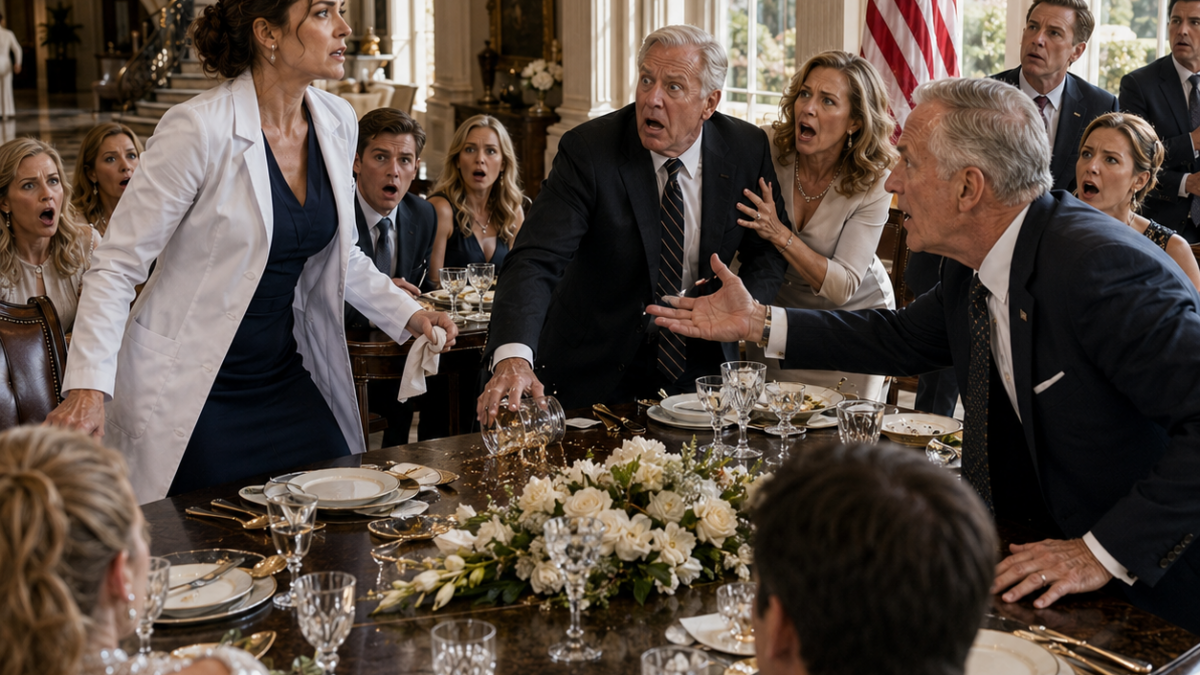
“Don’t Embarrass Us,” Dad Warned. “Dr. Calloway Is The Top Surgeon At Hopkins.” I Stayed Quiet. At Dinner, Dad Called Me “The One Who Settled.” Dr. Calloway Set Down His Fork. “Your Daughter Saved Lives I Couldn’t Have Saved.” Dad Set Down His Bourbon And Went Pale.
### Part 1
The man at the other end of the table wasn’t looking at my brother.
He wasn’t looking at my father, either.
He was looking directly at me.
And as soon as he said my name, I watched my father’s face lose every trace of color.
But I need to back up.
My name is Claire Whitmore. I’m thirty-four years old, and for the last eleven years, I’ve worked as a trauma nurse.
Not the television version of nursing where someone adjusts an IV, gives a reassuring smile, and disappears until the next scene.
I mean trauma.
I spent my first years at a Level I trauma center in Baltimore, where the ambulance bay doors seemed to open every five minutes on Friday nights. Later, I joined civilian surgical teams supporting military medical operations overseas. Now I work as a charge nurse at Mercy Regional in Charlotte, North Carolina.
I’ve held pressure on wounds while blood soaked through two pairs of gloves.
I’ve heard families scream when doctors walked into waiting rooms without smiling.
I’ve worked shifts so long that the fluorescent lights began to feel like daylight.
Once, after losing a twenty-two-year-old college student following a highway collision, I sat inside my car in the hospital parking garage with my forehead pressed against the steering wheel because I couldn’t make myself turn the key.
None of that ever impressed my father.
Richard Whitmore understood success through titles.
President.
Partner.
Chief executive.
Surgeon.
Attorney.
Developer.
He had spent thirty-five years building a commercial real-estate company and could estimate the value of an office tower within minutes of walking through the lobby. Unfortunately, he evaluated people almost the same way.
Doctors ranked high.
Corporate attorneys ranked high.
People whose names appeared on buildings ranked very high.
Nurses?
“Support staff.”
Those were his exact words when I was eighteen.
We were sitting at our old dining table when I told my parents I’d been accepted into nursing school.
Dad lowered his fork.
“You’re smart enough for medical school.”
“I know.”
“Then why would you settle?”
The word stayed with me.
Settle.
Not choose.
Not pursue.
Settle.
I didn’t argue. I rarely argued with Dad growing up. Trying to change his mind was like pushing against a locked door while he explained why the door was actually open.
My older brother, Jason, never had that problem.
Jason was thirty-seven and had followed the path Dad understood perfectly. He got an economics degree, then an MBA, married Lauren Bennett, whose family owned several successful auto dealerships, and eventually became managing partner at a property-development company in Raleigh.
Dad talked about Jason’s projects as if Jason were rebuilding entire cities by hand.
I loved my brother.
That mattered.
Jason wasn’t cruel.
But when Dad dismissed my career, Jason’s favorite response was silence.
He would inspect his plate.
Ask Mom about dessert.
Check a football score.
Anything except say, “Dad, that isn’t fair.”
I understood why.
Jason had spent his whole life benefiting from Dad’s approval. Challenging him meant risking some of it.
Understanding something, however, doesn’t make it hurt less.
Mom was different.
Margaret Whitmore could make kindness feel almost invisible. Whenever I stayed at my parents’ house after a long shift, she washed my scrubs and folded them on the guest-room bed. At dinners, if Dad said something sharp, her hand would sometimes find mine beneath the table.
But she never corrected him aloud.
She had spent four decades learning how to survive his certainty.
That was my family.
And for years, I convinced myself I had stopped caring what Dad thought.
Then came one brutally hot Saturday in August.
Jason and Lauren were hosting an engagement dinner for Lauren’s younger sister, Natalie Bennett, and her fiancé, Dr. Evan Mercer, who was finishing an orthopedic surgery residency at Duke.
Dad called me six days beforehand.
“This is an important evening,” he said.
“For Natalie?”
“For everyone.”
I almost laughed.
He continued.
“Lauren’s family will be there. Dr. Warren Bennett is bringing Dr. Samuel Harrington. Chief of surgery at Duke.”
I could hear the satisfaction in Dad’s voice.
“Okay.”
“I want the evening to go smoothly.”
“I’m not planning a bar fight, Dad.”
“That’s not what I mean.”
I knew exactly what he meant.
Then he said something that made my hand tighten around the phone.
“Just don’t get into your hospital stories. People like this don’t want to hear about blood and injuries over dinner.”
People like this.
I stared through my apartment window.
“And wear that navy dress,” he added. “The nice one.”
The call ended a minute later.
I stood there holding my phone, feeling eighteen again.
Then I opened my closet.
And against my better judgment, I reached for the navy dress.
I had no idea that by dessert, my father would wish he had never opened his mouth.
### Part 2
The engagement dinner was held in a private dining room at Bellamy House, one of those downtown Charlotte restaurants where the wine list is thicker than some college textbooks.
Outside, August heat shimmered above the pavement.
Inside, everything was chilled marble, dark wood, white linen, and low golden lamps reflected in polished glass.
I arrived directly after driving from Concord with my windows partially open because my car’s air conditioner had developed an irritating metallic rattle I hadn’t found time to fix.
The navy dress was still hanging properly despite the heat.
My feet hurt.
That was normal.
People imagine nurses become accustomed to being tired.
We don’t.
We just stop discussing it.
Lauren greeted me at the entrance.
“You look gorgeous.”
“Dad specifically approved the wardrobe.”
She winced.
“Of course he did.”
Lauren understood my father better than Jason sometimes did.
She hugged me, then whispered, “Ignore him tonight.”
“I’ve had thirty-four years of practice.”
Jason appeared behind her.
“Hey, Claire.”
He gave me a quick hug.
There was always something apologetic about Jason’s hugs after Dad had called me. I wondered sometimes if my brother knew exactly when those calls happened.
Mom spotted me from across the room.
She crossed over immediately and kissed my cheek.
“You look tired.”
“Thanks, Mom.”
“You know what I mean.”
“I know.”
She tucked a loose strand of hair behind my ear the same way she had when I was twelve.
Near the bar, Dad was speaking to a tall man with silver hair and expensive-looking glasses.
He was performing what I privately called Richard Whitmore Networking Theater.
Shoulders back.
Bourbon in hand.
Laughing half a second louder than necessary.
“Who’s that?” I asked.
Mom lowered her voice.
“Dr. Samuel Harrington. The Duke chief of surgery your father keeps talking about.”
“Ah.”
“He’s been talking to him for almost half an hour.”
“Of course he has.”
Mom gave me a warning look, but there was amusement beneath it.
I took sparkling water from a server.
I had a shift early the next morning, and nothing teaches respect for a five-thirty alarm quite like hospital work.
Natalie and Evan stood near the windows receiving congratulations.
Natalie was glowing. Not metaphorically. Her cheeks were pink, her eyes bright, and she kept touching her engagement ring as if checking whether it was still real.
I genuinely liked her.
She hugged me hard.
“You came!”
“Wouldn’t miss it.”
Evan shook my hand.
We talked briefly about Duke, Charlotte, wedding plans, and the botanical garden Natalie wanted for the ceremony.
He asked where I worked.
“Mercy Regional. Trauma.”
His eyebrows lifted.
“Level I?”
“Yep.”
“That place gets hammered.”
“Every Friday night.”
He laughed.
That was all.
No awkward sympathy.
No “why didn’t you become a doctor?”
Just one clinician recognizing another person’s workload.
It was refreshing.
I was standing near the window twenty minutes later when the private dining room door opened again.
A white-haired man stepped inside beside an elegant woman wearing silver earrings.
He was in his early seventies, lean, slightly weathered, dressed in a dark blazer without a tie.
He didn’t look flashy.
But the room seemed to reorganize itself around him.
Some people command attention by demanding it.
Others do it by having absolutely no need to.
I recognized him instantly.
Dr. Nathaniel Reeves.
For fifteen years, he had been a trauma surgeon with the Navy. After transitioning into civilian medicine, he became director of emergency surgical services at Johns Hopkins. His research on trauma response in austere environments had influenced emergency protocols used all over the country.
More important to me, his work had shaped the protocols my team used overseas.
I had met him once.
Three years earlier.
Washington, D.C.
A conference on civilian-military surgical cooperation.
I had been one of two nurses on a panel otherwise filled with surgeons and emergency physicians.
Afterward, Dr. Reeves had approached me.
Not the surgeons.
Me.
He told me he had reviewed data from our team and believed the nursing coordination model we developed deserved broader adoption.
I remembered every word because compliments from someone like Nathaniel Reeves weren’t handed out for politeness.
Seeing him now made my stomach tighten.
Not from intimidation.
From the strange sensation of seeing someone connected to the most meaningful part of my professional life suddenly standing in a room where my professional life had always been treated as a disappointing footnote.
I didn’t approach him.
This was Natalie’s engagement dinner.
I wasn’t going to turn it into a networking event.
Dad, naturally, had different instincts.
Within minutes, he was crossing the room toward Dr. Reeves.
I watched Dr. Harrington introduce them.
I watched Dad’s smile widen.
Then I watched his posture change.
It was subtle.
But I had seen it my entire life.
Dad had just learned exactly how important Nathaniel Reeves was.
And suddenly, the evening had become even more important to him.
What he didn’t know was that Dr. Reeves had already looked across the room.
And he had seen me.
### Part 3
I pretended not to notice.
That sounds ridiculous, but hospital work teaches you how to compartmentalize.
A screaming patient in one bed.
A worried family in another room.
A physician asking a question behind you.
A monitor beeping.
You learn to decide what requires attention now and what can wait.
At that moment, Dr. Reeves could wait.
Natalie’s engagement dinner couldn’t.
So I stayed near the window and listened to Lauren’s aunt tell me about a cruise.
Then Dad appeared.
“Claire.”
His bourbon glass was nearly empty.
“Hi, Dad.”
“Did you know Nathaniel Reeves was coming tonight?”
“No.”
“Samuel says he’s one of the most respected trauma surgeons in the country.”
“I know.”
Dad blinked.
“You do?”
“Yes.”
“He ran emergency surgical services at Hopkins.”
“I know.”
“He was Navy before that.”
“I know, Dad.”
For one second, he actually looked annoyed that I had interrupted his opportunity to educate me.
Then his expression smoothed out.
“Well. This is a very accomplished room tonight.”
There it was.
I took a sip of sparkling water.
“Seems that way.”
“I want you to enjoy yourself.”
“Planning on it.”
He lowered his voice.
“Let the people who have something to contribute do most of the talking.”
I looked at him.
Not because the sentence was new.
Because somehow, after eleven years, he could still surprise me with the precision of his condescension.
“What exactly do you think I might do?”
“Don’t turn this into something.”
“I’m asking.”
He sighed.
“Claire, nobody wants graphic emergency-room stories at an engagement dinner.”
“I wasn’t planning to tell any.”
“Good.”
He patted my shoulder.
That little gesture somehow made it worse.
Then he walked away.
I stayed where I was.
The room smelled faintly of grilled citrus and wine.
Ice clicked inside someone’s glass.
Behind me, silverware was being arranged for dinner.
I stared through the window at the city and felt an old exhaustion spread through me.
Not anger.
Anger requires energy.
This was older than anger.
When I was eighteen, comments like that could ruin an entire week.
At twenty-four, they made me desperate to prove something.
At thirty, they mostly made me tired.
At thirty-four, I had started to understand that defending myself to Dad was often another way of accepting his right to judge me.
Still, understanding a wound doesn’t stop it from hurting when someone presses on it.
Dinner began.
I was seated between Mom and one of Lauren’s cousins, a pleasant insurance broker named Colin.
He asked what kind of nurse I was.
“Trauma.”
“That must be intense.”
“It can be.”
“My wife can’t even watch medical shows.”
I smiled.
Conversation shifted to fishing.
Perfectly fine.
Most people had a vague idea of nurses based on television.
They pictured medication carts, blood-pressure cuffs, bedsheets.
They rarely pictured someone recognizing internal bleeding before a blood-pressure drop.
They didn’t think about coordinating multiple infusions while surgeons prepared an operating room.
They didn’t think about making decisions when resources were disappearing faster than patients were arriving.
I stopped trying to explain years ago.
The first course came.
Then the second.
Dad’s bourbon kept being replaced.
By the time salmon was served, his social volume had increased noticeably.
Evan described orthopedic residency.
Dr. Harrington asked him about his fellowship plans.
Dad beamed as if Evan were his own son.
“Duke trains them well,” Dad said.
Dr. Harrington laughed.
“We try.”
“Medicine takes a certain kind of mind,” Dad continued.
Mom’s fork stopped halfway to her mouth.
I knew that tone.
I looked down at my plate.
Please don’t.
Dad continued anyway.
“Claire actually had that kind of mind.”
Several people glanced toward me.
My shoulders tightened.
“She scored exceptionally well in school,” Dad said. “Could have done practically anything.”
Jason stared into his wineglass.
Then Dad laughed.
“But she’s always been our mystery.”
And there it was.
The smile.
The weapon disguised as affection.
“Smart as a whip,” Dad said, “and somehow she ended up a nurse.”
The table changed.
Not dramatically.
But enough.
Mom put her fork down.
Lauren looked at Jason.
Natalie’s smile disappeared.
Someone near the opposite end murmured, “Nursing is incredibly important.”
Dad raised a hand.
“Oh, absolutely. I’m not criticizing. She’s just a nurse, that’s all. I simply always thought she could have done more.”
My face grew hot.
Jason finally spoke.
“Dad.”
Dad ignored him.
“She had options.”
I looked down at the little sprig of rosemary beside my salmon.
I could have answered.
I could have listed every credential I had.
Every deployment.
Every patient.
Every night I had walked into chaos and stayed calm because someone had to.
Instead, I reached for my water.
Then I heard a chair move.
Not loudly.
Just enough.
Dr. Nathaniel Reeves placed his napkin beside his plate.
And when I looked up, his eyes were locked on mine.
“Excuse me,” he said.
The entire table went silent.
### Part 4
Dr. Reeves didn’t sound angry.
That somehow made what happened next more powerful.
His voice had the calm precision of someone accustomed to being heard without raising it.
“I don’t believe we’ve been formally introduced tonight.”
He looked directly at me.
“You’re Claire Whitmore.”
It wasn’t a question.
My father froze.
I felt Mom’s knee shift beside mine.
“Yes,” I said.
Dr. Reeves leaned forward slightly.
“Nathaniel Reeves. We met in Washington three years ago at the civilian-military surgical cooperation conference.”
“I remember.”
Dad’s bourbon glass stopped halfway to his mouth.
Dr. Reeves continued.
“You were on the austere-care panel.”
“Yes.”
“You were working with the second civilian surgical rotation at that time, weren’t you?”
I nodded.
“Two rotations total.”
He smiled faintly.
“I thought so.”
Something changed around the table.
People weren’t looking at Dad anymore.
They were looking at me.
“I reviewed your team’s outcomes afterward,” Dr. Reeves said. “Actually, I cited them in a paper last year.”
For a second, I thought I had misheard him.
“You did?”
“The trauma coordination model. Particularly nursing-led stabilization before operative transfer.”
I swallowed.
“I didn’t know that.”
“I should have sent you the paper.”
He said it as casually as someone apologizing for forgetting a birthday card.
Then he turned his glass slowly between his fingers.
“Your team was producing results with resources most major centers would consider inadequate.”
My instinct was immediate.
“It was a team effort.”
“Of course.”
“The surgeons were exceptional.”
“I’m sure.”
“And we were using protocols you helped develop.”
His expression sharpened—not unkindly.
“Protocols do not treat patients, Claire.”
I stopped.
“People do.”
No one moved.
Dr. Reeves continued.
“I read your documentation. The nursing coordination in those cases was extraordinary.”
My father’s face looked different.
Not embarrassed exactly.
More like reality had arrived from a direction he had never considered.
Dr. Harrington spoke next.
“You did field trauma work?”
I turned toward him.
“For about eighteen months total.”
“Where?”
I gave him the broad regions without details.
His eyebrows rose.
“That’s not easy work.”
“No.”
Dr. Reeves gave a quiet laugh.
“That’s one way of putting it.”
Then he glanced around the table.
“People misunderstand trauma nursing.”
Nobody interrupted.
“At that level, those nurses are among the most highly skilled clinicians in medicine. They manage rapidly changing patients with incomplete information and sometimes minimal resources. The good ones recognize problems before anyone else in the room.”
He looked back at me.
“The exceptional ones make everyone around them better.”
I didn’t know what to say.
So I said the simplest thing.
“Thank you.”
Mom’s hand found my forearm under the table.
Her fingers squeezed once.
Across from me, Jason looked ashamed.
Not of me.
Of himself.
I recognized that immediately.
Dad finally set down his bourbon.
The base of the glass touched the table with a soft click.
He opened his mouth.
Nothing came out.
For the first time in my life, Richard Whitmore had found himself in a conversation where professional status—the language he trusted most—had turned against him.
And I hadn’t engineered any of it.
I hadn’t announced my accomplishments.
I hadn’t defended myself.
I hadn’t even raised my voice.
Dr. Reeves had simply corrected the record.
That was all.
Then, almost as quickly as it had happened, he picked up his fork.
He turned toward Dr. Harrington.
“So, Samuel, what ever happened with that vascular fellowship proposal?”
Conversation restarted.
At first awkwardly.
Then naturally.
Forks moved.
Someone asked for bread.
Natalie laughed at something Evan whispered.
But the evening was no longer the same.
Neither was my father.
Every few minutes, I caught him glancing toward me.
Not the usual glance.
Not the one that asked whether I was behaving properly.
This was different.
It was the look of a man realizing he had been describing a painting for years without ever turning around to look at it.
Dessert arrived.
Chocolate cake with raspberry sauce.
Dad didn’t mention my career again.
That alone might have made the night memorable.
But the real surprise came as everyone began gathering coats.
I was near the exit when Dr. Reeves walked toward me.
His wife was talking with Natalie’s mother nearby.
“I meant what I said in there,” he told me.
“I know.”
“No, I don’t think you do.”
He reached inside his blazer.
When his hand came out, he was holding a cream-colored business card.
“I’m building a national trauma advisory group,” he said. “Civilian clinicians with field experience. We’re revising several emergency-response protocols.”
He handed me the card.
“I’d like you on it.”
I stared at the name printed across the top.
Nathaniel Reeves, M.D.
Below it was a direct number.
For eleven years, my father had treated my career like the path I chose because I lacked ambition.
Now one of the most respected trauma surgeons in the country was asking me to help shape how other clinicians would save lives.
I slipped the card into my purse.
“I’m interested.”
Dr. Reeves smiled.
“I assumed you would be.”
Then he walked away.
I thought the night was over.
I was wrong.
Because my father was waiting for me in the parking garage.
### Part 5
The garage smelled like hot concrete and gasoline.
My heels clicked against the floor as I walked toward my car.
I was exhausted.
Not hospital exhausted.
Something stranger.
Emotionally wrung out.
I unlocked the car and tossed my purse onto the passenger seat.
When I started the engine, the air conditioner made its familiar metallic rattle.
“Perfect,” I muttered.
Then I heard footsteps behind me.
“Claire.”
I closed my eyes for half a second.
Dad.
He stood several spaces away beneath fluorescent lights that made everyone look older.
Without the restaurant lighting, without the bourbon glass and polished table, he seemed smaller somehow.
Human.
That was dangerous.
Humanity makes it easy to excuse people before they have actually taken responsibility.
I stepped back out of the car.
“What?”
He put his hands in his jacket pockets.
“I didn’t know.”
I waited.
“About the overseas work.”
“You knew I went overseas.”
“I knew you were working with surgical teams. I didn’t understand what that meant.”
“That’s because you never asked.”
His mouth tightened.
I hadn’t planned to say it.
But once the sentence existed between us, I didn’t regret it.
“I thought you were doing support work.”
I almost laughed.
“Support work.”
“I’m trying to explain.”
“No, Dad. You’re trying to explain why you were wrong without actually saying you were wrong.”
His eyes narrowed automatically.
There was the father I knew.
Then something softened again.
“I was wrong.”
The garage seemed suddenly very quiet.
I stared at him.
Dad looked down the row of cars.
“I didn’t understand the level you were working at.”
“That isn’t the problem.”
“What is the problem, then?”
“You decided the level didn’t matter before you knew anything about it.”
He looked back at me.
I could see him fighting the urge to argue.
“You heard ‘nurse’ when I was eighteen,” I continued, “and you made up your mind.”
“I wanted more for you.”
“You wanted something you understood.”
“That’s not fair.”
I laughed once.
“Do you know how many times you’ve introduced Jason by mentioning his company?”
He said nothing.
“Do you know how many times you’ve introduced me by saying I ‘could have been a doctor’?”
His jaw shifted.
“Tonight wasn’t the first time.”
“I know.”
“No. I don’t think you do.”
My voice stayed quiet.
That surprised even me.
“When I was twenty-six, you told your golf friends I was ‘still doing the nursing thing.’ At Grandma’s funeral, you introduced me to Uncle Peter’s business partner as ‘our stubborn one.’ When I came home after my first overseas rotation, you asked if I was finally ready to apply to graduate school and get into administration.”
His face changed.
He remembered.
Good.
“I thought I was encouraging you.”
“You were telling me the life I had built wasn’t good enough.”
“That wasn’t my intention.”
“Intent doesn’t erase repetition.”
He rubbed a hand over his mouth.
For several seconds, neither of us spoke.
Cars moved on the street outside.
A horn sounded faintly somewhere beyond the garage.
Finally Dad said, “I’m proud of you.”
There it was.
The sentence I had wanted since I was eighteen.
I expected something dramatic.
Relief.
Tears.
Maybe some old internal knot finally loosening.
Instead, I felt almost nothing.
That surprised me more than anything Dr. Reeves had said.
“Thank you,” I answered.
Dad looked hurt by how little emotion was in my voice.
Maybe he expected his approval to land like a blessing.
Eleven years earlier, it might have.
But the woman standing in front of him wasn’t eighteen anymore.
“I mean it,” he said.
“I believe you.”
“You don’t seem—”
“What?”
“Happy.”
I looked at him for a long moment.
“Dad, you became proud of me after Nathaniel Reeves told you that you should be.”
He flinched.
I hadn’t raised my voice.
I didn’t need to.
“That’s the part you need to think about.”
He stared at the floor.
“I’m trying.”
“I know.”
“Doesn’t that matter?”
“It matters.”
Hope appeared on his face.
I hated what I had to say next, but not enough to avoid saying it.
“It just doesn’t erase anything.”
His expression closed slightly.
Not anger.
Disappointment.
For once, I let him carry it.
“I’m not going to fight with you,” I said. “But I’m also not pretending one dinner fixes thirty-four years.”
He nodded slowly.
I got into my car.
Before I closed the door, he said, “Claire?”
I looked back.
“I am sorry.”
This time I believed him.
But belief and forgiveness are not the same thing.
I drove out of the garage with Dr. Reeves’s card inside my purse.
For the first time in my life, my father’s approval was finally within reach.
And for the first time, I realized I didn’t need to reach for it.
### Part 6
The next morning, my alarm went off while the sky was still dark.
For a few seconds, I couldn’t remember why I felt different.
Then I saw the navy dress hanging over the chair.
The dinner came rushing back.
Dad.
Dr. Reeves.
The card.
I showered, pulled on navy scrubs, tied my hair back, and stopped for coffee on the way to Mercy Regional.
The hospital smelled the way hospitals always smell before sunrise: disinfectant, burnt coffee, warm plastic, and something metallic beneath all of it.
By six, I was taking report.
By seven, the emergency department was filling.
By eight, none of the previous night mattered.
That’s one thing I love about trauma.
It doesn’t care about your family drama.
A patient doesn’t stabilize because somebody important respected you at dinner.
A monitor doesn’t stop alarming because your father finally apologized.
You either know what you’re doing or you don’t.
That morning, we received a middle-aged man after a construction-site accident.
His blood pressure was dropping.
His skin had gone pale and clammy.
One of the newer nurses looked at me.
“Claire?”
“Call trauma surgery. Now.”
I moved closer.
The room became motion.
Gloves snapping.
Monitor tones.
Footsteps.
A physician asking for imaging.
Someone rolling equipment in.
The young nurse hesitated over a reading.
I said, “Don’t chase the monitor. Look at the patient.”
She looked.
Then she understood.
That was nursing.
Not glamorous.
Not a title you announced across a dinner table.
Observation sharpened through thousands of hours.
Pattern recognition built from mistakes you never forgot.
The patient went upstairs alive.
Afterward, I stood at the nurses’ station finishing documentation when my coworker Maya dropped a granola bar beside my keyboard.
“You look weird.”
“Good morning to you too.”
“Not bad weird. Distracted weird.”
I hesitated.
Then I told her the abbreviated version.
Dinner.
Dad.
The insult.
Dr. Reeves.
Maya stared at me.
“Nathaniel Reeves?”
“Yes.”
“The Nathaniel Reeves?”
“I’m fairly certain there’s only one relevant to this conversation.”
“He asked you to join an advisory board?”
“Group.”
She smacked my shoulder.
“Ow.”
“Why are you standing here like you found a coupon?”
I laughed.
“I haven’t called him yet.”
Her eyes widened.
“Claire.”
“I worked overnight emotionally.”
“That is not a thing.”
“It should be.”
She leaned toward me.
“Call him.”
So at lunch, I did.
I stood in the stairwell because it was the only place in the hospital where nobody seemed to need anything from me.
Dr. Reeves answered after several rings.
“Reeves.”
“Dr. Reeves, this is Claire Whitmore.”
“Claire. Good.”
He sounded unsurprised.
“I wanted to follow up about the advisory group.”
“I hoped you would.”
We spoke for twenty minutes.
The project was larger than I expected.
A multi-institution initiative aimed at updating protocols for trauma stabilization during large-scale emergencies and resource shortages.
Doctors.
Nurses.
Paramedics.
Military clinicians.
Public-health specialists.
“We’ve got plenty of people who know how things are supposed to work,” Dr. Reeves said. “I need people who know what happens after the plan breaks.”
I understood exactly what he meant.
“When do you start?”
“Next month.”
“I’m in.”
“Excellent.”
I hung up and stood there looking at the blank concrete stairwell wall.
No applause.
No family.
No dramatic music.
Just me and a scratched metal handrail.
And yet I felt lighter than I had in years.
Three weeks later, Dad invited me to dinner.
I declined.
He invited me again.
I declined again.
Then Mom called.
“Your father is trying, honey.”
“I know.”
“He feels terrible.”
“I’m sure he does.”
“Could you give him a chance?”
I stared through my apartment window.
There was a time when those words would have made me fold immediately.
Instead, I asked Mom a question I should have asked years earlier.
“Why does his discomfort always become my responsibility?”
She went silent.
And in that silence, I realized the problem in my family had never only been my father.
### Part 7
Mom came to my apartment the following Sunday.
She brought banana bread.
That was her peace offering for everything.
Growing up, if Dad shouted, Mom baked.
If Jason and I fought, she cooked.
If someone cried, food appeared.
The loaf was still warm when she set it on my kitchen counter.
I made coffee.
For several minutes, we talked about safe things.
My schedule.
Jason’s son starting school.
Natalie’s wedding plans.
Then Mom wrapped both hands around her mug.
“I’ve been thinking about what you said.”
I waited.
“About making your father’s feelings your responsibility.”
The refrigerator hummed behind us.
Outside, someone was mowing grass.
Mom stared into her coffee.
“You were right.”
I didn’t say anything.
She looked older suddenly.
Not physically.
Tired in a way I recognized.
“I thought I was keeping peace,” she continued. “For years.”
“I know.”
“When your father said things, I would talk to you afterward. I thought that was helping.”
“It did help.”
“But I never told him to stop.”
“No.”
Her eyes became wet.
“I should have.”
There are apologies you dream about receiving.
Then there are apologies that arrive so late you realize they belong more to the person giving them than the person receiving them.
I reached across the table and covered Mom’s hand.
“I love you.”
She squeezed my fingers.
“I love you too.”
“But I’m not going back to pretending everything is fine.”
“I’m not asking you to.”
That mattered.
Jason called later that week.
Unlike Mom, he had no banana bread.
He had awkwardness.
“I owe you an apology.”
I leaned against my kitchen counter.
“For which decade?”
“Fair.”
He sighed.
“I should have said something at dinner before Reeves did.”
“You should have said something years before that.”
“I know.”
I waited.
“I was a coward.”
That surprised me.
Jason was many things, but he rarely used ugly words about himself.
“I knew Dad was unfair to you,” he said. “I just figured it wasn’t my fight.”
“That was convenient.”
“I know.”
I heard him breathe out.
“I think part of me was scared that if I challenged him, I’d become the disappointing kid too.”
There it was.
The truth.
Dad’s approval had been a currency in our family, and Jason had been rich.
Of course he had been afraid of losing it.
“I understand,” I said.
“That doesn’t make it okay.”
“No.”
“I’m sorry.”
I accepted Jason’s apology because unlike Dad’s early attempts, Jason wasn’t asking me to erase anything.
He wasn’t demanding immediate closeness as proof that he had changed.
He simply named what he had done.
That autumn became busier than any year I could remember.
The advisory group met first in Baltimore.
Walking into that room felt strange.
There were twenty-two people around the table, including trauma surgeons whose research I had studied during training.
Nobody asked why I hadn’t gone to medical school.
Nobody called me “just” anything.
They asked what I thought.
That difference was almost disorienting.
During one session, a surgeon proposed a transfer sequence that looked flawless on paper.
I studied the workflow.
“It won’t work.”
The room turned toward me.
He frowned.
“Why?”
“Because it assumes you’ll have three experienced nurses available simultaneously.”
“We should.”
“You won’t.”
I explained how staffing collapsed during prolonged emergencies.
How one nurse became responsible for two critical patients.
How supplies ended up physically separated from the people needing them.
How perfect algorithms failed under imperfect conditions.
Dr. Reeves listened without interrupting.
Then he said, “Rewrite it.”
We did.
Three months later, the revised protocol passed review.
My name appeared among the clinical contributors.
When the document was published, Dad mailed me a printed copy.
He had highlighted my name.
Inside was a handwritten note.
I should have seen you sooner.
I stared at those words for a long time.
Then I put the note in a drawer.
Not because I hated him.
I didn’t.
But some relationships change permanently when you stop auditioning for love.
Dad was beginning to see me.
I simply no longer needed that vision to define myself.
Then, six months after the engagement dinner, he asked me one question I never expected to hear.
“Claire, will you tell me what your work is actually like?”
And this time, I had to decide whether he had earned the answer.
### Part 8
Dad asked the question over lunch.
Not at Bellamy House.
Not somewhere with a sommelier and linen napkins.
A small sandwich place near my hospital.
He had suggested somewhere expensive.
I chose the sandwich place.
That felt important.
He sat across from me in a booth holding coffee in a paper cup.
“No networking opportunities here,” I said.
He smiled reluctantly.
“I probably deserve that.”
“You definitely do.”
A year earlier, that exchange would have tightened my stomach.
Now it didn’t.
Dad looked toward the hospital visible through the window.
“Tell me what you do.”
I studied him.
“What do you mean?”
“I mean I realized I don’t know.”
For once, he wasn’t asking for achievements.
No publications.
No titles.
No respected surgeon’s endorsement.
Just the work.
So I told him.
Not everything.
Some things belong to patients and should remain there.
But I told him enough.
I told him about walking into a room where ten people were talking at once and learning which voice mattered.
I told him about recognizing fear in younger nurses and giving them something specific to do so fear couldn’t freeze them.
I told him about families.
About how sometimes my job was saving a life, and sometimes it was making sure someone didn’t die alone.
I told him about overseas operating tents where heat gathered under protective gear and fine dust seemed to reach everything.
I told him about coming home afterward and discovering grocery stores felt impossibly bright.
Dad barely spoke.
When I finished, he looked down at his untouched sandwich.
“I made it sound small.”
“Yes.”
“I’m ashamed of that.”
“I know.”
“I can’t change it.”
“No.”
That answer hurt him.
I let it.
Forgiveness, I had learned, is sometimes confused with rescuing someone from the consequences of understanding what they did.
I wasn’t interested in rescuing Dad anymore.
“Are we okay?” he asked.
I considered the question.
“We’re different.”
“That isn’t what I asked.”
“It’s the answer I have.”
He nodded.
I continued.
“I don’t hate you, Dad. But I’m not going back to the relationship we had. I spent too many years trying to earn something from you that should never have depended on my profession.”
“I understand.”
“I hope you do.”
That was the closest we came to forgiveness.
And it was enough for me.
Dad became quieter after that.
Not transformed overnight.
People rarely are.
Occasionally he slipped into old habits.
The difference was that now I corrected him.
Once, at Thanksgiving, he started to say, “Claire could have been a—”
I looked at him.
He stopped.
Then he smiled awkwardly.
“Claire is one of the people helping rewrite national trauma protocols.”
I raised an eyebrow.
“That’s slightly better.”
Jason laughed.
Mom nearly choked on her wine.
Life continued.
Natalie and Evan got married the following spring.
I attended in a green dress that Dad had absolutely no involvement in selecting.
The advisory project expanded.
I started traveling several times a year to train hospital teams in emergency trauma coordination.
Eventually Mercy Regional created a clinical education position that allowed me to divide my time between charge nursing and training.
I accepted.
Not because it sounded impressive.
Because it mattered.
That distinction had become one of the most important things in my life.
Two years after the dinner at Bellamy House, I was speaking at a trauma conference in Baltimore.
The auditorium lights were painfully bright.
I stood backstage listening to someone introduce me.
“Claire Whitmore has spent more than a decade in critical trauma nursing…”
I smiled.
Not because of the introduction.
Because I remembered being eighteen.
Dad saying, “Why would you settle?”
I remembered sitting at family dinners smiling while he explained my life to other people as though I were a disappointing decision he still hoped to correct.
I remembered Nathaniel Reeves moving his napkin beside his plate.
That tiny sound.
The chair shifting.
The moment a room full of people heard something about me that I had stopped bothering to say for myself.
Dr. Reeves was sitting in the second row that afternoon.
After my presentation, he found me backstage.
“You’ve gotten better at disagreeing with surgeons,” he said.
“I had a good teacher.”
He laughed.
My phone buzzed in my pocket.
A message from Dad.
Mom says your presentation is today. Hope it goes well.
No mention of famous names.
No request for photos with important people.
No question about who was attending.
Just that.
I typed:
Thanks.
Then I put the phone away.
Maybe that sounds cold.
It wasn’t.
It was peaceful.
Dad and I had a relationship now, but it was one built after I stopped needing him to validate the old one.
I loved him.
I did not forget.
I did not pretend the years hadn’t happened.
And I never again measured the worth of my career by whether he finally understood it.
That evening, I drove past the hospital where I had started my career.
The sky was turning purple over Baltimore, and ambulance lights flashed briefly at an intersection before disappearing toward the emergency entrance.
For a moment, I remembered my first patient who died.
I remembered the first patient I helped save.
The overnight shifts.
The cold coffee.
The parking garages.
The overseas operating rooms.
The families whose faces I could still remember years later.
Eleven years of work.
Eleven years of showing up.
None of it became meaningful because Nathaniel Reeves defended me at a dinner table.
None of it became worthy because my father finally became proud.
It had always mattered.
I had simply spent too much of my life waiting for someone else to say so.
That was the real thing I carried away from that dinner.
Not Dad’s white face.
Not the silence around the table.
Not even Dr. Reeves’s business card.
It was the realization that there are doors you spend years knocking on because you believe someone important is standing behind them.
Then one day, you look around and realize you have already built an entire life on your side of the door.
A life full of people who trust you.
Work that matters.
Skills earned the hard way.
A purpose nobody can downgrade with one careless word.
I spent years believing my father’s approval was the final credential I was missing.
It wasn’t.
I wasn’t “just a nurse.”
I was Claire Whitmore.
And long before that dinner, long before a famous surgeon stood up for me, that had already been enough.
THE END!
Disclaimer: Our stories are inspired by real-life events but are carefully rewritten for entertainment. Any resemblance to actual people or situations is purely coincidental.








