“She Never Amounted to Much.” Dad Told Her Fiancé—Then He Stood at Attention for Me
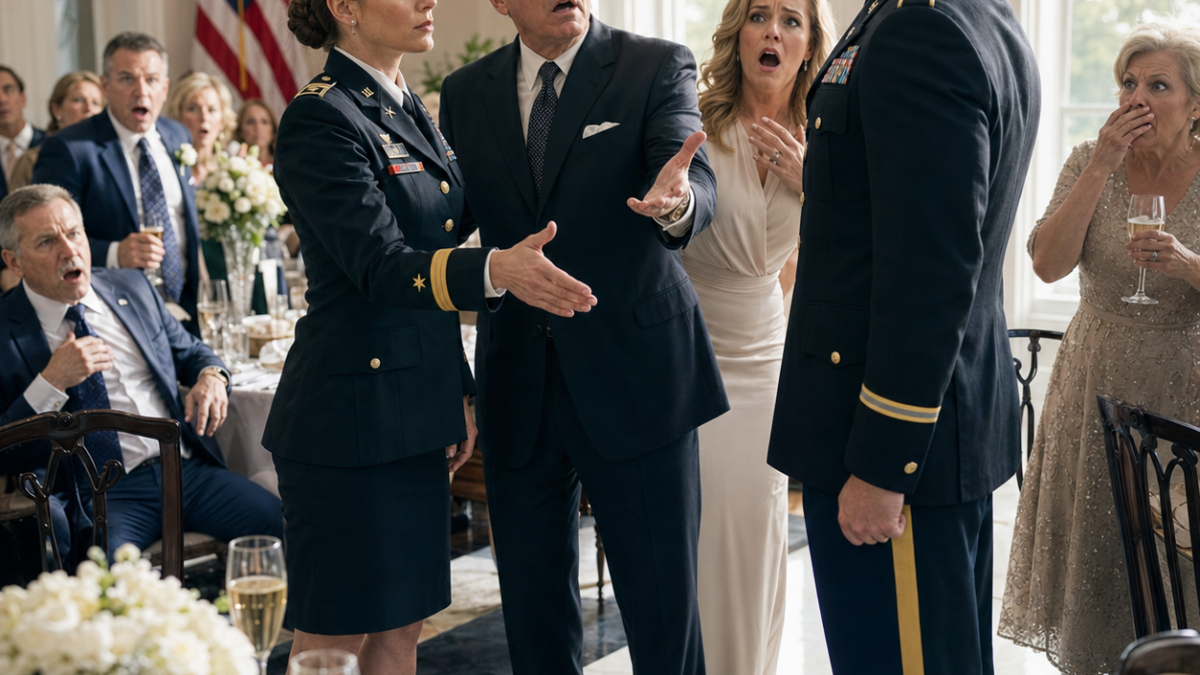
“It’s Embarrassing, But I Still Have To Introduce Her,” My Dad Said, Introducing Me To My Sister’s Fiancé—A JTF2 Commander. Everyone Smiled Politely. He Shook My Hand, Then Stood At Attention. “Brigadier General, Ma’am.” Everyone Went Silent.
### Part 1
My father introduced me to my sister’s fiancé the way someone might explain an old stain on the carpet.
“And this is Claire, my other daughter.”
He paused after “other” just long enough to make it sound like a punch line.
“She’s in the military. Does something with administration, I think.”
Then he chuckled.
My sister, Natalie, gave the little nervous laugh she had used since we were teenagers whenever Dad said something uncomfortable and everyone was expected to pretend it was funny.
I didn’t correct him.
I was forty-one years old. I had commanded people in places my family would never hear about, briefed senior officials whose names appeared on television, and learned long ago that some battles were won by refusing to step onto the field.
So I simply held out my hand.
Natalie’s fiancé, Gabriel Mercier, took it.
“It’s a pleasure to meet you.”
His voice was calm, but something in his face had changed.
His eyes had dropped briefly to the insignia on my uniform collar.
Then they returned to mine.
He didn’t laugh.
That was the first thing I noticed about him.
The second was the way he stood.
Still. Balanced. Alert without appearing tense.
Natalie had already told me Gabriel had served with Joint Task Force 2 before moving into private security consulting. Men from that world carried themselves differently. They watched exits without looking like they were watching exits. They noticed hands, doors, sounds, posture.
And apparently rank insignia.
Dad had already turned away.
“Come on, Gabriel. Hockey game’s on. I want to show you the renovations.”
He put a hand on Gabriel’s shoulder and guided him toward the living room with the warm enthusiasm he reserved for people whose accomplishments he understood.
I stayed in the hallway for one extra second.
The house smelled exactly as it always had—cedar from the old coat closet, cinnamon from something my mother had baked, and the faint cold smell of November air coming through the open door.
I had not been home in fourteen months.
There was a reason.
The drive from Ottawa to Oakville had taken nearly six hours because traffic was awful and because, somewhere outside Kingston, I had pulled into a gas station, bought a coffee I didn’t want, and stood beside my car breathing cold air.
I had almost turned around.
Natalie was the reason I hadn’t.
Three weeks earlier, she had called while I was standing outside a secure briefing room at National Defence Headquarters.
“I want you to meet him before we officially announce the engagement,” she had said.
Her voice had been unusually serious.
“He’s a good man, Claire.”
Then, after a pause, “And I want you there.”
I had understood what she wasn’t saying.
Dad would be there too.
My father, Richard Bennett, had spent twenty years reducing my career into something small enough for him to dismiss.
In his version of my life, I shuffled paperwork for the Department of National Defence.
I had tried correcting him once.
Then twice.
Then for years.
Every attempt ended the same way.
Dad would nod, interrupt, and redirect the conversation toward Natalie’s law degree, Natalie’s partnership, Natalie’s latest case, Natalie’s new house.
Eventually, I stopped trying.
That evening, my mother hugged me tightly in the kitchen.
“You look tired,” she whispered.
“I’m fine.”
She looked at my uniform.
“Long week?”
“Long year.”
She understood enough not to ask more.
From the living room came Dad’s booming laugh.
Then Gabriel’s quieter voice.
Natalie appeared beside me.
“He likes him,” she said.
“Dad likes anyone he can brag about.”
She winced.
I immediately regretted saying it.
“Sorry.”
“No.” She stared toward the living room. “You’re not wrong.”
That surprised me.
Natalie had always defended Dad.
Not because she agreed with him, I eventually realized, but because being the favored child comes with its own strange prison. If she admitted how unfair he was to me, she had to acknowledge that some of what she received came at my expense.
The door between the kitchen and dining room swung open.
Dad leaned through.
“Dinner!”
Then he looked directly at Natalie.
“Bring your brilliant fiancé before your mother lets everything get cold.”
He disappeared again.
Natalie closed her eyes for half a second.
I touched her arm.
“Tonight is about you.”
She looked at me strangely.
“No,” she said quietly. “I think tonight stopped being about me the second Gabriel saw your collar.”
I frowned.
“What did he say?”
“Nothing.”
“That doesn’t sound important.”
Natalie glanced toward the living room.
“That’s what worries me.”
### Part 2
Dinner at my parents’ house had always been more ceremony than meal.
My mother, Helen, brought out the good china, the heavy silverware, the cloth napkins nobody used except on holidays. Two candles burned in the center of the table beside a vase of dried autumn flowers.
The roast chicken smelled of rosemary and butter.
Outside, wind pushed dry leaves along the patio stones.
Inside, Dad held court.
Gabriel sat beside Natalie.
I sat across from them.
Dad asked him everything.
Where had he grown up?
What did his parents do?
How many years had he served?
Had he considered corporate work?
Did he invest?
Did he play golf?
Gabriel answered politely but carefully, especially when military service came up.
“Some parts of the work aren’t worth discussing at dinner,” he said.
Dad smiled approvingly.
“Discretion. I respect that.”
I almost laughed.
Apparently discretion impressed my father when it belonged to a man he had already decided was important.
My own silence had always been interpreted as lack of achievement.
Natalie caught my eye.
She knew exactly what I was thinking.
For most of the meal, I said very little.
That suited Dad perfectly.
Then my mother passed the bread basket.
Dad tore off a piece and said, “I read another story about defence spending this morning. Billions disappearing into bureaucracy.”
He looked toward me.
Here it comes, I thought.
“Claire probably knows all about that.”
I took a sip of water.
Dad grinned at Gabriel.
“She keeps the machine running. Filing, meetings, forms. Someone has to do it.”
Natalie’s fork stopped against her plate.
“Dad.”
“What?”
“That’s not—”
I interrupted gently.
“Let it go.”
Dad laughed.
“Claire never did like being teased.”
“I’m not upset.”
“See? Serious as ever.”
Then he turned back to Gabriel.
The subject moved on.
But Gabriel didn’t.
I could feel his attention from across the table.
Not staring.
Assessing.
Once, when Dad was describing Natalie making partner at thirty-eight, I looked up and found Gabriel watching me.
His expression wasn’t pity.
Thank God.
I would have hated pity.
It looked more like confusion.
He knew something Dad didn’t.
Or, more accurately, something Dad had never bothered learning.
Dad lifted his wineglass.
“To Natalie.”
My sister looked embarrassed.
“Our family success story.”
That one landed harder than I expected.
Not because it was new.
Because it wasn’t.
I stared at the candle flame.
Ten days earlier, I had been in a secure conference room delivering a logistics assessment to the Chief of the Defence Staff.
Forty-seven personnel rotations were waiting for final approval on my desk.
Three multinational planning groups were operating under directives carrying my authorization.
Yet at my parents’ table, I was apparently the daughter who filed things.
I almost admired the absurdity of it.
After dinner, Natalie helped Mom clear the plates.
Dad took Gabriel into the den.
I stayed behind.
For a minute, the dining room was quiet except for plates touching in the kitchen and the hum of the refrigerator.
Then Dad’s voice drifted through the partially open den door.
“Claire was always the serious one.”
I froze.
There was a pause.
“She never really found her footing.”
I didn’t move.
“She’s fine, of course. Steady government job. Pension eventually. But Natalie…”
His voice warmed.
“Natalie made something of herself.”
Something inside me went perfectly still.
Dad continued.
“Partner before forty. Beautiful home. Now Gabriel. I couldn’t be prouder.”
Gabriel said something too low for me to catch.
Dad answered.
“No, Claire’s all right. She gets by. She just never had Natalie’s drive.”
I placed my wineglass on the table.
Carefully.
There are moments when pain arrives hot.
This wasn’t one of them.
This was cold.
It felt like someone quietly confirming a diagnosis I had suspected for years.
I walked into the kitchen.
Mom was upstairs getting dessert plates.
Natalie stood at the sink.
She looked at my face and immediately knew.
“You heard him.”
“Yes.”
Her shoulders dropped.
“Claire…”
“Don’t.”
“He doesn’t understand.”
“He understands exactly what he thinks.”
She dried her hands.
“He’s wrong.”
“That has never stopped him.”
Natalie leaned against the counter.
For several seconds, all I could hear was water dripping from the faucet.
Then she said something unexpected.
“Gabriel asked Dad what your rank was.”
I turned toward her.
“When?”
“In the den.”
I waited.
“Dad said he didn’t know.”
That didn’t surprise me.
“Then Gabriel asked what command you were attached to.”
“And?”
“Dad didn’t know that either.”
I almost smiled.
Natalie didn’t.
“Gabriel stopped talking after that.”
“So?”
She looked toward the doorway.
“I’ve known him almost two years, Claire. When Gabriel goes that quiet, it means someone has just made a very serious mistake.”
### Part 3
I decided to leave.
Not dramatically.
No slammed doors. No speech.
I simply went upstairs and pulled my overnight bag from the closet in my old bedroom.
The room barely resembled the place I had grown up in. Mom had turned most of it into a guest room years ago, but one shelf still held the faded horseback-riding trophy I won at fifteen and a photograph of Natalie and me standing beside Lake Ontario in matching red jackets.
I stared at that photograph while folding a sweater.
We had been nine and twelve.
Back then, there had been no successful daughter and disappointing daughter.
At least not yet.
Natalie appeared in the doorway.
“You’re leaving.”
“I’m going to a hotel.”
“Please don’t.”
“I’m tired.”
“I know.”
“That wasn’t a metaphor.”
She stepped into the room.
“I asked you here because I wanted you to meet Gabriel.”
“You met the objective.”
Her mouth tightened.
“You do that.”
“Do what?”
“Turn everything into a mission so you don’t have to admit it hurts.”
I stopped folding.
For once, I had no immediate answer.
Natalie came closer.
“I know what Dad does.”
“Then why have you spent twenty years laughing along?”
The words came out sharper than I intended.
She flinched.
There it was.
The question we had avoided for most of our adult lives.
“I wasn’t laughing at you.”
“You were helping him.”
“I know.”
That stopped me.
Natalie looked down.
“I know,” she repeated. “And I hate that I did.”
Silence.
“When we were younger, being the favorite felt good,” she said. “I’m not going to lie to you. Then it became something else. Every time he praised me, he compared me to you. And if I challenged him, he acted like I was rejecting him.”
“That doesn’t excuse it.”
“I’m not asking you to excuse it.”
Her eyes were wet now, but she didn’t cry.
“I’m asking you to stay because Gabriel sees it. And because for once, Dad might have to hear the truth from someone he actually respects.”
That sentence hurt in a completely different way.
“You hear what you just said?”
“Yes.”
“He won’t hear me. But he might hear Gabriel.”
“I know how awful that is.”
I zipped the bag halfway.
From downstairs came the sound of Dad laughing again.
Then Gabriel’s voice.
Low.
Measured.
Natalie held my gaze.
“Stay for coffee.”
I should have left.
Instead, I unpacked the sweater.
Coffee was served in the living room with Mom’s butter tarts.
The filling was slightly runny, exactly the way I liked it.
Dad sat in his favorite chair.
Gabriel and Natalie took the sofa.
Mom sat near the fireplace.
I chose the armchair opposite Dad.
For the first ten minutes, everything was painfully normal.
Dad described a neighbor’s property dispute.
Mom asked Natalie about wedding venues.
Then Dad noticed my car through the front window.
“That thing must be getting old, Claire.”
“It runs.”
“You should replace it before maintenance gets expensive.”
“I’ll manage.”
He took a bite of tart.
“Good thing you’ve got that government pension eventually. Public salaries aren’t much for building wealth.”
Gabriel put down his coffee cup.
The sound was tiny.
Porcelain against saucer.
Yet every instinct I had developed over twenty-two years of service told me the room had just changed.
“Mr. Bennett,” Gabriel said.
Dad smiled.
“Richard.”
“What is Claire’s rank?”
Nobody moved.
Dad blinked.
“Her rank?”
“Yes.”
“Well…”
He looked toward me.
I looked at my coffee.
“She’s with Defence. Administrative work mostly.”
Gabriel’s expression remained completely neutral.
“That isn’t what I asked, sir.”
Dad gave an uncertain laugh.
“I’m not sure. Claire doesn’t talk much about work.”
My mother looked down at her hands.
Natalie stared straight ahead.
Gabriel nodded once.
“I noticed her insignia when she arrived.”
Dad said nothing.
“I wanted to make sure I was reading it correctly before saying anything.”
Then Gabriel looked directly at me.
“Brigadier-General Bennett?”
My father’s mouth opened.
No sound came out.
Gabriel stood.
Not quickly.
Not theatrically.
He rose with the precise control of a man whose body remembered protocol even when protocol wasn’t required.
His shoulders straightened.
His heels aligned.
And although we were in my parents’ living room instead of on a parade square, the gesture was unmistakable.
He came to attention.
“It’s an honor to meet you, General.”
The butter tart on my father’s plate slid from his fork and landed in the saucer.
### Part 4
The room became so quiet I could hear the clock in the hallway.
Dad stared at Gabriel.
Then at me.
Then back at Gabriel as though one of us would explain the joke.
Nobody did.
Finally he said, “Brigadier… what?”
“Brigadier-General,” Gabriel repeated.
His voice wasn’t loud.
That made it worse.
My father’s face slowly lost its color.
Mom’s eyes were fixed on me.
Natalie had both hands clasped tightly in her lap.
Dad laughed once.
A small, confused sound.
“Claire?”
“Yes.”
“You’re a general?”
“I hold the rank of brigadier-general.”
“Since when?”
“Almost three years.”
His eyes widened.
“Three years?”
“Yes.”
“But you never told me.”
That sentence nearly made me laugh.
Instead I said, “I did.”
He shook his head.
“No, you didn’t.”
“I called you after the promotion ceremony.”
His face changed.
I could almost see him searching his memory.
“You said you’d been promoted.”
“I told you the rank.”
He looked toward Mom.
She said quietly, “She did, Richard.”
Dad blinked.
Mom continued.
“You were driving to the golf club. You congratulated her, then spent ten minutes telling her about Natalie’s case.”
Nobody spoke.
Dad looked wounded.
Not because we were attacking him.
Because reality had betrayed the version of himself he preferred.
“I don’t remember that.”
“I know,” I said.
Gabriel remained standing.
I nodded toward the sofa.
“You can sit down.”
He did.
Dad leaned forward.
“What does a brigadier-general actually… I mean, what do you do?”
For the first time in decades, my father was asking.
I almost answered.
Then I looked at him and realized I was exhausted.
Not physically.
I had operated on three hours of sleep in far worse circumstances.
This was older exhaustion.
The kind built from repetition.
“I’m not giving you my résumé tonight.”
His face tightened.
“I’m trying to understand.”
“No. You’re trying to catch up because Gabriel embarrassed you.”
“That’s not fair.”
“Isn’t it?”
“Claire,” Mom warned softly.
I turned toward her.
“No, Mom. We’ve spent years keeping things comfortable.”
Dad set down his plate.
“I said I didn’t know.”
“And I said you never asked.”
“I thought I knew.”
“Exactly.”
He leaned back.
For once, he had no prepared argument.
Gabriel spoke.
“Sir, with respect…”
Dad looked at him.
“I don’t think the issue is that Claire’s rank surprised you.”
Dad’s jaw tightened.
“What do you mean?”
Gabriel glanced at me before continuing.
“The issue is that you were comfortable believing she had accomplished very little.”
Natalie inhaled.
Dad’s expression hardened.
“I love both my daughters.”
“I didn’t say you didn’t.”
“You’re new to this family.”
“Yes.”
“Then maybe you shouldn’t presume to understand it.”
Gabriel nodded.
“That’s fair.”
For half a second Dad seemed relieved.
Then Gabriel added, “But I understand professional rank. And I understand what it takes to reach hers.”
Dad looked away.
Gabriel continued carefully.
“People don’t accidentally become brigadier-generals.”
I wanted to stop him.
Not because he was wrong.
Because I suddenly hated needing someone else to say it.
I stood.
Every eye followed me.
“Enough.”
Dad looked up.
“I’m going to bed.”
“Claire—”
“No.”
I looked at him.
“You don’t get to discover that strangers respect me and suddenly become curious about who I am.”
His face shifted.
“You’re my daughter.”
“Yes.”
“That should matter.”
“It should have mattered yesterday.”
I walked upstairs.
My hands were shaking by the time I reached the bedroom.
That surprised me.
I sat on the edge of the bed in the dark.
Downstairs, voices started again.
Muted.
Then louder.
I couldn’t make out words until my father said something clearly enough to carry up the stairwell.
“I was proud of her too.”
Natalie answered.
“No, Dad.”
Her voice broke.
“You were proud of the version of Claire that never required you to admit you had been wrong about her.”
I closed my eyes.
For the first time that night, I realized my sister wasn’t defending him.
She was finally standing beside me.
And downstairs, my father was about to learn that his problem was much larger than a military rank.
### Part 5
I woke before sunrise.
Habit.
For a few seconds I didn’t know where I was.
Then I saw the pale shape of the old bookshelf and remembered.
Oakville.
My parents’ house.
Dad’s face.
Gabriel standing at attention.
I dressed quietly.
By the time I carried my bag downstairs, the sky outside was gray-blue and the lawn was silver with frost.
I expected the house to be asleep.
Mom was in the kitchen.
Coffee was already brewing.
She stood beside the counter wearing her blue robe and slippers.
“Leaving early?”
“Yes.”
She nodded as if she had expected it.
A plastic container sat beside my keys.
Butter tarts.
Of course.
Mom slid it toward me.
I smiled despite myself.
“Bribery?”
“Provisions.”
I poured coffee into a travel mug.
For a while neither of us spoke.
Then Mom said, “I should have stopped him.”
I looked at her.
She was staring at the floor.
“Years ago.”
I had imagined that conversation many times.
In every imaginary version, I was furious.
In the real kitchen, I simply felt tired.
“Yes,” I said.
Her eyes filled.
“I told myself you didn’t care.”
“I learned not to show it.”
“I thought you were strong.”
“I was.”
She flinched.
“That wasn’t permission.”
“No.”
Mom wrapped both hands around her mug.
“I’m sorry.”
I believed her.
That was the difficult part.
People want betrayal to come from villains.
It often doesn’t.
Sometimes it comes from people who love you but repeatedly choose comfort over courage.
Dad hadn’t been a monster.
Mom hadn’t been cruel.
Natalie hadn’t hated me.
And still, for years, all three had participated in a family structure where my achievements had to become smaller so Dad could keep his preferred story intact.
“I love you,” Mom said.
“I love you too.”
She looked relieved.
Then I added, “But that doesn’t make this fixed.”
The relief disappeared.
“I know.”
“Do you?”
She nodded slowly.
“I’m beginning to.”
I took the container.
At the front door she hugged me.
This time I hugged her back.
When I stepped outside, the cold hit my face hard enough to make my eyes water.
I loaded my bag into the car.
As I opened the driver’s door, the front door behind me opened again.
Dad stood there.
Sweatpants. Sweater. Bare feet.
He looked older than he had the night before.
“Claire.”
I waited.
He walked down two steps onto the porch.
“I couldn’t sleep.”
“I figured.”
“I want to apologize.”
I said nothing.
“I didn’t know.”
There it was again.
The phrase he kept using like a shield.
I rested one hand on the car door.
“You keep saying that.”
“Because it’s true.”
“No, Dad. You didn’t know my rank.”
He frowned.
“You did know I had a career. You knew I deployed. You knew I moved every few years. You knew I missed birthdays and Christmases because I was working. You knew I was proud of what I did.”
He opened his mouth.
I continued.
“You didn’t need to know I was a general to treat that as meaningful.”
That landed.
His shoulders lowered.
“I suppose not.”
“You were willing to respect Gabriel before you knew anything specific about his service.”
Dad looked toward the house.
“You heard some of that?”
“I heard enough.”
He rubbed his forehead.
“I sounded like an ass.”
“Yes.”
A short, unexpected laugh escaped him.
Not because it was funny.
Because there was nothing left to defend.
“I’m sorry,” he said.
“I believe you.”
He looked hopeful.
Then I closed the car door between us.
“Believing you’re sorry isn’t the same as pretending nothing happened.”
His hope faded.
I started the engine.
Dad remained on the porch.
Before backing away, I lowered the window.
“Dad?”
“Yes?”
“If you want to know me, you can start asking questions.”
He nodded.
“But understand something.”
I looked directly at him.
“I’m done auditioning for your respect.”
Then I drove away.
### Part 6
Gabriel called the following Thursday.
I was still at my office.
Darkness had already settled over Ottawa, and thin ice had begun forming along the edges of the river outside my window.
His name appeared on my phone.
I answered.
“Mercier.”
“General.”
I sighed.
“Claire.”
“Right. Claire.”
I could hear traffic in the background.
“I wanted to ask whether what I did Saturday was inappropriate.”
“Standing up?”
“Yes.”
“It was unusual.”
“That’s diplomatic.”
“It’s what they pay me for.”
He laughed.
Then his tone became serious.
“I hope I didn’t make things worse.”
“You made things visible.”
“I wasn’t trying to embarrass your father.”
“I know.”
He paused.
“I’ve met senior officers who demanded respect.”
“Unfortunately.”
“I’ve met others who earned it.”
I knew where he was going.
“Gabriel.”
“I’m not flattering you.”
“Good.”
“I’m telling you why I reacted.”
The building around me was almost silent.
Most of my staff had gone home.
On my desk sat three briefing folders and a mug of coffee that had gone cold two hours earlier.
Gabriel continued.
“When your father described you, it didn’t match what I saw.”
“What did you see?”
“The insignia first.”
“Obviously.”
“Then the way you watched the room.”
That surprised me.
“You noticed that?”
“I used to do this for a living.”
“Fair.”
He hesitated.
“Then I noticed something else.”
“What?”
“You kept making yourself smaller.”
I leaned back in my chair.
“I don’t do that.”
“At work? Probably not.”
I didn’t answer.
“At dinner,” he said, “you did.”
I looked out the window.
Cars moved along the road below, headlights sliding across wet pavement.
“I wasn’t interested in fighting with my father.”
“That isn’t what I mean.”
“No?”
“You were protecting everyone from the discomfort of acknowledging what he was doing.”
That sentence stayed with me.
Gabriel added, “Renee does it too.”
“I know.”
“She’s trying to stop.”
“I know that too.”
A pause.
“She loves you.”
“I never doubted that.”
“She feels guilty.”
“That’s hers to work through.”
“Agreed.”
I liked him more for not arguing.
Before we hung up, he said, “I’m going to be part of the family now.”
“That appears to be the plan.”
“I’d like to know the actual version of you.”
I smiled.
“That sounds dangerous.”
“I’ve had worse assignments.”
After the call, I stayed at my desk another twenty minutes without reading a single page.
Not because Gabriel had revealed anything new.
Because he had put words around something I hadn’t understood.
I had spent years telling myself I was above Dad’s comments.
Maybe sometimes I was.
Other times, I had simply learned that resistance created friction, and friction made everyone uncomfortable.
So I removed myself from the equation.
That was not the same thing as peace.
Three weeks passed before Dad called.
It was a Thursday night.
Again.
Apparently Thursday had become his chosen day for emotional growth.
“I’ve been reading,” he said.
“About what?”
“Your rank.”
I almost groaned.
“Dad.”
“No, listen.”
I waited.
“I looked up what it means. The responsibilities. How many people—”
“If this call is about being impressed by the title, you’ve missed the point.”
Silence.
Then, quietly, “I know.”
That surprised me.
“I called Natalie too.”
“Why?”
“I asked her what she knew about your career.”
My stomach tightened.
“She told me about Afghanistan.”
I stared at the wall.
Natalie knew only the broadest facts.
Dad continued.
“And Latvia. And that deployment you missed Christmas for.”
“Okay.”
“She said you came home once with a commendation and I spent dinner talking about her promotion.”
I remembered that night.
I wished I didn’t.
Dad’s voice became rough.
“I don’t remember the commendation.”
“I know.”
“But I remember the promotion.”
There was no defense left in his tone now.
Only shame.
Then he said something I never expected.
“I think I preferred not knowing.”
### Part 7
I didn’t answer immediately.
Dad breathed into the phone.
Finally I said, “Why?”
“Because your life made me uncomfortable.”
That was not the answer I expected.
I stood and walked toward the window.
Outside, snow had started falling.
“You joined at nineteen,” he continued. “I thought it was temporary. Then you stayed.”
“Yes.”
“You kept going farther into a world I didn’t understand.”
“So you decided it didn’t matter?”
“I think I decided it was easier to understand Natalie.”
That hurt more because it sounded true.
“She became a lawyer. I understood lawyers. Promotions, clients, partnerships, money. I could explain her life to my friends.”
“And mine?”
“You would say things you couldn’t discuss. Places you couldn’t name. Responsibilities I didn’t understand.”
I closed my eyes.
“So you translated it into paperwork.”
“Yes.”
At least he had finally stopped lying to himself.
“That wasn’t fair.”
“No.”
“I’m proud of you.”
There it was.
Twenty years late.
I thought it would feel enormous when I finally heard it.
It didn’t.
It felt small.
Not meaningless.
Just late.
“Thank you.”
He seemed to wait for something more.
I didn’t give it.
“I should have said that years ago,” he said.
“Yes.”
“I’d like to make it up to you.”
“You can’t.”
Silence.
I wasn’t cruel when I said it.
That mattered to me.
“You can do better going forward,” I continued. “But you can’t go back and sit at those dinners differently. You can’t hear what I told you after promotions. You can’t undo telling Gabriel I never amounted to much.”
“I didn’t use those exact words.”
“No. You said I never found my footing.”
His breath caught.
“I heard you.”
Another silence.
“I’m sorry.”
“I know.”
“Can you forgive me?”
There are questions families treat like obligations.
If someone apologizes sincerely, we’re taught forgiveness should arrive on schedule.
I didn’t believe that anymore.
“I don’t know what forgiveness means to you.”
“I want us to be close.”
“We weren’t close before.”
“That’s what I want to change.”
“You want the result before doing the work.”
He didn’t respond.
I softened my voice.
“Dad, I’m not trying to punish you. But I’m not going to pretend your apology created a relationship we never had.”
“So what happens?”
“You call sometimes.”
“I can do that.”
“You ask questions.”
“I can do that.”
“And when I answer, you listen.”
A shaky laugh.
“That might be harder.”
“Then practice.”
For the next six months, he did.
Sometimes badly.
Sometimes surprisingly well.
He called about work without asking whether I had been promoted again.
He asked about books I was reading.
He learned I hated golf despite twenty years of assuming I liked it because he did.
He learned I took my coffee black.
He discovered I had spent three years restoring an old motorcycle.
He had no idea.
The first time he saw it, he stared at the machine in my garage.
“You built this?”
“Mostly.”
“How did I not know this?”
I wiped grease from my fingers.
“You never asked.”
He nodded.
He had gotten better at accepting that answer.
Natalie and Gabriel married the following spring.
The ceremony was small, overlooking Lake Ontario.
I attended in dress uniform because Natalie asked me to.
Dad saw me before the ceremony.
For a moment, I caught something old in his expression.
A desire to tell people.
To display me.
To convert my rank into a new form of family prestige.
Then he stopped himself.
That mattered.
At the reception, one of his friends approached.
“Richard tells me you’re quite senior in the Forces.”
Before I could answer, Dad said, “You should ask Claire about her work yourself.”
I looked at him.
He gave me a small nod and walked away.
It was probably the healthiest thing he had ever done.
Later, Gabriel found me near the terrace.
“You okay?”
“Yes.”
“Your father’s trying.”
“He is.”
“You forgive him?”
I watched Dad dancing awkwardly with Mom across the floor.
“No.”
Gabriel looked surprised.
I smiled slightly.
“But I don’t hate him either.”
### Part 8
People often confuse healing with restoration.
They imagine every broken relationship has an original shape waiting to be recovered.
Mine didn’t.
There was no magical version of my father and me hidden underneath the damage.
There was only what had happened and whatever we chose to build afterward.
Dad kept calling.
I kept answering when I wanted to.
Sometimes I didn’t.
That was new.
For years, family obligation had meant showing up regardless of what it cost me.
Now I let a call go to voicemail when I was exhausted.
I declined dinners when I had other plans.
I stopped arranging my life around proving I wasn’t difficult.
Natalie changed too.
One evening, months after the wedding, she visited me in Ottawa.
We sat on my balcony with blankets over our knees while the river reflected city lights.
“I used to think you didn’t need anyone,” she said.
“I needed people.”
“You never acted like it.”
“I learned not to.”
She looked ashamed.
I nudged her shoulder.
“You were a kid too.”
“Not forever.”
“No.”
“I should have defended you.”
“Yes.”
She laughed quietly.
“You really don’t make forgiveness easy.”
“I’m not running a charity.”
That made both of us laugh.
Then she became serious.
“I’m sorry.”
“I know.”
“Are we okay?”
I thought about it.
“With you?”
“Yes.”
“We’re getting there.”
That was enough.
My relationship with Natalie became something we had never managed as children: honest.
Dad’s remained more distant.
Not hostile.
Not broken.
Simply limited.
He had apologized, and I accepted that the apology was real.
I did not give him absolution in exchange.
There was no dramatic punishment.
No final confrontation.
No speech where I listed everything he had done wrong and watched him collapse beneath the weight of it.
Real boundaries are less cinematic.
They look like shorter visits.
Fewer explanations.
The freedom to leave when someone crosses a line.
The absence of guilt afterward.
Two years after that Thanksgiving dinner, I accepted another posting.
It came with more responsibility and another move.
When I told the family, Dad was quiet.
Then he asked, “Is this what you want?”
Not, “Is it a promotion?”
Not, “What rank does that make you?”
Not, “How much does it pay?”
Just that.
“Is this what you want?”
I looked at him.
“Yes.”
“Then I’m happy for you.”
It was perhaps the first completely clean thing he had ever said about my career.
I smiled.
“Thank you.”
A week before I left Ottawa, Gabriel helped me load boxes into a rented truck.
He lifted one, examined the label, and groaned.
“Books? This thing weighs forty kilos.”
“Operational fitness.”
“You’re enjoying this.”
“Absolutely.”
He set it down.
Then his eyes caught something hanging on the garage wall.
A photograph from Natalie’s wedding.
In it, Gabriel was beside her.
Dad stood with Mom.
I was on the other side.
For once, no one looked arranged around a favorite.
Just five adults caught laughing at something outside the frame.
Gabriel nodded toward it.
“You know, that dinner could have gone differently.”
“Yes.”
“I almost kept quiet.”
I looked at him.
“Why didn’t you?”
He thought about it.
“Because I spent too many years in places where silence had consequences.”
I understood that.
He added, “And because he was wrong.”
I smiled.
“Mostly that.”
Before he left, he stopped at the garage door.
“For what it’s worth, Claire, the rank wasn’t why I stood up.”
I raised an eyebrow.
“No?”
“I recognized the rank first.”
He shrugged.
“But by dessert I understood enough about you to know the insignia wasn’t the impressive part.”
Then he left before I could make fun of him for becoming sentimental.
I stood alone in the garage.
Late afternoon sun spilled across the concrete floor.
Boxes were stacked everywhere.
My motorcycle waited beside the wall.
My next posting orders sat inside the house.
There had been a time when my father’s opinion occupied more space in my life than I wanted to admit.
I had carried his dismissal like a stone in my pocket, insisting it weighed nothing while adjusting every step around it.
I didn’t carry it anymore.
Dad was sorry.
I believed him.
He was trying.
I respected that.
But his regret did not become my responsibility, and his late pride did not erase the years when I had needed a father and received an audience instead.
I never told him everything was forgiven.
Because it wasn’t.
What I gave him was more honest.
A chance to know the woman he had ignored.
A relationship with boundaries.
A future that depended on how he behaved, not on what role biology said he was entitled to.
And what I gave myself was better.
I stopped measuring my worth against whether he finally understood it.
Years earlier, I had thought respect was something I needed him to grant me.
That Thanksgiving taught me otherwise.
Gabriel standing at attention had shocked my father.
But the part that changed my life came afterward.
I finally stopped standing at attention for him.
THE END!
Disclaimer: Our stories are inspired by real-life events but are carefully rewritten for entertainment. Any resemblance to actual people or situations is purely coincidental.








