“No Husband, No Access” The Captain’s Wife Shoved A Woman Off The Pier—Then The Admiral’s Barge Turned Straight For Her
### Part 1
“No husband, no access, honey.”
The woman saying it wore cream silk, pearl earrings, and the kind of smile that had probably ended arguments before they started.
“The pavilion is for wives of command,” she continued. “The public rope is behind the fuel shed. You can watch from there with the other spectators, or from the parking lot. Those are the choices I’m offering.”
I looked past her instead of answering.
Morning sunlight flashed across the harbor hard enough to make the gray destroyer alongside the pier look almost white. Tablecloths snapped beneath the pavilion awning. Sailors hauled lines, checked fenders, polished things that would be dirty again tomorrow.
Farther out, a carrier sat at anchor.
And near its shadow floated a small white boat.
Waiting.
I had been watching the waterfront for almost twenty minutes when Meredith Hale decided I was trespassing on her kingdom.
I knew her name because I had done my homework.
Forty-five years old. Wife of Captain Grant Hale, commanding officer of the destroyer tied up behind us. President of the local spouses association. Nineteen years of receptions, relocations, ceremonial dinners, and learning exactly how much authority she could borrow from her husband without anybody openly calling it authority.
“I know every wife on this pier,” Meredith said.
She stepped closer.
“I approved the list myself.”
“I’m sure you did.”
Her eyes narrowed.
I was wearing a plain navy dress, flat shoes, no jewelry except a watch, and no badge anyone could see. My hair was tied low at my neck. I had come alone through the waterfront gate and left the sponsor line blank.
That blank bothered her more than anything.
She touched one pearl.
“My husband commands that ship.”
“I know.”
“Then whose wife are you?”
The breeze shifted.
Behind Meredith, a young woman pouring lemonade looked over.
A master chief near the fenders looked over too.
I watched the current curl around the pilings.
“Nobody’s.”
Meredith laughed.
Loudly.
Several heads turned exactly as she intended.
“Well, that explains it.”
She lowered her voice.
“Women like you drift around events like this all the time. Cameras, uniforms, important men. You think standing near the captain’s table makes you belong here?”
I finally faced her.
There were people I could have called.
One message would have ended the conversation.
That was exactly why I didn’t send it.
People behave differently when they know what you can do to them. I had learned that years ago.
I wanted the waterfront before it knew my name.
So I simply said, “Ma’am, step back from the edge. The deck is wet.”
Something changed in her face.
I had meant it as a warning.
She heard an order.
And people who build their lives from borrowed authority cannot tolerate being ordered by someone they have already decided is beneath them.
“I don’t take instructions from strangers.”
“You’re too close to the edge.”
Her cheeks colored.
The young woman at the lemonade table stopped pouring.
The master chief’s head lifted.
Meredith stepped forward.
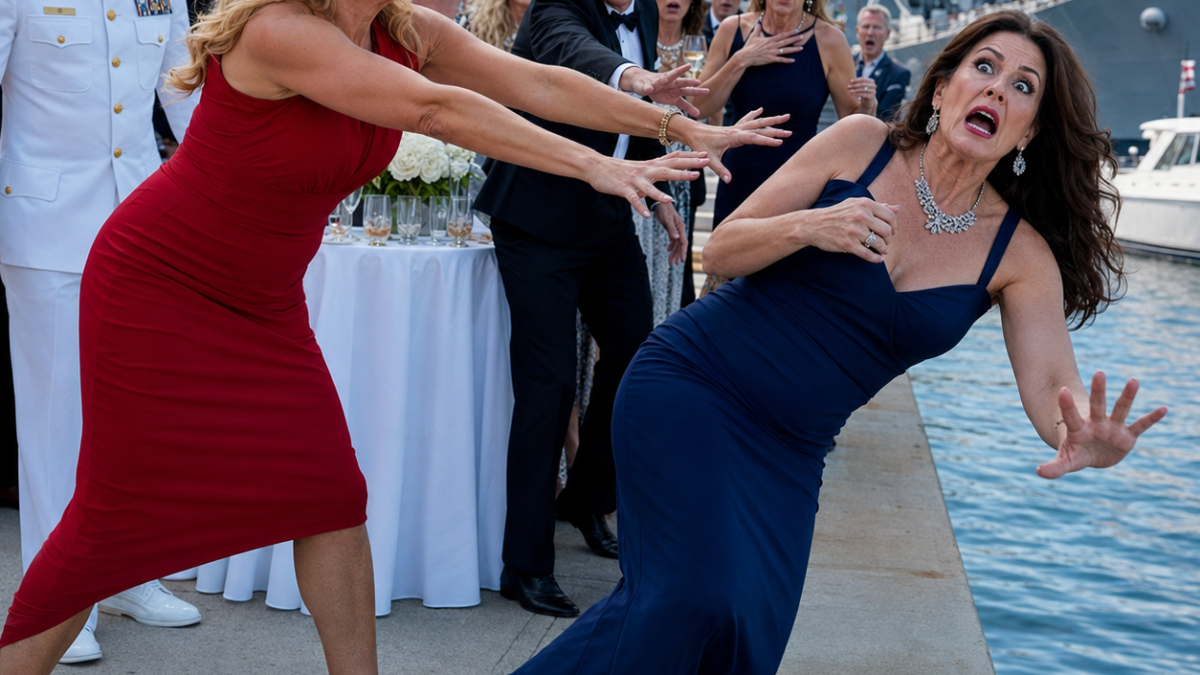
Then both her hands hit my shoulders.
Hard.
The world tilted backward.
Sky.
Sun.
A flash of white awning.
Then the harbor swallowed me.
Cold water closed over my head, heavier than people expect and darker than it looks from above.
I did not scream.
I did not panic.
I opened my eyes.
Found the light.
Found the current.
Then I surfaced already knowing which direction the water wanted to take me.
Somebody shouted, “Man overboard!”
A life ring hit the surface.
I ignored it, turned, and swam for the ladder.
Two efficient strokes.
One hand on the rung.
A pause to check myself.
Nothing broken.
Then I climbed.
Captain Grant Hale reached me at the bottom.
He had thrown off his jacket and nearly gone into the water after me.
“Ma’am, I’ve got you.”
“I have it.”
I let him take my forearm for the last rung anyway.
He had moved to save a stranger without asking who she was.
That mattered.
When I stepped onto the float, harbor water ran from my dress in sheets.
Forty people stared.
I wrung the hem twice.
Then I looked at the master chief.
“About sixty-eight degrees,” I said. “Ebb setting south.”
His eyebrows moved.
I nodded toward the floating spacer between the pier and landing float.
“And your after camel is chafing. You’ll want a new gripe on it before the wind comes up.”
The master chief stared at me.
Then at the worn line.
Then back at me.
Nobody on that pier knew he had written the same problem on his clipboard that morning.
Nobody except me.
Behind us, Meredith Hale found her voice.
“She lunged at me!”
And as forty witnesses began deciding whether they had really seen what they had seen, the small white boat remained motionless beneath the carrier’s shadow.
Waiting for eleven o’clock.
Waiting for me.
### Part 2
The first lie took less than thirty seconds.
“I asked her nicely to move.”
The second took another ten.
“She became aggressive.”
By the time someone wrapped a gray blanket around my shoulders, Meredith had reached the polished version.
“She came toward me, and I reacted in self-defense.”
Captain Hale stood beside me, wet to the elbows from helping me off the ladder.
He looked at his wife.
Then he looked at me.
I could see the question in his face.
Not who was I.
What had she done?
“I’m sorry,” he said quietly. “That was my wife.”
“I know.”
His embarrassment deepened.
He put his jacket over the blanket.
I adjusted the collar automatically.
A tiny movement.
Square the shoulders. Settle the seam.
The master chief noticed.
His nameplate read PIKE.
He had the weathered face of a man who had spent decades watching young sailors make mistakes around heavy lines and moving water.
His eyes followed my hands.
Then he looked at my shoes.
Then at the current.
He was building a file.
Good chiefs always do.
Meredith was building one too.
Hers was made from louder materials.
“She had no badge.”
Someone nodded.
“No sponsor.”
Another nodded.
“She was standing right beside the captain’s table.”
A woman under the pavilion whispered, “I knew something was strange.”
Within twenty minutes, I had transformed from a woman who had been shoved into a harbor into a suspicious stranger who had somehow caused the entire incident.
I watched it happen without interrupting.
That seemed to disturb Meredith most.
She wanted me angry.
Anger would have helped her.
Tears would have helped more.
Instead I went back to the railing.
The water had not changed its story.
That was one reason I trusted it.
Human beings will rewrite an entire morning to protect where they sit at lunch.
Water never does.
Near the lemonade table, the young woman who had watched Meredith shove me kept looking over.
She was maybe twenty-four, with sunburn beginning across her shoulders and a pitcher clenched in both hands.
Her name tag said JENNA BROOKS.
Every time Meredith glanced toward her, Jenna looked back at the lemonade.
I understood immediately.
Someone she loved worked for Meredith’s husband.
The lie had found its pressure point.
A woman named Lydia, wife of the executive officer, started repeating Meredith’s version.
“I saw the whole thing.”
She had been forty feet away.
Another woman, Caroline, claimed she had “felt the aggression.”
That was impressive considering her back had been turned.
Meredith moved through them with little touches and lowered voices.
No commands.
Nothing anyone could write down.
People who understand informal power rarely issue direct orders.
They make consequences visible and let everyone obey themselves.
Jenna finally tried once.
“I was actually pretty close—”
Lydia turned toward her.
Just a look.
Jenna stopped.
A few minutes later Meredith approached her personally.
“You had the best view, sweetheart.”
Jenna swallowed.
“Yes, ma’am.”
“Such a shame you were busy with the drinks when it happened.”
The ice shifted in the pitcher.
“I was pretty busy.”
“Exactly.”
Meredith smiled and moved away.
Jenna stared into the lemonade as if she wanted to disappear beneath it.
I wanted to tell her she had done nothing wrong.
I didn’t.
Not yet.
People have to choose truth when choosing it costs something, or they never really learn what it weighs.
Base security arrived shortly before ten.
Two masters-at-arms.
The senior one asked my name.
“Mercer.”
“First name?”
“Evelyn.”
He checked the visitor log.
There it was.
Evelyn Mercer.
Sponsor line blank.
Meredith leaned over his shoulder.
“Blank.”
She said it like she had found explosives.
“I want that noted.”
The petty officer looked at me.
“Ma’am, were you invited?”
“I’m expected.”
“By whom?”
“You’ll know soon.”
That answer did not help him.
Meredith smiled.
I understood why.
On paper, she was winning.
Behind him, Master Chief Samuel Pike walked up carrying his clipboard.
He leaned close enough that only the security officer and I could hear.
“Before you put anything official on her,” Pike said, “you might want to know something.”
The petty officer looked at him.
Pike nodded toward me.
“She read the wind before picking where to stand. Kept one of my sailors clear of a working bite without even turning around. Came out of that water like it was a swim qualification. Called the temperature close enough for government work. Then found a chafed camel nobody knew about except me.”
He tapped his clipboard.
The petty officer looked at me differently.
“Who is she?”
Pike scratched his jaw.
“Don’t know.”
Then he lowered his voice.
“But I’d find out before I let somebody make a bad piece of paper permanent.”
Meredith’s voice carried from behind us.
“I want her removed before the official party arrives.”
I almost smiled.
Because out in the channel, the white boat had still not moved.
But in my pocket, my phone buzzed once.
A message.
Barge away in one hour, ma’am.
Whites aboard.
And for the first time that morning, Master Chief Pike noticed the screen.
### Part 3
The security office smelled like old coffee and printer toner.
I wasn’t inside it.
Meredith was.
From the seawall, I could see her through the window dictating her complaint while a petty officer typed.
I later learned the exact phrases she used.
“Unknown female.”
“Aggressive behavior.”
“Refused repeated lawful requests.”
“Physical movement toward complainant.”
She signed at the bottom.
Three inches of confident handwriting.
Paper made Meredith feel safe.
I understood that type of person.
I had spent enough of my career reading reports written by people who believed a signature could change what had happened.
Years earlier, I had learned exactly how dangerous that belief could become.
It was late autumn, long before anybody put stars on my shoulders.
I was a commander then, eleven months into my first ship command, aboard the destroyer Jefferson Sound.
We were in heavy weather overnight.
The ship rolled hard enough that mugs slid in their racks and every steel surface smelled faintly of salt and machinery.
A fitting forward failed.
A sailor named Petty Officer Miguel Santos was swept overboard.
Miguel was twenty-seven.
He could splice line in the dark.
He laughed so loudly you could identify him from two compartments away.
His mother mailed boxes of homemade food to the ship every Christmas because Miguel had apparently decided two hundred sailors were all her responsibility.
We turned the ship around in weather that fought us for every degree.
We searched through the night.
We found him after sunrise.
Dead.
The investigation took months.
Every decision I had made was opened, timed, questioned, and reconstructed.
That part did not bother me.
Command should be questioned when somebody does not come home.
What bothered me was what the investigation eventually found.
The failed fitting had been signed off during maintenance years earlier.
Inspected on paper.
Corroded in reality.
A signature said safe.
The ocean said otherwise.
The ocean won.
It always does.
After that, I stopped trusting paperwork that had never been tested against the thing it described.
Before taking any new command, I started walking.
No entourage.
No announcement.
No uniform if I could avoid one.
At one installation I found an exhausted watchstander nearly asleep because a broken duty schedule had been hidden beneath months of clean reports.
At another I found a dangerous brow nobody had bothered to correct because the inspection sheet said acceptable.
Every place had a blank line somewhere.
Today, this pier had several.
The chafed camel.
A young officer who had not inspected his boat’s bilge.
And an entire social hierarchy built on spouses borrowing authority their husbands had sworn to use responsibly.
Meredith Hale was simply the loudest blank line.
I stood watching the harbor while my dress dried stiff with salt.
A young ensign approached carrying a form.
He was so new his white uniform still held fold marks.
“Ma’am?”
“Yes?”
“I’ve been instructed to ask you to leave the waterfront.”
His ears went pink.
“There’s a complaint.”
He held out the paper.
I glanced toward the utility boat behind him.
“Which boat is yours?”
He blinked.
“Boat Two, ma’am.”
“When did you last check her bilge?”
Silence.
A gull screamed above us.
His face changed.
Not because I had humiliated him.
I hadn’t.
Because suddenly the removal order in his hand seemed less important than a question about the boat he was responsible for.
“I’ll check it.”
“Soon.”
“Yes, ma’am.”
He stood there another moment.
Then lowered the form.
“Who are you?”
I looked toward the carrier.
“You’ll have your answer before lunch.”
Back on the pier, Captain Grant Hale had pulled his wife away from the pavilion.
They spoke quietly.
I couldn’t hear every word.
I didn’t need to.
His posture said enough.
His wife had embarrassed his command.
Meredith’s body language said something else.
She thought he had embarrassed her.
That difference mattered.
Near the landing float, Master Chief Pike studied the boat schedule clipped beneath a rusty metal clamp.
I saw the exact second something caught his attention.
His thumb stopped on a line.
1100.
Flag barge.
Landing float.
Passenger: FLAG.
His head came up slowly.
He looked toward me.
Then toward the carrier.
Then back at the sheet.
Thirty seconds later he pulled out his phone.
I turned away before he could catch me watching.
A little while later, Lieutenant Claire Sutton came down the pier carrying a garment bag.
My flag lieutenant.
She checked the float, the lines, the repaired camel.
Then Pike stopped her.
I saw them speak.
Saw Claire look toward me once.
Saw Pike’s expression change.
When she came over, she kept her voice low.
“Your whites are aboard.”
“Good.”
“Security is preparing a trespass notice.”
“I know.”
“Would you like me to stop it?”
“No.”
Claire stared at me.
“You were shoved into the harbor.”
“Yes.”
“And now they’re trying to remove you from your own change of command.”
“Yes.”
Her jaw tightened.
I looked back toward the pavilion.
“Let it finish.”
“Why?”
“Because right now everyone is choosing who they are.”
I looked at Jenna Brooks.
She was still holding that lemonade pitcher.
Still silent.
But no longer looking down.
“And choices made before people know my rank,” I said, “are usually the honest ones.”
### Part 4
For another forty minutes, I did nothing.
That was harder than people think.
Power trains you to intervene.
A phone call here.
A correction there.
One quiet word from me and the base commander could have shut the whole performance down.
But I had not walked onto that waterfront to see what happened after people recognized authority.
I wanted to know what they did when they thought authority was absent.
Meredith gave me an excellent demonstration.
She had the landing float roped off with ceremonial white line.
Then she added a sign.
AUTHORIZED FAMILIES OF COMMAND.
I watched her step back and admire it.
For the first time that morning, I almost laughed.
She had built a border around something she did not own, using authority she did not possess, to exclude the person whose ceremony the float existed to serve.
There was something almost mathematically perfect about it.
Jenna did not laugh.
She stood behind her lemonade table watching me.
Security returned at a few minutes before eleven.
This time the senior master-at-arms carried an official notice.
Pike stood several yards away with his arms folded.
He looked deeply unhappy.
The security officer approached me.
“Ms. Mercer.”
Meredith corrected him from behind.
“Unknown female.”
The officer ignored that.
“Ma’am, pursuant to the visitor policy and at the request of the event coordinator, I’m serving you notice to depart the waterfront.”
The pavilion had drifted closer.
Phones appeared.
Lydia stood beside Meredith.
Caroline whispered to another woman as if broadcasting live from a battlefield.
Captain Hale was on his destroyer’s quarterdeck.
He could see us.
I saw his hand tighten around the rail.
The security officer extended the paper.
His fingers were shaking slightly.
“There is an appeal process.”
I took it.
Read every line.
Description: female, dark hair, navy dress.
Unsponsored visitor.
Complaint on file.
Refusal to comply.
I folded the paper once.
Then slipped it into Captain Hale’s jacket pocket.
“Thank you.”
Meredith could have stopped there.
She had won every visible contest she thought mattered.
That was never enough for people like her.
Her eyes dropped to the jacket around my shoulders.
“And that belongs to my husband.”
Captain Hale moved on the quarterdeck.
Too late.
Meredith stepped across the rope and pulled the jacket off me with both hands.
The gray blanket underneath remained.
She held the jacket up.
“The name is stitched inside.”
Her voice carried.
“HALE. Right there.”
Nobody spoke.
“It’s a family thing.”
She folded it over one arm.
“It does not belong on strays.”
That word changed something.
Not in me.
In Jenna.
She put the lemonade pitcher down.
Hard enough that ice jumped against the sides.
Meredith glanced at her.
Jenna walked around the table.
Her face had gone pale.
She crossed the open space between us and stopped beside me.
Shoulder to shoulder.
She was trembling.
I could feel it without looking.
Meredith’s eyes sharpened.
“Jenna?”
Jenna swallowed.
“I saw what happened.”
The pier seemed to contract.
Meredith smiled.
A warning smile.
“You already said you were busy.”
“I was busy.”
Jenna’s voice shook.
“But I saw it.”
Lydia stared at her.
Jenna’s hands tightened.
“She didn’t lunge at you.”
Meredith’s face lost a degree of color.
Jenna continued.
“You shoved her.”
Silence.
“My husband serves on Captain Hale’s ship,” she said. “And I know saying this might make things difficult for him.”
Her voice broke.
She steadied it.
“But you shoved her.”
Meredith took one slow step forward.
“You need to think carefully about what you’re accusing me of.”
Jenna almost backed away.
I spoke quietly enough that only she could hear.
“Good footing here.”
She looked at me.
“What?”
“Upcurrent side. Best footing on the float.”
It was a sailor’s observation.
Nothing more.
But her shoulders settled.
She stayed.
Meredith looked from Jenna to me and made a decision.
I saw it happen.
Jenna had just been added to whatever private list Meredith kept for future punishment.
I smiled for the first time all morning.
Not because Meredith was finished.
Because Jenna had started.
Meredith’s gaze snapped to mine.
“What are you smiling at?”
“Nothing.”
“You think this is funny?”
“No.”
Behind her, Master Chief Pike slowly removed his cover.
That caught my attention.
Pike was not looking at Meredith.
He was looking past us.
Toward the channel.
Then eight bells rang across the waterfront.
Four clean pairs.
Eleven hundred.
The harbor seemed to hold still.
Out beneath the carrier’s shadow, the small white boat finally began to move.
Its bow swung.
Sunlight struck the brightwork.
A dark blue flag snapped open at the bow.
Two white stars.
Someone behind Meredith whispered, “Why is the admiral’s barge coming here?”
The diesel grew louder.
The barge altered course.
Not toward the destroyer.
Not toward the pavilion.
Straight toward the landing float.
Straight toward me.
### Part 5
There is a particular silence people make when reality arrives faster than their excuses.
The pier found it all at once.
The band stopped.
Glasses stopped clinking.
Even Meredith stopped talking.
Only the water continued moving.
Master Chief Pike put his cover back on.
“Stand by to receive.”
His voice was quiet but enormous.
His sailors moved instantly.
The white ceremonial rope Meredith had ordered across the float suddenly looked ridiculous.
The barge kept coming.
White hull.
Polished fittings.
Four sailors standing rigid.
Two-star flag flying hard in the breeze.
I watched Meredith do the arithmetic.
First confusion.
Then disbelief.
Then fear.
She looked at the barge.
At me.
At Captain Hale’s jacket over her arm.
Back at the barge.
The boat came alongside in one clean swing.
Lines went over.
Made fast.
Lieutenant Claire Sutton stepped onto the float carrying my garment bag.
She walked straight toward me.
Stopped one pace away.
Then saluted.
Perfectly.
“Rear Admiral Mercer.”
Her voice carried all the way to the pavilion.
“Your barge, ma’am. The strike group stands ready.”
Nobody breathed.
I returned the salute.
Wet dress.
Bare head.
Salt drying on my skin.
None of it mattered.
A salute is not in the fabric.
It is in the person wearing it.
The boat crew snapped straighter.
The two security officers came to attention.
Master Chief Pike’s sailors froze as one.
On the destroyer quarterdeck, Captain Hale saluted instantly.
The loudspeaker clicked.
“Strike Group Commander arriving.”
That finished it.
Forty people replayed the entire morning in their heads.
I watched it happen.
The woman with no sponsor.
The woman with no husband.
The shove.
The water.
The lie.
The complaint.
The trespass notice.
The white rope.
The word stray.
Every detail Meredith had used against me changed shape.
They were no longer proof that I did not belong.
They were evidence of what people had done when they thought I didn’t.
Lydia lowered her phone.
Caroline stopped whispering.
The security officer quietly removed a copy of my trespass order from his folder.
Jenna stared at me.
Her mouth actually fell open.
Then she whispered, “Oh my God.”
I almost smiled.
Meredith didn’t.
Captain Hale’s jacket slid from her arm and landed on the planks.
Nobody picked it up.
I looked at her.
She looked twenty years older than she had that morning.
“You asked whose wife I am.”
My voice did not need to be loud.
The entire waterfront was listening.
“I told you.”
Her lips moved.
No sound came out.
“I’m nobody’s wife, Mrs. Hale.”
I let the pause settle.
“I’m your husband’s boss.”
Jenna covered her mouth.
Somewhere behind Meredith, somebody inhaled sharply.
Meredith finally managed, “Admiral, I—I didn’t know.”
“I’m aware.”
“If I had known—”
“That is exactly the problem.”
Her face tightened.
I could have destroyed her socially in that moment.
It would have been easy.
Too easy.
Instead I turned away.
“Master Chief.”
Pike stepped forward.
“Ma’am.”
“Your full name?”
“Samuel Pike, Admiral.”
I offered my hand.
He took it.
“Good work on that after camel, Master Chief Pike.”
His eyes flicked toward the repaired line.
“Thank you, ma’am.”
“Your float was the squarest thing on this pier all morning.”
A few sailors tried not to smile.
I looked at Jenna.
“And Ms. Brooks?”
She straightened.
“Yes, Admiral?”
“Would you join us for the ceremony?”
Her eyes widened.
“Me?”
“You stood where the truth was.”
I glanced at the lemonade table.
“That seems more useful than pouring drinks.”
She made a sound halfway between a laugh and a sob.
“Yes, ma’am.”
Meredith stepped forward.
“Admiral, please.”
I turned.
She had lost the silk voice.
Now she sounded like an ordinary frightened woman.
“I’m sorry.”
“No.”
Her eyes widened.
“I apologize.”
“You regret knowing who I am.”
“That’s not fair.”
“Fair?”
I looked toward the water.
“You pushed a stranger into eighteen feet of harbor because you thought she was socially beneath you.”
“I thought you were trespassing.”
“You lied afterward.”
Her mouth closed.
“You pressured a junior sailor’s spouse to lie.”
Jenna went still.
“You used your husband’s position to make people afraid of telling the truth.”
I looked back at Meredith.
“I do not need an apology for being treated badly because I’m an admiral.”
I lowered my voice.
“I needed to see what you would do when you believed I was nobody.”
Meredith looked toward her husband.
Captain Hale was still standing on his quarterdeck.
He did not come to rescue her.
That was when she finally understood.
I stepped aboard the barge.
Claire followed.
Jenna hesitated until I motioned her aboard.
Lines came in.
As we backed away, I saw Meredith standing behind the rope she had ordered installed.
Her own sign fluttered beside her.
AUTHORIZED FAMILIES OF COMMAND.
For once, it was not protecting her.
### Part 6
I changed into service dress whites aboard the barge.
Claire hung my wet dress inside the cabin.
“You realize,” she said, “that uniform is probably going to smell like harbor until the end of time.”
“I’ve worn worse.”
She handed me my jacket.
Two stars on each shoulder.
I looked at them for a moment before putting it on.
Rank is useful.
It is also dangerous.
People straighten before you ever learn how they stand when they are tired.
They clean things you need to see dirty.
They tell you the watch bill is fine because they know the admiral asked.
That morning had given me something rank almost never does.
An unedited answer.
Captain Grant Hale came aboard the flagship before the ceremony.
He entered my cabin in whites and stood at attention.
I let him stand while I closed the folder in front of me.
“Captain.”
“Admiral.”
“You jumped for a stranger.”
He blinked.
“Ma’am?”
“When I went into the water.”
“Yes, Admiral.”
“You removed your jacket. Went down the ladder. Did not ask who I was.”
“No, ma’am.”
“Why?”
His expression suggested he suspected a trap.
“Because someone was in the water.”
“That is the entire file I need on that decision.”
He swallowed.
“The rest is paperwork.”
Some tension left his shoulders.
Then returned.
“My wife—”
“No.”
He stopped.
“This meeting is about your command.”
His eyes lifted.
“Not her.”
“Admiral, what she did reflects on me.”
“Yes.”
His jaw tightened.
“But not in the way you think.”
I leaned back.
“Your wife believes your rank belongs partly to her.”
His face changed.
“She believes your sailors’ families should fear upsetting her because it may affect their careers.”
He looked down.
“That is not a social problem, Captain.”
“No, Admiral.”
“That is a command climate problem.”
“Yes, Admiral.”
“Do you understand the distinction?”
“I do now.”
I studied him.
“The young woman who told the truth is married to one of your petty officers.”
“Jenna Brooks. Her husband works in engineering.”
“Will her husband suffer professionally because she contradicted your wife?”
His answer came fast.
“No, Admiral.”
I said nothing.
He corrected himself.
“Absolutely not.”
“Good.”
I closed the folder.
“Stand your deck this afternoon.”
He looked surprised.
“I’m not relieving you because your wife shoved me into a harbor.”
“Thank you, Admiral.”
“Do not thank me yet.”
His shoulders straightened.
“I’ll be watching your ship closely.”
“Yes, ma’am.”
“For the right reasons.”
He nodded.
Then hesitated.
“I’m sorry.”
“I know.”
This time, I believed him.
Back ashore, the social reckoning had already started without me.
That was appropriate.
Organizations reveal themselves not only in whom they elevate but in how quickly they abandon people after borrowed power becomes expensive.
At three o’clock, Lydia remembered an urgent obligation elsewhere.
At four, Caroline’s memory improved dramatically.
She now remembered Meredith using both hands.
By five, the spouses association discovered a bylaw allowing emergency transition of the presidency.
The same people who had been too uncertain to contradict Meredith before lunch were suddenly very certain about governance.
I was not impressed.
Jenna had impressed me.
Master Chief Pike had impressed me.
The young ensign with the unchecked bilge had impressed me too, because Claire later told me he went directly to Boat Two after leaving me.
He found standing water above where it should have been.
Nothing catastrophic.
Yet.
He corrected it.
Sometimes one uncomfortable question is worth more than a hundred inspection reports.
Meredith received no dramatic arrest.
No handcuffs.
No military police hauling her through the pavilion.
I did not press charges.
People later asked why.
The answer was simple.
I had no interest in making myself the center of the lesson.
Meredith had spent years believing power meant the ability to control where people stood, what they said, and who belonged inside a rope.
The worst consequence was not punishment from me.
It was that everyone now knew exactly what she did when she thought nobody important was watching.
That kind of knowledge lasts longer than paperwork.
Shortly before the ceremony, Claire brought me the final seating list.
“Any changes?”
“One.”
She handed me a pen.
I wrote a name in the front family section.
Jenna Brooks.
Personal guest of incoming commander.
Claire smiled.
“Subtle.”
“I’ve never been accused of that.”
Then she pointed at another line.
“Mrs. Hale?”
I looked at the blank seat.
“No.”
Claire waited.
“She may attend.”
“But?”
“She can stand where she told strangers to stand.”
Claire’s smile disappeared.
She understood.
Past the rope.
With the spectators.
### Part 7
The change of command lasted eleven minutes.
Ceremonies on ships are shorter than people imagine.
Orders are read.
Colors move.
A chaplain prays.
Someone speaks about duty, tradition, and the sea.
Then responsibility changes hands with language simple enough to hide how enormous it is.
I stood before thousands of tons of steel and several thousand sailors and read my orders.
My voice carried across the waterfront.
Hours earlier, most of those people had not known my face.
I preferred it that way.
When the outgoing commander finished, I stepped to the microphone.
I had prepared remarks.
I did not use them.
“I walk waterfronts.”
A few heads turned.
Master Chief Pike stood near the float.
He knew.
“Before I take responsibility for ships and people, I like to see both before they know I’m looking.”
The pavilion was absolutely still.
“Reports matter. Inspections matter. Paper matters.”
I paused.
“But when a blank line on a form disagrees with the truth, bring me the truth.”
I saw the young security officer swallow.
“I’ll take the paperwork.”
Jenna sat in the front row.
Her husband beside her looked both proud and terrified.
Good.
Fear and courage often occupy the same chair.
I continued.
“Know your water.”
I looked toward Pike.
“Know your people.”
Then toward Captain Hale.
“And never confuse access to authority with possession of it.”
Nobody needed the last sentence explained.
When the ceremony ended, sailors moved back to work.
That was another thing I loved about the Navy.
Even humiliations eventually have to make way for lines, watches, maintenance, and the next tide.
Meredith watched from the parking apron.
Past the rope.
She had changed dresses.
Fresh silk.
Same pearls.
But nobody clustered around her.
Nobody waited for her opinion.
Nobody needed her permission to sit.
Her association presidency was already disappearing beneath polite emails and carefully worded thanks.
I felt no triumph.
Triumph requires wanting the other person’s life.
I didn’t.
I wanted her influence away from sailors’ families.
That was all.
At sunset, I found Captain Hale near his destroyer.
He had finished the formal obligations and was watching his crew secure equipment.
“How’s your wife?” I asked.
He almost laughed at the absurdity.
“Angry.”
“At me?”
“At everyone.”
“That will pass.”
He looked toward the parking apron.
“I’m not sure our marriage will.”
That was not my business.
So I said nothing.
After a moment he added, “She said you were trying to ruin me to punish her.”
“I’m not.”
“I know.”
He rubbed the back of his neck.
“She doesn’t.”
I looked at him.
“Captain, I am responsible for whether your ship can fight and whether your sailors can trust the command structure over them.”
“Yes, Admiral.”
“I am not responsible for preserving the story your wife tells herself.”
His face tightened.
Then he nodded.
“She told me she thought this was how the world worked.”
“How?”
“That rank travels through marriage. That if I became important enough, she became untouchable.”
The wind shifted, carrying diesel and salt across the pier.
“What did you tell her?”
“That ships don’t work that way.”
I looked at his destroyer.
“They had better not.”
He gave me a tired smile.
“No, ma’am.”
A little later, I found Jenna near the lemonade table, helping clean up despite no longer being assigned to anything.
“You can go home.”
“I know.”
“Then why are you stacking cups?”
She shrugged.
“Habit?”
I picked up a stack beside her.
She stared.
“Admiral, please don’t.”
“Don’t what?”
“Help clean up.”
“Why?”
“Because you’re…”
She stopped.
“Important?”
Her face went red.
I stacked the cups.
“This morning you thought I was nobody.”
“I’m sorry.”
“Why?”
“I didn’t speak up right away.”
That was the thing she had been carrying.
I put the cups down.
“Were you afraid?”
“Yes.”
“Did you speak anyway?”
“Eventually.”
“Then remember the eventually.”
She looked at me.
“Courage is rarely the first feeling.”
Her eyes filled.
I pretended not to notice.
After a moment she asked, “Did you really know who she was the whole time?”
“Yes.”
“And you could have stopped her?”
“Yes.”
“Why didn’t you?”
I looked toward the harbor.
“Because I needed to know who would stop themselves.”
Jenna glanced toward the empty pavilion.
“Most people didn’t.”
“No.”
“Does that make you angry?”
“It makes me informed.”
She thought about that.
Then she smiled faintly.
Before leaving, she asked one last question.
“Admiral?”
“Yes?”
“When Mrs. Hale asked whose wife you were… did you know you were going to tell her who you really were?”
“No.”
“What were you going to say?”
I laughed.
“The truth.”
“Nobody’s?”
“Exactly.”
### Part 8
Meredith called my office three days later.
Claire asked whether I wanted to take it.
“No.”
“She says she wants to apologize privately.”
“That is what letters are for.”
A letter arrived the next morning.
Six pages.
The first page apologized.
The next five explained.
Stress.
Ceremony pressure.
Miscommunication.
Years of sacrifice as a military spouse.
Fear for her husband’s reputation.
Concern over unauthorized visitors.
The word “shove” appeared once.
The word “Jenna” did not appear at all.
I placed it in my desk and never answered.
Forgiveness is not the same as restored access.
People confuse those things because restored access is what they actually want.
I had no desire to hate Meredith.
Hatred requires maintenance.
I had ships to run.
But I also had no intention of pretending the morning had been a misunderstanding.
Captain Hale stayed in command.
He earned that.
Over the following months, his ship improved in several measurable ways, but the detail I cared about most came from Master Chief Pike.
He sent me a short message one afternoon.
Brooks made second class.
Performance earned it. No interference.
I replied with two words.
As expected.
The young ensign from Boat Two qualified ahead of schedule.
Years later, I would meet him again as a lieutenant commander.
He reminded me of our first conversation.
“You asked about my bilge while I was trying to throw you off your own waterfront.”
“I remember.”
“That question scared me more than finding out you were an admiral.”
“Good.”
He laughed.
“I check my bilges now.”
“That was the idea.”
Master Chief Pike retired eighteen months after my arrival.
At his ceremony, somebody told the story about the mysterious woman in the blue dress.
By then the tale had expanded.
Apparently I had swum half a mile.
The harbor had become forty degrees.
Meredith had thrown me twelve feet through the air.
The barge had arrived at full speed while the band played the anthem.
Sailors are gifted storytellers.
I corrected none of it.
Pike did.
“Admiral swam about fifteen feet,” he said.
“Water was warm enough to complain about.”
Then he pointed at me.
“But she did call my chafed camel before I did anything about it, and I’ll resent that until death.”
Everyone laughed.
Later, when the room emptied, he handed me his old clipboard.
The original one.
Rusty clip.
Scratched plastic.
On the page beneath it, he had preserved the maintenance note from that morning.
AFTER CAMEL—CHAFE. REGRIP BEFORE WIND SHIFT.
“You kept this?”
“Evidence.”
“Of what?”
“That sometimes admirals know something useful.”
I laughed harder than I had in months.
He became serious.
“Ma’am, permission to speak freely?”
“Always dangerous, but granted.”
“You know what bothered me most that day?”
“The shove?”
“No.”
He looked down at the clipboard.
“The way everybody started changing what they saw.”
I understood.
“I’ve seen sailors scared after accidents. Seen officers scared after mistakes. But that was different.”
“How?”
“Nobody was scared of the truth.”
He looked toward me.
“They were scared of the wrong person.”
That sentence stayed with me.
Because he was right.
Organizations do not collapse when people make mistakes.
They collapse when everyone learns that telling the truth is more dangerous than the mistake.
That was why Jenna mattered.
Why Captain Hale’s jump into the water mattered.
Why that young ensign checking his bilge mattered.
Why Pike speaking to security mattered.
None of them knew what I could do for them.
They simply decided what kind of person they wanted to be.
Meredith eventually left the spouses association entirely.
She and Captain Hale separated the following year.
I heard about it from someone else and asked no questions.
Their marriage belonged to them.
Her relationship with me did not exist.
She sent one final letter before leaving the area.
Shorter this time.
No explanations.
“I understand now that the worst thing I said to you wasn’t ‘stray.’ It was asking whose wife you were as if that was the only possible reason you mattered.”
That was the first sentence she had written that sounded like truth.
I still did not answer.
Some lessons do not require reconciliation.
Some apologies arrive after the door has already closed.
I wished her no harm.
I simply had no reason to reopen it.
### Part 9
On my final evening with the strike group years later, I walked the same waterfront alone.
No ceremony.
No silk.
No crowd.
Just gulls, steel, fuel, and water touching the pilings.
The landing float had been rebuilt.
The old camel was gone.
Pike’s replacement had newer equipment and less rust.
The destroyer Captain Hale once commanded had transferred elsewhere.
Most of the people from that morning had moved on.
That is the strange thing about moments that feel permanent.
The place forgets them first.
Waterfronts renew themselves.
People rotate.
Ships deploy.
Names disappear from office doors.
But some mornings remain inside you because they show you something you would rather not have learned.
I stopped at the upcurrent corner.
My corner, Jenna used to joke.
I never corrected her.
The current was beginning to flood.
Wind from the south put a small chop across the channel.
I could smell rain far out beyond the harbor entrance.
For a moment I remembered the shock of the water closing over my head.
The flash of Meredith’s cream sleeves.
Captain Hale throwing off his jacket.
Pike staring at me after I mentioned the chafed line.
Jenna’s trembling shoulder beside mine.
And that absurd white rope.
Mostly, though, I remembered being nobody.
No stars.
No uniform.
No staff.
No one announcing me.
I had spent decades earning rank, and that morning had reminded me how little rank reveals about character.
Meredith had looked at me and seen a woman without a husband beside her.
Pike had seen someone who understood a working waterfront.
Captain Hale had seen a person in the water.
Jenna had eventually seen someone being lied about.
Each person revealed themselves through what they thought mattered.
That became one of the rules I carried through the rest of my career.
Watch how people treat those who cannot advance them.
Watch what happens when the name tag means nothing.
Watch whether they still move when somebody falls into the water.
Those tests tell you things medals cannot.
Claire found me there near dusk.
Still my chief of staff by then, older and entirely unimpressed by admirals.
“You planning to miss your own farewell dinner?”
“Possibly.”
“There are three hundred people waiting.”
“That sounds like their mistake.”
She stood beside me.
After a moment she said, “Do you remember what Mrs. Hale said right before the barge arrived?”
“Unfortunately.”
“I still think ‘It doesn’t drape on strays’ was the craziest possible sentence.”
I laughed.
“She committed to the role.”
Claire looked at the water.
“Do you ever wish you’d told her immediately?”
I thought about it.
“No.”
“Even after she shoved you?”
“Especially after.”
Claire frowned.
“Why?”
“Because if I had introduced myself, she would have been gracious.”
“You’re sure?”
“Absolutely.”
“And that would have been fake.”
“Not fake.”
I considered the word.
“Incomplete.”
The person Meredith became around an admiral was also real.
But so was the person who shoved an unknown woman toward eighteen feet of harbor because she believed status gave her the right.
Leadership means seeing both.
Sometimes it means refusing to let one erase the other.
The lights began coming on across the ships.
One by one.
Yellow squares against gray hulls.
A boatswain’s pipe sounded somewhere behind us.
I looked at the current one last time.
“The tide’s turning.”
Claire glanced at her watch.
“You say that like it’s profound.”
“It’s literally turning.”
She rolled her eyes.
That was why I kept her around.
We started back toward the pier.
At the place where Meredith’s white rope had once stretched across the float, there was nothing now except two metal fittings and a worn patch in the deck.
I stepped across without slowing.
Years earlier, she had tried to teach me how access worked.
Who belonged.
Who didn’t.
Whose name mattered.
Whose wife mattered.
She had been wrong about almost everything.
The sea had given the simplest answer.
It had taken me without checking my rank.
Captain Hale had reached for me without checking either.
Pike had judged what I knew.
Jenna had finally judged what she saw.
And when the barge turned toward that float, it had not made me important.
I already was who I was.
The barge merely forced everyone else to confront how they had behaved when they thought I wasn’t.
That was why I never hated Meredith Hale.
And why I never forgave her in the way she wanted.
She did not lose my friendship that morning.
She never had it.
She lost the chance to convince herself that cruelty becomes acceptable when aimed at someone without status.
As Claire and I left the waterfront, the evening tide pushed against the pilings with the same steady sound it had made the morning I arrived.
No applause.
No explanation.
No apology.
Just water doing what water has always done.
Telling the truth to whoever is willing to read it.
THE END!
Disclaimer: Our stories are inspired by real-life events but are carefully rewritten for entertainment. Any resemblance to actual people or situations is purely coincidental.








