My Parents Flaunted My Sister’s Fake Rank — They Didn’t Know I Signed Her Demotion That Morning
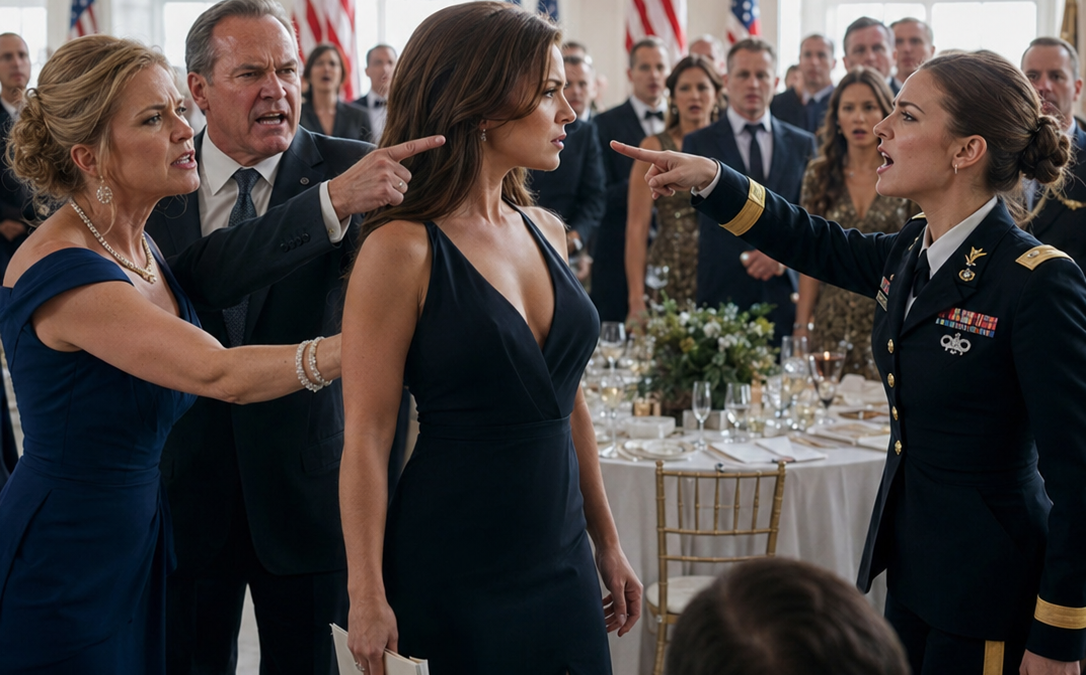
“My daughter is the pride of this family. Major before thirty,” my father announced while my sister Elowen stood beneath crystal chandeliers wearing gold oak leaves she never truly earned. My mother pushed me toward the back of the ballroom and warned, “Don’t embarrass your sister,” while everyone celebrated her perfect military image. They had no idea I was the one who reviewed the file that morning. As the champagne flowed and my family prepared to use my name for an $8.9 million loan, the truth was already moving through official channels. They thought I was a nobody. They forgot who had the authority to sign.
### Part 1
My mother lifted her champagne glass before the string quartet had even finished the first song.
“To Major Elowen Whitlock,” she announced, her voice bright enough to cut through a ballroom full of senators, contractors, judges, and retired officers. “The pride of our family.”
One hundred and thirty people applauded beneath crystal chandeliers at the Sea Pines Grand Club in Hilton Head. Silverware glittered. Champagne bubbled. Cameras flashed. Every table looked like it had been arranged for people who wanted to be seen congratulating someone powerful.
My younger sister stood near the stage in her Army dress uniform, smiling like she had personally invented discipline.
The gold oak leaves on her shoulders caught the white lights overhead. Her ribbons sat straight. Her collar was perfect. Her hair was pinned in a smooth twist that probably took two hours and three people to finish. She looked exactly like what everyone in that room wanted her to be.
A rising star.
A future leader.
A Major before thirty.
That was the entire point.
Guests lined up to shake her hand.
“I knew you had it in you.”
“Fastest promotion I’ve heard of in years.”
“Washington is going to love you.”
Elowen laughed softly, touching one hand to her chest as if humility had just surprised her. “I’ve just been blessed with incredible mentors.”
I almost choked on my water.
Almost.
Instead, I stood near the ballroom entrance in a dark blazer, black slacks, and plain low heels while my mother spotted me from across the room. Her smile tightened immediately.
Not because she was happy I came.
Because she wanted to manage the damage.
“Maren,” she said, hurrying toward me with her perfume arriving before she did. “Thank goodness you dressed normally.”
I looked down at myself. “It’s a blazer.”
“I know, sweetheart.” She placed one manicured hand against my forearm and lowered her voice. “Listen carefully. We have very important people here tonight. Two state senators. The Whitmore family. Several defense executives. Please don’t start explaining your little office job.”
“My little office job?”
Her eyes flicked toward a cluster of guests. “People hear military paperwork and think clerical. I don’t want anyone confusing your career with Elowen’s accomplishments.”
I stared at her for a second too long.
She leaned closer. “Just stay near the back tables. Maybe by the service hallway. Smile when spoken to. Don’t embarrass your sister.”
The flowers near the entrance smelled too sweet. Orchids, lilies, roses. Expensive things arranged to look effortless. My mother had always loved that. Appearances polished so hard no one noticed what was rotten underneath.
I nodded once. “If that’s what you want.”
“It is.” She patted my arm like I was a child who had finally obeyed. “Tonight is about Elowen.”
She turned away before I could answer.
Across the ballroom, my sister raised her glass as another wave of applause rolled toward her. My father stood beside her with his chest puffed out, one arm resting proudly around her shoulders.
“My daughter earned every bit of this,” he told a group of investors. “Major before thirty. That’s discipline. That’s Whitlock blood.”
Whitlock blood.
When I was sixteen, that same blood apparently meant cleaning mud off my father’s construction boots after school because he said hard work built character. Elowen had been “too delicate” for job sites. Too pretty for dust. Too special for consequences.
Some family traditions never retired.
A waiter passed carrying champagne. I took a glass of ice water from the tray beside him. Nobody noticed. That was normal.
I had spent years being the useful daughter when bills needed paying, the invisible daughter when praise was being handed out, and the embarrassing daughter whenever my parents wanted to impress people with Elowen’s shine.
They had no idea how bright a lie could burn before it turned into ash.
My phone buzzed once in my pocket.
I didn’t check it immediately.
Timing mattered.
Instead, I watched Elowen pose with her fiancé, Bennett Whitmore, whose family owned Whitmore Strategic Systems, a defense contractor with offices in three states and enough government connections to make my father drool in public if he wasn’t careful.
Bennett looked proud. His parents looked pleased. My father looked hungry.
That was when I understood the party wasn’t just a celebration.
It was a transaction.
Elowen’s “promotion” was being used as a key. A family connection. A polished military credential to unlock contracts, financing, political favors, and a marriage that my parents treated like a merger.
My mother drifted back toward the stage.
My father clinked his fork against a glass.
“Everyone,” he called, “we’ll have a special toast in just a few minutes. There are some people here tonight who believed in Elowen before the rest of the world knew what she could become.”
Elowen lowered her lashes modestly.
I checked my phone.
One secure notification waited on the screen.
Certified action transmitted.
No one in that ballroom knew what those three words meant.
Not my mother.
Not my father.
Not Elowen.
Not Bennett.
The official order had already started moving through military channels before the first centerpiece was set on the tables. By morning, there would be no donor, attorney, senator, or family story strong enough to stop what was coming.
I slipped my phone back into my pocket.
Then I looked at the gold oak leaves on Elowen’s shoulders.
They shone beautifully beneath the chandeliers.
Borrowed things often do, right before someone asks for them back.
### Part 2
I stepped through the glass doors onto the veranda before anyone could corner me.
The music faded behind me, replaced by waves rolling against the dark shoreline beyond the club. The Atlantic smelled like salt and cold wind. The air outside was sharp enough to cut through my blazer, and for a few quiet seconds, I let it.
Four seconds in.
Four seconds hold.
Four seconds out.
Four seconds hold.
Box breathing.
I hadn’t learned it from an app or a wellness podcast. I learned it from instructors who understood that panic makes smart people stupid. Slow the pulse. Narrow the noise. Decide before emotion decides for you.
By the fourth cycle, my mother’s voice became almost funny.
“Your little office job.”
She had no idea what happened inside Army Human Resources Command. Most people didn’t. They pictured uniforms, field exercises, medals, salutes. They didn’t picture databases, audit trails, promotion boards, legal reviews, personnel files, and the long paper road between ambition and authority.
Paperwork does not look heroic.
That is why careless people underestimate it.
I rested my elbows against the wooden railing and watched moonlight scatter across the black water. My fingertips brushed the raised scar beneath my collarbone through the thin fabric of my blouse.
Cold. Uneven. Still there.
My family never asked where it came from.
Not once.
The scar came from an evacuation mission years earlier, outside a place where the dust got into your teeth and the heat made metal too hot to touch. There had been no heroic speech. No dramatic slow-motion moment. Just a blast behind our convoy, a piece of shrapnel tearing through a side panel, and me arguing with a medic because someone else was bleeding worse than I was.
When I came home, my mother asked if I planned to start dressing “less severe.”
My father asked if my retirement plan would be good enough.
Elowen asked if my scar was “one of those things that made men uncomfortable.”
I learned early that some families don’t ignore your pain because they missed it.
They ignore it because it doesn’t flatter them.
Through the tall windows, I saw Elowen lifting her phone while three women angled around her for a photo. One of them adjusted her shoulder so the oak leaves showed better.
“Turn a little,” the woman said. “We need to see the rank.”
Elowen turned.
Of course she did.
The irony nearly made me smile.
They were photographing evidence.
A young server stepped onto the veranda carrying an empty tray. “You doing okay, ma’am?”
“I’m fine.”
“Big night in there.”
“Apparently.”
He glanced through the glass. “Your sister seems popular.”
“She’s always been good at that.”
He nodded like he understood more than he should. Then he slipped back inside.
I checked my watch.
8:52 p.m.
The systems would be updating now. Slowly. Secure systems rarely moved as fast as gossip. That was why Elowen still had time to smile. Why my parents still had time to brag. Why Bennett still had time to believe the story he had been sold.
Three weeks earlier, none of this had felt personal.
It started as a routine audit at Fort Knox. Tuesday morning. Bad coffee. Two encrypted monitors. Forty-seven pending promotion reviews in my queue. Most were ordinary. Awards matched. Service histories checked out. Command endorsements were clean. One packet after another moved through the system.
Then candidate number thirty-one appeared.
Whitlock, Elowen S.
For one second, I thought there had to be another Elowen Whitlock in the Army.
There wasn’t.
Same date of birth.
Same service number.
Same hometown.
Same sister who once forged my mother’s signature on a school absence note and cried until I got blamed for “not watching her.”
I sat back in my chair and stared at the screen.
Family meant nothing inside that office.
The packet would either survive review or it wouldn’t.
At first glance, it looked perfect. Too perfect. Every endorsement sat in place. Every evaluation was polished. Every date lined up neatly. Real careers are rarely that clean. Someone forgets an attachment. Someone mislabels a file. Someone uploads a scan sideways at two in the morning because duty stations do not care about neatness.
Perfect packets usually deserve a second look.
So I looked.
Elowen claimed operational service in Djibouti long enough to qualify for promotion consideration. I opened deployment verification.
No match.
I searched by service number.
Nothing.
I searched transportation records.
No flight manifest. No arrival. No theater accountability. No temporary duty authorization. No customs processing.
Nobody vanishes from every military system by accident.
Then I opened leave history.
Administrative leave.
Same dates.
Destination: Myrtle Beach, South Carolina.
I sat very still.
Payroll confirmed it. No hazardous duty pay. No overseas allowance. No combat-zone tax exclusion. No family separation allowance. Every financial record said the same thing.
She had never left the country.
The next attachment was worse.
A combat service certification bearing the signature of a retired lieutenant general. The name was familiar. The signature was not. I enlarged it, pulled authenticated samples from archived personnel records, and placed them side by side.
The differences jumped out.
Wrong spacing.
Wrong pressure.
Digital compression artifacts repeating across the same letters.
Someone had copied, cleaned, pasted, and submitted a fake endorsement to the United States Army.
Badly.
I requested metadata.
The document had been modified six times, exported twice, stripped of author data, and uploaded through an external submission portal.
Then the system displayed the advisory banner.
Manual review recommended.
I stared at it for a long time.
Not because I doubted the evidence.
Because I remembered Elowen at eight years old, crying in the driveway because she was scared to ride without training wheels. I remembered holding the back of her bicycle seat until she screamed at me not to let go.
I had let go.
She kept pedaling because she believed I was still holding her.
Maybe that was the first lie she learned to enjoy.
I entered my authentication code and initiated formal fraud review.
The packet locked instantly.
No edits. No withdrawals. No quiet corrections.
The ghost inside the system was no longer invisible.
And once the Army starts following forged records, it does not stop because the last name belongs to your sister.
### Part 3
At 2:55 that afternoon, I walked into Conference Room Four with a sealed folder under my arm and my grandfather’s old brass compass in my pocket.
The room had no windows. No decorations. No softness. Just a long gray table, a wall-mounted screen, and coffee that tasted like it had been brewed as a punishment.
Lieutenant General Rowan Haldane sat at the far end.
Two legal officers waited on his left. A Criminal Investigation Division agent sat on his right with a laptop open and his hands folded.
General Haldane didn’t waste time.
“Walk us through it, Major.”
“Yes, sir.”
I connected my encrypted tablet and began.
No drama. No accusations. Just the sequence.
Routine promotion audit.
Claimed overseas operational service.
No matching deployment records.
No transportation documentation.
Leave records placing the candidate inside the continental United States.
Payroll inconsistencies.
Digitally altered endorsement.
Stripped metadata.
External upload.
Each click landed another fact onto the screen.
Nobody interrupted.
Good investigators know silence is not emptiness. It is space for evidence to breathe.
The CID agent leaned forward when I enlarged the signature comparison.
“Confidence level?”
“Ninety-nine point eight percent.”
“Basis?”
“Repeated compression artifacts, unnatural line pressure, inconsistent stroke termination compared to authenticated signatures, and document history showing multiple image export cycles.”
He nodded once. “Agreed.”
General Haldane’s eyes stayed on the screen. “Can we identify the upload source?”
“Yes, sir.”
I moved to the final forensic exhibit.
The gateway logs preserved originating network information. Cyber Forensics traced the upload to a corporate account registered to Whitlock Meridian Construction.
My father’s company.
The legal officer across from me exhaled through his nose.
No one else reacted.
Professional rooms have their own kind of gravity.
General Haldane looked at me. “So a fraudulent promotion packet for Lieutenant Elowen Whitlock originated from an executive network controlled by Cyrus Whitlock.”
“Yes, sir.”
“Do you have proof that the candidate personally created the documents?”
“No, sir. Not from the records currently available.”
“But?”
“But the documents were submitted on her behalf, contain false claims directly benefiting her career advancement, and include certifications she knew or should have known were inaccurate.”
The General leaned back. “This is not an administrative typo.”
“No, sir.”
“This is not résumé embellishment.”
“No, sir.”
“This is an attempt to obtain federal military promotion through falsified service documentation.”
“Yes, sir.”
He studied me for a moment longer.
“You disclosed the family relationship?”
“Immediately, sir.”
“Do you wish to recuse yourself from the final certification?”
I had known the question was coming.
I had considered it for twelve hours.
Then I remembered something my grandfather told me the day I received my first commission.
“The uniform isn’t a costume, Maren. It’s a second skin. Never let anyone treat it like jewelry.”
My signature would not make Elowen guilty.
The evidence already had.
“My relationship requires disclosure,” I said. “It does not change the independently verified records.”
The General nodded.
Then he opened the legal recommendation in front of him.
“This office does not punish people for embarrassing their families,” he said. “It punishes fraud.”
He slid the document across the table.
The action recommended reduction to her last verified substantive grade, revocation of the unlawful promotion, administrative separation proceedings, and referral for further investigation.
My hand hesitated over the pen.
Not because I doubted the order.
Because for one short, stupid second, I remembered Elowen at Christmas when she was ten, sleeping under the tree because she wanted to catch Santa. I remembered her stealing my sweaters in high school. I remembered defending her when our father called her lazy, before she learned how useful it was to become his favorite.
Those memories belonged to my sister.
The file belonged to Lieutenant Elowen Whitlock.
Those were no longer the same person.
I signed.
Major Maren Whitlock.
The ink dried fast.
General Haldane signed beneath my name.
“The action becomes effective at 0800 on the scheduled processing date.”
The scheduled processing date was the same morning my parents planned to throw Elowen’s grand celebration.
Nobody in that room smiled.
Justice does not feel satisfying when it lands inside your own family.
It feels like a door closing quietly and permanently.
Now, standing on the veranda at the Sea Pines Grand Club, I could still feel the weight of that pen between my fingers.
A burst of laughter from inside pulled me back to the present.
I turned and looked through the windows.
My father had guided Bennett’s parents into a private lounge beside the ballroom. My mother stood beside them, glowing. Elowen’s hand rested on Bennett’s arm. Everyone looked pleased, arranged, expensive.
Then a hostess stepped outside.
“Miss Whitlock?”
“Yes?”
“Your parents asked that you join them in the private lounge.”
“Did they say why?”
She smiled politely. “Family business.”
Of course.
Whenever my father said family business, someone else was about to carry the risk.
I followed her inside.
The lounge smelled of bourbon, leather, and old money. Shelves lined the walls. Golf photos hung in gold frames. Through the open doorway, I could still hear the party beyond us.
My father stood beside a small cocktail table with a thick folder in his hands.
“There you are,” he said. “I need your signature.”
I didn’t touch the folder. “On what?”
“Nothing complicated.”
That meant it was complicated.
He opened it himself.
Loan guarantee.
Collateral schedule.
Expansion financing.
Whitlock Meridian Construction.
Amount: $8,900,000.
I read it twice.
Then I looked at him. “You want me to guarantee an eight-point-nine-million-dollar loan.”
“Co-sign,” he said.
“That is not the same thing.”
“Close enough.”
“No.”
His smile disappeared. “You haven’t even read all of it.”
“I read enough.”
He lowered his voice. “Elowen is entering an entirely different world now. Washington connections. Defense opportunities. Whitmore relationships. This family needs to think bigger.”
I stared at him.
“So that’s why I was invited.”
“Don’t be dramatic.”
“You wanted my credit profile.”
He tapped the paper. “You have federal employment, no debt problems, and boring little stability. For once, that can be useful.”
There it was.
The truth, undressed.
Then he delivered the sentence that explained my entire childhood.
“Elowen is the future of this family, Maren. You’re a paper-pusher. Help where you can.”
I almost smiled.
If only he knew what paper could do.
### Part 4
I slid the folder back across the cocktail table.
“I’m not signing.”
My father’s face hardened. “You don’t understand what’s at stake.”
“I understand perfectly.”
“No, you don’t.” His voice dropped lower. “This deal supports Elowen’s future with Bennett. It supports the company. It supports your mother and me. It supports the family name.”
“The family name seems very expensive tonight.”
He glared at me. “Don’t get clever.”
Behind him, my mother laughed too loudly at something Bennett’s father said. She kept looking toward us, checking whether I had obeyed yet.
That was the way my parents treated me.
Not as a daughter.
As a signature waiting to happen.
My father pushed the folder closer again. “Your sister has done something extraordinary. Major before thirty. Do you know what kind of doors that opens?”
“Yes,” I said quietly. “I do.”
He misread my tone. “Then sign.”
Before I could answer, the ballroom music stopped.
Not faded.
Stopped.
The last violin note hung in the air like someone had cut a wire.
Conversations died one by one.
My father frowned and turned toward the ballroom doors.
The staff had stepped aside near the entrance. Guests shifted in their seats. A few stood. People who love status can smell authority before they understand it.
Lieutenant General Rowan Haldane entered in full dress uniform.
Every ribbon sat in exact regulation. Every movement was measured. Behind him walked two Military Police officers in formal service uniforms. They were not there to impress anyone. They were there because procedure required witnesses.
My mother practically floated toward him.
“General!” she called, both hands extended. “What an incredible honor. I can’t tell you what this means to our family.”
Guests whispered immediately.
“A lieutenant general?”
“He came himself?”
“Elowen must really be going places.”
Someone started clapping.
Two tables joined in.
My mother beamed as if heaven itself had confirmed her seating chart.
General Haldane did not take her hands.
He did not pause.
He walked past her.
Her smile froze so completely that for one second she looked like a photograph of herself.
“Elowen,” she said quickly, turning back toward the stage. “Sweetheart, come here.”
Elowen straightened her shoulders. She touched one gold oak leaf as if checking it was still there, then stepped forward with a polished smile.
General Haldane kept walking.
Past Elowen.
Past Bennett.
Past my father.
Past the senators.
Straight toward me.
The room grew quiet enough that I heard the crystal in someone’s glass tremble against a ring.
I stood near the edge of the lounge doorway with my portfolio tucked under one arm.
Six feet away from me, General Haldane stopped.
Then he raised his right hand in a perfect salute.
Training moved faster than thought.
I returned it.
A murmur ran through the ballroom.
“Why is he saluting her?”
“I thought the younger one was the Major.”
“Is Maren military too?”
General Haldane lowered his hand.
“Major Whitlock.”
The title struck the room harder than thunder.
My mother blinked. “Major?”
My father stared at me as if I had changed shape in front of him.
Elowen laughed once. Small. Nervous. Wrong.
“There must be some misunderstanding,” she said.
General Haldane didn’t look at her.
“The Human Resources Command has finalized the administrative review.”
Elowen’s smile weakened. “What review?”
I set my portfolio on a nearby table.
A waiter reached for my blazer when I shrugged it off, probably thinking I needed help. I handed it to him calmly.
Underneath, my Army service uniform came into full view.
Pressed. Correct. Unadorned by vanity.
And on my shoulders were gold oak leaves.
Real ones.
The silence that followed was different from the silence before.
Before, they were confused.
Now, they were rearranging reality.
My mother stared at my shoulders. Then at Elowen’s. Then back at mine.
“I wasn’t hiding my rank,” I said. “I simply never found it necessary to perform it at dinner.”
Someone near the back whispered, “Oh my God.”
Bennett turned slowly toward Elowen. His expression had changed. Pride was being replaced by math.
General Haldane accepted a dark command case from one of the Military Police officers and placed it on the nearest banquet table beside a silver champagne bucket.
The contrast was almost cruel.
Celebration beside consequence.
He opened the clasp.
Inside was the certified order.
I removed one transparent evidence sleeve from my portfolio and laid it flat beside the command case. Original certification stamp. Official seal. Chain-of-custody markings. No decoration. No emotion. Just authenticated facts.
General Haldane spoke clearly.
“Certified administrative action regarding Lieutenant Elowen Whitlock.”
Elowen flinched.
Not because of the document.
Because of the title.
Lieutenant.
Not Major.
My mother rushed forward. “That is not her rank.”
General Haldane looked at her for the first time.
“As of 0800 this morning,” he said, “it is.”
The ballroom absorbed those words slowly, like a body realizing it had been wounded before feeling pain.
My father stepped forward. “General, perhaps we should discuss this privately.”
“The United States Army has already exercised appropriate discretion.”
“I’m sure this can be cleared up.”
“There is nothing to clear up.”
Elowen shook her head. “No. I received my promotion paperwork.”
“You received paperwork,” General Haldane said. “Not the paperwork you believed.”
She looked at me then.
Really looked.
Her eyes dropped to my shoulders again.
And for the first time in her life, my sister understood that the invisible daughter had been standing above her in the chain of accountability all along.
### Part 5
General Haldane turned toward the club’s event coordinator.
“Use the presentation screen.”
The woman looked terrified. “Sir?”
“The certified order.”
No one argued with him.
Within minutes, the giant screen behind the stage went dark. Earlier, it had displayed smiling photographs of Elowen in uniform, Elowen beside flags, Elowen shaking hands, Elowen lifting champagne beneath soft white lights.
Now the first page of the official administrative order appeared.
United States Army Human Resources Command.
Administrative Fraud Findings.
Subject: Lieutenant Elowen Whitlock.
A wave of whispers rolled across the room.
People looked from the screen to Elowen’s shoulders.
Then back again.
My sister stood frozen beneath the chandeliers with stolen oak leaves still pinned to her uniform.
The document did not shout.
That made it worse.
It listed falsified deployment records.
Fraudulent combat service certification.
Digitally altered endorsements.
False promotion qualifications.
Unauthorized submission of altered federal personnel documents.
Every finding referenced supporting exhibits and applicable regulations. The language was dry, exact, and merciless. Federal facts rarely need adjectives.
Bennett moved closer to the screen.
His father, Graham Whitmore, followed slowly. Graham was a defense contractor. He knew how to read government documents. More importantly, he knew when a scandal could infect everyone standing too close to it.
His expression changed before his son’s did.
Bennett noticed.
“What is it?” he asked.
Graham didn’t answer. He kept reading.
Bennett read faster.
Then he turned to Elowen.
“You told me you deployed.”
Elowen swallowed. “I was assigned to support operations.”
“You told me you were overseas.”
“I was part of—”
“You showed me pictures.”
Her mouth opened.
No words came out.
Bennett’s voice lowered. “Were any of them real?”
My mother rushed between them. “This is not the place.”
Graham looked at her. “Apparently it is exactly the place.”
My father tried to recover his authority. He walked toward General Haldane with his chin lifted, the same posture he used with subcontractors and bank officers.
“General, with respect, I know people in Washington.”
General Haldane’s face did not move.
“I have supported campaigns,” my father continued. “I have relationships with officials who will be very interested in how this evening was handled.”
One of the senators near the front suddenly became fascinated by his napkin.
General Haldane gave a single nod to the Military Police officer beside him.
The officer stepped forward with a sealed envelope.
“Mr. Cyrus Whitlock?”
My father frowned. “What is that?”
“You are being served.”
The room went silent again.
The officer read clearly.
“A federal subpoena issued by the United States District Court requiring production of financial and electronic records related to allegations of conspiracy to commit fraud, electronic forgery, identity misuse, and the creation or transmission of falsified federal military documents.”
My father’s face went pale.
“That’s absurd.”
The officer held out the envelope.
My father did not take it.
The officer let it rest against his chest until instinct forced him to grab it.
“Service is complete,” the officer said.
No one applauded now.
No one whispered compliments.
The room that had celebrated influence suddenly wanted nothing to do with it.
My mother clutched Elowen’s hand. “This is a mistake. Tell them, sweetheart.”
Elowen looked like a person watching a house burn while still holding the match.
“I didn’t think it would go this far,” she whispered.
The words were soft.
They still reached the nearest tables.
Bennett took one step back.
“Elowen.”
She turned toward him. “I just needed the promotion to go through. Daddy said once it was final, no one would check so closely.”
My father snapped, “Stop talking.”
Too late.
Graham Whitmore closed his eyes for one second.
When he opened them again, the marriage arrangement was dead.
Bennett removed a small velvet box from his jacket pocket. My mother saw it and inhaled sharply, probably thinking for one insane moment that love might rescue the room.
It didn’t.
He placed the box on the table near the untouched champagne.
“I was going to give this to you after the toast,” he said.
Elowen stared at it. “Bennett, please.”
“I can forgive fear,” he said. “I can forgive failure. I can’t marry someone who builds her life out of forged documents.”
His mother joined him without touching Elowen.
That distance said everything.
My mother turned on me then.
Her face twisted with something worse than grief.
“You,” she hissed.
The word carried across the ballroom.
“You did this.”
I said nothing.
“You were jealous. You were always jealous. You couldn’t stand that your sister finally mattered.”
An elderly retired officer near the front muttered, “That is not what happened.”
My mother ignored him.
She stepped so close I could see mascara gathering beneath her lower lashes.
“You destroyed her life.”
I looked at Elowen, kneeling slightly now as if her legs could barely hold her. I looked at my father, subpoena trembling in his hand. I looked at the screen, where the truth waited without blinking.
Then I looked back at my mother.
“I didn’t destroy her life.”
My voice was quiet.
That made everyone lean in.
“I audited her lies.”
My mother recoiled as if I had slapped her.
General Haldane stepped forward.
“Lieutenant Elowen Whitlock.”
Elowen’s shoulders shook.
“You are no longer authorized to present yourself as a Major in the United States Army. Your promotion was revoked effective 0800 hours this morning. Your current display of Major insignia constitutes unauthorized wear of military rank.”
Her hands rose protectively to the gold oak leaves.
General Haldane’s voice remained steady.
“Remove them.”
“No,” she whispered.
“Remove them now.”
The ballroom became so silent I could hear the air conditioning hum overhead.
Elowen looked at our mother.
Our father.
Bennett.
Me.
No one moved to save her.
Finally, with trembling fingers, she gripped the first gold oak leaf and pulled.
The pin snapped free.
It struck the marble floor with a tiny metallic click.
The sound was small.
The damage was not.
### Part 6
The second oak leaf came off harder.
Elowen yanked it so violently that one button from her dress coat popped loose and skittered beneath a banquet table. She stared at the two pieces of insignia on the marble floor as if they had betrayed her by becoming objects again.
For years, she had worn attention like armor.
Now she had nothing beneath it.
Her knees gave out.
My mother dropped beside her immediately, gathering Elowen against her silk gown.
“Oh, sweetheart,” she cried. “This isn’t your fault.”
Several guests turned away.
Even they could hear the lie in it.
My father still tried to perform power.
“This is not over,” he barked at General Haldane. “I will call attorneys tonight. I will call everyone I know.”
General Haldane looked at him with professional indifference.
“Do that.”
My father blinked.
People like him were not used to being invited to waste their threats.
The senators left first. Quietly. Smoothly. With the practiced escape of men who understood public association was a kind of currency. Then the business owners drifted toward the coat check. The retired officers remained longer, not out of loyalty, but because military disgrace has its own gravity.
Bennett and his parents spoke briefly near the entrance. I couldn’t hear every word, but I heard enough.
“Return the gifts.”
“Legal review.”
“No contact until counsel speaks.”
Elowen heard it too.
She pushed herself up from my mother’s arms. “Bennett.”
He stopped.
“Please,” she said. “You know me.”
He looked at her for a long, tired second.
“No,” he said. “That’s the problem.”
Then he walked out.
My mother made a sound that was almost animal.
Not because her daughter had lied.
Not because my father had been served with a federal subpoena.
Because the audience was leaving before she could rewrite the story.
She stood slowly and pointed at me.
“You have always hated this family.”
I picked up my blazer from the waiter, who looked like he wished he had chosen a different profession.
“No,” I said. “I kept hoping this family would become honest.”
My father laughed bitterly. “Honest? You humiliated us in public.”
“You threw a public party for a promotion she didn’t earn.”
“We are your parents.”
“I know.”
The words hurt less than I expected.
Maybe grief has a limit. Maybe after years of being used, insulted, dismissed, and summoned only when convenient, something inside simply closes for protection.
My mother’s voice sharpened. “After everything we did for you?”
I looked at her carefully.
“You told me to stand by the service hallway because I looked clerical.”
Her mouth tightened.
“You asked me not to embarrass Elowen while she wore a rank she didn’t earn.”
She flinched.
“You let Dad bring me here to co-sign an eight-point-nine-million-dollar loan without telling me beforehand.”
My father’s eyes darted toward Graham Whitmore, who had stopped walking just long enough to hear that part.
I continued.
“You didn’t invite me as family. You invited me as collateral.”
For once, neither of my parents had an answer ready.
Around us, the room continued emptying.
The quartet packed their instruments without another song. Waiters cleared untouched desserts. The champagne fountain still flowed, cheerful and absurd, while the celebration dissolved table by table.
Elowen wiped her face with both hands.
“Maren,” she said.
It was the first time all night she had used my name without contempt.
I waited.
She swallowed. “You could have warned me.”
That almost did it.
Not anger.
Sadness.
Because even then, she did not ask why I had found forged documents in her file. She did not ask how far the lie had spread. She did not ask who else might suffer because an unqualified officer wore a rank she hadn’t earned.
She asked why I hadn’t protected her from consequences.
“No,” I said. “I couldn’t.”
“You’re my sister.”
“And you were an officer.”
Her face crumpled again.
“I just wanted them to be proud of me.”
I looked at our parents.
My mother was still trying to calculate how to look wounded. My father was gripping the subpoena so hard the envelope bent in his hand.
“I know,” I said.
That was the saddest part.
I did know.
Elowen had spent her whole life being rewarded for becoming whatever our parents wanted to display. Pretty. Charming. Accomplished. Better than me. More useful than me. More marketable than me.
But pity could not outrank truth.
General Haldane approached me once the room had thinned.
“Major.”
“Sir.”
“The official process continues from here.”
“Yes, sir.”
His expression softened by a fraction. “You handled an ugly duty properly.”
I nodded.
That was the closest thing to comfort I wanted.
My mother heard him and scoffed.
“Duty,” she said. “Is that what we’re calling betrayal now?”
I picked up my portfolio.
“No, Mother.”
I looked once at the fallen oak leaves on the floor.
“Betrayal is wearing honor you didn’t earn and asking everyone else to applaud.”
She opened her mouth.
Nothing came out.
For the first time in my life, my mother had no better story available.
So I left.
### Part 7
Three weeks later, I changed my phone number while standing at the end of my grandfather’s dock on Norris Lake.
The confirmation message appeared quietly.
Your number has been successfully changed.
No music.
No speech.
No final family argument.
Just a clean, permanent line drawn through years of being reachable whenever someone needed money, silence, or a scapegoat.
The lake was almost still that morning. Thin ice clung to the shaded banks. Bare trees reflected in the gray water. The cold air stung my lungs, but after the ballroom, the subpoenas, the legal notices, and the endless attempts by my parents to “talk sense,” the silence felt clean.
My grandfather’s cottage sat behind me with smoke rising from the stone chimney.
Two bedrooms. Old pine floors. A screened porch that rattled whenever the wind came across the water. He bought it before my father cared about country clubs and political dinners. He always said the view was worth more than any mansion because nobody could manufacture another lake.
He left it to me alone.
Not the family.
Not my parents.
Me.
At the time, my mother called it “strange.”
My father called it “impractical.”
Now I understood my grandfather perfectly.
He had left me the one place they could not leverage.
Inside, my secure laptop sat open on the kitchen table. One final update waited in the personnel system.
Administrative separation proceedings: continuing.
Criminal referral: active.
Financial investigation: pending.
I read it once, then closed the laptop and locked it in its case.
Work was finished.
Whatever happened next belonged to investigators, prosecutors, military attorneys, and the slow machinery of consequences.
Not me.
News traveled fast after the gala.
Within four days, local papers stopped calling it a promotion celebration and started calling it a federal fraud investigation. Whitlock Meridian Construction lost two pending government contracts before the week ended. Three banks suspended financing. My father’s company issued a public statement that said almost nothing in too many words.
That was how guilty people tried to sound cautious.
Elowen moved out of her luxury condo outside Charleston.
A friend of a friend told me two moving trucks emptied the place in one afternoon. Designer sofa. Glass dining table. Custom wardrobe. White grand piano she had once posted online with a caption about discipline, although I knew she had never learned to play more than the first page of one beginner song.
Appearances are heavy when strangers have to carry them downstairs.
She rented a small apartment near Lexington after that.
I hoped she found honesty there.
I did not call to ask.
My parents called at first. Then texted. Then emailed. Then sent messages through distant relatives who suddenly remembered my name after years of forgetting birthdays.
Your mother is devastated.
Your father made mistakes, but he loves you.
Family should not end over paperwork.
That last one made me laugh out loud alone in the cottage kitchen.
It was never paperwork.
It was the lie beneath it.
It was my mother telling me to hide in the back of a ballroom because my real career did not flatter her.
It was my father turning my stability into loan collateral while calling me a paper-pusher.
It was Elowen wearing a rank that represented trust she had not earned.
It was a family system built on using the honest person to protect the dishonest ones.
I stopped replying.
Not because I hated them.
Because I finally respected myself enough to stop attending trials where they were always the judge, jury, victim, and witness.
A week later, a package arrived at the cottage.
No return address.
Inside was my old childhood photo album. The one my mother used to keep in the hallway cabinet. Several pictures had been removed. Mostly Elowen’s pageant photos, award ceremonies, birthdays. Mine were still there, tucked between faded plastic sheets.
Me with missing front teeth.
Me holding a fishing pole on this same dock.
Me in my first uniform, standing beside my grandfather, who looked prouder than anyone else in the picture.
At the bottom of the box was a note in my mother’s handwriting.
You chose strangers over blood.
I folded the note once and placed it in the fireplace.
The paper curled quickly, blackening at the edges before disappearing into ash.
Then I opened the album to the photo of my grandfather and me.
His hand rested on my shoulder. My posture was too stiff. My smile was nervous. His was steady.
On the table beside me sat his old brass compass. The leather strap had finally cracked beyond repair, but the needle still moved.
North.
Always north.
Funny thing about compasses.
They do not care who is watching.
They do not care who claps.
They do not care how badly someone wants east to become north because east is more convenient.
They only tell you where you actually stand.
I carried my coffee outside and sat on the dock steps while the winter sun rose higher over the lake.
For years, I thought being invisible meant I had failed to matter.
Now I knew better.
Some people only call you invisible because they cannot use what they refuse to see.
My family had mistaken noise for power. Applause for respect. Titles for character. They had built a whole dynasty out of performance and then acted shocked when proof arrived at the door.
Truth is patient.
It does not panic when lies become popular.
It waits.
And when it finally asks for documentation, the room changes very quickly.
I took one last sip of coffee and watched two geese drift across the water.
I did not forgive my parents.
Not in the way people mean when they want forgiveness to become permission.
I did not forgive Elowen so she could call me someday and ask me to help her rebuild another image.
But I stopped carrying them.
That was different.
That was freedom.
My grandfather used to say there is a difference between knowing where you are going and remembering who you are.
It took me years to understand him.
But standing on that dock, with the cold wind in my face, my phone number changed, my family’s noise finally gone silent, and the compass needle steady in my palm, I understood completely.
Never borrow honor you did not build.
Never wear a title you did not earn.
And never shrink yourself to keep peace in a family that only feels peaceful when you are useful.
The ballroom had been full of people when my sister’s lie collapsed.
But the most important witness was the quietest one.
Me.
For the first time in my life, I had not stepped backward.
I had stood exactly where I belonged.
THE END!
Disclaimer: Our stories are inspired by real-life events but are carefully rewritten for entertainment. Any resemblance to actual people or situations is purely coincidental.








