My Mom Sent A $100K Bill For “Raising A Soldier” — So I Mailed Her My Deployment Photos Back
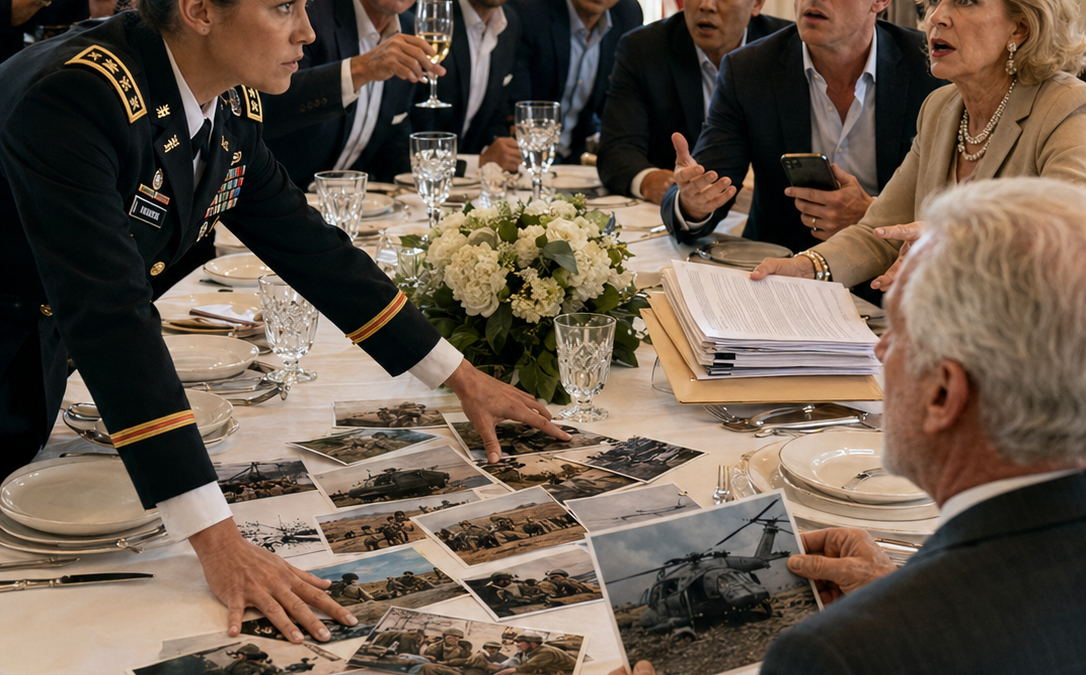
“Just let me know how fast you can wire the funds, okay?” my brother said after our mother mailed me an eighteen-page, $104,217.83 invoice for the cost of raising me—because his third startup needed money. I had just returned from deployment with savings they already treated like family property. So at Sunday dinner, surrounded by Callum’s investors and my mother’s country-club friends, I silently spread photographs of blood-streaked helicopters, exhausted medics, and wounded soldiers across her white tablecloth. They expected me to feel guilty. Then Uncle Leland picked up one photograph, went completely silent, and finally looked at my mother.
### Part 1
The paper felt expensive.
Not normal printer paper. Not the kind that curled at the edges after sitting beside cheap coffee too long. This was thick cream-colored cardstock with a faint texture pressed into it, the same kind my mother used for country club gala invitations and Christmas cards where nobody in the photo actually liked each other.
The certified mail envelope sat beside my half-finished coffee while I stared at the first page without blinking. Outside my barracks window, somebody was backing a fuel truck across the tarmac.
Beep. Beep. Beep.
Every four seconds, that reverse alarm cut through the afternoon heat like a warning.
The document in my hand wasn’t a letter.
It was an invoice.
An actual invoice.
My mother had titled it: Cost of Rearing and Emotional Distress.
Underneath that, in neat columns, she had listed my childhood like a failed business expense.
Piano lessons: $3,450.
Orthodontics: $6,200.
High school groceries, prorated for “teenage consumption”: $5,814.
Transportation expenses: $9,488.
Household emotional tension caused by adolescent resistance: $12,000.
I read that last one three times.
Emotional tension.
Like I had been a plumbing issue.
Like the years I spent trying not to be noticed, trying not to cry too loudly, trying not to make my mother’s face harden at dinner, had somehow cost her money.
The invoice ran eighteen pages. Every year of my childhood had been broken down into neat little accounting categories with color-coded tabs. Some of the formulas were still visible near the bottom of the cells, because apparently my mother had converted the spreadsheet into a polished PDF and still missed the human part.
There was even a section labeled Opportunity Cost.
Underneath it, she had written a paragraph explaining how my “rebellious decision” to enlist in the Army had reduced her social standing among certain friends at Fairmont Pines Country Club.
That one actually made me laugh.
A real laugh.
Short, dry, and mean.
Outside, three mechanics started arguing loud enough for me to hear through the open window. Somebody dropped a metal wrench. The clang echoed across the tarmac.
Jet fuel drifted through the afternoon heat along with hot asphalt and diesel exhaust. I sat there on my deployment footlocker in an old gray Army T-shirt while my mother billed me for existing.
The final page was highlighted in yellow.
Total Outstanding Balance Due: $104,217.83.
Underneath it, in bold:
Cost of Rearing and Emotional Distress.
No greeting.
No “hope you’re safe.”
No “welcome home.”
Just an invoice.
Honestly, I should have expected it.
My younger brother, Callum, once got a brand-new Tesla because he said his old Audi was hurting his confidence with investors. The Audi was eleven months old at the time.
When I graduated flight school, my mother mailed me a lavender candle with a sticky note that said, “Military bases always smell depressing. This might help.”
Different children. Different investments. Different returns.
I flipped through the pages again, slower this time. She had included scanned receipts from places that didn’t even exist anymore. Ballet academies. Family restaurants. A pediatric dentist office that had probably turned into a vape shop ten years ago.
Then I hit page fourteen.
Therapy-related stress management for parent: $8,900.
I stared at that one until my coffee went cold.
I remembered those therapy appointments.
They weren’t for me.
They started after Callum got caught selling fake concert tickets out of his dorm room sophomore year. My mother spent six months crying to therapists about “family pressure” while I was overseas flying medevac support in eastern Syria.
Apparently, that was my bill now.
The sticky note almost slipped out when I turned the final page.
Pink paper.
Perfect handwriting.
“Rowan, I know the timing isn’t ideal, but this would help the family tremendously right now. Callum is very close to securing retail space for his new company. He only needs additional liquidity to satisfy the landlord’s commercial lease requirements. You have substantial deployment savings and no children to support. I’m sure you understand sacrifice better than most. Love, Mom.”
I read it twice.
Not because it was complicated.
Because it was so unbelievably calm.
That was always my mother’s real talent. She could turn cruelty into administrative language. She could make betrayal sound like a parking validation notice.
Callum’s new company was called Nimbus Lane.
His third startup in five years.
The first had been an NFT platform for luxury pet branding. It died in seven months.
The second involved cryptocurrency and gourmet vending machines. I still didn’t fully understand it, and apparently neither did the IRS.
Now he needed over a hundred grand from me so he could rent office space for another app nobody asked for.
I picked up the envelope again and noticed my mother had spent $26.40 on certified priority shipping.
Of course she had.
You couldn’t aggressively invoice your daughter without tracking information.
The reverse alarm outside finally stopped.
The sudden silence felt strange.
I could hear the old air conditioner rattling above my bunk and somebody laughing down the hallway.
I looked at the total one more time.
$104,217.83.
That number didn’t make me angry anymore.
That part had passed.
Anger was loud, hot, and fast.
This felt colder than that.
Cleaner.
I grabbed a pen from the metal desk beside my bunk and started writing numbers on the back of the envelope.
Current savings.
Remaining deployment pay.
Callum’s estimated debt load.
Commercial lease averages near Phoenix.
My mother had taught me one thing well. Always read the fine print before someone tried to sell you obligation wrapped in love.
I didn’t cry.
I calculated.
And right underneath my mother’s perfect little total, I wrote a number of my own.
Zero.
### Part 2
I stared at the word Nimbus until the ink blurred around the edges.
Callum always named his businesses like rejected superhero side characters. Nimbus Lane. VaultBright. PetCrest. Every single one came with a custom logo, expensive branding, and a launch party catered by people carrying tiny grilled cheese sandwiches on wooden trays.
Every single one somehow ended with my mother refinancing something.
The strange part was that she never even sounded embarrassed about it. She talked about Callum’s failures the way rich people talk about skiing accidents.
Unfortunate. Expensive. But proof you belonged in the right circles.
“He’s entrepreneurial,” she would say.
“He takes risks.”
“He has vision.”
Meanwhile, I got asked why I didn’t wear more lipstick in my military ID photo.
I folded the invoice carefully and slid it back into the envelope while the air conditioner rattled overhead like it was losing a fight. Somebody down the hall turned on a country song loud enough to vibrate the walls for about ten seconds before another soldier yelled at him to shut up.
Normal Tuesday.
I checked my watch.
1642.
My sleep was still wrecked from deployment, so technically this counted as mourning for my nervous system.
I leaned forward and dragged my old green duffel bag closer with my boot. Sand still lived in the seams from my last rotation overseas. It didn’t matter how many times you cleaned military gear. The desert always came home with you.
Kind of like family dysfunction.
That stuck too.
I found myself thinking about Callum’s wedding, because that was the first time I realized my mother genuinely believed we were two completely different species.
Forty thousand dollars.
That was what she spent on a four-day destination wedding in Sedona for a marriage that lasted fourteen months.
They rented out an entire boutique resort called Copper Ridge Vista. Imported orchids, engraved whiskey glasses, a violinist standing in the desert playing Coldplay covers while everybody pretended that wasn’t incredibly weird.
I missed most of it because I was stationed in Kuwait.
My mother sent me exactly nine photos afterward.
Eight were of Callum.
One was of the wedding cake.
None included his wife.
I remembered sitting in a folding chair outside a maintenance tent at 2:10 in the morning, scrolling through those photos while eating a protein bar that tasted like drywall. One of the medics looked over my shoulder and asked if Callum was famous.
I said, “No. Just unemployed.”
That got a bigger laugh than it deserved.
The thing was, Callum wasn’t evil.
That would have been easier.
He was charming, funny, good with people. The kind of guy who could walk into a room wearing sneakers that cost more than your rent and somehow convince everybody he was relatable.
My mother loved that about him because she treated personality like currency.
Callum made people feel important for five minutes at a time.
I made people uncomfortable because I noticed things.
That was the real difference.
I noticed when my mother introduced him as “my son, Callum,” but introduced me as “Rowan is in the military now.”
I noticed she stopped hugging me around thirteen but still touched Callum’s face when he was thirty.
I noticed every conversation about me eventually turned into logistics.
“What shift are you working?”
“When are you leaving again?”
“How dangerous is your assignment?”
“Could you help your brother with this one thing?”
That was my role.
Not loved.
Not hated.
Useful.
I stood and walked toward the tiny barracks window. The sun was starting to drop behind the hangars, turning the concrete outside orange and gray. A pair of crew chiefs walked past carrying toolboxes while arguing about fantasy football like civilization depended on it.
I remembered the recruiter’s office suddenly.
It had sat between a payday loan place and a tanning salon outside Mesa Ridge Mall. Cheap linoleum floors. Burnt coffee. A flickering fluorescent light near the printer that buzzed like a dying mosquito.
I was eighteen, skinny from high school track, still stupid enough to think adults automatically became wiser with age.
The recruiter slid paperwork across the desk while my mother sat beside me scrolling through her phone.
She never asked where I might be stationed.
Never asked if I was scared.
Her only question was whether military photos required “those awful short haircuts.”
When I signed the enlistment papers, she looked up long enough to say, “Well, at least one of my children believes in job security.”
That was it.
No tears.
No hug.
No dramatic goodbye.
Just silence during the drive home while Callum complained from the back seat about a parking ticket.
I used to think that silence bothered me because it felt cold.
Now I realized it bothered me because it felt organized.
Like she had already categorized me.
Asset deployed elsewhere.
My phone buzzed against the metal desk hard enough to snap me out of it.
Callum, of course.
I let it ring twice before sending it to voicemail.
Three seconds later, the notification popped up.
I played it on speaker while staring out the window.
“Hey, Rowan. So, uh, Mom said she mailed you everything. I know it probably feels a little intense seeing it all itemized like that, but honestly, she’s not wrong about the sacrifices here.”
I closed my eyes slowly.
His voice stayed smooth and casual, like he was pitching brunch plans.
“Anyway, I’m in kind of a tight spot because the investors are breathing down my neck about the lease timeline. If we can lock the Gilbert property by Friday morning, Nimbus Lane can still hit Q3 projections. So just let me know how fast you can wire the funds, okay? It doesn’t have to be the full amount immediately. We can structure it in phases if that helps. Love you, sis.”
The message ended.
Q3 projections.
Structure it in phases.
Love you, sis.
I looked at the envelope sitting on the desk.
Then I looked at the deployment trunk near my bed.
For the first time since opening that invoice, I stopped thinking about money entirely.
### Part 3
The metal latch on my deployment trunk snapped open hard enough to echo through the room.
That sound always did something to me.
Heavy steel against steel. Solid. Honest. Nothing polished about it.
Military gear never pretended to be prettier than it was.
The trunk smelled like canvas, dust, and old engine oil the second I lifted the lid. Real life. Not country club life. Not retail lease requirement life.
I crouched beside it and started pulling things out one piece at a time.
My flight gloves sat on top, stiff from wear around the fingers. Underneath them was a faded tourniquet I had never replaced after Kandahar. People who have never been around combat think soldiers keep trophies.
We don’t.
We keep evidence.
A dented brass compass rolled toward the corner when I shifted a uniform aside.
Uncle Leland had given me that compass before my second deployment. Vietnam era. Scratched initials on the back. He never made speeches about patriotism or sacrifice. He just handed it to me at Thanksgiving and said, “The Army gives directions. That thing helps you find your way back.”
Then he went back to eating pie.
That was the longest conversation we had ever had.
I picked up the compass and turned it once in my hand before setting it beside the invoice on the desk.
My mother’s cream-colored paperwork looked ridiculous next to it, like a luxury spa brochure accidentally landed inside a trauma bay.
The photo bundles sat underneath a stack of old mission reports held together with rubber bands that were starting to crack. Hundreds of pictures, most printed at the PX overseas because sometimes physical photos felt safer than phones.
Phones broke.
Servers crashed.
Paper stayed angry forever.
I pulled the first stack loose.
Ceremony photos. Promotion photos. People smiling beside helicopters, pretending the heat wasn’t melting their organs.
I skipped those immediately.
My mother loved those versions of military life.
Uniforms pressed sharp. Flags. Medals. Formal dinners where politicians shook hands with people they would never remember afterward.
Safe military.
Pretty military.
Instagram military.
I dug deeper.
There was reality.
A dust storm so thick the horizon disappeared completely.
A flight medic asleep sitting upright against a wall with an IV wrapper stuck to his boot.
Blood smeared across the floor after a triple extraction outside Raqqa.
No filters.
No speeches.
Just work.
One photo showed a young private named Milo Ramirez sitting on an ammo crate eating cold ravioli straight from the can at 3:18 in the morning while staring at absolutely nothing.
He was nineteen in that picture.
Two weeks later, he lost three fingers during a mortar strike.
Another showed Keira Shaw asleep with her forehead pressed against a helicopter window while still wearing stained gloves because she had been awake for thirty-six straight hours. Someone had written “Princess” on her helmet in silver marker because military humor was basically middle school bullying with federal funding.
I smiled a little at that one.
Then the smile disappeared again.
There were pictures I barely remembered taking.
A burned-out transport truck.
A field hospital at dawn.
Rows of boots outside a temporary surgical tent.
One blurry photo caught me off guard because I recognized the exact moment before my brain fully processed the image.
A medic named Torres standing in ankle-deep mud, screaming for plasma while rain hammered the landing zone so hard nobody could hear each other without shouting directly into faces.
Torres survived.
The kid on the stretcher didn’t.
I set that photo aside separately.
The room had gone completely quiet around me except for the buzzing fluorescent light overhead. Even the hallway noise seemed far away.
I kept sorting.
Not looking for the worst pictures.
Looking for the honest ones.
I didn’t want shock value.
I wanted contrast.
My mother thought sacrifice looked like writing tuition checks and attending uncomfortable therapy sessions after Callum embarrassed her at a charity fundraiser.
She had no idea what actual cost looked like.
Or smelled like.
Or sounded like at two in the morning when rotor blades shook your ribs hard enough to make your teeth ache.
Then I found the picture.
It had been taken inside a Black Hawk somewhere near Al-Hasakah during my third deployment. I remembered because the combat journalist who took it threw up twenty minutes later from the smell inside the aircraft.
In the photo, soot covered half my face. My sleeves were blackened near the cuffs. I was crouched beside a stretcher, holding an IV line above my shoulder while staring toward the cockpit.
I looked exhausted.
Not movie exhausted.
Real exhausted.
The kind where your body keeps moving strictly because other people will die if you stop.
There was blood on the floor beneath my boots.
Not mine.
I stared at the picture for a long time.
Then I reached to the desk and grabbed a red pen.
The same one I had used earlier to write zero beneath my mother’s invoice.
I flipped the photo over carefully and wrote one sentence across the back.
“This was the only interest I ever owed anybody.”
I let the ink dry.
Then I stood and grabbed a large manila envelope from the bottom drawer.
One by one, I slid the photographs inside.
Dust storms.
Broken stretchers.
Exhausted medics.
Blood-streaked helicopter floors.
Reality.
By the time I sealed the envelope, the coffee beside me had gone completely cold.
I looked at my mother’s invoice one last time before sliding it underneath the remaining photos.
Then I wrote her address across the front of the manila envelope in slow, careful block letters.
Not angry.
Not emotional.
Precise.
That was the part people misunderstood about soldiers.
The dangerous moments usually weren’t loud.
They were quiet.
Very quiet.
### Part 4
The smell of roasted garlic hit me before I reached the front door.
Garlic. Butter. Expensive red wine.
My mother always cooked like she was hosting a political fundraiser instead of dinner.
Three luxury SUVs lined the circular driveway when I pulled up behind them in my eight-year-old Tacoma with the cracked rear bumper and a faded national parks sticker peeling off the tailgate. Somebody had parked a white Porsche Cayenne halfway across the curb because apparently parking lines became optional once your watch cost four grand.
I killed the engine and sat there with the manila envelope resting on the passenger seat.
The house looked exactly the same.
Stone entryway.
Warm yellow lights.
Perfect landscaping.
Everything trimmed and controlled within an inch of its life.
Growing up there had always felt like living inside a furniture showroom where emotions were considered clutter.
Laughter drifted through the front windows as I walked up carrying the envelope under my arm.
I recognized Callum’s voice immediately because he always sounded like he was halfway through pitching something.
I rang the bell once.
Not because I needed to. I still had my key.
The door opened almost instantly.
One of my mother’s friends blinked at me in confusion while holding a wine glass with both hands like it contained classified information.
“Oh,” she said. “Rowan.”
Not “Rowan’s home.”
Not “good to see you.”
Just my name, delivered the way people react to finding an unexpected bill in the mailbox.
I stepped inside.
The dining room was already full. Twelve people total.
Callum sat near the center of the table wearing a navy blazer over a white T-shirt, like every tech founder in America had agreed to share one personality. Two men beside him were probably investors. You could always tell. Expensive shoes. Startup beards. Faces permanently tightened from pretending enthusiasm counted as business strategy.
Uncle Leland sat near the far end, quietly eating bread with butter while everybody else talked over each other.
And my mother stood at the head of the table, pouring cabernet into crystal glasses like she was blessing the room.
Vivienne Mercer.
Sixty-one years old.
Cashmere sweater. Gold bracelet. Perfect makeup.
Still moving through dinner parties like a cruise director with unresolved trauma.
The bottle sat beside her plate.
Something French and old enough to have a personality. About one hundred eighty bucks retail. I knew because Vivienne loved announcing wine prices indirectly.
“Oh, this little thing. The vineyard only released six hundred cases.”
Translation: Please calculate my self-worth accordingly.
The room shifted when they noticed me fully.
Not dramatic silence.
Worse.
That tiny hesitation people make when something socially inconvenient walks into the room.
Callum recovered first.
“Rowan,” he said too loudly. “Wow. Didn’t know you were coming.”
“Neither did I.”
One investor laughed nervously like he thought maybe I was joking.
My mother set the wine bottle down carefully.
Then the performance started.
Her smile appeared instantly. Warm. Controlled. Public.
“Oh, sweetheart,” she said, walking toward me with open arms she never actually intended to use. “You should have told me you were stopping by.”
I noticed she didn’t touch me.
Not even casually.
Probably worried my jacket smelled like aviation fuel.
To be fair, it did.
The olive field jacket I wore had faded around the sleeves from years of washing in desert sun. My jeans were clean, but old. Nothing about me matched the polished room around us, and everybody could feel it.
Especially Vivienne.
Appearances only mattered when contrast existed.
“You remember everyone, don’t you?” she asked quickly, already trying to steer the mood back under control.
I nodded toward the table.
“Some of them.”
One investor stood halfway to shake my hand.
“Graham Vale,” he said. “Callum’s told us a lot about you.”
That almost made me smile.
Callum never talked about me unless military service somehow helped his image.
“Hopefully not enough to ask me for money too,” I said.
That landed harder than I intended.
The investor blinked.
Callum coughed into his wine.
My mother laughed immediately. Sharp and artificial.
“Oh, Rowan always has such a dry sense of humor after deployment.”
After deployment.
Like I had returned from summer camp with attitude problems.
I looked around the table again.
Perfect white tablecloth. Gold-trimmed plates. Little name cards beside each setting because apparently twelve adults couldn’t identify chairs independently. A bowl of roasted potatoes sat near the center beside candle holders tall enough to become aviation hazards.
And suddenly I realized something.
My mother hadn’t invited me because she wanted family reconciliation.
She had invited witnesses.
Business investors. Friends. An audience.
She wanted the check handed over publicly because public generosity counted more in her world than private love ever did.
Everything with Vivienne was transactional eventually.
She stepped closer while the room slowly restarted conversation around us. Her smile stayed frozen perfectly in place.
Then she lowered her voice.
“Did you bring it?”
There it was.
Not “how are you?”
Not “you look tired.”
Not “I missed you.”
Straight to billing operations.
I stared at her for two seconds too long.
Close up, I could see faint lines near her eyes where makeup had settled. I could smell cabernet on her breath mixed with expensive perfume that reminded me of department store cosmetics counters.
Behind her, Callum was pretending not to watch us while absolutely watching us.
My mother tilted her head slightly.
“Well?”
I shifted the manila envelope from under my arm into my hand. The edges were bent from travel. One corner still carried a faint brown dust stain from my barracks trunk.
For the first time all night, I smiled.
Small.
Calm.
“Yeah,” I said. “I brought something.”
Then I walked past her.
Every conversation at the table slowed as I reached the center of the dining room.
Forks paused.
Glasses lowered.
Callum straightened in his chair immediately.
I placed the thick, battered envelope directly onto the pristine white tablecloth beside the wine bottle.
The sound wasn’t loud.
Just paper against linen.
But somehow, it shut down the entire room.
My mother stared at the envelope.
Then at me.
And for the first time since I walked in, her smile disappeared completely.
### Part 5
My mother’s fingers rested on the envelope like it had personally offended her.
Perfect manicure. Pale pink polish. Diamond bracelet catching candlelight every time she moved her wrist.
Nobody at the table spoke.
Even the soft background music from the kitchen suddenly felt too loud.
Callum forced a smile first.
“Rowan, if this is some kind of joke—”
“It’s not.”
That shut him up.
Vivienne looked around the table quickly, measuring the room the way politicians measure cameras. She was already trying to regain control before she even opened the envelope.
“Well,” she said lightly. “This certainly feels dramatic.”
One of the investors gave a nervous chuckle.
Wrong move.
Nobody joined him.
My mother slid one manicured finger underneath the flap and opened the envelope carefully, probably expecting legal documents or a cashier’s check.
For half a second, I almost admired how calm she looked.
Then she tipped the contents out.
Twenty-four photographs spilled across the white tablecloth.
The sound was soft. Glossy paper sliding over linen.
A few pictures drifted across plates. One landed against a crystal butter dish beside the roasted potatoes. Another stopped near Callum’s wine glass.
Nobody touched anything.
The entire room leaned forward at once.
A Black Hawk landing in the middle of a dust storm.
A medic kneeling beside a stretcher dark with blood.
A nineteen-year-old private asleep sitting upright against a wall with exhaustion carved into his face.
No captions.
No explanations.
Just reality dumped directly onto imported table linens.
Callum’s smile disappeared instantly.
One of the investors picked up a photograph before my mother could stop him. I watched his face change while he looked at it.
That always happened.
People thought military service looked like recruitment commercials until they saw the parts nobody put on posters.
The investor swallowed hard and lowered the photo slowly.
“What is this?” Vivienne asked sharply.
I didn’t answer.
She grabbed another picture.
This one showed the inside of a helicopter after an extraction mission. Blood streaked across the floor beneath hanging IV bags while a medic pressed both hands against somebody’s chest.
Her expression tightened.
“Oh my God.”
A woman across the table covered her mouth.
Another guest set her wine glass down without drinking.
The room kept getting smaller somehow. More silent. More honest.
Callum reached toward the photos.
“Rowan, what exactly are you trying to prove here?”
I looked at him.
“You wanted repayment.”
“That’s not what this is.”
“Your voicemail said otherwise.”
His jaw flexed.
One of the investors slowly glanced toward him now with the expression people get when they realize they accidentally walked into a hostage negotiation disguised as dinner.
My mother snatched another photograph off the table too quickly.
Bad choice.
This one was worse.
A close shot inside the aircraft cabin during a nighttime medevac. Smoke stains. Torn uniforms. A soldier’s boot visible near the edge of the frame while another medic worked in the background with dark stains halfway up his sleeves.
Vivienne physically recoiled.
Not subtle discomfort.
Actual recoil.
The photograph slipped from her hand and fluttered onto the table beside the cabernet bottle.
“Oh, for God’s sake,” she snapped. “How dare you bring this filth to my table?”
“Filth,” I said. “Interesting word.”
Nobody moved after she said it.
Because suddenly everyone understood something important about my mother all at once.
She wasn’t horrified by suffering.
She was horrified suffering had entered her dining room.
Big difference.
I leaned against the back of an empty chair and crossed my arms loosely.
“You mailed me an invoice for my existence,” I said calmly. “I mailed you the receipts.”
That landed hard.
One of Callum’s investors looked back down at the photographs again, slower this time. He picked up another image near his plate. This one showed Keira Shaw asleep in the helicopter doorway with stained gloves and an oxygen mask hanging from one hand.
“Jesus,” he muttered.
Callum heard him.
That was the first moment panic crossed his face.
Not when the photos appeared.
Not when my mother lost control.
When the investors stopped seeing him as the smartest guy in the room.
Because Callum understood social gravity better than anyone I knew.
And the gravity had shifted.
Fast.
“These are all operational photos,” Callum said quickly, trying to sound authoritative. “She probably shouldn’t even have these here.”
I almost laughed.
Of course he would turn into a compliance expert now.
“They were cleared,” I said. “Relax, Silicon Valley.”
One guest snorted unexpectedly into her wine.
Callum ignored it.
My mother stood frozen at the head of the table, staring at the spread of photographs like they were contagious.
The candles reflected off glossy paper covered in exhaustion, smoke, dirt, blood, and twenty-year-olds carrying responsibilities too heavy for their bodies.
The contrast inside that room became impossible to ignore.
Crystal glasses. Cashmere sweater. Expensive wine.
And pictures of kids younger than Callum trying to keep people alive at three in the morning.
One image had slid directly beside my mother’s place setting.
The soot-covered photo.
The one with me holding the IV line.
Her eyes landed on it slowly.
Then she flipped it over.
I watched her read the sentence written in red ink across the back.
“This was the only interest I ever owed anybody.”
Her face changed.
Not guilt.
My mother wasn’t built for guilt.
But something cracked.
Not emotionally.
Structurally.
Like the room no longer obeyed her the way it always had.
One investor finally looked directly at me.
“How long were you deployed?”
“Most of my adult life,” I said.
The answer sat heavily between the wine glasses and candlelight.
Meanwhile, Callum still looked offended somehow.
That part almost impressed me.
Human ego is incredible under pressure.
“You’re making Mom look like some kind of monster,” he said quietly.
I glanced around the table at the photographs scattered across imported linen, then back at him.
“I didn’t bring anything into this room that wasn’t already true.”
### Part 6
Nobody touched the food anymore.
The roasted potatoes went cold beside the candles. Butter hardened slowly in the crystal dish near the photographs while twelve grown adults sat frozen around the table, pretending their lives hadn’t split open in the middle of Sunday dinner.
I reached down and picked up one of the photos near Callum’s plate.
The room went still immediately.
That surprised me a little.
My voice wasn’t loud. It never had been. Flying medevac taught you fast that panic wasted oxygen, and volume didn’t make people listen better.
Usually the opposite.
I held up the picture carefully.
Three medics sat against a wall outside a field hospital, faces gray with exhaustion. One guy still wore stained gloves because he had fallen asleep before taking them off.
“You billed me eighteen thousand dollars for groceries,” I said.
Nobody interrupted.
“This picture was taken after a forty-hour rotation outside Aleppo. I drank expired electrolyte packets mixed with instant coffee because we ran out of energy drinks on day two.”
One investor shifted uncomfortably in his chair.
I pointed toward the exhausted kid in the photo.
“He was twenty. He stayed awake long enough to stabilize three casualties so they could go home to their actual mothers.”
I set the photograph back down gently.
Across the table, my mother folded her arms tighter.
Defensive posture.
Classic Vivienne.
When reality cornered her, she always switched to indignation first.
“This is unnecessary,” she said sharply. “Nobody here understands why you’re behaving like this.”
I looked at her.
“No,” I said quietly. “I think they’re starting to.”
Callum rubbed both hands together under the table like he physically needed movement.
“Rowan, come on. Mom’s invoice was obviously symbolic.”
“Was the payment deadline symbolic too?”
“That’s not what I meant.”
“Then explain it better.”
He opened his mouth.
Nothing came out.
One of the investors slowly reached for his wine again, then stopped halfway, eyes still locked on the photographs scattered around the tablecloth.
The room smelled different now.
Not garlic and cabernet anymore.
Tension changed air.
I picked up another photograph.
This one showed the inside of the Black Hawk during a night extraction. Torn equipment bags. Blood smeared near the floor rails. A teenager from Ohio lying beneath thermal blankets while a medic tried to keep pressure on his chest wound.
I remembered his name immediately.
Nolan Mercer.
Nineteen years old.
Loved dirt bikes.
Talked constantly about opening a landscaping company with his cousin after discharge.
Dead before sunrise.
“You billed me for emotional distress,” I said.
My mother’s jaw tightened.
I kept going.
“This kid died in my helicopter while I held an IV line above my head for twenty-three minutes because turbulence kept ripping the needle loose from his arm.”
Nobody moved.
“Don’t ever talk to me about distress.”
That one landed deep.
You could feel it.
One of the women at the table quietly wiped beneath her eye without saying anything.
Across from her, Callum looked furious now because anger was easier for him than shame.
“You’re being dramatic,” he snapped.
There it was.
The family defense mechanism.
Minimize. Redirect. Mock emotion before accountability arrives.
I turned toward him fully.
“No,” I said calmly. “You just finally lost control of the room.”
His face flushed.
“You know what your problem is? You act like you’re the only person who struggled.”
I almost laughed.
Instead, I reached into my jacket pocket and pulled out my folded copy of the invoice.
The paper cracked softly as I opened it.
“You want to discuss struggle?”
Callum leaned back in his chair.
Bad instinct.
I looked directly at the two investors beside him.
“Nimbus Lane is his third company in five years,” I said. “The luxury pet branding platform lost sixty-two thousand dollars in under eight months.”
Callum’s expression changed immediately.
“Rowan—”
“The gourmet vending machine project lost another forty-one thousand after the health inspection issues.”
One investor blinked hard.
The other slowly lowered his wine glass.
“And the Sedona wedding cost roughly forty thousand before divorce attorney fees kicked in.”
“Okay, stop,” Callum snapped.
I ignored him.
“My mother took out a home equity loan eighteen months ago to cover part of his debt restructuring after VaultBright collapsed.”
That did it.
Both investors turned toward Vivienne at the exact same time.
Her face drained of color so fast it almost looked painful.
Callum stood halfway from his chair.
“That’s private family information.”
“No,” I said. “Private family information was the invoice you mailed me demanding over a hundred thousand dollars so you could secure office space for another startup.”
Nobody defended him now.
That part mattered.
Nobody.
Because facts are brutal in rooms built on performance.
I watched one investor mentally recalculate the entire evening in real time. You could practically see the spreadsheets forming behind his eyes.
Retail lease.
Debt exposure.
Hidden liabilities.
Family-funded operations.
The fantasy version of Callum Mercer started collapsing one sentence at a time.
And the worst part?
I wasn’t exaggerating anything.
I didn’t need to.
Callum looked toward our mother desperately.
Vivienne finally spoke again, but the confidence was gone.
“Rowan,” she said tightly. “This conversation is cruel.”
I stared at her for a long moment.
Then I looked around the table at the photographs again.
Kids carrying stretchers.
Medics asleep sitting upright.
Blood drying on helicopter floors while twenty-year-olds tried to keep strangers alive.
“Cruel,” I said. “Interesting word choice.”
Her throat moved.
“You charged your daughter interest for existing,” I said quietly. “Don’t lecture me about cruelty.”
The silence afterward felt enormous.
Not empty.
Earned.
Callum sat back down slowly without another word.
For the first time in his entire life, nobody at that table rushed to save him.
### Part 7
The silence stretched so long I could hear the kitchen refrigerator humming from the next room.
Nobody looked comfortable anymore.
One investor stared down into his untouched wine like maybe the cabernet could teleport him out of the house. The woman beside him kept folding and unfolding her napkin into smaller squares. Callum looked pale now, the kind of pale rich people get when consequences arrive without warning.
My mother still stood at the head of the table alone.
That mattered too.
Vivienne Mercer had spent most of her adult life controlling rooms through momentum. Compliments. Hosting. Appearances. Social pressure.
She kept conversations moving fast enough that nobody stopped to inspect the foundation underneath them.
But truth was heavy.
And once a room slowed down enough, people started noticing things.
A chair scraped against hardwood.
Everybody turned.
Uncle Leland stood from the far end of the table.
For a second, nobody said anything because I couldn’t remember the last time Leland voluntarily entered a conversation at one of these dinners. He usually operated like furniture that occasionally drank bourbon.
Quiet.
Still.
Watching everything.
My mother’s lips tightened slightly the moment she saw him moving toward the table.
Leland was technically my father’s older brother. After Dad died fifteen years earlier, he had drifted in and out of family events without much attention from anyone, especially Vivienne.
Vietnam veterans made her uncomfortable.
Too quiet. Too real. Too difficult to display socially.
Leland walked toward the photographs without rushing.
Old canvas jacket. Faded jeans. Slight limp in his left leg from something he never talked about.
The room stayed frozen while he reached the center of the table.
He didn’t look at Vivienne.
Didn’t look at Callum.
Didn’t look at the investors.
He looked at the photographs one by one, long enough to actually see them.
That alone separated him from almost everyone else in the room.
His rough hands picked up the soot-covered photograph carefully. The one with me holding the IV line inside the helicopter. The one with the sentence written in red ink on the back.
Leland turned it over silently.
Read it once.
Then he looked back at the image, and something changed in his face.
Not shock.
Recognition.
Deep recognition.
Combat veterans could spot certain things instantly in one another. Nobody taught it. You just knew.
The posture.
The eyes.
The exhaustion that settled permanently into somebody’s nervous system after enough nights convincing yourself exhaustion was optional.
Leland stared at the photograph for a long time.
Then finally, he looked up at me.
I hadn’t realized until that moment how badly I needed someone in that room to understand what they were seeing.
Not admire it.
Not thank me for my service like a man holding a discounted appetizer coupon.
Understand it.
Leland’s eyes looked wet suddenly, though he never lost composure.
He gave one tiny nod.
That was all.
But somehow it hit harder than anything else that night.
Callum shifted uncomfortably in his chair.
“Uncle Leland, this whole thing has gotten way out of hand.”
Leland ignored him completely.
My mother tried next.
“Leland,” she said carefully. “Rowan is being emotional.”
That almost made me laugh.
Emotional.
Because apparently mailing your daughter a six-figure invoice for childhood expenses was rational business management.
Leland finally turned toward Vivienne.
Slowly, the room became absolutely still.
I didn’t think I had ever heard him raise his voice.
But he didn’t need volume.
People who survived real things rarely did.
“You spent thirty-four years trying to make her feel like a debt, Vivienne,” he said quietly.
Not angry.
Certain.
Every person at that table listened harder because of how calm he sounded.
Leland glanced down at the photographs again.
Then back at my mother.
“You don’t have enough money in the world to buy the air she breathes.”
Nobody moved.
Not one person.
The sentence landed with strange finality, like somebody had finally spoken the truth out loud after years of everyone editing themselves around Vivienne’s version of reality.
My mother looked genuinely stunned for the first time all night.
Not offended.
Not defensive.
Stunned.
Because Leland never took sides.
And now he had.
Publicly.
Clearly.
Without hesitation.
Callum forced a laugh that died almost immediately.
“Come on,” he muttered. “That’s a little dramatic.”
One of the investors looked at him with open disgust.
Not irritation.
Disgust.
Different thing entirely.
Because up until that night, Callum’s story probably sounded impressive.
Young founder. Big ideas. Strong family support system.
Now the actual picture sat scattered across the table beside the potatoes.
A mother financially cannibalizing one child to keep another one artificially successful.
That wasn’t ambition.
That was addiction with nicer furniture.
Leland set the photograph back down carefully.
Then he stepped toward me.
I suddenly became aware of how tired I felt.
Not physically.
Something deeper than that.
The kind of exhaustion you carry after defending your own existence for too many years.
Leland stopped beside my chair and placed one hand on my shoulder.
Simple gesture.
Heavy hand.
Warm.
I hadn’t realized how long it had been since someone in my family touched me without wanting something first.
No speech followed it.
No performance.
Just respect.
Clean and direct.
Across the table, my mother looked completely isolated now, despite standing in a room full of people she had spent decades trying to impress.
Nobody rushed to comfort her.
Nobody defended Callum anymore.
One investor quietly pushed his chair back an inch from the table like instinct was telling him to create distance.
The candles flickered softly between all the photographs.
Combat.
Exhaustion.
Truth.
And standing there beside Uncle Leland with his hand on my shoulder, I realized something for the first time in years.
I wasn’t the embarrassing part of this family.
I never was.
### Part 8
Leland’s hand stayed on my shoulder for maybe three seconds.
Then he let go.
That was enough.
Nobody spoke after that.
Not my mother.
Not Callum.
Not the investors.
The dining room looked different now, like someone had turned on brighter lights and exposed all the cheap wiring behind the walls.
The candles still flickered. The expensive wine still breathed in crystal glasses. Dinner still sat untouched across gold-trimmed plates.
But the illusion was dead.
Everybody knew it.
I looked at my mother one last time.
She still stood near the head of the table with her arms folded tightly across herself, but the posture had changed. Earlier it had looked authoritative. Controlled.
Now it looked small.
Protective.
She kept staring at the photographs spread across the tablecloth like they had personally betrayed her.
Maybe in her mind, they had.
They had interrupted the version of reality she spent years building.
A successful son.
A difficult daughter.
A polished family.
Nice house. Nice wine. Nice lies.
The problem with truth was that it didn’t care how much money you spent decorating around it.
Callum finally cleared his throat.
“Rowan,” he started carefully. “I think we should all calm down and talk this through.”
That almost made me laugh again.
People like Callum always wanted calm after the damage became public.
Not before.
Never before.
I picked up my jacket from the back of the chair.
“You already sent the invoice,” I said. “Looks pretty talked through to me.”
He looked toward the investors immediately after that, instinctively checking whether they still saw him the same way.
They didn’t.
One of them couldn’t even look directly at him anymore. The other had pulled out his phone under the table and started doing the universal rich-guy move for I’m calculating how fast I can legally leave this situation.
Honestly, I respected it.
My mother finally spoke again, but the sharpness was gone from her voice.
“You’re humiliating this family.”
I slid my arms into my jacket sleeves.
“No,” I said calmly. “I stopped helping you hide it.”
That one stayed in the air behind me while I walked toward the front hallway.
Nobody followed.
Not even Callum.
The photographs remained scattered across the dining room table like evidence after a trial nobody expected to lose.
I grabbed my truck keys from the entryway table beside a decorative bowl filled with fake lemons. My mother had owned those fake lemons for at least twelve years.
Same bowl.
Same perfect arrangement.
Nothing in that house ever aged naturally.
Even the fruit had commitment issues.
Behind me, voices finally started again in low, panicked murmurs.
One investor asking a question quietly.
Callum answering too fast.
My mother interrupting.
Damage control mode.
I kept walking.
The front door opened with the soft hydraulic hiss I remembered from high school.
Cool night air hit my face immediately.
God, that felt good.
The silence outside sounded completely different from the silence inside the house.
Outside felt honest.
Crickets near the hedges. Distant traffic beyond the neighborhood gates. Wind brushing through trees.
Real sounds.
I stepped off the stone entryway and walked toward my truck while muffled voices leaked through the front windows behind me.
Callum’s voice carried the most.
Faster now. Higher.
Trying to recover momentum.
“Temporary misunderstanding.”
“Family stress.”
“Obviously emotional.”
Same old Callum.
Trying to pitch reality into becoming something more marketable.
I unlocked the Tacoma and tossed my jacket onto the passenger seat before climbing inside. The cab smelled faintly like dust, old coffee, and motor oil.
Home.
Not luxury home.
Home.
My home.
The truck took two tries to start because the battery had been acting dramatic since February. The engine finally turned over with a rough growl that sounded more trustworthy than anything said inside that dining room all night.
I rested both hands on the steering wheel without pulling away.
My reflection stared back at me through the rearview mirror.
Tired eyes.
Sun damage near the temples.
Small scar near my chin from a rough landing outside Mosul six years earlier.
For most of my life, whenever I looked at myself, I saw whatever role my family had assigned me that week.
The difficult daughter.
The embarrassing daughter.
The cold one.
The utility daughter.
The backup financial plan.
But sitting there in that old truck with the house glowing behind me, something finally shifted.
I didn’t see somebody unwanted anymore.
I saw a woman who paid her own bills.
A woman who carried people out of war zones.
A woman who stayed awake when other people couldn’t.
A woman who survived things nobody at that dinner table could even look at in photograph form.
And suddenly my mother’s invoice felt ridiculous in a completely different way.
Because dignity was never something she could give me.
Which meant it was never something she could take away.
I put the truck into reverse.
Through the dining room window, I could still see movement around the table. Callum talking with both hands. One investor standing. My mother frozen beside the candles.
For the first time in my life, none of it felt like my responsibility.
I drove away without looking back.
I didn’t wait for an apology I knew would never come.
And I didn’t care whether Callum’s investors walked out behind me.
My ledger was finally clear.
Some debts were paid simply by walking away.
### Part 9
The highway outside Phoenix looked almost empty at that hour.
Long stretches of black asphalt. Truck headlights in the distance. Radio stations fading in and out every twenty miles like they were giving up halfway through conversations.
I didn’t drive back to base right away.
I told myself I needed gas.
Honestly, I needed distance.
Physical distance first.
Emotional distance later.
The adrenaline from dinner started wearing off somewhere outside Chandler. That was the funny thing about confrontation. People imagined it felt powerful afterward.
Most of the time, it just felt exhausting.
I pulled into a Circle K near the freeway around 11:43 p.m. The fluorescent lights made everybody look slightly dead. A teenager behind the register argued with his girlfriend through one AirPod while pretending to stock beef jerky.
America stayed consistent.
I bought the worst coffee on earth and sat back inside my truck without turning the engine on. The cup warmed my hands while I stared through the windshield at nothing for a while.
Not the fight.
Not my mother.
The moment I kept thinking about was Uncle Leland standing beside me without needing explanations.
That stayed with me.
When you spend enough years inside a dysfunctional family, you stop noticing how abnormal certain things are. Your brain adapts. You normalize emotional hunger the same way people normalize background noise near train tracks.
You stop hearing it after a while.
Then one healthy moment happens.
Suddenly everything sounds different.
I realized something sitting there in that gas station parking lot.
I had spent most of my adult life trying to become useful enough to deserve love.
Not lovable.
Useful.
There was a difference.
Useful people solved problems. They stayed calm. They handled things. They didn’t complain because everybody depended on them functioning properly all the time.
Families like mine rewarded that role heavily until the moment you stopped providing something.
Then people started sending invoices.
I laughed quietly into the coffee cup.
A man pumping gas nearby looked over like maybe I was having a breakdown.
Fair concern, honestly.
The thing nobody tells you about dysfunctional families is that they assign roles early, usually before you’re old enough to recognize it happening.
One child becomes the golden child.
One becomes the caretaker.
One becomes the emotional punching bag.
One becomes invisible.
Once those roles settle in, everybody unconsciously protects them because changing the system would require accountability from the people who benefit from it.
Callum became valuable because he reflected well on my mother socially.
I became valuable because I absorbed pressure.
Different functions.
Same machine.
The dangerous part was that I eventually started confusing the assigned role with my actual identity.
For years, I genuinely believed that if I worked harder, achieved more, sacrificed more, maybe my mother would look at me the same way she looked at Callum.
Proud.
Soft.
Interested.
That kind of thinking can drain your entire life if you let it.
Because people who measure relationships transactionally don’t suddenly become emotionally generous because you suffer harder in front of them.
I took another sip of coffee and immediately regretted it.
It tasted like someone filtered hot water through drywall.
Still drank it.
Military habit.
Across the parking lot, two construction workers climbed into a pickup truck, laughing about something stupid while country music played through open windows.
A completely ordinary moment.
Somehow healthier than that entire dinner table.
That hit me hard too.
You could spend years chasing validation from emotionally unavailable people while overlooking peaceful things already sitting around you.
Good coworkers.
Quiet mornings.
Friends who actually asked if you made it home safe.
The medic who saved you the last decent energy drink before a flight because he knew your shift had been rough.
Real care rarely looked dramatic.
That was another lesson I learned too late.
I reached over and opened the center console, pulling out the small stack of photographs I had kept with me after leaving the house.
Not all of them.
Just a few.
The soot-covered helicopter photo sat on top.
Underneath it was the picture Leland had held.
I looked at it again under the parking lot lights.
Same tired eyes.
Same dirt-streaked uniform.
But something felt different now.
Not the image.
Me.
For the first time in years, I stopped seeing that exhausted woman in the photograph as someone trying to prove her worth.
She already had worth.
She had just been surrounded by people too emotionally broken to recognize it.
That realization changed me slowly.
Permanently.
I pulled out my phone and deleted the photo of the invoice from my camera roll.
No speech.
No drama.
Just delete.
Done.
I kept Leland’s photograph though.
That one mattered.
Because for one quiet moment at that dinner table, somebody in my family had seen me clearly instead of evaluating me.
That was rarer than people thought.
By the time I finally drove back toward base, the sky had started turning dark blue near the horizon. Early shift crews were already moving around the hangars when I parked. Floodlights reflected off helicopters lined up on the tarmac while exhausted medics shuffled toward briefing rooms carrying terrible coffee and unfinished conversations.
One of the younger crew guys spotted me climbing out of the truck.
“You look like hell, Captain.”
“Family dinner,” I answered.
He nodded immediately.
“Damn. Worse than deployment.”
“That depends,” I said. “How many incoming mortars?”
He laughed hard enough to spill coffee on himself.
And standing there in the cold morning air, listening to exhausted soldiers joke about caffeine and misery before another long shift, I realized something simple.
This life wasn’t perfect.
But it was honest.
And after everything that happened inside my mother’s dining room, honesty felt like the most peaceful thing in the world.
### Part 10
Three weeks after the dinner, Nimbus Lane collapsed.
Not dramatically.
No screaming investors. No viral LinkedIn essay about “unexpected market headwinds.” No brave founder video filmed against exposed brick.
It just quietly died the way most bad startups did once rich people stopped pretending to believe in them.
One of Callum’s investors sent me a message afterward.
Not apologizing.
Not picking sides.
Just short and honest.
“I think I saw the real financial structure for the first time that night.”
That sentence stayed with me.
Because that had been the entire problem from the beginning.
Everyone around my family saw the presentation version.
Successful son.
Elegant mother.
Military daughter somewhere in the background making everybody look respectable during holidays.
Nobody saw the machinery underneath.
The loans.
The guilt.
The emotional bookkeeping.
The constant expectation that one child existed partly to stabilize the other.
My mother stopped calling after the dinner.
Technically, she sent one text six days later.
“You embarrassed this family in front of important people.”
No “how are you?”
No reflection.
No accountability.
Just public relations damage assessment.
I stared at the message for maybe thirty seconds before deleting it.
That was new for me too.
The old version of me would have spent hours drafting the perfect response. Calm enough not to sound emotional. Clear enough to defend myself. Gentle enough to avoid escalation.
That was another trap dysfunctional families created.
They trained you to overexplain your boundaries because they raised you to believe protecting yourself required permission first.
Now, delete felt cleaner.
Distance changed things faster than arguments ever did.
When you finally stepped away from emotionally manipulative people, your nervous system started recalibrating slowly. At first, peace felt uncomfortable because chaos was familiar.
Hypervigilance was familiar.
Walking on eggshells was familiar.
Peace could actually feel suspicious in the beginning.
That part surprised me.
I kept waiting for guilt to crush me afterward.
It didn’t.
What showed up instead was clarity.
Very different feeling.
One Saturday morning, I was cleaning my apartment while an old baseball game replayed quietly on TV. Nothing important. Just noise. The kind of ordinary weekend moment I used to miss constantly while deployed.
I opened a drawer looking for batteries and found my mother’s invoice folded underneath some old paperwork.
The original copy.
Cream paper.
Perfect formatting.
$104,217.83 still ridiculous.
I stood there staring at it for a second.
Then something unexpected happened.
I laughed.
Not angry laughter.
Not bitter laughter.
Genuine disbelief that another human being had sat down and calculated childhood into line items.
Piano lessons.
Groceries.
Emotional distress.
Like parenthood had been a failed business merger.
I carried the invoice to the shredder near my desk and fed the pages through one at a time while the baseball announcer talked about bullpen statistics in the background.
Normal life happening beside old damage.
That felt important somehow.
The paper disappeared into thin strips, page by page.
And with every page, I realized something else.
The debt had never been mine.
That was the real lesson underneath the entire story.
Some parents raised children with love.
Others raised investments.
And children raised as investments often spent adulthood trying to pay emotional bills that never should have existed in the first place.
You saw it all the time once you knew what to look for.
Parents attaching support to obedience.
Adult children terrified to disappoint people who only showed affection conditionally.
Families keeping score forever instead of healing.
Sometimes the most expensive thing a person could lose wasn’t money.
It was self-worth.
And once somebody convinced you your value depended on performance, usefulness, or sacrifice, they could control you almost indefinitely.
That was why boundaries mattered.
Not because boundaries punished people.
Because boundaries revealed people.
Healthy people adjusted when you communicated limits.
Manipulative people got angry because limits interfered with access.
Big difference.
I also learned something watching Callum.
Helping someone during genuine hardship was love.
Funding someone’s endless irresponsibility was enabling.
Those were not the same thing, no matter how emotional people got while explaining it.
If someone repeatedly created chaos and everyone around them kept cushioning the consequences, eventually that person stopped developing because the system rewarded avoidance.
Callum had failed upward for years because nobody let him hit the ground hard enough to learn anything.
Honestly, that was sad too.
Not just for me.
For him.
Accountability felt cruel when someone had been protected from it their entire life.
I grabbed dinner with a medic from my unit about a month after the dinner disaster. Tiny Mexican place near base. Plastic menus. Great tacos. The waitress called everybody “honey” regardless of age or rank, which immediately made it healthier than most formal family gatherings I had attended.
At one point, he asked why I seemed calmer lately.
I almost told him the whole truth.
Instead, I said, “I stopped volunteering for emotional hostage situations.”
He laughed so hard he inhaled salsa.
Worth it.
But I meant it.
I stopped answering guilt with money.
I stopped mistaking panic for obligation.
I stopped explaining my humanity to people committed to misunderstanding it.
And one night, I took the brass compass Uncle Leland had given me and set it beside the framed medevac photo on my bookshelf.
Not as a war souvenir.
Not as trauma decoration.
Just a reminder.
At the time he gave it to me, I thought he had been talking about war. Directions. Survival. Navigation.
He wasn’t.
He had been talking about identity.
Because life would strip things away from you eventually.
Relationships.
Careers.
Money.
Entire versions of yourself.
But if you still knew who you were underneath all the noise, you could rebuild almost anything.
That was the part nobody could invoice.
Late that night, I sat on the edge of my bed, turning the brass compass slowly in my hand while helicopters moved across the distant runway outside.
Same old room.
Same rattling air conditioner.
Same terrible military lighting.
But for the first time in years, my chest felt quiet.
Not empty.
Quiet.
And honestly, that felt better than winning.
I never paid my mother a dollar.
I never rescued Callum’s company.
I never went back to that house for another polished dinner where love came with a receipt.
Months later, Uncle Leland sent me a small package. Inside was a new leather case for the compass and a note written in shaky block letters.
“Keep going west until the air feels clean.”
That was all.
No apology on behalf of the family.
No request.
No lecture about forgiveness.
Just permission to keep moving.
So I did.
I kept my savings.
I kept my dignity.
I kept my distance.
And whenever my mother’s voice tried to rise in the back of my mind, calculating what I owed her, I looked at that compass and remembered the truth.
I had already paid for my life.
Not with money.
With every night I survived becoming someone she could never understand.
And the balance due was still zero.
THE END!
Disclaimer: Our stories are inspired by real-life events but are carefully rewritten for entertainment. Any resemblance to actual people or situations is purely coincidental.








