Dad Texted, “Don’t Come to Your Sister’s Wedding—The Guest List Is Final.” Then He Saw That Photo…
Dad Texted Me, “Don’t Come To Your Sister’s Wedding. The Guest List Is Already Full.” So I Went Back To My Base. That Night, My Sister Called Me Crying, “How Could You Do This To Our Family?” Dad Had Just Seen That Photo, And…
### Part 1
The message arrived while I was sitting on the edge of my bunk, pulling the laces tight on my boots.
“Don’t come to your sister’s wedding. The guest list is final.”
I read it twice.
Then a third time.
My father, Grant Mercer, had always been good at making cruelty sound administrative.
No apology. No explanation. Not even my name.
Just an order.
Six days before my younger sister Olivia was supposed to get married.
Three weeks earlier, my leave had been approved. I had bought a dark green dress that still hung inside its plastic cover in the back of my closet, looking absurd between camouflage uniforms and field jackets. I had ordered Olivia a pair of hand-blown glass vases because years ago, during a weekend trip together, she’d stopped outside a gallery and said, “Someday, when I have a real dining room, I want something like those.”
I remembered that.
Apparently, remembering wasn’t enough to earn a chair at her wedding.
I called my mother, Elaine.
Four rings.
Voicemail.
I didn’t leave a message.
Then I texted Olivia.
“Did you know about this?”
For the rest of the day, she didn’t answer.
That silence hurt worse than Dad’s message.
I had spent years teaching myself not to expect much from my family. Expectations were dangerous things in the Mercer house. My father liked obedience. Olivia had always been better at giving it to him.
I wasn’t.
At twenty-two, I joined the Army.
Partly because I wanted to serve.
Partly because it was the first place I’d ever found where asking “Why?” didn’t automatically make me disrespectful. Sometimes it meant you cared enough to understand the mission.
Competence mattered there.
Preparation mattered.
Results mattered.
At home, none of that seemed to count.
When I made captain, Dad had said, “That’s your job, Natalie. Don’t turn it into your whole personality.”
When Olivia bought her first home, he threw a backyard party and told anyone who would listen it was the proudest moment of his life.
When I missed Christmas because I was overseas, he told relatives I’d “chosen the Army over family.”
Nobody asked whether I’d had a choice.
So after physical training and a day full of meetings, I finally answered him.
“Understood. I won’t come.”
He never responded.
That night I canceled the hotel, moved my leave days, and stared at the dress hanging in the closet.
I told myself it didn’t matter.
Then my phone rang.
Olivia.
For one foolish second, I thought she was going to tell me Dad had overstepped, that she’d fixed it, that she still wanted her sister there.
Instead, the first thing I heard was her breathing.
Fast.
Uneven.
“Natalie,” she whispered. “Dad just saw that photo.”
I sat upright.
“What photo?”
“The one from your ceremony. Someone from his old veterans group shared it.”
I frowned.
“What ceremony?”
“The Army ceremony. You’re standing beside some general.”
Then I remembered.
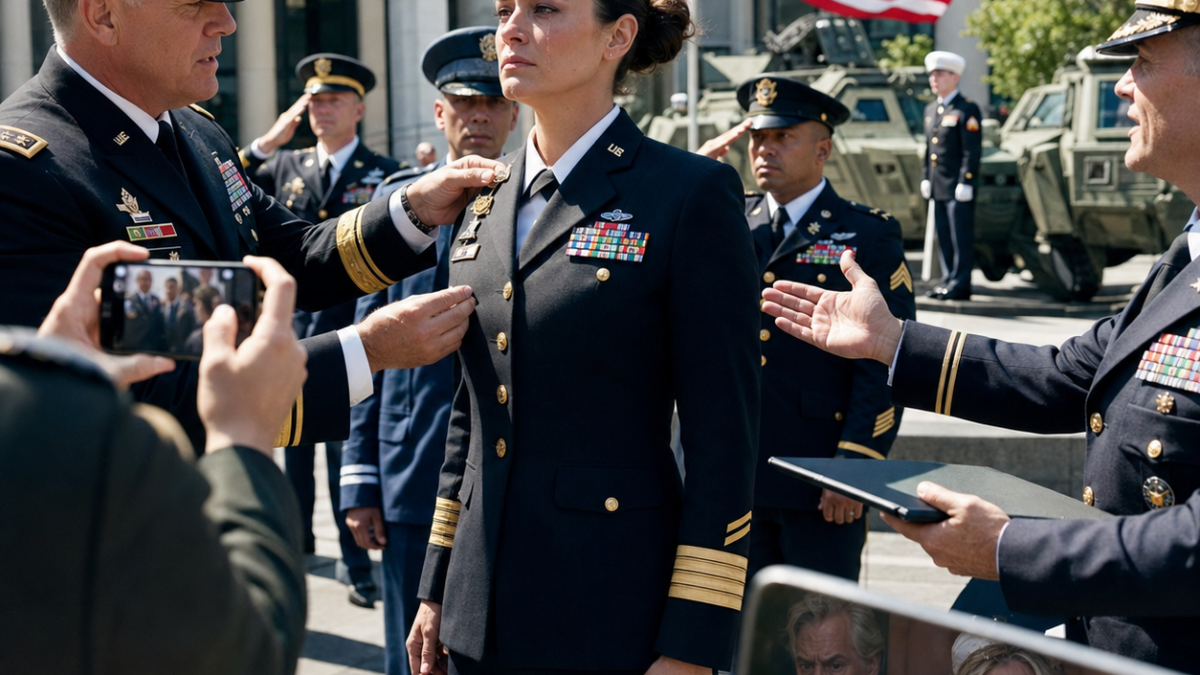
Cold morning. Formal uniform. An award presentation. Brigadier General Thomas Keller shaking my hand after recognizing the work my unit had done.
Someone had taken pictures.
I hadn’t thought about them since.
“So?”
“Dad’s been staring at it forever.”
There was fear in her voice now.
“He keeps asking how long you’ve been a major.”
My hand tightened around the phone.
“Two years.”
Silence.
“He didn’t know,” Olivia said.
That landed harder than I expected.
My own father didn’t know my rank.
Not because I’d hidden it.
Because he’d never asked.
Then Olivia said something even stranger.
“He keeps saying you weren’t supposed to be there.”
I looked toward the dark window.
“Wasn’t supposed to be where?”
“I don’t know.”
Her voice dropped almost to a whisper.
“But, Natalie… there’s something else.”
I waited.
“Dad’s been talking about Grandpa’s estate.”
My chest tightened.
“What about it?”
“He told Ryan you have no claim to anything.”
I stopped breathing for a second.
Because until that moment, I hadn’t known there was anything I was supposed to claim.
And suddenly Dad’s panic over one harmless photograph didn’t feel harmless at all.
### Part 2
My grandfather, Henry Mercer, had been the kind of man who wore the same brown leather belt until the holes stretched out and refused to replace a lawn mower if he could repair it himself.
He wasn’t flashy.
But he had done well.
He owned a hardware business for decades, bought property carefully, saved even more carefully, and never discussed money unless he thought someone was being foolish with it.
When Olivia and I were little, he’d slip us small bills and say, “Spend half. Save half. That’s how you learn which half mattered more.”
After he died, Dad handled everything.
At least, that’s what we’d been told.
I had been overseas when most of the estate paperwork was settled. I signed one routine acknowledgment that arrived through certified mail, exchanged a few stiff phone calls with my parents, and assumed whatever Grandpa had owned had gone where he wanted it to go.
It never occurred to me that I should investigate my own family.
That was my first mistake.
“What exactly did Dad tell Ryan?” I asked Olivia.
Ryan was her fiancé—technically her husband in six days, assuming no one else got deleted from the guest list before then.
“He said Grandpa’s money was already settled. Ryan asked if there was anything I needed to know financially before we got married.”
“That sounds reasonable.”
“I know.”
“And Dad brought me up?”
“Immediately.”
That bothered me.
“Why?”
“I don’t know.”
Olivia hesitated.
“He said, ‘Natalie’s handled. She doesn’t have a claim on this.’”
Handled.
The word made something cold settle behind my ribs.
“Did Ryan ask what that meant?”
“He tried. Dad shut him down.”
Outside my quarters, headlights swept briefly across the wall and disappeared.
I said, “Olivia, I need you to answer something honestly.”
“Okay.”
“Did Dad give you money for your house?”
Silence.
Then, “Yes.”
“How much?”
“I don’t know if I should—”
“I’m not angry at you.”
“You sound angry.”
“I am. I’m just not sure at who yet.”
She exhaled shakily.
“It was enough for most of the down payment. Dad said it was family money he’d set aside.”
“Did he say Grandpa’s money?”
“No.”
“Did you sign anything?”
“No.”
That mattered.
I got out a notebook.
“Anything else?”
“What are you doing?”
“Trying to understand the shape of the problem before I decide how big it is.”
That was the Army talking.
Information first.
Emotion later.
“I think Dad’s scared,” Olivia said.
“Of what?”
“I don’t know.”
Neither did I.
But people don’t panic over a photograph for no reason.
The next morning, instead of calling my father, I called an estate attorney two counties away from my parents.
Her name was Rebecca Sloan.
No relationship to my family.
No hometown connection.
No reason to protect anyone.
I told her I needed someone to explain public estate records and trust documents in plain English.
“Do you suspect fraud?” she asked.
“I suspect I don’t know enough to suspect anything yet.”
She liked that answer.
“Good. Let’s keep it that way until the documents tell us otherwise.”
I spent the next two nights building what looked embarrassingly like a case file.
Probate records.
Property filings.
Old business registrations.
Trust references.
Dates.
Names.
Signatures.
Most of it was dull enough to make my eyes burn.
Then I found Grandpa’s will.
I read it once.
Then again.
Then I called Rebecca.
“My sister and I are named equally.”
“Yes.”
“Equal beneficiaries.”
“Yes.”
“Not my father.”
“Not of the trust you’re looking at.”
I stared at the screen.
The document was painfully clear.
Grandpa had created a trust funded partly from the sale of his business.
Half for Olivia.
Half for me.
But several years after his death, control had shifted into a family fund.
The administrator?
Grant Mercer.
My father.
Sole signatory.
“Is that normal?” I asked.
“It can be.”
“Can he move the money?”
“That depends on the governing documents.”
So I kept digging.
And then I found a withdrawal.
It was large enough that I leaned closer to the screen as though proximity might change the number.
The transaction date looked familiar.
I pulled up another record.
Olivia’s house purchase.
The dates were almost identical.
The room seemed to go very quiet.
My father hadn’t given Olivia his money.
He had given her ours.
And before I had time to fully process that betrayal, Rebecca called back.
“Natalie,” she said, “I found something else.”
Her voice had changed.
“This fund isn’t finished.”
### Part 3
I didn’t call Olivia immediately.
I needed to know what I could say without turning suspicion into accusation.
Rebecca sent me another packet of records, and I printed them at the small desk in my quarters.
The printer rattled loudly in the otherwise quiet room.
One page.
Then another.
Then another.
There, buried behind several routine filings, was a reference to a pending distribution.
No completed signature.
No final execution.
But clearly prepared.
And much larger than the money that had gone toward Olivia’s house.
I called Mom.
She answered on the second ring.
“Natalie.”
The way she said my name told me she’d been expecting me.
“Did Dad use Grandpa’s trust money for Olivia’s house?”
A long pause.
Then she sighed.
“Your father wanted to give her a fresh start.”
“That wasn’t my question.”
“He didn’t think of it as taking from you.”
I closed my eyes.
That sentence told me more than any confession could have.
“What was I supposed to receive?”
Nothing.
Just silence.
“Mom?”
“You were doing well.”
I laughed once.
There wasn’t any humor in it.
“So because I had a career, my half stopped being mine?”
“That’s not how he saw it.”
“Then how did he see it?”
“You didn’t need help the way Olivia did.”
My grip tightened around the phone.
“I didn’t realize ownership depended on need.”
“Natalie, please don’t turn this into something ugly before the wedding.”
There it was.
Not “You’re wrong.”
Not “There must be a mistake.”
Don’t make it ugly.
Meaning she knew.
Maybe not everything.
Enough.
“Is there another transfer pending?”
Her breathing changed.
“Mom.”
“Your father mentioned finalizing some family things.”
“When?”
“Before the wedding, I think.”
That sentence sent me back to the documents.
Now that I knew what to look for, I found it.
A prepared transaction.
A large one.
The paperwork referenced Grandpa’s original trust and contained signature spaces for both beneficiaries.
Olivia.
And me.
Mine was empty.
I called Rebecca.
“Can Dad execute this without me?”
“Not cleanly.”
“What does that mean?”
“It means if the underlying documents require beneficiary authorization, your signature matters.”
“And if someone tried to move it anyway?”
“Then we would have a much more serious conversation.”
I looked again at Dad’s text.
“Don’t come to your sister’s wedding. The guest list is final.”
For the first time, I wondered if the wedding itself had never been the point.
Maybe he needed me away.
Maybe he needed a room full of relatives hearing his version before I could tell mine.
Maybe he planned to put paperwork in front of Olivia while she was distracted, newly married, exhausted, surrounded by people who trusted him.
Or maybe I was giving him too much credit and his motives were simply petty.
I didn’t know.
Yet.
Saturday arrived warm and bright.
Olivia got married without me.
I worked.
A colleague with two young children had been scheduled that weekend, so I took her shift.
It gave me somewhere useful to put my attention.
My phone stayed face down most of the day.
I didn’t look at photographs.
I didn’t imagine Olivia walking down the aisle.
I didn’t wonder whether my mother had glanced at the empty space where I should have been.
Then, that evening, Olivia sent me one message.
“I’m sorry.”
I stared at it.
Before I could respond, another arrived.
“Dad told everyone you couldn’t get leave.”
That one hurt.
Because exclusion was one thing.
Rewriting my absence into my fault was another.
Later, Olivia told me exactly how it happened.
A cousin had asked, “Where’s Natalie?”
Dad had smiled.
“Natalie couldn’t get leave. You know how the Army is.”
Easy.
Smooth.
Believable.
Then somebody joked, “You two still fighting?”
Dad’s smile apparently disappeared.
“She cares more about the Army than family.”
That was the story he needed everyone to carry home.
I had abandoned them.
Again.
Except this time Olivia knew it was a lie.
She knew my leave had been approved.
She knew he’d told me not to come.
And she said that was the first moment on her wedding day when she looked at our father and wondered what else he’d been lying about.
But the real problem began during the reception.
Ryan went into my parents’ office looking for a phone charger.
On Dad’s desk was a manila folder.
One handwritten label.
ESTATE – FINAL.
Ryan wasn’t snooping.
At first.
Then a document slipped partly out when he moved the charger cable.
He saw Olivia’s name.
He saw mine.
And beneath both names, he saw a transfer amount large enough to make him put the charger down.
He didn’t steal the file.
He didn’t photograph it.
He put everything back exactly as he’d found it.
But two days after the wedding, he called me.
And his first sentence told me Dad’s secret had just become much harder to contain.
“Natalie, I think your father is trying to transfer money that doesn’t fully belong to him.”
### Part 4
I had met Ryan Pierce exactly four times.
One Thanksgiving.
One Christmas.
Olivia’s engagement dinner.
And one painfully polite weekend barbecue where Dad spent most of the afternoon explaining to Ryan how a grill worked.
So getting a phone call from my brand-new brother-in-law about suspected estate misconduct wasn’t on my list of expected family milestones.
“I don’t know what you already know,” Ryan said, “so I’m going to tell you exactly what I saw and nothing more.”
That made me trust him more immediately.
No dramatics.
No exaggerated claims.
Just facts.
He described the folder.
The reference to Grandpa’s trust.
The pending transfer.
The empty signature line.
“Did you confront Dad?”
“Yes.”
Of course he had.
Ryan had always seemed calm, but he wasn’t passive.
“What happened?”
“He told me it was a family matter.”
Despite everything, I almost smiled.
“What did you say?”
“I told him, ‘It becomes my matter when my wife’s inheritance is involved.’”
“And?”
“He told me to stay out of it.”
That sounded exactly like Dad.
Control first.
Explanation never.
“Ryan, does Olivia know you called me?”
“Yes.”
That surprised me.
Then I heard movement on his end.
“Natalie?”
Olivia’s voice.
She’d been there.
“I found the document myself this morning,” she said.
My stomach tightened.
“Where?”
“On the printer in Dad’s office.”
“Seriously?”
“I think Mom printed something for him and forgot it was there.”
Of all Dad’s carefully managed secrets, it might ultimately have been a printer tray that betrayed him.
“I read everything.”
Her voice trembled.
“Natalie, your signature was supposed to be on it.”
“I know.”
“You knew?”
“For a few days.”
“And you didn’t tell me?”
“I wasn’t going to accuse Dad before I understood what I was looking at.”
She went quiet.
Then she said, “The money for my house came from that fund, didn’t it?”
There are moments when lying would be kinder.
That doesn’t make lying right.
“Yes.”
Olivia started crying.
Not loudly.
That almost made it worse.
“He told me it was his.”
“I know.”
“I never would’ve taken it.”
“I know that too.”
“What if I stole from you without knowing it?”
“You didn’t steal anything.”
“But I benefited.”
“Yes.”
I wouldn’t lie about that either.
She sat with it.
I could hear Ryan speaking softly to her, too low for me to make out the words.
Then Olivia said, “Dad wants us over Sunday.”
“For what?”
“To ‘clear the air before things get out of hand.’”
I leaned back in my chair.
That phrase was pure Grant Mercer.
Translation: come into my territory so I can control the conversation.
“Are you going?”
“Yes.”
“Good.”
A pause.
Then I said, “So am I.”
Olivia didn’t hesitate.
“I was hoping you’d say that.”
Dad hadn’t invited me.
That mattered less than he thought it did.
Sunday morning, I drove three hours toward the house where I’d grown up.
The farther south I went, the more familiar everything became.
The gas station where Dad used to buy coffee before taking us fishing.
The church Mom attended.
The diner where Olivia once threw a milkshake at me when we were teenagers and then laughed so hard she cried.
Memories have terrible timing.
They arrive when you’re trying to stay angry and remind you that people are rarely monsters in every chapter of your life.
Dad had taught me to ride a bicycle.
He’d sat beside me through a broken wrist.
He’d once driven through a thunderstorm to get me from summer camp because I’d called home sick.
None of that disappeared.
Neither did what he’d done.
Both could be true.
That’s the hardest thing about family betrayal.
You aren’t usually betrayed by a stranger.
You’re betrayed by someone whose good memories are still sitting beside the bad ones.
Olivia opened the door before I knocked.
Her eyes were tired.
“Dad doesn’t know you’re coming.”
“I assumed.”
“Mom does.”
That stopped me.
“What did she say?”
“Nothing.”
Of course.
The living room smelled like coffee and furniture polish.
Dad stood near the window.
Ryan sat beside Olivia.
Mom hovered at the kitchen entrance.
The moment Dad saw me, his face changed.
Only for a second.
Surprise.
Then irritation covered it.
“You weren’t invited.”
I placed my bag on the coffee table.
His jaw tightened.
“And yet somehow,” he said, “you’re still the one causing problems.”
I unzipped the bag.
“No, Dad.”
I pulled out Grandpa’s will.
Then the trust records.
Then the house withdrawal.
Then the pending transfer.
“I brought the problems with me.”
His face went pale.
And for the first time since his text, I realized something.
He had expected anger from me.
He had not expected evidence.
### Part 5
Nobody touched the documents at first.
I arranged them across the coffee table in chronological order.
Grandpa’s will.
The original trust.
The restructuring.
The withdrawal linked to Olivia’s house.
The pending transfer.
Dad watched my hands.
Not my face.
That told me he already knew what every page said.
“Let’s stop talking about feelings,” I said. “Let’s talk about paperwork.”
Dad gave a humorless laugh.
“You hired a lawyer against your own family?”
“I hired someone to read documents.”
“Same thing.”
“No. It isn’t.”
Olivia picked up Grandpa’s will.
I watched her eyes move down the page.
Equal shares.
Equal beneficiaries.
Equal.
Such a simple word.
Apparently one my family had spent years complicating.
She looked at Dad.
“You told me the house money was yours.”
“It was family money.”
“That isn’t what you told me.”
“I was trying to help you.”
“With Natalie’s money?”
“With money neither of you was using.”
I stared at him.
There it was.
The logic.
Ugly because it almost sounded reasonable if you didn’t look too closely.
“You decided I wasn’t using it,” I said.
“You didn’t need it.”
“You don’t know what I needed.”
“You had a salary. A career. Benefits. Olivia was trying to start her life.”
Something inside me finally settled.
For years, I’d wondered why success never seemed to buy me approval.
Now I understood.
My independence hadn’t impressed him.
It had become permission.
Permission to exclude me.
Permission to take from me.
Permission to assume I’d survive anything because I always had before.
Olivia’s voice sharpened.
“You don’t get to make her being capable into a reason to cheat her.”
Dad turned toward her.
His expression changed.
He hadn’t expected that either.
“She has always been jealous of you.”
I almost laughed.
There was the old weapon.
When facts failed, divide the sisters.
Olivia stood up.
“Stop blaming her.”
Dad blinked.
Even Mom looked up.
Olivia held the will in one hand.
“You told me she didn’t care about us. You told me she stayed away because she thought she was better than everyone. You told everyone at my wedding that she couldn’t get leave.”
“She couldn’t.”
Olivia stared at him.
“Yes, she could.”
Silence.
Dad looked at me.
I said nothing.
Olivia continued.
“She showed me the approval.”
I’d sent her a screenshot the morning after the wedding lie.
Dad’s mouth tightened.
“You’re taking her side now?”
Olivia shook her head.
“No. I’m taking the truth’s side.”
Dad’s anger shifted to me.
“You think that uniform makes you better than us?”
I’d heard versions of that sentence my entire adult life.
I looked down at my civilian clothes.
“I didn’t even wear it here.”
“You know what I mean.”
“Yes.”
I held his gaze.
“And no. The uniform doesn’t make me better than anyone.”
He opened his mouth.
I continued.
“But it did teach me something useful.”
“What?”
“Rank doesn’t matter when you’re wrong.”
Ryan looked away, hiding what might have been a smile.
Dad didn’t.
His face hardened.
Mom finally stepped out of the kitchen.
“Grant.”
He snapped, “Stay out of this, Elaine.”
“No.”
One word.
Soft.
But after decades of hearing her avoid conflict, it sounded enormous.
Dad turned.
Mom’s hands were trembling.
“I knew about the house money.”
Olivia closed her eyes.
Mom continued.
“I told myself you were helping one daughter because the other didn’t need help. I told myself Natalie would understand.”
I looked at her.
“Did you ever plan to tell me?”
Her eyes filled.
“No.”
I appreciated the answer precisely because it hurt.
No excuses.
No rewriting.
Just truth.
Dad started pacing.
“This whole thing is being blown out of proportion.”
Ryan finally spoke.
“There’s still a pending transfer.”
“That’s none of your concern.”
“It is when Olivia’s signature is attached to it.”
Dad stopped.
My eyes narrowed.
“Attached?”
Ryan looked at me.
Then Olivia.
Olivia frowned.
“My signature isn’t on the copy I saw.”
Ryan’s expression changed.
“I saw another page in the folder.”
Dad went completely still.
And suddenly every person in that room understood the same thing at once.
There wasn’t just one version of the transfer document.
### Part 6
“Show me,” I said.
Dad stepped between Ryan and the hallway.
“No one is going through my office.”
That was the wrong response.
If he’d laughed, denied it, called Ryan confused—anything—maybe doubt would have survived another minute.
Instead, he guarded the hallway.
Olivia stared at him.
“Dad.”
“No.”
“Is there a version with my signature?”
“I said this matter is handled.”
Ryan stood.
“You told me to stay out because it was a family matter. She’s your daughter.”
He pointed at Olivia.
“So let her see it.”
Dad’s face flushed.
Mom looked suddenly sick.
I stayed seated.
“Nobody needs to search anything.”
Everyone looked at me.
I took my phone from my pocket.
“My attorney already requested a formal accounting.”
Dad’s head snapped toward me.
“You what?”
“The paperwork was filed Friday.”
“You had no right.”
“I am a beneficiary.”
That shut him up.
“The pending transaction will be reviewed,” I continued. “So will previous distributions. Every signature, every authorization, every transfer.”
Olivia’s face went pale.
“If someone signed my name?”
Rebecca had warned me not to make accusations without evidence.
So I answered carefully.
“Then it’ll be examined properly.”
Dad stared at me like I had become a stranger.
Maybe I had.
Or maybe he’d simply never met the version of his daughter who stopped trying to keep him comfortable.
“I was protecting this family,” he said.
“From what?”
“You.”
The room went silent.
Strangely, the word didn’t hurt.
Not anymore.
It clarified.
Dad pointed toward me.
“You come in here with lawyers and documents and military discipline like everything is an investigation. You don’t understand what family requires.”
“Apparently it requires me not attending my sister’s wedding.”
His face twitched.
“That had nothing to do with this.”
Olivia spoke.
“Yes, it did.”
Dad looked at her.
She had tears on her cheeks now, but her voice was steady.
“Why were you so terrified of that photograph?”
Dad’s eyes moved toward me.
The photograph.
We had almost forgotten how this started.
Olivia wiped her face.
“You saw Natalie standing beside General Keller and suddenly you couldn’t stop talking about her. You called me. You called Mom. You complained that she was showing off.”
“I didn’t say that.”
“You said she embarrassed you.”
Dad looked away.
That told us enough.
I thought about the picture.
An ordinary official photograph.
Me in uniform.
General Keller shaking my hand.
Several other officers behind us.
No family context.
No explanation.
Just evidence that somewhere outside the Mercer house, I wasn’t the difficult daughter.
I was respected.
Trusted.
Successful.
And my father hadn’t authored any of it.
“The picture frightened you because you couldn’t control what it said about me,” I said.
He laughed bitterly.
“Don’t flatter yourself.”
“Then explain it.”
Nothing.
“Explain why seeing your daughter receive an award made you angry.”
“I wasn’t angry.”
“You told Olivia I shouldn’t have been there.”
His expression shifted.
Mom whispered, “Grant.”
He sank into the chair near the window.
For the first time, he looked older than I remembered.
“I needed one day,” he said.
Nobody spoke.
“One day where this family wasn’t about Natalie and the Army and people asking questions.”
I almost couldn’t believe what I was hearing.
“My sister’s wedding wasn’t about me.”
“It would have become about you.”
“How?”
“People would’ve asked about the picture. Your promotion. Your career. They would’ve asked why I didn’t know.”
There it was.
Not pride.
Embarrassment.
His embarrassment.
Olivia stared at him.
“So you disinvited her because you were ashamed you didn’t know your own daughter’s rank?”
Dad shook his head.
“It wasn’t only that.”
Of course it wasn’t.
His eyes dropped toward the estate documents.
I understood before he said anything else.
“If I came,” I said slowly, “people might’ve asked questions.”
He didn’t answer.
“Grandpa’s old friends would’ve been there.”
Still nothing.
Mom closed her eyes.
Some of Grandpa’s former business associates and veterans-group friends were extended family acquaintances. People who might remember how his estate had been structured.
People who might hear Dad’s version and say, “That’s not what Henry intended.”
“You weren’t protecting Olivia’s wedding,” I said.
“You were protecting the story.”
Dad whispered, “I never wanted things to go this far.”
And that was the closest thing to a confession we were going to get.
But Olivia wasn’t finished.
She lifted the pending transfer.
“This isn’t happening.”
Dad looked at her.
“Olivia—”
“Not like this. Not anymore.”
Then she turned toward me.
“And neither is pretending we can fix this just because he finally admitted part of it.”
That surprised me.
Because for the first time in our lives, my sister was refusing the easy ending.
### Part 7
The formal accounting changed everything.
Dad tried to call me twice the following week.
I didn’t answer.
He sent a message.
“You’ve made your point. We need to resolve this privately.”
I forwarded it to Rebecca.
Then I deleted it from my screen.
There was nothing private left to resolve.
Privacy was how we’d gotten there.
The pending transfer was frozen before anything moved.
An independent review began.
Dad lost sole control of the family fund while the records were examined.
The process wasn’t dramatic.
No courtroom shouting.
No handcuffs.
No triumphant speech.
Real accountability is usually more boring than people imagine.
Emails.
Certified letters.
Financial statements.
Requests for records.
People in quiet offices asking questions nobody in my family had bothered to ask for years.
Rebecca kept reminding me, “Don’t focus on punishment. Focus on restoration.”
That was what I wanted.
At least financially.
Emotionally, restoration was impossible.
You can return money.
You cannot return a wedding.
You cannot unsay, “Don’t come.”
You cannot retrieve every conversation in which a father reduced one daughter so the other could remain comfortable.
The review confirmed what we already suspected.
Dad had treated the fund like something he had broad moral authority over, even when his legal authority was much narrower.
Money intended equally for Olivia and me had been redistributed according to his own judgment of who “needed” it.
More had gone toward Olivia’s house.
Some had covered other family expenses.
The largest pending transfer never happened.
Olivia was devastated when the final accounting reached us.
She called me that evening.
“I benefited from more than I knew.”
“Yes.”
“You should hate me.”
“No.”
She sounded surprised.
“You don’t?”
“I don’t hate you.”
“Why?”
“Because Dad making decisions for you doesn’t make you responsible for his dishonesty.”
“But I never asked questions.”
“That part is yours.”
She went quiet.
I wasn’t going to absolve her just to make the conversation easier.
“I should’ve asked,” she said.
“Yes.”
“I should’ve asked why you were always missing from things. Why Dad always had an explanation ready.”
“Yes.”
“I should’ve called you before the wedding.”
That one hurt.
“Yes.”
She cried.
I didn’t rush to comfort her.
Some truths deserve room.
Finally, she said, “I’m sorry.”
“I believe you.”
“Can you forgive me?”
I looked out my apartment window.
Cars moved along the road outside base, headlights glowing against the dark.
“I don’t know yet.”
Another silence.
“That’s fair,” she said.
It was the right answer.
Mom came to see me a month later.
We met in a coffee shop halfway between base and home.
She looked smaller somehow.
Not physically.
Just less protected by the version of herself she’d worn for years.
“I spent our whole marriage telling myself your father was difficult but good,” she said.
“He can be both.”
She looked at me.
“I thought keeping the peace helped you girls.”
“It helped Dad.”
Her eyes filled.
“I know.”
For once, she didn’t ask me to understand her.
She didn’t tell me marriage was complicated.
She didn’t say she’d done her best.
She simply apologized.
I accepted the apology.
I did not offer her instant closeness in return.
Those are different things.
Dad remained the hardest part.
The independent trustee permanently replaced him as manager of what remained.
The surviving assets were divided according to Grandpa’s original intent.
Equal shares.
For the first time, Dad couldn’t decide who deserved more.
He called after the decision.
I answered because I wanted the conversation finished.
“You happy now?” he asked.
“No.”
That seemed to confuse him.
“You got what you wanted.”
“I got what Grandpa wanted.”
“Same difference.”
“No.”
Silence.
Then he said, “I did everything for this family.”
“Except listen to me.”
“You never needed anybody.”
I almost laughed.
There it was again.
The excuse underneath everything.
“I needed a father.”
He said nothing.
“I needed one who knew what rank I held. One who could ask instead of assume. One who wouldn’t punish me for becoming self-sufficient.”
His breathing grew heavier.
“So that’s it?”
“Yes.”
“You’re cutting me off?”
“For now, completely.”
“Over money?”
“No.”
I looked at the old wedding message still saved in my phone.
“Over the fact that you erased me and then lied about why.”
He tried to interrupt.
I didn’t let him.
“You thought strength meant I could absorb whatever you did and still come back when called.”
Then I said the words that finally ended it.
“You were wrong.”
And I hung up before he could issue another ruling.
### Part 8
Life after a family explosion is surprisingly ordinary.
Monday still comes.
Laundry still piles up.
Meetings still start whether your father speaks to you or not.
I went back to work and fell into the rhythm that had carried me through harder things than family dinners.
Morning briefings.
Training schedules.
Personnel issues.
Coffee that tasted burnt no matter which machine it came from.
People who knew me as Major Natalie Mercer and had no idea that somewhere three hours away, my childhood family was learning how to exist without one person controlling every version of the truth.
Olivia and I rebuilt slowly.
Not back.
Forward.
That distinction mattered.
We didn’t pretend we’d suddenly become sisters from a movie, calling every night and finishing each other’s sentences.
Sometimes weeks passed between conversations.
But the conversations we did have were real.
She told me when she and Ryan were having problems adjusting to married life.
I told her when an assignment scared me more than I wanted to admit.
She stopped asking Dad what I thought.
She started asking me.
The first Christmas after everything happened, she mailed me a photograph from her wedding.
I stared at it for a long time.
Olivia and Ryan beneath strings of white lights.
Mom beside them.
Dad smiling at the camera.
An empty space at the edge where I might have stood.
On the back Olivia had written:
“I wish you were in this.”
I placed the photograph in a drawer.
Not because I hated her.
Because I wasn’t ready to look at it every day.
A year after the wedding, I returned home for Thanksgiving.
Not to reconcile with Dad.
I want to make that clear.
I went because Olivia invited me.
Her house had changed since I’d last visited.
Ryan had built shelves in the dining room.
There were herbs growing on the kitchen windowsill.
And on the table, holding fresh autumn branches, were the hand-blown glass vases I’d bought for her wedding.
The gift I’d almost returned.
I touched one lightly.
“You kept them.”
Olivia smiled.
“Of course.”
Then her expression changed.
“I know that doesn’t fix anything.”
“No.”
“I know.”
That was what I liked about our relationship now.
Nobody rushed to make pain smaller.
The table was set for six.
Ryan.
Olivia.
Mom.
Me.
An aunt.
One cousin.
There was an empty chair near the end.
“Where’s Dad?” I asked.
Olivia glanced toward Mom.
Mom answered.
“He decided not to come.”
I understood immediately.
“He knew I’d be here.”
“Yes.”
A strange feeling moved through me.
Not victory.
Not satisfaction.
Something quieter.
For most of my life, I had been the person removed to make Dad comfortable.
This time, nobody had asked me to disappear.
He had made his own choice.
Olivia touched my arm.
“I told him you were invited whether he liked it or not.”
I looked at her.
“And?”
“He said he wouldn’t sit at a table with someone who had humiliated him.”
I almost smiled.
“What did you say?”
Her mouth twitched.
“I said, ‘Then don’t come.’”
We both laughed.
It wasn’t cruel laughter.
It was release.
Dinner was messy and loud.
Ryan burned the rolls.
Mom brought a pie nobody could cut without destroying the crust.
My cousin asked whether Army food was really as terrible as people claimed.
Nobody whispered around me.
Nobody treated my presence like an inconvenience.
After dinner, Olivia and I stood outside on the back porch with coffee.
Cold air moved through the yard.
She leaned against the railing.
“I used to think Dad protecting me meant he loved me more.”
I said nothing.
“Now I think maybe he protected me because I was easier to control.”
“That could be part of it.”
“He made you the difficult daughter.”
“Yes.”
“And me the good daughter.”
“Yes.”
She looked at me.
“I don’t want either job anymore.”
That made me smile.
“Good.”
She stared toward the lit windows.
“Do you think you’ll ever forgive him?”
I thought carefully.
“I don’t spend every day angry anymore.”
“That wasn’t what I asked.”
“I know.”
I looked at her.
“No. Not in the way he wants.”
Dad wanted forgiveness to mean restoration.
A reset.
An invitation back into my life without consequences.
I could let go of the anger without giving him that.
“I hope he has a good life,” I said. “I just don’t need to be part of it.”
Olivia nodded.
There was sadness in her face.
But no argument.
And that was enough.
Then Ryan opened the back door.
“You two coming inside? Your mother is accusing me of murdering the pie.”
Olivia smiled.
“We’re coming.”
As I stepped toward the door, I glanced once at the empty chair through the dining room window.
For years, Dad had taught me that whoever controlled the invitation controlled the family.
He’d been wrong about that too.
### Part 9
Several months later, General Keller visited our installation for a leadership event.
I hadn’t thought about the old photograph in a while.
Apparently he remembered it.
After the event, he shook my hand and said, “Mercer, your unit still making the rest of us look good?”
“Trying, sir.”
A public affairs officer took another photograph.
This time, when the camera flashed, I laughed.
General Keller looked at me.
“Something funny?”
“Old family story, sir.”
“The dangerous kind?”
“Aren’t they all?”
He smiled.
The photo was posted publicly the next day.
I saw it while eating breakfast.
For a moment I wondered if Dad would see it.
Then I realized I didn’t care.
That was the final freedom.
Not winning.
Not proving him wrong.
Not imagining him staring at a screen and regretting everything.
Just not caring whether he saw me anymore.
Olivia called that weekend.
“Dad saw the new photo.”
I almost laughed.
“Of course he did.”
“He didn’t say anything about it.”
“Good.”
“He asked Mom whether you’d been promoted again.”
I looked down at my coffee.
“No.”
“He asked her what you actually do.”
That stopped me.
After all those years.
Finally asking.
Too late.
Olivia seemed to know what I was thinking.
“I told Mom not to answer for you.”
“Thank you.”
“He could ask you himself.”
“He could.”
“But you’d probably ignore him.”
“Yes.”
She laughed softly.
“Fair.”
Dad eventually sent a letter.
A real letter.
My name written across the envelope in the same handwriting I’d seen on birthday cards when I was little.
I left it unopened for three days.
Then I read it.
He wrote that he’d made mistakes.
That he had been afraid of losing his place in the family.
That he’d convinced himself my independence meant I didn’t need the things Olivia needed.
That seeing the photograph had forced him to realize how little he knew about my life.
He said he regretted the wedding.
He asked for another chance.
I folded the letter.
Then I put it back in the envelope.
I didn’t answer.
Maybe some people would call that cold.
Maybe they believe every apology deserves reconciliation.
I don’t.
An apology can be sincere and still arrive after the relationship it was meant to save has ended.
I believed Dad regretted what he’d done.
I also believed regret was something he needed to learn to live with.
Just like I’d learned to live with his choices.
That winter, I received orders for a new assignment.
A bigger responsibility.
A new state.
A clean apartment waiting somewhere I’d never lived.
Olivia helped me pack.
At one point she found the green dress I’d bought for her wedding.
It was still in the garment bag.
She held it up.
“You never wore this?”
“No.”
She smiled sadly.
“It’s pretty.”
“It is.”
“What are you going to do with it?”
I considered that.
Then I took it from her.
“Wear it somewhere better.”
A few months later, I did.
Not to a wedding.
Not for revenge.
Not beside some man inserted into the ending because apparently a woman needs romance to prove she’s happy.
I wore it to a formal unit dinner celebrating a successful year with people who knew exactly what I’d contributed.
Someone took a photograph.
I stood between two officers I’d served beside for years, laughing so hard my eyes were nearly closed.
No general.
No dramatic salute.
No family secret hiding behind the frame.
Just me.
When Olivia saw it, she texted:
“That dress finally got the night it deserved.”
I wrote back:
“So did I.”
Sometimes I think about Dad’s original message.
“Don’t come to your sister’s wedding. The guest list is final.”
At the time, I thought he’d taken something from me.
And he had.
I’ll never get that day back.
I’ll never know what it would’ve felt like to stand beside Olivia while she got ready, straighten her veil, or cry when she said her vows.
Some losses stay losses.
But being excluded also forced me to see the family more clearly than I ever had from inside it.
Dad had believed belonging was something he distributed.
Approval to Olivia.
Distance to me.
Money where he thought it should go.
Invitations when they served his version of events.
He was wrong.
A chair at somebody’s table is not the same thing as belonging.
And being excluded from one room doesn’t mean you’re alone.
Sometimes the person telling you not to come isn’t protecting the celebration.
They’re protecting themselves from what might happen if you arrive carrying the truth.
My grandfather’s estate is managed independently now.
Olivia and I receive exactly what he intended us to receive.
Mom and I speak occasionally. Our relationship is cautious but real.
Dad and I do not speak.
I don’t hate him.
I don’t spend my nights imagining ways to punish him.
I simply stopped giving him access to a life he’d spent years refusing to know.
And strangely, that has been more peaceful than forgiveness ever could have been.
The last time Olivia visited me, we sat on my balcony after dinner, talking until the city lights blurred into the darkness.
She asked, “Do you ever wish none of it happened?”
I thought about the wedding.
The money.
The photograph.
Dad’s letter.
Then I thought about the relationship Olivia and I had finally built without him standing between us, assigning our roles.
“Yes,” I said. “I wish he hadn’t done it.”
She nodded.
“But?”
“But I don’t wish I were still the person who would’ve accepted it.”
Olivia smiled.
Neither of us said anything for a while.
We didn’t need to.
My father once believed he could decide who belonged in the family by deciding who got invited into the room.
What he never understood was that eventually I would build a life with doors he didn’t control.
And when I finally did, I didn’t lock him out for revenge.
I simply stopped holding them open for someone who had spent years telling me I wasn’t welcome.
THE END!
Disclaimer: Our stories are inspired by real-life events but are carefully rewritten for entertainment. Any resemblance to actual people or situations is purely coincidental.








