Cop Handcuffed a Tired Nurse for “Disrespect” — 8 Minutes Later, a Pentagon Chopper Landed
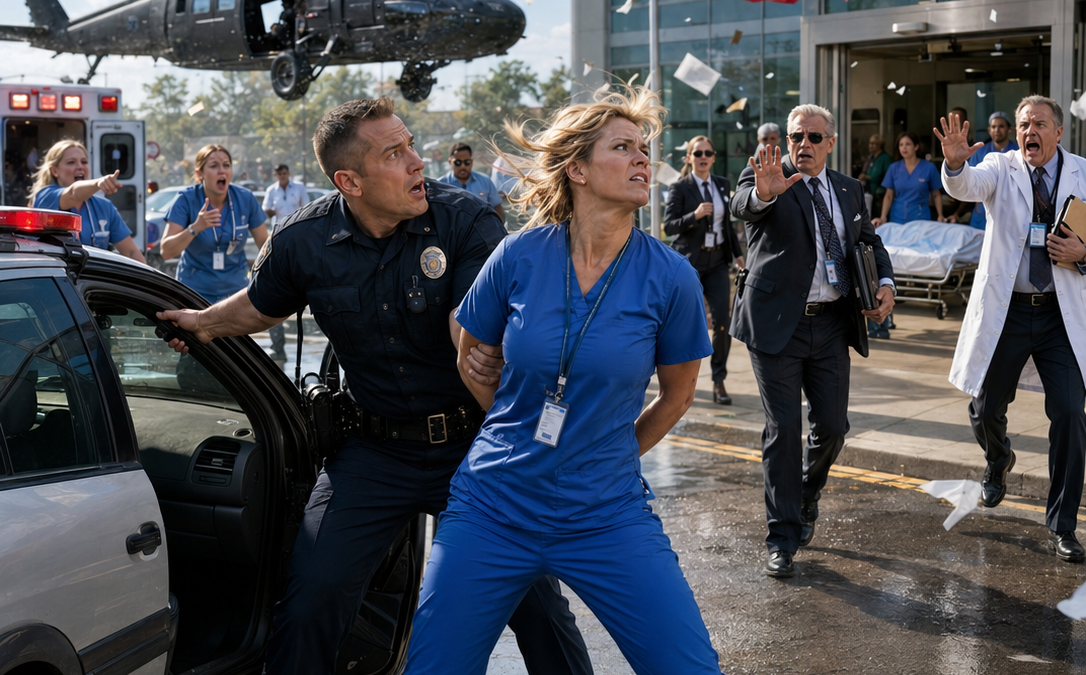
“Sweetheart, you are interfering with a felony investigation,” Officer Kellan sneered after I refused to draw blood from an unconscious trauma patient without legal authorization. When I said no again, he twisted my arm behind my back, tightened handcuffs around my wrists, and marched me through my own emergency department while patients and nurses watched. Then, as he shoved me into his cruiser, the pavement began to shake. A matte-black helicopter descended outside the hospital, and armed federal personnel stepped out. Kellan thought he had arrested a stubborn nurse. He had no idea whose life I had just protected.
### Part 1
Fluorescent lights do not buzz the way people say they do. They hum. It is lower than a buzz, meaner than a whisper, the kind of sound that gets behind your eyes after midnight and stays there until you forget what silence feels like.
By 2:15 on Tuesday morning, I had been inside St. Cormac’s emergency department for fourteen hours.
My name is Maren Vale. I was thirty-four years old then, a charge nurse with a bad lower back, a coffee habit I called “survival,” and a pair of navy scrubs that had started the shift clean and ended up stained with iodine, saline, and something rust-colored I hoped was not as bad as it looked.
The ER had been eating people alive all night.
A toddler with a fever. A teenager with a broken collarbone from a football tackle. A drunk man who kept calling me “princess” until he vomited on his own shoes. A grandmother who held my wrist and whispered, “Please don’t let me die alone,” while her daughter was still stuck in traffic.
People think nurses get used to that.
We do not.
We just learn how to keep moving.
The radio on the charge desk cracked through the noise.
“St. Cormac’s, inbound trauma. Male, mid-fifties. Unconscious. Significant crush injury to chest and left side. Vitals unstable. ETA two minutes.”
I closed my eyes for half a second, then opened them again.
“Bay Three,” I called. My voice sounded like sandpaper. “Rapid infuser ready. Respiratory on standby. Someone page Dr. Selwyn. Let’s move.”
My friend Tessa, the night charge from step-down who had come to help because we were drowning, looked over at me and mouthed, “You okay?”
I gave her a thumbs-up.
It was a lie, but in the ER, lies like that are a kind of teamwork.
The ambulance doors slammed open before anyone had time to breathe.
The paramedics rushed in with a gurney between them, their boots squeaking across the polished floor. The man on the stretcher looked less like a person and more like a disaster wrapped in a torn black suit. His face was cut from shattered glass. His shirt had been ripped open. His chest rose wrong, one side moving like it was trying to remember how lungs worked.
“Driver of a black sedan,” the lead medic said, rattling off details fast. “T-boned at Fifth and Carver by a commercial truck. No wallet. No ID. Phone smashed. We got weak pulses, pressure dropping, left chest trauma, decreased breath sounds.”
“On three,” I said, grabbing the sheet. “One, two, three.”
We moved him from stretcher to bed in one practiced heave.
After that, time folded in on itself.
People imagine medicine as calm white coats and gentle voices. Trauma medicine is not that. Trauma medicine is controlled chaos with sharp objects. It is cutting away a stranger’s clothes while strangers shout numbers. It is pushing air into lungs that forgot their job. It is needles, tubes, pressure bags, gloved hands, and the awful rhythm of a monitor that keeps threatening to turn into a flat scream.
I did not look at the man’s face for long. Faces could make you hesitate.
I looked at his chest. His color. His pressure. His pupils. The way his left side barely lifted when the ventilator pushed air into him.
“Chest tube tray,” Dr. Selwyn said.
“Already open,” I replied.
He glanced at me once, grateful and grim.
For twenty-six minutes, we fought for that man.
We intubated him. Packed wounds. Started fluids. Adjusted medication. Got his pressure from terrifying to merely bad. He was still on the edge, but he was on our side of the edge.
Barely.
At 2:43 a.m., I peeled off my gloves. They snapped at my wrists, damp and sticky. I dropped them into the red bin and stared down at my hands for one second longer than I should have.
They were trembling.
Not enough for anyone else to notice.
Enough for me.
Tessa leaned close. “Maren, go drink water.”
“I’ll chart first.”
“You always say that.”
“And I always mean it for about thirty seconds.”
She almost smiled.
That was when I heard the footsteps.
Heavy. Slow. Confident.
The kind of footsteps that did not belong in a trauma bay unless the person making them had no idea what room they had entered.
A police officer stepped through the doors of Bay Three like he owned the hospital.
He was young, late twenties maybe, broad in the shoulders, with a stiff uniform, polished boots, and the kind of haircut men choose when they want strangers to understand they like rules. His badge read D. KELLAN.
He looked around the trauma bay, then at me.
“I need blood drawn from your John Doe,” he said.
No “excuse me.” No “can I speak with someone?” No attempt to lower his voice around an unconscious critical patient.
Just a command.
I was too tired to be impressed.
“He’s unconscious,” I said, looking back at the monitor.
“I can see that.”
“Then you can also see he’s unstable.”
Officer Kellan’s jaw flexed. “We believe he caused a serious collision. I need a blood alcohol test.”
I picked up my tablet and tapped in the last medication change. “Is he under arrest?”
“He’s unconscious.”
“Do you have a warrant?”
His eyes narrowed, like I had insulted his mother.
“I don’t need a warrant.”
I finally looked at him fully.
There are moments in an ER when the air shifts before the disaster actually happens. You feel it under your skin. The same way you feel a storm before rain hits pavement.
This was one of those moments.
“You do,” I said. “Unless he can consent, unless he is formally under arrest under the correct conditions, or unless you have a judge’s order. Hospital policy is very clear.”
“I’m not here for a lecture.”
“And I’m not here to collect evidence for you.”
The room got quiet.
Too quiet.
Even the hum of the lights felt like it had leaned closer to listen.
Officer Kellan stepped toward me, and I caught the smell of cold air, cheap cologne, and coffee gone stale in a paper cup.
“Listen carefully,” he said. “I’m conducting an investigation. You’re going to draw the blood.”
I pointed my pen toward the man on the bed.
“My job is to keep him alive. Your job is to get a warrant.”
His face changed then.
Not dramatically. Not like in movies.
It was smaller than that. Meaner.
A flush crept up his neck. His eyes hardened. His mouth went flat.
He was not used to being told no, especially not by a tired woman in stained scrubs.
And I realized, too late, that Officer D. Kellan had not walked into my trauma bay looking for cooperation.
He had walked in looking for obedience.
### Part 2
I had dealt with difficult police officers before.
Most were fine. Some were kind. A few had held pressure on wounds, helped calm panicked families, or stood quietly by while we worked on people who had screamed at them fifteen minutes earlier.
Then there were men like Kellan.
Men who treated every room like a courtroom where they were judge, witness, and executioner.
“I am ordering you,” he said, “under the authority of the city police department, to draw that blood.”
A resident named Jamie stood near the monitor, pretending to adjust a line that did not need adjusting. His eyes flicked from me to the officer and back again.
He was twenty-seven, brilliant, and still new enough to believe reason could stop unreasonable people.
I knew better.
“Officer,” I said, forcing my voice to stay calm, “your department has an agreement with this hospital. It’s in writing. I can show it to you.”
“I don’t care about hospital paperwork.”
“That paperwork exists because of constitutional law.”
His upper lip curled. “You nurses think you run everything.”
I almost laughed.
Not because it was funny, but because my feet hurt so badly I had gone past pain into some glittery outer ring of exhaustion where absurdity felt dangerous.
“No,” I said. “We run the things keeping people alive. That is enough.”
I opened the drawer under the workstation and pulled out the laminated policy card we kept exactly for nights like this. I placed it on the counter between us.
“Read this. Call your supervisor. Call the hospital administrator. Call a judge. But until you bring me legal authorization, nobody draws evidence blood from my patient.”
He did not look at the card.
He looked at me.
That was when I understood the policy did not matter to him. The law did not matter either. The patient, unconscious and breathing through a tube, mattered least of all.
What mattered was that two techs, one resident, a respiratory therapist, and Dr. Selwyn had all heard me tell him no.
Kellan leaned closer.
“Sweetheart,” he said softly.
Behind him, Tessa’s face snapped up.
I felt my spine go cold.
There are words that do more than insult you. They reveal the entire shape of the person saying them.
“Sweetheart,” he repeated, “you are interfering with a felony investigation.”
“My name is Maren Vale. You can use it.”
“Draw the blood.”
“No.”
One syllable.
Flat. Final.
I turned away from him to check the norepinephrine drip.
That was the moment that broke him.
I felt it before I saw it, the way the room tightened. Jamie took a half-step back. Tessa muttered, “Oh, hell no,” under her breath. Dr. Selwyn looked up from the ultrasound machine.
Kellan reached for his radio.
“Dispatch,” he said, his eyes still on me. “I have hospital staff obstructing an active investigation. Send a supervisor and an additional unit to St. Cormac’s ER.”
I turned slowly.
“Are you serious?”
He smiled without warmth.
That smile was the first thing that scared me.
Not the radio. Not the uniform. The smile.
Because it told me he was enjoying this.
“I gave you a lawful order,” he said.
“No. You gave me an illegal demand.”
“You’re under arrest.”
The room stopped.
For a second, nobody moved.
Somewhere down the hall, a patient coughed. A printer spat out labels. The ventilator gave its steady hiss-click beside the bed.
Then Dr. Selwyn said, “Officer, don’t be ridiculous.”
Kellan ignored him.
I placed my tablet on the counter very carefully. “I am the charge nurse responsible for a critical trauma patient. You are not arresting me because I refused to violate hospital policy.”
“Turn around.”
“No.”
“Turn around now.”
Tessa stepped forward. “Maren, I’m calling security.”
Kellan’s head snapped toward her. “You stay out of this.”
I lifted my hands, palms out, not touching him, not moving toward him, just trying to slow the entire room down.
“Officer Kellan,” I said, “think very carefully about what you’re doing.”
He closed the distance in two strides.
His hand locked around my right wrist.
The pressure was immediate and shocking. Not a guiding grip. Not professional restraint. Pain shot up my arm so fast my breath caught.
“Don’t,” I gasped. “You’re hurting me.”
“Stop resisting.”
“I’m not resisting.”
He twisted my arm behind my back.
My shoulder screamed.
It is a strange thing, being hurt in the place where you spend your life healing people. Your brain refuses to accept it at first. The trauma bay was my room. My monitors. My supply drawers. My patient. I knew which cabinet stuck, which oxygen port hissed, which wheel on which stretcher pulled left.
And suddenly I was bent forward against the metal counter, cheek inches from a stack of gauze, with a police officer wrenching my arm like I was a threat.
Tessa shouted my name.
Dr. Selwyn rushed forward. “Let her go. She is doing her job.”
Kellan’s other hand dropped toward his belt. “Back up, doctor.”
The words landed like a slap.
Everybody froze.
I hated them for freezing.
Then I hated myself for hating them, because I knew exactly why they did.
The first cuff snapped around my left wrist.
Cold steel. Hard teeth.
Then the second.
He tightened them until I made a sound I did not mean to make.
A small, strangled cry.
Tessa’s eyes filled with tears. Jamie looked like he might be sick.
“You cannot do this,” Dr. Selwyn said, voice shaking.
“I just did,” Kellan snapped.
He grabbed the chain between the cuffs and pulled.
Pain ripped through both wrists. I stumbled backward, my clogs squealing on the linoleum.
“Walk.”
I tried to look once more at my patient. The nameless man in the torn suit. His blood pressure blinked on the monitor, low but holding.
“Tessa,” I said, forcing the words through my teeth. “Watch his pressure. If his MAP drops under sixty-five, call Selwyn. Check the central line dressing. Do not let anyone touch—”
Kellan yanked me again.
“Enough.”
The doors to Bay Three slid open.
And Officer Kellan marched me into the main ER in handcuffs.
Every head turned.
Patients. Nurses. Techs. Security. A mother holding a sleeping child. A man with a towel wrapped around his bleeding hand. A janitor gripping a mop so tightly his knuckles turned white.
All of them stared.
The humiliation hit harder than the pain.
My face burned. My throat tightened. Tears pricked my eyes, hot and furious, but I blinked them back until the world went sharp.
Kellan leaned close as he pushed me toward the ambulance entrance.
“Maybe next time,” he muttered, “you’ll learn some respect.”
Outside, the automatic doors opened to the freezing night.
Cold air slapped my damp face. Red and blue lights flashed over the pavement. Two more squad cars had pulled up near the ambulance bay.
Kellan shoved me into the back of his cruiser.
I landed sideways on the slick vinyl seat, wrists trapped behind me, shoulder throbbing.
The door slammed.
The sound was final.
I sat in the dark cage of the back seat, breathing hard through my nose, while Officer Kellan stood outside telling his story to the arriving sergeant.
I could not hear every word.
But I saw his hands.
Pointing. Cutting the air. Performing outrage.
He was making himself the victim.
I leaned my forehead against the cold window and closed my eyes.
All I could think was, My patient is still alive in there.
And then, underneath the distant sirens and the hum of the hospital lights, something began to vibrate through the pavement.
Low.
Heavy.
Getting closer.
### Part 3
At first, I thought it was my own pulse.
My wrists had started to go numb. The cuffs were too tight, pressed deep into the skin below my palms. Every heartbeat seemed to throb against the metal.
But then the cruiser trembled.
Not much. Just enough that my shoulder shifted against the seat and pain flashed white behind my eyes.
I opened them.
Outside, Officer Kellan stopped talking.
The sergeant beside him turned toward the street.
A paper coffee cup rolled across the pavement though there was no wind.
Then the sound came again.
Thud.
Thud.
Thud.
Not thunder.
Not sirens.
Something heavier.
The air itself seemed to pulse.
The sergeant lifted one hand to shade his eyes, staring above the hospital roof. Kellan looked irritated first, then confused. His mouth moved around a question I could not hear through the thick glass.
Inside the cruiser, I tried to sit up straight, but with my hands behind me, every movement felt awkward and humiliating. I twisted enough to look through the windshield.
A light cut through the low clouds.
White. Hard. Blinding.
Then the helicopter dropped into view.
It was not one of our medical helicopters. I knew those by sound alone. The medevac birds had red markings, bright panels, familiar crews who joked with us over bad coffee and cafeteria muffins.
This aircraft was matte black.
No red cross.
No hospital logo.
No friendly color at all.
It came down fast over the main access road, rotor wash blasting loose leaves, paper wrappers, and grit across the ambulance bay. The cruiser rocked harder. A trash can toppled and skidded ten feet, spilling cups and gloves across the asphalt.
Kellan stumbled backward, one hand on his hat.
The sergeant shouted something.
The helicopter hovered just above the ground, never quite landing, as if the pavement did not deserve its full weight.
The side door opened.
Men stepped out.
Not police. Not paramedics. Not anyone who belonged to our city.
They moved with frightening precision, dark gear, covered helmets, no visible names, no shouting. Their weapons stayed lowered, controlled, pointed at the ground, but nobody in that parking lot mistook them for decoration.
Two positioned themselves near the ambulance entrance. Two moved toward the street. Another stood near the helicopter, scanning the roofline.
Then one man in a dark overcoat stepped down behind them.
He was older, late forties maybe, with silver at his temples and a face so calm it made everyone around him look frantic. He carried a metal case in his left hand. He did not run. He did not duck from the rotor wash. He walked through it like weather had no authority over him.
Kellan tried to recover himself.
I saw it happen.
His shoulders squared. His chin lifted. His hand hovered near his belt, not drawing anything, just needing everyone to see he had one.
“Hey!” he shouted, barely audible over the dying roar. “You can’t land here. This is an active police scene.”
The man in the overcoat did not stop.
Kellan stepped directly into his path.
That was when one of the dark-clad operators moved.
Fast, but not wild.
He placed one gloved hand against Kellan’s chest and forced him backward with such clean, controlled power that the officer lost his footing and sat down hard on the pavement.
The sergeant raised both hands.
Whatever he understood in that second, he understood it completely.
Kellan did not.
He scrambled up, face pale and furious. “You assaulted a police officer!”
The operator looked down at him.
“Stay seated.”
Two words.
Flat as concrete.
The man in the overcoat kept walking.
The sliding ER doors opened for him.
And then he was gone inside my hospital.
I sat frozen in the back of the cruiser, breathing in stale vinyl and pine air freshener, trying to make sense of what I had just seen.
A military-looking helicopter had landed outside St. Cormac’s eight minutes after a nameless trauma patient came in.
Eight minutes after Officer Kellan arrested me.
No.
Not nameless.
I thought of the ruined suit. The smashed phone. The missing wallet. The way the paramedic had said, “No ID,” almost apologetically.
Something had been wrong from the beginning.
Inside the ER, I later learned, that same realization had already hit everyone harder than the rotor wash.
While I was locked in the cruiser, Tessa and Dr. Selwyn had gone back to work on our patient. They had no choice. Hurt feelings, police tantrums, my bruised wrists—none of it mattered as much as the man fighting to breathe in Bay Three.
His pressure dipped again.
Tessa pushed medication exactly when she was supposed to. Jamie adjusted the ventilator. Dr. Selwyn ordered another scan, then cursed under his breath because there was no time to get it.
Meanwhile, one of our techs, Noah, had started cataloging the patient’s cut clothing. That was standard procedure. Every item removed from a trauma patient had to be bagged and listed.
Torn suit jacket.
Damaged watch.
Broken phone.
Black leather shoes.
Bloodstained tie.
Then Noah found the inner pocket.
It was sewn deeper than a normal breast pocket, hidden under the lining. He almost missed it until his fingers brushed something hard.
He pulled out a small black case.
Not a wallet.
A case.
Tessa told me later she felt the room change the second he opened it.
Inside was a metal identification card, heavier than any driver’s license, with a seal etched into it and small holographic markers that caught the fluorescent light. The name on it was not familiar to anyone in that room.
Cassian Rook.
Under the name was not an address.
Not a birthday.
Just a line of letters and numbers, and beneath that, in red:
FEDERAL DEFENSE AUTHORITY — RESTRICTED CLEARANCE
Noah whispered, “What does that mean?”
Tessa said, “It means we stop guessing.”
There was another device in the case too, blocky and black, with no screen. As they stared at it, a green light began to pulse.
Slow at first.
Then faster.
Then solid.
Dr. Selwyn had gone pale. “Call administration. Now.”
By the time the man in the overcoat entered Bay Three, the entire room was waiting for him like people waiting for a verdict.
He looked at the patient first.
Only the patient.
His face did not soften exactly, but something in his eyes flickered.
Relief, maybe.
Or fear briefly losing its grip.
“I’m Deputy Director Alden Greaves,” he said. “Who is in charge of this trauma?”
Dr. Selwyn stepped forward. “I’m the attending physician. Patient is critical but alive.”
Greaves opened his metal case on the counter. “Status.”
“Crush injury to the chest and left abdomen. Intubated. Pressure unstable but responding. Possible internal bleed we have not isolated. He needs surgery immediately.”
Greaves listened without blinking.
Then his eyes moved to the tablet on the rolling stand.
“Where is Maren Vale?”
The room went silent.
Tessa crossed her arms.
“Maren is outside,” she said.
Greaves looked at her. “Outside where?”
“In the back of a police car.”
For the first time, his composure cracked.
Just a hair.
“Why?”
Dr. Selwyn’s voice was cold with anger. “Because a city officer demanded an illegal blood draw from your restricted-cleared patient. Maren refused. He handcuffed her in the trauma bay and dragged her out.”
The click of Greaves closing his case cut through the room.
He turned toward the doors.
Tessa said, “Her wrists were purple when he took her.”
Greaves stopped.
Only for a second.
Then he walked out.
### Part 4
When the rear door of the cruiser opened, I flinched.
I hated that I flinched.
I hated that Kellan had done enough in a few minutes to teach my body to expect pain when a door opened.
But it was not Kellan standing there.
It was the man in the dark overcoat.
Up close, he looked even more unreal against the flashing police lights. Calm eyes. Silver temples. Expensive coat dusted with rotor grit. He smelled faintly of cold air and leather.
“Maren Vale?” he asked.
My throat was dry. “Yes.”
“I’m Deputy Director Alden Greaves. I’m going to get those cuffs off you.”
Behind him, I saw Officer Kellan pressed against the side of his own cruiser by two of the operators. Not injured. Not dramatic. Just firmly held in place while his own sergeant stood nearby, staring at the ground like he wanted it to open.
Greaves turned his head slightly.
“Officer Kellan,” he said, voice mild. “Keys.”
Kellan’s face was the color of wet paper.
“I—she was obstructing—”
“Keys.”
No one shouted.
That somehow made it worse.
Kellan fumbled at his belt. The key ring slipped from his fingers and hit the pavement. He bent too fast, grabbed it, dropped it again, then finally passed it to one of the operators, who passed it to Greaves.
Greaves leaned into the cruiser.
“I need you to turn as much as you can,” he said.
His tone was different from Kellan’s. Professional. Human.
I shifted, jaw clenched against the pull in my shoulder. The key entered the lock.
Click.
The left cuff opened.
Click.
The right one followed.
My hands fell forward, and the returning blood burned so badly I gasped.
Deep red grooves circled both wrists. The skin had already started to swell. My fingers tingled and twitched in my lap like they belonged to somebody else.
Greaves stepped back to give me space.
“Are you injured?”
“I’ll bruise,” I said.
My voice broke on the last word.
I cleared my throat hard and tried again.
“I’ll bruise. I’m fine.”
I was not fine.
But nurses say “I’m fine” the way some people say “amen.”
He held out a hand to help me from the cruiser. I almost refused out of pride, then realized my legs were shaking. I took it.
The second my feet hit the pavement, cold air moved through my scrubs. The hospital lights were too bright. The helicopter’s rotors slowed behind me, heavy blades cutting the night into pieces.
Kellan stared at my wrists.
For one second, I thought he might apologize.
Instead, he looked away.
That told me everything I needed to know about him.
Greaves followed my gaze.
“Officer Kellan is being detained pending review by federal authorities and his command staff.”
Kellan’s head snapped up. “Detained? You can’t—”
His sergeant said, “Dane. Stop talking.”
Dane.
So that was his first name.
Dane Kellan looked smaller with it.
Greaves turned back to me. “The patient you treated is Cassian Rook. His condition is a matter of national security. I need a direct medical handoff from the nurse who stabilized him.”
The words were so absurd that for a second I almost laughed.
I had been handcuffed, shoved into a police car, and humiliated in front of half the ER. Now a federal official was standing in front of me asking for a medical briefing like we had met at a conference table.
But the patient was still the patient.
And I was still me.
“What’s his pressure?” I asked.
Greaves blinked once.
Then something like respect moved across his face.
“When I left, they said he was holding.”
“That means nothing. Holding at what?”
“I don’t know.”
“Then we should go.”
I walked past Kellan without looking at him.
That was not mercy.
That was dismissal.
The ER doors opened, and the entire department turned toward us.
I had walked out in handcuffs.
I walked back in beside a federal deputy director with blood on my scrubs and bruises around my wrists.
No one spoke.
The waiting room stared. The security guards stared. The same mother with the sleeping child pressed a hand to her mouth. Tessa stood just inside the nurses’ station, eyes bright with fury and relief.
She started toward me.
I shook my head once.
Later.
Bay Three first.
The trauma doors slid open, and I stepped back into my room.
Everything was too loud again. Monitor beeps. Ventilator hiss. The squeak of wheels. The rip of packaging. My own heartbeat in my ears.
Dr. Selwyn looked at me and stopped mid-sentence.
“Maren.”
“What’s his MAP?”
Tessa answered instantly. “Sixty-four, dipping.”
“Urine output?”
“Almost nothing.”
“Pressors?”
“High and climbing.”
I moved to the sink and washed my hands.
The water hit the raw skin around my wrists and sent pain up both arms. The antibacterial soap stung. Pink suds ran down the drain, carrying away dried blood, parking lot grit, and whatever remained of Kellan’s fingerprints.
I stared at the water for one breath.
Then I shut it off.
“Transport team?” I asked.
Greaves nodded. “Two minutes.”
“He may not have two minutes if that abdomen is bleeding.”
Dr. Selwyn said, “OR is ready, but Greaves says they’re transferring.”
I turned to Greaves. “You want him alive or contained?”
The whole room froze.
Greaves did not look offended.
Good.
“He needs to be moved to a secure surgical facility,” he said.
“He needs to be opened before his pressure bottoms out. Secure means nothing if he arrests in the elevator.”
Greaves studied me.
I knew that look. Men deciding whether the woman in front of them was difficult or correct.
I had survived it a thousand times.
I pointed at the patient. “His left side is lying to us. Chest looks dramatic, but his abdomen is where the clock is. If your surgeons are not cutting in the next twenty minutes, you’re transporting a body with clearance.”
Dr. Selwyn quietly said, “She’s right.”
The second helicopter grew louder outside.
Greaves looked at the monitors, then at me. “Can he survive transport if we move immediately?”
“With a nurse managing his lines, a physician ready to decompress, and no one jostling the central line like luggage? Maybe.”
“Then you come.”
“No.”
The word left my mouth before I thought about it.
Greaves looked at me sharply.
I lifted my wrists.
“I am not leaving this hospital in custody of anyone tonight. Not local, not federal, not God himself.”
Tessa made a sound that might have been a laugh or a sob.
Greaves held my gaze.
Then he nodded once.
“Understood. Then give the handoff here, and your attending rides.”
Dr. Selwyn said, “I’ll go.”
I turned back to the bed.
For the next four minutes, I gave the cleanest report of my life.
Medication times. Pressure trends. Tube placement. Fluid totals. Suspected bleed. What we had done. What we had not had time to do. What would kill him first if they got careless.
The federal transport medics listened like their lives depended on it.
Maybe they did.
When they rolled Cassian Rook out of Bay Three, I walked with the bed until the ambulance doors.
No farther.
The night outside roared again, full of rotor wash and white light.
Greaves paused beside me.
“You saved him,” he said.
I looked at the man on the stretcher, then down at my bruised wrists.
“I protected him,” I said. “There’s a difference.”
### Part 5
After the helicopters lifted away, the ER did not return to normal.
Emergency departments are built to swallow chaos. A shooting, a pileup, a heart attack in the waiting room—give us ten minutes, enough gloves, and a functioning coffee machine, and we will make a rhythm out of almost anything.
But that night, the rhythm stayed broken.
The ambulance bay was littered with leaves and paper cups. One of the sliding doors had jammed from the rotor wash and kept opening halfway, then closing, like it could not decide whether to let the night back in. The waiting room whispered every time I crossed it.
Tessa tried to make me sit.
I refused.
She brought me an ice pack anyway.
“Wrists,” she said.
“I’m charting.”
“You can chart with ice.”
“I can chart faster without it.”
“Maren.”
Her voice cracked on my name.
That stopped me more effectively than any command could have.
I looked up.
Tessa had been a nurse for eleven years. She had cleaned vomit from shoes, argued with surgeons, held pressure on gunshot wounds, and once delivered a baby in the hospital gift shop because the mother refused to miss her older daughter’s discharge.
I had seen her cry twice.
This was almost the third.
“I watched him bend your arm behind your back,” she said quietly. “Don’t make me pretend that was normal.”
The words landed in the soft place I had been avoiding.
I sat.
Just for a minute.
She wrapped ice packs around my wrists with gauze, gentle as a mother with a feverish child. The cold hurt first, then soothed. I watched her hands because looking at her face felt dangerous.
“Did he damage anything?” she asked.
“I can move my fingers.”
“That’s not what I asked.”
“I don’t know.”
That was the honest answer.
My right shoulder throbbed. My ribs ached where the counter had caught me. My wrists looked worse under full light, red rings already darkening purple at the edges.
Across the nurses’ station, Dr. Selwyn had disappeared into a conference room with hospital administration, two federal officials, and the police sergeant. Through the glass, I could see gestures but not hear words. The sergeant kept rubbing his forehead. The hospital administrator, Lorraine Pike, stood with both hands braced on the table, speaking in short, sharp bursts.
Officer Kellan was no longer in the ambulance bay.
Nobody had told me where they took him.
I told myself I did not care.
That was another lie.
At 4:07 a.m., Lorraine came out of the conference room and walked straight to me. She was a tall woman in her sixties who wore pearls to budget meetings and steel in her voice when doctors got arrogant.
“Maren,” she said. “I need you examined.”
“I’m on shift.”
“You were assaulted on shift.”
The word assaulted made half the nurses’ station go silent.
I hated that too.
Not because it was wrong.
Because it was true.
“I have patients,” I said.
“And you are one.”
I opened my mouth, but she raised a hand.
“You can argue after occupational health photographs your injuries.”
So I went.
Not because I wanted to.
Because every nurse knows documentation matters.
A nurse named Calvin from occupational health took photos of my wrists, my shoulder, the red mark along my ribs. He did it with the careful neutral face we use when a patient’s body tells a story the patient is not ready to say out loud.
“Pain from one to ten?” he asked.
“Three.”
He looked at me.
“Fine. Six.”
He wrote seven.
When I came back, the sun had begun to gray the edges of the windows. Dawn was not pretty in St. Cormac’s ER. It came in pale and exhausted, turning the coffee stains on the floor into little brown islands.
My shift officially ended at 6:30.
I left at 9:10.
That was nursing too.
By then, the story had already grown legs.
A nurse from pediatrics texted me: Is it true a Blackhawk landed for your patient?
An old coworker from ICU sent: Tell me you are okay before I lose my mind.
My younger brother, Ronan, called three times because someone’s cousin’s girlfriend had posted about “a nurse getting arrested at St. Cormac’s” in a neighborhood group.
I did not answer any of them.
I drove home with both wrists wrapped and the radio off.
My apartment was small, second floor, one bedroom, with a balcony that faced the brick wall of another building. I loved it because it was quiet. That morning, quiet felt less like peace and more like evidence that the rest of the world did not know what had happened to me.
I stood in my kitchen and tried to open a bottle of water.
My fingers would not grip the cap.
That was when I finally cried.
Not gracefully.
Not with one cinematic tear.
I cried like a person whose body had waited until the door was locked to fall apart.
I cried because my wrists hurt.
Because my shoulder hurt.
Because I had been called sweetheart by a man who thought my refusal was disrespect.
Because people had watched.
Because I had gone back to work afterward like bleeding dignity was just another fluid to clean off the floor.
When I was done, I sat on the kitchen tile with my back against the cabinet and listened to my phone buzz on the counter.
Once.
Twice.
Again.
Finally, I reached for it.
Unknown number.
I almost ignored it.
Then a voicemail appeared.
I played it on speaker.
“Ms. Vale, this is Deputy Director Alden Greaves. Cassian Rook survived surgery. Your assessment was correct. The abdominal bleed would likely have killed him during transport if not anticipated. I also want you to know the incident involving Officer Kellan is not being treated as a misunderstanding.”
I held the phone in both aching hands.
Greaves continued.
“You will be contacted by federal investigators and your hospital’s legal counsel. I understand if you do not trust anyone in authority today. You have reason not to. But you have my word: this will not disappear.”
The message ended.
I sat there for a long time, staring at the screen.
Then another text came in.
This one was from Lorraine Pike.
Do not speak to police union reps. Do not sign anything. Hospital counsel will call by noon. Rest.
Below it, Tessa had sent a photo.
Not of me.
Of Bay Three.
The bed was empty. The floor was clean. The monitor was dark.
Her message said: Your patient lived.
I read it three times.
Then I looked at my bruised wrists and whispered to my empty kitchen, “So did I.”
But survival, I was beginning to understand, was not the same as being safe.
### Part 6
By noon, my name was everywhere inside St. Cormac’s.
By dinner, it was outside the hospital too.
Someone in the waiting room had recorded the moment Officer Kellan marched me through the ER in handcuffs. The video was shaky and partly blocked by a vending machine, but it showed enough. My stained scrubs. My bent shoulders. Kellan’s hand gripping the chain between the cuffs. Tessa following behind us, shouting that I had done nothing wrong.
The clip hit local news before the police department issued its first statement.
That statement used the word “incident” four times.
It used my name zero times.
Officer involved in a procedural dispute at St. Cormac’s Medical Center.
That was what they called it.
A procedural dispute.
I sat on my couch with ice on my shoulder, watching a news anchor in a red blazer explain my humiliation like it was a traffic delay.
My brother Ronan sat beside me, furious enough to vibrate.
He was twenty-nine, a high school art teacher with gentle hands and a temper that appeared only when someone hurt people he loved.
“Procedural dispute?” he said. “He cuffed you.”
“Apparently that’s a procedure.”
“This isn’t funny.”
“No,” I said. “It really isn’t.”
He softened immediately. “I’m sorry.”
I reached for the remote and turned the TV off.
Ronan looked at my wrists. “Mom would have burned the police station down.”
That made me smile despite myself.
Our mother had been five feet tall, Irish by ancestry and volcanic by personality. She died when I was twenty-six, and every terrible day since then had been measured partly by the fact that I could not call her afterward.
“She would have brought a casserole first,” I said. “Then burned it down.”
Ronan laughed once, then rubbed his face.
“What are you going to do?”
The question sat between us.
All day, people had told me what they wanted me to do.
Hospital counsel wanted a formal statement. Federal investigators wanted a timeline. The police department’s internal affairs office wanted an interview. A union attorney representing Kellan had left a message saying he hoped we could “clear up confusion.” That one I deleted after five seconds.
What did I want?
I wanted my wrists to stop hurting.
I wanted to walk through my own ER without seeing everyone stare.
I wanted Officer Kellan to understand, truly understand, that he had not disciplined me. He had exposed himself.
But wanting was not a plan.
At 6:20 p.m., Deputy Director Greaves arrived at my apartment building.
He called from the lobby instead of appearing at my door unannounced. I appreciated that.
Ronan did not.
“He’s federal?” my brother asked.
“Yes.”
“Does federal mean trustworthy now?”
“No.”
“Good.”
Greaves came upstairs carrying no briefcase this time. He wore a plain charcoal suit and looked slightly less carved from stone, though not by much.
Ronan opened the door and stood in the frame like a guard dog in flannel.
Greaves looked at him. “You must be her brother.”
“You must be the reason a helicopter landed at her job.”
“Part of the reason.”
“Not a comforting answer.”
“No,” Greaves said. “It isn’t.”
I let him in.
He did not sit until I did. Another small thing I noticed.
Nurses notice everything.
Greaves placed a folder on my coffee table but did not open it.
“Cassian Rook is alive,” he said. “Still critical, but alive.”
“Good.”
“He regained consciousness briefly this afternoon.”
I sat straighter despite the pull in my ribs. “Neurologically intact?”
“Enough to ask who kept him alive.”
My throat tightened unexpectedly.
“What did you tell him?”
“The truth.”
Ronan crossed his arms. “Does the truth include the part where a cop arrested my sister for doing that?”
“Yes.”
Greaves opened the folder.
Inside were still images printed from hospital security footage. Kellan entering Bay Three. Kellan leaning into my space. Kellan twisting my arm. Kellan forcing me through the doors.
Seeing it from outside my body made me feel cold all over.
I looked away.
Greaves closed the folder halfway.
“I’m sorry,” he said.
People had said that all day.
His was the first one that did not sound like a bandage slapped over liability.
“The Department of Defense cannot dictate local criminal charges,” he continued. “But we can cooperate fully with state investigators. We can also confirm that Officer Kellan attempted to obtain evidence from a restricted federal patient without legal authorization, then removed the medical professional responsible for that patient’s stabilization.”
Ronan said, “In normal English?”
Greaves looked at him. “He made himself very difficult to protect.”
I almost smiled.
Almost.
Greaves turned back to me. “There is something else.”
I hated that sentence.
Every nurse does.
There is something else means the scan found a shadow. The lab came back wrong. The family is not who they claimed to be. The night is not done with you.
“What?” I asked.
“Officer Kellan’s body camera was active.”
My hands went still.
“He recorded the whole thing?” Ronan asked.
“Yes.”
“Then why is the police department calling it a procedural dispute?”
Greaves’s expression did not change.
“Because they hoped no one outside their building would see it.”
The room went quiet.
Outside my balcony door, traffic hissed on wet pavement. Somewhere downstairs, a dog barked twice.
Greaves slid a small card across the table.
“The state attorney general’s office is opening an independent review. They will contact you tomorrow. You do not have to speak before you are ready, but I recommend you preserve everything. Photos. Medical records. Messages. The voicemail I left. All of it.”
I looked at the card.
Then at the bruises around my wrists.
Kellan had counted on the moment belonging to him. His badge, his cuffs, his version of the story.
But he had made one mistake.
He had done it in a hospital.
Hospitals document everything.
I picked up the card.
For the first time since the cuffs closed around my wrists, I felt something steadier than anger.
I felt evidence.
### Part 7
The investigation took six months.
People think justice arrives like the helicopter did that night—loud, fast, impossible to ignore.
It does not.
Justice arrives in emails, sworn statements, delayed hearings, postponed meetings, and phone calls that make your stomach hurt before you answer. It arrives through lawyers who say “process” when they mean “waiting.” It arrives through people asking you to repeat the worst ten minutes of your life until your own memories start to feel like a script you are tired of performing.
I gave my statement four times.
Once to hospital counsel.
Once to federal investigators.
Once to the state attorney general’s office.
Once in a deposition where Officer Kellan sat across the room in a gray suit, looking smaller than I remembered and somehow more dangerous because of it.
He never apologized.
Not once.
His attorney tried to make the night sound complicated.
He asked if the ER had been loud.
Yes.
He asked if I was tired.
Yes.
He asked if fatigue might have made me “less cooperative than usual.”
My attorney, a woman named Blythe Soren with silver hair and a voice like a closing door, leaned forward.
“She had been awake too long to tolerate an illegal order, if that is what you mean.”
I loved her a little for that.
Kellan stared at the table.
When his body camera footage was finally released to the review board, the room went silent.
I did not watch most of it.
I kept my eyes on my own hands.
But I heard enough.
My own voice saying, “Do you have a warrant?”
His voice saying, “Sweetheart.”
My voice saying, “No.”
The scrape of movement.
My gasp.
His shout: “Stop resisting.”
Even though the video showed I was not.
That was the moment the police department stopped using the phrase procedural dispute.
Kellan resigned two weeks before his termination hearing.
The union called it a personal decision.
The attorney general called it part of an ongoing civil rights review.
I called it running before the door locked.
Criminal charges came later. Official misconduct. Unlawful restraint. Assault under color of authority. The words sounded both too big and too small.
I attended the first hearing because I thought it would make me feel powerful.
It did not.
Kellan stood before the judge with his hands folded, wearing a navy suit and a solemn expression he had never once worn for me. His attorney spoke about his “promising career,” his “stressful assignment,” his “split-second judgment.”
Split-second.
As if he had not argued.
Threatened.
Called backup.
Ignored policy.
Twisted my arm.
Tightened the cuffs.
Performed his authority step by step.
The prosecutor played thirty seconds of the body camera footage.
Just thirty seconds.
That was all it took.
The judge’s face changed.
Not dramatically.
But enough.
Beside me, Tessa squeezed my hand.
My right wrist still ached sometimes in cold weather. Occupational health called it soft tissue damage. My body called it memory.
Cassian Rook recovered.
I never learned exactly what he did, and I stopped asking. Some stories have locked doors for a reason. But three months after the incident, I received a letter on thick cream paper with no return address except a federal building in Virginia.
Ms. Vale,
I am told you dislike being thanked for doing your job, so I will not insult you by pretending gratitude is enough. I will only say this: I am alive because you understood your duty better than the man who tried to punish you for it.
Respectfully,
C. Rook
I kept the letter in my kitchen drawer, under takeout menus and spare batteries, because putting it somewhere important felt too dramatic.
Still, on bad nights, I read it.
St. Cormac’s changed too.
Lorraine Pike made sure of that.
Every nurse in the emergency department received legal escalation training. Every police request for patient testing had to go through a documented chain. Security was retrained to intervene when staff were threatened, badge or no badge. A panic button was installed in every trauma bay.
The police department complained.
Lorraine invited them to put their complaints in writing.
They did not.
The civil settlement came near the end of the sixth month. I will not write the number. Not because I am ashamed, but because the money was never the point, and people get strange when they hear numbers. They start measuring pain like property.
I used part of it to pay off my student loans.
Part went to Ronan’s classroom, because he had been buying paint for his students with his own grocery money.
Part went into savings.
And part went into something Lorraine Pike suggested when she called me into her office one rainy Thursday afternoon.
“You should apply,” she said.
She slid a job posting across her desk.
I glanced down.
Clinical Director of Emergency Ethics and Patient Advocacy.
I laughed.
“No.”
“You haven’t read it.”
“I don’t need to.”
“You’d be good.”
“I’m a trauma nurse.”
“You are also the reason half this hospital now understands constitutional consent.”
“I did not ask to become a policy lesson.”
“No,” Lorraine said. “You became one anyway.”
I hated how often wise people were annoying.
I took the posting home.
I left it on my kitchen table for two weeks.
Then one morning, after a night shift where a rookie officer politely asked for the correct paperwork and waited without complaint, I came home, made coffee, and filled out the application.
I got the job.
Not immediately. Not magically. I interviewed with people who asked careful questions and pretended not to already know my story. I wore a blazer over a blouse that hid the last faint marks on my wrists. When they asked why I wanted the role, I told the truth.
“Because policy is only useful if the person under pressure knows someone will stand behind them.”
Three days later, Lorraine called.
“You got it,” she said.
I sat down on my kitchen floor again, in the exact place where I had cried after opening that water bottle months earlier.
This time I did not cry.
I laughed.
Softly at first.
Then harder.
Not because everything was healed.
Because for the first time, the next door opening did not scare me.
### Part 8
A year after the helicopter landed, St. Cormac’s held a training seminar for regional hospitals on law enforcement boundaries in emergency care.
I stood at the front of a conference room in a dark green dress, my hair pinned back, a clicker in my hand and a hundred nurses, doctors, administrators, and security supervisors watching me.
The first slide had no picture of my arrest.
No bruises.
No helicopter.
No dramatic headline.
Just one sentence:
The patient does not lose rights because the room is chaotic.
I let them read it.
Then I said, “Most of you will never have a federal helicopter land outside your ER. But all of you will have someone walk into your unit and demand something they are not legally allowed to take.”
No one moved.
Good.
“Sometimes that person will be scared. Sometimes they will be misinformed. Sometimes they will be powerful. And sometimes they will simply be angry that you said no.”
In the third row, Tessa grinned at me like a proud sister.
Ronan sat in the back because he said he wanted to see me “boss around a room full of important people.” He had brought coffee and a blueberry muffin in his bag in case I forgot to eat, which I had.
Deputy Director Greaves stood near the wall, hands folded in front of him, unreadable as ever. He had come as a guest speaker, though I suspected he mostly came because Cassian Rook had asked him to make sure I was all right.
I was.
Mostly.
That is the truth about endings.
They are rarely clean.
My wrists still ached in winter. I still hated the sound of cuffs in police shows. For months, if a man stepped too close behind me, my shoulders tightened before my mind caught up.
But I was not trapped in that cruiser anymore.
Officer Dane Kellan pleaded guilty to reduced charges after the body camera footage became impossible to explain away. He lost his badge permanently. He served a short sentence, longer probation, and became the subject of every training his department should have given before he ever touched a pair of cuffs.
At his sentencing, he finally looked at me.
“I’m sorry,” he said.
The courtroom waited.
Maybe they expected tears. Forgiveness. A softening that would make everyone more comfortable.
I stood at the victim’s podium with my statement folded in both hands.
“I believe you are sorry there was a camera,” I said. “I believe you are sorry the patient mattered to people more powerful than you. I believe you are sorry the story did not stay yours.”
His face tightened.
I kept going.
“But I do not believe you were sorry when I told you that you were hurting me. I do not believe you were sorry when you called me sweetheart. I do not believe you were sorry when you shoved me into the back of your cruiser and let me sit there in pain because you wanted to teach me respect.”
The judge watched me steadily.
My voice did not shake.
“So no, I do not forgive you. My forgiveness is not part of your sentence. It is not community property. It is not something you get because consequences finally found you.”
Kellan looked down.
I looked at the judge.
“That night, I protected a patient who could not speak. Today, I am speaking for the nurse I was then. She deserved protection too.”
Afterward, outside the courthouse, reporters shouted questions.
I ignored most of them.
One asked, “Maren, do you feel like justice was served?”
I stopped on the courthouse steps.
The air smelled like rain and hot pavement. Cars moved through downtown traffic. Somewhere nearby, a food truck generator rattled. Life, rude and ordinary, kept going.
“I feel like justice was started,” I said.
That was the quote they used.
Not the neatest answer.
But the truest one.
A month after the seminar, I returned to Bay Three for a night shift coverage emergency. We were short two nurses, the waiting room was packed, and an ambulance brought in a construction worker with a crushed leg just before midnight.
The fluorescent lights still hummed.
The floor still smelled faintly of bleach and coffee.
The cabinet by the airway cart still stuck unless you pulled it from the left side.
I washed my hands, snapped on gloves, and stepped to the bed.
For a second, I saw myself from that other night. Exhausted. Stained scrubs. Hands shaking where no one could see. A police officer in the doorway. A patient with no name.
Then the moment passed.
The new patient groaned, terrified.
I leaned over him.
“Hey,” I said, firm and calm. “My name is Maren. You’re at St. Cormac’s. We’re going to take care of you.”
He grabbed my wrist.
Not hard. Just scared.
I did not pull away.
His fingers pressed over the place where the cuffs had been.
The ache was there, faint and familiar.
So was I.
Tessa moved beside me, hanging fluids. Dr. Selwyn called for imaging. A young nurse watched me from the foot of the bed, nervous, waiting for direction.
I gave it.
Clear. Fast. Certain.
The room moved.
The patient breathed.
The night tried, as nights always do, to become chaos.
But this was my room.
My voice.
My hands.
My line in the sand.
And when the ambulance bay doors opened again, I did not flinch.
THE END!
Disclaimer: Our stories are inspired by real-life events but are carefully rewritten for entertainment. Any resemblance to actual people or situations is purely coincidental.








