I Saw the Admiral’s Tattoo—Then I Said My Mother’s Name and He Went Pale
I Saw the Admiral’s Tattoo—Then I Said My Mother’s Name and He Went Pale
I was supposed to pick up a four-star admiral at the airport and drive him to his hotel. Instead, one faded tattoo on his wrist shattered everything I believed about my childhood. He knew my mother’s name before I explained anything. He carried a letter addressed to her for twenty-nine years. And when I finally asked what he had been to Margaret Sullivan, his answer forced me to question the story I had lived with since I was a little girl—the story that my father had simply walked away. Someone had lied. Someone had stolen decades. And the truth was still waiting inside a yellowed envelope.
## Part 1: An airport tattoo reveals the father I never knew existed
“Margaret Sullivan.”
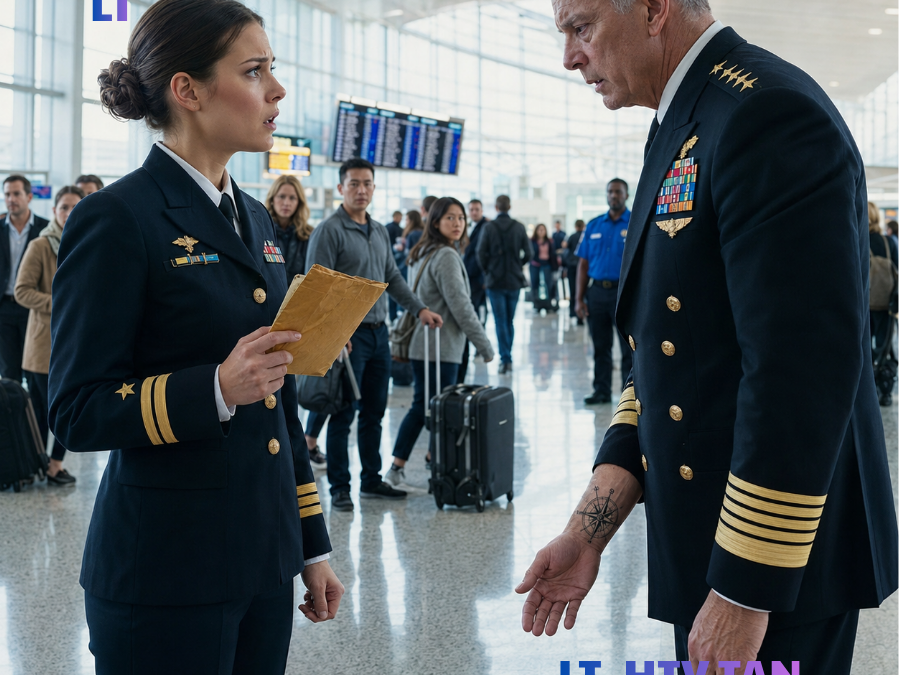
The moment I said my mother’s name, Admiral Thomas Callahan’s face went pale.
His hand, still extended from our handshake, slowly dropped to his side. His eyes became glassy, and I watched a decorated four-star officer suddenly look less like a powerful man and more like someone who had just been pulled into a painful memory.
“Your mother?” he whispered.
“Yes, sir.”
His eyes moved to my wrist, then back to my face.
“What is your name?”
“Wren Sullivan.”
He took one step backward.
I had been assigned to pick him up at Norfolk International Airport. That was all. A routine transportation detail.
I had not expected to uncover a secret that had apparently survived for almost thirty years.
But everything changed when I saw his wrist.
An old-fashioned compass was tattooed there, its needle pointing toward the Big Dipper.
My mother had the exact same tattoo.
Same design.
Same place.
As a little girl, I had traced the faded ink on Mom’s wrist and asked what it meant.
She would smile sadly.
“It reminds me that some promises are worth keeping, even when keeping them hurts.”
She never explained more.
Now the man standing in front of me wore the same symbol.
“Sir, are you all right?”
He swallowed.
“Does your mother still live in Virginia?”
That question hit harder than his reaction.
“How do you know my mother?”
He looked away.
Travelers passed us dragging suitcases. Airport announcements echoed overhead. Somewhere behind us, a child was crying.
But I heard only my heartbeat.
“I asked you a question, Admiral.”
He finally looked at me.
“I knew your mother a long time ago.”
“How long?”
He hesitated.
“Before you were born.”
My stomach tightened.
I had spent most of my life believing my father had simply walked away. Mom never spoke badly about him. She only said he had chosen a different life.
As a child, I accepted it.
As an adult, I stopped asking.
Now a four-star admiral was staring at me as though my existence was something he had never expected to see.
I forced myself back into professionalism.
“I’m assigned to get you to your hotel, sir.”
“Yes.”
His voice sounded distant.
We walked to the parking garage in silence. The moment we got inside the government vehicle, I closed my door and turned toward him.
“Who are you to my mother?”
He stared through the windshield.
Then he reached into the inside pocket of his uniform jacket.
He pulled out a small, worn envelope.
The paper had yellowed with age.
Across the front was one name.
Margaret Sullivan.
My breath caught.
“Where did you get that?”
“I’ve carried it for twenty-nine years.”
“Why?”
“Because I thought I would never get the chance to return it.”
He placed it in my hand.
I didn’t open it.
“What’s inside?”
“A letter.”
“From my mother?”
He nodded.
“Then why didn’t you give it to her?”
His jaw tightened.
“Because I never received it.”
I stared at him.
“That doesn’t make sense.”
“It didn’t make sense to me either. Not for a very long time.”
He turned toward me.
“Wren, your mother and I loved each other.”
The words landed with a weight I could almost feel.
I looked at the tattoo again.
“The compass?”
His fingers covered it instinctively.
“She gave me the idea. We were young enough to believe we could keep a promise forever.”
“What promise?”
“That no matter where the Navy sent us, we would find our way back to each other.”
Something from my childhood flashed through my mind.
My mother sitting alone at our kitchen table late at night.
Her fingers touching her tattoo.
Her voice barely above a whisper.
“He was supposed to come back.”
I had always assumed she meant my father.
Now I wasn’t sure.
Callahan studied my face.
“What has your mother told you about your father?”
“Not much.”
“Did she say he left?”
“Yes.”
His eyes closed.
“And you believed her?”
“I was a child.”
“I know.”
There was something in his voice that made me angry.
“You know?”
He opened his eyes.
“I know because I believed the same thing about her.”
The silence between us became enormous.
I looked down at the envelope.
Maybe my childhood had not been built around abandonment.
Maybe it had been built around betrayal.
Callahan started the engine, then stopped.
“Don’t call your mother yet.”
“Why?”
“Because if I’m right, she has spent almost thirty years believing something that isn’t true.”
He looked directly at me.
“And Wren… so have you.”
That night, the envelope sat unopened on my kitchen counter.
By morning, I could no longer stand looking at it.
I drove straight to my mother’s house.
And the second she saw Thomas Callahan’s handwriting, her hands began to shake.
## Part 2: My mother’s hidden letters expose a betrayal spanning thirty years
Mom stared at the envelope on her kitchen table.
“Where did you get that?”
“Admiral Thomas Callahan gave it to me.”
The color drained from her face.
“You met Thomas?”
“I picked him up at the airport.”
She closed her eyes.
I had seen my mother face surgery without trembling. I had watched her say goodbye when I deployed overseas.
I had never seen her frightened.
“Mom. Who is Thomas Callahan?”
Silence.
“He showed me his wrist.”
Her eyes lifted.
“The tattoo,” I said. “The compass. The Big Dipper.”
Her lips trembled.
“He was supposed to come back.”
Those same words.
The words I had heard as a child.
I leaned forward.
“Is Thomas Callahan my father?”
She looked at me.
I knew the answer before she spoke.
“Yes.”
The room seemed to tilt.
“You told me my father left.”
“I told you what I believed.”
“You knew his name.”
“Yes.”
“You knew he was Thomas.”
“Yes.”
“Why didn’t you tell me?”
“Because I thought he chose not to know you.”
My anger rose.
“He thought you abandoned him.”
Her head snapped up.
“What?”
“He believed you left him.”
“No.”
Her voice cracked.
“I never abandoned Thomas.”
She walked to a cabinet beside the dining room and removed a small wooden box hidden behind old cookbooks.
Inside were photographs, military papers and letters tied with blue ribbon.
One photograph showed my mother at twenty-six beside a young Thomas Callahan in Navy uniform.
They were glowing.
On the back were four faded words.
Find your way home.
“We got the tattoos after Thomas received orders overseas,” Mom said.
“The stars?”
“He said sailors needed stars.”
Despite everything, I almost smiled.
Then her expression hardened.
“Someone lied to us.”
“Who?”
“Richard Hayes.”
Hayes had served with Thomas. He was ambitious, well connected and involved in the same command structure.
“He told me Thomas had moved on,” Mom said. “He said Thomas called our relationship a mistake.”
“And Thomas was told you wanted nothing to do with him.”
Mom stared at me.
Then she pulled out another bundle of letters.
“I wrote Thomas dozens of times.”
Some had been returned.
Others had never been opened.
“I found out I was pregnant after he deployed,” she whispered. “I tried to tell him.”
My throat tightened.
I picked up an envelope dated three months before my birth.
Inside, Mom had written:
Thomas, if you are reading this, then someone finally let my letter reach you.
Beneath those words, in different handwriting, were four words.
Returned. Do not forward.
I stopped breathing.
This was not a misunderstanding.
Someone had actively stood between them.
That night, I called Callahan.
“My mother told me.”
Silence.
“She told me you’re my father.”
I heard him inhale.
“Wren…”
“I found the letters.”
“All of them?”
“Enough.”
We met the next afternoon at a small diner outside Norfolk.
For the first time, I saw him without stars on his shoulders.
Just an older man with regret in his eyes.
He told me Hayes had shown him a supposed copy of a letter claiming Margaret had met someone else.
“Did you ever see the original?” I asked.
“No.”
“Did you call her?”
“No.”
“You should have.”
“I know.”
No excuse.
No defense.
Just two words.
I know.
Then he told me something else.
At the time, he had been reviewing procurement irregularities involving a defense contractor.
Richard Hayes was connected to the review.
And suddenly the broken love story on my mother’s kitchen table looked like something much darker.
Because Hayes had not merely lied to two frightened young people.
He may have had a reason to keep them apart.
## Part 3: One frightened witness finally reveals who intercepted their love letters
I started digging.
Not for revenge.
For evidence.
Public records. Newspaper archives. Old military biographies. Documents my mother had saved for decades.
Then I found a 1998 article about a procurement investigation that quietly ended after a senior officer transferred commands.
The officer named in the article was Richard Hayes.
Beside it was a photograph.
Hayes stood next to Thomas Callahan.
Trusted colleagues, the caption said.
I almost laughed.
Inside one of Mom’s envelopes, I found another handwritten note.
Richard said Thomas would lose his career if I kept contacting him.
Below that:
He said Thomas had already chosen someone else.
I called Callahan.
“Mom wrote that Hayes threatened your career.”
He went silent.
Then he said, “I remember that conversation.”
“What conversation?”
“Hayes warned me that Margaret contacting me could complicate my career.”
“You remembered this?”
“Yes.”
“And you never questioned it?”
“I was young, angry and scared.”
Fear.
That word kept appearing.
Then Callahan found the one person who might know more.
Richard Hayes’s wife.
Evelyn.
She agreed to meet us at a small church fellowship hall.
She was in her late sixties, with silver hair and exhausted eyes.
The moment she saw me, she said, “You’re Margaret’s daughter.”
My chest tightened.
“You knew about me?”
“I knew there was a child.”
“Did you know Thomas was my father?”
She looked at Callahan.
“I suspected.”
I placed copies of the letters on the table.
“What did Richard do?”
Evelyn stared at them.
Finally, she whispered, “Richard was afraid of Thomas.”
“Why?”
“Because Thomas was getting close to something Richard didn’t want discovered.”
“The contracts?”
She nodded.
“Did Richard interfere with my mother’s letters?”
Her eyes filled.
“Yes.”
Callahan leaned forward.
“How do you know?”
“Because I saw him do it.”
The room went still.
“He had envelopes addressed to Thomas. Others addressed to Margaret. He opened them.”
“Why?”
“He said he was protecting Thomas from personal distractions.”
I felt sick.
“My mother wasn’t a distraction.”
“I know.”
Evelyn reached into her purse.
She placed a small key on the table.
“There’s something I kept.”
The key opened a box in her car.
Inside were correspondence copies, notes and one letter written by Richard himself.
It referred to the procurement investigation.
Then came the sentence that destroyed any remaining doubt.
Margaret Sullivan must not be allowed to contact him directly.
Callahan’s face went completely still.
Evelyn began crying.
“I should have stopped him.”
“You can’t change what happened,” I said.
“I know.”
“But you can tell the truth now.”
She nodded.
“I will.”
That was when I understood something.
The truth would not come from revenge.
It would come from people finally becoming brave enough to admit what they had seen.
Later, Callahan told me I didn’t have to keep digging.
“My mother waited almost thirty years,” I said. “I spent my life believing my father didn’t want me.”
“You don’t have to carry this alone.”
Those words hit harder than I expected.
For thirty years, I had learned to carry everything alone.
Now the father I had never known was offering to stand beside me.
But there was one person left.
Richard Hayes.
And this time, I wanted to hear the truth from the man who had created the lie.
## Part 4: The man behind our broken family finally admits everything aloud
Richard Hayes opened his front door himself.
White hair.
Thin frame.
A cane in one hand.
He looked older than the villain I had imagined.
That almost made it worse.
“You’re Wren.”
“Yes.”
“Does Thomas know you’re here?”
“He does.”
I placed copies of the letters on his dining room table.
“You told my mother Thomas abandoned her.”
Silence.
“You told Thomas she abandoned him.”
Nothing.
“You intercepted their letters.”
His hand tightened around the cane.
Finally, he whispered, “I was afraid.”
“Of what?”
“Losing everything.”
I pointed at the letters.
“You didn’t just protect your career. You stole a family.”
Hayes lowered himself into a chair.
“I never meant for it to go this far.”
“Almost thirty years is a long way to go.”
He rubbed his hands together.
“Thomas was getting close to the procurement problems. There were people above me involved. If he kept digging, my career was finished.”
“And my mother became leverage.”
His eyes lowered.
“Yes.”
“You knew Thomas loved her.”
“Yes.”
“So you convinced him she had rejected him.”
“Yes.”
“And told her the same thing.”
“Yes.”
“Did you know she was pregnant?”
His expression changed.
“No.”
I studied him carefully.
For some reason, that answer hurt.
There had been no elaborate plot to steal a daughter from her father.
Just fear.
Selfishness.
And one man deciding he had the right to manipulate other people’s lives.
“What happened to the letters?”
“I intercepted most of them.”
“And the rest?”
“Destroyed.”
My jaw tightened.
“Why?”
“Because by then I was protecting the lie.”
There it was.
The truth.
Not dramatic.
Not complicated.
Just ugly.
“I don’t want excuses,” I said.
“I know.”
“I want everything documented.”
He nodded.
“I’ll cooperate.”
“And you’re going to tell my mother.”
His eyes filled.
“I will.”
I left without shaking his hand.
When I called Callahan, I said only two words.
“He confessed.”
There was a long silence.
Then he asked, “Are you all right?”
“No.”
He didn’t tell me I should be.
That mattered.
When I reached Mom’s house, Callahan was already standing on the porch.
The four-star admiral looked terrified.
Mom opened the door.
“Thomas.”
“Margaret.”
Neither moved.
Then he said, “I thought you left me.”
Her eyes filled.
“I thought you didn’t want me.”
“I never stopped loving you.”
She shook her head.
“You should have come looking.”
“I should have.”
“I should have found you.”
“Yes.”
“I should have known there was a child.”
She looked at him.
“You didn’t know?”
“If I had known, Margaret, I would have come.”
For the first time, she believed him.
Then Callahan turned to me.
“Wren, I’m sorry.”
“You didn’t know I existed.”
“No. But I’m still sorry.”
My arms folded across my chest.
“I spent years thinking there was something wrong with me.”
His face broke.
“There was never anything wrong with you.”
“I thought my father didn’t want me.”
“I would have wanted every minute.”
I looked away before the tears came.
He didn’t ask forgiveness.
He didn’t ask me to call him Dad.
He simply said, “If you ever want to know me, I’ll be here.”
And somehow, that was the first promise in this family that felt completely honest.
## Part 5: Truth cannot restore lost years, but it can restore home
The evidence was formally documented and turned over to the proper authorities and Navy channels.
Richard Hayes could no longer hide behind retirement or reputation.
But when consequences finally reached him, I felt no victory.
Only closure.
Justice, I learned, was not making Hayes suffer.
It was making sure the truth could never be buried again.
Mom and Thomas began talking.
Slowly.
Carefully.
They did not pretend thirty years had vanished.
They had missed birthdays, holidays, ordinary mornings and photographs that would never exist.
Sometimes they argued.
Sometimes they laughed.
Sometimes they simply sat together drinking coffee.
One afternoon, I found them on Mom’s porch.
Thomas was holding two mugs.
Mom was reading the newspaper.
“You’re early,” she said.
“I came to check on you.”
Thomas smiled.
“You always check on people.”
“Occupational hazard.”
His sleeve moved as he lifted his coffee.
The compass tattoo appeared.
Mom noticed it too.
“I never changed mine,” she said.
Thomas rolled his sleeve farther back.
“Neither did I.”
Two identical compasses.
Two needles pointing toward the Big Dipper.
Two people who had spent decades believing they had lost each other.
A few weeks later, Thomas invited me to dinner.
He cooked enough food for a squadron.
I laughed when I saw the table.
“Expecting company?”
“Your mother said you like leftovers.”
“She’s giving you instructions already?”
“She’s very thorough.”
It felt strangely normal.
After dinner, he brought out an old photograph.
The same one Mom had shown me.
Young Margaret.
Young Thomas.
Happy.
On the back:
Find your way home.
He handed it to me.
“I want you to have this.”
“Are you sure?”
“Yes.”
For the first time, the photograph didn’t feel like evidence of what had been stolen.
It felt like evidence that the truth had survived.
Thomas looked at me.
“I can’t give you back the years I missed.”
I said nothing.
“But I can make sure I don’t miss the ones ahead.”
Something inside me finally gave way.
“Thanks, Dad.”
His eyes filled instantly.
He looked down, trying to compose himself.
Then he laughed softly.
“Yeah.”
That was enough.
Mom and Thomas never tried to become twenty-six again.
They simply stopped letting twenty-nine lost years control the years they still had.
And I stopped believing that healing required forgetting.
It doesn’t.
Forgiveness does not erase truth.
Second chances do not replace first chances.
But another person’s lie does not have to determine who you become.
I once thought revenge would be the satisfying ending.
I was wrong.
The satisfying ending was seeing Richard Hayes’s lies lose their power.
He had taken years from us.
He could not take the years we had left.
Months later, I stood on Mom’s porch watching Thomas reach for her hand.
Two faded compass tattoos rested beside each other.
The needles still pointed toward the same stars.
“You know what it means now?” Mom asked.
I nodded.
“Finding your way home.”
She smiled.
“That’s what we always called it.”
I finally understood.
A compass does not promise you will never get lost.
It only gives you a direction when you are ready to move again.
The truth had arrived late in my family.
Almost thirty years late.
It came through an airport terminal, a faded tattoo, a yellowed envelope and people finally brave enough to admit what they had done.
We could not change the past.
But we could decide what happened next.
Mom chose forgiveness without forgetting.
Thomas chose to make up for the time he still could.
And I chose not to let someone else’s fear define my life.
For most of my childhood, I believed home was something my father had abandoned.
Now I knew better.
Sometimes home is not the place you never leave.
Sometimes home is the place you spend half a lifetime trying to find again.
THE END.
All the characters and events in this story are fictional and created for the purpose of storytelling and entertainment.
If this story brought you a moment of reflection, comfort, or curiosity, then it has truly fulfilled its purpose.
Thank you sincerely for reading. Your feedback and support are always appreciated and inspire me to keep sharing more stories with you.








