The mother insisted her eight-year-old son only had “a mild flu.” Then I touched the blue fingertips sticking out of his filthy cast and realized his body had been fighting something far worse for days. She tried to stop us from cutting the cast open. “His orthopedic doctor said two more weeks,” she snapped. But when the saw touched the fiberglass, her anger vanished. She looked straight at me and whispered, “Please… don’t open it.”
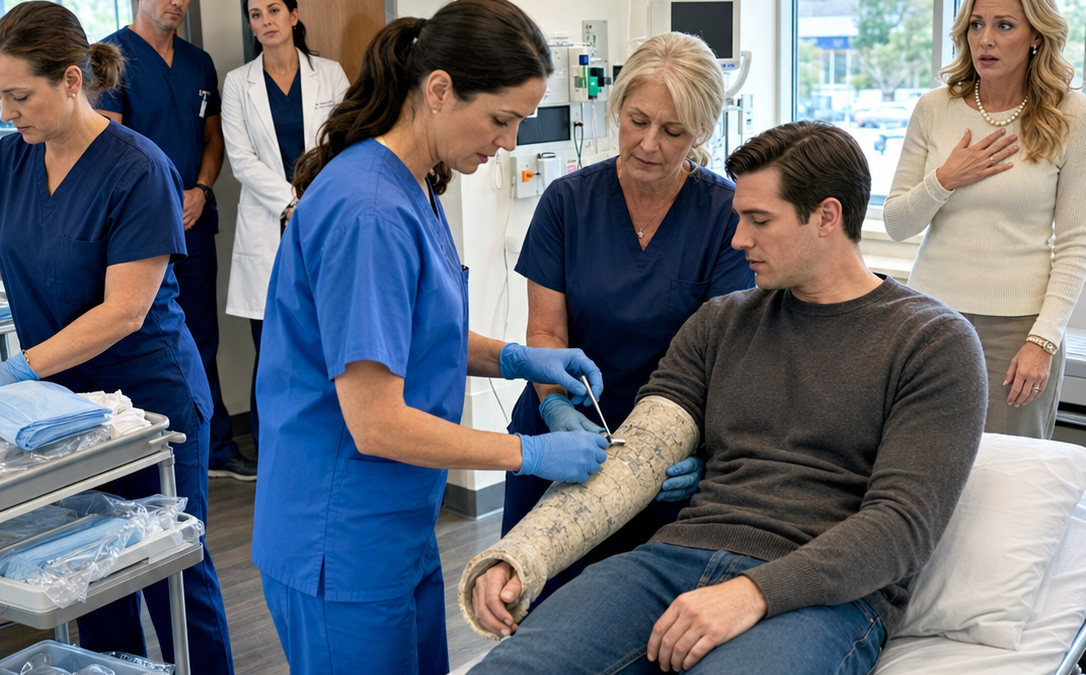
The Cast Came Off—and the ER Finally Saw What Had Been Hidden
The mother insisted her eight-year-old son only had “a mild flu.” Then I touched the blue fingertips sticking out of his filthy cast and realized his body had been fighting something far worse for days. She tried to stop us from cutting the cast open. “His orthopedic doctor said two more weeks,” she snapped. But when the saw touched the fiberglass, her anger vanished. She looked straight at me and whispered, “Please… don’t open it.”
Part 1
The smell reached the hallway before the stretcher cleared the emergency-room doors.
Sweet.
Metallic.
Rotten.
The kind of odor that did not disappear when you turned your head.
It seemed to settle behind your tongue.
The emergency department at St. Catherine Medical Center was already busy that Saturday afternoon.
Fluorescent lights buzzed above the nurses’ station.
A printer spat out blood-tube labels.
A toddler cried behind Curtain Six.
Someone dropped a stainless-steel tray near the medication room.
Disinfectant hung in the air.
Coffee had burned into the bottom of a pot near the break room.
Under all of it—
that smell.
I’m Dr. Sarah Jenkins.
At forty-one, I had spent eight years in emergency medicine and another four before that in pediatric residency.
Long enough to know that the most dangerous cases did not always arrive loudly.
Sometimes there was no screaming family.
No dramatic blood on the floor.
No frantic parent shouting for help.
Sometimes danger arrived politely.
Wearing pearls.
Marcus Reed, one of our senior nurses, came toward me quickly.
One hand covered his mask.
His face looked gray.
“Sarah.”
He rarely called me that during a shift.
That told me almost as much as his expression.
“Trauma Two. Eight-year-old male.”
“What happened?”
“Mom says flu.”
He looked back toward the room.
“Heart rate one-forty. Fever one-oh-three point eight. Pressure is dropping. He’s barely responsive.”
Then his voice lowered.
“It’s his arm.”
The sliding door opened.
The smell became physical.
I entered.
The boy looked too small for the hospital bed.
His name was Noah Harris.
Eight years old.
Fifty-one pounds.
Brown hair stuck damply against his forehead.
Dry lips.
Hollow cheeks.
His skin had the pale, waxy color I had seen in children whose bodies had been spending too much energy surviving.
His eyes were open.
They did not settle on anything.
His right arm lay beside him beneath a fiberglass cast running from his knuckles to above his elbow.
A cast should have been one of the least frightening objects in an emergency room.
This one was not.
The fiberglass was dirty.
Not playground dirty.
Not a few grass stains.
Dark rings overlapped one another along the length of it.
The padding had frayed around the edges.
Near his hand, the material seemed to have tightened against swollen skin.
Three fingertips remained visible.
Blue-purple.
I touched one gently.
Pressed.
Released.
The color barely changed.
My stomach tightened.
“How long has this cast been on?”
A woman stood in the corner.
Cream sweater.
Pearl necklace.
Smooth blonde bob cut perfectly against her jaw.
French manicure wrapped around a paper Starbucks cup.
Martha Harris.
Noah’s mother.
She looked cleaner than anyone else in the room.
Almost untouched by the emergency around her.
“A month, maybe.”
“Maybe?”
“Four weeks.”
She took a small sip of coffee.
“He broke it falling out of a tree. Boys.”
I looked at Noah.
Then back at her.
“When was his last orthopedic follow-up?”
“Oh, they told us six weeks.”
“That wasn’t my question.”
Her smile tightened.
“He’s been fine.”
I returned to Noah’s hand.
Cool.
Swollen.
Discolored.
“Marcus, pediatric sepsis protocol.”
“Already opening it.”
“Two IVs if you can get them.”
He nodded.
Clara Jensen entered carrying supplies.
Clara had worked emergency nursing for twenty-seven years.
She had seen nearly everything people hope never to see.
She stopped three feet from the bed.
Her eyes went to the cast.
Then to me.
No words.
She put on a second mask.
A moment later, she dabbed peppermint oil beneath her nose.
That frightened me.
Clara did not rattle easily.
I leaned closer to Noah.
“Noah?”
His eyes moved slightly.
“My name is Dr. Sarah.”
Nothing.
“Can you hear me?”
His lips moved.
I could not understand the answer.
I checked his arm again.
The smell was strongest near the lower portion of the cast.
Something inside was wrong.
Very wrong.
I turned toward Martha.
“Mrs. Harris.”
She lifted her eyebrows.
“Your son is extremely sick.”
“He has a fever.”
“No.”
My voice remained calm.
“He is in shock.”
The coffee cup lowered.
“From the flu?”
“We don’t know yet.”
I looked toward Noah’s hand.
“But this cast needs to come off immediately.”
Her expression changed.
Not to fear.
Irritation.
“No.”
I stared at her.
“What?”
“No.”
She stepped closer.
“His orthopedic surgeon said two more weeks.”
“His fingertips are blue.”
“He always has cold hands.”
“Not like this.”
“He complains about everything.”
Marcus stopped for half a second beside the IV tray.
Clara looked toward Martha.
I kept my voice level.
“Mrs. Harris, I’m concerned that swelling and infection beneath the cast are compromising circulation to your son’s hand.”
Martha crossed her arms.
“Give him antibiotics.”
“We are.”
“Then leave the cast alone.”
“That is not an option.”
Her jaw hardened.
“You people always make things dramatic.”
That sentence.
You people.
As though medicine itself were a personality flaw.
I had heard versions of it before.
Overreacting.
Too cautious.
Children exaggerate.
It looks worse than it is.
Parents say those things for many reasons.
Fear.
Denial.
Guilt.
Sometimes they are simply terrified.
But there was something in Martha’s face I did not recognize as fear for Noah.
She was watching us.
Calculating.
“Clara.”
“Yes?”
“Security.”
Martha stepped forward.
“What?”
“And bring the cast saw.”
Martha moved before Clara reached the door.
She went toward the bed.
Fast.
“You are not cutting that off.”
Clara stepped between them.
“Ma’am, step back.”
“I’m his mother.”
“And we’re treating an unstable child.”
“I said no!”
Her voice finally rose.
Two security officers appeared in the doorway.
Martha pointed toward me.
“If you touch that cast, I’ll sue this hospital.”
I looked at Noah’s fingers.
Then at his blood pressure.
Lower.
The monitor alarmed.
I did not argue.
“Please move her away from the bedside.”
One officer lifted a hand.
“Ma’am, come with us.”
Martha resisted enough that her cream sweater twisted at the shoulder.
Then Clara returned carrying the cast saw.
The moment Martha saw it—
everything changed.
Her anger disappeared.
Completely.
Not gradually.
Gone.
Her eyes locked onto the saw.
“Wait.”
I looked at her.
She swallowed.
“Don’t.”
Her voice had become almost inaudible.
“Don’t open it.”
That was the first moment I stopped wondering whether Martha understood the seriousness of Noah’s arm.
She understood something.
The question was what.
“Why?”
Her eyes stayed on the cast.
“Please.”
“Martha.”
“Just…”
She looked at me.
Fear had finally appeared.
But not the kind I wanted.
“Don’t open it.”
Clara’s eyes met mine.
I switched on the saw.
The mechanical whine filled the room.
Noah flinched weakly.
I leaned close.
“My name is Sarah.”
His eyes moved toward me.
“I’m going to take this cast off because your arm needs help.”
He tried to speak.
“You don’t have to do anything.”
I placed one hand gently near his shoulder.
“We’re doing the work now.”
His eyes closed.
The saw touched the fiberglass.
Martha made a strangled sound behind the security officers.
“Stop.”
I cut the first line.
“Stop!”
I continued.
Fiberglass opened reluctantly.
The odor intensified.
Marcus turned away and coughed behind his mask.
Clara froze for one beat.
Then training took over again.
She stabilized the arm.
I finished the cut.
We spread the fiberglass.
The padding underneath was soaked and compacted.
Dark.
Contaminated.
When Clara lifted one loosened section, small pale larvae dropped from the damaged padding onto the floor.
A nurse near the doorway gasped.
Another stepped back into the supply cart.
Metal rattled.
For half a second, the room stopped being an emergency department.
It became a room full of human beings trying to understand how something like this had been hidden beneath a cast.
Then the monitor alarmed again.
Training returned.
We moved.
I will not describe Noah’s arm in unnecessary detail.
Children should never become spectacle simply because something terrible happened to them.
What mattered was enough.
His skin was severely damaged.
The arm was swollen.
Infection had progressed beneath areas that had been sealed away.
His circulation was compromised.
This had not happened that morning.
This was not a seasonal virus.
This was not something an eight-year-old had created by being careless for an afternoon.
His body had been losing this fight for some time.
“Marcus.”
“Yeah?”
“Page pediatric surgery and ortho now.”
“Already doing it.”
“Clara, help me with the remaining padding.”
Martha started speaking.
Fast.
“He plays outside.”
Nobody answered.
“He gets dirty constantly.”
I focused on Noah.
“He probably pushed something down there.”
Silence.
“You know children.”
Nobody looked at her.
Then:
“He never said it hurt that badly.”
My hands stopped.
Only for a second.
I looked up.
“What?”
Martha’s mouth tightened.
“I said broken arms hurt.”
“No.”
My voice became very quiet.
“You said he never told you it hurt that badly.”
Her eyes shifted.
“That’s not what I meant.”
“When did he complain?”
“He didn’t.”
“You just said he did.”
“Obviously he complained at first.”
“How recently?”
Martha folded her arms.
“This is ridiculous.”
“When did Noah tell you his arm hurt?”
One of the monitors alarmed.
His pressure dropped again.
The question could wait.
His body could not.
I turned away from her.
That was the difference between medicine and argument.
The patient decides the priority.
Fluids ran.
Antibiotics continued.
Blood was drawn.
Additional medications were prepared.
The surgical team called back.
Orthopedics was on the way.
A respiratory therapist appeared.
Noah’s body became the center of the room again.
Exactly where it belonged.
For the next several minutes, Martha disappeared from my awareness.
Not physically.
Emotionally.
I had no energy left for her story.
Noah needed us.
We stabilized him enough to move.
When we transferred him onto a transport bed, his eyes opened.
For the first time, they settled on me.
Not well.
But enough.
“Sarah?”
His voice was barely audible.
“I’m here.”
He looked toward his arm.
Then whispered something I did not understand.
I leaned closer.
“What?”
“Am I bad?”
Everything inside me went still.
“No.”
His lower lip moved.
“Because I got it dirty.”
Cold moved through my chest.
Not rage.
Something heavier.
“Noah.”
I crouched until my face was close to his.
“You are not bad.”
His eyes searched mine.
“You’re sick.”
I kept my voice steady.
“And we’re going to take care of you.”
Behind me, Martha spoke immediately.
“See?”
I turned.
“He admitted it.”
Clara’s face hardened.
“He got it dirty himself.”
I stared at Martha.
She seemed almost relieved.
As though an eight-year-old blaming himself had just offered her evidence.
Clara walked toward the discarded cast.
She placed every removed piece carefully inside the appropriate containment bag.
Martha watched.
“What are you doing?”
“Preserving what matters.”
Clara’s voice was flat.
Martha’s face tightened.
That was when the explanations multiplied.
It got wet once.
Maybe twice.
Noah scratched beneath it.
He ignored instructions.
He refused to keep the arm elevated.
The orthopedic office never answered.
He did not want to go back.
He hated doctors.
Each statement could have been plausible alone.
Together they formed noise.
I had learned something about truth during eight years in emergency medicine.
Truth usually becomes simpler as questions become clearer.
A lie often does the opposite.
It expands.
We transferred Noah to the surgical team.
I walked beside the bed until the elevator.
Before the doors closed, he looked at me again.
“Dr. Sarah?”
“Yes?”
“Are they mad?”
“Who?”
“The doctors.”
My throat tightened.
“No.”
“Mom said they’d be mad if I ruined it.”
The elevator doors began closing.
I put one hand against the frame.
“Noah.”
His eyes stayed on me.
“If something hurts, telling us is never bad.”
He said nothing.
“Never.”
The doors closed.
I stood there for several seconds.
Then I returned to Trauma Two.
Martha sat in the chair now.
Her Starbucks cup had fallen onto the floor.
Cold coffee spread beneath it.
For the first time, she no longer looked polished.
Not because her hair had changed.
Not because her pearls had disappeared.
Because control had.
I opened Noah’s medical record.
Not hunting for a dramatic secret.
I wanted dates.
Records do not care about personalities.
They care about timelines.
Original fracture.
Four weeks earlier.
Routine reduction.
Cast placement.
Discharge instructions.
Follow-up recommended.
Return precautions clearly documented.
Increasing pain.
Swelling.
Change in finger color.
Wet padding.
Bad odor.
Fever.
Any of those meant reassessment.
There were notes.
Multiple attempted follow-up contacts.
One missed orthopedic visit.
Then another appointment rescheduled.
Then canceled.
A nurse had documented a phone conversation eight days earlier.
I read it twice.
Mother reports odor from cast and child complaining of increasing tightness. Advised immediate urgent evaluation. Mother states transportation difficult and will monitor.
My hands became cold.
Eight days.
I opened another note.
Four days later.
Clinic attempted follow-up. Voicemail left.
Another.
Mother returned call. Reports child “fine now.” Declined same-day evaluation.
I stared at the screen.
Martha’s voice came from behind me.
“You checked his chart.”
Not a question.
“Yes.”
“I want an attorney.”
“You are free to contact one.”
“You’re treating me like a criminal.”
I turned.
“I haven’t called you anything.”
“You think I did this.”
“I think Noah arrived in septic shock.”
She looked away.
“I think his circulation was impaired.”
Her jaw tightened.
“I think there were documented warnings about odor, pain, swelling, and cast problems.”
Martha said nothing.
“And I think you tried to stop us from removing the cast.”
Her hands clenched.
“Those are facts.”
“You don’t know what it’s like.”
“No.”
I waited.
“What is it like?”
She stared at the floor.
Nothing.
So I returned to the chart.
Silence has weight.
People often try to fill it when the truth inside them becomes heavier.
Martha lasted thirty seconds.
“He complained all the time.”
I looked up.
There it was.
Not:
He never complained.
All the time.
“When?”
“At night.”
“How long?”
“I don’t know.”
“Martha.”
“Maybe a week.”
I sat down across from her.
She started crying.
Quietly at first.
“I thought he was being dramatic.”
That word again.
“He said it was itching.”
I waited.
“Then he said it felt tight.”
Her hands shook.
“I called.”
“Yes.”
“The nurse made me feel like I’d done something wrong.”
“What did she say?”
“That I needed to bring him back immediately.”
“That isn’t an accusation.”
“It felt like one.”
I said nothing.
Martha wiped her face.
“The cast had gotten wet.”
“When?”
She hesitated.
“About two weeks ago.”
“How?”
“He was playing near the backyard sprinkler.”
“Was it soaked?”
“I don’t know.”
“You didn’t have it checked?”
“I dried the outside.”
Something tightened behind my ribs.
“Then the smell started.”
I waited.
“He was embarrassed.”
“Noah?”
Her eyes moved.
“I was.”
There.
Finally.
One honest sentence.
Martha covered her mouth.
“I knew they’d ask why I waited.”
She cried harder.
“Every day I thought I’d take him tomorrow.”
I felt no triumph.
Only horror.
“But then it looked worse.”
Her voice cracked.
“And I knew if I took him in, they’d ask why I hadn’t gone before.”
So she waited.
The worse it became, the more ashamed she felt.
The more ashamed she felt, the longer she waited.
And the person paying for her avoidance was eight years old.
“I thought antibiotics at urgent care would fix it.”
“You brought him here calling it flu.”
“I was scared.”
“So was Noah.”
She looked at me.
That sentence landed.
I continued.
“He was scared enough to ask whether he was bad because his arm got sick.”
Martha’s face crumpled.
I did not comfort her.
That may sound cruel.
It was not punishment.
My responsibility in that moment was not relieving her guilt.
There was a child upstairs whose body had nearly lost a fight while the adult responsible for him protected herself from embarrassment.
Sometimes compassion requires refusing to rescue an adult from a feeling they need to face.
The hospital’s child-safety process had already begun.
Security remained nearby.
Social work was contacted.
A child-protection specialist was notified according to policy.
I explained none of this as a threat.
It was procedure.
Procedure matters when emotion becomes unreliable.
Martha looked toward the door.
“Are you taking my son away?”
“That is not my decision.”
“You called social services.”
“The hospital initiated the required safety process based on Noah’s condition.”
“You’re destroying our family.”
No.
I had heard that sentence before too.
Different families.
Different hallways.
Same defense.
Accountability arrives.
Someone calls it destruction.
“I’m treating your son.”
I stood.
“That is my job.”
I left the room.
My hands were shaking.
Clara found me near the medication room.
“You okay?”
“No.”
“Good.”
I stared at her.
She shrugged.
“If that didn’t get to you, I’d be worried.”
I leaned against the wall.
Three years earlier, a little girl named Sofia had come through my department.
Bruising.
A caregiver with explanations.
A fall.
Then another fall.
Clumsy child.
Easy bruising.
I documented concerns.
Asked questions.
Then allowed myself to be reassured because everything around the child looked stable.
Clean clothes.
Polite caregiver.
Good insurance.
Perfect paperwork.
Sofia returned weeks later with injuries nobody could explain away.
She survived.
But I never forgot the first visit.
Some mistakes do not leave when the patient does.
They become rules.
Mine was simple.
When a child’s body tells a different story from the adult beside them—
listen to the body.
Clara must have known where my mind had gone.
“You didn’t miss this one.”
I looked at her.
“That doesn’t fix the other one.”
“No.”
Clara adjusted her scrub top.
“It isn’t supposed to.”
She walked away.
That was why I trusted her.
No sentimental absolution.
No pretending one good decision erases a painful one.
You carry the lesson.
You do better.
That is all responsibility allows.
Two hours later, orthopedic surgeon Dr. Michael Levin found me.
He had gray hair, reading glasses resting low on his nose, and the irritated expression of a man who had been called into the hospital on his daughter’s birthday.
“How bad?”
I asked.
“Bad.”
My stomach dropped.
Then he added:
“But we have circulation.”
I exhaled.
“For now.”
He nodded.
“They’ve debrided infected tissue. We’re watching the hand closely.”
“Amputation?”
“Not the plan right now.”
Right now.
In medicine, those words can carry enormous hope.
Not promise.
Hope.
Levin pulled out his phone.
“You know something strange?”
“What?”
“I know this kid.”
My eyes narrowed.
“You treated the fracture?”
“No.”
He opened the chart.
“One of my partners did.”
Then he looked toward Trauma Two.
“But I spoke to the mother last week.”
My stomach tightened.
“Personally?”
“Yes.”
“When?”
“Seven days ago.”
“What did she tell you?”
“Bad smell. Pain. Swelling.”
He frowned.
“I told her to bring him to the emergency department.”
My body became still.
“She said?”
“That she was traveling.”
“Was she?”
“I have no idea.”
He continued.
“I told her if the fingertips changed color or he developed fever, she needed immediate evaluation.”
I stared at him.
“She knew.”
Levin looked toward me.
“I documented the call.”
There it was.
The authoritative witness.
Not opinion.
Not memory from a frightened child.
A physician.
A chart.
A timestamp.
Clear instructions.
Martha had not simply failed to recognize danger.
She had been told what danger looked like.
And then danger appeared exactly as described.
Have you ever watched a person’s entire defense collapse not because someone shouted, but because one quiet document existed?
That is the power of facts.
They wait.
Patiently.
While people perform.
Then the right question arrives—
and suddenly the room changes.
Part 2
Noah remained in intensive care for three days.
The first night was the worst.
Fever.
Low blood pressure.
Close monitoring.
Surgeons checked his arm repeatedly.
Circulation improved.
Then worsened slightly.
Then improved again.
Every update came with cautious language.
Encouraging.
Promising.
Watching closely.
No guarantees.
I checked on him whenever my shift allowed.
Not because I was his surgeon.
Not because I had some heroic role.
Because I remembered one question.
Am I bad?
Children should not carry adult failure as self-definition.
On the second morning, Noah was awake.
Really awake.
His arm was wrapped in clean medical dressing.
No cast.
Nothing sealed away.
His hand remained visible.
Inspectible.
Clara stood beside him changing an IV bag.
He recognized me.
“Dr. Sarah.”
“Hey.”
His voice sounded stronger.
“You look less terrible.”
Clara stared at me.
“Excellent bedside manner.”
Noah almost smiled.
That counted as victory.
I pulled a chair closer.
“How’s the arm?”
He hesitated.
The hesitation mattered.
Then:
“It hurts.”
“Good.”
He frowned.
“Good?”
“You told me.”
He stared.
“That’s good.”
He looked toward Clara.
She nodded.
“Doctors are weird.”
For the first time, Noah smiled.
Small.
But real.
“Is Mom mad?”
The smile disappeared from me.
“Noah.”
He looked down.
“Your job right now is to get better.”
“But—”
“You do not have to manage grown-up feelings.”
His eyes lifted.
That was probably too large a concept for eight.
So I simplified.
“If you hurt, tell us.”
He nodded.
“If you’re scared, tell us.”
Another nod.
“If somebody tells you not to tell because they’ll be mad…”
I waited.
Noah whispered:
“Tell anyway?”
“Yes.”
He thought about that.
Then looked at the call button near his hand.
Clara placed it closer.
“If you need anything, you press this.”
He touched it.
“Even at night?”
“Especially at night.”
“What if you’re busy?”
Clara smiled.
“We’re nurses. We’re always busy.”
I gave her a look.
She continued.
“That’s not your problem.”
Noah touched the button.
Then stopped.
“Can I test it?”
“Absolutely.”
He pressed.
A light appeared over the door.
A second later, Marcus spoke through the intercom.
“Need something in there?”
Noah looked startled.
Then delighted.
“No.”
He glanced at me.
“I was checking.”
Marcus answered:
“It works, buddy.”
For some reason, that tiny exchange hurt more than the operating-room update.
Noah needed proof that asking would make someone come.
Not anger.
Not blame.
Someone.
Come.
The child-safety team interviewed him later with people trained specifically for that work.
I was not present.
That mattered.
Children do not need a parade of adults repeatedly asking them to relive the worst parts of their experience.
My job was to report what he told me medically.
Then step aside.
But over the next several days, I learned parts of what had happened.
Not from gossip.
From records relevant to his medical care.
Noah had complained repeatedly.
The cast became wet.
Then smelled.
His fingers swelled.
He told Martha the hand tingled.
Then felt numb.
At one point, she wrapped plastic around the outside and sprayed air freshener near it because the smell embarrassed her when relatives visited.
That detail stayed with me.
Air freshener.
Not medical care.
Odor management.
Appearance over reality.
The cast had become the perfect symbol of the entire situation.
Hard shell.
Dirty underneath.
Problems sealed out of sight.
As long as nobody opened it, Martha could continue saying everything was fine.
People do this with more than casts.
Families.
Marriages.
Workplaces.
Communities.
Something underneath is rotting.
Everyone smells it.
But opening the structure would force them to acknowledge what has been allowed to grow inside.
So they spray perfume.
Smile.
Say:
It’s fine.
Do not make a scene.
Do not open it.
Three days after Noah arrived, a hospital case conference took place.
Medical team.
Child-safety specialist.
Social worker.
Care coordination.
Orthopedics.
People who had different responsibilities but needed the same facts.
Martha’s attorney attended by phone for part of the process.
I was asked to summarize the emergency presentation.
I did.
No adjectives.
Eight-year-old.
High fever.
Shock.
Altered responsiveness.
Compromised circulation.
Severe infection beneath neglected cast.
Mother resisted cast removal.
Medical record documented prior warnings and recommended urgent evaluation.
Dr. Levin spoke after me.
His words were even simpler.
“I personally advised immediate assessment seven days before the emergency presentation.”
The room became still.
“What was reported to you?”
“Odor, worsening pain, swelling.”
“What instructions did you give?”
“Emergency evaluation.”
“Did you suggest waiting two more weeks for routine cast removal?”
“No.”
One word.
The entire story Martha had told in Trauma Two disappeared.
No screaming.
No accusation.
No dramatic reveal.
Just:
No.
That is how authority should work.
Not overwhelming the room.
Clarifying it.
Martha’s attorney asked whether a parent might reasonably misunderstand medical advice.
Levin nodded.
“Of course.”
Then:
“That is why I documented the conversation.”
He looked at his notes.
“I told her clearly that bad odor, swelling, color changes, fever, or worsening pain were not routine and should not wait.”
Facts.
Again.
Martha sat at the other end of the table.
No pearls that day.
No coffee.
Plain gray sweater.
Her face looked exhausted.
For a moment, I almost felt sorry for her.
Then I remembered Noah asking whether he was bad.
Compassion can exist without removing accountability.
That distinction matters.
Martha finally spoke.
“I was afraid.”
Nobody interrupted.
“I thought they would blame me because the cast got wet.”
The social worker, Dana Ellis, asked gently:
“So you delayed bringing him in?”
Martha cried.
“At first I thought it would dry.”
“How long?”
“Days.”
“And when he complained?”
“I told him to stop touching it.”
Dana waited.
“When his fingers changed color?”
Martha closed her eyes.
“He said they looked weird.”
“When?”
No answer.
“Martha?”
“Two days before.”
My chest tightened.
Two days.
Blue fingertips.
A child pointing at his own body, asking an adult to notice.
“And the fever?”
“Friday night.”
He came in Saturday afternoon.
Dana did not raise her voice.
“Why did you tell the emergency team you only noticed he felt warm that morning?”
Martha covered her face.
“I didn’t want them to know.”
There.
No more story.
No more misunderstanding.
She knew.
Not necessarily the medical severity.
But enough to know the truth would create questions.
And she chose concealment over care.
I have spent years thinking about what makes neglect frightening.
It is not always hatred.
Not always cruelty.
Sometimes neglect grows from cowardice.
A person knows something is wrong.
They are afraid of judgment.
So they delay.
Delay creates more danger.
More danger creates more fear.
Eventually, self-protection becomes more important than the vulnerable person who needed them.
That does not make the harm smaller.
Sometimes it makes it harder to recognize.
Dana asked Martha one final question.
“What were you hoping would happen when you brought Noah to the emergency department?”
Martha lowered her hands.
“That you’d give him medicine.”
“And the cast?”
“I thought if the fever came down, we could go home.”
I stared at the table.
The cast would remain.
The arm would remain hidden.
The smell would remain.
Everything dangerous would stay sealed beneath fiberglass.
As long as nobody opened it.
Martha looked toward me.
“You think I’m horrible.”
I answered carefully.
“What I think is not the most important thing in this room.”
She stared.
“Noah is.”
That ended my part.
Child-protection authorities and the court would decide what came next for custody and safety.
I was not the judge.
I did not need to become one.
That is another form of restraint.
People often believe justice requires every witness to become prosecutor.
It does not.
Sometimes the most ethical thing you can do is remain inside your role.
Treat.
Document.
Report.
Tell the truth.
Then allow the people responsible for the next decision to make it.
Several days later, I learned Noah would not be discharged directly back into Martha’s care while the investigation continued.
A maternal aunt named Rebecca had been approved as a temporary caregiver.
I met her once.
She came into Noah’s room carrying a stuffed dinosaur and a backpack full of pajamas.
No pearls.
No polished speech.
She walked to the bed and stopped.
“Can I hug you?”
That question mattered.
Noah nodded.
She hugged him.
Carefully.
His injured arm stayed protected.
Rebecca cried into his hair.
“I’m sorry I didn’t know.”
Noah looked embarrassed.
“It’s okay.”
“No.”
She pulled back.
“It doesn’t have to be okay for me.”
I liked her immediately.
Adults should carry their own guilt.
Children have enough.
When Rebecca stepped out to speak with the care team, Noah looked at me.
“She asked.”
“Asked what?”
“If she could hug me.”
“Yes.”
“Mom doesn’t ask.”
I did not respond.
He studied his hand.
Then:
“Does everybody have to ask?”
“For your body?”
He nodded.
“Yes.”
“Even grown-ups?”
“Yes.”
“Even moms?”
I felt something tighten inside me.
“Yes.”
Noah thought for a long time.
Then he smiled slightly.
“I like Aunt Rebecca.”
“So far she’s doing well.”
He laughed.
That laugh was the first sound I heard from him that belonged entirely to an eight-year-old.
No fear.
No fever.
No guilt.
Just a child amused by a doctor.
We still did not know the final outcome for his hand.
But we had something.
A foothold.
Part 3
Noah kept his hand.
That sentence deserves space.
Not because the story became magically happy.
It did not.
He needed repeated procedures.
Weeks of wound care.
Physical therapy.
Occupational therapy.
Follow-up appointments.
Pain.
Fear.
Patience.
His grip remained weak for months.
Several fingers were stiff.
Scars remained.
But the hand survived.
More importantly—
so did he.
I did not see Noah every week.
Emergency physicians rarely get the luxury of following every patient.
We stabilize.
Transfer.
Discharge.
Move to the next room.
That is the nature of the work.
But Clara kept track through permitted clinical updates.
She pretended she was not emotionally invested.
Nobody believed her.
“Kid flexed three fingers today.”
“Good.”
“Not great.”
“I said good.”
“Doctor said excellent progress.”
“Then why did you say not great?”
“Because his hand therapy schedule looks miserable.”
Three weeks later:
“Grip strength improving.”
Six weeks:
“He beat the therapist at some stupid card game.”
Two months:
“Going back to school part-time.”
Each update felt like someone opening a window.
Then one Tuesday afternoon, while I was signing discharge papers near the nurses’ station, a familiar voice said:
“Dr. Sarah.”
I turned.
Noah stood beside Rebecca.
His right arm was free.
No cast.
No bulky dressing.
A soft protective sleeve covered part of the forearm.
His fingers looked thinner than the left.
But they were pink.
Pink.
I noticed that before anything else.
“You’re walking.”
He rolled his eyes.
“I always walked.”
“Excellent point.”
Rebecca smiled.
“We had ortho upstairs.”
Noah lifted his hand.
“Look.”
He opened his fingers slowly.
Then closed them.
Not perfectly.
Enough.
I smiled.
“That’s showing off.”
He grinned.
Rebecca handed him something.
A small plastic bag.
Inside was a button.
Bright red.
Large.
The kind teachers use for classroom games.
Noah held it toward me.
“What’s this?”
“A present.”
I took it.
One word had been written across it in black marker.
CALL
I looked at him.
He became serious.
“Like the hospital button.”
My throat tightened.
“I figured.”
“When I got scared at Aunt Rebecca’s house, she made one.”
Rebecca looked embarrassed.
“It was his idea.”
Noah continued.
“If I need her at night, I push it.”
“What happens?”
“She comes.”
Simple.
He smiled.
“It works.”
That phrase.
Again.
It works.
For Noah, safety needed to become something measurable.
Press button.
Adult comes.
Say pain.
Someone listens.
Ask question.
Nobody gets angry.
He needed repetition.
The same way his body needed physical therapy, his trust needed exercise.
We often talk about trauma as though healing happens when the dangerous person leaves.
That is only the beginning.
The nervous system still expects danger.
A child still waits for the punishment that used to follow honesty.
Healing is the slow process of teaching the body a new prediction.
If I speak, someone listens.
If I hurt, I receive help.
If I say no, safe people stop.
If I press the button—
someone comes.
I placed Noah’s red button inside my desk drawer after he left.
Next to an old photograph of my medical-school class.
For months, I saw it whenever I reached for a pen.
A reminder.
Not of the cast.
Of the answer.
People come.
Martha’s case continued through the child-protection and legal systems.
I learned only what became relevant to Noah’s medical care.
She entered counseling.
Parenting education.
Court supervision.
Access remained restricted.
There were hearings.
Evaluations.
Requirements.
I had no interest in transforming her into a cartoon villain.
Human beings are more dangerous when we reduce them to monsters.
Monsters are easy to identify.
People are complicated.
Martha loved Noah.
I believe that.
She also failed him terribly.
Both can be true.
Love is not magic.
It does not automatically create safety.
It does not automatically make someone responsible.
It does not excuse avoidance.
People sometimes hurt the people they love because protecting themselves from shame becomes more important than doing what love requires.
That is not a comforting lesson.
It is an important one.
About nine months after Noah first came through our ER, I received a letter.
Not from Martha.
From Rebecca.
She had asked through the hospital whether she could send it.
Inside was a photograph.
Noah sitting at a kitchen table.
Right hand wrapped awkwardly around a pencil.
Homework in front of him.
A dinosaur sticker on one notebook.
Under the photograph, Rebecca wrote:
He complained that writing hurts. I told him complaining is allowed. He said Dr. Sarah would agree.
I laughed.
Then cried.
Clara found me.
“What?”
I handed her the note.
She read it.
“Great. Now you’re influencing children.”
“I’m a menace.”
“He remembered you.”
I looked at the photograph.
“No.”
Clara frowned.
“He remembered what we told him.”
That was better.
Doctors like being remembered.
We pretend we do not.
But there is something more important than a patient remembering your face.
They remember the rule.
Pain is information.
Fear is information.
Blue fingers are information.
A bad smell is information.
A child saying something hurts is not an inconvenience.
It is a message.
Our responsibility is to listen before the body has to scream louder.
The first anniversary of Noah’s admission arrived without ceremony.
Hospitals do not commemorate those dates.
I did.
Not intentionally.
I walked past Trauma Room Two and smelled peppermint.
Clara had opened a small bottle because someone nearby was nauseated.
The smell stopped me.
Suddenly I remembered everything.
The fiberglass saw.
The contaminated padding.
Martha’s pearls.
The Starbucks cup.
Noah asking:
Am I bad?
Memory is strange.
It stores suffering inside smells.
I stood near the supply cart longer than necessary.
Clara noticed.
“You okay?”
“Yes.”
She gave me the look experienced nurses use when doctors lie.
“No.”
I corrected myself.
“Not completely.”
“Better.”
We leaned against the counter.
I thought about Sofia.
The child from three years earlier.
The one I had allowed myself to be reassured about.
I had never stopped carrying her.
For years, I treated that memory like punishment.
If I felt guilty enough, perhaps that meant I cared enough.
Noah taught me guilt is useful only if it changes what you do next.
Otherwise it becomes another form of self-absorption.
A clinician endlessly replaying their mistake is still focused on themselves.
The patient needs the lesson, not the performance.
I had learned to ask one more question.
Read one more note.
Look beneath the clean explanation.
Not because every parent was lying.
Most were not.
Not because every injury meant abuse or neglect.
It did not.
Because good medicine requires curiosity when facts do not fit.
That became another rule.
When the story and the body disagree—
do not force the body to fit the story.
Investigate.
At a departmental teaching conference that winter, I presented Noah’s case without identifying details.
Not the dramatic parts.
The system parts.
Missed follow-up.
Telephone documentation.
Return precautions.
Bias created by polished presentation.
The danger of accepting “the doctor said wait” without checking the record when the physical findings contradict it.
One resident asked:
“What was the biggest red flag?”
Several people expected me to say the smell.
Or blue fingers.
Or larvae.
I shook my head.
“The mother’s reaction when we said the cast had to come off.”
Someone asked:
“Because she resisted care?”
“Not exactly.”
I thought about the moment.
Angry.
Then afraid.
“Because her emotion did not match the medical information she claimed to believe.”
The room became quiet.
“If she truly believed the cast was fine, removing it should have worried her about orthopedic disruption.”
I paused.
“But she did not say, ‘You’ll damage the fracture.’”
I remembered her face.
“She said, ‘Don’t open it.’”
That difference mattered.
Sometimes language reveals what a person is protecting.
The bone?
The child?
Or the secret?
The resident wrote something down.
I continued.
“Never build a case from one sentence. But when the physical exam, timeline, records, and behavior all point in the same direction, stop demanding that each clue explain itself alone.”
That was the same lesson I had learned outside medicine too.
Harm survives through fragmentation.
One nurse noticed something.
One teacher notices something.
One doctor receives a strange explanation.
One neighbor hears shouting.
One relative sees fear.
Each person thinks:
Maybe it is nothing.
The pattern becomes visible only when information is allowed to meet.
That is why documentation matters.
Not because paperwork is sacred.
Because memory is vulnerable.
And children should not have to tell the same painful story twenty times before adults believe them.
Almost two years after Noah’s hospitalization, he returned again.
Not sick.
School field trip.
His fourth-grade class toured parts of the hospital as part of a community-services week.
Emergency departments are terrible field-trip locations, so they stayed in a conference area.
Clara texted me.
Your fan club is here.
I walked down during lunch.
Noah was taller.
Hair longer.
Two front teeth too large for his face.
Exactly the age he should have been allowed to look.
His teacher was explaining medical equipment.
Noah saw me.
“Dr. Sarah!”
Half the class turned.
He ran over.
Right hand swinging normally.
I noticed.
Of course I noticed.
He hugged me.
Then immediately pulled back.
“Sorry. I forgot to ask.”
That nearly broke me.
“You’re okay.”
“No.”
He looked serious.
“You said people ask.”
He remembered.
I smiled.
“You’re right.”
He stepped backward.
“Can I hug you?”
“Yes.”
Then he hugged me again.
A child practicing consent after learning it through pain.
I hated that he needed the lesson that way.
I loved that he carried it forward.
His teacher asked how we knew each other.
Noah answered before I could.
“She took off my bad cast.”
Simple.
Not:
She saved me.
Not:
My mother neglected me.
Not:
I almost lost my hand.
She took off my bad cast.
Children sometimes heal by shrinking trauma back to the size they can carry.
I did not correct him.
Later, Clara watched Noah leave with his class.
“You know what’s weird?”
“What?”
“I barely remember what was under the cast anymore.”
I knew what she meant.
At first, the horrific discovery dominated everything.
Months later, the memory had changed.
Noah pressing the call button.
Noah smiling.
Noah flexing his fingers.
Noah asking before a hug.
Healing had replaced the worst images one ordinary memory at a time.
That is how trauma loses territory.
Not through forgetting.
Through competition.
Enough safe memories gather around the dangerous one that it no longer owns the entire landscape.
Martha eventually progressed to supervised contact with Noah.
I learned this years later from Rebecca when Noah transitioned out of specialty follow-up.
I asked only one question.
“How is he with it?”
Rebecca answered:
“He sets the rules.”
That was enough.
Visits did not happen because Martha was his mother.
They happened when the professionals involved believed they were appropriate and when Noah felt safe.
He could end them.
He could decline.
He could speak.
Martha had apologized to him.
Not once.
Repeatedly.
At first, Noah did not accept it.
Nobody forced him.
Then one day, according to Rebecca, he told her:
“I know you’re sorry. I still want to live with Aunt Rebecca.”
Martha cried.
But she accepted it.
That was perhaps the first truly parental thing she had done in a long time.
She allowed his safety to matter more than her desire for access.
People can change.
That does not mean consequences disappear.
This distinction matters.
Remorse is not restoration.
Love is not entitlement.
Biology is not automatic permission.
Martha could become healthier and still not receive the old relationship back.
Sometimes redemption means becoming safe enough to respect the distance your actions created.
I never spoke to her again.
I did not need to.
My role ended.
Years later, I found the red CALL button while cleaning my office.
Noah would have been a teenager by then.
I held it in my hand.
Plastic.
Cheap.
Black marker fading around the edges.
For a moment, I thought about throwing it away.
Then I remembered the first call button beside his hospital bed.
He had pressed it experimentally.
People come?
People come.
I placed the red button on a shelf.
Not as a trophy.
As a reminder of what medicine is supposed to promise.
Not perfection.
Not miracles.
Presence.
You hurt?
Tell us.
You are scared?
Tell us.
Something does not fit?
Show us.
Someone says you are bad for needing help?
They are wrong.
We come.
The old fiberglass cast had hidden everything.
Pain.
Infection.
Fear.
A mother’s avoidance.
A child’s belief that suffering quietly meant being good.
Removing it exposed something terrible.
But exposure was also the beginning of treatment.
That truth extends far beyond medicine.
Sometimes the thing protecting a secret looks like stability.
A cast.
A family rule.
A polished explanation.
A respected adult.
A closed bedroom door.
A phrase repeated often enough:
He’s dramatic.
She worries too much.
It’s not that bad.
We’ll deal with it later.
Do not embarrass the family.
Do not make a scene.
Do not open it.
But some things need to be opened.
Not recklessly.
Not for spectacle.
Carefully.
Professionally.
With support waiting nearby.
Because you cannot treat what everyone is required to pretend they cannot see.
The first day Noah arrived, Martha wanted antibiotics and discharge.
A clean solution.
No questions.
No opening.
No accountability.
If we had accepted her framing, we might have treated the fever while leaving the source sealed beneath fiberglass.
That image has stayed with me.
How often do people ask for symptom relief while refusing to expose the cause?
They want the child to stop acting out.
Not ask why he is afraid.
They want the employee to become more productive.
Not examine the supervisor humiliating them.
They want the marriage to become peaceful.
Not open the resentment underneath it.
They want the family to stop arguing.
Not acknowledge the person everyone is protecting.
They want antibiotics.
But they refuse to remove the cast.
Real healing is usually less comfortable.
It asks:
What is underneath?
How long has this been happening?
Who knew?
Who was afraid to tell?
Who was taught silence was safer?
Then it cleans what it finds.
Slowly.
Sometimes painfully.
Noah’s hand did not survive because one doctor had dramatic instincts.
It survived because many people did their jobs.
Marcus recognized shock.
Clara supported the arm.
Security created space.
The surgeons operated.
Nurses watched through the night.
Social workers initiated safeguards.
Records preserved telephone instructions.
Dr. Levin had documented his call.
Rebecca showed up.
Therapists worked for months.
And an eight-year-old boy eventually learned that saying “it hurts” was not misbehavior.
That is what saved him.
A chain of people refusing to look away.
We like stories with one heroic person because they are simple.
Real safety is usually a system.
One person notices.
Another records.
Another believes.
Another intervenes.
Another follows up.
Another comes when the button is pressed.
The strongest institutions are not the ones where nothing terrible ever happens.
No institution can promise that.
The strongest are the ones where dangerous truths can travel upward without being punished on the way.
Noah taught me that.
So did Sofia.
I carry both children into every room.
One reminds me what happens when reassurance arrives too easily.
The other reminds me what can happen when someone finally opens what everyone else wanted left closed.
If a child tells me something hurts, I listen.
If a caregiver’s explanation does not match the body in front of me, I ask again.
If the chart contains a timeline, I read it.
If a nurse says something feels wrong, I do not dismiss instinct merely because it is difficult to quantify.
And if someone becomes more afraid of exposure than they are afraid for the vulnerable person in front of them—
I remember Martha staring at the cast saw.
Please.
Don’t open it.
That was the sentence.
Not because it proved everything.
Because it told me exactly where the truth was hiding.
Underneath.
Noah is probably too old for stuffed dinosaurs now.
Maybe he barely remembers me.
I hope so.
Doctors sometimes say that jokingly, but I mean it.
I hope I became a small character in a much longer life.
I hope there are birthdays.
Soccer games.
Bad grades.
First dates.
Arguments over screen time.
A driver’s license.
Ordinary disappointments.
I hope his hand occasionally aches in cold weather and annoys him more than it frightens him.
I hope he complains.
Loudly.
Because he learned something at eight that too many people never learn at all:
Pain is not a moral failure.
Needing help is not weakness.
Speaking up does not make you difficult.
A child is not responsible for protecting an adult from embarrassment.
And silence is never the price of being considered good.
Sometimes the bravest sentence in a hospital is not complicated.
It hurts.
Sometimes the most important question is not technical.
How long?
And sometimes the difference between tragedy and survival is whether someone is willing to look beneath the thing everyone else keeps insisting should remain closed.
Our story ends here.
But its lesson belongs far beyond one emergency room.
If someone vulnerable tells you something is wrong, listen before their body has to prove it.
Do not let clean clothes, polite voices, expensive coffee, professional titles, or family reputation make you distrust what the facts are showing you.
Do not confuse shame with responsibility.
Do not delay care because asking for help may expose a mistake.
A mistake admitted early can often be treated.
A mistake hidden grows.
And if someone says—
Don’t open it.
Don’t ask.
Don’t tell.
Don’t make this bigger.
—pause.
Ask what silence is protecting.
Because sometimes the most dangerous thing in the room is not what everyone can see.
It is what someone has worked very hard to keep covered.
Open carefully.
Document honestly.
Protect the vulnerable person first.
And when they finally find enough courage to say that something hurts—
believe them.
You Might Also Enjoy
Dad Told Me To Leave Forever After My Sister’s Kid Threw My Son’s Lunch — By 6AM He Was Begging At M
My Nephew Shut Down My Daughter’s Birthday Party For A BMX Bike — The Venue Owner’s Photo Made My Si
At 11:30 P.M., My Brother Took The Marina Keys. By Sunrise, The $92,000 Speedboat Was Smashed Agains
My Niece Took My Son’s $1,800 Scooter And Dad Called Him A Nobody — By 6AM A Locksmith Blocked My…