My wealthy son hid me in his freezing mudroom during his promotion dinner, but the broken keepsake I found afterward exposed a family secret he never imagined existed
My wealthy son hid me in his freezing mudroom during his promotion dinner, but the broken keepsake I found afterward exposed a family secret he never imagined existed
Part 1: The night my son decided I was an embarrassment
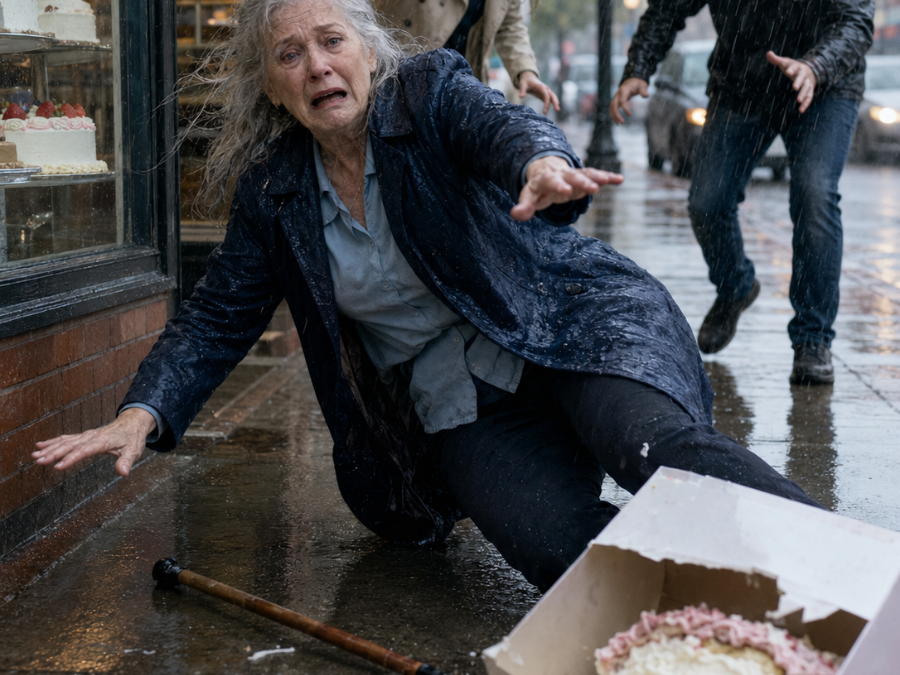
The rain had been falling over Pine Hollow, North Carolina, since dawn, turning every parking lot into a sheet of gray water, and by the time seventy-one-year-old Margaret Ellis stepped carefully out of a neighborhood bakery, she was holding a large birthday cake with both hands while balancing painfully on the knee that had troubled her for years. Her granddaughter Emma was turning eight, and Margaret had agreed to collect the cake only because her daughter-in-law, Vanessa, had called that morning claiming she was “absolutely drowning” in preparations for the elaborate party being held at their house.
Margaret should have refused, because her physician had warned her against walking long distances in bad weather, but Emma adored strawberry cake and had once told Margaret that birthdays felt more special when Grandma was involved. So Margaret paid for a rideshare she could barely afford, tucked her cane beneath one arm, collected the decorated box, and began inching toward the curb while rain hammered against the hood of her faded navy coat.
Her shoe slipped before she reached the car.
The cake flew from her hands as her body twisted sideways, and the pain that exploded through her hip was so violent that she could not even scream at first, only stare at the ruined frosting spreading across the wet pavement while strangers rushed toward her.
That fall changed everything.
There were two surgeries, followed by nearly ten weeks in a rehabilitation center where Margaret learned how quickly a strong life could shrink into a schedule of medication, exercises, metal rails, and people asking her to rate her pain from one to ten. She eventually left using a wheelchair, with doctors hopeful that she would walk again with therapy, but the modest two-story house where she and her late husband Daniel had spent thirty-seven years was almost impossible to navigate.
Her bedroom was upstairs, the shower was upstairs, and even the narrow downstairs hallway seemed determined to punish every turn of the wheelchair.
Her son, Preston, visited the rehabilitation center twice.
He was forty-four now, polished and successful, with carefully combed brown hair, expensive-looking suits without visible labels, and the rushed manner of a man who acted as though every conversation stole money from him. During his second visit, he spent thirteen of his eighteen minutes answering messages while telling Margaret that things were “crazy at the office.”
Vanessa never visited.
Emma mailed a card decorated with purple stars.
Margaret kept it beside her bed.
When she finally returned home, her financial situation became impossible to ignore.
The monthly retirement check that had once seemed adequate disappeared into property taxes, utilities, medication, transportation, groceries, and the payments on a loan Margaret believed still existed against the house. She had sold jewelry, canceled insurance policies she considered nonessential, and stopped buying anything that could be described as a luxury.
The reason for that loan lived twelve miles away in a five-bedroom house behind stone gates.
Seven years earlier, Preston had come to his parents desperate.
His small commercial design company was drowning, investors were leaving, and Vanessa had made it clear that she was tired of living in what she called “temporary houses.” Preston wanted $325,000 to stabilize the company and make the down payment on a large property in Briar Ridge, the kind of neighborhood where driveways curved through landscaped lawns and nobody parked on the street.
Daniel had said no.
“He’s our son, Margaret, not our retirement plan,” Daniel had warned.
But Preston had cried.
Margaret had never seen her adult son cry before.
She begged Daniel to reconsider, and eventually her husband returned from a meeting carrying paperwork showing that they had borrowed against their home.
Preston received the money.
His company survived.
Within three years, he was wealthy.
The repayments stopped after twelve months.
Daniel died two years later after a brief illness, and Margaret found herself staring at statements she barely understood while Preston repeatedly promised they would “sit down and straighten everything out.”
They never did.
Then came the notice.
Margaret was sitting at her kitchen table when she opened an official-looking envelope informing her that delinquent obligations connected to the property had reached a critical stage. Whether because of exhaustion, confusion, or fear, she understood only the sentence that seemed to shout from the page:
VACATE WITHIN SEVENTY-TWO HOURS IF BALANCE REMAINS UNRESOLVED.
Margaret called Preston immediately.
“I need help,” she whispered when he answered.
There was a long pause.
“I’ll speak with Vanessa.”
“Preston, I may lose the house.”
“I heard you, Mom.”
He never called back.
The following afternoon Margaret packed two nightgowns, medication, toiletries, Daniel’s old photograph, and the card Emma had mailed from school.
Then she hired an accessible car and went to Briar Ridge without warning.
She told herself that Preston might be frustrated, embarrassed, even angry.
She never imagined he would be ashamed of her.
Music drifted through the house when she pressed the doorbell, and through the tall front windows Margaret could see people carrying wineglasses beneath warm pendant lights. Preston opened the door in a dark dinner jacket, and his smile vanished the moment he saw his mother sitting in the wheelchair.
“Mom?”
“I need somewhere to stay.”
His eyes moved toward the room behind him.
“You came tonight?”
“I didn’t have anywhere else to go.”
“Not tonight.”
Margaret blinked.
“What?”
Preston stepped outside and pulled the door almost closed.
“My regional partners are here. The board chair is here. They’re deciding who gets the new division.”
Margaret stared at him.
“I’m not asking to join your dinner, Preston. I’m asking for a bed.”
His gaze dropped to her old coat, her canvas overnight bag, and the wheelchair.
Then something inside his face hardened.
“You can’t come through the house looking like this.”
Before Margaret understood his meaning, Preston moved behind her and took hold of the wheelchair.
“Preston, stop.”
He pushed her quickly along the side path.
“Where are you taking me?”
“Just until everyone leaves.”
He opened a service entrance beside the attached garage and rolled her into a mudroom used for boots, gardening supplies, and storage. The room was unheated, illuminated only by a small window overlooking the driveway, and cold enough that Margaret could see a faint cloud when she exhaled.
“You want me to sit here?”
“Please don’t make this harder.”
“You brought me into the world,” Margaret whispered. “I never thought I’d live long enough to hear my own son say that.”
Preston looked away.
“I’ll deal with this later.”
The door closed.
A lock clicked.
For almost four hours, Margaret listened to laughter drifting through the wall.
Near midnight, Vanessa appeared wearing a silver-gray dress, holding an envelope and a brochure.
“We found somewhere appropriate,” she said.
Margaret looked at the brochure.
Willow Creek Assisted Housing.
It was a subsidized residential facility nearly fifty miles away.
Vanessa placed eighty dollars on Margaret’s lap.
“There’s a car waiting by the gate.”
Margaret slowly raised her eyes.
“Did Preston ask you to give me this?”
Vanessa hesitated only a moment.
“We both agree it’s best.”
Margaret folded the bills once, placed them inside the brochure, and said nothing.
Something had broken inside her.
She just didn’t yet understand that something else was about to open.
Part 2: The shattered frame that changed everything overnight
Margaret returned to her silent house shortly after one in the morning, and the driver helped her through the front door before disappearing into the rain. She sat alone beneath the hallway light for several minutes with Vanessa’s brochure still resting on her knees, listening to the old house settle around her while memories seemed to breathe from every wall.
Daniel had installed the crown molding himself.
Preston had taken his first steps beside the fireplace.
Emma had once fallen asleep under the dining table during Christmas dinner.
Margaret wondered how a house could contain so much love while its owner felt so completely abandoned.
The next morning, she began packing.
There was no organized plan because panic had replaced organization, so Margaret simply started in Daniel’s downstairs study, filling boxes with folders, photographs, books, old birthday cards, receipts, and the ordinary debris of nearly four decades together.
Above the desk hung a framed photograph from their thirty-fifth anniversary.
Daniel stood beside Margaret near a lake, his arm around her shoulders, both of them laughing at something outside the frame.
Margaret reached for it.
“I could use you right now,” she whispered.
The frame slipped.
It struck the corner of the desk before crashing onto the hardwood floor, splitting along the back edge.
Margaret gasped.
She lowered herself awkwardly from the wheelchair, fighting the pain in her hip as she gathered the broken pieces.
Then she heard something metallic slide beneath the desk.
It was a key.
Not an ordinary key, but a thick rectangular brass key stamped with the characters C-218.
Margaret stared at it.
When she pulled the photograph from the damaged frame, she discovered a folded envelope hidden behind the backing.
Her name was written across it.
Margaret.
Daniel’s handwriting.
Her fingers shook so badly she nearly tore the paper opening it.
Inside was a letter dated six months before his death.
Margaret read the first paragraph twice before understanding it.
Daniel explained that he had never borrowed against their house.
The loan paperwork Margaret had seen years earlier had been part of a carefully constructed arrangement designed to convince Preston that his parents had exhausted their resources, because Daniel had already begun recognizing a pattern in their son: every rescue became permission to request another rescue.
The $325,000 had come from Daniel’s private investment account.
Their home remained free of any mortgage.
The frightening property notice Margaret had received was not a foreclosure order at all, despite its intimidating language; it was a warning connected to unpaid administrative charges and taxes that could easily be resolved.
Then came the sentence that made Margaret cover her mouth.
You are not facing poverty, Maggie. You are facing confusion, and I regret that I left you to untangle it alone.
Daniel had spent decades quietly investing the income from a consulting partnership he sold before Preston was born.
He had never lived extravagantly.
Margaret had assumed they were comfortable, nothing more.
According to the letter, Daniel had created a private estate structure that Margaret could access through a secure trust office in downtown Bellhaven.
The key would identify the account.
Margaret kept reading.
There was one final paragraph.
Preston’s house was involved.
Daniel had not given their son $325,000 directly.
Instead, he had created Harbor Ridge Property Group, a private holding company that purchased the Briar Ridge house and leased it back to Preston under a long-term purchase agreement. Daniel had done it because Preston’s credit was unstable at the time, but he had also included repayment requirements that would eventually transfer ownership once Preston fulfilled them.
He never fulfilled them.
After Daniel’s death, control of Harbor Ridge passed entirely to Margaret.
She had never known.
The letter ended simply:
If Preston becomes the man I hope he becomes, forgive the paperwork and give him the house someday. If he becomes a man who forgets what you sacrificed for him, read every document before you decide what he deserves.
Love always,
Daniel.
Margaret remained on the floor for a long time.
She remembered Preston shoving her wheelchair through the side entrance.
She remembered the lock.
She remembered Vanessa placing eighty dollars on her lap.
For years Margaret had confused love with endless rescue.
Daniel, apparently, had understood the difference.
By noon, Margaret was wearing a charcoal pantsuit she had not touched since Daniel’s memorial service, her silver hair neatly pinned behind her head. She booked an accessible town car and asked the driver to take her downtown.
Bellhaven Trust House occupied a quiet limestone building between two office towers.
There were no lines and no public counters, only a reception desk and two security officers.
Margaret rolled forward and placed the key on the desk.
The receptionist looked down.
Her entire expression changed.
“Mrs. Ellis?”
Margaret’s heart accelerated.
“Yes.”
The woman immediately stood.
“Mrs. Ellis, Mr. Daniel Ellis left standing instructions regarding your arrival.”
Margaret felt the room tilt.
“He did?”
“Yes, ma’am.”
The receptionist stepped around the desk.
“We’ve been expecting you.”
Part 3: My husband had protected me from a future I never saw
Margaret spent nearly three hours inside a private conference suite with a trust administrator named Caroline Meyers and an estate attorney named Samuel Reed. They explained everything slowly, translating years of financial planning into language Margaret could understand, and with each new document the life she believed had collapsed around her began reorganizing itself.
Daniel’s investments, property interests, municipal bonds, private funds, and cash reserves had grown substantially.
Margaret was not merely financially secure.
She possessed more money than she could reasonably spend during the remainder of her life.
But the discovery that affected her most was Harbor Ridge Property Group.
The company owned three commercial properties and one residential property.
Preston’s house.
“The agreement gave your son the right to acquire full title once he completed the repayment schedule,” Samuel explained. “He stopped making payments six years ago.”
Margaret stared at the page.
“He told me business expenses were temporarily high.”
Samuel glanced toward Caroline.
“He also received written notices.”
“He knew?”
“Yes.”
Margaret’s throat tightened.
“So when I told him I was losing my home, he knew he was living in a house tied to my husband’s money while believing I was drowning?”
Samuel chose his words carefully.
“He certainly knew his own contractual obligations had not been satisfied.”
Margaret turned toward the window.
The humiliation in the mudroom suddenly felt different.
It was no longer simply cruelty committed by a selfish son.
It was entitlement.
Preston had built his life on a sacrifice he had stopped acknowledging the moment acknowledgment became inconvenient.
“What are my options?” Margaret asked.
Samuel placed three folders in front of her.
“You can forgive the outstanding balance and transfer the property to him. You can renegotiate the agreement. Or you can terminate his occupancy according to the default provisions and reclaim the property.”
Margaret looked at the third folder.
Her hands remained completely still.
“I don’t want to ruin my son.”
Samuel nodded.
“That is your decision.”
“But I won’t protect him from consequences anymore.”
That afternoon Margaret paid every legitimate obligation connected to her own home, hired an elder-law consultant, arranged private physical therapy, and moved temporarily into an accessible apartment overlooking a small riverfront park while renovations began downstairs at her house.
She did not buy diamonds.
She did not order champagne.
She did not call Preston.
Instead, she slept for nine uninterrupted hours.
Over the following two weeks, something unexpected happened.
Margaret grew stronger.
She graduated from the wheelchair to a walker for short distances, then to a cane under supervision.
She also began examining the records Daniel had left behind.
The more she learned, the less she wanted revenge.
She wanted clarity.
She instructed Samuel to offer Preston one final opportunity.
A formal letter was delivered requesting that Preston contact Harbor Ridge Property Group within ten business days to address years of missed obligations.
He ignored it.
A second notice followed.
Preston forwarded it to an assistant.
A third notice explained that termination proceedings would begin.
Vanessa called the number listed on the paperwork and reportedly told an administrator that “some retired bookkeeper was trying to shake them down.”
Margaret nearly laughed when Samuel repeated the story.
Then Emma called.
“Grandma?”
Margaret’s anger disappeared instantly.
“Sweetheart.”
“Dad said you’re mad at us.”
“I’m not mad at you.”
“Are you sick?”
Margaret swallowed.
“I’m getting stronger every day.”
Emma lowered her voice.
“Mom said you went somewhere for old people.”
Margaret closed her eyes.
“No, honey. I’m living in a little apartment while my house gets repaired.”
“Can I see you?”
Those four words changed the entire shape of Margaret’s decision.
Whatever happened next, the children would not become collateral damage.
Margaret told Samuel that Preston and Vanessa must receive enough time and money from their own accounts to arrange suitable temporary housing, and Emma’s school routine was not to be interrupted.
Then she signed the termination order.
Three days later, Preston called.
He did not say hello.
“What are you doing?”
Margaret sat beside the apartment window with her cane resting against the chair.
“Good afternoon to you too.”
“You’re behind this Harbor Ridge nonsense?”
“It isn’t nonsense.”
“You don’t understand those documents.”
“I understand them now.”
There was silence.
Then Preston’s voice dropped.
“Mom, don’t do something stupid because you’re emotional.”
Margaret almost smiled.
For forty-four years, that tone would have frightened her.
Not anymore.
“You had ten days to call.”
“I’m busy.”
“So was I when I raised you.”
“Mom—”
“You had six years to honor the agreement your father created.”
Preston’s breathing changed.
“How much do you know?”
Margaret looked down at Daniel’s letter.
“Enough.”
And for the first time in her life, Margaret ended the call before her son did.
Part 4: He finally understood whose sacrifice had built his life
The confrontation happened on a bright Thursday morning, not during a dramatic storm or beneath flashing lights, but under a clear blue Carolina sky while a moving company waited quietly at the end of Preston’s driveway. Harbor Ridge had legally terminated the occupancy agreement, and Preston had been given five days to remove personal belongings after repeatedly refusing to negotiate.
Margaret did not intend to attend.
Then Preston called at 7:14 a.m.
“Come here.”
His voice was stripped of arrogance.
“You wanted this,” he continued. “Come watch.”
Margaret almost refused, but after several minutes she asked her driver to take her to Briar Ridge.
She arrived walking with a cane.
Preston stood in the driveway wearing jeans and a wrinkled blue shirt, looking as though he had not slept.
Vanessa was near the front door directing movers while crying angrily into her phone.
When Preston saw Margaret step from the car, his face changed.
“You’re walking.”
“I’m improving.”
He looked at the cane.
Then at her.
Then at Samuel, who had arrived in another vehicle.
“You planned all of this.”
Margaret shook her head.
“Your father planned the structure. You planned the consequences.”
Vanessa stormed toward them.
“This is insane. We’ve lived here seven years.”
“You were supposed to purchase it over time,” Margaret replied.
“We improved this house.”
“With whose original money?” Margaret asked.
Vanessa stopped.
Preston looked away.
Margaret continued gently.
“I gave you everything I thought I had because you told me your family would fall apart without it. Your father protected me because he knew I would empty every account if you asked me with tears in your eyes.”
Preston rubbed both hands over his face.
“I was going to repay you.”
“When?”
“My company was expanding.”
“When, Preston?”
He had no answer.
Margaret’s voice trembled now, not from weakness but from finally saying words she had swallowed for years.
“I called you from a house where I couldn’t reach my own shower. I was sleeping on a sofa because I couldn’t climb the stairs. I told you I thought I was being forced out, and you left me waiting for a phone call.”
“Mom—”
“Then I came here.”
Preston’s eyes closed.
“You pushed me through the side entrance because your coworkers might see me.”
Vanessa folded her arms.
“That night was important.”
Margaret turned toward her.
“So was mine.”
No one spoke.
Margaret could hear movers carrying boxes through the foyer where Preston had refused to let her enter.
“I spent four hours in a room colder than the sidewalk because my son was embarrassed by a wheelchair,” Margaret said. “Then your wife handed me eighty dollars and a brochure for subsidized housing.”
Vanessa’s face reddened.
“I was trying to find a solution.”
“You were trying to remove an inconvenience.”
Preston stepped closer.
“What do you want me to say?”
Margaret looked at him for a long moment.
“I wanted you to say, ‘Come inside, Mom.’”
His face crumpled.
It was not theatrical.
There was no shouting, no dramatic collapse, only a grown man suddenly forced to confront the smallest sentence he had failed to speak.
Margaret felt grief rather than triumph.
That surprised her.
“Take the children somewhere comfortable,” she said. “Samuel has arranged thirty days before the property is listed. Nobody is putting Emma through chaos.”
Preston stared at her.
“You’re still selling it?”
“Yes.”
“After everything?”
Margaret’s eyebrows lifted.
“After everything is exactly why.”
Vanessa walked away.
Preston remained.
“What happens to us?”
Margaret remembered the brochure.
For one bitter second she imagined handing it back.
Instead, she reached into her handbag and removed the folded paper.
Preston recognized it.
Margaret placed it in his hand.
“This is what your wife gave me.”
His eyes lowered.
“I thought about giving you the same advice.”
He said nothing.
“But that would make me cruel instead of making you accountable.”
Preston looked up.
“So what are you doing?”
“Nothing.”
He frowned.
“You’re forty-four years old. You have income, savings, professional skills, and a family. For once, I am not solving your problem.”
Those words hurt him more than any insult could have.
Margaret turned toward her car.
Behind her, Preston said quietly, “Mom.”
She stopped.
“I’m sorry.”
Margaret stood without turning around.
Part of her had waited years to hear those words.
Another part understood that an apology offered while movers carried away his furniture was only the beginning, not redemption.
“I hope one day you understand what you’re sorry for,” she said.
Then she left.
Part 5: Losing the mansion became the beginning of something harder
Margaret sold the Briar Ridge property two months later.
She used part of the proceeds to renovate her own home, installing a downstairs bedroom, wider doorways, handrails, and an accessible bathroom, but she refused every suggestion that she should transform the familiar house into something extravagant. She wanted comfort, sunlight, photographs, Emma’s drawings on the refrigerator, and the old maple tree outside the kitchen window.
The rest of the money remained invested.
Margaret also created a small housing assistance fund through a local nonprofit network for older adults recovering from serious injuries, because she could not forget how terrifying it had felt to believe that physical weakness and financial confusion might leave her homeless.
Preston moved his family into a rented townhouse.
Vanessa hated it.
Within four months, she and Preston began living separately.
Margaret did not celebrate that either.
Emma visited every Saturday.
The first afternoon she came to Margaret’s renovated house, she ran through the front door carrying a paper bag filled with cookies and wrapped both arms around her grandmother.
“Dad said he did something really bad.”
Margaret stroked her hair.
“Your dad made some serious mistakes.”
“Are you still his mom?”
Margaret felt tears rise unexpectedly.
“Always.”
“Then why doesn’t he come here?”
Margaret looked toward the driveway.
“That part is up to him.”
Several weeks later, Preston finally did.
He arrived alone wearing an ordinary sweater and dark pants, without the polished armor of his old professional life.
Margaret opened the door using her cane.
He remained on the porch.
“I wasn’t sure you’d let me in.”
Margaret studied him.
“I won’t hide you in the garage.”
His face tightened with shame.
“Mom.”
“I know.”
She moved aside.
“Come in.”
They sat at the kitchen table where Preston had once cried seven years earlier, asking his parents for money.
For a while neither spoke.
Then Preston placed an envelope on the table.
Margaret did not touch it.
“What’s that?”
“The first payment.”
“Toward what?”
“Everything.”
She gave him a tired smile.
“You can’t repay everything with money.”
“I know.”
That answer surprised her.
Preston stared at his hands.
“I’ve been seeing someone.”
Margaret raised an eyebrow.
“A counselor.”
She nodded.
He continued.
“I keep remembering that night.”
“So do I.”
“I told myself I was protecting one important evening. I told myself you would understand once the guests left. Then Vanessa suggested the facility and I let her handle it because I didn’t want to deal with it.”
Margaret listened.
“I became the kind of person Dad was afraid I’d become.”
Margaret’s expression softened, but she did not rescue him from the sentence.
“Your father loved you very much.”
“I know.”
“He just didn’t trust the version of you that appeared whenever money and status were involved.”
Preston looked toward the window.
“I don’t trust that version either.”
For the first time, Margaret saw something she had not seen when he begged for money or apologized in the driveway.
Responsibility.
Not self-pity.
Not panic.
Responsibility.
She pushed the envelope back toward him.
“Keep it.”
Preston frowned.
“I don’t want your money,” Margaret said. “Use it for Emma’s education.”
“Mom, I owe you.”
“Yes.”
His shoulders sagged.
“But what you owe me cannot be deposited.”
He looked at her.
“You owe me time. Honesty. Respect when nobody important is watching.”
Preston nodded slowly.
“And if I fail?”
“Then I stop opening the door.”
Six months passed.
Preston came every Sunday morning.
Sometimes he fixed things around the house.
Sometimes he brought groceries.
Sometimes they argued.
Sometimes Margaret told him to go home.
But he kept returning.
Vanessa eventually apologized too, although Margaret sensed that regret came more slowly to her, and their relationship remained careful and distant.
Margaret accepted that.
Forgiveness, she had learned, did not require returning every relationship to its previous shape.
One spring afternoon, nearly a year after the accident, Margaret stood in Daniel’s study without her cane for the first time.
The repaired anniversary photograph hung above the desk in a simpler oak frame.
The brass key rested inside a small wooden box beneath it.
Emma entered carrying lemonade.
“Grandma, why do you keep that old key?”
Margaret smiled.
“Because your grandfather hid it somewhere I would only find it when I really needed it.”
“What does it open?”
Margaret considered the question.
Technically, it had opened a trust vault.
It had revealed accounts, contracts, property records, and a fortune she never knew existed.
But none of those answers felt quite right.
She looked at Daniel’s smiling face in the photograph, then toward the bright hallway where Preston was installing a shelf he had promised to finish weeks earlier.
“It opened my eyes,” Margaret said.
Emma made a face.
“That doesn’t make sense.”
Margaret laughed.
“It will someday.”
Outside, rain began tapping lightly against the windows.
For a moment Margaret remembered lying helpless on cold pavement beside a destroyed birthday cake, then sitting alone inside Preston’s freezing mudroom while laughter passed through the walls.
She remembered believing her life was ending.
Instead, that night had revealed something she should have understood years earlier: love did not mean surrendering every boundary, family did not excuse cruelty, and helping someone endlessly could sometimes prevent them from becoming the person they needed to be.
Margaret had not destroyed her son.
She had stopped carrying him.
The difference changed both of their lives.
And every time Preston entered through her front door now, he paused for half a second before crossing the threshold, as though remembering the night he had denied his mother the simplest kindness in the world.
“Come inside, Mom,” he always said.
Margaret knew those words could never erase what happened.
But over time, spoken sincerely and supported by action, they became something better than revenge.
They became proof that a closed door did not always have to remain closed forever.
The End. This story is entirely fictional and was created for entertainment purposes. All characters, names, locations, events, and situations depicted in this story are imaginary. Any resemblance to actual people, organizations, places, or events is purely coincidental.








