My Parents Tried to Take Over My Lake House for Their Anniversary While My Daughter Recovered From a Transplant—Then Mom Humiliated Us in Front of Forty Guests
My Parents Tried to Take Over My Lake House for Their Anniversary While My Daughter Recovered From a Transplant—Then Mom Humiliated Us in Front of Forty Guests
Part 1: The House They Suddenly Decided Belonged to Them
By the time my thirteen-year-old daughter came home from the hospital, I had learned to fear ordinary things that most people never noticed: an uncovered cough in a grocery aisle, muddy shoes near the front door, a delivery driver rubbing his nose before handing over a package, even a vase of fresh flowers carrying invisible mold spores. Sophie had survived months of treatment and finally received a stem-cell transplant, but her doctors warned me that surviving the procedure did not mean the danger had passed, because for several fragile months afterward her immune system would be so weak that a minor infection could send her straight back into intensive care.
Our home outside the fictional town of Briar Glen, Wisconsin, became less like a house and more like a carefully controlled sanctuary, with air purifiers humming beside the stairs, disinfectant bottles lined along the kitchen counter, disposable shoe covers near the mudroom, and a handwritten chart where I recorded Sophie’s temperature morning and night. She hated the precautions sometimes, especially when she could see Lake Hollow sparkling beyond her bedroom window, but she never complained for long because she understood that every lonely week brought her closer to getting her ordinary life back.
The lake house had not always been beautiful enough for anyone to envy. Nine years earlier, when my grandfather’s modest estate was settled, my parents had laughed at the weather-beaten cedar house with its leaning porch, outdated plumbing, collapsing boathouse, and six acres of tangled weeds, while my mother, Marianne Holloway, declared that anyone buying it would spend the rest of her life repairing someone else’s problems.
I bought it anyway. I was thirty-one, newly divorced, raising Sophie alone, and terrified by the mortgage, but I loved the quiet shoreline and the memory of summer afternoons there with my grandfather, so I purchased the property from the estate at its appraised value and spent years rebuilding it room by room.
I replaced rotten porch boards myself, learned how to tile bathrooms from instructional manuals, hired local contractors only for the jobs I could not safely do, and turned the crumbling boathouse into a small studio where I ran my bookkeeping business. By the time the renovation was finished, the ugly property my mother had mocked had become a warm cedar-and-stone home overlooking the lake, with a broad deck, a landscaped lawn, and enough space that suddenly my parents could not stop talking about it.
At first, their entitlement arrived quietly. Dad left fishing equipment in my garage because transporting it back and forth was “ridiculous,” Mom stored extra serving dishes in my pantry, and they began bringing friends without asking because, as she cheerfully explained one afternoon, “People love seeing our lake place.”
I corrected her the first few times. “My lake place, Mom.”
She would smile as if I had made an adorable joke. “Of course, sweetheart. You know what I mean.”
Eventually, while Sophie was sick, I stopped correcting anything because chemotherapy appointments, insurance calls, medication schedules, nausea, blood tests, and sleepless nights consumed every ounce of energy I possessed. My parents interpreted exhaustion as surrender, and by the time Sophie received her transplant, my mother had started referring to my home as “the Holloway family lake house” whenever she spoke to relatives.
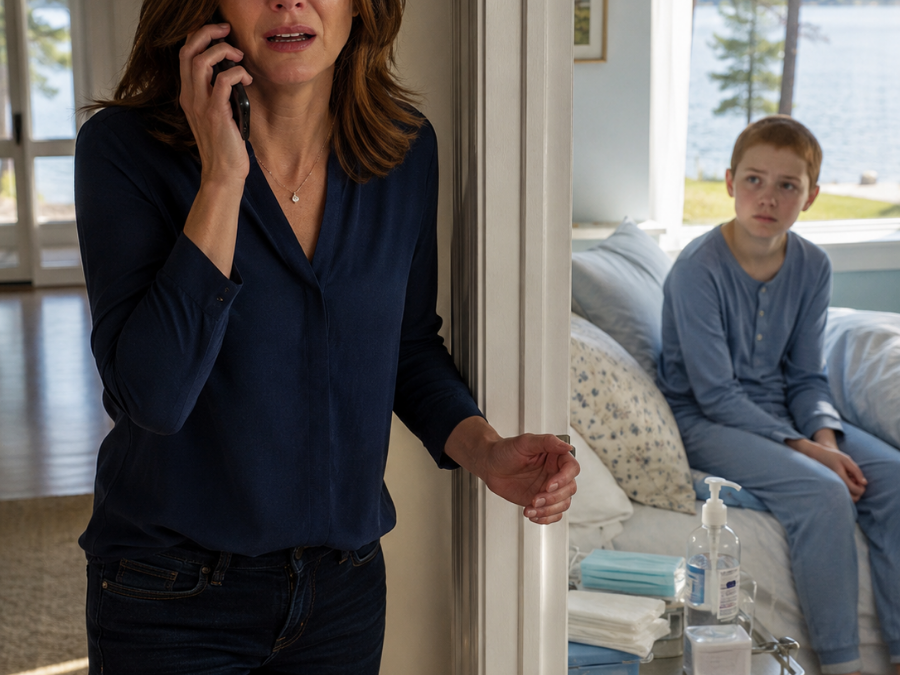
Three weeks after Sophie came home, I was changing the pillowcases in her room when my phone rang. Sophie was asleep beneath a lightweight blue quilt, her once-thick auburn hair only beginning to grow back in soft patches, and because she had finally managed to sleep without waking nauseated, I hurried into the hallway before answering.
“Hi, Mom.”
“Rachel, thank goodness,” Marianne said. “We have a crisis.”
My stomach tightened immediately, although her definition of crisis rarely resembled mine. “What happened?”
“The event lodge canceled our anniversary dinner.”
My parents’ forty-second anniversary was four days away, and Marianne had spent months planning an elaborate celebration for nearly forty people. She had discussed flowers, musicians, custom desserts, and table arrangements during hospital visits while Sophie slept three feet away, never once noticing that I had stopped responding.
“There was some electrical problem,” she continued impatiently. “Apparently the county inspector won’t let them reopen until next week, so your father and I have already decided on the obvious solution.”
I knew before she said it. Still, some frightened part of me hoped I was wrong.
“We’ll have it at the lake house.”
“No.”
Silence followed.
Then Marianne laughed once, softly. “I’m sorry?”
“You cannot have forty people here, Mom. Sophie just had a transplant.”
“Oh, Rachel, everyone knows Sophie has been sick.”
“This isn’t about people knowing. Her immune system barely functions right now, and her doctors have ordered strict isolation.”
My mother sighed with the weary patience she used when she wanted someone to feel foolish. “They’ll be downstairs.”
“That doesn’t matter.”
“The deck is enormous, and if the weather stays nice, most people will be outside anyway. The musicians can set up near the windows, catering can use your kitchen, and we’ll move your medical clutter somewhere less visible.”
I squeezed the phone so tightly my fingers hurt. “There is no party happening here.”
Her voice changed.
“You are not seriously going to embarrass your father and me over this.”
“My daughter could end up in the hospital.”
“Then keep her in her bedroom.”
I could not speak.
Marianne continued as casually as if she were solving a seating problem. “Close the upstairs hallway, put one of those air machines in her room, and tell her to stay there until everyone leaves.”
I stared through the hallway doorway at Sophie, sleeping peacefully beneath the quilt.
“Mom,” I whispered, “did you just tell me to confine my recovering child upstairs so you can entertain your friends in my home?”
“Don’t twist my words.”
“You said exactly that.”
“I am trying to find a reasonable compromise, Rachel, because unlike you, I understand that other people have commitments. Forty people have rearranged their Saturday, and some are driving several hours.”
“Then call them.”
“No.”
“Find another venue.”
“Absolutely not.”
“Then cancel.”
My mother’s voice hardened. “The party is happening at the lake house, Rachel. Your father already told the caterer.”
Something inside me became very still.
“You don’t own this house.”
“Oh, don’t start that nonsense.”
“I bought it.”
“From your own family.”
“At full price.”
“After your grandfather left it to all of us.”
“No. The estate sold it, and I bought it.”
Marianne exhaled sharply. “I refuse to have this ridiculous conversation again. We arrive Saturday morning at eight-thirty, and I expect you to behave like an adult instead of creating some dramatic spectacle.”
Then she added the sentence that finally ended years of excuses.
“And please make sure Sophie doesn’t come downstairs looking sick in front of everyone. This is supposed to be a celebration.”
I looked again at my child.
“All right,” I said quietly. “I understand perfectly.”
“That’s better.”
Marianne hung up believing she had won.
She had no idea that the daughter who had always avoided confrontation had finally disappeared.
Part 2: I Stopped Asking Permission and Started Setting Boundaries
The first call I made was not to my mother, my father, or another relative who might beg me to compromise. I called Sophie’s transplant coordinator and explained exactly what my parents intended to do, and the nurse’s response erased whatever tiny doubt still remained in my mind.
“Absolutely not,” she said. “Forty visitors inside that home would be an unnecessary medical risk, especially this soon after transplant, and Sophie should not be displaced because someone wants to hold a party.”
I asked her to send the current isolation instructions through the patient portal, then printed them and placed them in a folder beside Sophie’s discharge paperwork. After that, I opened the fireproof document box in my office and removed the deed showing one owner of 114 Pinewater Road: Rachel Holloway.
My next call was to a locksmith.
By Thursday afternoon, the old exterior locks had been replaced, the keypad code had been changed, and the spare key my parents believed still worked was useless. I also changed the code on the detached garage, disabled the remote opener Dad kept in his SUV, and installed a simple chain across the private gravel entrance with clearly visible PRIVATE PROPERTY signs.
Then I tackled everything my parents had slowly deposited inside my house over the years.
Dad’s fishing rods, tackle boxes, folding chairs, and tool chest went into labeled containers. Mom’s holiday dishes, decorative lanterns, spare table linens, framed photographs, garden sculptures, and six boxes of wineglasses were packed just as carefully, because I was furious but not destructive.
I rented a storage unit in Briar Glen, moved everything there with help from my neighbor, and paid for sixty days in advance. Their belongings were safe, documented, photographed, and completely removed from my home.
On Friday afternoon, I sent both parents the same text.
“Your belongings have been moved to a secure storage unit. I have repeatedly denied permission for Saturday’s event. Do not enter my property or send vendors onto it. Sophie’s medical isolation makes a large gathering unsafe.”
My father called twenty seconds later.
I let it ring.
Mom called twice.
I ignored those calls too.
Then a voicemail arrived.
“Rachel, this behavior is humiliating,” Marianne said. “Your father says you changed the entry code, which is unbelievably childish. We have already paid deposits, so if you try locking us out tomorrow, Dad will use the side door with his spare key, and if that fails, we’ll have someone open it. Stop making everything harder than it needs to be.”
I replayed the message once.
Then I saved it.
That evening, I drove to the county sheriff’s substation ten minutes from town and explained the situation to Deputy Chief Nolan Pierce, a broad-shouldered man in his late fifties who listened without interrupting while I showed him the deed, the medical instructions, the text message revoking permission, photographs of the posted entrance, and my mother’s voicemail.
“You’re not asking us to mediate a disagreement,” he finally said. “You’re telling us people have announced they may enter your property after permission was expressly denied.”
“Yes.”
“And there is a medically vulnerable child inside.”
“Yes.”
He leaned back and studied me. “Do you expect them to actually show up?”
“With caterers, musicians, and approximately forty guests.”
For the first time, his eyebrows rose.
He promised to have a deputy patrol nearby during the expected arrival window, although he explained that officers would intervene according to whatever actually happened rather than arresting people simply because I requested it. That was all I wanted; I did not need revenge, I needed my boundaries to become real.
When I returned home, Sophie was sitting at the kitchen island wearing soft gray pajamas and assembling a puzzle. She looked up at me with the cautious expression children develop when adults have been whispering around them.
“Grandma’s mad, isn’t she?”
I placed my keys down.
“Grandma is upset because I told her she can’t have her party here.”
Sophie lowered her eyes. “Because of me?”
“No.”
She looked unconvinced.
I moved around the island and crouched beside her.
“Listen carefully,” I said. “You are not ruining anything. You are recovering from something incredibly hard, and protecting you is my responsibility.”
“What if they get really mad?”
“They probably will.”
Her mouth tightened.
“But being angry doesn’t make someone right,” I continued. “And loving someone does not mean they get to ignore your safety.”
Sophie studied me for several seconds.
Then she whispered, “Grandma told Aunt Dana on the phone that everybody has to reorganize their lives because I’m fragile.”
The words hurt more than I expected.
“When did she say that?”
“Last week. She didn’t know I heard.”
I took my daughter’s hand.
Saturday’s confrontation had just stopped being about a house.
It was about teaching Sophie what love was supposed to look like.
Part 3: Forty Guests Arrived to a Gate My Parents Couldn’t Open
Saturday morning was painfully beautiful, the kind of summer morning when sunlight glittered across Lake Hollow and the pine trees barely moved in the warm breeze. At eight-fifteen, I checked Sophie’s temperature, made her breakfast, confirmed that her medications were taken, and asked my neighbor Nora—one of the few people approved by Sophie’s medical team to enter after precautions—to stay upstairs with her.
At eight-thirty, I walked onto the front porch wearing jeans, a navy blouse, and the expression of someone who had finally stopped negotiating. The chain across the driveway was visible from the county road, as were the signs stating that the property was private.
At eight-forty-seven, the first vehicle appeared.
My parents’ dark green SUV rounded the curve, followed by two passenger shuttles, three catering vans, a florist’s delivery vehicle, and several cars. The absurd procession slowed as soon as Dad noticed the chained entrance.
I watched him climb from the SUV.
Even from eighty yards away, I could see his confusion.
He walked to the keypad, entered the old combination, waited, and tried again.
Nothing happened.
Mom emerged next.
Marianne wore a pale blue dress, pearl earrings, and the fixed smile she used whenever strangers were watching. She looked at the chain, then at the house, and lifted both arms as if demanding an explanation from the sky.
“Rachel!”
I remained on the porch.
“Open this!”
Behind her, shuttle doors opened and guests began stepping onto the roadside. Men adjusted jackets, women shielded their eyes from the sun, and caterers stood beside their vans waiting for instructions.
Mom shouted again.
“Rachel, people are here!”
I walked slowly down the driveway.
By the time I reached the entrance, roughly twenty guests were standing outside their vehicles, while others watched through shuttle windows. Dad was pulling uselessly on the chain.
“What are you doing?” he demanded.
“Protecting my daughter.”
Mom gave a sharp laugh and turned toward the gathering crowd. “Everyone, please excuse my daughter. She’s been under tremendous stress lately.”
I almost admired how quickly she transformed disobedience into mental instability.
“Mom, I told you repeatedly that this event was not happening here.”
“You were emotional.”
“I was clear.”
“This is your parents’ anniversary.”
“And this is my home.”
Dad stepped forward. “Rachel, stop this before you make a fool of yourself.”
A county patrol vehicle appeared behind the last shuttle.
My mother noticed it and smiled with visible relief.
“Oh, wonderful.”
Deputy Lena Ortiz parked on the shoulder and approached calmly.
Marianne immediately intercepted her.
“Officer, thank goodness. My daughter has chained us out of our family property during a private anniversary event.”
Deputy Ortiz looked from her to me.
“Who owns the property?”
“I do,” I said.
Mom waved dismissively. “Technically.”
“There is no technically,” I replied. “I am the sole owner.”
The deputy asked for identification, then reviewed the copy of the deed I had brought outside.
Marianne’s smile disappeared.
“This is absurd,” she said. “I’m her mother.”
“That does not give you property rights,” Deputy Ortiz answered.
Several guests exchanged uncomfortable glances.
My father lowered his voice. “Could we please discuss this privately?”
“No,” Mom snapped. “We are not being humiliated because Rachel has decided to become vindictive.”
Then movement appeared in an upstairs window.
Sophie stood behind the glass wearing her protective mask, one hand holding the curtain aside.
My heart sank.
She looked frightened.
Mom followed everyone’s gaze upward.
And then she made the mistake she could never take back.
“There,” she exclaimed, pointing toward Sophie. “She’s upstairs already, exactly where Rachel could have kept her during the party.”
The murmuring stopped.
Marianne continued, apparently believing she had made a brilliant argument.
“No one needs to go upstairs. The child can stay in her room for four hours, the guests remain downstairs, and everyone gets what they need.”
A woman standing beside one shuttle stared at her.
“You’re talking about your granddaughter?”
“She’s recovering,” Marianne said impatiently.
The woman’s expression changed.
“So you want forty people inside the house while she’s medically isolated?”
Mom crossed her arms. “She has a bedroom.”
Something passed through the crowd then, almost visible—a collective understanding that this was not the harmless family misunderstanding Marianne had been presenting.
My father saw it too.
“Marianne,” he muttered. “Enough.”
But she was furious now.
“No. I will not be treated like some criminal because my daughter enjoys drama.”
I took out my phone.
“You left me a voicemail yesterday.”
Mom froze.
I pressed play.
Her own voice filled the quiet roadside.
“If you try locking us out tomorrow, Dad will use the side door with his spare key, and if that fails, we’ll have someone open it.”
The recording ended.
Deputy Ortiz looked at my parents.
“You were explicitly denied entry?”
My father stared at the ground.
Mom’s face reddened.
“This is unbelievable.”
The deputy gestured toward their SUV.
“You need to leave.”
Marianne stepped toward the chain.
“I am going inside.”
“Ma’am, don’t.”
“She cannot keep me out.”
“She can.”
“This belongs to our family!”
Marianne grabbed the chain.
Deputy Ortiz moved between us.
“Do not cross that boundary.”
Mom looked around at her guests, and I watched pride defeat common sense in real time. She ducked beneath the chain.
The deputy stopped her immediately.
What followed happened quickly: another warning, my mother jerking her arm away, Dad shouting, guests backing toward the shuttles, and Marianne insisting loudly enough for everyone to hear that no police officer would remove her from “her own daughter’s property.”
A second patrol car arrived minutes later.
Mom was placed in the back seat.
Not because she was my mother.
Not because I wanted revenge.
Because after every warning, she still believed rules were for other people.
Part 4: The Anniversary Party Collapsed Under the Weight of Truth
Once Marianne was inside the patrol vehicle, the atmosphere outside my gate changed from confusion to unmistakable embarrassment. Guests who had arrived expecting champagne beside the lake were suddenly standing beside a county road watching my father argue with law enforcement while his wife sat furious in the back of a cruiser.
One older couple quietly returned to their car without speaking to anyone. The musicians packed their cases back into their van, the catering manager approached my father with paperwork in his hand, and within minutes the celebration Marianne had spent months designing began dismantling itself in full public view.
Dad finally turned toward me.
“You satisfied?”
The question stunned me.
“Is that really what you think this is?”
“You could have handled this privately.”
“I tried.”
“You could have let us use the lawn.”
“Sophie cannot safely have forty visitors using the property, bathrooms, kitchen, and common spaces.”
“We would have been careful.”
“You were literally planning to force your way inside.”
His jaw tightened.
Then he used the weapon my parents had relied on whenever guilt stopped working.
“Your mother and I have done a lot for you.”
I almost laughed.
“Dad, I’m not twelve.”
“You’re certainly behaving like it.”
“No. I’m behaving like Sophie’s mother.”
Several guests were still close enough to hear us.
Dad noticed.
His voice dropped.
“If you pursue this, there will be consequences.”
“Such as?”
“You can forget about inheriting anything from us.”
For years, that threat would have terrified me, not because I desperately wanted their money, but because disinheritance represented something deeper in our family: exile, rejection, proof that you had officially become the disappointing child.
That morning, it sounded almost childish.
“Keep it.”
He stared at me.
“Excuse me?”
“Spend every dollar. Donate it. Burn the paperwork if you want. I’m not trading Sophie’s safety for an inheritance.”
Someone behind Dad whispered, “Good for her.”
His face changed immediately.
That small piece of public approval wounded him more deeply than anything I could have said.
He climbed into the SUV without another word.
One by one, the remaining vehicles departed.
When the road finally emptied, I stood behind the chain staring at tire marks in the gravel while my entire body began to shake. The anger vanished first, leaving only exhaustion.
Then I remembered Sophie.
I ran.
She was sitting cross-legged on her bed when I entered, her protective mask resting beside her.
“Did Grandma get arrested?”
“She was taken away because she refused to leave.”
Sophie looked worried.
“Is it my fault?”
I sat beside her immediately.
“No.”
“But if I wasn’t sick—”
“No.”
I took both her hands.
“If you weren’t recovering, I still would not let someone take over our home after I said no. Your illness made the situation more dangerous, but Grandma’s behavior belongs to Grandma.”
Sophie blinked quickly.
“She looked at me like I was embarrassing.”
That sentence broke something in me that the shouting outside never could.
“You listen to me,” I said, fighting tears. “There is nothing embarrassing about surviving.”
Her face crumpled.
I pulled her against me carefully.
“You survived something frightening,” I whispered. “You lost your hair, your strength, your school year, your privacy, and months of being a normal kid, and you still wake up every morning and try again. Nobody gets to make you feel ashamed for that.”
She cried quietly against my shoulder.
So did I.
The legal aftermath was far less dramatic than the roadside confrontation. Marianne was released later that day after processing, attorneys became involved, and the final charges were resolved without the theatrical courtroom battle she repeatedly predicted, but the incident created something more permanent than punishment.
It created distance.
My parents demanded apologies.
I refused.
They demanded access to Sophie.
I refused that too.
Relatives called to tell me blood was blood, family disagreements should remain private, and Marianne had simply become emotional because an important celebration had been ruined. I answered them with one question: “Would you invite forty people into the home of a newly transplanted child after her doctor ordered isolation?”
Most went silent.
The few who kept defending my parents stopped receiving my calls.
For the first time in my life, I discovered that peace sometimes begins with a smaller contact list.
Part 5: Two Years Later, the Gate Means Something Completely Different
Two summers later, Lake Hollow looked almost exactly as it had on the morning of the confrontation, yet everything inside our lives had changed. The cedar porch had weathered slightly, wildflowers filled the beds beside the driveway, and the chain that once blocked my parents was hanging unused from a post because that afternoon the gate stood wide open.
Sophie was fifteen.
Her hair had returned in thick auburn waves, her cheeks were full again, and she was sprinting barefoot across the lawn with three friends while trying unsuccessfully to keep a bright orange beach ball away from our clumsy rescue dog. Their laughter carried across the water so loudly that I could hear it from the deck.
Her doctors had gradually lifted the restrictions.
First came short outdoor visits.
Then school.
Then restaurants during quiet hours.
Then sleepovers, swimming, birthday parties, and eventually the breathtaking ordinariness of forgetting sanitizer in the car without feeling panic claw through my chest.
That afternoon was the first large gathering we had hosted since Sophie’s transplant.
There were twenty-three people in our yard: neighbors, hospital friends, two nurses from Sophie’s transplant team, families we had met during treatment, and several relatives who had supported us without demanding that forgiveness become the price of belonging. Children chased one another near the dock, adults carried bowls from the kitchen, and music drifted from a small speaker near the porch.
At one point, Nora handed me lemonade and nodded toward Sophie.
“She looks happy.”
“She is.”
“So are you.”
That surprised me.
Then I realized she was right.
My parents had not spoken to us in nearly eighteen months.
Their last meaningful attempt came when Dad mailed me a letter saying that reconciliation was possible if I acknowledged that I had “overreacted publicly.” I returned it unopened after recognizing his handwriting on the envelope.
Occasionally, distant relatives provided updates I had never requested.
My parents had sold their large suburban home and moved to a smaller townhouse several states away. Some friendships apparently faded after the anniversary incident, while others remained, because life rarely delivers the perfectly symmetrical punishment people expect from dramatic stories.
I did not need them destroyed.
I needed them unable to destroy our peace.
That distinction became more important with time.
Late that afternoon, Sophie joined me on the porch carrying two slices of strawberry cake.
“One for you,” she said.
“You’re my favorite child.”
“I’m your only child.”
“Convenient.”
She laughed and sat beside me.
For several minutes, we watched sunlight move across the lake.
Then Sophie glanced toward the open driveway.
“Do you ever think about that day?”
“Sometimes.”
“Do you regret calling the police?”
I considered my answer carefully.
“I regret that things ever reached that point.”
“That isn’t what I asked.”
I smiled faintly.
“No. I don’t regret protecting you.”
She picked at the icing.
“I used to feel guilty.”
“I know.”
“Like everybody would still be together if I hadn’t gotten sick.”
I set down my plate.
“Sophie, our family didn’t break because you got sick.”
She looked at me.
“Your illness revealed things that were already broken.”
The breeze moved her hair across her face.
I tucked one strand behind her ear.
“There are people who love you when loving you is convenient, and there are people who love you when it costs them something. Illness taught us the difference.”
Sophie looked toward the yard, where Nora was laughing with one of the nurses.
“I think we got better people.”
“I think so too.”
She leaned against my shoulder.
From the lawn, someone called her name.
Sophie stood and started toward the steps, then stopped.
“Mom?”
“Yeah?”
“I’m glad you didn’t lock me upstairs.”
My throat tightened.
“I never would have.”
“I know.”
That was the moment I understood what mattered most.
Not the police cars.
Not my mother’s humiliation.
Not my father’s threats.
Not the relatives who disappeared or the inheritance I would probably never receive.
What mattered was that my daughter believed me when I said she was worth protecting.
Years earlier, I had bought a neglected house because I wanted somewhere safe to raise her, never imagining that the greatest renovation would have nothing to do with cedar siding, plumbing, or rotten floors. The real rebuilding happened inside me, where I finally tore out the old belief that keeping family meant accepting whatever family demanded.
As evening settled over Lake Hollow, strings of warm patio lights flickered on above the deck.
Sophie and her friends ran toward the water carrying towels.
Someone turned the music higher.
The dog stole a hamburger bun from an unattended plate.
I laughed so hard I nearly spilled my drink.
The house was noisy.
People were everywhere.
Doors opened and closed.
Shoes crossed my clean floors.
Glasses covered the kitchen counter.
Two years earlier, that kind of chaos would have terrified me because Sophie’s life depended on keeping the world outside.
Now the noise meant she had made it back into the world.
I walked to the edge of the porch and looked down the long gravel driveway at the open gate.
For years, my parents treated access to my home, my time, and my obedience as privileges they owned simply because we were related. I spent even longer believing that boundaries were cruel if they disappointed someone I loved.
I know better now.
A boundary is not punishment.
It is a door whose owner decides when it opens.
That evening, my door stood wide open because the people walking through it understood something my parents never had: being welcomed into someone’s home, heart, or life is not a permanent entitlement.
It is a gift.
Behind me, Sophie shouted that they needed another towel.
I turned toward the house.
“Coming!”
Then I stepped inside the home I had rebuilt, surrounded by the family we had chosen, carrying no anger strong enough to poison the happiness waiting there.
For the first time, I understood that winning had never meant watching my parents lose.
It meant reaching a beautiful summer evening when they were no longer important enough to ruin it.
The End. This story is entirely fictional and was created for entertainment purposes. All characters, names, locations, events, and situations depicted in this story are imaginary. Any resemblance to actual people, organizations, places, or events is purely coincidental.








