My Fiancé Told Me, “If You Leave Me, I’ll Go After Your Family First,” So I Ran Home to My Father—Then He Appeared in Our Driveway and Everything I Feared Became Real
My Fiancé Told Me, “If You Leave Me, I’ll Go After Your Family First,” So I Ran Home to My Father—Then He Appeared in Our Driveway and Everything I Feared Became Real
Part 1: The Night I Finally Believed His Threats
The last thing my fiancé said before I locked myself in the bathroom was, “If you walk out on me, I’ll make sure your family pays before you do.”
He said it quietly, which frightened me more than shouting ever had. His face was inches from mine, his jaw rigid, one hand still pressed against the wall beside my head, and there was something terrifyingly calm in his eyes, as though he had already rehearsed what hurting us would look like.
My name is Hannah Mercer, and I was twenty-seven when I finally understood that love was not supposed to make you calculate how loudly you could breathe.
I met Cole Bennett when I was twenty-three. He was funny, attentive, almost embarrassingly thoughtful in the beginning, the kind of man who remembered I hated cinnamon in coffee and kept an umbrella in his car because I always forgot mine.
My parents adored him.
My mother called him “a keeper.”
My father, Frank, who had spent twenty-two years in the Army before retiring to our small hometown of Cedar Hollow, Tennessee, shook Cole’s hand after their first dinner and told me, “He looks you in the eye. I like that.”
So did I.
The first real fracture came six months into the relationship after a stranger at a crowded restaurant asked me where the restrooms were. Cole said nothing there, but the second we reached my apartment, he threw his keys hard enough to dent the drywall.
“You enjoyed that.”
“Enjoyed what?”
“Him talking to you.”
“He asked me a question.”
“You smiled.”
I remember staring at him because the accusation felt so ridiculous that I almost laughed.
He punched the wall.
Then, forty minutes later, he was on his knees crying.
“I’m scared of losing you,” he said. “That’s all this is.”
He told me about his parents’ chaotic marriage, about the father who screamed and the mother who stayed. He promised he would never become that kind of man.
I believed the promise because I wanted to believe the person who broke the wall was less real than the person crying beneath it.
Over the next two years, Cole’s control arrived disguised as concern.
He wanted my phone password because “couples shouldn’t have secrets.”
He wanted location sharing because “anything could happen to you.”
He wanted to know who sat near me at work, who texted me after nine, why my friend Paige called so often, why my younger sister Lauren “needed” me for every family birthday.
At first I argued.
Then I got tired.
Eventually, giving in became cheaper than defending myself.
I stopped meeting Paige for dinner because Cole would sulk for days afterward. I stopped going home for Sunday lunches because he always found a reason to start a fight Friday night.
My mother began asking, “Did we do something wrong?”
I always said work was busy.
The first time Cole hit me was after our first anniversary dinner.
The server complimented my necklace.
That was enough.
Cole waited until we were home.
“You love making me look stupid.”
“I didn’t do anything.”
The slap came so fast I didn’t understand what had happened until my cheek started burning.
Then came the apologies.
Always the apologies.
Flowers.
Tears.
Promises.
“I hate myself for doing that.”
“I’ll get counseling.”
“I’ll never touch you again.”
Three months later, he shoved me into a kitchen cabinet.
Six months after that, I started wearing long sleeves when it was eighty degrees outside.
When my sister asked about a bruise near my wrist, I laughed.
“Caught it on a door.”
I became excellent at lying.
That was almost the worst part.
Two years into our relationship, Cole proposed.
I said yes because I was afraid of saying no.
By then, he had spent so much time telling me I was difficult, unstable, ungrateful, too sensitive, and lucky anyone tolerated me that a piece of me had started believing him.
Then Paige showed up without warning.
Cole was at work.
I answered the door wearing sunglasses indoors because the skin around my left eye was still purple.
Paige stared at me.
“Hannah.”
“I have a headache.”
She stepped inside.
“Take the glasses off.”
I didn’t.
She started crying.
That broke me.
I sat on the living-room floor and told her everything.
Not pieces.
Everything.
The hitting.
The monitoring.
The isolation.
The threats.
The way Cole sometimes described what he would do if I ever left him, including the names of people he would hurt.
My father.
My brothers, Mason and Drew.
My sister.
Even my nieces’ school.
“He knows where everybody is,” I whispered. “He makes sure I know that.”
Paige held my hands.
“Then we make a plan.”
I didn’t leave that day.
I wish I had.
Instead, I spent three months preparing quietly.
I moved my birth certificate, passport, family photos, and grandmother’s jewelry out one tote bag at a time.
I opened a bank account Cole didn’t know existed.
My supervisor, Karen, caught me crying in the break room one afternoon and became the second person I told.
Karen had escaped an abusive marriage fifteen years earlier.
She listened without interrupting.
Then she said, “The day you leave may be the day he becomes most dangerous. So when you go, don’t announce it. Don’t negotiate. Go.”
The final night came in late April.
Cole found a message from Paige that said, You deserve a peaceful life.
He stared at the screen.
“What does that mean?”
“Nothing.”
He looked at me.
“Are you planning to leave?”
“No.”
He knew I was lying.
His face changed.
He shoved me against the wall and pinned me there by the throat.
Then he told me, in horrifyingly specific language, that if I left, he would start with my father.
After he let go, I dropped to the floor and stayed there until he walked out of the apartment.
I called Paige.
“I’m ready.”
“Leave now.”
I packed one bag.
Then I heard Cole’s car return.
I ran into the bathroom and locked the door.
Seconds later, he found my bag.
The pounding began.
“Hannah!”
The door shook in its frame.
“You lying little—open this door!”
I texted Paige.
CALL POLICE.
Cole kept screaming that I owed him, that after everything he had spent on me I had no right to leave, that I was throwing away our future because my family had “poisoned” me.
The police arrived twelve minutes later.
I remember every second.
Cole tried to tell them I was having an emotional breakdown.
Then they saw my neck.
He was arrested.
And for the first time in four years, I slept somewhere he could not unlock the door.
Part 2: Leaving Him Did Not Make Him Let Me Go
Cole posted bail the next morning.
My phone started ringing before breakfast.
The first voicemail was crying.
“Hannah, baby, please. I didn’t mean it.”
The next was rage.
“You ruined my life.”
Then another apology.
Then another threat.
It went on until I blocked his number.
Then new numbers appeared.
Emails.
Fake accounts.
Messages sent through acquaintances.
I obtained a restraining order.
The judge warned Cole clearly that he was prohibited from approaching me.
Cole learned exactly how close he could get without technically crossing the line.
He stood across the street from my office.
He parked in the back corner of the grocery store lot.
He would lean against his car and watch me until I noticed.
He never waved.
Never spoke.
Just watched.
Karen and several coworkers started walking me to my car.
I stopped sleeping.
I lost nearly fifteen pounds.
Paige finally said, “Go home.”
I had resisted because home meant admitting everything to my family.
For four years, I had lied to them.
Every missed birthday.
Every cancelled holiday.
Every fake excuse.
I called Dad.
He answered on the second ring.
“Hannah?”
The second he heard my voice, he knew.
“What happened?”
I started crying before I could finish the first sentence.
I told him everything.
The violence.
The threats.
The restraining order.
The stalking.
Dad was silent for so long that I thought the call had dropped.
Then he said, “Come home, sweetheart.”
His voice cracked.
“We’ll figure everything else out after you’re here.”
Paige drove with me to Cedar Hollow.
Mom opened the front door before we reached the porch.
She wrapped both arms around me and sobbed into my shoulder.
Dad stood behind her, pale and rigid.
My brothers arrived within an hour.
Mason, thirty-four, paced the kitchen with both fists clenched.
Drew stood beside the sink, staring at nothing.
“I’m going to kill him,” Mason said.
“No.”
He looked at me.
“Hannah—”
“No. I left him because I wanted this family safe. You going to jail does not make me safe.”
Dad spoke quietly.
“She’s right.”
Mason turned away so hard his chair scraped against the floor.
Later that night, I heard something strike the garage wall.
Drew’s voice followed.
“Get it together.”
For the first week, home felt almost normal.
Mom made too much food.
Dad asked whether I wanted coffee every hour.
My brothers rotated through the house under increasingly ridiculous excuses.
“I needed to borrow a drill.”
“I was in the neighborhood.”
“You live forty minutes away.”
“Still technically the neighborhood.”
Then Cole found me.
The first message showed our mailbox.
The second showed Dad’s truck.
The third described the wind chimes hanging near Mom’s back porch.
My stomach turned over.
He had been there.
Watching.
Dad called the police.
The threats were carefully worded enough that officers said they needed clearer evidence of an actual violation.
Dad hung up looking furious.
“He’s testing the boundaries.”
The next morning, he installed additional cameras.
He upgraded locks.
Exterior lights went up around the yard.
My brothers adjusted their schedules so someone was almost always home.
Dad never turned the house into a fortress in front of the children, though.
Mason’s wife, Erin, and their two kids moved in temporarily because Mason refused to leave us overnight.
The children were told we were having “an extended family sleepover.”
They accepted that for about two days.
Kids know when adults are afraid.
I knew they did because eight-year-old Noah once asked me quietly, “Is the bad man coming here?”
My chest hurt.
“No.”
I hoped I wasn’t lying.
Cole’s messages became increasingly obsessive.
He knew where Dad bought lumber.
He knew which route Mom drove to church.
He knew Drew’s work schedule.
Every new detail felt like another window being opened from the outside.
Depression took over before I recognized it.
I stopped brushing my hair.
Stopped showering regularly.
Stopped going downstairs unless someone came to get me.
Mom never said, “You need to snap out of this.”
She simply started leaving breakfast beside me.
One morning she sat on the edge of my bed and said, “I made an appointment with a counselor.”
“I don’t want to go.”
“I know.”
“I don’t want everyone thinking I’m broken.”
She looked at me.
“I think you’re injured.”
That difference mattered.
I began therapy with Dr. Elise Warren.
She never asked me why I stayed.
She asked what made leaving feel impossible.
That question felt like mercy.
Slowly, I started talking.
One afternoon she said, “Fear taught your brain that constant vigilance kept you alive. Healing is teaching it that not every moment requires survival.”
I wrote that sentence down.
Then, one Saturday in May, survival came back to our driveway.
Part 3: He Came to My Father’s House Looking for Me
Dad and my brothers were rebuilding the back deck.
Mom and I were chopping vegetables for dinner.
Erin was in the living room with the children.
My sister Lauren had come up for the weekend and was upstairs helping her daughters settle down for a nap.
Then I heard gravel crunch.
I looked through the kitchen window.
A dark rental sedan had stopped near the driveway.
Cole got out.
For half a second, my body forgot how to move.
He looked worse than I had ever seen him.
His hair was greasy and overgrown.
A patchy beard covered his jaw.
His shirt looked slept in.
But his eyes were the same.
I knew those eyes before I recognized anything else.
“Dad.”
It came out as a whisper.
Then louder.
“Dad!”
He came through the back door immediately with Mason and Drew behind him.
One look at my face was enough.
“He’s here.”
Mom moved without hesitation.
“Erin, upstairs.”
Within seconds, every child was away from the front of the house and Lauren was calling 911 from the second floor.
Cole started pounding on the front door.
“Hannah!”
Max, Dad’s large protection-trained shepherd, erupted into barking.
Dad held the dog by the collar.
“Hannah, go into the hall.”
I shook my head.
“I want to know what he does.”
Dad stared at me.
Then nodded.
He didn’t argue.
That mattered too.
Cole kept shouting.
“I just want to talk!”
He said my family was manipulating me.
He said we belonged together.
He said I had promised him forever.
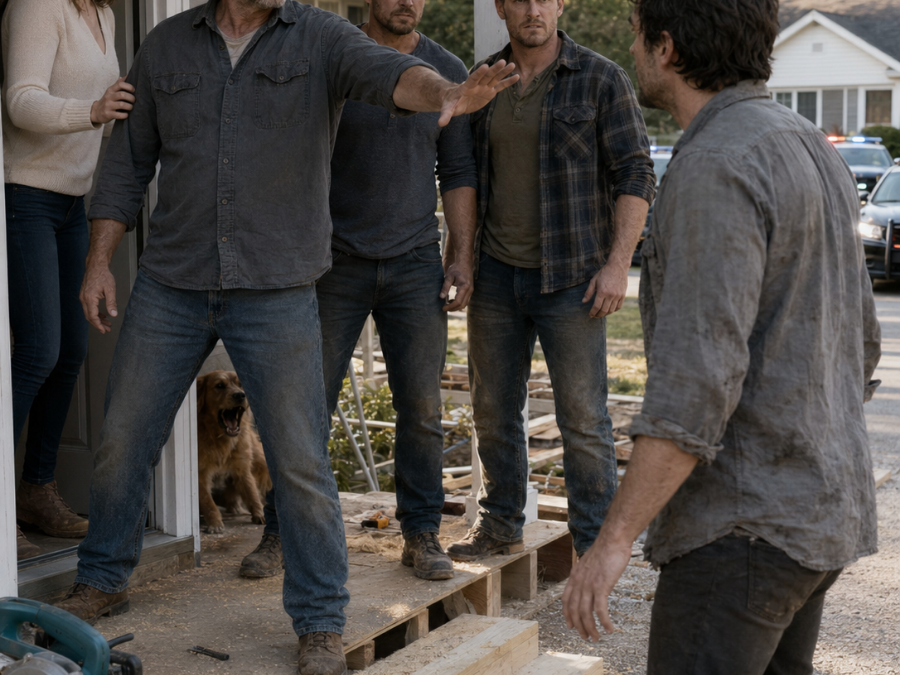
Dad stepped onto the porch with Mason and Drew behind him.
They were not looking for a fight.
But they were not afraid of him either.
I remained inside where I could see without being directly exposed.
Cole tried to look past Dad.
“I need Hannah.”
“No.”
“That’s not your decision.”
Dad’s voice stayed level.
“It became my decision when you came onto my property after she told you not to contact her.”
Cole laughed.
“She’s my fiancée.”
Mason answered from behind Dad.
“Not anymore.”
Cole’s face twitched.
“You people turned her against me.”
“No,” Drew said. “You did that.”
Cole’s expression changed.
The pleading vanished.
“You don’t know what she’s like.”
I watched Dad’s shoulders stiffen.
Cole continued.
“She needs somebody to control her. She makes stupid decisions when she gets emotional.”
Mason took one step forward.
Dad raised an arm to stop him.
Then Dad looked at Cole.
“You spent years convincing my daughter she couldn’t trust her own judgment.”
Cole sneered.
“You don’t know anything about us.”
“I know what bruises look like.”
That silenced him for a second.
Then Cole reached toward his jacket.
Everything tightened at once.
Dad immediately ordered him to keep his hands visible.
Mason and Drew shifted position, protecting the doorway rather than advancing.
Cole stopped.
Slowly, he removed his phone.
Sirens became audible in the distance.
Cole heard them too.
His eyes moved toward the street.
Then toward the door.
Then, somehow, he saw me through the narrow space beside the curtain.
Our eyes met.
That was the moment I had dreaded for weeks.
He stared directly at me.
“You hear me, Hannah?”
My heart hammered.
“This isn’t finished.”
I stepped fully into view.
Dad turned slightly.
I knew he wanted to move me back.
I shook my head.
Cole’s face changed because I wasn’t hiding anymore.
“You belong with me.”
My legs were trembling.
But my voice came out clear.
“No.”
His mouth opened.
I said it again.
“No.”
The police arrived moments later.
Cole put his hands up when ordered and was taken into custody for violating the restraining order.
Officers searched his vehicle under lawful authority connected to the arrest.
What they discovered changed the case from frightening to chilling.
Items in the trunk suggested he had come prepared to restrain someone and transport them.
I didn’t need to know more than that.
The detective who spoke with me afterward looked exhausted.
“You did the right thing by documenting everything.”
For months, people had told me to stay calm.
Forgive.
Avoid drama.
Give Cole space.
That afternoon, documentation became the reason nobody had to argue about whether I was exaggerating.
He had messages.
Photos.
Violations.
A pattern.
And now physical evidence showing intent.
Cole remained in custody.
This time, he did not make bail.
That night, our family ate dinner late.
Nobody spoke much.
Then Dad reached across the table and covered my hand with his.
“You said no.”
I looked at him.
“What?”
“Through the window.”
His eyes were wet.
“You looked him in the face and said no.”
I started crying.
Not because I was afraid.
Because I finally realized I had heard myself say it.
Part 4: I Had to Tell the Truth in Front of Him One Last Time
The case took months.
During that time, I began rebuilding pieces of myself that had nothing to do with Cole.
Karen let me return to work remotely.
Dr. Warren saw me twice a week.
Paige came every weekend with terrible magazines, expensive coffee, and a refusal to let me spend every Saturday in pajamas.
Dad took me fishing.
Mom taught me recipes I had never bothered learning when I was younger.
Those ordinary things became more important than I expected.
Cooking dinner without someone criticizing how I held a knife.
Taking a walk without sending a location update.
Leaving my phone in another room.
Laughing loudly.
Healing felt less like becoming brave and more like recovering small freedoms.
The trial began in September.
I had dreaded seeing Cole.
When I entered the courtroom, he was already seated beside his attorney.
He looked cleaner than he had in the driveway.
Hair cut.
Suit pressed.
For one irrational second, I saw the man who once remembered my coffee order.
Then he looked at me.
And I remembered everything else.
When I testified, the defense attorney asked the question survivors learn to fear.
“If the relationship was truly as dangerous as you’re describing, why did you remain for years?”
The courtroom became completely still.
I gripped the edge of the witness stand.
“Because he didn’t hurt me every day.”
The attorney paused.
I continued.
“Some days he brought flowers. Some days he cried. Some days he convinced me the person who hurt me was gone forever. Then he isolated me, monitored me, threatened my family, and made leaving feel more dangerous than staying.”
The attorney glanced at Cole.
I said, “That is why.”
The prosecutor presented years of evidence.
Medical records.
Photographs.
Police calls.
Voicemails.
Messages.
Statements from neighbors.
Paige testified.
Karen testified.
My parents and brothers testified about the stalking and driveway confrontation.
The defense tried to frame Cole as emotionally devastated by a breakup.
The prosecutor answered with one question.
“Does heartbreak explain photographing her mother through a backyard fence?”
The defense had no good response.
Cole’s mother testified too.
She cried while saying her son had “never been like this before Hannah.”
The prosecutor handled her gently but firmly.
“Did your former husband ever hurt you?”
Cole’s mother froze.
“Yes.”
“And did people ever ask what you did to provoke him?”
Her face crumpled.
The courtroom went silent.
“No.”
The jury deliberated less than four hours.
Guilty on every major count.
I didn’t cheer.
My family didn’t either.
I simply exhaled.
Cole was sentenced to several years in prison, followed by strict supervision and a permanent protective order.
When deputies led him away, he turned toward me.
Months earlier, that look would have destroyed my sleep.
I met his eyes.
And felt nothing I needed to obey.
That was freedom.
Not absence of memory.
Absence of control.
Part 5: My Family Helped Me Build a Life He Could Not Reach
I stayed in Cedar Hollow after the trial.
At first, I told myself it was temporary.
Then I realized I liked knowing my neighbors.
I liked running into Dad at the hardware store.
I liked Mom texting me pictures of vegetables from her garden as if every tomato were breaking news.
Eventually, I left my old company and accepted a position at the town library.
Quiet suited me.
Books suited me.
My supervisor, Margaret Ellis, was in her sixties and possessed the rare gift of knowing when not to ask questions.
She brought tea.
She told me I was doing good work.
That was enough.
Paige moved to Cedar Hollow months later after finding a teaching job nearby.
She claimed the move had nothing to do with me.
Nobody believed her.
I started volunteering a few hours each week with a local domestic-violence advocacy center.
The first time another woman sat across from me with bruises she was trying to hide, I had to excuse myself afterward and cry in the restroom.
But I went back.
I did not tell women what to do.
I listened.
Sometimes that is the first thing control takes from you—the belief that your own voice deserves to be heard.
My relationship with my family changed too.
My brothers remained protective, but they learned not to confuse protection with deciding for me.
Dad stopped asking where I was going every time I picked up my keys.
Mom stopped watching my face whenever a car slowed near the house.
We were all healing from the same storm differently.
One afternoon, Dad and I finally finished the deck we had abandoned the day Cole appeared.
I was kneeling beside a board with a hammer when Dad looked over.
“I’m proud of you.”
“For what?”
“For leaving.”
I shrugged.
“I should’ve left earlier.”
Dad put down his tools.
“No.”
I looked at him.
“Don’t turn survival into another reason to punish yourself.”
That sentence stayed with me.
Months later, I started dating again.
His name was Evan Brooks.
He worked in architectural design and spent afternoons at the library because he claimed his home office was too quiet.
Our first conversations were about books.
Then coffee.
Then dinner.
On our fourth date, I said no to changing restaurants after we had already made plans.
I braced automatically.
Evan simply said, “Okay. We’ll keep the reservation.”
It embarrassed me that such a normal response almost made me cry.
He noticed.
“You good?”
“Yeah.”
He didn’t demand an explanation.
That mattered.
The holidays came.
For the first time in years, I attended every family gathering.
At Thanksgiving, there were too many chairs, too much food, three arguments about football, and my mother insisting everyone take leftovers.
I stood to make a small toast.
“Thank you for letting me come home without making me feel ashamed that I needed to.”
My voice cracked.
Dad looked down.
Mason rubbed both hands over his face.
Drew stared at his plate.
Mom cried openly.
Nobody told me I had ruined dinner.
At Christmas, Evan joined us.
Dad interrogated him about structural engineering.
Mom fed him until he looked frightened.
Paige laughed through the entire thing.
Later, Evan and I sat on the porch under a blanket.
He told me he cared about me.
I told him I was scared.
“I know.”
“I might stay scared for a long time.”
“That’s okay.”
“I need slow.”
“Then slow.”
No argument.
No guilt.
No price attached.
The following spring, I found a small apartment above an independent bookstore downtown.
It had one bedroom, hardwood floors, a narrow balcony, and enough morning light to make the whole place feel warm.
I signed the lease.
Then sat in my car and cried because I was terrified.
And because I was happy.
My family helped me move.
Mason built shelves.
Drew installed a security system because it made both of us feel better.
Mom bought dishes.
Dad carried boxes until I ordered him to sit down.
That night, after everyone left, I stood alone in my own kitchen.
I locked the door.
Checked it once.
Then stopped myself from checking it again.
I made tea.
Put my phone on the counter.
And sat beside the window.
Nobody knew my password.
Nobody tracked my location.
Nobody demanded proof of where I had been.
The silence was just silence.
Not punishment.
Not warning.
Not the moment before an explosion.
Months later, a letter from Cole arrived through an approved prison channel.
He said he was sorry.
Said therapy had changed him.
Said he understood now.
He asked me to answer once so he would know I had read it.
I didn’t.
I tore the letter into pieces and threw it away.
Dr. Warren asked me how that felt.
“Quiet.”
She smiled.
“That sounds good.”
“It is.”
Some people believe healing requires forgiveness.
I don’t.
I wish Cole no harm.
I also owe him nothing.
Not forgiveness.
Not friendship.
Not proof that I survived him gracefully.
He already took years of my life.
He does not get another minute because he wants closure.
I still have nightmares sometimes.
I still scan parking lots.
I still notice unfamiliar cars.
But the fear has grown quieter.
There are more good days than bad now.
More laughter than silence.
More plans than escape routes.
Last month, my mother planted tomatoes again.
Dad called because he needed help replacing a section of fencing.
Paige invited me out Friday night.
Evan asked whether I wanted dinner Saturday.
I had plans.
Ordinary plans.
And that may be the greatest thing I have recovered.
Cole once convinced me that leaving him would destroy everyone I loved.
Instead, leaving him brought me back to them.
And eventually, it brought me back to myself.
The End. This story is entirely fictional and was created for entertainment purposes. All characters, names, locations, events, and situations depicted in this story are imaginary. Any resemblance to actual people, organizations, places, or events is purely coincidental.








