My d**d mother called me from an abandoned Virginia estate at 3:17 a.m.—then the family secret inside began using her voice to bring me home
My d**d mother called me from an abandoned Virginia estate at 3:17 a.m.—then the family secret inside began using her voice to bring me home
Part 1 — The call came from a house nobody had entered in years
The first time I heard my mother’s voice after she died, I was wide awake, completely sober, and lying in my apartment in the fictional Virginia town of Hollow Creek while a summer storm rolled somewhere beyond the mountains.
My phone started vibrating at exactly 3:17 a.m.
I almost ignored it, but the number was unfamiliar and something about the timing made me reach across the nightstand.
“Hello?”
For several seconds, I heard nothing except slow breathing.
Then a woman whispered my name.
“Ethan.”
Every muscle in my body locked.
My mother, Margaret Cole, had been dead for six years.
“Who is this?”
There was another wet, trembling breath.
“Don’t go to Briarwood House.”
My hand tightened around the phone.
My mother had spoken slowly whenever she was frightened, as though she had to force each sentence through a locked door.
This woman spoke exactly the same way.
“Who are you?”
“Don’t open the room at the end of the west hall.”
I sat upright.
“Stop this.”
A soft sob came through the speaker.
“If someone calls you from behind that door, don’t answer them.”
The line disconnected.
I stared at the screen until it went dark.
Before I could call back, a message appeared.
YOU’LL GET THE KEYS IN THE MORNING.
I never slept again.
At 9:40, my supervisor, Carl Denton, dropped a thick brown property folder on my desk at Shepherd County Estate Services, where I worked inspecting abandoned houses before insurance transfers and estate sales.
Most jobs were simple.
Photograph structural damage, identify anything valuable, document unsafe rooms, check for trespassers, and leave.
Carl scratched at his gray beard.
“Got an unusual one for you.”
I opened the file.
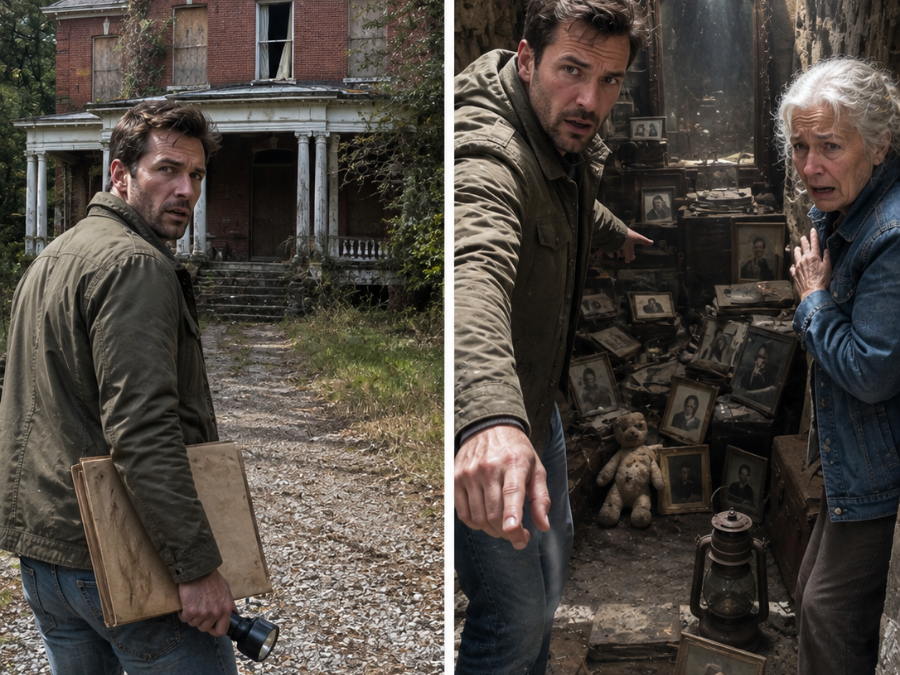
The photograph on top showed a sprawling brick mansion surrounded by dying oak trees.
BRIARWOOD HOUSE.
My stomach tightened.
“Where is this?”
“About two hours west, outside a place called Ash Hollow.”
“Who owns it?”
“That’s complicated.”
“What does that mean?”
Carl avoided my eyes.
“The last legal owners disappeared.”
I stopped turning pages.
The Dalton family had lived at Briarwood until October 1994.
Father: Samuel Dalton.
Mother: Ellen.
Two teenage sons, David and Lucas.
And an eight-year-old daughter named Rose.
All five vanished.
No bodies.
No confirmed escape.
No convincing suspects.
The property was locked, disputed among distant relatives, and eventually abandoned.
“Why now?” I asked.
“County transfer. Someone wants a complete inventory.”
“Who?”
Carl’s jaw tightened.
“The paperwork came through an estate trust.”
“That isn’t what I asked.”
“No, it isn’t.”
By three that afternoon, I was driving through the Blue Ridge foothills beneath a bright but hazy sky.
Briarwood appeared at the end of a narrow gravel road.
The house was enormous.
Dark red brick.
Tall white columns stained by rain.
A wraparound porch sagging on one side.
Vines climbing toward second-story windows.
Every upstairs window was boarded.
Except one.
A pale curtain hung from the open frame.
There was almost no wind.
Yet the curtain moved.
Carl had followed me in his truck to hand over the keys.
Before leaving, he pointed toward the house.
“The old caretakers left three warnings.”
I stared at him.
“You’re serious?”
“Don’t stay after sunset.”
“Fine.”
“Don’t move the family portraits.”
“That’s strange.”
“And don’t open the gray door at the end of the west hall.”
The hair rose along my arms.
“That’s what the caller told me.”
Carl’s face changed.
“What caller?”
“Last night. A woman.”
He swallowed.
“Who?”
“She sounded like my mother.”
Carl stepped backward.
“Ethan, finish the ground floor, document what you can, and leave.”
“You knew something would happen.”
“No.”
“Then why are you scared?”
He looked toward the upstairs window.
“Because twelve years ago, another inspector got the same warning.”
“What happened?”
Carl opened his truck door.
“He disappeared.”
“That’s it?”
Carl hesitated.
“His camera was found in the west hallway.”
He climbed inside.
Then he rolled the window down.
“One more thing.”
“What?”
“If you hear three knocks, don’t knock back.”
He drove away.
The house smelled of wet plaster, dust, and old fireplace ash.
I started photographing the foyer.
There were covered chairs, a broken umbrella stand, a grandfather clock frozen at 3:17, and several family portraits turned toward the wall.
I left them alone.
For almost an hour, nothing happened.
Then I found an old photograph behind a cabinet.
The Dalton family stood on Briarwood’s porch, smiling.
Five people.
Samuel.
Ellen.
David.
Lucas.
Little Rose holding a stuffed rabbit.
Someone had written a sentence on the back in faded pencil.
DON’T LET HER MAKE SIX.
That was when I heard it.
Knock.
From upstairs.
My breathing stopped.
Knock.
Second time.
I stared toward the staircase.
Knock.
Third.
Then a little girl began crying above me.
“Is somebody down there?”
I said nothing.
“Please.”
The voice sounded young.
Terrified.
“Can you help me?”
I forced myself to stay silent.
Then she whispered something that turned my knees weak.
“Ethan, your mother said you would come eventually.”
At that moment, I understood Carl had sent me into more than an abandoned house.
Something inside Briarwood had been waiting for me personally.
Part 2 — The little girl behind the door knew my mother’s secret
Every rational instinct told me to leave.
Instead, I climbed the stairs.
The upper hallway stretched beneath a row of cracked windows, its wallpaper peeling in long strips while dusty family photographs lined the walls.
At the far end stood one gray door.
A thick chain crossed it.
The padlock attached to that chain was almost new.
“Ethan,” the girl whispered.
Her voice came from behind the door.
I stopped several feet away.
“Who are you?”
“Rose.”
I looked toward the nearest family photograph.
“You mean Rose Dalton?”
“Yes.”
“Rose Dalton would be almost forty now.”
Silence.
Then another sob.
“I’m still eight here.”
I stepped closer.
“Are you locked inside?”
“Yes.”
My hand moved toward the chain.
“I’ll get you out.”
The girl screamed.
“No!”
I jumped backward.
“What?”
“You can’t open it.”
“You just said you’re trapped.”
“I am.”
“Then why shouldn’t I open it?”
Her voice dropped to a whisper.
“Because I’m not the only thing in here.”
Something struck the door from the other side.
The chain rattled violently.
I stumbled backward.
“Who else is there?”
The girl began crying harder.
“The one who learned how to be my sister.”
Then another voice spoke.
“Ethan.”
My legs nearly gave out.
My mother.
“Don’t open that door, honey.”
A pressure built behind my eyes.
“Mom?”
The little girl stopped crying.
Immediately.
“Don’t answer her,” she whispered.
But I already had.
From behind the gray door came a quiet laugh.
It was almost my mother’s laugh.
Almost.
I ran.
I drove ten miles into Ash Hollow, a tiny fictional mountain town built around an old courthouse square, a diner, a general store, and a white clapboard church.
When I mentioned Briarwood inside the diner, three people stopped talking.
An elderly woman sitting near the window studied me.
“You’re Margaret’s boy.”
I froze.
Her name was Ruth Bellamy.
She was eighty-one, with silver hair braided down her back and a faded denim jacket folded beside her.
“You knew my mother?”
Ruth nodded.
“I watched her carry you out of Briarwood when you were a baby.”
“That’s impossible.”
“Your mother spent thirty years making sure you believed that.”
I sat opposite her.
“She told me I was born in Richmond.”
“No.”
“She said my father died before I could remember him.”
Ruth looked down at her coffee.
“That part is closer to the truth.”
I told her about the phone call.
Her fingers tightened around the cup.
“So it found her voice.”
“What found it?”
Ruth looked toward the diner windows before answering.
“The Listener.”
According to Ruth, Briarwood had belonged to the Dalton family for generations.
During renovations in the 1950s, workers uncovered a stone chamber beneath the basement.
Inside stood an unusual piece of furniture: a tall dark-glass cabinet mirror framed in black walnut.
The glass did not reflect anyone clearly.
Instead, people claimed it showed loved ones who had died.
At first, families traveled secretly to Briarwood for a chance to see someone they had lost.
Then people began hearing voices outside the room.
“You’re telling me the mirror was haunted?”
“I’m telling you people believed they were speaking to the dead.”
“What do you believe?”
Ruth stared at me.
“I believe something was listening.”
She said whatever lived around the mirror learned slowly.
Voices.
Expressions.
Private phrases.
Memories.
Eventually, it could imitate people well enough to make grieving families open doors they had been warned never to open.
“What happened to the Daltons?”
“They tried to shut it away.”
“And Rose?”
Ruth’s face tightened.
“They locked the wrong child in the room.”
We returned to Briarwood before sunset.
Ruth knew about a concealed cupboard behind the old pantry shelves.
Inside we found journals, family records, photographs, and newspaper clippings.
One journal belonged to Samuel Dalton.
His wife had originally been pregnant with twin girls.
Rose survived.
Her sister, Grace, did not.
Samuel never accepted the loss.
Years later, he discovered the mirror.
Something appeared in it claiming to be Grace.
At first it only spoke.
Then family photographs began changing.
Five Daltons became six.
A second little girl appeared behind Rose.
“What happened in 1994?” I asked.
Ruth closed her eyes.
“They finally understood Grace wasn’t Grace.”
“And?”
“They tried to trap it.”
“Did they?”
Ruth looked toward the ceiling.
“They trapped Rose instead.”
Footsteps sounded above us.
A little girl began humming.
Ruth turned pale.
“We need to leave.”
“Not until you tell me how my mother was involved.”
She looked at me with tears gathering in her eyes.
“Margaret Cole wasn’t born Margaret Cole.”
My stomach tightened.
“She was Margaret Dalton.”
I stared at her.
“No.”
“She was Samuel’s oldest daughter from his first marriage.”
I felt the room tilt.
“And you,” Ruth said quietly, “are the last direct descendant anyone knows about.”
The house did not know my name because I had entered it.
It knew my name because some part of me had belonged to Briarwood before I was born.
Part 3 — The woman helping me had been feeding the house for years
We never made it to the car.
The engine would not start.
The dashboard lights worked.
The battery was fine.
The starter did nothing.
Ruth stared at the house.
“We’re too late.”
“For what?”
She did not answer.
When we returned to the porch, the front door slammed behind us.
The walls began creaking.
Not randomly.
Slowly.
Rhythmically.
Like breathing.
Dust drifted from the ceiling.
“Ruth.”
She began crying.
“I’m sorry.”
“For what?”
She backed away.
“The Listener needs someone connected to the house.”
My stomach dropped.
“You knew I was coming.”
“I knew someone from Margaret’s family eventually would.”
“You brought me here?”
“No.”
“But you wanted me here.”
She looked away.
That was enough.
“How many others?”
Her face collapsed.
“I don’t know.”
“The missing inspector?”
“I tried to stop that one.”
“Did you?”
“No.”
She began crying harder.
“My daughter disappeared in Briarwood forty-four years ago.”
“What?”
“She came here with friends when she was seventeen.”
Ruth wiped her face.
“For years afterward, I heard her calling from the house.”
“That isn’t your daughter.”
“I know.”
Her answer stopped me.
“Then why keep coming back?”
Ruth looked toward the upstairs hallway.
“Knowing something is false doesn’t make it hurt less when it uses the voice of your child.”
A hidden panel in the dining room floor suddenly dropped open.
Cold air rushed upward.
I grabbed a flashlight and descended because remaining upstairs felt worse.
The basement should have been small.
It wasn’t.
A stone corridor extended farther than the footprint of the house allowed.
The walls were covered in photographs.
Hundreds.
Families.
Workers.
Teenagers.
Visitors.
Inspectors.
In every photograph, one additional figure appeared somewhere in the background.
A young girl.
At the center of the underground room stood the mirror.
Black glass.
No reflection.
Instead, Rose sat inside it.
Still eight years old.
Still holding her rabbit.
“Ethan.”
I stepped closer.
“Are you really Rose?”
“Yes.”
“How do I get you out?”
“You open the gray door.”
“You told me not to.”
“She was behind it before.”
“And now?”
Rose stared past me.
“Now she’s behind you.”
I turned.
My mother stood near the stairs.
She wore the same green cardigan she had worn every Thanksgiving during the final years of her life.
Even the small scar beside her chin was correct.
“Ethan.”
My eyes flooded instantly.
“No.”
She smiled.
“You always were stubborn.”
My mother said that constantly.
For one terrible second, I wanted to cross the room and hug her.
Then something occurred to me.
My mother almost never called me Ethan when we were alone.
She called me E.
I swallowed.
“What did you call me when I had nightmares?”
The woman did not answer.
“Come here, Ethan.”
I stepped backward.
“You’re not her.”
The smile disappeared.
Her face seemed to blur, not grotesquely, but like a photograph losing focus.
For seconds it became Ruth.
Then Rose.
Then Carl.
Then my mother again.
“She lied to you your whole life.”
“She was protecting me.”
“She lied about your father.”
I froze.
“What happened to him?”
The mirror brightened.
A young man appeared behind the glass.
He had dark hair.
My eyes.
“Ethan.”
I stepped toward him.
“I’m your father.”
Rose screamed.
“Don’t listen!”
The man pressed both hands against the black glass.
“Your mother left me here.”
I stopped.
Everything inside Briarwood could imitate.
Every voice might be a trap.
Ruth appeared at the foot of the stairs.
“We have to close the chamber!”
The figure wearing my mother’s face turned toward her.
Then its voice changed.
“Mama.”
Ruth collapsed to her knees.
A teenager’s voice.
Her daughter.
“Mama, please.”
Ruth sobbed.
“No.”
“Take me home.”
Ruth stood.
I grabbed her arm.
“Don’t.”
“She sounds exactly the same.”
“That’s how it gets you.”
“I know!”
The agony in Ruth’s face was worse because she truly did know.
Then she pulled away.
“Jenny!”
She ran toward the voice.
The lights died.
Ruth screamed.
When my flashlight came back on, she was gone.
Her denim jacket lay on the floor.
Nothing else remained.
Part 4 — My mother had left one last message inside the house
I ran upstairs.
The gray door stood open.
Behind it was not a bedroom.
It was another hallway.
The walls were covered with photographs from my own life.
Me at six.
Me at graduation.
Me sitting beside my mother at Christmas.
Me moving into my first apartment.
Me sleeping two weeks earlier.
The Listener had watched me for years.
At the far end stood my mother.
I stopped.
“Tell me what you called me.”
Her eyes filled.
“My E.”
I could barely breathe.
“Mom?”
“I’m not your mother the way you want me to be.”
“What does that mean?”
“I’m what she left behind.”
Before dying, Margaret had secretly returned to Briarwood.
She knew the house would eventually find me, so she had hidden recordings, coded memories, and personal details throughout the property, hoping they could interrupt the imitation long enough for me to recognize what was real.
“Why didn’t you tell me any of this when you were alive?”
“She wanted you to have a life first.”
“What happened to my father?”
My mother’s image looked toward the floor.
A section of boards shifted.
Beneath them lay a small hidden room.
Inside were old human remains beside a rusted watch and a weathered leather jacket.
“His name was Michael Hayes,” she said. “He came here with your mother when she was pregnant with you.”
My knees weakened.
“What happened?”
“He tried to destroy the mirror.”
I looked toward the basement.
“That man downstairs wasn’t him.”
“No.”
“Is Rose still alive?”
Her expression changed.
“Not in any way you would recognize.”
I closed my eyes.
“So how do I stop it?”
“For generations, the Daltons thought the mirror was a doorway.”
“It isn’t?”
“It’s a teacher.”
I looked at her.
“The thing doesn’t live inside it?”
“No. The mirror taught it how to imitate us.”
“What do I do?”
“Destroy the mirror and everything around it.”
“The house?”
“Yes.”
“And you?”
She smiled.
“E, I already died six years ago.”
My throat closed.
“I didn’t get to say enough.”
“You said plenty.”
The walls shook.
Photographs crashed to the floor.
My mother pointed toward the basement.
“Go.”
In an old maintenance room, I found several containers of heating fuel and carried them downstairs.
The Listener appeared in front of the mirror.
It looked like my mother.
“Don’t.”
I poured fuel across the old wooden frame.
“I can give him back.”
I kept moving.
“Your father.”
I said nothing.
“Ruth.”
Nothing.
“Your mother.”
My hands shook.
The creature stepped closer.
“You can have them all.”
I pulled a metal lighter from the maintenance shelf.
“All you have to do is stay.”
I looked directly into my mother’s copied face.
“My mother spent thirty years making sure I never came back here.”
Its smile vanished.
“She would never ask me to stay.”
I lit the fuel.
Flames raced across the floor.
The mirror cracked.
Hundreds of voices erupted through Briarwood.
People crying.
Laughing.
Calling my name.
My mother.
Ruth.
Carl.
A child begging for help.
I answered none of them.
I ran.
As I reached the front porch, the old bell above the carriage house began ringing.
Once.
Twice.
Three times.
I kept moving until I reached the gravel road.
Briarwood burned behind me beneath the dark mountain sky.
Fire crews arrived from neighboring towns.
The house was nearly destroyed.
They found no trace of Ruth.
No evidence explaining the Dalton disappearance.
Investigators blamed the fire on deteriorated wiring and old fuel lines.
I did not argue.
I quit my job.
Moved three counties away.
Changed my number.
For seven months, nothing happened.
Then one morning, I found an envelope beneath my new apartment door.
Inside was a photograph.
Briarwood House.
Completely intact.
Rose stood on the porch holding her rabbit.
Behind her, in an upstairs window, was my mother.
Four words were written on the back.
THANK YOU FOR LETTING ME OUT.
Part 5 — I finally understood the house was never the prison
I sealed the photograph inside a box and pushed it into the back of my closet.
For days, I convinced myself someone was tormenting me.
Maybe Carl.
Maybe Ruth had survived.
Maybe some person connected to the Dalton estate knew enough about my family to create a cruel illusion.
Then my phone rang.
3:17 a.m.
Unknown number.
I did not answer.
It stopped.
Knock.
Someone tapped on my apartment door.
I lived on the ninth floor.
Knock.
Second.
I sat up slowly.
Knock.
Third.
I remained silent.
Then my mother spoke from the hallway.
“E.”
My eyes filled.
“No.”
“Open the door.”
I backed away.
My phone vibrated.
A message.
YOU BURNED THE WRONG THING.
Another followed.
I WAS NEVER INSIDE THE MIRROR.
The apartment walls began creaking.
The hallway light beneath my door went dark.
I walked toward the window.
Below me, Hollow Creek stretched through the valley, streetlights glowing beneath a clear night sky.
Then I saw something four blocks away.
A white column.
A sagging porch.
Dark red brick.
Briarwood House stood between two apartment buildings where no house had existed the day before.
One upstairs window illuminated.
Rose appeared behind the glass.
She lifted one hand.
Not waving.
Pointing.
At me.
I stepped away from the window.
A breath sounded behind me.
Inside my apartment.
I turned.
Nothing.
Then my mother’s voice came from the kitchen.
“E.”
I clenched my jaw.
“Don’t answer,” she whispered.
Tears rolled down my face.
I almost said Mom.
Stopped myself.
The television screen was dark.
In its reflection, I saw myself standing near the window.
But another version of me stood several feet behind my real body.
Smiling.
I did not move.
Neither did the reflection.
Then it tilted its head.
“Now you understand.”
Its mouth moved even though mine did not.
“The mirror never trapped me.”
My chest tightened.
“It introduced me.”
I looked toward the apartment door.
The reflection smiled wider.
“It taught me your faces.”
I remembered the photographs.
My childhood.
My mother.
Every visitor who had entered Briarwood.
The Listener had never needed to remain inside the estate.
The house had simply been where generations of frightened, grieving people taught it how to become someone they loved.
I had burned the classroom.
Not the student.
Three knocks sounded again.
Not from the apartment door.
From the wall behind me.
Knock.
Knock.
Knock.
My mother whispered from the kitchen.
“Whatever happens, don’t answer.”
I closed my eyes.
Then I realized the cruelest part.
I already had.
The first night, when I heard my mother’s voice and whispered Mom behind the gray door, I had acknowledged it.
I had given it something it could use.
A connection.
A permission.
Perhaps nothing mystical had ever been attached to Briarwood’s bricks or mirror at all.
Perhaps the thing survived through recognition.
Through grief.
Through that desperate human instinct to answer when someone we love calls our name.
The reflection stepped closer.
I could see it moving in the television even though the room behind me remained empty.
“You brought me farther than anyone before you.”
I kept silent.
Outside, the lights inside Briarwood turned on one room at a time.
The porch.
The foyer.
The upstairs hall.
The west room.
Then the house disappeared.
Not gradually.
One blink, and there were only apartment buildings again.
For several seconds, nothing happened.
Then my phone vibrated.
One final message.
CHECK YOUR HALLWAY.
I did not.
Instead, I sat on the floor with my back against the wall and stayed there until sunrise.
I moved again the following week.
Then again six months later.
I stopped keeping family photographs in my home.
I never answered unknown numbers after midnight.
I never responded when someone knocked three times.
Friends thought I had become paranoid.
Maybe I had.
Sometimes I still wondered whether Ruth had been right about everything, whether my mother’s final messages had really existed, whether Briarwood had somehow changed shape, or whether fear and grief had broken something inside me that would never fully repair itself.
But every year, on the anniversary of my mother’s death, at exactly 3:17 in the morning, my phone lights up.
The number always changes.
The message never does.
COME HOME, E.
I never answer.
Because I finally understand why my mother spent her entire life hiding my connection to Briarwood.
She was not protecting me from an old house.
She was protecting me from something that learned patience before I was born.
Something willing to wait decades until grief opened a crack.
Something that never needed a body, a room, a mirror, or even a particular place.
It only needed one familiar voice.
One impossible call.
And one lonely person willing to answer.
The End. This story is entirely fictional and was created for entertainment purposes. All characters, names, locations, events, and situations depicted in this story are imaginary. Any resemblance to actual people, organizations, places, or events is purely coincidental.








