At her eighteenth birthday, my mother mocked my daughter with a bargain gift, then flaunted my niece’s luxury SUV—until one sealed envelope exposed the betrayal
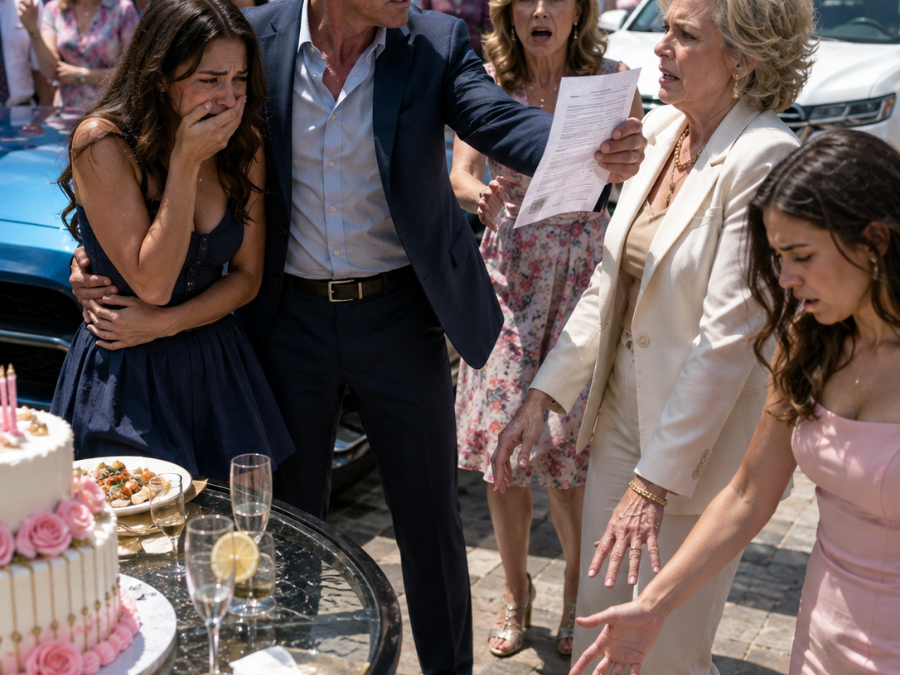
At her eighteenth birthday, my mother mocked my daughter with a bargain gift, then flaunted my niece’s luxury SUV—until one sealed envelope exposed the betrayal
Part 1: The birthday party that was never really hers
By three o’clock on a blistering Saturday afternoon, my mother’s backyard in Briar Glen, Indiana, looked less like a family birthday party and more like the opening night of a private country club, with white tents stretched across the lawn, catered food steaming beneath polished lids, and enormous balloon arrangements framing the patio doors. Officially, the gathering celebrated two cousins turning eighteen within the same week, my daughter Emily and my sister’s daughter, Madison, but anyone who walked through the gate could tell within seconds which girl the party was actually for.
Madison’s name appeared on the cake, the gift table, the balloon arch, the custom drink station, and even the decorative wooden sign beside the pool, while Emily’s name had been squeezed onto a small paper banner hanging crookedly near the side porch. Emily noticed, of course, but she simply smiled and helped one of the catering workers carry a tray inside because that was the kind of young woman she had somehow become despite growing up around people who treated kindness like weakness.
I was forty-four, divorced, and the owner of a regional commercial renovation company I had built from a borrowed pickup, two ladders, and an unreasonable amount of stubbornness. My mother, Evelyn Mercer, had spent most of my life making it clear that my younger sister, Caroline, was the daughter she understood, admired, financed, defended, and displayed, while I was the son who had embarrassed her by choosing construction sites instead of executive offices.
Emily inherited none of my mother’s hunger for attention, which Evelyn seemed to consider a personal insult. She worked weekends at a small neighborhood bookstore, had excellent grades, and planned to study structural engineering in the fall, yet my mother described her as “pleasantly average” whenever she thought I was out of earshot.
My late father, Walter, had adored Emily.
Before he died five years earlier, he had created a protected education account for her because he knew exactly what would happen if Evelyn ever controlled her future without supervision. He appointed my mother as the administrative custodian for routine paperwork, but any major withdrawal required my authorization as co-trustee, and Dad had been so meticulous about the arrangement that I never seriously considered the possibility that anyone could interfere with it.
That afternoon, I stood beneath a maple tree watching Emily straighten a stack of napkins while Madison lounged beside the pool scrolling through her phone. Madison was not cruel every minute of every day, but Caroline and Evelyn had spent eighteen years teaching her that being wanted more than everyone else was a birthright.
Then my mother disappeared briefly into the house and returned carrying two gift boxes.
The larger one was wrapped in glossy silver paper.
The other was small enough to fit in her palm.
Something about her smile made my stomach tighten.
Evelyn adored an audience when she planned to hurt someone.
She tapped a spoon against her glass and called everyone toward the patio, and about thirty relatives and family friends gathered around while Emily stepped quietly beside Madison. My daughter wore a simple navy summer dress and small silver earrings she had purchased herself, while Madison stood beside her in an elaborate pale-pink outfit her mother had spent weeks choosing.
“Eighteen is an important birthday,” Evelyn announced, spreading her arms as if she were hosting an awards ceremony. “It is when a young woman begins to understand what sort of future she deserves.”
My jaw hardened.
Emily glanced at me.
I gave her a small nod.
Evelyn approached her first and placed the tiny box into her hands.
“For Emily,” she said.
Emily opened it carefully.
Inside was a thin costume-metal bracelet with a tiny glass charm, the kind sold from a rotating rack beside a department-store register. The little orange clearance sticker had not even been removed from the underside of the box.
$12.50.
Emily stared down at it for half a second before recovering.
“Thank you, Grandma,” she said softly.
Evelyn laughed.
Not warmly.
Not affectionately.
She laughed loudly enough for everyone to hear.
“Well, sweetheart, you have always been good at appreciating the little things,” she said, then turned toward me. “Some children receive according to the ambition they show.”
The entire patio went still.
Emily’s fingers tightened around the box.
Caroline covered a smile with the edge of her drink.
I took one slow step forward.
Evelyn was already turning toward Madison.
“And some young women,” she continued brightly, “have earned something appropriate for where they are headed.”
She lifted a set of keys.
Madison screamed before the vehicle even appeared.
A pearl-white luxury SUV rolled slowly from behind the detached garage, driven by one of the hired parking attendants, with a huge lavender ribbon stretched across the hood. Caroline clapped, Madison bounced on the balls of her feet, and several guests gasped as Evelyn proudly announced that the vehicle belonged completely to her “exceptional granddaughter.”
Then she delivered the sentence I would remember for the rest of my life.
“Emily gets a bracelet,” Evelyn said, glancing toward my daughter, “and Madison gets something meant for a real future.”
Emily looked down.
A tear reached her cheek before she could stop it.
I walked directly to her.
“Look at me,” I said.
She did.
I reached inside my jacket and took out another set of keys.
They belonged to a deep-blue performance coupe parked around the corner, purchased outright three days earlier after Emily had quietly admitted she had been saving toward a reliable used car for college. It was newer, safer, and far more expensive than anything she had expected me to buy.
I placed the keys into her palm.
“Happy birthday, kid.”
Her mouth opened.
“Dad…”
“Go look.”
As she turned toward the street, the car rolled slowly into view, driven by my longtime office manager, who parked it beside the curb and stepped out smiling.
The crowd erupted.
Emily covered her mouth with both hands.
Evelyn’s smile vanished.
“You bought her that?” she demanded.
“I did.”
“You financed it just to embarrass Madison?”
“Paid in full,” I said. “And I didn’t buy it for Madison.”
The humiliation Evelyn had intended for my daughter suddenly belonged to her.
Before she could answer, a man in business-casual clothes hurried up the driveway carrying a thick sealed envelope.
“Mr. Mercer?” he called.
I recognized him as Nathan Pierce, the manager from the dealership where I had purchased Emily’s car.
He stopped beside me and lowered his voice.
“This was delivered to our office less than an hour ago with instructions that I bring it directly to you today.”
Then he looked at my mother.
“And apparently Mrs. Evelyn Mercer is required to be present when you open it.”
For the first time all afternoon, my mother looked afraid.
Part 2: The envelope with my mother’s name on it
The laughter disappeared so completely that I could hear the soft mechanical hum of the pool filter behind us. Nathan handed me the heavy envelope while Evelyn immediately began insisting that whatever it contained could wait until after dinner.
I looked at the return information.
The envelope came from Harrison & Cole Estate Counsel, the firm that had handled my father’s trust.
My phone buzzed inside my pocket at almost the same instant.
I pulled it out and saw three missed calls from James Harrison, my father’s longtime attorney, along with an urgent message telling me not to allow anyone to leave before I reviewed the documents.
A cold pressure settled behind my ribs.
I tore open the envelope.
The first document was a purchase invoice for Madison’s new SUV.
The price was $68,400.
The second page showed a withdrawal from Emily’s education trust.
The amount was exactly $68,400.
For several seconds, I genuinely could not understand what I was looking at.
Then I found the authorization page.
Two signatures appeared beneath the withdrawal request.
Evelyn Mercer.
And mine.
Except I had never signed it.
I stared at the crooked imitation of my name, and the party seemed to move farther away from me, as if I were standing underwater while everyone else remained above the surface. Whoever had copied my signature had tried to imitate the broad hook on the first letter, but they had missed the shape I had used since high school.
I looked at my mother.
Her face had turned pale.
“What did you do?”
Evelyn lifted both hands.
“Ryan, lower your voice.”
“What did you do?”
Caroline moved beside her.
“What’s going on?”
I raised the purchase invoice.
“This SUV was paid for with Emily’s education fund.”
Madison stopped smiling.
Emily stared at me.
My mother shook her head rapidly.
“No, that isn’t what happened.”
I held up the forged authorization.
“Then explain my signature.”
Nobody moved.
Evelyn swallowed.
“It was temporary.”
I actually laughed once.
Not because anything was funny.
Because sometimes disbelief has nowhere else to go.
“Temporary?”
“I intended to replace it.”
“You stole almost seventy thousand dollars from your granddaughter.”
“Don’t use that word.”
“What word would you prefer?”
Caroline stepped forward.
“Ryan, Mom would never steal from Emily.”
I turned the paperwork toward her.
“She did.”
My sister looked at the amount.
Her eyes widened.
Then something changed in her face.
She looked toward the SUV.
“Mom told me she used her retirement account.”
Evelyn spun toward her.
“Caroline, stop.”
“No, you told me the money was yours.”
“Stop talking.”
Madison slowly lowered the keys she had been clutching against her chest.
Emily had not spoken.
That frightened me more than anything.
I walked to her.
“Sweetheart, your account is protected. We’ll fix this.”
Her eyes filled.
“Grandma bought Madison a car with Grandpa’s money for me?”
The sentence broke something inside me.
“Yes.”
Evelyn hurried toward us.
“Emily, listen to me, honey, I was going to return every penny before school started.”
Emily stepped backward.
“Then why didn’t you ask me?”
My mother opened her mouth.
Nothing came out.
Emily looked at the cheap bracelet still in her hand.
Then at Madison’s SUV.
And then at her grandmother.
“You gave me twelve dollars from your pocket while you gave her sixty-eight thousand dollars from mine.”
No one needed to say anything after that.
The cruelty was suddenly too precise to hide.
Nathan quietly took one step away from the family circle.
Then my phone rang.
James Harrison.
I answered.
“Ryan, have you opened the envelope?”
“Yes.”
“Then listen carefully. The bank flagged the transaction after I requested an audit this morning. We have digital records showing where the authorization originated, and I’ve already contacted the financial crimes unit.”
I stared at Evelyn.
“How long?”
“They are on their way.”
My mother seemed to understand from my expression.
She grabbed Caroline’s arm.
“We’re leaving.”
Caroline pulled away.
“No.”
Evelyn stared at her.
“What?”
“I said no.”
For the first time in my life, I saw my sister choose self-preservation over our mother.
And Evelyn knew it too.
Part 3: Thirty people watched the favorite child disappear
My mother’s entire identity had been built around control, and once she realized she was losing it, the elegant grandmother who had spent the afternoon directing caterers and arranging photographs disappeared. In her place stood a frightened woman who began speaking too quickly, changing explanations every few sentences and accusing everyone else of misunderstanding her intentions.
“It was a family loan,” she insisted. “Walter would have understood.”
“Dad created that trust because he knew you wouldn’t,” I replied.
Her face twisted.
“You always thought you were better than us.”
“No, Mom. I just finally stopped believing I was worse.”
The words silenced her.
Caroline stood several feet away, arms folded tightly around herself.
Madison had begun crying.
Not dramatically this time.
She looked genuinely frightened.
“I didn’t know,” she whispered.
Emily glanced toward her cousin.
For eighteen years, Evelyn had trained those girls to believe they were opponents in a competition neither one had chosen. Emily suddenly seemed to understand that Madison had been spoiled by the same system that had wounded her.
“I believe you,” Emily said quietly.
Madison looked shocked.
Caroline looked even more shocked.
Evelyn did not.
She looked furious.
“You’re all acting as though I robbed a bank,” she snapped.
“You forged my name,” I said.
“I raised you.”
“That doesn’t make my signature yours.”
“You owe this family everything.”
I stepped closer.
“No. That sentence has controlled me for forty-four years, and it ends today.”
For once, Evelyn had no immediate answer.
A few relatives began leaving the patio quietly, embarrassed to have witnessed so much, while others remained rooted where they stood. Aunt Diane, who had spent decades defending my mother, removed her sunglasses and stared at Evelyn with an expression I had never seen before.
“You really took Walter’s money?” she asked.
Evelyn stiffened.
“He was my husband.”
“He left it to Emily.”
“It was under my administration.”
“That isn’t ownership.”
My mother looked around at the faces she had controlled through status, gifts, guilt, and access.
Nobody was supporting her.
The empire was collapsing.
Then sirens sounded somewhere down the street.
Not loud.
Not dramatic.
Just close enough.
Evelyn’s head snapped toward the driveway.
She moved quickly toward the house.
I stepped sideways, blocking the path without touching her.
“Don’t.”
“You cannot imprison me in my own home.”
“I’m not.”
She reached for my sleeve.
“Ryan, tell them this was a misunderstanding.”
I removed her hand.
“You can tell them yourself.”
Two unmarked sedans stopped along the curb.
Three investigators approached with James Harrison walking beside them, his gray suit slightly rumpled from the heat and a leather folder tucked under his arm. He looked older than I remembered, but his expression was exactly the same one he had worn while reading my father’s will: patient, careful, and impossible to intimidate.
Evelyn tried immediately.
“James, thank goodness. Explain to these people that Walter always intended me to manage the family money.”
James stopped.
“Manage, Evelyn. Not appropriate.”
Her face hardened.
“This is private.”
“No longer.”
One investigator asked everyone to remain available for questions.
Another photographed the SUV.
Madison suddenly held the keys out toward me.
“I don’t want it.”
I didn’t take them.
“Give them to the investigator.”
She did.
Emily stood beside me.
Her shoulders had straightened.
The bracelet was gone from her hand.
I noticed it lying near a patio chair.
My mother noticed too.
Perhaps that bothered her more than anything.
The little object she had chosen specifically to demonstrate Emily’s place in the family had become meaningless.
An investigator asked Evelyn to accompany him inside to discuss the transaction.
She refused.
Then he explained that the records included a digital authorization submitted from a device registered to her home office.
Caroline covered her mouth.
Evelyn looked at me.
“You set me up.”
“No.”
“You knew.”
“I found out fifteen minutes ago.”
“You wanted this.”
“I wanted my daughter to have a birthday.”
That finally broke through her performance.
Her eyes filled with tears.
For one brief second, I saw something human behind all the pride.
Then she whispered the sentence that ended whatever remained between us.
“If Emily had been more like Madison, none of this would have happened.”
I stared at her.
Emily heard it.
So did everyone else.
There are moments when a relationship does not slowly weaken.
It simply ends.
That was ours.
Part 4: My father had protected more than the college money
The investigators did not arrest Evelyn immediately, but they escorted her inside for a formal interview while another officer explained that the SUV could not be transferred or driven until the financial dispute was resolved. Caroline sat near the pool looking twenty years older than she had that morning, while Madison remained beside Emily in a silence neither of them seemed prepared to break.
James motioned me toward the side porch.
“There’s more,” he said.
I almost laughed.
“Of course there is.”
He opened his leather folder.
My father had apparently amended several provisions of his estate approximately eight months before his death.
I knew about Emily’s trust.
I knew about a modest life-insurance policy.
I knew my mother had lifetime residency rights in the large Briar Glen house.
What I had never fully understood was the structure beneath those rights.
Dad had placed the actual deed into a family property trust.
My mother could live there as long as she remained financially responsible for taxes and maintenance, but she could not sell the house, mortgage it, or use it as collateral without trustee authorization.
I was the controlling trustee.
“Why didn’t you tell me?” I asked.
“Walter instructed us to disclose it only if Evelyn attempted to encumber the property or if a major trust violation occurred.”
I looked through the glass doors toward my mother.
“And today qualifies.”
“Very much so.”
James then showed me something else.
Over the previous eighteen months, Evelyn had quietly accumulated significant debt.
She had been supporting Caroline’s household, paying Madison’s private expenses, maintaining the estate, and preserving a lifestyle that exceeded her remaining income. The SUV had not been purchased from abundance.
It had been purchased from desperation.
“She couldn’t afford that party,” I realized.
James nodded.
“She could barely afford the property tax due next quarter.”
For a moment, pity tried to surface.
Then I remembered Emily holding that clearance bracelet while my mother publicly told her she did not deserve more.
Pity disappeared.
“What happens to Emily’s money?”
“The transfer has been frozen. The dealership will reverse the purchase, and the funds should be restored.”
I closed my eyes.
That was all I needed.
“What happens to Mom?”
“That depends on the prosecutor, the evidence, and whether she cooperates.”
Later that evening, a recovery truck arrived for the SUV.
Madison stood near the front steps watching as the vehicle was loaded.
She did not scream.
She did not argue.
She simply walked over to Emily.
“I’m sorry,” she said.
Emily looked at her.
“You didn’t forge anything.”
“I still enjoyed it.”
“At first.”
Madison nodded.
“I liked being the favorite.”
Emily was quiet for several seconds.
“I think Grandma made sure you thought you had to.”
Caroline overheard.
She started crying.
That conversation mattered more to me than the investigators, the money, or the car.
Because favoritism had always depended on keeping everyone divided.
Once the girls stopped competing, my mother lost her strongest weapon.
Before leaving, I retrieved the cheap bracelet from beside the chair.
Emily saw me.
“Dad, throw it away.”
I looked at it.
“You sure?”
She smiled faintly.
“I don’t need evidence that she didn’t value me.”
Then she lifted the keys to her new coupe.
“I have better evidence that you do.”
I laughed.
For the first time that day, it felt natural.
We drove home together.
She followed behind me in her new car, careful and nervous at first, then more confident as we reached the open county road.
In my rearview mirror, I watched her headlights remain steady behind mine.
It occurred to me that my father had spent years protecting Emily from what he knew my mother could become.
But protection was not the same as healing.
That part was now my responsibility.
Part 5: Four years later, nobody was competing anymore
The legal case moved slowly, as those cases do, but the evidence was impossible to explain away. Evelyn eventually accepted responsibility for the forged authorization and unlawful transfer, avoided prison because of her age and lack of prior convictions, but received strict probation, substantial financial penalties, and a court order preventing her from administering family trusts.
Emily’s education account was restored completely.
Not one dollar was lost.
Caroline and Madison moved into a smaller rental across town after Evelyn could no longer subsidize their lives, and for the first time my sister had to support herself. She struggled, complained, stumbled through two jobs, and eventually kept one long enough to discover that earning something was different from being handed it.
Madison changed more than I expected.
She enrolled at a public university, worked part-time, and began calling Emily without their mothers arranging it.
Their relationship never became magically perfect.
Real families do not heal like that.
But slowly, they learned to speak to each other without Evelyn standing between them and assigning value.
My mother lost the Briar Glen house two years later.
Not because I seized it.
Not because I wanted revenge.
Because she could no longer pay the taxes and maintenance required under my father’s trust.
The property was sold according to the estate terms, the remaining proceeds divided among designated beneficiaries, and Evelyn moved into a modest senior apartment.
She called me several times during that period.
At first she demanded help.
Then she threatened.
Then she cried.
Finally, she apologized.
But every apology contained a condition.
“I’m sorry, but you embarrassed me.”
“I’m sorry, but Emily should understand.”
“I’m sorry, but Caroline needed help.”
Eventually I stopped answering.
Four years after that birthday party, I sat in a university auditorium waiting for Emily’s name to be called.
She walked across the stage wearing a black graduation gown, honors cords draped around her shoulders, and the same quiet smile she had worn while helping caterers at her own birthday party.
“Emily Mercer, Bachelor of Science in Structural Engineering, summa cum laude.”
I stood before I realized I was standing.
She found me in the crowd.
Her smile widened.
After the ceremony, we walked through rows of families taking photographs beneath flowering trees.
Her blue coupe was parked at the far end of the lot.
She still drove it.
There were tiny scratches near one wheel and a coffee stain in the passenger cup holder now, which somehow made me love it more.
“It survived college,” I said.
“Barely.”
“So did you.”
She laughed.
My phone vibrated.
For a second, I expected another business message.
Instead, it was a notification from the property trustee confirming that the final paperwork connected to the old Briar Glen estate had closed.
I read it.
Then deleted it.
Emily noticed.
“Everything okay?”
“Everything’s finished.”
She studied my face.
“Grandma’s house?”
I nodded.
For years, I had imagined that moment arriving with satisfaction.
Instead, I felt almost nothing.
And that absence felt peaceful.
Emily leaned against the roof of her car.
“Do you ever miss them?”
I thought carefully.
“I miss what I wanted them to be.”
She nodded.
“That makes sense.”
“What about you?”
She looked across the parking lot at families hugging, laughing, carrying flowers, and taking too many photographs.
“I stopped trying to win a contest I never entered.”
I smiled.
“That might be the smartest thing anyone in this family has ever said.”
She opened the driver’s door.
Before getting in, she paused.
“Dad?”
“Yeah?”
“Do you remember that bracelet?”
Unfortunately, I did.
“I remember.”
“I kept it.”
That surprised me.
“Why?”
She reached into her graduation bag and pulled out a tiny cloth pouch.
Inside was the same cheap bracelet.
The metal had darkened further.
“I don’t keep it because it hurt,” she said. “I keep it because that was the last day I believed Grandma got to decide what I was worth.”
I could not answer immediately.
Emily tucked the bracelet away.
“After that day, I understood something.”
“What?”
“If somebody has to make you feel small so they can make someone else feel important, they were never measuring your value. They were showing you theirs.”
My throat tightened.
I pulled her into a hug.
She laughed against my shoulder.
“Dad, people are looking.”
“Let them.”
When we finally separated, she climbed into the driver’s seat.
I walked around to the passenger side.
The engine started smoothly.
We pulled onto the highway with the windows cracked, warm spring air moving through the car.
No one was being favored.
No one was competing.
No one was standing on a patio waiting to discover whether they had been chosen.
There was only my daughter beside me, a degree in the back seat, a future she had earned waiting ahead, and an old bracelet hidden inside a cloth pouch that no longer possessed the power it once had.
My mother had spent decades believing love was something you could distribute unevenly until people fought for the largest share.
She had been wrong.
Love was never the SUV, the sports car, the inheritance, the house, or the money.
It was the person who stood beside you when somebody tried to convince you that you deserved less.
Emily glanced at me.
“Dinner?”
“The biggest steak in town.”
She laughed.
And as the road opened ahead of us, I realized my father’s greatest gift had never been the trust fund.
It was giving us enough protection to finally walk away.
The End. This story is entirely fictional and was created for entertainment purposes. All characters, names, locations, events, and situations depicted in this story are imaginary. Any resemblance to actual people, organizations, places, or events is purely coincidental.








