For three generations, my family protected a strip of coastal sand everyone else called useless
Part 2: The forbidden channel opens while buried evidence starts surfacing.
For twelve nights, I documented everything.
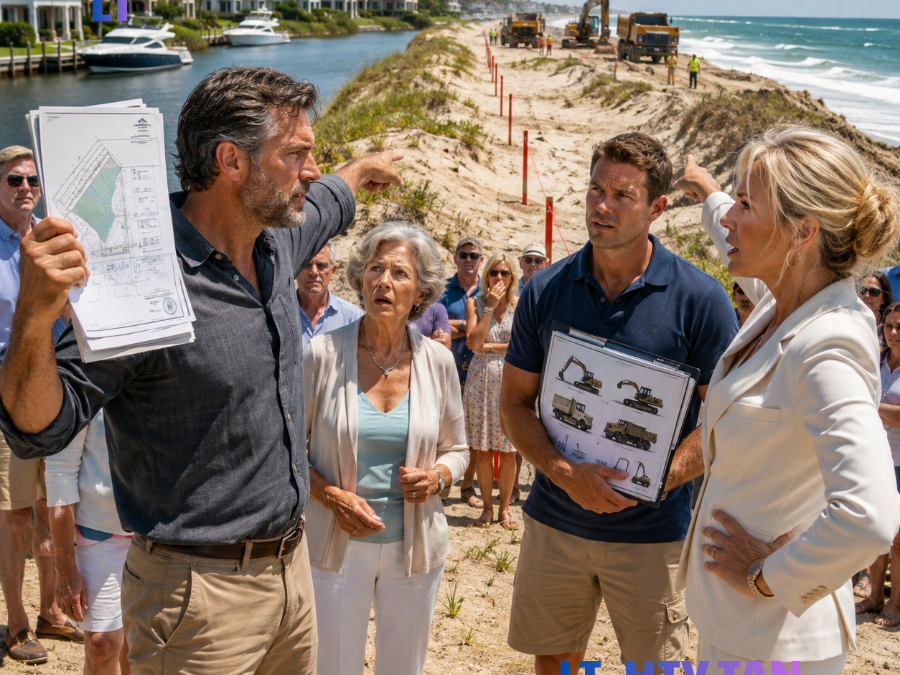
Dump trucks moved after residents went inside. Excavators removed thousands of tons of sand. HOA notices called it “marina circulation improvements.”
Most homeowners assumed they were watching routine dredging.
I knew better.
I photographed equipment numbers, work times, excavation limits, every section of disappearing dune.
Luke began noticing changes before the cut was even complete.
“The docks are pulling differently,” he told me one morning.
He opened a weathered maintenance notebook.
Water heights.
Tide times.
Bracket strain.
Current direction.
“All this used to move with wind,” he said. “Now the tide outside is starting to pull the lagoon.”
Then the last strip of sand disappeared.
Atlantic water entered Lake Marlowe on the next rising tide.
People cheered.
Monica stood at the yacht club with champagne while contractors installed two long rock jetties to keep natural sand from closing the opening again.
They named it Azure Passage.
The first yacht crossed through in minutes.
Residents applauded like they had conquered geography.
I stood on my family’s observation platform and watched the boat reach open ocean.
Then I turned around.
From that angle, the channel pointed directly back toward forty-four homes.
The shortcut worked both ways.
I hired Calvin Mercer, a fifty-nine-year-old coastal surveyor, to measure the passage from land I could legally access.
His results made my stomach tighten.
“They dredged it deep,” he said.
“Deeper than they need?”
“Much deeper.”
That meant more water could move through the opening whenever Atlantic and lagoon elevations separated.
Then I found something worse.
Months before construction, Azure Crown had commissioned hurricane modeling.
The public file contained only a summary, but several tables compared Lake Marlowe with an intact dune against Lake Marlowe with a new inlet.
Projected water velocities increased.
Surge elevations increased.
The numbers were ugly.
I contacted Dr. Natalie Pierce, a coastal scientist with a regional university program.
She spread my maps across a table and studied them silently.
Finally she tapped the artificial channel.
“This removes the long-path protection.”
“Meaning?”
“The natural inlet forces storm surge to travel six miles before reaching this lagoon. Monica just created a direct hydraulic pathway.”
Meanwhile, Monica changed tactics.
Security stopped me near HOA paths.
Residents received a letter describing the situation as a “private land dispute involving a neighboring family opposed to community improvements.”
That neighboring family was mine.
Eleanor didn’t believe it.
Neither did Rachel Kim, an emergency-room nurse living in Mansion 18 with her husband and two children.
Rachel asked the HOA for updated evacuation plans.
Nothing had changed since Azure Passage opened.
So she quietly started her own emergency roster—elderly residents, children, pets, medications, mobility issues, transportation needs.
Then a former Azure Crown administrator named Melissa Hart contacted me.
“I processed invoices before the dredging,” she said. “There was a coastal consulting company.”
“Do you remember the name?”
She did.
I spent weeks chasing records.
When the full report finally arrived, I sat alone in my truck outside the county building and read one sentence twice.
Then a third time.
“A new inlet will create a direct storm surge path into the development.”
The report had been delivered eight months earlier.
Before the excavators.
Before the champagne.
Before Monica told everyone my concerns were sentimental.
She had not been guessing.
Azure Crown had been warned.
And somebody had decided the property premiums were worth the risk.
Part 3: Property values soar as a distant hurricane changes everything.
Azure Passage became a sales miracle.
Homes sold at premiums.
Marina slips filled.
Agents advertised five-minute Atlantic access.
The old six-mile route through the natural inlet vanished from brochures as though it had never existed.
I watched homeowners celebrate rising property values while I overlaid Calvin’s measurements onto old hurricane maps.
Several garages and pool terraces were frighteningly low.
The artificial channel pointed almost directly toward the center of the residential crescent.
Luke kept recording stronger currents during king tides.
He wrote a maintenance report recommending reinforced fuel connections, emergency disconnects, and extra shutoff controls.
Management returned it.
“Remove the language that makes normal tidal conditions sound dangerous.”
Luke revised the official version.
But he kept the original.
So did Rachel.
When she asked again about evacuation planning after the new inlet, nothing changed.
Eleanor brought me her closing documents.
Every flood map in her package showed Lake Marlowe behind an intact dune.
“You bought one coastal configuration,” I told her. “They gave you another.”
Near the end of summer, the National Hurricane Center began tracking a large storm offshore.
The forecast cone stayed away from us.
Monica called it “a distant coastal event.”
People kept walking dogs.
Contractors kept working.
Yachts remained tied at the marina.
But I wasn’t watching the eye.
I was watching the wind field.
Persistent onshore winds were pushing Atlantic water toward our coast for hours.
Before sunrise, Luke called.
“Grant, the current is wrong.”
I drove toward Lake Marlowe.
Waves were breaking hard against the ocean side of the intact dunes north and south of Azure Passage.
The dunes held.
At the passage, there was nothing to hold.
Luke shut off marina fuel.
Disconnected electrical panels.
Secured emergency valves.
Ordered yacht owners off shore power.
Natalie’s temporary water sensor showed the lagoon rising much faster than rainfall could explain.
Outside the jetties, Atlantic water stood higher.
The difference kept growing.
I carried the consultant report, new water measurements, and evacuation maps to the county emergency command post.
Michael Torres, the emergency management director, studied them without interruption.
Then he looked at me.
“How much time?”
“I don’t know.”
“That’s not what I asked.”
I pointed to the channel.
“If the ocean keeps stacking, every low waterfront property around that lagoon is exposed.”
Michael picked up his radio.
Evacuation orders expanded immediately.
Rachel activated her roster.
Eleanor had already left Mansion 31 when she realized her seventy-four-year-old neighbor, Walter Jennings, had not checked in.
Two deputies found Walter inside his garage organizing medication while water was already entering the lower road.
They got him out just before the route became impassable.
By midmorning, everyone was accounted for.
Then the Atlantic outside Azure Passage rose into a broad white surge.
The natural dune still stood on both sides.
It did not collapse.
It did not wash away.
The water simply found the opening Monica had paid people to excavate.
From the command post, I watched the first surge squeeze between those decorative jetties.
And I knew exactly where it was going.
Part 4: The Atlantic uses Monica’s shortcut exactly as engineers predicted.
The first surge hit the marina with terrifying precision.
Floating docks twisted against their connections. Several boats broke loose. Sections of decking disappeared into brown-green water.
Luke completed the final mechanical fuel shutoff before the county ordered all marina personnel away.
That one decision prevented damaged fuel equipment from turning flooding into something much worse.
Then Lake Marlowe rose.
Fast.
The surge crossed the ruined marina and spread outward in a widening fan.
Exactly like the consultant’s model.
Seawalls failed near the marina axis.
Ground-floor windows broke.
Water moved through living rooms, kitchens, terraces, and garages.
Vehicles lifted from their tires.
A large motor yacht crossed a damaged dock and ended up in somebody’s landscaped backyard.
Swimming pools disappeared beneath seawater carrying branches, patio furniture, dock fragments, and pieces of landscaping.
The yacht club lost much of its lagoon-facing glass.
But Rachel kept checking names at the evacuation center.
One household after another.
Forty-four families.
Children.
Grandparents.
Pets.
Medication.
Everyone.
No one died.
That mattered more than every mansion combined.
When aerial images arrived, Michael stood beside me staring at the screen.
Neighborhoods north and south of Azure Crown had storm damage and ordinary coastal overwash.
Lake Marlowe looked completely different.
The destruction began at Azure Passage.
Then widened across the lagoon.
Monica still called it unavoidable hurricane damage.
But the hurricane had never needed to break through the intact dune.
It had entered through her yacht shortcut.
After the storm moved farther offshore, state investigators arrived.
Caroline Hayes led the coastal review.
Her team collected contractor invoices, night-work schedules, security logs, permits, dredging records, and correspondence.
The boat-ramp permit was exactly what I had said it was.
There had never been authorization for a permanent 180-foot ocean inlet.
Then investigators obtained the full consulting report.
“A new inlet will create a direct storm surge path into the development.”
The predicted surge map was placed beside the post-storm aerial survey.
The patterns nearly matched.
Luke turned over his private notebook.
Original tide readings.
Dock photographs.
His unedited maintenance recommendations.
Rachel produced records showing her request for revised evacuation planning had gone nowhere.
Eleanor showed that homeowner disclosure packages used old maps showing an intact barrier.
Then Caroline found one email.
Monica had written it while waterfront properties were still approaching closing.
“We’ll strengthen the seawalls after the oceanfront lots close.”
Eleanor read the sentence in a temporary resident meeting and slowly lowered the page.
Nobody spoke.
Not one person.
That email changed the room.
This was no longer about a woman who had made one terrible engineering mistake.
It suggested Azure Crown understood additional protection might be necessary and kept selling the shortcut anyway.
Monica had spent months telling everyone I was protecting useless sand because my family hated progress.
Now forty-four families finally knew what she had been protecting.
It wasn’t their future.
It was the sale.
Part 5: One hidden email destroys Monica’s story and restores the barrier.
The state issued an emergency coastal order.
No recreational navigation.
No dredging.
No jetty repairs.
No reopening Azure Passage.
Then came the sentence Monica had fought to prevent from the beginning.
The artificial inlet would be permanently closed.
Restoring what Azure Crown destroyed in less than two weeks took months.
Excavators dismantled the decorative jetties.
Barges removed rock.
Trucks delivered engineered fill and graded sand.
Natalie and I joined the technical advisory team, but I refused to let restoration become another beauty project designed for brochures.
“We rebuild the coastal system,” I told the engineers. “Not the photograph.”
The reconstructed dune followed historic elevations and the surviving natural ridge on Caldwell land.
Crews installed sand fencing.
Native beach grasses were planted.
Protected vegetation zones replaced ornamental landscaping near the barrier.
Eventually, standing on Lake Marlowe, you could no longer see the Atlantic through the place Azure Passage had been.
The yacht club reopened.
The marina came back with stronger fuel isolation, higher emergency shutoffs, and improved floating connections.
Yacht owners returned to the natural inlet six miles south.
Nobody called it inconvenient anymore.
The financial recovery was harder.
Homeowners pursued claims involving concealed surge modeling, unauthorized shoreline alteration, and incomplete hazard disclosures.
Insurance investigations continued.
Developer assets and other responsible sources covered part of the losses.
But not everything.
All forty-four homeowners eventually paid a special assessment for common infrastructure and coastal restoration.
The irony hurt.
They were helping pay to rebuild the barrier their own association had spent money destroying.
Still, this time the financial records were open.
Every engineering report was accessible.
Every major contract could be reviewed.
Monica lost her position before reconstruction reached its midpoint.
Her permits, emails, consultant reports, construction records, and sales documents were transferred to the appropriate authorities for further review.
Eleanor joined the interim homeowner committee.
Rachel turned her emergency roster into Azure Crown’s permanent hurricane preparedness program.
Luke returned to the rebuilt marina.
Inside his office, he mounted one aerial photograph from the storm.
It showed Azure Passage at the narrow end of the destruction fan.
“If another board ever talks about cutting through that dune,” he told me, “they’ll have to do it while looking at this.”
I made one final decision of my own.
The Caldwell family placed our barrier property under a permanent coastal conservation easement.
Future developers, HOAs, and successor owners could not excavate another navigation route through it.
One year after the hurricane, I stood on the observation platform with Eleanor, Rachel, Luke, and several residents.
A large yacht departed the rebuilt marina.
It crossed Lake Marlowe.
Turned south.
Then began the six-mile journey toward the natural inlet.
No one complained.
Where the 180-foot shortcut had once cut toward the Atlantic, an uninterrupted dune now stood again.
Waves crashed against the ocean side.
Behind it, Lake Marlowe moved in small wind-driven ripples.
Eleanor looked at the restored grass.
“You tried to tell us.”
“I tried to tell Monica.”
“No,” she said quietly. “You tried to tell all of us. We just liked her answer better.”
I understood why.
Monica had promised convenience.
Higher values.
Shorter trips.
I had brought maps, elevations, old easements, and warnings about water nobody could see yet.
People usually prefer the beautiful answer until reality arrives.
Monica believed the dune stood between Azure Crown residents and the ocean they had paid to enjoy.
My grandfather had understood something simpler.
The dune stood between the ocean and them.
And the final twist was almost cruel in its simplicity.
The most valuable improvement Azure Crown ever received was not the yacht passage that added hundreds of thousands of dollars to property listings.
It was the strip of “useless sand” they had nearly destroyed.
THE END.
All the characters and events in this story are fictional and created for the purpose of storytelling and entertainment.
If this story brought you a moment of reflection, comfort, or curiosity, then it has truly fulfilled its purpose.
Thank you sincerely for reading. Your feedback and support are always appreciated and inspire me to keep sharing more stories with you.








