My Family Shut Me Out for 20 Years—Then Tried to Steal My House on Christmas Eve
Part 2: I build a life while my brother inherits every excuse.
I started my future with a yellow cleaning bucket.
My first client was an exhausted single mother working double shifts. I scrubbed her kitchen until the stove looked new.
She cried.
Then she recommended me to two friends.
For almost a year, I slept in my Corolla more often than I admitted. I showered at a nine-dollar gym and divided every payment into three piles.
Gas.
Supplies.
Someday house.
Being unwanted had made me dangerous in one particular way.
I could not tolerate failure.
I cleaned baseboards nobody inspected. Returned to fix things clients hadn’t complained about. Worked sick. Worked holidays.
By twenty-five, I had two employees.
By twenty-eight, I had an office, a logo, and a company called Booth Home Care.
We cleaned houses, managed properties while owners traveled, handled move-outs, and checked on elderly clients.
I was building a business around the thing I had never been given.
Care.
Meanwhile, Travis lived in another universe.
He received a car at sixteen. College money he barely used. Rescue after rescue whenever his latest business collapsed.
Lawn service.
Vending machines.
“Consulting.”
My parents paid every bill.
At our grandmother’s funeral, I tried one final time to belong.
I stood at the church sink washing cups when Travis leaned against the counter.
“You know you don’t have to keep showing up, right?”
I looked at him.
“What?”
He smiled almost kindly.
“Nobody expects you to. You’re not really one of us, Charlotte.”
He walked away.
I stood there holding a wet dish towel while those words settled deeper than any insult screamed in anger.
You’re not really one of us.
That afternoon, I stopped begging for a chair.
The years after that became the best years of my life.
By 2025, Booth Home Care had four vans, eleven employees, and contracts across the county.
I had savings.
Security.
Peace.
My family knew none of it because they had never bothered to ask.
Then I found Maple Hollow.
Three stories of brick built in 1912. Wraparound porch. Turret room. Tall windows glowing gold at sunset.
It needed repairs.
I didn’t care.
The moment I entered the empty dining room, I saw a long table beside the windows.
A table where nobody would be excluded.
I bought the house with my own money.
At closing, the lawyer slid the deed toward me.
Grantee: Charlotte Booth.
Sole owner.
I read those words three times.
That night, I sat alone on my porch and thought about the eighteen-year-old girl crying over diner coffee.
“We did it,” I whispered.
Three weeks later, Mom called for the first time in years.
“I hear you bought a big old house.”
Her voice was suddenly warm.
“We’d love to visit, honey.”
Two days later, Travis texted.
How many bedrooms?
What did you pay?
Good investment?
Then came the question that made me place my phone slowly on the kitchen counter.
Who’s the house under?
Just you?
Part 3: My new house turns sudden family warmth into something sinister.
People don’t suddenly remember you exist.
Sometimes they remember what you own.
I called Ruth Callaway, the real estate lawyer who handled my closing.
“Can somebody take your house if they really want to?”
She became quiet.
Then she explained deed fraud.
A person could forge my signature on a quitclaim deed and file it with the county. The recorder’s office recorded documents; it didn’t conduct a forensic investigation at the counter.
“Usually,” Ruth said, “the person knows the victim.”
My stomach tightened.
She told me about the county’s property fraud alert.
I enrolled that afternoon.
If anything was recorded against Maple Hollow, I would know immediately.
I printed my enrollment confirmation and placed it beside my deed.
Two pages.
One said the house belonged to me.
The other promised I would know if anyone tried to change that.
I told nobody.
Then my cousin Patty called.
“I shouldn’t tell you this…”
Patty always began important news that way.
Travis was nearly ninety thousand dollars in debt.
A failed business loan.
Late rent.
Creditors calling.
My parents had finally exhausted their savings after decades of rescuing him.
I stood in my kitchen and did the math.
A desperate brother.
A sister with a valuable house.
A mother suddenly calling every week.
In November, Mom invited me to Christmas for the first time in almost twenty years.
“There’s a place for you, Charlotte.”
I nearly laughed.
I had spent my childhood waiting for those words.
Now they sounded terrifying.
Travis started texting constantly.
One message read:
With an old house like that, you should protect important documents. Where do you keep the deed? Safe? Fireproof box?
I took a screenshot.
Then another.
I created a folder and saved every message.
The next call came from Megan.
Travis’s wife was smarter than he was. Organized. Controlled.
She chatted pleasantly before becoming very specific.
“Travis and I were discussing a quitclaim deed for tax reasons. Does the county actually verify the signature? Or do they just record whatever gets submitted?”
I stared at the wall.
That wasn’t curiosity.
That was research.
I kept my voice light.
“No idea. Ruth handled everything. You know me. Paperwork makes my eyes glaze over.”
Megan laughed.
I could hear her relax.
Afterward, I sat perfectly still.
Travis had the desperation.
Megan had the plan.
Then Mom slipped.
“It’s so much house for one person,” she said one evening. “A place like that should really be for the whole family.”
I said nothing.
“You shouldn’t be rattling around alone. You know how it is, honey. We can only set so many places.”
My eyes closed.
She didn’t even remember saying those exact words to eight-year-old me.
Once, they meant there wasn’t room for Charlotte.
Now they meant Charlotte herself was occupying something the family wanted.
They weren’t rebuilding a relationship.
They were circling an asset.
I called Ruth again.
My instinct was to confront everyone.
She stopped me.
“If you warn them now, they disappear. Right now you have suspicious conversations. If someone actually forges a deed, then you have evidence.”
So I did something that went against every instinct I had.
I pretended to soften.
When Travis sent angry messages saying the house should belong to someone who “actually cared about family,” I saved them.
Then I answered:
I hear you.
Let’s talk after Christmas.
It’s a lot to think about.
They believed I was weakening.
They had no idea I was documenting everything.
And then, at 4:47 p.m. on December 3, my phone buzzed.
Property Fraud Alert.
A new document had been recorded against my home.
Document type: Quitclaim Deed.
Grantor: Charlotte Booth.
Grantee: Travis Booth.
According to the county record, I had just given my brother my house.
I had signed absolutely nothing.
Part 4: A forged deed proves my family plans to erase me.
The next morning, I stood beneath fluorescent lights at the county recorder’s office holding a certified copy of the lie.
There was my name.
Charlotte Booth.
The signature looked close.
But it wasn’t mine.
The curve of the C was convincing. The rest was wrong.
Below it sat a notary stamp claiming I had personally appeared and signed voluntarily.
I had never met that notary.
I photographed every page.
Recording number.
Date.
Names.
Then I went to the police.
Detective Ray Foster listened while I placed everything on his desk.
My legitimate deed.
The forged deed.
Travis’s messages about my house.
Megan’s question about signature verification.
The ninety-thousand-dollar debt.
Mom’s sudden Christmas invitation.
When I finished, Foster leaned back.
“In twenty years, I haven’t seen many victims walk in this organized.”
“I own a business,” I said. “Records keep you alive.”
He explained that forgery and filing a false instrument could bring serious criminal charges.
But possession mattered.
“If they show up and actually try to take control of the property,” he said, “that makes the story very easy for a jury to understand.”
I knew exactly when they might come.
Christmas Eve.
For twenty years, my family had told themselves Charlotte spent holidays alone.
Charlotte had nobody.
That belief was about to work against them.
I also wanted witnesses outside the family.
So I contacted Dana Whitfield, a local reporter covering deed fraud.
I showed her everything.
“The cruelest part,” Dana said, closing her notebook, “is that people imagine strangers doing this.”
“Sometimes it’s the person who knows where your Christmas table is,” I said.
We made a plan.
I politely declined Mom’s invitation.
“I’ll probably stay home and rest.”
There was a tiny pause.
Satisfaction.
She thought the house would be easy to approach.
On Christmas Eve, I parked my car three streets away.
Maple Hollow stayed dark.
But it wasn’t empty.
Detective Foster waited inside with two officers.
Dana stood upstairs with her camera.
I sat in the front parlor with my folder on my lap.
Then headlights moved across the windows.
Car doors opened.
Travis’s voice carried through the cold.
“Told you. Place is dead.”
Megan told someone to hurry.
A stranger answered.
The locksmith.
Then I heard Mom.
“Are we sure about this?”
Travis answered confidently.
“The house is ours now. It’s legal.”
A heavy tool bag hit my porch.
Metal clinked.
“Standard deadbolt,” the locksmith said. “Two minutes.”
Then came the scratching.
Twenty years earlier, I had been the little girl outside the dining room.
Now my family stood outside my door.
The lock clicked.
My deadbolt slid backward.
And for the first time in their lives, they walked into my house believing I was the one who didn’t belong there.
Part 5: Christmas Eve exposes the crime—and the secret behind my childhood.
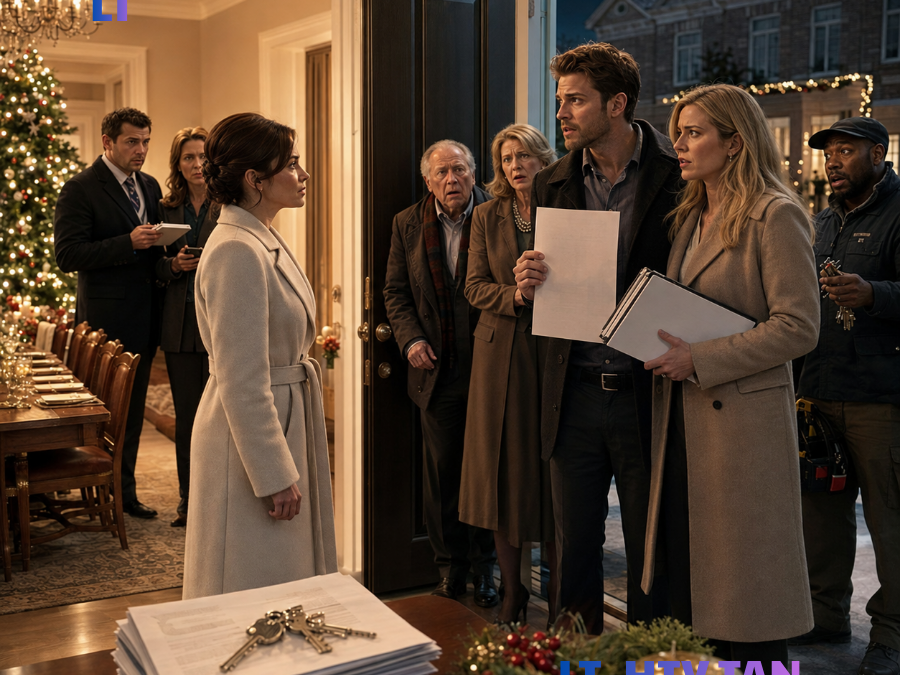
Megan entered first with a flashlight.
Travis followed holding the forged deed.
“Would you look at this place?” he said.
The locksmith hovered near the doorway.
“We change every lock tonight,” Megan said. “Tomorrow we’re owners in possession.”
My parents entered last.
Mom looked around the dark foyer.
“It’s so big.”
Then Travis laughed.
“She never belonged in a place like this anyway.”
He paused.
“She never belonged anywhere.”
That was enough.
I reached toward the lamp.
Click.
Light flooded the room.
Everyone froze.
Detective Foster stepped from the dining room with his badge visible.
Two uniformed officers appeared behind him.
Dana stood on the staircase, camera raised.
I stood slowly.
Travis’s face emptied.
The forged deed remained in his hand.
“What is this?” he demanded.
“Merry Christmas,” I said.
His shock became rage.
“This is my house! I have the papers!”
“Those papers,” I said, “are evidence.”
Foster began listing what they had.
The December 3 deed.
My fraud alert.
My verified signature samples.
The messages.
The locksmith.
Their entry.
Travis started shouting.
Megan went completely silent.
Then Foster turned toward him.
“Travis Booth, you’re under arrest for forgery and filing a fraudulent instrument.”
When the handcuffs appeared, Mom finally broke.
“Charlotte, please. We can fix this. We’re family.”
I looked at her across my bright foyer.
“There were always enough places, Mom.”
She stared at me.
“You just never set one for me.”
Her mouth trembled.
“So tonight, I set the table myself.”
I glanced toward Foster.
“And I set it for the police.”
Outside, red and blue lights washed across Maple Hollow’s windows.
For once, Mom had nothing to say.
My father stayed behind after Travis and Megan were taken outside.
He sat on the bottom stair with his face in his hands.
“I always knew it was wrong,” he whispered.
“The Christmas dinners. The presents. All of it.”
I stared at him.
“Then why?”
His answer finally opened the room my family had kept locked for decades.
Before I was born, Mom had another daughter.
A baby who died shortly after birth.
Near Christmas.
The yellow blanket in the silver frame had belonged to her.
When Mom became pregnant with me soon afterward, she never processed the loss. Instead of loving the daughter standing in front of her, she somehow treated me like an unwanted replacement for the daughter she had lost.
Dad knew.
And he allowed it.
“She grieved one daughter,” I said quietly, “by erasing the other.”
He couldn’t answer.
For the first time, the truth explained my childhood.
It did not excuse it.
Travis and Megan eventually accepted plea agreements. Megan admitted she had researched the process, while Travis had practiced and written the forged signature.
The fraudulent deed was voided.
The house remained mine.
The ninety-thousand-dollar debt remained theirs.
Dana’s article ran after New Year’s and prompted several local homeowners to enroll in property fraud alerts.
Mom and I stopped speaking.
Dad began sending handwritten letters.
I haven’t answered.
But I haven’t thrown them away.
The morning after the arrests, I changed every lock myself.
Then I hung one stocking over the fireplace.
CHARLOTTE.
The following Christmas, I finally placed that long table beside the windows.
Twelve chairs.
My employees.
Friends.
Neighbors.
Patty and her daughter.
People who had shown up when showing up actually mattered.
Before dinner, I stood in the doorway.
For one second, I was eight again, counting.
One.
Two.
Three.
All the way to twelve.
Every place was filled.
And then someone beside me laughed.
“Charlotte, aren’t you sitting down?”
I looked at the chair waiting at the head of the table.
My chair.
For twenty years, I thought belonging was something my family could give me.
A seat they could offer.
A door they could open.
A place they could take away.
I had been wrong.
Belonging was the house I bought.
The locks I changed.
The friends I chose.
The table I set.
And when I finally sat down that Christmas, nobody had to move over to make room for me.
There had always been enough space.
I had simply spent too many years asking the wrong people for permission to take it.
THE END.
All the characters and events in this story are fictional and created for the purpose of storytelling and entertainment.
If this story brought you a moment of reflection, comfort, or curiosity, then it has truly fulfilled its purpose.
Thank you sincerely for reading. Your feedback and support are always appreciated and inspire me to keep sharing more stories with you.








