She Slapped My Daughter Over a Chair—Then My Husband Kept Eating

She Slapped My Daughter Over a Chair—Then My Husband Kept Eating
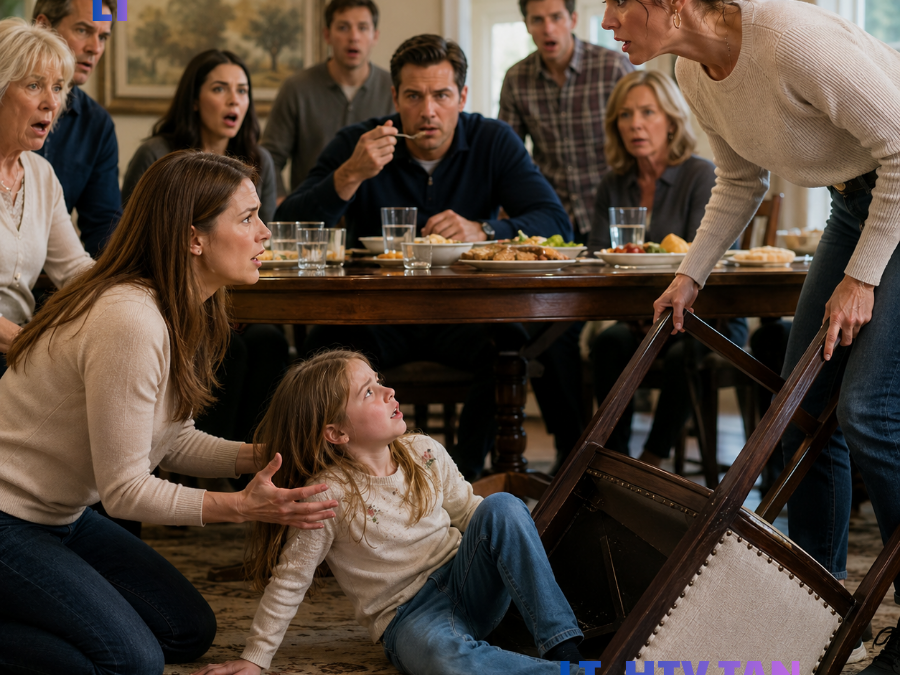
For eleven years, I convinced myself that keeping peace in my husband’s family was worth swallowing every insult. Then one Sunday, his older sister slapped my eight-year-old daughter for sitting in “her” chair and yanked it away as my child tried to stand. Lennox crashed onto the hardwood floor. My sister-in-law looked down at her and said, “Maybe now she’ll learn her place.” I turned to my husband, expecting him to protect his daughter. Instead, he called his sister “strict,” lifted his fork, and kept eating. That was the moment our marriage ended, although he wouldn’t understand it for months.
Part 1: One empty chair exposes eleven years of dangerous family silence.
My name is Briar Vaness, and for eleven years, I told myself peace was worth almost any price.
I bit my tongue at Sunday dinners. I ignored insulting comments. I smoothed over arguments before they became uncomfortable. I told myself that was what good wives did.
I was wrong.
It took my eight-year-old daughter hitting a hardwood floor for me to understand that peace built on silence isn’t peace at all. It’s a debt collecting interest, waiting for the day it finally comes due.
I met my husband, Cash, when I was twenty-six. He was calm, steady, easy to be around. Back then, I mistook his refusal to argue for emotional maturity.
Years later, I understood the truth.
Cash wasn’t peaceful. He was terrified of conflict.
And there was one person he feared disappointing more than anyone else: his older sister, Maren.
Maren had practically raised him while their parents worked double shifts. She fed him, walked him to school, signed permission slips. Cash carried that childhood debt into adulthood like something sacred.
I respected it at first.
Then Maren began rearranging our kitchen while we were on our honeymoon because our layout “didn’t make sense.” She showed up without warning to criticize our paint, our furniture, even the way I folded towels.
“That’s just how she shows she cares,” Cash always said.
So I kept swallowing my discomfort.
After Lennox was born, Maren’s opinions became rules.
Lennox held her fork wrong. Lennox laughed too loudly. Lennox didn’t say thank you quickly enough. If I objected, Cash rubbed his face and told me I was reading too much into things.
“Maren had a hard childhood,” he would say. “Her tone can be rough.”
Eventually, I stopped bringing it up.
Not because I agreed.
Because I was exhausted from watching my husband turn every concern about our daughter into a debate about protecting his sister’s feelings.
Then came the chair.
At Cash’s parents’ house, there was one dining-room chair closest to the kitchen that everyone silently understood belonged to Maren. Nobody had ever announced it. Nobody needed to.
Adults avoided it.
Children were expected to somehow know better.
That Sunday, we arrived late because Lennox couldn’t find her shoes. Most of the family was already seated. Maren was standing at the stove with her back toward us.
Her chair was empty.
Lennox saw an open seat and climbed into it.
I was setting a casserole on the counter when Maren’s voice sliced across the room.
“That’s my seat.”
Lennox looked up.
“I didn’t know,” she said softly. “I can move.”
She was already sliding forward when Maren crossed the room.
What happened next lasted maybe four seconds.
I have replayed every one of them a thousand times.
Maren’s hand struck Lennox across the cheek.
The sound stopped every conversation in the room.
Before Lennox could fully stand, Maren grabbed the chair and jerked it backward.
My daughter fell.
Her hip hit first. Then her shoulder. Her head snapped against the leg of the dining table.
For one horrible second, nobody moved.
Then Lennox screamed.
It was that sharp, breathless cry children make when fear reaches them before pain does.
“Maybe now she’ll learn her place,” Maren said.
She stared down at my daughter as though she had corrected bad manners instead of injured a child.
I dropped beside Lennox.
A knot was already rising near her ear. She clutched her wrist to her chest and cried when I tried to touch it.
My hands shook as I checked her eyes.
Her breathing.
Her head.
Then I looked across the table at my husband.
Cash was still sitting there.
I waited for him to stand.
He didn’t.
“Cash?”
He glanced at Maren, then at me.
“She’s just strict.”
I thought I had misheard him.
“What?”
“She didn’t mean for Lennox to fall like that.”
Our daughter was crying on the floor.
And my husband picked up his fork.
Then he took another bite.
Something inside me went completely silent.
I lifted Lennox into my arms. She buried her face against my neck, her whole body trembling.
Nobody followed us.
Behind me, I heard Cash’s mother whisper, “Briar, don’t make a scene.”
I stopped at the doorway.
For eleven years, those words would have worked.
That night, they didn’t.
I carried my daughter to the car and drove straight to the emergency room.
And before that night was over, I would make one phone call that Cash’s entire family would never forgive me for.
Part 2: The hospital documents what my husband’s family wants buried.
Lennox kept asking the same question during the drive.
“Why was Aunt Maren so mad about a chair?”
I kept one hand on the steering wheel and reached backward with the other whenever we stopped at a light.
“I don’t know, sweetheart.”
There was no answer that could make sense because what happened made no sense.
The triage nurse took one look at Lennox’s swelling cheek and hurried us back.
The next two hours were a blur of examinations, imaging, whispered questions, and cold hospital lights.
A doctor crouched beside Lennox’s bed.
“Has anyone hurt you before?”
Lennox shook her head.
“Do you feel safe at home?”
“Yes.”
I watched her answer and felt something inside me harden.
The diagnosis was almost merciful: mild concussion, sprained wrist, deep bruising along her hip and cheek. No fracture. No internal bleeding.
It could have been worse.
That thought terrified me more than almost anything else.
A little after midnight, Lennox finally drifted into an uneasy sleep.
My phone buzzed.
Cash’s mother.
Please don’t make this bigger than it needs to be. Maren feels terrible.
I stared at the message.
Maren felt terrible.
Not Lennox.
Not me.
Maren.
I placed the phone facedown.
A hospital social worker approached a few minutes later and asked to speak privately.
She explained that because the injuries involved an adult striking a child and intentionally removing the chair beneath her, the hospital had a responsibility to report what happened.
“Would you like us to contact law enforcement,” she asked, “or would you prefer to make the call yourself?”
For eleven years, I had allowed that family to decide what counted as serious.
Not anymore.
“I’ll call.”
I stepped into the hallway.
My voice was strangely steady when the dispatcher answered.
I gave the address.
I described the slap.
The chair.
The fall.
The words Maren said afterward.
And then I gave them her full name.
Officers met me at the hospital while another unit went to my in-laws’ house.
Almost everyone at that dinner had witnessed what happened.
Suddenly, most of them remembered very little.
One person didn’t.
Cash’s younger cousin, Tori, was in her twenties and rarely attended Sunday dinner. She had been sitting only a few feet away.
She told police everything.
The slap.
The chair scraping backward.
Lennox hitting the floor.
And Maren saying, “Maybe now she’ll learn her place.”
Her statement matched mine almost word for word.
The officer closed his notebook.
“We’ll include the medical documentation with the report.”
For the first time that night, I understood something important.
This was no longer my word against Maren’s.
There was evidence.
There was a witness.
There was a medical record.
A week later, prosecutors decided to move forward.
Maren was formally charged with assault against a minor.
And that was when Tori called me with something the rest of the family had apparently spent years hoping no one would ever mention.
“Maren had trouble with a child before,” she said.
I gripped the phone tighter.
“What do you mean, before?”
Part 3: An old family secret proves Maren’s cruelty wasn’t isolated.
Tori hesitated.
“Before you married Cash, Maren worked at a daycare.”
I remembered hearing something vague about that job. Maren had supposedly quit because she hated the management.
That wasn’t the version Tori had heard.
“There was an incident with a child,” she said. “I don’t know every detail. Nobody talks about it. She left right after.”
“Did Cash know?”
“I don’t know.”
That answer bothered me almost as much as a yes.
The information wasn’t proof. It wasn’t something I could hand a prosecutor and call evidence. But it reframed years of behavior I had dismissed as Maren being “strict.”
The toddler scolded until he cried at Christmas.
The nephew forced into a corner during a birthday party.
Lennox constantly corrected, watched, criticized.
Maybe Sunday dinner wasn’t one terrible moment.
Maybe it was simply the first time the family’s habit of looking away had produced an injury nobody could hide.
I confronted Cash three nights later.
He sat on the edge of our bed while I packed clothes for Lennox.
“You’re really leaving?”
“Yes.”
“Briar, Maren didn’t mean for her to hit her head.”
I stopped folding.
“Listen to yourself.”
“She was trying to teach her something about respect.”
“She taught her something.”
He looked almost relieved.
Then I finished the sentence.
“She taught our daughter that her father can watch someone hurt her and keep eating.”
His face changed.
“That’s not fair.”
“No, Cash. What happened to Lennox wasn’t fair.”
He rubbed both hands over his face.
“There’s a court case now. What more do you want me to do?”
I stared at him.
“You still think this is about me wanting something from you.”
He said nothing.
“I wanted you to stand up from that table.”
Silence.
“I wanted you to pick up your daughter.”
His eyes dropped.
“I wanted you to tell your sister that nobody touches our child.”
He finally whispered, “I froze.”
“No. You ate.”
That landed.
I zipped the suitcase.
Within a month, Lennox and I were living in a small rental two towns away.
Her therapist helped her find words for feelings an eight-year-old should never have needed to understand.
The bruises faded quickly.
The deeper wound didn’t.
One afternoon she asked me, “Why didn’t Daddy help me?”
There are moments when being a parent means resisting the temptation to give your child a comforting lie.
“I think Daddy was scared to stand up to Aunt Maren.”
Lennox stared at the floor.
“But he’s bigger than me.”
My throat tightened.
“Yes.”
That night, after she fell asleep, I sat alone at our kitchen table and finally admitted what I had been avoiding.
I hadn’t only left Cash because Maren hurt Lennox.
I left because in the four seconds when our daughter needed him most, my husband showed me exactly who came first.
Then my attorney called.
Maren had decided to accept a plea agreement.
And Cash’s family wanted me at the hearing.
Part 4: Court draws the boundary my marriage never could enforce.
I sat three rows behind Cash’s family at the hearing.
None of them spoke to me.
Maren wore a dark blazer I recognized from Christmas dinners and family birthdays. Without her kitchen, her chair, and a room full of relatives automatically yielding to her, she looked strangely ordinary.
For one second, I almost felt sorry for her.
Then I remembered Lennox crying on the floor.
The feeling disappeared.
Maren accepted a plea agreement that included probation, mandatory anger-management courses, and a protective order requiring her to stay away from Lennox and have no direct contact.
When the judge explained the order, something loosened inside my chest.
Not victory.
Relief.
A system had finally done what the Vaness family never could.
It drew a line.
And it held it.
The backlash began almost immediately.
An aunt called me.
“Surely this has gone far enough.”
“Far enough?”
“Maren made a mistake. She understands that now. Did her whole life really need to be disrupted?”
I looked across the room at Lennox, who had developed a habit of testing chairs before sitting all the way down.
“Have you asked Lennox whether her life was disrupted?”
Silence.
I stopped explaining myself after that.
Cash’s visits with Lennox were supervised at first.
For months, I watched carefully.
I expected him to defend Maren.
He didn’t.
Instead, something in him slowly changed.
He listened when Lennox spoke. He remembered details. He asked real questions. When she became quiet, he noticed.
Five months after that Sunday, he came to pick her up for the park.
Lennox ran inside for her shoes.
Cash stayed in the driveway.
“I keep replaying that night,” he said.
I waited.
“I keep seeing myself sitting there.”
His voice cracked.
“I don’t know how I did that. She was on the floor, and I just… kept eating.”
For years, I had wanted him to understand.
Now that he finally did, I felt almost nothing.
“I don’t know how you did it either,” I said. “But you did.”
“I’m sorry.”
“I believe you.”
He looked surprised.
Then I added, “But believing you’re sorry doesn’t mean I can forget what happened.”
“I know.”
Some apologies are sincere and still insufficient.
His was one of them.
“I filed for divorce last week,” I told him. “The paperwork should arrive soon.”
He closed his eyes.
But he didn’t argue.
After a long silence, he said, “I think you’re a better parent than I’ve ever been.”
I looked toward the house, where Lennox was searching loudly for her sneakers.
“I hope she grows up knowing that,” he said.
“She already does.”
The divorce was almost painfully peaceful.
But just before it became final, Cash told me something I never expected.
He had finally confronted Maren about her old daycare job.
And for once, she hadn’t denied that something had happened.
Part 5: The final truth ends my marriage but gives Lennox peace.
Cash never gave me every detail of that conversation.
I didn’t ask for them.
What mattered was what he finally admitted.
The family had known Maren had a temper around children long before Lennox was born.
Maybe not every fact.
Maybe not enough to prove anything legally.
But enough that uncomfortable stories had been buried, renamed, softened, and forgotten whenever bringing them into the open would have required someone to confront her.
Sunday dinner wasn’t created by one chair.
It was created by years of silence.
That was the final truth.
And I had participated in that silence too.
Not anymore.
Cash told Maren he could no longer defend her, no matter what she had done for him as a child.
Their relationship cooled after that.
For the first time in his adult life, he stopped paying his childhood debt with everyone else’s comfort.
I was glad for him.
I still didn’t go back.
The divorce became final quietly.
Cash continued rebuilding his relationship with Lennox, first through supervised visits and later on his own. One afternoon at a time. One promise kept at a time.
He became a better father.
I believe that.
But sometimes people become who you needed only after the part of your life that needed them has already ended.
I grieved that version of him.
I did not return to it.
Maren completed her court-ordered programs and stayed away exactly as required.
I stopped wondering whether she understood what she had done.
Her understanding was no longer necessary for our healing.
Lennox and I built a life in our little rental.
She chose soft yellow paint for her bedroom.
No family vote.
No criticism.
No permission required.
She started Saturday swimming lessons and made a best friend two doors down. Slowly, the child who used to check every chair before sitting began forgetting to check.
That was how I knew she was healing.
Not because she announced it.
Because fear stopped being part of ordinary things.
These days, Sunday dinner is usually just the two of us.
We have a small round table with four chairs, though we rarely need more than two.
One Sunday, I carried pasta to the table and found Lennox already sitting down.
She had chosen the chair closest to the kitchen.
For half a second, I stopped moving.
She noticed.
“What?”
“Nothing.”
She narrowed her eyes playfully.
“Mom.”
I smiled.
“I was just thinking that you picked the best seat.”
She looked toward the kitchen.
“It’s closest to seconds.”
I laughed.
“So it is.”
That was all the chair meant to her now.
Not authority.
Not fear.
Not somebody else’s invisible rules.
Just the best place to reach another piece of garlic bread.
I sat across from her and realized my throat was tight.
For years, I thought keeping a family together meant staying quiet when something felt wrong.
I know better now.
Family isn’t preserved by silence.
It is preserved by protecting the people who trust you enough to believe you will stand up when they fall.
Sometimes I still think about that Sunday.
I think about Maren’s hand.
The scrape of that chair.
Cash lifting his fork.
But I also remember what happened afterward.
I lifted my daughter.
I walked out.
I called the police.
I told the truth even when an entire family wanted a softer version.
And when my marriage asked me to choose between keeping everyone comfortable and teaching Lennox that she deserved protection, I finally chose correctly.
I regret every dinner before that one when I stayed quiet.
I regret every small cruelty I renamed as “family tension.”
I regret waiting until my daughter was on the floor to understand the difference between patience and surrender.
But I do not regret one decision I made after she fell.
That evening, Lennox reached across the table and stole a piece of garlic bread from my plate.
“Hey,” I said.
She grinned.
“I’m learning my place.”
My heart stopped for half a second.
Then she pointed toward the empty serving bowl.
“Apparently, my place is closest to the food.”
We both started laughing.
Real laughter.
Easy laughter.
The kind that doesn’t check the room first.
And watching my daughter sit wherever she wanted at our own table, without fear and without permission, I understood something I wished I had learned eleven years earlier.
Peace is not everyone staying quiet.
Peace is knowing nobody at your table has to be afraid.
THE END.
All the characters and events in this story are fictional
and created for the purpose of storytelling and entertainment.
If this story brought you a moment of reflection, comfort,
or curiosity, then it has truly fulfilled its purpose.
Thank you sincerely for reading. Your feedback and support
are always appreciated and inspire me to keep sharing more stories with
you.








