My Pregnant Sister Begged For Help At 3 A.M. Mom’s Message Was Clear She Deserves To Be Alone…
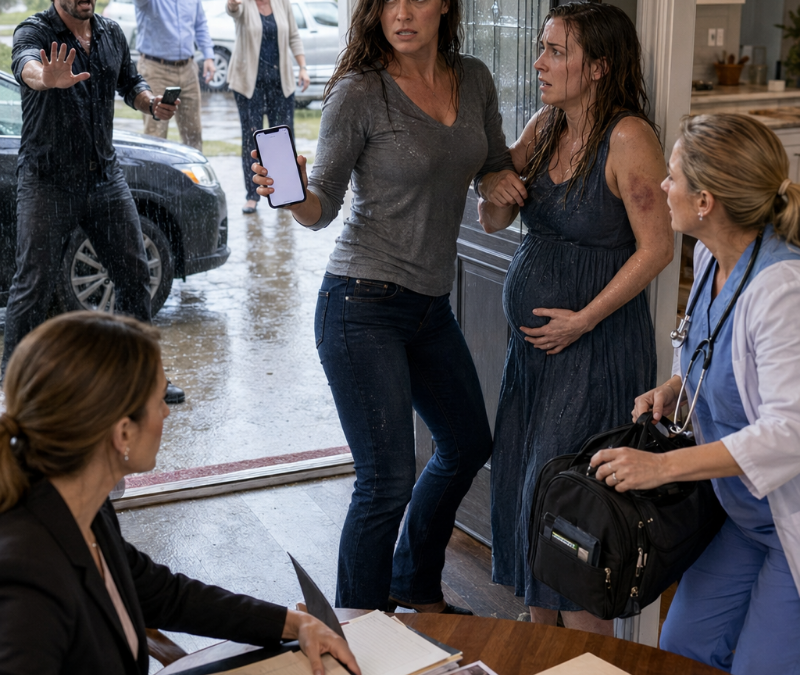
“Don’t you dare let her in. She made her bed. Now she can lie in it,” my mother texted while my seven-month-pregnant sister stood drenched on my doorstep at 3:02 a.m., bruises shaped like fingers around her arm. Emily had just discovered her husband Marcus was cheating, and when she confronted him, he slammed her into a counter and called her unstable. Our parents believed him before they even heard her side—and threatened to disown anyone who helped her. I opened the door anyway, called a doctor and a divorce attorney, and started saving every message. At first, I thought Mom was protecting appearances. I had no idea she and Dad had a much darker reason for needing Emily to go back to Marcus.
Part 1
The pounding didn’t sound like a neighbor. It sounded like panic—too fast, too hard, the kind of knocking that came with bad news.
I fumbled for my phone, squinting at the screen. 3:02 a.m.
Outside my apartment, the hallway lights were dim and quiet. The whole building felt like it was holding its breath, the way it did during storms. Rain hammered the windows behind me, slanting sideways like it had a grudge against the city.
I padded to the door and leaned into the peephole.
Emily.
My little sister stood there drenched, shivering, her hair plastered to her cheeks. One hand clutched her swollen belly, like she could shield the baby—like she could shield herself—from whatever had chased her into the night.
I slid the deadbolt back so fast my fingers slipped.
When I opened the door, she fell forward, a broken exhale punching out of her. “Katie,” she sobbed. “Please.”
The air around her smelled like rain and cold concrete. Her mascara had turned into dark tracks down her face. The hem of her cardigan dripped onto my doormat.
“Hey, hey—come in,” I said, catching her before she could collapse. She was all bone and tremble under the wet clothes, and the belly made her balance clumsy. Seven months pregnant shouldn’t look like this. Seven months pregnant shouldn’t be standing in a hallway at three in the morning, begging.
I pulled her inside and kicked the door shut with my heel. The sound echoed too loudly, like the building itself was listening.
Emily tried to speak, but only a strangled noise came out. I guided her to my couch and grabbed a throw blanket, wrapping it around her shoulders.
“What happened?” My voice came out sharper than I meant. “Em, where’s Marcus? Why are you—”
Her face crumpled. “He… he’s been having an affair.”
The words hit the room and just stayed there.
Marcus. Marcus Hart. The man my parents called “the answer to prayer,” the man who shook my hand the first time we met like he was closing a deal, the man with perfect teeth and perfect manners and a job title my mother loved to drop into conversation like a designer handbag.
Successful lawyer. Charming. “Solid,” Dad had said, like he was talking about a purchase. Our parents’ dream son-in-law.
Emily’s voice cracked. “When I confronted him, he said the baby probably isn’t even his.” She swallowed, staring at her hands like she was surprised to find them still attached. “He—he grabbed me.”
I felt my chest go hollow. “He did what?”
Emily tugged her sleeve up with trembling fingers.
Bruises bloomed along her forearm. Dark, finger-shaped. Fresh.
Something inside me went cold and quiet, like a switch flipped.
“Oh my God,” I whispered, then louder, “Emily. Did he hit you?”
“No,” she said quickly, then shook her head like she was trying to rearrange the truth. “He didn’t… not like that. He—he slammed my arm into the counter and told me to stop making things up. He said I was hormonal and paranoid.” Her breath hitched. “Katie, he’s been acting strange for months. He watches my phone. He asks where I am every hour. Tonight he… he looked at me like he didn’t know me. Like I was—”
Her eyes went wide, and she pressed her palm against her belly. “I was scared he might kill me.”
The rain against my windows sounded suddenly like applause for something cruel.
I knelt in front of her, careful not to overwhelm her. “You did the right thing coming here,” I said, steady and sure, even though my insides were shaking. “You’re safe here.”
Emily’s lips trembled. “Mom and Dad are going to hate me.”
Before I could answer, my phone buzzed on the coffee table.
Mom.
A text.
Emily just left Marcus. Don’t you dare let her in. She made her bed. Now she can lie in it.
I stared at the screen, waiting for it to make sense. Like maybe the words would rearrange themselves into something less monstrous.
“How does she already know?” I said out loud before I could stop myself.
Emily gave a broken laugh that wasn’t funny. “He called them. Or she called him. They’ve… they’ve been talking.”
Another message popped up.
Your father and I warned her about getting pregnant so soon. She chose to ignore us. She deserves to be alone.
Emily peered at my phone. Fresh tears slipped down her face, carving new trails through old mascara. “They already called you,” she murmured. “She told me I was dead to them for leaving. She said I was throwing away the perfect marriage for silly suspicions.”
She fumbled for her own phone and shoved it toward me with shaking hands. The screen was smeared with raindrops and fingerprints, but the messages were clear enough.
What are you doing to our family?
Stop embarrassing us.
Go home.
You’re selfish.
You’re unstable.
Marcus has been so patient with you.
I felt sick in a way that had nothing to do with the storm.
Our parents had always been obsessed with appearances. In our house growing up, problems didn’t exist unless the neighbors could see them. Dad fixed things with silence. Mom fixed things with performance.
Emily had been their pride. The obedient one. The one who wore the right dresses and said the right things. The one who followed the script they wrote for her.
I had been the wrong kind of daughter. The one who moved across the city for a job I wanted instead of marrying a man my mother approved. The one who didn’t smile on command. The one who learned early that love from our parents came with strings—tight, cutting strings.
Maybe that was why I could see the trap now, so clearly.
Emily was shivering harder. I stood up, forcing my hands to unclench. “Have you eaten?” I asked, already heading for the kitchen because movement was the only thing keeping me from breaking something.
She shook her head.
I heated leftover chicken soup on the stove, the kind you make when you’re tired and pretending you’re fine. The microwave hummed. The rain raged. My phone began to vibrate again and again—calls this time.
Mom. Dad. Marcus.
I flipped it face-down and silenced it. Let them drown in their own noise.
When I brought Emily the soup, her hands were shaking so badly she could barely hold the spoon. I sat beside her, one hand resting lightly on the blanket around her shoulders.
“Marcus told them I’m lying,” she whispered. “He said I’m having… mental issues because of the pregnancy. Mom believed him instantly.”
“Of course she did,” I said, and then I regretted the bitterness in my voice because Emily flinched like she was still trained to defend them.
I softened. “Listen to me, Em. You’re staying here. As long as you need.”
Her eyes snapped up. “Katie—”
“No.” I held her gaze. “Tomorrow, we’re calling your doctor. We’re getting you checked. And I’m calling my friend Anna.”
“The attorney?”
“The divorce attorney,” I said. “And we’re documenting everything. Every message. Every bruise. Every threat. He doesn’t get to rewrite your reality.”
Emily’s breath shook in her chest, like she didn’t know whether to believe that kind of safety existed.
My phone buzzed again. A group text—family thread—Mom had dragged half our relatives into it.
Emily has had a mental breakdown. She’s making horrible accusations about Marcus. If anyone helps her continue this delusion, they’re no longer welcome in this family.
I watched Emily take a slow sip of soup, watched the way her shoulders curled inward like she was trying to become small enough to disappear.
And I felt something in me harden into a decision.
I picked up my phone and typed with calm hands.
Emily and her baby are safe with me. Anyone who believes an abuser over their own daughter has lost their way. Don’t contact us again unless you’re ready to hear the truth.
I hit send.
Then I blocked them all—Mom, Dad, Marcus, and the cousins who would text later pretending they were neutral while repeating Mom’s lines.
Emily made a small sound, half sob and half relief.
“Get some rest,” I told her, standing and offering my hand. “My guest room’s ready. Tomorrow we start fighting back.”
As I tucked her into clean sheets and listened to the storm grind itself against the building, I understood something I hadn’t fully admitted until that moment.
Opening my door wasn’t just letting Emily in.
It was shutting our parents out.
And there was no undoing that.
Part 2
Morning didn’t arrive so much as it seeped in—gray light sliding through rain-streaked glass, the city outside washed raw and quiet.
I made coffee I barely tasted and sat at my kitchen table with Emily’s phone in my hand, scrolling through messages while she slept in the next room.
The pattern was unmistakable: Marcus’s charm turning into control, control turning into fear, fear turning into shame. He didn’t have to say I will hurt you every time. He just had to make her believe he could.
When Emily shuffled out around nine, she looked like someone who’d run a marathon in her dreams. Her eyes were puffy, her hair a mess, but she was standing on her own feet.
“How’s the baby?” I asked immediately.
She pressed her palm to her belly, concentrating. “Kicking,” she whispered, and then she flinched like the word itself could jinx it. “They’re… okay.”
“Good.” I slid my phone across the table. “We’re calling your OB.”
Emily’s face tightened. “What if Marcus already—”
“We don’t assume,” I cut in, gentler than my tone the night before. “We check. And we tell the doctor the truth.”
She stared at the coffee mug I set in front of her. “My mom always said you don’t talk about private matters outside the family.”
I leaned forward. “This isn’t private. It’s dangerous. And the family you’re trying to protect isn’t protecting you.”
Emily’s jaw trembled, but she nodded.
Dr. Patel’s office squeezed her in that afternoon. While Emily showered, I dug out an old shoebox from my closet—the one where I kept important documents because my brain loved chaos but my anxiety loved backups.
I found my spare external hard drive, a pack of USBs, and an envelope of cash I’d forgotten I had.
I wasn’t being dramatic. I was being prepared.
Anna texted back within minutes when I told her what was happening.
Bring her in tonight. Don’t communicate with him directly. Screenshot everything. If he shows up, call the police.
Anna always wrote like she was moving pieces on a board. Calm, strategic. It was the opposite of the way my mother communicated—emotion as weapon, guilt as currency.
Emily sat beside me on the couch while I helped her back up her phone to a new cloud account under my name. She watched my fingers move like she was watching someone build a door.
“I didn’t even know you could do all this,” she murmured.
“That’s the point,” I said. “People like Marcus count on you not knowing your options.”
We found it when we went into her settings: a profile installed that didn’t belong there. A “device management” app that gave someone else access.
Emily’s hands flew to her mouth. “That’s why he always knew where I was.”
“That’s why he always had an answer,” I said, anger tightening my throat. “He wasn’t guessing. He was watching.”
She started to cry, silent tears that made her shoulders shake but didn’t make noise. Like her body had learned that sound could make things worse.
I wrapped my arms around her and held her until her breathing slowed. “We’ll get you a new phone,” I promised. “Today.”
At Dr. Patel’s office, Emily sat on the paper-covered exam table in a borrowed sweater of mine, her knees pulled in close. I stood near her shoulder, close enough that she could feel me without feeling cornered.
Dr. Patel came in, a woman in her forties with tired eyes and a voice that didn’t waste words.
“Emily,” she said softly, then looked at me. “And you are?”
“Kate. Her sister.”
Dr. Patel’s gaze flicked back to Emily. “Emily, your nurse told me you asked for an urgent appointment.”
Emily swallowed. “I… I left my husband last night.”
Dr. Patel’s face didn’t change, but her attention sharpened. “Are you safe right now?”
“Yes,” Emily said, then hesitated. “With my sister.”
“And are you here because you’re worried about the baby, or because you’re worried about you?”
Emily’s breath caught. “Both.”
Dr. Patel nodded once. “Okay. We’re going to do a full check. And I’m going to ask you questions I ask anyone who might be in danger. Your answers are confidential, but if you tell me you’re at risk of serious harm, I’m going to help you make a plan.”
Emily’s eyes flicked to me, terrified and relieved at the same time.
Dr. Patel asked gently, directly. Had Marcus hurt her? Had he threatened her? Did she have access to money? Did he control her transportation? Was there a gun in the house?
By the time Emily rolled up her sleeve and showed the bruises, her voice sounded steadier, like naming the truth gave her spine back.
Dr. Patel examined her carefully, then ordered an ultrasound “to check growth and stress markers.” Emily’s hands gripped mine as we moved into the dim room.
The technician spread gel across Emily’s belly and moved the wand, the screen flickering into life.
Two minutes in, the technician paused.
Emily’s face drained. “What’s wrong?”
“Nothing wrong,” the technician said quickly, then smiled like she was trying to contain delight. “It’s just—sometimes I forget how often people don’t know.”
“Don’t know what?” Emily whispered.
The technician angled the screen.
Two small, distinct shapes. Two rhythmic flickers.
Emily sucked in air like she’d been punched.
Dr. Patel, who had stepped in, smiled softly. “Emily… you’re having twins.”
Emily’s mouth opened, but no sound came out. Tears spilled down her temples into her hair. She laughed once, broken and stunned.
“Twins,” she breathed. “Oh my God.”
I felt my own eyes burn. I squeezed her hand until she squeezed back, hard, like she was anchoring herself to the world.
When we left the office, Emily’s face looked different. Still scared, but… lit from within, like there was a line she’d crossed and couldn’t uncross.
In the car, she stared out the window at wet streets and blurred taillights.
“He doesn’t deserve to know,” she said quietly. “Not yet. Not until they’re safe.”
“They will be,” I said. “We’ll make sure.”
That night, Anna met us in her office, surrounded by stacks of folders that made her look like she lived inside a paper storm.
She hugged Emily first—quick, fierce. Then she sat us down and laid out our next steps like she was building a bridge.
“Emergency protection order,” she said. “We file tonight. We include the bruises, the threats, the tracking app, everything. We request temporary exclusive possession of the marital home if you want it, or we request he stay away from her location.”
Emily shook her head immediately. “I don’t want that house. I don’t want anything of his.”
“Fine,” Anna said. “Then we focus on safety. And we get you a new phone tomorrow, new accounts, a separate bank. He’s going to try to cut you off.”
Emily’s voice came out small. “My parents already cut me off.”
Anna’s eyes narrowed. “Your parents are going to regret picking the wrong side.”
I didn’t tell Anna about the group text, the way my mother had turned our family into a jury and declared Emily guilty before any evidence existed. Anna didn’t need more fuel. She already had enough.
We filed the paperwork. Emily signed her name with shaky hands and then, for the first time since she’d shown up at my door, she sat back in her chair like her body remembered what it felt like to not be braced for impact.
When we got home, my phone buzzed from a number I hadn’t blocked.
Unknown.
I didn’t answer. I let it go to voicemail.
The message came through a moment later. Marcus’s voice, smooth as ever, like he was leaving a work update instead of hunting my sister.
“Kate,” he said, the way he always said my name like it was a problem to solve. “Emily isn’t well. You know she gets dramatic. Bring her home and we can talk like adults. Don’t make this worse.”
I deleted it without listening twice.
Emily watched me do it, her hands resting on her belly.
“Thank you,” she whispered.
I looked at her—really looked at her—and saw how much of her life had been about staying agreeable, staying quiet, staying easy to love.
Not anymore.
“You don’t have to earn safety,” I told her. “You just have to take it.”
That night, as the city finally dried and the storm moved on, Emily fell asleep in my guest room with one hand over her stomach, protecting two tiny heartbeats she’d just discovered.
And in the living room, I sat with my laptop open, building a folder titled EVIDENCE.
Because Marcus wasn’t just going to lose control quietly.
And neither were our parents.
Part 3
The first time Marcus got served, it happened in daylight—bright, public, humiliating.
Anna called me the moment it was done. “He was at his firm,” she said, satisfaction edged into her voice. “Conference room. Big glass walls. Everyone saw.”
Emily sat across from me at my kitchen table, coloring a nursery layout on graph paper like planning could keep panic away. When I told her, she froze.
“He’s going to come here,” she said.
“That’s why we already told my building security,” I reminded her. “And Miguel knows his face.”
Miguel was my doorman, a man built like a refrigerator with gentle eyes and an instinct for trouble. When Emily arrived that first night, he’d seen her wet and shaking and hadn’t asked questions. He’d just nodded once, like: I understand.
Now, I’d given him Marcus’s photo.
“No entry,” Miguel had said. “Not even if he cries.”
Emily tried to smile at that, but her fear was sticky. It clung to the corners of everything.
Over the next week, Marcus unleashed his favorite weapon: reputation.
He didn’t scream in texts anymore. He didn’t threaten directly. He framed everything as concern.
I’m worried about Emily.
She’s unstable.
The pregnancy has been hard on her.
Kate is manipulating her.
The messages came through mutual friends, through distant relatives, through a woman from Emily’s prenatal yoga class who suddenly “just wanted to check in.”
It was like watching a swarm move—one mind, many bodies.
Emily’s phone, now replaced and scrubbed clean, stayed in airplane mode most of the time. She could breathe easier without the constant buzz, but every silence made her imagine a knock at the door.
Then came Jennifer.
Anna called late one afternoon. “I got an email through my office intake,” she said. “From someone named Jennifer Hall. Claims she works for Marcus.”
Emily, curled up on my couch with a pillow under her belly, sat up so fast she winced.
“What does she want?” Emily asked, voice tight.
Anna exhaled. “To help. Apparently she’s been keeping records. She says he’s done this before.”
Emily’s face went pale. “Before me?”
“Yes,” Anna said. “And she has proof. Emails. Notes. Maybe audio.”
I watched Emily’s throat move as she swallowed. Part of her looked relieved—validation had weight. But another part looked sick, like it meant she wasn’t special enough to be the exception.
“Is it a trap?” Emily whispered.
“It could be,” Anna admitted. “Which is why we meet smart. Public place. No phones. No identifying details beyond what’s necessary. I’ll be there.”
Two days later, we met Jennifer at a crowded coffee shop near Anna’s office. Jennifer was in her late twenties, wearing an oversized blazer like armor. Her eyes kept scanning the room, flicking to every man who walked in.
When she spotted Anna, she stood so fast her chair scraped.
“I didn’t know who else to contact,” she said, voice low. “I’m sorry. I should’ve—” She swallowed, then looked at Emily. “I’m really sorry.”
Emily stared at her like she was a ghost. “Why now?” she asked.
Jennifer’s hands twisted together. “Because he’s escalating. He’s angry. And when Marcus gets angry, he stops being careful.”
She slid a small flash drive across the table.
“On that,” Jennifer said, “are files from the last three years. Not just yours. Other women. Settlement drafts. Threat emails. A spreadsheet he kept—he called it risk management. It’s disgusting.”
Emily’s breath hitched.
Jennifer’s gaze shifted to me. “He talks about your family too. Your parents.”
My spine tightened. “What about them?”
Jennifer hesitated. “He said they’d ‘back him no matter what’ because they ‘owe him.’ His words.”
Emily’s eyes widened. “Owe him?”
Jennifer nodded. “I don’t know what it means. But he said it like… like it was leverage.”
Anna’s face stayed calm, but I saw her mind sprinting. “You’re doing the right thing,” she told Jennifer. “But I need to ask: why were you keeping this?”
Jennifer’s voice broke. “Because I didn’t know how to stop him without destroying myself. He makes you feel like you’re the crazy one for noticing. He makes you feel like you’ll lose everything if you speak.”
Emily flinched like she’d been hit by a memory.
Jennifer leaned closer to Emily. “He likes women who want to be good. Who want to be believed. And when you are, he uses that against you.”
Emily’s hand went to her belly, protective and steady. “Not anymore,” she said, and the firmness in her voice startled even her.
That night, Anna copied everything onto her secure drives and filed an amended motion that made Marcus’s behavior look like what it was: a pattern.
Meanwhile, my mother discovered new ways to hurt without getting her hands dirty.
The first call came to my elderly neighbor, Mrs. Sullivan. She showed up at my door with a plate of cookies and a look that could slice steel.
“Your mother called me,” she said. “Twice.”
I blinked. “She did what?”
“She said she was ‘concerned’ about her daughter’s mental health.” Mrs. Sullivan’s mouth tightened. “She asked if I’d seen anything strange. She asked if I’d heard screaming.”
Emily appeared behind me, her face draining color.
Mrs. Sullivan’s gaze softened when it landed on Emily. “Honey,” she said gently, “I told your mother the only thing I’ve heard is rain, and the only screaming I’ve imagined is someone wanting to control you.”
Emily’s eyes filled with tears.
“And for the record,” Mrs. Sullivan added, “I recorded every call.”
She held up her phone.
I nearly laughed from sheer disbelief. “You recorded my mother?”
Mrs. Sullivan shrugged. “I’m old, not stupid. People who call to ‘check on someone’ don’t ask leading questions unless they’re trying to build a story.”
In the weeks that followed, that became our theme: their story versus the truth.
Marcus’s story was that Emily was unstable.
My parents’ story was that Emily was ungrateful.
Our truth was bruises, threats, tracking apps, and a file folder that grew thicker by the day.
One evening, my phone buzzed with a voicemail from Dad—new number, because I’d blocked the old one.
I almost deleted it without listening.
But something made me press play.
His voice was low, strained, like he’d stepped outside his own skin to say something he wasn’t allowed to say in our family.
“Kate,” he said. “Your mother is… upset. You know how she is. But this is going too far. Marcus is… complicated.”
Complicated. Dad’s favorite word for anything he didn’t want to name.
“Call me,” he said, then paused. “You don’t understand what’s at stake.”
The line went dead.
I stared at my phone, the last words ringing like a warning.
Emily watched me from the couch. “What did he say?”
I hesitated. Emily had enough weight on her chest already. But she’d spent years being lied to gently.
“He said we don’t understand what’s at stake,” I said finally.
Emily’s laugh came out humorless. “My life,” she said. “That’s what’s at stake. Our babies. Isn’t that enough?”
“It should be,” I agreed, but Dad’s message sat in my gut like a stone.
A week later, Marcus made the mistake Anna had been waiting for.
He came to my building.
Not through the front entrance—Miguel shut that down. He tried the side door, tailgating behind a delivery guy. Security caught him on camera and called Miguel. Miguel walked out like a bouncer in a suit.
Marcus argued. Marcus smiled. Marcus tried charm.
Then Marcus lost it.
The lobby’s security audio caught his voice rising, slick rage spilling out between polished syllables.
“You think you can hide her from me?” he snapped. “She’s my wife. Those are my kids. Tell your little doorman he works for me if he works in this town.”
Miguel didn’t flinch. “You’re not coming in,” he said, calm as a wall.
Marcus shoved against him.
And that was it. The building called the police.
When the officers escorted Marcus out, he was still shouting about Emily’s “breakdown,” still performing for anyone who might be watching.
But the camera caught something else too: the moment his mask slipped entirely, eyes cold and calculating when he thought no one mattered.
Anna watched the footage later and smiled without humor.
“Exhibit A,” she said. “He just gave us a gift.”
Emily sat beside me as we replayed it at home. She didn’t cry this time. She just watched, jaw clenched, and then placed both hands over her belly.
“They’re not growing up with that,” she said.
“No,” I replied. “They’re not.”
And in the quiet after, as the city lights flickered on and my sister’s future took shape in our cramped living room, the question Dad had planted kept nagging at me:
What did my parents think they were protecting?
Because it wasn’t Emily.
And it wasn’t the babies.
Part 4
By the time Emily hit eight months, our apartment started to look like a nursery warehouse.
Diapers stacked in the hallway. Tiny onesies folded in neat piles. Two cribs we assembled with equal parts patience and swearing. Emily’s swollen ankles propped up on pillows while she supervised like a project manager.
She was still scared, but the fear had changed. It wasn’t paralyzing anymore. It was focused.
She went to therapy twice a week with a counselor Anna recommended, a woman named Dr. Lin who spoke in a calm voice that made Emily’s shoulders drop an inch every time she walked into the room.
“She keeps telling me I’m not crazy,” Emily said one night, half laughing. “Like she has to remind me.”
“You’ve been trained to doubt yourself,” I said, handing her a glass of water. “That takes time to undo.”
Emily took a sip, then looked down at her belly. “Sometimes I talk to them,” she admitted. “I tell them… I tell them the truth. That the world can be messy, but we’re going to build something safe inside it.”
My throat tightened. “They’re lucky,” I said.
Emily’s eyes softened. “So am I.”
Marcus didn’t disappear. He shifted tactics like a man who thought control was a puzzle with infinite solutions.
He filed motions. He tried to subpoena records. He sent polite emails to Anna’s office with language so reasonable it made your skin crawl.
I just want to co-parent.
I want my wife healthy.
I want what’s best for the children.
Then, when that didn’t work, he tried pressure.
He had a friend at a bank freeze Emily’s joint account. Anna handled that. He tried to contact Emily’s old OB office pretending to be her. Dr. Patel’s staff flagged it. He called Emily’s friends with tears in his voice. A few believed him. Most didn’t.
What broke his rhythm was Jennifer.
Jennifer testified. Not in a dramatic courtroom scene—those came later—but in a sworn statement that read like a map of Marcus’s habits.
Control, isolation, financial leverage, reputation warfare.
She wrote about how he kept folders on “potential liabilities.” How he referred to women as “problems” and “solutions.” How he laughed after hanging up calls with Emily’s parents, calling them “easy.”
Anna read the statement aloud in my kitchen while Emily sat stiff as a board.
When Anna reached the line where Jennifer wrote: He said the Mitchells would do whatever he asked because they were ‘in this with him,’ Emily’s face crumpled.
“My parents,” she whispered, like the words tasted wrong.
I wanted to rage. Instead, I said carefully, “Your parents made choices. That doesn’t make you responsible.”
Emily’s eyes flashed, sudden anger lighting through her sadness. “I spent my whole life trying to be what they wanted,” she said. “And the minute I needed them to be parents instead of judges, they chose him.”
She pressed her palms to her belly. “They chose him over this.”
That was the night Emily stopped calling them Mom and Dad in her sentences. She started calling them “Linda” and “Robert.” Names stripped of comfort.
Two weeks before Emily’s due date, Linda and Robert made their big move.
They showed up at my apartment—no warning, no shame—standing in the lobby like they belonged there, with a woman in a cardigan beside them.
Miguel called me. “Your parents are downstairs,” he said. “And they brought someone.”
Emily’s face went white when I told her. Then her chin lifted. “Fine,” she said quietly. “Let them come up.”
Miguel looked like he wanted to argue on our behalf, but I told him, “Send them up. And stay nearby.”
When I opened my door, my mother walked in first like she was entering a hotel suite, scanning my living room with mild disgust.
“You’ve let her turn this into a spectacle,” she said immediately.
Emily stood behind me, her belly enormous now, her face calm in a way that made my mother blink.
Linda gestured to the woman beside her. “This is Dr. Whittaker. A family therapist. We thought it was time for an intervention.”
I almost laughed. “An intervention,” I repeated.
Linda’s eyes narrowed. “This has gone on long enough. Emily needs to return home, apologize to Marcus, and stop poisoning the family with lies.”
Emily’s voice came out steady. “Hello, Dr. Whittaker,” she said politely. “Before you decide anything, I’d like you to hear something.”
My mother opened her mouth, but Emily held up a hand—not rude, just firm.
She walked to my coffee table and picked up a small speaker. She connected her phone, and before Linda could stop her, Emily pressed play.
Marcus’s voice filled the room.
You think anyone will believe you? I own this town. Your own parents know you’re crazy. Come home or you’ll never see a penny.
Then my mother’s voice, from one of the calls Mrs. Sullivan recorded.
Stop embarrassing us. Go home. Marcus is a wonderful man. You’re being dramatic.
The therapist’s face changed—professional concern melting into horror.
Emily played another clip. Marcus in my lobby, raging, calling Miguel a nobody.
Linda’s mouth went tight. “That’s taken out of context.”
Emily’s eyes sharpened. “Context doesn’t change the words,” she said. “Or the bruises. Or the tracking app. Or the fact that you called my sister’s neighbor to fish for stories.”
Dr. Whittaker’s lips parted slightly. “Mrs. Mitchell,” she said slowly, looking at Linda, “did you know your daughter reported physical harm?”
Linda’s gaze flicked like a trapped animal. “Emily is unstable,” she snapped. “She’s always been emotional.”
Emily’s voice didn’t rise. “I’m not the one who needs therapy,” she said. “But I’d suggest you look into why you value your social status more than your daughter’s life.”
Silence.
Dr. Whittaker cleared her throat. “Emily,” she said softly, “I’m… I’m very sorry. This is not what I was told.”
Linda’s face flushed with fury. “We came here to help you,” she hissed at Emily.
“No,” Emily said. “You came here to help yourselves.”
Dr. Whittaker stood abruptly. “I can’t participate in this,” she said, voice firm. She reached into her bag, pulled out a card, and held it toward Emily. “This is my private number. If you ever need a therapist who understands trauma, call me.”
Linda stared like she’d been slapped.
Dr. Whittaker left without another word. Robert followed her with his eyes, shoulders slumped, like he was watching a chance to do the right thing walk out the door.
When the therapist was gone, my father finally spoke. “Emily,” he said quietly. “You don’t understand what you’re doing.”
Emily looked at him. “I understand exactly what I’m doing,” she said. “I’m choosing my children.”
My mother’s eyes went shiny with anger. “You’re ruining everything,” she said.
Emily’s mouth curved—small, bitter. “Maybe everything deserves to be ruined,” she replied.
I stepped forward. “You need to leave,” I told them. “Now.”
Linda’s gaze snapped to me. “Catherine Anne Mitchell,” she said, using my full name like a weapon, “you have always been a bad influence.”
I smiled without warmth. “And you have always been a bad mother,” I said.
Robert flinched. Linda’s face twisted.
“You won’t get a penny,” Linda spat. “We changed the will.”
Emily didn’t blink. “Keep it,” she said. “I’d rather be broke than dead.”
Miguel appeared at my door like he’d been summoned by justice itself. “Time to go,” he told my parents.
Linda stormed out. Robert hesitated, eyes lingering on Emily’s belly. For a split second, I thought he might say something human.
Instead, he followed Linda.
When the door shut, Emily exhaled like she’d been holding air for decades.
“I thought that would destroy me,” she whispered, staring at the door. “Seeing them choose him again. But it didn’t.”
She turned to me, tears bright but controlled. “It made me lighter.”
I pulled her into a hug carefully around her belly. “Good,” I whispered. “Because you’re going to need that strength.”
The next morning, Emily woke up with a headache and swelling that worried Dr. Patel. Within hours, we were in the hospital.
Preeclampsia, early signs. The doctor’s voice was calm but urgent.
“We’re monitoring closely,” Dr. Patel said. “And we may deliver early.”
Emily’s eyes went wide. Her hand gripped mine.
“We’re ready,” I said, even though my heart was slamming against my ribs.
Emily nodded slowly. “We’re ready,” she echoed.
In the hospital room, with monitors beeping and rain starting again against the window like the world couldn’t help repeating itself, Emily leaned toward me.
“If anything happens,” she whispered, “promise me you’ll fight.”
I squeezed her hand hard. “Nothing’s happening,” I said. “But yes. I promise.”
And in the corner of the room, my phone buzzed with a new message—unknown number again.
I didn’t open it.
Because whatever Marcus wanted to say, it didn’t matter anymore.
Emily was done being a character in someone else’s story.
She was about to become a mother.
And nothing—not Marcus, not Linda, not the family name—was going to take that from her.
Part 5
The twins came into the world on a Tuesday morning, under fluorescent lights and a storm that finally decided to give the city a break.
Charlotte arrived first—small, furious, and loud, like she was already protesting the unfairness of being born into chaos. James followed twelve minutes later, quieter, eyes squeezed shut, his tiny hand curling around Emily’s finger like he’d made a decision to stay.
Emily sobbed when they placed the babies on her chest. Not the shattered sobs from that first night at my door. These were different—raw and relieved and holy.
“I did it,” she whispered, voice shaking. “Katie, I did it.”
“You did it,” I echoed, tears spilling down my own face without permission.
For a moment, everything else disappeared: the court motions, the threats, the family drama, the relentless fear. There were only two newborns and my sister’s exhausted smile.
Then reality returned, because reality always does.
Anna arrived that afternoon with her hair pulled back and a grin she didn’t bother to hide.
“The judge reviewed the evidence,” she said, dropping her bag onto the chair and pulling out paperwork like she was unveiling a prize. “Marcus gets no custody right now. Supervised visitation only, and only after he completes anger management and domestic violence counseling.”
Emily’s arms tightened around Charlotte and James. Her eyes filled again, but this time the tears were light.
“They’re safe,” she whispered. “They’re really safe.”
“There’s more,” Anna added. “Jennifer’s testimony opened a bigger investigation. Three women came forward. Not just complaints—documentation. And Marcus’s firm put him on indefinite leave pending their internal review.”
I watched Emily’s face change, the weight on her shoulders shifting.
Justice didn’t erase trauma. But it gave trauma a witness.
In the weeks after we brought the babies home, my apartment transformed into something I barely recognized.
It smelled like baby lotion and coffee that had gone cold. Tiny cries punctured the night at unpredictable intervals. I learned to change a diaper one-handed. Emily learned to nurse while half asleep, her body running on instincts older than fear.
Mrs. Sullivan became a regular, shuffling in with casseroles and unsolicited advice that was somehow always right.
“Sleep when they sleep,” she told Emily. “Ignore anyone who tells you motherhood has to look pretty.”
Miguel started leaving little gifts at our door—stuffed animals, pacifiers, a ridiculous onesie that said Future Boss.
Jennifer came over on Sundays, sitting on the floor with Charlotte and James like she was trying to rewrite her own guilt into something useful.
“I should’ve spoken sooner,” she said one day, rocking James gently while Emily dozed.
“You spoke when you could,” Emily murmured from the couch, eyes half shut. “That matters.”
Emily started an online support group during late-night feedings, typing with one hand while Charlotte slept against her chest. It began as a few women messaging quietly, then grew into dozens, then hundreds.
Her voice, once trained to be polite, became a lifeline.
One afternoon, while Emily napped and the babies finally slept at the same time—an event we treated like a solar eclipse—I sat at my kitchen table and opened the folder labeled EVIDENCE, scrolling through financial documents we’d pulled from Emily’s accounts.
Something snagged my attention: a series of transfers from the Mitchell Family Foundation to a consulting company with a name that meant nothing.
I clicked deeper.
The consulting company’s legal representation?
Hart & Associates.
Marcus’s firm.
I frowned, unease crawling up my spine.
Maybe it was nothing. Maybe Marcus had provided legitimate services. Maybe my parents had donated for tax reasons.
But Dad’s voicemail returned to my memory like a splinter.
You don’t understand what’s at stake.
That night, when Emily woke to feed Charlotte, I brought it up carefully.
“Do you know why Mom and Dad’s foundation would be paying Marcus’s firm?” I asked.
Emily blinked, exhausted. “My mom handles that stuff,” she said. “They always said Marcus was ‘helping’ them with legal paperwork. Trusts. Estate planning.”
“Did you ever see any of it?”
Emily shook her head. “They never let me. They said it was ‘adult business.’” She snorted softly, then winced like laughing hurt. “Meanwhile, I was married to him.”
I stared at the screen, feeling the shape of something I didn’t like.
A week later, we received a letter from our parents’ pastor.
Not Linda and Robert directly—of course not. They would never touch anything that could make them look vulnerable. They always sent messages through intermediaries so their hands stayed clean.
The pastor’s letter was kind. It expressed support for Emily. It included a check from the congregation’s domestic violence support fund.
Emily read it twice, then taped it to our fridge.
“Not for the money,” she said, voice quiet. “For the reminder.”
She donated the check back to the fund the next day.
Two months later, we heard through a cousin—one we hadn’t blocked because she’d quietly apologized—that Marcus had left town.
“His reputation is wrecked,” she whispered over the phone. “He’s trying to get hired somewhere else.”
Emily didn’t even look up from nursing. “Good riddance,” she said.
And Linda and Robert?
They “needed a break,” according to the same cousin. “A trip abroad to clear their heads.”
Emily rolled her eyes. “Translation: they’re hiding until people stop talking.”
The babies grew, fast and relentless. Charlotte became a crier who demanded her opinions be heard. James became a watcher, eyes following every face like he was cataloging who was safe.
One night, when the twins were six weeks old and Emily was finally laughing more than crying, we sat on my balcony again, like we had the day she learned she was having twins.
Emily sipped her strange craving drink—virgin mojito with extra lime—and watched the city lights blink below.
“I used to think their approval was oxygen,” she said softly. “Like I’d die without it.”
I leaned back in my chair. “And now?”
“Now I realize it was a mask,” she said. “And I’ve been breathing fine without it.”
I smiled. “You’re more than fine.”
Emily looked through the sliding glass door, toward the nursery we’d painted together—the soft green walls, the two cribs, the chosen family that filled the space with real love.
“We did something,” she said quietly. “We broke something.”
“We broke a cycle,” I corrected.
Emily’s eyes flicked to me. “Promise me,” she said, “that if Mom and Dad ever try to come back, we don’t forget what they did.”
My stomach tightened, thinking of those transfers, of Dad’s warning.
“I promise,” I said.
Emily nodded slowly, satisfied, and rested her hand on her belly out of habit—even though the babies were already here, warm and real, sleeping inside.
We thought the worst had passed.
We thought the story was ending.
We didn’t know we were standing at the edge of a deeper truth—one that explained why Linda’s cruelty had been so immediate, so vicious.
Why she hadn’t just been protecting her image.
Why she’d been protecting a secret.
Part 6
Two years later, Charlotte and James ran through the park like they owned it.
Charlotte sprinted first, curls flying, shouting “Aunt Katie!” like my name was a victory chant. James followed with a determined wobble, his little legs pumping like he was chasing purpose itself.
Emily sat on the bench beside me, sunlight warming her face. She looked different than she had that night in the rain. Not just healthier. Larger somehow. Like she’d grown into her own life.
Her support group had become a nonprofit with an actual office, a small staff, and a waiting list for services. She spoke at community events now, not with polished perfection but with raw honesty that made rooms go quiet.
Sometimes women showed up afterward with tears in their eyes and said, “I thought it was just me.”
Emily would take their hands and say, “It’s not.”
She’d built that out of fear. She’d turned damage into direction.
I’d changed too. I stopped answering to my parents’ expectations years ago, but standing beside Emily had done something deeper—it carved out the last bit of guilt I’d been carrying like a family heirloom.
We were the Mitchell daughters who didn’t play along anymore.
And the world didn’t end.
It got better.
Then, on a Wednesday in March, my phone rang with a number I didn’t recognize.
I almost ignored it. Unknown numbers meant scams, or worse—Marcus.
But something made me answer.
“Kate,” a familiar voice said, thin and strained.
My spine went rigid. “Mom.”
She hadn’t called me directly in over two years. She’d tried once through an email forwarded by an aunt, which I’d deleted. She’d sent a Christmas card with no message, which Emily had tossed in the trash without opening.
Now her voice sounded… different.
“What do you want?” I asked.
A pause. Then, quietly: “I need to talk to you. Alone.”
I stared at Charlotte chasing a pigeon across the grass. My heart beat slow and hard.
“No,” I said. “If you have something to say, you can say it with Emily present.”
“I can’t,” Linda snapped, the old sharpness flashing through. Then her voice dropped again, almost pleading. “Please, Kate. It’s important.”
I almost laughed. Important. Like Emily’s bruises hadn’t been important. Like the twins’ safety hadn’t been important.
But Dad’s old voicemail flickered in my mind. What’s at stake.
“Fine,” I said. “Public place. One hour. You leave if you start manipulating.”
Linda exhaled like she’d been holding her breath. “There’s a café near your office. Tomorrow. Noon.”
I didn’t agree to tomorrow. I just hung up.
Emily watched me, eyebrows raised. “Who was that?”
I didn’t want to poison the sunlight, but secrets were how our parents controlled people. I wasn’t carrying one for them.
“Linda,” I said.
Emily’s face tightened. “What does she want?”
“I don’t know,” I admitted. “But I’m meeting her.”
Emily’s mouth pressed into a line. “I’m coming.”
“I know,” I said.
The next day, we walked into the café like we were stepping onto a battlefield, except the weapon wasn’t a gun—it was history.
Linda sat alone at a corner table, hands wrapped around a coffee she wasn’t drinking. She looked older. Her hair was still perfectly styled, her makeup still careful, but there were shadows under her eyes that no foundation could erase.
When she saw Emily, she flinched.
“I asked for Kate,” she said.
Emily slid into the chair across from her. “And you got both of us,” she replied evenly.
Linda’s gaze darted to the stroller parked beside our table—James chewing on a toy, Charlotte humming to herself.
For a second, I saw something flicker in Linda’s face that might’ve been longing.
Then it hardened into calculation.
“Marcus is back,” she said.
Emily’s fingers tightened around her cup. “So?”
Linda’s eyes snapped to mine. “He’s threatening us.”
Us.
That word landed like a confession.
Emily’s voice went sharp. “Threatening you how? He hasn’t been able to get near us.”
Linda’s lips pressed tight. “He’s filing again,” she said. “He wants more access. He says he has ‘new evidence’ about Emily’s instability.”
Emily let out a short laugh. “He can try.”
Linda leaned forward, voice low. “He says if we don’t support him—if we don’t help him—he’ll expose things.”
My pulse kicked.
“Expose what?” I asked.
Linda’s gaze flicked toward the window, like she was checking for eavesdroppers. “Your father,” she whispered. “The foundation.”
Emily stared. “What about it?”
Linda’s voice shook now, anger and fear tangled together. “You don’t understand what Marcus has done for us,” she said, and there it was—Jennifer’s line, echoed like proof.
Owe him.
Emily’s face went pale. “What did you do?” she asked quietly.
Linda’s eyes flashed with offense, as if Emily had no right to question her. “We didn’t do anything,” she snapped. “Your father made some business decisions that—”
“That what?” I pressed. “That were illegal?”
Linda’s jaw clenched. She didn’t answer directly, which was an answer.
Emily’s voice went cold. “So that’s why,” she said, barely above a whisper. “That’s why you chose him. Not because you believed him. Because you needed him.”
Linda’s face twisted. “We needed to protect the family,” she insisted.
Emily gestured toward the stroller. “This is my family.”
Linda’s eyes flicked to the twins again, then away like she couldn’t stand to look too long. “Marcus says he’ll drag you through court again,” she said, voice desperate now. “He says he’ll bankrupt you. He says—”
“He says a lot,” Emily cut in. “He’s a liar.”
Linda swallowed, then said the sentence that finally made the whole meeting make sense.
“He says he’ll tell the authorities about the transfers,” she whispered.
The transfers.
My stomach dropped. My mind flashed to the consulting company, the foundation payments, Hart & Associates.
I leaned back slowly. “What transfers, Mom?”
Linda’s eyes widened, realizing she’d said too much. “Kate—”
“What transfers?” I repeated, sharper.
Linda’s mouth tightened. “It’s complicated.”
I stared at her, then nodded once. “No,” I said. “It’s not. It’s either legal or it’s not.”
Emily’s face was eerily calm. “You used me,” she said. “You married me off to him to keep your secrets safe.”
Linda’s eyes filled with angry tears. “We didn’t marry you off,” she snapped. “You chose him.”
Emily’s laugh came out soft and devastating. “You built the stage,” she said. “You picked the lighting. You handed him the script.”
Linda’s hands shook on her cup. “Marcus is dangerous,” she said, and for the first time, it didn’t sound like she was talking about Emily.
It sounded like fear.
I looked at Emily, then at the twins, then back at Linda.
“You’re not asking for forgiveness,” I said. “You’re asking for protection.”
Linda’s eyes flashed. “We’re still your parents.”
Emily stood, the movement steady and final. “Not in any way that matters,” she said.
Linda’s voice cracked. “Emily—”
Emily didn’t stop. She pushed the stroller toward the door. Charlotte looked back once and waved, cheerful and unaware.
I stayed seated a moment longer, staring at Linda.
“You want help?” I asked quietly. “Tell the truth. All of it. To the right people.”
Linda’s face drained. “You wouldn’t,” she whispered.
I smiled without warmth. “You’re right,” I said. “I wouldn’t have. Two years ago. But you taught me what you do when someone hurts your family.”
I stood and followed Emily out.
As the café door shut behind us, I realized something with nauseating clarity:
Marcus hadn’t just tried to control Emily.
He’d been holding our parents by the throat the whole time.
And now, if he couldn’t control Emily through fear, he’d try to control her through the collapse of the Mitchell name.
Which meant we weren’t just fighting for custody anymore.
We were fighting for the truth.
And the truth, once you let it out, doesn’t care who looks perfect.
Part 7
Anna didn’t look surprised when I told her what Linda said.
She listened, elbows on her desk, eyes steady, then asked, “Do you have proof?”
“I have suspicion,” I admitted. “And some records. Foundation payments to Marcus’s firm. A consulting company that feels like a shell.”
Anna nodded slowly. “Suspicion won’t save you. Proof might.”
Emily sat beside me, hands folded tight in her lap. She looked calmer than I felt, like once the worst had happened, she’d stopped being afraid of it repeating.
“I don’t want them in my life,” she said. “But I also don’t want Marcus using them to come at my kids.”
Anna tapped a pen against her legal pad. “Then we stop playing defense,” she said. “We go on offense.”
Over the next month, we became detectives in our own story.
Anna pulled public filings. Jennifer helped quietly, still connected to the legal world enough to know where bodies got buried. Mrs. Sullivan, bless her relentless soul, showed up with a friend who “used to do bookkeeping for nonprofits” and loved a mystery.
And me?
I used the skill set my parents never respected: I was a compliance analyst at a financial tech company. My job was literally to notice what didn’t match.
Transfers that didn’t line up. Vendor names that didn’t exist anywhere else. Patterns that looked like someone washing money through paperwork until it smelled clean enough to serve at a charity gala.
The Mitchell Family Foundation had been paying “consulting fees” for years.
And the consulting company’s address traced back to a mailbox rental.
Hart & Associates had been the legal funnel.
Marcus hadn’t just been an abuser.
He’d been a fixer.
A man who used charm and fear to keep people quiet—women, employees, even my parents.
And Linda and Robert had clung to him because he kept their hands from being exposed.
That explained her first message to me that night.
Don’t you dare let her in.
It wasn’t just image. It was panic.
If Emily left Marcus, she wasn’t just leaving a marriage.
She was leaving a lock.
The day we put it together fully, Emily sat at my kitchen table while Charlotte and James colored beside her, tongues poking out in concentration.
Emily watched them, then whispered, “They would’ve sacrificed me for money.”
“They tried,” I said.
Emily’s jaw clenched. “Then we don’t let them do it to anyone else.”
Anna laid out our options. “If we report this, it becomes bigger than family,” she warned. “Investigations. Subpoenas. Public records. People will talk.”
Emily’s eyes didn’t waver. “Let them,” she said. “I’m done being quiet to make bad people comfortable.”
We reported it.
Not with drama, not with speeches. With files. Timelines. Bank statements. Jennifer’s testimony about Marcus’s leverage. Mrs. Sullivan’s recordings. My analysis notes.
It took two weeks before the first subpoena hit.
Then everything moved fast.
Marcus, sensing the ground shifting, tried one last play: a grand gesture.
He showed up at the twins’ preschool pickup.
He didn’t get near the children—security protocols were tight, and his name was flagged. But he stood outside the gate in a crisp suit, smiling like a man who belonged in a brochure.
Emily froze when she saw him.
Charlotte and James were holding hands, stepping toward her. Emily scooped them up so quickly Charlotte squealed.
Marcus lifted his hands like he was harmless. “Emily,” he called softly. “I just want to talk.”
Emily’s voice came out steady, loud enough for witnesses. “You’re not allowed near us,” she said. “Leave.”
Marcus’s smile tightened. “You’re making a scene.”
Emily’s eyes narrowed. “You’re the scene,” she replied.
The staff had already called the police. When officers arrived, Marcus’s charm flickered—then cracked when they told him he was violating court orders.
As they led him away, he looked directly at Emily.
His face wasn’t angry.
It was cold.
“This ends when I say it ends,” he murmured.
Emily didn’t flinch. “No,” she said. “It ends now.”
Three days later, Marcus was arrested again—this time not for violating a protection order.
For fraud.
And the charges didn’t stop at him.
My father was arrested in his office, escorted out past coworkers who’d once admired his “integrity.” The local news ran the story with careful wording, but the message was clear: the Mitchell name was no longer untouchable.
Linda wasn’t arrested that day. She was questioned, then released, her attorney walking close like a shadow.
She called me that night, sobbing.
“Kate,” she whispered, “you’ve ruined us.”
I closed my eyes. In my mind, I saw Emily at my door, drenched and shaking.
“You ruined yourselves,” I said.
Linda’s voice cracked. “We were trying to protect the family.”
I let the silence stretch long enough that she had to sit inside it.
Then I said, “You protected money. You used your daughter as collateral.”
Linda made a sound like she’d been hit.
The next month was chaos—court hearings, press, relatives crawling out of the woodwork with opinions. Some blamed Emily, because people always blame the woman who refuses to stay quiet. Some blamed me, because I’d always been the “difficult” one.
Emily didn’t engage. She focused on the twins and her nonprofit and her own healing.
And Marcus?
His supervised visitation request died quietly under the weight of federal charges. His firm disowned him. His friends vanished. His polished life cracked open like cheap paint.
In the end, he wasn’t destroyed by Emily’s courage.
He was destroyed by his own need to own people.
One evening, months later, Emily and I sat in my living room watching Charlotte and James build a “castle” out of couch cushions.
Charlotte declared herself queen. James declared himself dragon. Both roles involved yelling.
Emily smiled, then turned to me. “Do you ever think about that night?” she asked softly. “When I knocked on your door?”
“All the time,” I admitted.
Emily’s gaze drifted to the kids. “If you hadn’t opened it…”
I didn’t let her finish. “I did,” I said. “And I’d do it again.”
Emily nodded slowly. “Me too,” she said. “Even knowing everything. Even knowing it would expose them.”
She didn’t say Mom and Dad. She didn’t have to.
Outside, the city hummed. Inside, the twins laughed, the sound bright and unafraid.
A message popped up on my phone—an email notification from an unknown address. For a second, my heart clenched.
Then I read the subject line.
From: Dr. Whittaker
Subject: Checking in
I opened it.
Just a short note. She’d been thinking of Emily. She’d heard, through professional circles, that Emily’s nonprofit was helping women in crisis. She offered pro bono sessions if needed. She called Emily brave.
Emily read over my shoulder and smiled, small and real.
“You know what’s funny?” she said. “Mom always wanted us to be respectable.”
I raised an eyebrow. “And?”
Emily watched Charlotte hand James a stuffed animal like it was a treaty. “I think this is the first time I’ve ever respected myself,” she said.
I swallowed hard. “Yeah,” I whispered. “Me too.”
Emily leaned back, exhaling like she’d finally reached the end of a long race. “We’re free,” she said.
Not free from consequences. Not free from scars.
But free from the lie.
And that was the twist our parents never saw coming: the thing they feared most wasn’t scandal.
It was daughters who stopped being controllable.
Charlotte climbed onto Emily’s lap and declared, “Mommy, we’re having pizza night forever.”
Emily laughed, wrapping her arms around her. “Okay,” she said. “Forever sounds good.”
James crawled into my lap, clutching a plastic dinosaur. He looked up at me with serious eyes and then, like he was making a promise, pressed the dinosaur into my hand.
“Yours,” he said.
I closed my fingers around it, heart full in a way my parents’ version of family never managed.
“Thanks, buddy,” I told him.
Emily caught my eye across the room.
And in that look—quiet, steady, unbreakable—was the real ending.
Not a perfect family.
A real one.
Built on love, truth, and the simple, life-saving act of opening a door.
THE END!
Disclaimer: Our stories are inspired by real-life events but are carefully rewritten for entertainment. Any resemblance to actual people or situations is purely coincidental.








