I Was Abandoned Five Days After I Was Born—Then 108 Criminals Became My Fathers
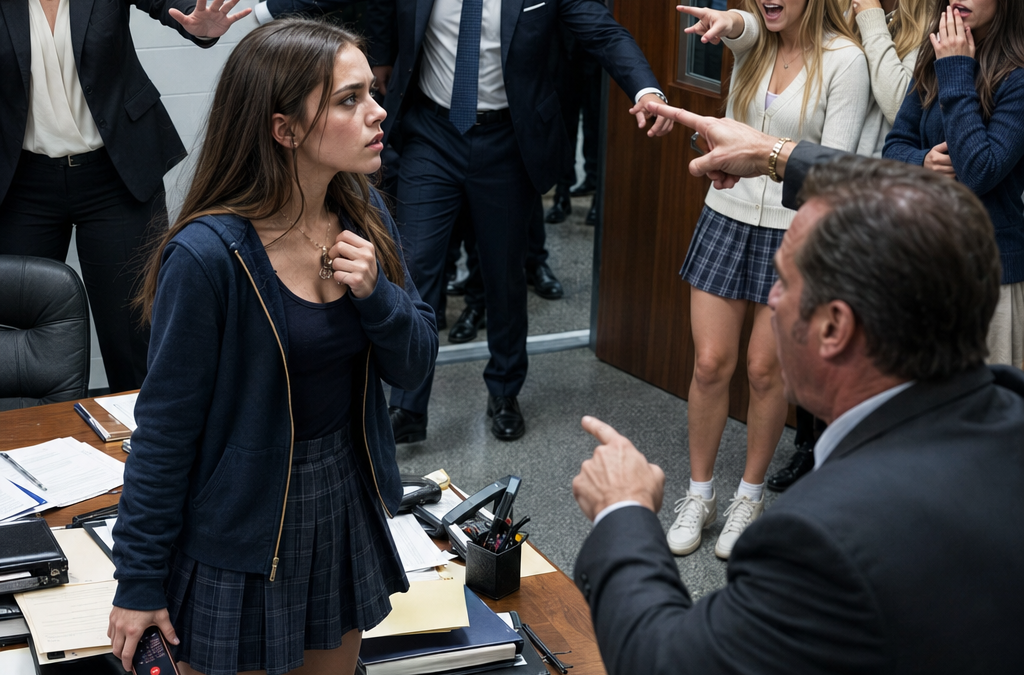
“You attacked her. Call your parents,” the vice principal ordered after a wealthy girl and her friends cornered me at school, tore at the pendant I’d worn since infancy, and somehow convinced every adult I was the problem. Then her father walked in, slapped me across the face, and warned, “I know judges, cops, and school board members. If I press charges, your future ends today.” I was seventeen, abandoned five days after birth, and I had spent my whole life hiding one impossible secret: I wasn’t alone. I had 108 fathers. So when I finally called Victor, everyone in that office thought they were about to meet one desperate guardian. They had no idea who was already coming.
Part 1
I was five days old when someone left me beneath a flickering streetlamp outside the Southside Syndicate’s headquarters in Ravenwood City. The story I grew up hearing was that 108 hardened criminals opened the door, stared at the screaming bundle on their doorstep, and argued about whether to call the police. Then I supposedly looked at them and whimpered, “Dad.”
Dad Victor always swore that was the exact moment their organization lost the ability to act normal.
By seventeen, I had 108 fathers, no mother, and one rule: never let school discover who raised me. I attended Ravenwood Central on scholarship. I kept my grades perfect, my head down, and my home life invisible. That worked until Madison Crowe decided I was entertaining.
Madison’s father owned mines, trucking companies, charities, and enough local influence that teachers smiled before he even entered a room. Madison collected weaknesses like trophies. Mine was obvious: cheap neighborhood, no visible parents, scholarship kid.
One rainy Thursday, she and three friends cornered me in the west restroom. The fluorescent lights buzzed while one girl lifted a phone to record. Madison hooked a finger under the silver pendant I had worn since infancy.
“Did your mother leave you fake jewelry before she dumped you?”
I grabbed her wrist. “Don’t touch that.”
Her smile vanished. Seconds later, cold water poured over my head. My backpack hit the floor. Madison shoved me into the sink and clawed at the chain while her friends laughed. I lunged for the phone. We slipped through the doorway, tangled together, and crashed near the third-floor railing.
When I woke in the nurse’s office, Madison was crying in the next room and Vice Principal Mercer was standing over me.
“You attacked her. Call your parents.”
Before I could answer, Madison’s father, Grant Crowe, walked in. He slapped me so hard I tasted blood.
No adult stopped him.
Grant leaned close enough that I smelled his expensive cologne. “I know judges, cops, and school board members. If I press charges, your future ends today.”
My phone felt impossibly heavy. I called Victor.
He answered immediately. “Avery? What happened, sweetheart?”
Then a gunshot cracked through the speaker.
Victor returned a second later, calm as ever. “Sorry. Dropped something.”
I stared at the adults waiting for me to summon the men they would never understand.
“No reason,” I whispered. “I won an award.”
I hung up.
Grant smiled because he thought I was alone. He offered me a deal: public confession, no police.
Madison added one condition.
“One hundred bows at Monday assembly,” she said. “On your knees.”
I agreed.
I thought humiliation was cheaper than exposing my family.
I had no idea one of my fathers was already on his way to Ravenwood Central.
Part 2
Monday morning smelled like wet grass, cheap perfume, and fear. I stood on the football-field stage holding a typed confession while nearly the entire school watched.
“I, Avery Quinn, admit that I attacked Madison Crowe out of jealousy…”
Every word felt filthy.
When I finished, Madison raised one manicured hand from the wheelchair she did not need. “Now bow.”
By thirty, my knees burned. By sixty, students were filming. By one hundred, blood had begun sliding from the scrape on my forehead.
Nobody stopped it.
After school, Madison and her friends cornered me behind the science wing. She was already walking perfectly.
“Say you’re trash,” she ordered.
One girl dumped water over my head. Another kicked my perfect math test into a muddy puddle.
I swallowed. “I’m trash.”
Madison smiled. “Good. And remember—my father can always ask the police to look into those strange men around your apartment.”
That frightened me more than anything she had done.
When they left, I crouched beside the puddle and lifted my ruined test. A shadow crossed the page.
Victor stood at the alley entrance.
Behind him were Elias, Marco, Henry, and two other men I had spent years begging never to come near my school.
Victor crouched and picked up the muddy paper. “Who did this?”
I tried to lie. Then Marco found my pendant chain snapped near the clasp.
I broke.
I told them everything—the restroom, Grant’s slap, the forced confession, the bows, the threats.
Victor listened without interrupting. Then he made one call.
“One hour. Ravenwood Central. Our daughter was bullied.”
The next morning, Madison grabbed my backpack at the front gate.
“If it isn’t my dog.”
I turned. “Let go.”
Her hand lifted to slap me. I caught her wrist.
Grant lunged from beside his SUV.
Then the sky thundered.
Helicopters crossed above the school. Black SUVs turned the corner. Reporters spilled onto the sidewalk. Men in dark suits stepped from the vehicles until the entire entrance seemed to belong to my family.
Victor walked straight toward Grant. “Take your hand off my daughter.”
Grant’s face changed when he saw Elias.
“No,” he whispered. “You’re dead.”
“Disappointing,” Elias replied.
Henry dropped a thick folder onto Grant’s hood. Bank transfers. School donations. Messages from Vice Principal Mercer promising to “make the scholarship girl break.” Payment records from parents who had paid to make disciplinary problems disappear.
Then Elias held up a phone.
“Cloud backups.”
Madison went white.
Her own recording showed her cornering me first.
Victor never touched Grant. He didn’t need to. Grant knelt after Elias quietly listed shell companies and hidden accounts.
Then Grant saw my broken pendant.
He stared at it like he had seen a ghost.
“Her mother—”
Victor’s expression hardened.
That unfinished sentence followed me home.
Three weeks later, I found a steel box in Victor’s apartment. Inside was my newborn hospital blanket, a photograph of a woman with my eyes, and a newspaper clipping.
INVESTIGATIVE REPORTER NORA QUINN MISSING.
My mother had a name.
And Grant Crowe had known it.
Part 3
Victor finally told me the truth.
My mother, Nora Quinn, had been an investigative reporter digging into Black Harbor Mining, the foundation of the Crowe family fortune. She suspected bribery, illegal shipments, corrupted judges, and police protection.
She had also known Victor.
“She trusted us more than the police,” he said.
Inside the steel box was the note she had left with me:
“Take care of her. They’re coming for me. Her name is Avery. Protect her from the Crowes.”
I read it until my hands stopped shaking.
Then Victor opened my pendant. Hidden inside was a tiny claim ticket.
BLACK HARBOR STATION — LOCKER 214.
The abandoned station smelled like rust, mold, and standing water. Victor, Elias, and I found the locker, then a concealed basement room beneath it. Under a loose floor slab sat a fireproof case containing reporter notebooks, cassette tapes, memory cards, photographs, and another note.
If Avery finds this, it means I ran out of time.
The next line named the person who had betrayed my mother.
Celeste Quinn.
Her older sister.
My aunt.
The tapes told the rest in fragments. My mother had traced Crowe money through judges, police officials, charity foundations, and mine accounts. Celeste had secretly given Gideon Crowe—Grant’s father—my mother’s route to a source meeting.
Years later, while I was in law school, Celeste emailed me.
Subject: Family.
“I think we should meet. I’m your aunt.”
I met her after graduation in a quiet downtown café. She looked like an older version of me, right down to the eyes.
“I loved your mother,” she began.
“That isn’t what her note says.”
Her fingers tightened around her tea. She admitted enough without meaning to. Gideon had known where Nora was going because Celeste told him. She claimed she only wanted to scare my mother into stopping.
Then I asked, “How much did he pay you?”
Her face answered first.
“You don’t understand. Nora always made me feel small. She thought truth mattered more than survival.”
“And you sold her route.”
“I was scared.”
“No. You were jealous.”
Her expression hardened.
Then came the sentence that ended any chance of forgiveness.
“You were the baby everybody decided to save.”
I stood.
Blood, I realized, was not family.
That same week, now working as an assistant district attorney in Ravenwood County, I helped obtain a search warrant for a sealed tunnel beneath Black Harbor’s oldest processing site.
Deep underground, investigators found ledgers, flash drives, sealed files, and one final cassette labeled with my mother’s name.
Her voice crackled through the headphones.
“If you grow up with the Southside men, you’ll probably be loved too fiercely. Take the love.”
Then she said the words I had needed my whole life.
“I did not leave you because I wanted less of you. I left you because there was no safe place left that wasn’t already bought.”
When the tape ended, I finally understood.
I had not been abandoned.
I had been delivered.
Part 4
The Black Harbor evidence shattered Ravenwood.
Gideon Crowe fled the state with cash and a false passport. Federal marshals found him six days later. Grant Crowe folded under questioning. Old judicial files reopened. Police officials hired lawyers. Vice Principal Mercer resigned before investigators could finish cataloging the school’s payment records.
Celeste was arrested at her townhouse.
Fourteen months later, the convictions came.
Racketeering. Bribery. Obstruction. Conspiracy. And, after investigators corroborated my mother’s tapes with financial records, witness statements, and evidence recovered beneath the mine, murder.
The city called it the biggest corruption case in decades.
To me, it was the first time my mother had been allowed to finish her story.
After sentencing, Celeste asked to see me.
County lockup smelled like bleach and stale air. She sat behind thick glass wearing a plain jumpsuit, suddenly smaller without pearls, silk, and polished excuses.
She picked up the phone.
“I was scared.”
“I know.”
“I never meant for Nora to die.”
“You told Gideon where she was going.”
“I thought he would pressure her. She never listened. She always thought she was better than us.”
There it was again.
Not remorse.
Resentment.
She pressed her palm against the glass. “Avery, I’m still your family.”
I remembered my mother’s final tape.
Family is who keeps the door open when it costs them. Family is who chooses you before they know what you’ll become.
I looked at Celeste and felt nothing I needed to rescue.
“No. You share my blood. That’s all.”
Her face crumpled.
“I’m sorry.”
“I believe you’re sorry about where your choices put you. That isn’t the same as being sorry for what they did to her.”
“Avery—”
“I won’t forgive you because guilt arrived after handcuffs.”
I hung up.
A week later, we placed a headstone for Nora Quinn on a hill above the Ravenwood River. There had never been a grave before.
Victor chose the inscription:
She told the truth when it was dangerous.
All 108 dads came.
Not in matching suits. Not in armored vehicles. Just coats, sweaters, coffee cups, badly wrapped flowers, and the ordinary chaos of the men who had raised me.
Henry brought too much food. Marco cried before anyone else. Elias pretended his eyes were watering because of the wind.
Victor stood beside me.
“You sound like her,” he said.
I touched the cold stone. “I’m glad she chose you.”
That was the truth.
My mother had not handed me to saints. She had handed me to dangerous men who kept their word when respectable men did not.
They had hidden knives before my school concerts. Learned to cook soup when I was sick. Filled graduation bleachers with flowers. And when I chose the law instead of their old world, they let me.
Years later, people still asked why I never tried to reconnect with Celeste after prison.
I always gave the same answer.
Late love is not love when it arrives only after the danger is over.
I had already spent my life with family.
One hundred and eight men had opened a door to a crying infant and never closed it again.
Ravenwood once called them criminals.
I called them Dad.
THE END!
Disclaimer: Our stories are inspired by real-life events but are carefully rewritten for entertainment. Any resemblance to actual people or situations is purely coincidental.








