My Mother Told Me My Father Died in Combat — Until the General Called Me by My Real Name
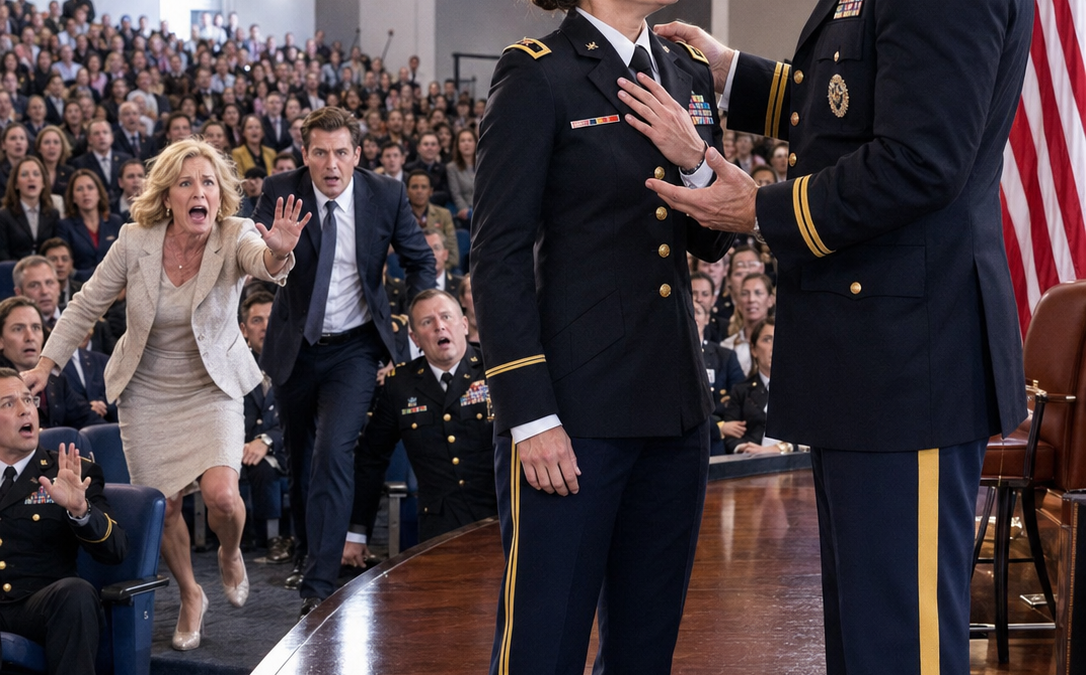
“You were not supposed to know that name,” my mother texted after Brigadier General Nathan Calder pinned on my new rank and called me “Major Whitaker” in front of a theater full of officers. I stood frozen beneath the bright stage lights, my hands trembling as Mom bolted from the back row with Warren behind her. For thirty-three years, she had told me my father died a hero in Iraq. Then General Calder looked me straight in the eyes and said, “Your father did not die in combat.” My mother thought she had buried Daniel Whitaker forever. Instead, one promotion ceremony had just ripped open the lie my entire identity was built on.
### Part 1
My name was Madison Vale for the first thirty-three years of my life, and for most of those years, I believed that name was the only thing my mother had left me from a childhood built out of grief, duty, and the kind of silence people call strength when they do not want to explain the truth.
I grew up outside Colorado Springs in a tidy beige house with trimmed hedges, vacuum lines in the carpet, and a framed photograph on the mantel of a young officer in dress uniform, his face serious, his shoulders squared, his eyes so much like mine that even as a little girl I used to climb onto the couch just to stare at him closer.
My mother, Evelyn Vale, told me my father had died in combat when I was still too young to remember him, and whenever I asked for details, she gave me the same answer in the same flat voice, like she was reading from a card she had memorized long ago.
“Your father died a hero, Madison. That is all you need to know.”
So I made that sentence the foundation of my life.
I imagined him brave, loyal, steady under pressure, the kind of man who would have come home if the world had not taken him first, and because I could not have him, I tried to become someone he would have recognized if he had lived.
My mother was not cruel when I was young, at least not in the obvious ways people talk about cruelty. She packed my lunches, signed permission slips, made sure the utilities stayed on, and kept every room in the house so clean it smelled faintly of lemon cleaner and laundry powder.
But she was never soft.
She did not linger in doorways to ask about my day, did not brush my hair while telling me stories, did not say she was proud unless I had done something so undeniable that silence would have looked strange.
When I brought home straight A’s, she said, “Good. Keep that up.”
When I won a scholarship, she said, “That will help with expenses.”
When I told her at seventeen that I wanted to join the Air Force, she stood at the sink with her hands in hot dishwater and did not turn around for almost a full minute.
Then she said, “Why would you choose the one life that took your father from me?”
I remember the sound of the water dripping from her fingers onto the stainless steel, slow and sharp, and I remember feeling guilty before I even knew what I had done wrong.
“I want to serve,” I said carefully. “I think he would have understood.”
Her shoulders tightened.
“You do not know what he would have understood.”
That was the first time I noticed that my father, who was supposed to be a sacred memory in our house, somehow made my mother angry whenever I reached for him.
Still, I left at eighteen.
I worked harder than anyone expected me to because I thought discipline could fill the empty spaces. I learned to sleep four hours and still function, to brief senior officers without my voice shaking, to lead airmen who were older than me, sharper than me, and waiting to see if I would crack.
By twenty-two, I was a second lieutenant.
My mother came to the commissioning ceremony, sat in the back row, clapped politely, and left before the reception because she said traffic would be bad if she waited too long.
By twenty-six, I was a captain.
She sent a card with a grocery store flower printed on the front and wrote, “Congratulations. Stay safe.”
By thirty, when I made major, I had already spent years becoming the responsible one in our family, the one who wired money when her furnace broke, co-signed when her car died, called insurance companies, argued with billing offices, and paid property taxes she somehow forgot every single year.
She never asked directly.
She just mentioned problems in passing, then waited for me to solve them.
“The roof is making that noise again.”
“The credit card bill got away from me this month.”
“Warren thinks the car repair is going to be more than we expected.”
Warren Ellison was the man she had lived with for nearly ten years, a quiet insurance adjuster with polished shoes, careful hands, and the kind of voice that made every warning sound reasonable.
He never called himself my stepfather, and I never gave him the courtesy of pretending he was.
He was simply there, sitting beside my mother at holiday dinners, watching me with mild concern whenever I asked too many questions about the past.
For a long time, I accepted the arrangement because I thought family meant endurance. My mother had raised me alone, so I owed her patience. She had carried grief, so I owed her gentleness. She had protected my father’s memory, so I owed her trust.
But trust has a sound when it starts to crack.
For me, it started with the absence of paperwork.
There was no folded flag. My mother said she had donated it because looking at it hurt too much.
There was no death certificate. She said she had packed it away somewhere and could not remember where.
There was no memorial program, no letter from a commander, no name engraved in any place I could find.
When I asked once in my twenties if I could see anything official, just something to know more about him, my mother looked at me across the kitchen table with a hardness that made me feel twelve years old again.
“Why do you need proof from me?” she asked. “Am I not enough?”
I dropped it because daughters like me were trained to drop things.
But the question did not disappear.
It waited.
### Part 2
The year before my promotion ceremony, I requested my father’s service record through official channels, telling myself it was harmless, telling myself I wanted something framed for my office, something real to put beside my own commendations so I could feel connected to the man whose death had supposedly shaped my entire life.
I filled out the forms carefully, using the name my mother had given me: Aaron Vale, age twenty-three, killed in Iraq in 2003.
The response came back with no match.
At first, I assumed I had made a mistake. I tried a different spelling, then a different birth year, then a different middle initial my mother had once mumbled and never repeated.
Still nothing.
The staff sergeant on the phone was patient, but by the end of the call, his voice carried the professional firmness of someone who had checked every possible field.
“Ma’am, I cannot find a casualty report for that name in 2003 or 2004. A standard combat death would be public record.”
“Could it have been classified?” I asked, hating how desperate I sounded.
“For a normal combat casualty? No, ma’am.”
I thanked him, hung up, and sat in my car outside the base library with both hands on the steering wheel, watching wind push dry leaves across the pavement.
For twenty minutes, I created excuses for my mother.
Maybe the military had misfiled him.
Maybe she had remembered the wrong year.
Maybe he had used another name.
Maybe grief had broken her memory in some permanent way.
But when I drove to her house that weekend and asked again, the excuses started to collapse.
She was standing in the laundry room folding towels with sharp, efficient movements when I said, “Mom, I tried to look up Dad’s casualty record.”
Her hands stopped.
“Why?”
The word was not curious. It was defensive.
“I just wanted to know more.”
“You know enough.”
“They cannot find him.”
She resumed folding, but now each towel slapped the counter a little too hard.
“Those databases are full of mistakes.”
“I checked more than one source.”
“Then stop checking.”
I stared at her, hearing the dryer thump behind us, warm air filling the room with the smell of cotton and heat.
“Why does this bother you so much?”
She looked at me then, and the expression on her face was not grief.
It was fear.
“Because digging up old wounds does not bring anyone back.”
That sentence should have ended the conversation, but something in me had shifted, and I could not unhear the tremor beneath her anger.
A month later, my security clearance update required a fresh copy of my birth certificate, and I mentioned it casually at dinner.
Warren lowered his fork.
My mother’s face went blank.
“It is just paperwork,” I said, looking between them. “Why are you both acting like I announced a crime?”
Warren dabbed his mouth with a napkin, the way he always did before saying something he thought sounded wise.
“Some paperwork complicates old pain, Madison.”
“It is my birth certificate.”
“Your mother has been through enough,” he said softly. “There is no need to open boxes that were closed for a reason.”
My mother nodded too quickly.
“That is right. Leave it alone.”
I ordered it online the next morning.
When it arrived, it looked official enough, but something about the paper bothered me. It was too crisp, too new, too clean for a document tied to the year I was born.
I called the county records office and asked how to tell if a birth certificate had been amended.
The woman on the line said amendments usually appeared as notations, depending on the state and the kind of change.
“What kind of changes?” I asked.
“Name changes, paternity updates, adoption updates, corrections to parent information,” she said.
Parent information.
I wrote those two words on a sticky note and stared at them until they stopped looking like words.
Around that same time, my promotion to major became official.
The ceremony would be held on a Friday afternoon in late September, inside the base theater, with my squadron, my commander, and anyone else who wanted to attend.
I called my mother because despite everything, some stupid hopeful part of me still wanted her there.
“I made the list,” I said. “The pinning ceremony is in six weeks.”
There was a pause long enough for me to hear the television murmuring in the background.
“That is nice, Madison.”
“It is a big deal, Mom.”
“I am sure you worked very hard.”
“Will you come?”
Another pause.
“I will try.”
“It is one day.”
“Do not push me.”
I looked down at the promotion email on my desk, the one that should have made me feel proud, and felt something inside me go cold.
For years, I had accepted scraps of affection and called them enough.
That day, I finally stopped pretending I was full.
“Fine,” I said. “Let me know.”
I hung up before she could answer.
I did not call again before the ceremony, and for the first time in my life, I told myself that if my mother chose not to show up, I would survive it.
What I did not know was that she would show up.
And so would the man who carried the truth into the room.
### Part 3
The base theater smelled like polished wood, coffee, and pressed uniforms on the afternoon of my promotion ceremony, and the room looked almost too bright beneath the white ceiling lights, with flags behind the podium and rows of chairs filling faster than I expected.
I had thought maybe thirty people would come.
Nearly fifty did.
There were airmen I had trained, senior NCOs who had watched me stumble through my first command briefings, fellow officers who had become friends after years of shared exhaustion, and my squadron commander, Lieutenant Colonel Miles Carver, standing near the stage with a folder under one arm.
My mother arrived twenty minutes early.
I saw her slip into the back row wearing a gray blazer and the same guarded expression she wore at funerals, though this was supposed to be a celebration.
Warren sat beside her, hands folded over his stomach, eyes moving around the room like he was checking exits.
I nodded toward them.
My mother nodded back.
No smile.
No wave.
No warmth.
Still, I told myself, she came.
Then the general walked in.
Brigadier General Nathan Calder entered ten minutes before the ceremony began, and the reaction in the room changed instantly. People straightened. Conversations dropped. My commander looked surprised enough that I knew this was not planned.
I had never met General Calder, though I knew his reputation.
He was based out of Peterson, respected across multiple commands, the kind of officer people described with words like measured, disciplined, and impossible to impress.
Lieutenant Colonel Carver introduced us near the side of the stage.
“Captain Vale, General Calder wanted to attend today.”
The general’s eyes rested on my face for one second longer than courtesy required.
“Congratulations, Captain,” he said. “I am pleased to be here.”
“Thank you, sir,” I replied. “I am honored.”
He nodded once, but something in his expression made my stomach tighten.
Recognition.
Not the casual kind.
The painful kind.
The ceremony began on time.
Lieutenant Colonel Carver spoke about leadership, responsibility, and what it meant to step into the field-grade ranks, and I stood at attention with my eyes fixed forward, trying not to think about my mother in the back row or the general in the front.
When the moment came for the pinning, Carver called me forward.
Then General Calder stood.
My commander hesitated, but only briefly, before stepping aside to allow him onto the stage.
It was unexpected, but not inappropriate. Senior officers sometimes participated in ceremonies when schedules aligned or when they wanted to honor someone.
I held still as he removed my captain’s rank and replaced it with the gold oak leaves of a major.
His hands were steady.
Mine were not.
He stepped back, looked me directly in the eyes, and extended his hand.
I shook it.
Then he said, clearly enough for the first three rows to hear, “Congratulations, Major Whitaker.”
The room went silent.
Not quiet.
Silent.
The kind of silence that lands all at once, like glass breaking without sound.
My legal name was Madison Vale.
It had always been Madison Vale.
Whitaker was not a name I used, not a name in my personnel file, not a name anyone in that theater should have connected to me.
But I knew it.
I knew it because once, when I was maybe seven, I had found the name Daniel Whitaker written on the back of my father’s framed photograph before my mother snatched it from my hands and told me never to touch things that did not belong to me.
My mouth went dry.
General Calder held my gaze for another beat and said, quieter but still audible, “Your father would be proud.”
I do not know how I stayed upright.
Training, maybe.
Shock, probably.
I managed to say, “Thank you, sir.”
The rest of the ceremony passed through me like a recording I had no control over. I saluted. I smiled. People congratulated me. Someone handed me a small card. Someone hugged me. My commander clapped me on the shoulder.
But all I could hear was one name.
Whitaker.
I looked toward the back row as soon as I could.
My mother was already standing.
Warren followed her out the side door with his hand at her elbow, and she did not look back once.
By the time I escaped the crowd, General Calder was near the rear of the theater speaking quietly with Lieutenant Colonel Carver.
I approached with my pulse hammering in my ears.
“Sir,” I said, “may I ask you something?”
He turned to me, and his expression changed from formal to regretful.
“Of course, Major.”
“Why did you call me Whitaker?”
He looked at me for a long moment.
“Because that is your name.”
“My legal name is Vale.”
“I am aware.”
I forced my voice to stay steady.
“How do you know that name?”
The general exhaled slowly.
“I served with your father, Colonel Daniel Whitaker. I was a captain when he was a lieutenant colonel. We deployed together years ago.”
“My mother told me he died in combat in 2003.”
General Calder’s face did not move, but his eyes hardened.
“Your father did not die in combat, Major.”
The room seemed to tilt.
“What?”
“He is alive,” he said quietly. “Retired now. Living in Virginia.”
I stared at him, waiting for the correction, the misunderstanding, the apology that would put my life back where it had been.
None came.
“I thought you knew,” he said. “When I saw your mother here, I assumed the situation had been resolved.”
“My mother left.”
“I am sorry.”
I could barely breathe.
Outside the theater, my phone buzzed.
A text from my mother lit up the screen.
You were not supposed to know that name.
Not I am sorry.
Not let me explain.
Just that.
### Part 4
I did not go to my mother’s house the next day, even though she sent three more messages telling me we needed to talk in person, because I knew that if I walked into her living room too soon, she would do what she had always done.
She would control the room.
She would decide which questions were allowed.
She would turn my pain into her suffering, my confusion into disrespect, and my need for answers into proof that I was ungrateful.
So instead, I requested a meeting through General Calder’s office.
I did not expect him to accept.
Men with stars on their shoulders did not usually clear time for newly promoted majors whose family secrets had detonated in public, but two days later, his aide called and said the general could see me at 0900 on Wednesday.
I drove to Peterson alone, rehearsing sentences like I was preparing for an inspection.
Be professional.
Be calm.
Do not cry.
Do not accuse.
Ask for facts.
His office was understated, almost plain, except for the flags, framed citations, and photographs from deployments that looked like pieces of history pinned behind glass.
He stood when I entered.
“Major Vale,” he said, then paused. “Or do you prefer Whitaker?”
“Vale is fine for now, sir.”
He gestured to a chair.
“I owe you an apology.”
“With respect, sir, I think you gave me something I needed.”
He sat across from me, hands folded on his desk.
“I can tell you what I know, but I will not pretend to know every private detail. Your father and I served together. Daniel Whitaker was one of the finest officers I ever knew. He retired a colonel after a long career, and we kept in loose contact through mutual friends.”
He paused.
“When your promotion list crossed my desk, your biographical details caught my attention. The age, birthplace, mother’s name. I reached out to him because I thought he would want to know what you had become.”
My throat tightened.
“And what did he say?”
The general looked toward the window for a moment.
“He said he had not seen you since you were an infant. He said your mother cut off contact, moved, changed information, blocked every attempt. He eventually stopped pushing because he believed fighting harder would make your childhood worse.”
“He just gave up?”
“I think,” General Calder said carefully, “he believed he was choosing your peace over his own.”
The sentence landed in my chest like a bruise.
“She told me he was dead.”
“I understand that now.”
“Did he know she told me that?”
“No.”
I looked down at my hands.
They were curled so tightly in my lap that my knuckles had gone pale.
“Can I contact him?”
“That is your decision.”
He wrote a phone number and email address on a notepad, tore off the page, and slid it across the desk.
Colonel Daniel Whitaker, USAF Retired.
For a moment, I could not touch it.
Then I folded the paper carefully and placed it inside my uniform pocket like it was something fragile and dangerous.
That evening, I drove to my mother’s house without calling.
Warren answered the door, and his face did something strange when he saw me, a quick collapse of annoyance into concern.
“Madison, your mother is not feeling well.”
“I am not here for her comfort.”
He stepped aside.
My mother sat on the couch with her arms folded, her posture rigid, her eyes red but dry.
“You lied to me,” I said.
“I protected you.”
“You told me my father was dead.”
“He was not part of your life.”
“Because you made sure he was not part of my life.”
Her jaw tightened.
“You have no idea what I went through.”
“Then tell me.”
She stood, and for the first time in my life, I saw panic under her anger.
“He was never home. He chose the Air Force over us again and again. I was alone with a baby, alone with bills, alone with fear, and every time he came back, everyone acted like his uniform made him noble while I was just supposed to wait.”
“That does not explain telling me he was dead.”
“It was easier.”
The room went still.
Even Warren looked at her.
“Easier for who?” I asked.
My mother looked away.
“For both of us.”
“No,” I said, feeling my voice shake. “It was easier for you. You erased him because you were angry. You changed my life because you were scared he might still matter.”
She snapped her eyes back to me.
“I raised you.”
“You also lied to me.”
“I fed you, housed you, worked double shifts, gave you stability.”
“You gave me a story built on a grave that never existed.”
Warren stepped forward.
“Madison, maybe lower your voice.”
I turned on him so fast he stopped moving.
“Do not speak to me like you have earned a place in this conversation.”
My mother’s face hardened.
“If you contact him, you will destroy what little family you have left.”
I stared at her, and all at once the old guilt appeared, familiar and heavy, trying to pull me back into obedience.
But this time, I saw it for what it was.
A leash.
“I do not have a family,” I said. “I have a mother who lied to me for thirty-three years and a father I was told to mourn before I was old enough to spell his name.”
She flinched.
For one second, I thought she might apologize.
Instead, she lifted her chin.
“If you walk out that door, do not expect me to be here when you come back.”
I looked at her for a long moment, waiting for the fear of losing her to stop me.
It did not.
I walked out.
### Part 5
The first person I told everything to was Major Natalie Cross, a logistics officer I had worked with on a readiness project the year before, because she had the rare ability to listen without rushing to soften the truth.
We met at a coffee shop off base at 0800, and she was already there when I arrived, two paper cups on the table, her expression serious before I even sat down.
“You look like you fought a war in your living room,” she said.
“In a way.”
Then I told her.
I told her about the ceremony, the general, the name, my mother’s text, the meeting at Peterson, and the confrontation that had ended with me walking out of the only home I had ever really known.
I said it all like a briefing, clean facts in chronological order, because if I let emotion into it, I was afraid I would fall apart in public.
Natalie listened without interrupting.
When I finished, she leaned back and said, “Madison, your mother did not just lie. She built your identity around that lie.”
“I feel like I am betraying her by wanting answers.”
“You are not betraying her,” she said. “You are refusing to keep betraying yourself.”
That sentence stayed with me.
Over the next three weeks, Natalie helped me think clearly while I took steps I should have taken years earlier.
I requested my sealed original birth record from the county where I was born. It required an affidavit, proof of identity, a fee, and more patience than I had, but eventually a thick envelope arrived in my mailbox on a Thursday evening after work.
I carried it inside, set it on my kitchen table, and stood there for a long time while the refrigerator hummed and the sun lowered behind the apartment blinds.
Then I opened it.
My original birth certificate listed my name as Madison Claire Whitaker.
Father: Daniel Robert Whitaker.
Mother: Evelyn Marie Porter.
Six months after my birth, my name had been amended to Madison Claire Vale, using the surname of a man my mother briefly married before I was old enough to form memories.
My father’s name had been removed from the version I was given.
Legal.
Official.
Devastating.
I sat at the table until the room went dark, staring at the document that proved I had been born into one life and raised inside another.
My mother had not just kept a painful story quiet.
She had rewritten me.
That night, I took out the folded paper General Calder had given me.
I typed an email to Daniel Whitaker five times and deleted it five times before finally sending the simplest version I could manage.
Colonel Whitaker,
My name is Madison Vale. I recently learned that you are my father. I was told my entire life that you died in combat in 2003. I do not know what happened between you and my mother, and I am not writing to accuse anyone, but I would like to understand the truth if you are willing to talk.
Madison
I hit send before courage could leave me.
Six hours later, while I was in the gym, my phone buzzed.
I opened the email standing beside a row of weights, sweat cooling on my neck.
Madison,
I have thought about you every day for thirty-three years. I did not know what you had been told, and I am so sorry that you carried grief for a father who was still alive and still loving you from a distance he did not know how to cross.
I tried to stay in your life when you were little. Your mother made that impossible, and eventually I stopped because I believed forcing a fight would hurt you more. That may have been the wrong choice. I have lived with that question for decades.
I do not expect anything from you. I am here if you want to talk. I have always been here.
Your father,
Daniel
I read the email once.
Then again.
Then a third time.
By the fourth time, my knees had weakened enough that I sat down on the gym floor with my back against the wall and cried into my hands where no one could see my face clearly.
I was not crying because everything was fixed.
Nothing was fixed.
I cried because somewhere in Virginia, there was a man who had not needed money from me, had not needed me to manage his life, had not needed me to earn my place beside him.
He had simply waited.
My mother, meanwhile, began texting every day.
Some messages were furious.
You have no idea what he put me through.
Some were wounded.
After everything I sacrificed, you choose him?
Some were practical, as if normal life could resume through errands.
The water heater is acting up again. Please call me.
I answered only once.
I need space. Do not contact me unless it is an emergency.
She replied within seconds.
You will regret treating your mother like this.
I deleted the message.
For the first time, I did not feel guilty enough to fix what she had broken.
### Part 6
Daniel and I began with emails because phone calls felt too intimate and the word Dad still sat in my throat like something I had not earned the right to say.
He answered every question carefully, never rushing, never insulting my mother even when the facts gave him every reason to.
He told me he and Evelyn had married young, too quickly, both convinced love could survive distance, deployments, resentment, and pride.
He had been overseas when I was born and had flown home as soon as he could. For a few months, he had held me, fed me, taken photographs, and believed there would be time to repair what was already breaking.
Then my mother left.
At first, she stayed in Maryland.
Then she moved to Colorado.
Then she changed her number, changed her name, and made contact so difficult that every attempt became a legal and emotional maze.
“I hired an attorney,” he wrote once. “Then your mother’s attorney claimed my pursuit was destabilizing you. I was warned that a drawn-out fight could turn your childhood into a battlefield. I convinced myself stepping back was the least selfish option.”
I stared at that sentence for a long time.
Part of me wanted to be angry at him for stepping back.
Part of me was.
But another part of me understood that my mother had created a trap where every choice hurt someone.
Three months after the promotion ceremony, I flew to Virginia to meet him.
We agreed on a quiet restaurant near his home, neutral ground, low pressure, no promises.
I arrived fifteen minutes early and still found him already seated at a corner table, hands wrapped around a water glass, his eyes on the door.
When he saw me, he stood.
He was taller than I expected, fit for a man in his late fifties, with graying hair and a careful military posture that made him seem both strong and nervous.
“Madison,” he said.
“Daniel,” I replied.
Calling him by his first name felt strange, but Dad felt impossible.
We shook hands first.
Then he hesitated, and I stepped forward because I knew if I did not, we would both regret it.
The hug was brief, awkward, and unbearably sad.
Over lunch, we talked for three hours.
He asked about my career, not politely, not vaguely, but with real attention. He knew what a command climate could do to a young officer. He knew why logistics mattered, why readiness reports looked boring until they became the difference between success and disaster, why making major young meant both achievement and pressure.
For the first time in my life, I spoke to a parent who understood the world I had chosen.
When I told him about my first deployment scare, he listened without flinching.
When I told him about briefings, promotions, the lonely parts of military life, he did not change the subject.
He said, “You built a remarkable career.”
I looked down at my napkin because praise from him felt like sunlight on a place that had been kept cold too long.
At the end of the meal, he walked me to my rental car.
“I would like to see you again,” he said. “But only if you want that.”
“I do.”
His face shifted, just slightly, like he was holding back more emotion than he wanted me to see.
This time, I hugged him first.
When I returned home, there was a voicemail from my mother waiting on my phone.
I almost deleted it.
Instead, I pressed play.
Her voice was quieter than I expected.
“Madison, I know you are angry. I know you think I am a terrible person. Maybe I am. But I did what I thought I had to do. I did not want you torn between two parents who could not stand each other. I did not want you waiting by windows for a man who was always gone. I wanted you stable. I wanted you safe.”
She paused, and I heard her breathe.
“I know I hurt you. I cannot undo it. But I am still your mother, and I love you.”
The message ended.
I sat on my couch in the dark with the phone in my hand, feeling thirty-three years press against me from every side.
I believed that she loved me.
That was the hardest part.
But love without honesty is not safety.
It is control wearing a softer face.
I did not call her back.
### Part 7
Six months after the ceremony, my life had divided into two versions of family.
There was Daniel, who called only when invited, answered questions without demanding emotional payment, and seemed grateful for even the smallest pieces of my life that I was willing to share.
Then there was my mother, who communicated through long texts, wounded silences, and Warren’s occasional messages about how poorly she was doing.
Your mother is devastated, he wrote one morning.
I typed back, She is facing consequences. That is not the same thing.
He did not respond.
Eventually, my mother contacted Daniel, accusing him of turning me against her, which would have been almost funny if it had not been so predictable.
Daniel called me that evening.
“I wanted you to hear it from me,” he said. “She reached out.”
“What did she say?”
“That I was taking you from her.”
I closed my eyes.
“What did you say?”
“That you reached out to me, and that I would not apologize for answering my daughter.”
The word daughter made my chest tighten.
“She wants to talk to you,” he added. “But you do not owe her anything before you are ready.”
It took me a week to decide.
Then I texted my mother.
I will meet you for one hour in a public place. If you guilt me, threaten me, or blame me for asking questions, I leave.
She answered immediately.
Tell me when and where.
We met at a coffee shop near the base, bright with morning light and crowded enough that neither of us could raise our voices without drawing attention.
My mother looked smaller when she walked in.
Older.
Not weaker, exactly, but diminished, as if the story she had controlled for decades had been the thing holding her upright.
She sat across from me and folded her hands on the table.
“Thank you for meeting me.”
“I am listening,” I said.
She looked down.
“When I left your father, I was scared. He was gone so much, and everyone admired him for it. No one asked what it felt like to be the woman at home with a baby, waiting, worrying, resenting him, then feeling guilty for resenting him.”
I said nothing.
“When he came back, he wanted to fix everything. I did not want it fixed. I wanted out. Then he wanted access to you, and I panicked. I thought he would take you. I thought his rank, his friends, his reputation would matter more than my fear.”
“So you erased him.”
Her eyes filled, but no tears fell.
“Yes.”
The honesty was so plain that it hurt worse than her excuses.
“You told me he died.”
“I thought death would be easier for you to understand than abandonment.”
“But he did not abandon me.”
“No,” she whispered.
“You made me believe he did.”
“Yes.”
I swallowed hard.
“Why did you not tell me when I got older?”
“Because by then, the lie was too big,” she said. “And I knew you would hate me.”
“I do not hate you.”
She looked up sharply, hopeful for half a second.
I did not let it save her.
“I am devastated by you. That is different.”
Her face crumpled, but this time I did not rush to comfort her.
For years, my pain had been rearranged to make room for hers.
Not anymore.
“What do you want from me?” she asked.
“I want you to stop calling your fear protection. I want you to stop using love as a reason to control me. I want you to accept that my relationship with Daniel is mine, not yours to permit or punish.”
She nodded slowly.
“I do not know how to be your mother without being afraid of losing you.”
“Then learn,” I said. “But do not make me responsible for teaching you.”
That conversation did not heal us.
It did something more useful.
It made the truth clear.
Over the next year, I kept my distance. I answered some of her messages, ignored others, and stopped sending money automatically whenever something went wrong at her house.
When her water heater failed, I texted her the number of a repair company instead of paying the bill.
When Warren hinted that she was struggling with expenses, I told him she needed a budget, not another emergency transfer from me.
It felt cruel the first few times.
Then it felt clean.
Meanwhile, Daniel and I built something real, not dramatic, not perfect, but steady.
A year after my promotion, I visited his house and saw the box of photographs he had kept in a closet for more than three decades.
There I was as a newborn, wrapped in a white blanket, resting against his chest while he smiled down at me like I was the whole world.
There I was in a tiny yellow outfit, fists raised, mouth open in a furious baby cry.
There was my mother too, younger and softer, standing beside him in a kitchen I did not remember, before fear became her religion.
Daniel stood beside me quietly.
“I did not know if I would ever get to show you these.”
I touched the edge of one photograph.
“She took this from both of us.”
“Yes,” he said. “She did.”
He did not tell me to forgive her.
He did not tell me bitterness would hurt me more than her.
He simply stood with me in the truth.
And that was the first time I called him Dad.
### Part 8
Three years after the promotion ceremony, I stood in a briefing room at the Pentagon as a lieutenant colonel, presenting readiness assessments to senior leaders whose faces revealed nothing unless you knew exactly where to look.
By then, I had legally changed my name back to Madison Whitaker.
It took paperwork, court filings, fingerprints, certified copies, and a patience I did not feel, but the day the final order arrived, I sat alone in my office and looked at the name I had been born with until the letters stopped shaking in my hands.
I was not changing my name because my mother had no place in my life.
I was changing it because she no longer owned the story of who I was.
After the briefing, a brigadier general I barely knew shook my hand and said, “Excellent work, Colonel Whitaker.”
I did not correct him.
My father stood near the back of the room, retired but invited because of advisory work he had done years before. When our eyes met, he smiled like he was trying not to make the moment too big.
Outside afterward, he hugged me in the hallway.
“You were outstanding.”
“I had a good teacher.”
“No,” he said, pulling back to look at me. “You built that yourself.”
I believed him.
Not completely, not effortlessly, but more than I would have years earlier.
My mother and I remained civil but distant. She came to one change-of-command ceremony and stayed through the reception, though she stood near the back and left before dinner.
She sent birthday cards.
I sent holiday texts.
Sometimes we spoke on the phone about weather, house repairs, and neighborhood gossip, never staying too long in the deeper waters where the truth still waited.
She never fully apologized in the way I once thought I needed.
She admitted what she had done, but she could not seem to hold the full weight of it without reaching for excuses.
I stopped asking her to.
Some people cannot give you closure because closure would require them to stand still inside the damage they caused.
So I built my own.
Ten years after that ceremony, I was forty-three, a full colonel at Joint Base Andrews, married to a patient, steady man named David Mercer, and mother to an eighteen-month-old daughter named Grace, who had Daniel’s eyes and my stubborn little chin.
My father visited once a month, always bringing books, soft toys, or some small wooden puzzle he had found at a local shop.
He never arrived empty-handed, and he never came without asking first.
My mother had met Grace twice.
Both visits were polite, brief, and strained, the way some rooms remain cold no matter how high you turn the heat.
I wished it were different.
I also accepted that wishing did not make people safer.
That year, my wing commander asked me to consider applying for brigadier general.
The offer should have felt like the final proof of everything I had worked for, but instead I stood in my office after he left, looking out at the flight line, and felt strangely quiet.
For twenty-one years, I had served with everything I had.
The Air Force had given me purpose, discipline, identity, and eventually, in the strangest and most painful way, it had given me back my father.
But it had also taken time.
Birthdays.
Sleep.
Relationships.
Ordinary evenings that seemed small until they were gone.
I called my father that night.
“Hey, sweetheart,” he said.
“Hey, Dad.”
The word no longer hurt.
It fit now.
“Can I ask you something?”
“Always.”
“Do you regret the career?”
He was quiet for a moment.
“I regret missing you,” he said. “I do not regret serving. But if I had known what it would cost, I might have made different choices.”
“I am being considered for star rank.”
“I heard.”
I laughed softly.
“Of course you did.”
“You would be an excellent general.”
“That is not what I asked.”
“No,” he said gently. “It is not.”
I watched the last light spread across the tarmac.
“What do you think I should do?”
“I think you should decide what you want your life to look like in ten years, then work backward from there.”
In ten years, Grace would be eleven.
David would have spent another decade sharing me with a career that never stopped asking for more.
My father would be older.
My mother, if still alive, would be older too, though age had never softened her the way people promised it might.
And I would either be chasing another rank or building a life that no longer needed constant proof of worth.
“I think I might be done,” I said.
“Then be done.”
“It feels like quitting.”
“It is choosing,” he said. “That is different.”
The next morning, I wrote the email.
I thanked my commander for his confidence. I told him I would not pursue promotion to general officer and would begin planning for retirement when the timing made sense for my family and my team.
My hands trembled before I sent it.
Then I looked across the kitchen, where David was feeding Grace pieces of banana while she laughed like the world had never lied to anyone, and I pressed send.
That evening, I drove home under a pale Colorado sky and thought about the girl I had been at seventeen, chasing the ghost of a father she had been told was dead.
I thought about the woman I had been at thirty-three, standing on a stage while a general called her by the name her mother had buried.
And I thought about who I was now.
Madison Whitaker.
Daughter.
Officer.
Wife.
Mother.
Not a secret.
Not an amendment.
Not the edited version of someone else’s fear.
My mother had tried to protect herself by controlling the truth, but truth does not stay buried because someone finds burial convenient.
It waits.
It gathers weight.
And when it rises, it does not ask whether you are ready.
I lost the mother I thought I had, and I gained the father I had been taught to mourn.
I did not forgive everything.
I did not pretend the lost years were harmless.
But I stopped letting those years define the rest of my life.
A name can be stolen.
A past can be hidden.
A child can be raised inside a lie.
But identity, the real kind, has a way of finding its way back through locked doors, sealed records, and thirty-three years of silence.
Mine found me in a theater full of uniforms, in one sentence spoken by a man who did not know he was handing me my life back.
And once I had it, I never let it go.
THE END!
Disclaimer: Our stories are inspired by real-life events but are carefully rewritten for entertainment. Any resemblance to actual people or situations is purely coincidental.








