He Told Me He’d Loved Someone Else the Whole Time—So I Said “Okay” and Left. Six Months Later, She Was Engaged to Someone Else, and He Showed Up at My Door Expecting Me to Become His “Home” Again…
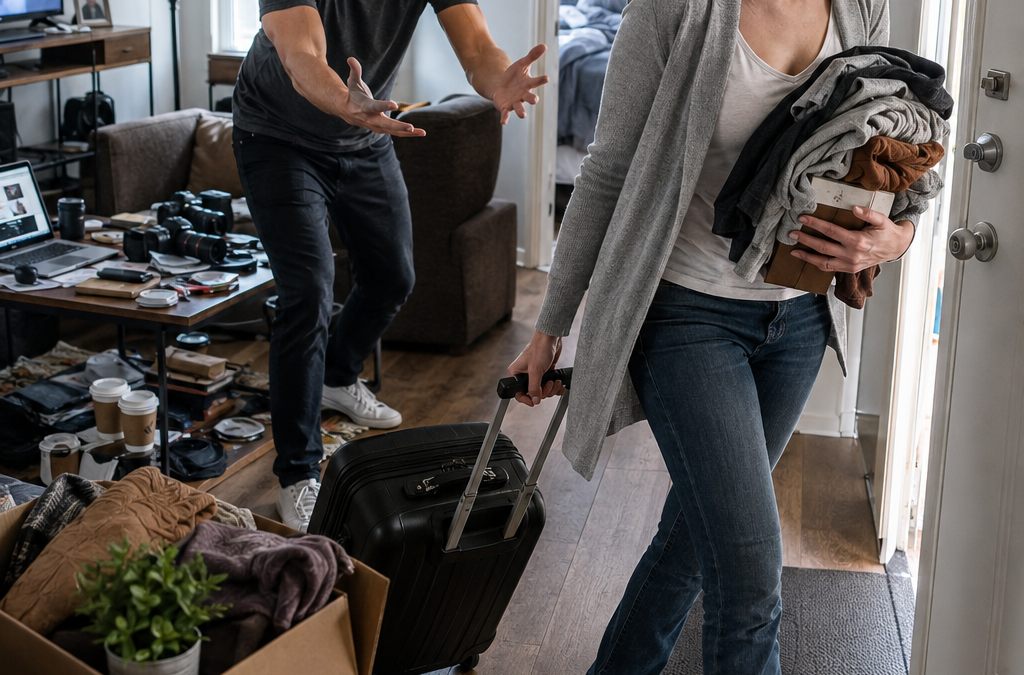
“I’ve been in love with someone else this whole time,” Evan told me after four years of letting me pay more rent, build his photography website, chase his invoices, and keep our life running while he secretly obsessed over Serena. He stood beneath the flickering television light waiting for me to cry, beg, or fight for him. I just said, “Okay,” walked into the bedroom, and started packing. That almost offended him more than the breakup. “You’re not even going to fight for us?” he demanded. I looked at the man who had lied to me, then blamed me for noticing. “You already chose.” Months later, when Serena abandoned him for someone else, Evan came pounding on my door begging for his “anchor” back.
Part 1
My name is Claire Bennett, and for four years I believed loving someone meant making room for the life they were trying to build.
Evan Cole was a freelance photographer when I met him at a crowded coffee shop downtown. He had a camera over one shoulder and the kind of grin that made bad decisions look charming. I worked in operations for a logistics company, which meant spreadsheets, deadlines, and fixing problems before anyone noticed them. He called me “the practical one.” At first, it sounded like affection.
When we moved in together, I paid more of the rent because my salary was steady. I built his portfolio website, reminded him about invoices, drove forgotten camera batteries across town, and learned where to buy groceries cheaply because Evan was always “between payments.” He called me his anchor. I thought that meant I mattered.
Then I met Serena Blake.
It happened at a gallery opening smelling of white wine, old brick, and perfume. Serena wore black from head to toe and spoke about photography like she had invented light itself. When Evan introduced us, she barely looked at me before turning back to him. “I loved what you said about negative space,” she told him. His whole face changed.
Soon Serena’s name entered our apartment more often than mine. “Serena thinks real artists should take bigger risks.” “Serena knows a curator in Los Angeles.” Our nightly conversations disappeared. Evan started leaving his phone facedown. He changed his passcode and carried it into the bathroom. If I asked where he had been, I got one-word answers: “Working.” “Networking.” “Busy.” But if Serena came up, suddenly he had stories.
One rainy night, I found him barefoot on our balcony at two in the morning, smiling at his phone. “Who are you talking to?” I asked. His expression shut instantly. “Nobody.” Then he brushed past me. “Don’t start, Claire.”
A week later, I cooked his favorite dinner and finally said, “I feel like you’re leaving me while still living here.” Evan sighed like I had interrupted something important. “You overthink everything.” I asked if he still wanted our relationship. He snapped, “My work is finally moving. Not everything is about us.”
The next morning, I saw a public photo from an after-party. Evan had told me he was home editing. Instead, he was beside Serena, laughing, one hand low on her back. When I showed him, he didn’t apologize. “You’re stalking me now?” “You lied.” He gave me a tired look. “You make everything ugly, Claire.”
That was when I stopped arguing.
Two weeks later, he came home unusually quiet. He stood beneath the flickering television light and looked at me with something almost like regret. Then he said, “I’ve been in love with someone else this whole time.”
For several seconds, I heard only the dishwasher humming behind him. He waited for tears.
I simply said, “Okay.”
### Part 2
Evan blinked. “Okay?”
I stood, walked into the bedroom, pulled two cardboard boxes from the closet, and started packing. He followed me while I folded sweaters, rolled socks, and wrapped the framed photo from my nightstand in a T-shirt. “You’re actually leaving?” There was genuine offense in his voice.
That was when I understood what he had expected: tears, bargaining, maybe a dramatic fight that would let him feel important enough to destroy me. Instead, I carried my first box toward the door. “You’re not even going to fight for us?” he demanded. I looked at him. “You already chose.”
That night I slept on my friend Naomi’s couch under a blanket that smelled like lavender detergent. Three days later, when I repeated Evan’s exact words, Naomi shook her head. “He’s rewriting history to make his betrayal sound romantic.”
A month later, I rented a tiny third-floor studio with a clanking radiator and a kitchen barely wider than my arms. It was quiet enough to hurt at first. I cried in a grocery aisle when I saw the expensive granola Evan always insisted on buying. But little by little, quiet stopped feeling empty.
I ran before work. I reconnected with friends. I fixed a loose cabinet hinge myself and laughed when it held. I started sleeping without waiting for a key in the lock.
Six months passed. Then Naomi asked me to meet her for drinks. Halfway through the evening, she lowered her voice. “I heard something about Serena.” My stomach tightened. “She’s engaged.” I looked at her. “To Evan?” Naomi shook her head. “Someone else. A photographer she met in L.A.”
The irony should have felt satisfying. It didn’t. What I felt was clarity. Evan had not thrown away our life because he found some once-in-a-lifetime love. He had chased a fantasy that reflected back the version of himself he wanted to see.
A week later, his first text arrived: Hope you’re doing well.
I ignored it.
Then: Been thinking about you.
Then: I miss our talks.
Then the calls started. One voicemail caught me while I was chopping garlic for dinner. “Claire, I know I hurt you. Serena wasn’t who I thought she was. I can’t stop thinking about us. Please let me explain.”
I stood at the counter and heard the sentence clearly: Serena wasn’t who I thought she was. Even his apology began with what happened to him.
His mother texted next, begging me to talk to him because he was “falling apart.” Then one of his friends called, asking me to give Evan “closure.” Apparently my pain had been survivable, but his discomfort had become a community emergency.
I blocked his mother, silenced Evan’s number, and refused every messenger he sent.
For several peaceful days, my apartment belonged only to me again.
Then late on a Friday night, someone pounded on my door.
Three hard knocks.
I looked through the peephole.
Evan was standing in the hallway.
### Part 3
He looked thinner than I remembered. His hair was uncombed, his eyes red, his jacket damp from rain. I left the chain latched and opened the door only a few inches.
“What are you doing here?”
“I had to see you.”
“No. You wanted to see me. Why?”
He stared at the floor. “Everything’s falling apart.”
There it was. Not I hurt you. Not I owe you an apology. His life was burning, and he remembered where the fire extinguisher used to live.
“Serena used me,” he said. “She made me feel like I mattered, then dropped me the second somebody better came along.”
I folded my arms. “That sounds familiar.”
He flinched. “I know I was selfish. I know I destroyed what we had.”
“What exactly do you think we had?”
“We were real, Claire. You understood me. You kept me grounded. You believed in me.”
Grounded. Anchor. Home. He had always loved nouns that described what I did for him. Never who I was.
Then he said, “I need you.”
I looked behind me at my apartment. My book sat open on the couch. A mug of tea cooled beside it. My running shoes were by the radiator. My life was small, ordinary, and mine.
“No.”
He stared. “No?”
“You don’t need me. You need the woman who made excuses for you.”
His eyes filled. “Claire, please. I have nothing left.”
That sentence finished the puzzle. His pain was still about entitlement. He believed losing everything should buy him access to me.
“You chose Serena,” I said. “You chose lying. You chose making me feel crazy for noticing. Those choices don’t disappear because they eventually hurt you.”
“I said I’m sorry.”
“I believe you’re sorry you lost what I gave you. That’s not the same thing as being sorry for what you did to me.”
For the first time, Evan had no clever answer.
I closed the door.
The lock clicked softly.
The next morning, I blocked his number, his email, and every person who tried carrying his messages into my life. A week later, an envelope appeared in my mailbox with Evan’s handwriting across the front. The old Claire would have opened it and searched every sentence for meaning.
I dropped it into the trash unopened.
That was when I knew I had really changed. Not because I hated him. Because I no longer needed anything from him.
Spring arrived slowly. I started drawing again, something I had abandoned years earlier after Evan once joked that I “wasn’t really creative.” I bought a secondhand desk and placed it beside the window. On Thursday nights, I joined a sketch class above a neighborhood bookstore.
The room smelled like paper, pencil shavings, and old wood. My first drawings were simple: a chipped mug, the radiator, my hand holding a key.
One night, our instructor stopped behind me. “There’s a local showcase next month,” she said. “You should submit something.”
My first instinct was to refuse.
Instead, I looked at the graphite on my fingers and said, “Okay.”
### Part 4
The showcase was held on a Friday night beneath strings of warm white lights. I submitted three charcoal drawings: a chipped mug, my apartment window at dawn, and a pair of hands locking a deadbolt.
I almost left the last one at home because it felt too personal, but my instructor studied it and said, “That one knows something.” So I framed it.
Naomi arrived carrying tulips wrapped in brown paper. My brother came. Even my manager stopped by after work. People stood in front of my drawings and actually looked—not at Evan’s version of me, not at the reliable girlfriend who paid bills and made herself smaller around somebody else’s ambition, but at something I had made.
A woman in a camel coat paused in front of the deadbolt drawing. “This feels like a decision,” she said.
“It was.”
Later, the bookstore owner invited me to join a monthly art group. “You have a clear eye,” he told me.
A clear eye.
For years, Evan had trained me to distrust mine.
Near the end of the night, I stood alone in front of the deadbolt drawing. On the title card beneath it, I had written one word: Okay.
Evan had heard that word as shock. Maybe surrender. He never understood it was the first boundary I had ever given him without apology.
On my walk home, my phone buzzed. Unknown number. One voicemail. My body remembered fear before my mind caught up. I stood under a streetlamp with the tulips against my coat and stared at the screen.
Then I deleted the voicemail without listening.
Upstairs, I put the flowers in a glass jar. Months earlier, when Evan first began calling again, I had quietly documented everything: screenshots, dates of calls, saved voicemails, and a written note about the night he appeared at my apartment. I told my landlord not to let him into the building, changed my emergency contact at work, and asked mutual friends not to share my address or schedule.
I did not do it to punish him. I did it because peace deserves protection.
Evan never got another conversation. His mother eventually stopped contacting me. His friends moved on. The messages ended.
Months later, I saw him outside a pharmacy. He recognized me instantly and took one step forward.
I kept walking.
No speech. No anger. No final scene. Just distance.
That evening, I sat at my secondhand desk and drew the view from my window while traffic moved below in thin ribbons of light.
I never forgave Evan.
People sometimes act as if forgiveness is the only respectable ending. I disagree. I did not need to hate him, and I did not need to rescue him from the consequences of what he chose.
I simply stopped carrying him.
Maybe I will fall in love again. Maybe I won’t. Either way, my life is no longer a waiting room for someone else’s regret.
I watered the basil plant beside my window, turned off the lamp, and looked once at the deadbolt catching a thin line of city light.
He thought “okay” meant I had lost.
It was the first word of the life I finally chose for myself.
THE END!
Disclaimer: Our stories are inspired by real-life events but are carefully rewritten for entertainment. Any resemblance to actual people or situations is purely coincidental.








