I Came to My Husband’s Office With Our Daughter and His Migraine Meds, But His Receptionist S…
I Came to My Husband’s Office With Our Daughter and His Migraine Meds, But His Receptionist S…
For six years, I believed my husband’s long nights at the office were the price of ambition. Then I arrived at his firm holding our five-year-old daughter’s hand, carrying his migraine medicine and homemade soup, and a nervous receptionist refused to let me upstairs because he was with a “personal guest.” That single sentence led me to an old girlfriend, a secret $1.5 million life insurance policy, a suspicious $15 million contract, federal investigators, and a betrayal that reached far beyond our marriage. But the most painful truth wasn’t what my husband had done behind closed doors. It was how long I had been ignoring the signs.
Part 1: A receptionist’s warning exposes the secret my husband hid upstairs.
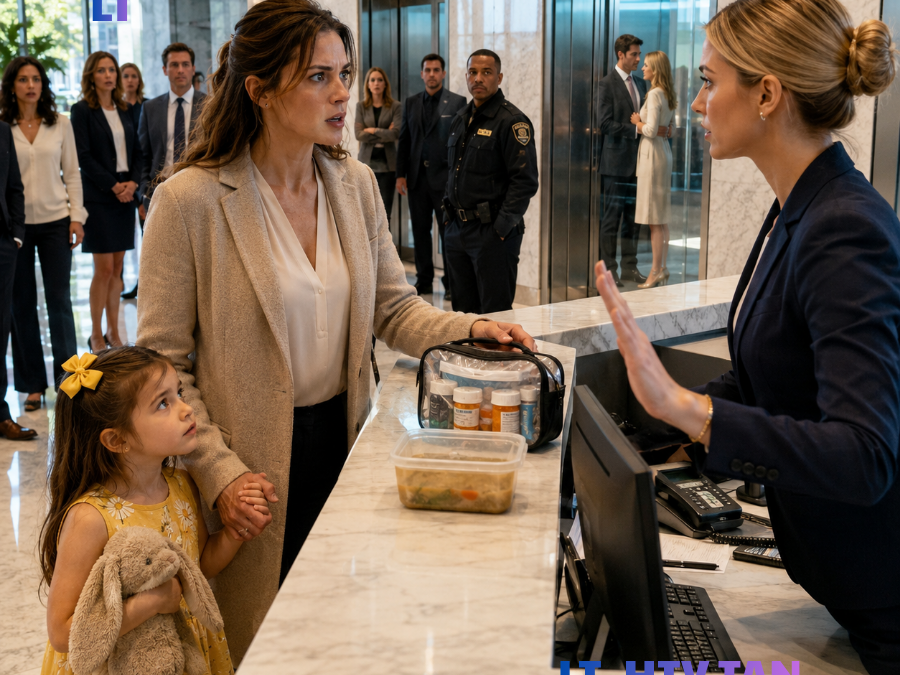
I had Maeve’s hand in mine and a migraine kit in the other when the receptionist stopped me at the elevator bank of Voss and Associates.
I’d been to that office a hundred times in six years. My husband worked late there. Missed dinners there. Missed Maeve’s first steps because he was trapped in a meeting on the fourteenth floor.
That afternoon, Declan had texted that his head was splitting. He’d forgotten his prescription, so I packed his sumatriptan and a container of lemon chicken soup.
Maeve had insisted on coming.
She wore her yellow dress with embroidered daisies and carried her stuffed rabbit against her chest.
“Daddy’s going to be so surprised,” she’d said.
The receptionist was young. New. When I introduced myself, something crossed her face.
Not rudeness.
Discomfort.
“I’m Margot Voss. I’m just dropping off my husband’s medication.”
She picked up the phone, spoke quietly, listened, then put it down.
“Mrs. Voss, Mr. Voss has asked not to be disturbed this afternoon.”
I almost smiled.
“He has a migraine. I’m his wife.”
Her jaw tightened.
“He has a guest.”
I waited.
“A personal guest,” she added. “He was very specific.”
The lobby was kept at sixty-eight degrees because Declan complained about it constantly.
Yet suddenly my hands felt colder than the marble floor.
I looked at Maeve.
She was staring at me with those enormous dark eyes children get when they know something is wrong but don’t have the words for it.
I knelt.
“Baby, Mama needs to make one quick call.”
I gently covered her ears with both hands.
Then I called my oldest brother, Graham.
He answered immediately.
“Hey, you.”
“Graham.”
Something in my voice changed his.
“I’m at Voss and Associates. I came to bring Declan his migraine medication. The receptionist says he has a personal guest and specifically told them not to let anyone upstairs.”
Silence.
Graham Caldwell was fifty-one and ran a two-billion-dollar investment firm. He hadn’t raised his voice in a business meeting in fifteen years.
The quieter he became, the more people listened.
“Who’s with him?” he asked.
“I don’t know yet.”
“Are you okay?”
I looked at Maeve.
“I will be.”
I left the soup on the receptionist’s desk.
“Please tell Mr. Voss his wife came by.”
Then Maeve and I walked outside.
In the car, I buckled her into her seat.
“Mommy?”
“Yes?”
“Is Daddy coming home for dinner?”
My fingers tightened around the steering wheel.
“Mommy will make your favorite tonight. Mac and cheese with breadcrumbs.”
She stopped asking about Daddy.
I called Declan once.
No answer.
Then I called my brother Forrest, a former federal prosecutor.
“Portia Langham,” I said.
He went quiet.
“She dated Declan in college. She came back to the city about four months ago after years in London and Singapore. I need everything.”
“How soon?”
“As soon as you can.”
“Give me twenty-four hours.”
I had heard Portia’s name only three times in six years.
Once from Declan’s mother, almost wistfully.
Once from an old friend who’d had too much wine and said, “We all thought it would be Portia.”
And once at three in the morning when Declan whispered her name in his sleep.
That night, after Maeve was asleep, I entered Declan’s home office.
Bottom drawer.
Manila envelope.
Unsealed.
Inside was a life insurance policy.
Policyholder: Declan Voss.
Beneficiary: Portia Langham.
Relationship: Friend.
Coverage amount: $1.5 million.
I read the document three times.
Then one date stopped my breathing.
The policy had been issued six months earlier.
Portia had supposedly returned to the city only four months ago.
Which meant whatever was happening between them hadn’t started when she came back.
It had started before.
Part 2: A secret contract reveals betrayal far bigger than an affair.
I photographed every page.
Then I called my sister Cordelia, a corporate attorney feared by men who usually feared nothing.
“I need every dollar Caldwell Capital has connected to Voss and Associates. Contracts. Credit lines. Partnerships. Everything.”
Silence.
“Margot, what happened?”
“I’ll explain tomorrow.”
She knew better than to push.
“I’ll have a preliminary list by morning.”
Forrest’s report arrived the following afternoon.
Twelve pages.
Portia had worked overseas for Meridian Group, a financial consulting company with offices in seven countries.
Then I reached page nine.
Six months earlier, Voss and Associates had awarded a Meridian subsidiary a $15 million vendor contract.
No competitive bidding.
One managing partner had approved it.
Declan.
I called Forrest.
“The Meridian contract.”
“It may be worse than you think,” he said. “The subsidiary was formed shortly before Portia returned. There are financial flows that shouldn’t exist.”
“What kind?”
“The kind regulators notice. There may also be client-data exposure.”
My kitchen seemed suddenly too quiet.
“Is this big enough for outside investigators?”
“I’ve already made preliminary calls.”
“Give me until tomorrow.”
Declan came home at nine that night carrying his briefcase and an expression I had never noticed before because I’d never known to look for it.
Guilt.
“Hey,” he said. “Sorry. Big day.”
“I came to your office.”
His face changed.
“I brought your medication. And your soup.”
“Margot—”
“The receptionist said you had a personal guest.”
He shoved his hands into his pockets.
“I can explain.”
“Good. How many times have you seen Portia since she came back?”
He froze.
“How many times, Declan?”
“She’s connected to a client relationship. It’s professional.”
“The Meridian contract?”
He stared at me.
“Yes,” I said. “I know.”
I stood.
“The guest room is ready.”
“Margot, listen to me.”
“I have listened for six years. I listened when your mother mentioned Portia at our rehearsal dinner. I listened when your friend said everyone thought you’d marry her. I even listened while you said her name in your sleep.”
His face drained.
“I kept telling myself I was irrational.”
He said nothing.
That silence answered more than words ever could.
By sunrise, I made three calls.
Graham first.
He listened to everything.
Then said, “Caldwell Capital holds nine percent of Voss and Associates’ operating fund. I’ll freeze our position and request a full audit of the Meridian approval.”
“That could destroy their expansion.”
“I know.”
“So do I.”
Forrest was second.
“Make the calls,” I told him.
Cordelia was third.
“Find me the best divorce attorney in the city.”
Two days later, Cordelia called.
“Her name is Rebecca Slater. Twenty-two years practicing family law.”
Then her voice changed.
“And Margot?”
“Yes?”
“Forrest’s people found where Meridian was sending the client data.”
I gripped the phone.
“Where?”
“To a competing investment firm overseas.”
And suddenly, my husband’s secret meeting wasn’t merely threatening our marriage.
It might destroy everything he had spent sixteen years building.
Part 3: Federal scrutiny grows as my daughter quietly reveals the damage.
The Meridian subsidiary had been given access to confidential client information because Declan approved the contract.
Whether he understood what Portia intended to do with that access was still unknown.
“He probably didn’t,” Cordelia told me.
“He trusted her,” I said.
“Yes.”
That was almost worse.
He had allowed a woman from his past into his marriage, then into his firm, then through the door of a $15 million contract because some part of him still saw the woman he’d loved twenty years ago.
And he hadn’t asked enough questions.
But the investigation wasn’t what kept me awake.
Maeve did.
That evening, she sat at the kitchen table with her crayons.
Later, after she’d gone to sleep, I found a folded drawing on my pillow.
Three figures.
One tall.
One medium.
One small.
Underneath, in her kindergarten handwriting:
MAMA.
MAEVE.
DOG.
I stared at it.
We didn’t have a dog.
Daddy wasn’t in the picture.
I folded it carefully and put it inside my nightstand.
The following Thursday was the annual Voss and Associates gala at the Whitmore Hotel.
Three hundred guests.
Black tie.
Silent auction.
Speeches about record profits and expansion.
I had attended every gala for six years.
I almost stayed home.
Instead, I opened my closet and found the midnight-blue silk gown Cordelia had given me after Maeve was born.
She’d said, “Wear this when you need to remember who you are.”
That night, I finally understood what she meant.
When I entered the ballroom, Declan was speaking to several board members.
He saw me.
Surprise.
Relief.
Fear.
Then the careful smile of a man hoping the floor beneath him was still solid.
I smiled back.
Dinner passed.
Champagne moved through the room.
Then Declan stepped behind the podium.
“This has been a transformative year for Voss and Associates,” he began.
He was good at speeches.
Always had been.
“We have expanded into three markets and developed what may become the most important strategic partnership in our history.”
Then he looked toward the right side of the ballroom.
My stomach hardened.
“Much of that success is due to an exceptional consultant who returned after nearly a decade abroad.”
I already knew the name before he said it.
“Portia Langham.”
Applause filled the ballroom.
And across the room, I finally saw her.
Elegant.
Composed.
Smiling at my husband like the last twenty years had been nothing more than an interruption.
I stood.
The applause slowly faded as I stepped into the center aisle.
Declan saw me walking toward the stage.
And for the first time that evening, his practiced smile disappeared.
Part 4: I expose the contract, the affair, and our marriage publicly.
My heels made small, steady sounds against the parquet floor.
People turned.
Whispers followed me.
I climbed the steps and approached the podium.
Declan leaned toward me.
“Margot. Don’t.”
That was the wrong thing to say.
I faced the microphone.
“Excuse me.”
Three hundred people became silent.
“My name is Margot Voss. I’m Declan’s wife.”
I looked across the ballroom.
“My husband just asked you to applaud someone. Before you do, I think you deserve to know a little more.”
Declan gripped the podium.
“Six months ago, Declan signed a $15 million vendor contract with a subsidiary of Meridian Group. Portia Langham is Meridian’s point of contact.”
Faces changed.
“The contract bypassed the standard competitive bidding process.”
Someone near the board’s table lowered his champagne glass.
“Two days ago, federal investigators began examining allegations that Meridian used access obtained through that contract to transfer confidential client investment data to an overseas competitor.”
The room erupted.
I waited.
Then continued.
“There’s something else.”
I turned toward Declan.
“Four days ago, I came to this firm with our five-year-old daughter. Declan had a migraine. I brought his prescription and homemade soup.”
No one moved.
“I was stopped downstairs because my husband had specifically instructed reception not to disturb him.”
I looked toward Portia.
“He was with a personal guest.”
Declan whispered, “Please.”
“My daughter was wearing a yellow dress and carrying her stuffed rabbit. I had to kneel on that marble floor and cover her ears before calling my family.”
A woman near the front covered her mouth.
Then I delivered the part Declan clearly hadn’t expected.
“I also found a life insurance policy in our home.”
His face went white.
“Coverage: $1.5 million.”
Portia stopped smiling.
“The beneficiary is Portia Langham.”
A murmur moved like electricity through the ballroom.
“His wife and daughter are nowhere on that document.”
“Margot,” Declan said, and his voice broke.
I removed my wedding ring.
Placed it on the podium.
The microphone amplified the tiny metallic click until it seemed to echo through the entire ballroom.
“Caldwell Capital invested thirty million dollars in this firm and opened doors that money alone could never open.”
I looked directly at him.
“We did that because you were family.”
Then I picked up my clutch.
“You are no longer family.”
I walked down the aisle.
Nobody applauded.
Nobody spoke.
Three hundred people simply watched.
Outside the ballroom, my phone rang.
Forrest.
I answered.
“They traced the money,” he said.
“How much?”
“Two hundred thousand went to an overseas account connected to the competitor. Another eighty thousand went directly to Portia.”
I closed my eyes.
Then Forrest said something that made me stop walking.
“Margot, agents are moving faster than we expected.”
“How fast?”
“Portia may not make it through next week as a free woman.”
Part 5: Portia’s confession clears Declan of fraud—but reveals something worse.
Portia Langham was arrested the following Tuesday.
Federal agents entered Meridian’s twenty-second-floor office at 8:30 that morning.
The forensic accounting had confirmed the transfers.
Two hundred thousand dollars routed overseas.
Eighty thousand to Portia personally.
Confidential client data had been transferred without authorization.
Forrest called after she was taken in.
“She talked.”
“What did she say?”
“She claims Declan knew nothing about the fraud.”
I sat on the edge of my bed.
Of all the things I expected to feel, relief wasn’t one of them.
“He didn’t know?”
“According to her, no. She selected him because he still had feelings for her. She knew those feelings would make him trust her.”
The words landed slowly.
Portia had not stumbled back into Declan’s life.
She had chosen him.
Studied the weakness.
Used the history between them like a key to a door she already knew how to open.
Voss and Associates suspended Declan pending an internal review.
He never fought the divorce papers.
Rebecca Slater did in six weeks what most attorneys required months to accomplish.
Then, during our final meeting, she placed the insurance policy beside the divorce documents.
“There’s something I want you to notice,” she said.
“I’ve noticed enough.”
“Look at the dates.”
Policy issued: six months earlier.
Portia’s documented return to the city: four months earlier.
I stared.
Rebecca didn’t need to explain.
The fraud might not have been Declan’s.
But his lie went back further than he had admitted.
He had named Portia the beneficiary of $1.5 million before she supposedly came back.
Meaning they had already been communicating.
Perhaps planning.
Perhaps remembering.
Whatever word he preferred, “professional” wasn’t one of them.
That was my final answer.
Not that Declan was some criminal mastermind.
He wasn’t.
He was simply a man who believed he could keep one door cracked open to his old life without burning down the life waiting for him at home.
And Portia had walked straight through it.
I signed the divorce papers.
Rebecca slid one last form toward me.
“This becomes effective today.”
Name change.
Maeve Caldwell.
I remembered the yellow dress.
The rabbit.
“Is Daddy coming home for dinner?”
I signed.
Then I signed my own name.
Margot Caldwell.
For the first time in years, my hand didn’t hesitate.
But when I arrived home, there was one final envelope waiting inside my mailbox.
No return address.
Inside was a single handwritten letter.
From Declan.
Part 6: His final letter cannot undo what my daughter already taught me.
I almost threw the letter away.
Instead, I opened it at the kitchen table.
Declan didn’t ask me to come back.
That surprised me.
He didn’t blame Portia.
He didn’t blame the firm.
He wrote that the investigators had shown him emails, dates, meetings and decisions he had spent months telling himself were harmless.
He admitted he’d been speaking to Portia before she returned.
Nothing physical then, he claimed.
But emotional lines had already been crossed.
The insurance policy had been his most unforgivable act.
Portia had told him she had no close family in the United States. He had convinced himself that naming her beneficiary was kindness.
Reading that sentence, I almost laughed.
Kindness.
There was always a respectable word available for betrayal if someone wanted one badly enough.
His final paragraph was about Maeve.
He wrote that losing daily access to his daughter had forced him to understand something he should have understood when she was standing downstairs in that yellow dress.
A father can’t keep choosing work, secrets and old memories, then expect his child to keep drawing him into the family picture.
I folded the letter.
Put it away.
Not because I forgave him.
Not because I hated him.
Because I finally understood I no longer needed another explanation.
Thanksgiving was at my mother’s house.
The kitchen smelled of sage stuffing, wood smoke and too many people trying to help.
Graham came with his family.
Forrest was there.
Cordelia brought two bottles of wine far too expensive for a Thursday afternoon, which was exactly like her.
Maeve discovered the old tin box of toys from my childhood and spent an hour examining every object.
After dinner, Graham sat across from me by the fireplace.
He didn’t ask whether I was okay.
That was his way.
“She’s doing well,” I said, nodding toward Maeve.
“She has your stubbornness.”
“That sounds like an insult.”
“It’s not.”
My phone buzzed.
A Caldwell Capital dividend notification.
Graham had recently restored shares that had always technically been mine, shares I had left untouched for years because I thought I didn’t need them.
I set the phone down without checking the amount.
“Do you remember what Dad always said?” I asked.
Graham nodded.
“We look after our own. And when someone can’t look after themselves, we do it for them.”
“Until they can.”
Across the room, Maeve suddenly held something up.
“Mama, look.”
A tiny ceramic bluebird.
Blue glaze.
One chipped wing.
I reached for it.
Cold ceramic warmed slowly in my palm.
Outside, the old maple tree my grandmother had planted sixty years earlier had turned the color of embers.
That tree had survived births, deaths, weddings, divorces, mistakes and second chances.
Its roots went so deep none of us knew where they ended.
I looked at my daughter.
Maeve Caldwell.
Then at my own signature on the papers beside my purse.
Margot Caldwell.
I had once thought losing my marriage meant losing my family.
I finally understood the opposite was true.
I hadn’t destroyed my family that afternoon in the lobby.
I had protected the part of it that was still worth saving.
Maeve leaned against my shoulder.
The bluebird rested between our hands.
And the roots went down a long way.
THE END.
All the characters and events in this story are fictional and created for the purpose of storytelling and entertainment.
If this story brought you a moment of reflection, comfort, or curiosity, then it has truly fulfilled its purpose.
Thank you sincerely for reading. Your feedback and support are always appreciated and inspire me to keep sharing more stories with you.








