My Father Introduced Me as His Little Clerk—Then His SEAL Friend Stood Up and Saluted Me
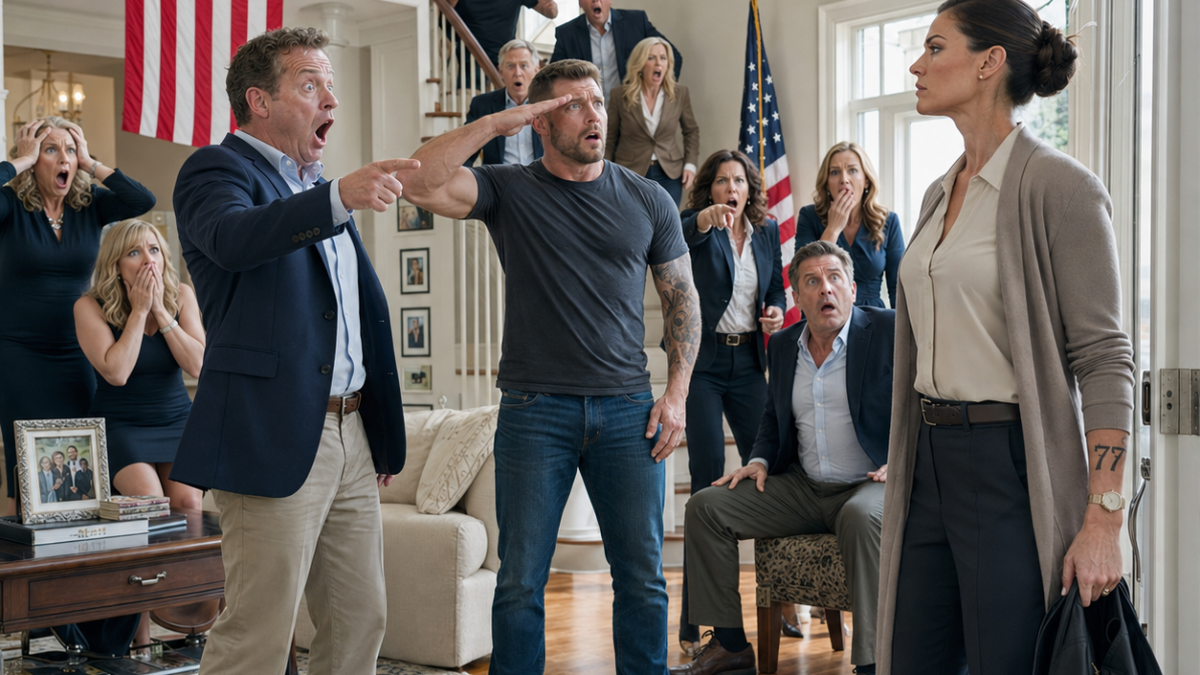
“Our Little Office Clerk Is Home,” My Dad Joked As I Walked In. His Friend, A Navy SEAL, Saw My Tattoo: Unit 77. His Laugh Died. “Sir,” He Said To Dad, “Do You Not Know Who Your Daughter Is?” Before Turning To Me: “Admiral Callahan, Ma’am, It’s An Honor.”
### Part 1
The smell of charcoal smoke and cheap beer reached me before I stepped through my father’s backyard gate.
Someone had dragged an old speaker onto the patio, and classic rock crackled through it between bursts of laughter. Folding chairs were scattered across the grass. A cooler sweated beside the picnic table. Half a dozen retired military men stood around the grill comparing scars, deployments, divorces, bad knees, and stories that had apparently grown more heroic with every passing year.
My father, Jack Mercer, stood in the middle of them.
He had always known how to occupy a room.
Even at sixty-four, with gray cutting through his close-cropped hair and an old shoulder injury making him favor his left side, he still carried himself like the senior man in every group.
When he saw me, he raised his bottle.
“There she is.”
I had barely closed the gate before his hand came down on my shoulder.
“Guys, this is my daughter, Claire.”
For half a second, something foolish inside me warmed.
Then he smiled.
“My little clerk from the base office. Keeps all the paperwork straight so the real soldiers can do their jobs.”
The men laughed.
Not cruelly, at first.
The way people laugh when a host makes a joke and nobody wants to be the one person standing there silently.
My father laughed harder than anyone.
I felt the cold neck of my beer bottle pressing against my palm.
I had commanded aircraft into hostile airspace.
I had made decisions while men shouted coordinates through static.
I had listened to people die over radios and continued speaking because six other lives depended on whether my voice shook.
But standing in that backyard, I became seventeen again.
“Dad,” I said quietly.
“What?” He grinned. “You know I’m kidding.”
One of his friends lifted his bottle toward me.
“Nothing wrong with paperwork, sweetheart.”
Sweetheart.
I smiled.
It was an old skill.
The same smile I’d used when instructors assumed I had been assigned to observe rather than lead.
The same one I’d worn when officers twice my age asked whether I was “sure” I could handle operational command.
The same smile I’d learned from my mother.
Smile first.
Bleed later.
“Excuse me,” I said.
I turned toward the picnic table.
That was when I noticed the man by the fence.
He was younger than most of my father’s friends, maybe early forties, broad-shouldered, with close dark hair and the stillness of someone who never completely stopped scanning a room.
Nathan Cross wasn’t his name in my life.
Not yet.
Here, he was Commander Ethan Vale.
I’d never met him face-to-face.
I had only seen his name buried in operational reports.
And he had never seen mine without most of it blacked out.
He wasn’t laughing.
His eyes were fixed on my uniform.
More specifically, on the silver insignia pinned above my chest.
I saw his expression change.
Recognition.
Then disbelief.
Then something else.
He put his drink down.
My father was still talking behind me.
“Claire’s always been the cautious one. Desk, air-conditioning, schedules. Her mother would’ve liked that.”
The bottle in my hand tightened.
A hairline crack appeared near the neck.
A thin line of beer ran across my fingers.
And then I heard boots move against concrete.
Ethan Vale stood straight.
His heels came together.
Every trace of casualness vanished from his face.
He raised his hand.
“Colonel Mercer, ma’am.”
The laughter around us faded unevenly.
One man chuckled another second before realizing nobody else was.
Ethan’s salute remained perfectly still.
“It’s an honor.”
My father stared at him.
Then at me.
Then at the insignia on my chest.
“What the hell are you doing, Vale?”
Ethan didn’t lower his hand until I returned the salute.
Only then did he look toward my father.
“Showing respect, sir.”
“For what?”
There it was.
Not curiosity.
Not pride.
Offense.
As though the possibility that I deserved something he hadn’t given me was personally insulting.
Ethan’s jaw tightened.
But he looked at me before answering.
He was asking permission without words.
I gave him the smallest shake of my head.
Not here.
Not yet.
He understood.
My father didn’t.
“What am I missing?” Dad demanded.
Nobody answered.
The grill hissed behind him.
A drop of beer fell from my fingers and struck the metal tabletop with a bright little tap.
I placed the cracked bottle down.
“Nothing,” I said. “You aren’t missing anything you ever wanted to see.”
His face changed then.
Just slightly.
But I saw it.
Because daughters become experts at reading fathers who rarely say what they mean.
He knew there was a secret in that yard.
He knew everyone else might understand it before he did.
And for the first time in my life, that frightened him.
I left before he could ask another question.
Behind me, nobody laughed.
Driving away, I expected satisfaction.
Instead, my hands shook against the steering wheel.
Because humiliation wasn’t the worst part.
The worst part was knowing exactly why Ethan Vale had saluted me.
Seven years earlier, in a desert half a world away, I had been the voice that decided whether he lived or died.
And my father had spent those same seven years believing the person who made that decision was a man.
### Part 2
I grew up under aircraft noise.
At Eglin, jets passed low enough to shake kitchen windows. The smell of hot pavement and aviation fuel floated through the neighborhood on summer mornings. Other children learned to sleep through thunderstorms.
I learned to sleep through engines.
My father had been a military pilot before injuries and age pushed him toward training and eventually retirement. My mother, Diane in the old version of our family story, became Rebecca Mercer in mine—a flight nurse with soft brown hair, immaculate uniforms, and an ability to make every temporary base house smell like cinnamon even when all she had was instant coffee.
Dad adored her.
At least, I think he did.
He simply never knew how to adore anyone without trying to control what could hurt them.
“Again,” he would say when I struggled with math.
Or tying knots.
Or changing a tire.
Or assembling the cheap wooden glider he bought me when I was nine.
“If you’re going to do something, Claire, do it correctly.”
I used to think that was encouragement.
Children are generous translators.
When I cried after falling off my bicycle, he inspected my scraped knee and said, “Crying doesn’t put skin back on.”
When I came second at a school science competition, he asked what first place had done better.
When I was fourteen and told him I wanted to fly someday, he stared at me over his coffee.
“You like the idea of flying.”
“No. I like flying.”
“You’ve never flown anything.”
“I could learn.”
His mouth flattened.
“Wanting danger doesn’t make you brave.”
My mother interrupted from the sink.
“Neither does hiding from it.”
Dad didn’t answer her.
I remembered that exchange years later.
Especially after she got sick.
I was sixteen when Rebecca began coughing at night.
At first she blamed allergies. Then an infection. Then something she picked up during years of deployments.
The explanations got quieter as the appointments multiplied.
By winter, there were pill bottles beside the kitchen sink and oxygen equipment in the bedroom.
Dad became even more rigid.
He cleaned obsessively.
Made charts.
Organized appointments.
Called doctors twice.
Checked every lock before bed.
Anything except admit he was terrified.
My mother died before spring.
At the funeral, he stood beside me in dress uniform with his jaw locked so hard a muscle jumped near his ear.
I reached for his hand.
He moved it to adjust his sleeve.
Maybe he didn’t realize what I was doing.
For years, I told myself that.
Afterward, he packed her uniforms into two cardboard boxes.
I found him sealing the second one with silver tape.
“Can I keep one?”
“No.”
“Just one jacket.”
“No.”
“Why?”
His hands stopped.
“We are not turning this house into a museum.”
“She’s my mother.”
“She was my wife.”
The words came like a door slamming.
I stared at him.
He stared back.
Then he pushed the tape across the cardboard.
“We move forward.”
That became his religion.
Move forward.
Don’t cry.
Don’t discuss.
Don’t remember in inconvenient ways.
When I earned an ROTC scholarship, I waited until dinner to tell him.
I thought he would finally look proud.
Instead, he cut his chicken and said, “They’re desperate for numbers these days.”
I laughed because I assumed it was a joke.
He didn’t.
“I got accepted, Dad.”
“I heard you.”
“That’s it?”
“What do you want, Claire? A parade?”
I put down my fork.
“I thought you might be happy.”
He finally looked at me.
“You’ve spent your whole life confusing stubbornness with capability.”
Something inside me went very still.
“I can do this.”
“You don’t know what this is.”
“Neither did you until somebody trained you.”
His chair scraped backward.
“Don’t compare yourself to me.”
He walked away before dinner was finished.
Three years later, he skipped my commissioning ceremony.
Every other graduate seemed surrounded by parents holding flowers and taking pictures.
I kept checking the crowd anyway.
Afterward, an instructor handed me an envelope.
No return address.
Inside was a small piece of paper in my father’s block handwriting.
Keep your head down.
That was all.
No congratulations.
No love, Dad.
Just an instruction.
I kept it.
Maybe that sounds pathetic.
It probably was.
But when you grow up hungry, even crumbs feel like a meal.
Years later, during training in pouring rain, I reached into my wallet and touched that damp folded paper.
Keep your head down.
I treated it like armor.
At twenty-eight, I was selected for a joint operations program called Meridian.
The selection rate was brutal.
The work was classified.
When Dad asked what I’d be doing, I gave him the safest explanation possible.
“Planning. Coordination. Logistics.”
His shoulders actually relaxed.
“Good.”
I stared at him.
“Good?”
“That’s where you belong.”
“Why?”
“Because you’re smart.”
It might have sounded like praise from anybody else.
From him, I heard the rest.
Smart enough to stay behind a desk.
Smart enough not to become one of the people he considered real soldiers.
That night I sat alone in my apartment with my mother’s photograph on the desk.
The glass had cracked across her smile during my last move.
Beside it lay Dad’s old field watch.
He had given it to me after she died.
It no longer worked.
The hands were frozen at the time recorded on her hospital paperwork.
I wore it anyway.
Not because it told time.
Because it reminded me what stopped people from living.
Fear.
My father thought fear had made him careful.
I was beginning to understand that it had made him cruel.
And Meridian was about to put me in a position where careful and cruel could both get people killed.
### Part 3
The operation that changed everything began with a voice breaking over a radio.
“Falcon team pinned. Multiple casualties. Extraction route compromised.”
I was thirty-five.
The command room was cold enough that my fingertips felt numb against the edge of the console.
Monitors threw blue-white light across tired faces. Coffee had burned down to sludge in a carafe behind me. Someone nearby smelled like sweat and dust despite the freezing air.
On the screen, a map pulsed with markers.
Friendly positions.
Hostile positions.
Aircraft.
A narrow extraction corridor rapidly closing.
The SEAL team had entered expecting one kind of mission and found something entirely different waiting for them.
They were trapped.
I had air assets available.
Barely.
The safe decision was to wait for confirmation.
The correct decision was less obvious.
“Colonel?” my deputy asked.
I watched a symbol disappear from the screen.
One man down.
Then another transmission.
“Need support now.”
I could hear breathing.
Gunfire.
Somebody shouting for a medic.
I asked for updated coordinates.
They came back incomplete.
My deputy leaned closer.
“If we’re wrong—”
“I know.”
If we acted too early, we could make the battlefield worse.
If we waited, the team might not exist by the time certainty arrived.
My father’s voice came back to me.
Keep your head down.
Safe.
Logistics.
Not combat.
I looked at the clock.
Then I gave the order.
The room changed.
People moved.
Voices sharpened.
Aircraft shifted.
There was no dramatic music. No heroic speech.
Real decisions are uglier than movies make them.
You say a sentence.
Somebody obeys.
Somebody lives with what follows forever.
Six men came out.
Two did not.
For years afterward, people told me Falcon Echo was a success.
I never used that word.
Success shouldn’t leave names you can’t forget.
One of the survivors was Lieutenant Commander Ethan Vale.
I knew his name only from the report.
I never met him.
He knew me only as a command identifier.
Specter Nine.
Months later, I came home for Christmas.
Dad had fallen asleep in his recliner with the television on.
A cable news segment was replaying footage connected to Falcon Echo. Most details were vague enough for public release: special operations team rescued, air support decisive, command decisions under review and later commended.
Dad woke when I entered.
He squinted at the television.
“They’re still talking about this?”
I put my bag down.
“Apparently.”
He reached for the beer on his side table.
“They nearly lost that whole team.”
My body tightened.
“Nearly.”
“Bad command.”
I looked at him.
“What makes you say that?”
“Hesitation.”
He took a drink.
“Whoever was calling that operation waited too long.”
My throat dried.
There were details he couldn’t know.
Details nobody outside the chain would ever know.
But he had accidentally found the exact wound.
I sat down across from him.
“What if they needed confirmation?”
“Commanders get paid to know.”
“They aren’t gods.”
“No. That’s why the wrong people shouldn’t be in those chairs.”
The television showed blurred footage of aircraft moving through darkness.
Dad shook his head.
“This is what happens when standards change.”
“What standards?”
He glanced at me.
“You know.”
“No. Say it.”
He exhaled impatiently.
“Claire, don’t start.”
“Say it.”
“War isn’t an equal-opportunity exercise.”
There it was.
He looked back at the television.
“Some people get emotional under pressure. That’s reality.”
“Women.”
He shrugged.
“If that’s the word you want.”
I stared at the man who had raised me.
He was criticizing my decision.
My dead.
My survivors.
My command.
Without knowing any of it belonged to me.
I could have told him.
The authorization was mine.
The voice on the radio was mine.
The two names I woke up remembering were mine to carry.
Instead I said, “Six people came home.”
He snorted softly.
“Two didn’t.”
I looked down at my hands.
He had no idea those four words could still make me physically ill.
“Maybe whoever made the call remembers that every day.”
“Good. They should.”
I stood.
He didn’t notice the movement until I reached the hallway.
“You going somewhere?”
“Bed.”
“It’s eight-thirty.”
“I’m tired.”
He turned back toward the television.
“Desk work shouldn’t wear you out that much.”
I closed the bedroom door before my face betrayed me.
The following morning, I found the folded note in my wallet.
Keep your head down.
For the first time, it didn’t feel like protection.
It felt like a hand on the back of my neck.
That Christmas, I mailed Dad one of the ribbons associated with my service.
Not the classified commendation.
Just something I thought might make him ask a question.
Where did you earn this?
What did you do?
Who are you when I’m not looking?
Two weeks later, an envelope came back.
Inside was the ribbon.
Nothing else.
No note.
I sat at my kitchen table staring at it until the afternoon light disappeared.
Then I put it in a drawer.
After that, I stopped trying.
Or at least I told myself I did.
Six months later, while reviewing an archived Falcon Echo report, I saw Ethan Vale’s name again.
Beneath it was a statement I had never read.
Command voice remained calm throughout extraction. Without Specter Nine’s decision, I do not believe any of us would have survived.
I stared at that sentence for a long time.
Then I closed the file.
I didn’t know Ethan.
He didn’t know me.
And neither of us knew that years later he would stand in my father’s backyard with a beer in his hand and recognize a silver insignia.
But life has a strange way of dragging buried truths into daylight.
Sometimes it even invites witnesses.
### Part 4
I barely slept after the barbecue.
Dad called twice the next morning.
I ignored both.
The third call came while I was in my office.
I let it ring until voicemail picked up.
A minute later, a text appeared.
WHAT WAS VALE TALKING ABOUT?
All capital letters.
Typical.
Not Are you okay?
Not Did I embarrass you?
Not Is there something about your life I don’t know?
He wanted to know why another man had treated me with respect.
I turned the phone facedown.
That afternoon, an unfamiliar number messaged me.
Specter Nine. I owe you my life. Ethan Vale.
I stared at the screen.
Nobody had called me that in years.
We met two days later at a coffee shop overlooking Pensacola Bay.
Ethan arrived early.
Of course he did.
He sat with his back to the wall and a clear view of both exits.
His coffee was black.
Mine had gone cold before I took the first sip.
“I’ve wondered about you,” he said.
“That’s usually not good news.”
He smiled.
“I thought you were a man.”
“Most people did.”
“I heard your voice that night.”
“Distortion.”
“No. Assumption.”
That answer surprised me.
He rubbed one thumb along the cardboard sleeve around his coffee cup.
“You gave us another route when there wasn’t one.”
“I gave you a risky route.”
“You gave us a living route.”
“Not everyone.”
His expression changed.
There were certain conversations veterans didn’t need explained.
He nodded once.
“No.”
The gulls outside wheeled over the water.
I watched one dive and disappear briefly beneath the surface.
Ethan said, “I’ve met your father before.”
“I gathered.”
“He talks about Falcon Echo.”
That got my attention.
“What does he say?”
Ethan hesitated.
“Claire.”
“What does he say?”
“He calls it one of the finest examples of men holding together under fire.”
I almost laughed.
Instead, something bitter rose into my throat.
“Men.”
“He didn’t know.”
“He never wanted to know.”
Ethan studied me.
“There’s a difference.”
“Is there?”
“Yes.”
I looked at him.
He leaned back.
“Not wanting to know is a choice.”
For some reason, hearing a stranger say it hurt more than hearing Dad’s insults.
Because it removed the excuses I had spent years making for him.
Ethan opened a folder.
“I brought something.”
He pushed a redacted document toward me.
I didn’t touch it.
“What is this?”
“An after-action copy that’s cleared for you.”
“I know what Falcon Echo paperwork looks like.”
“Look at the recommendation section.”
My eyes moved across black bars until they reached a visible line.
Operational Commander: Colonel Claire Mercer, Joint Tactical Meridian.
Below it were statements from surviving team members.
Leadership under extraordinary pressure.
Decisive action.
Directly responsible for preservation of remaining team.
I pushed the folder back.
“I know what I did.”
“Does your father?”
“No.”
“Why?”
I laughed once.
No humor.
“Because I told him I worked logistics.”
“Why?”
“Because when I told him I wanted to serve, he told me not to compare myself to him.”
Ethan’s jaw shifted.
“He deserves to know.”
“No.”
“He deserves the truth.”
I looked through the window.
“My father deserves exactly what he built.”
“And what’s that?”
“Distance.”
Ethan considered that.
Then nodded.
“Fair.”
He closed the folder.
“But if he asks me what happened, I won’t lie for him.”
“I wouldn’t ask you to.”
The confrontation came sooner than expected.
Dad hosted dinner the following weekend for several former teammates and friends.
I considered not going.
Then I realized something.
Avoiding him was still allowing him to determine where I could stand.
So I went.
The backyard looked almost identical to the barbecue.
Same grill.
Same cooler.
Same men.
Only this time, nobody called me sweetheart.
Dad noticed.
It made him irritable.
During dinner, he started telling an old deployment story.
“Back when people didn’t need a computer to tell them where north was.”
Someone laughed.
Ethan didn’t.
Then an older man named Bill Turner asked me, “Claire, you’re still with Air Force operations?”
Before I answered, Dad cut in.
“She’s administrative.”
I slowly placed my fork down.
Ethan looked at me.
I said nothing.
Dad continued.
“Important work. Somebody has to keep the boys organized.”
The word boys landed between us.
Ethan’s glass touched the table.
“Jack.”
Dad glanced at him.
“What?”
“She’s not administrative.”
Dad smiled thinly.
“She’s my daughter. I think I know what she does.”
Ethan’s expression hardened.
“No, sir. I don’t think you do.”
Every conversation around the table stopped.
Dad looked at me.
Then back at Ethan.
“What exactly are you implying?”
Ethan didn’t blink.
“You like telling the Falcon Echo story.”
“What’s that got to do with Claire?”
“Everything.”
My pulse thudded.
Ethan turned fully toward him.
“She commanded it.”
Dad’s face went blank.
For a few seconds, I don’t think he understood the words.
Then he laughed.
One short, disbelieving sound.
“That’s not funny.”
“I wasn’t joking.”
Dad looked at me.
“Claire?”
I met his eyes.
He waited for me to rescue him from the truth.
I didn’t.
Ethan continued.
“I was on the ground. I heard her voice. I followed her orders. Six of us came home because your daughter made the call nobody else wanted to make.”
The color drained from Dad’s face.
“No.”
That single word was quieter than anything I’d ever heard him say.
Ethan leaned forward.
“Sir, the person you’ve been calling one of the finest commanders in Falcon Echo was sitting across from you every Christmas.”
Dad stood so quickly his chair tipped backward.
Nobody moved to pick it up.
He looked at my insignia.
Then at my face.
I expected pride.
Maybe even shame.
What I saw first was anger.
“You lied to me.”
And just like that, he found a way to make my achievement another offense against him.
### Part 5
I looked at my father across the dinner table.
“You want to talk about lying?”
“You told me logistics.”
“I told you what you were willing to hear.”
His nostrils flared.
“Don’t twist this.”
Ethan started to stand.
I raised one hand.
“No.”
This was mine.
Dad’s old friends suddenly found their plates fascinating.
The citronella candle near my elbow flickered in the evening breeze.
Somewhere down the street, a dog barked.
Everything ordinary continued around the most extraordinary conversation of my life.
Dad pointed toward me.
“You let me sit there talking about that operation while you knew—”
“Knew what?”
“You knew I didn’t have the whole story.”
I almost smiled.
“That’s been true for thirty years.”
His mouth opened.
Closed.
I stood.
“Do you remember my commissioning?”
His eyes shifted.
“What’s that got to do with—”
“You didn’t come.”
“I had reasons.”
“You mailed me three words.”
He knew exactly which three.
His gaze dropped.
I continued.
“Do you remember the ribbon I sent you?”
“You never explained it.”
“You sent it back.”
“You expected me to guess?”
“No, Dad. I expected you to ask.”
His face reddened.
“Maybe I thought my daughter would tell me when she became some classified war hero.”
“Hero?”
The word came out sharper than I intended.
“Don’t call me that because you’re embarrassed in front of your friends.”
The table went silent.
Dad’s expression cracked.
Only for a second.
I saw pain underneath.
Then the armor returned.
“I was trying to keep you safe.”
There it was.
The excuse.
The word that had followed me my entire life.
Safe.
I stared at him.
“You didn’t keep me safe.”
“I tried.”
“You made home the one place I always had to prove I deserved to exist.”
He flinched.
Good.
I wanted him to.
Maybe that made me cruel.
I didn’t care anymore.
“You told me women didn’t belong in command. You mocked my career. You called me a clerk in front of men whose lives depended on decisions I made.”
“I didn’t know.”
“You didn’t ask.”
“I thought—”
“Exactly.”
My voice stayed quiet.
“You thought. You decided. You dismissed. And every time reality threatened the version of me you’d created, you looked away.”
He stared at me.
The men around us became ghosts.
For once, there was nobody else in the backyard.
Only a father and daughter standing across twenty years of things never said.
Dad swallowed.
“Your mother—”
I felt my body go cold.
“Don’t.”
“Claire, your mother came back from deployments sick. You saw what happened.”
“Don’t use her.”
“I’m not using her.”
“You buried everything that belonged to her and then used her death as permission to bury me.”
His face collapsed inward.
That hit.
He walked toward the house.
At the doorway, he stopped.
His hand closed around the frame.
For a moment, I thought he would turn around.
Instead he went inside.
A few seconds later, something struck a wall.
Nobody spoke.
Bill Turner eventually picked up Dad’s chair.
He looked at me with wet eyes.
“For what it’s worth, Claire, he talks about you.”
I nearly laughed.
“What does he say?”
Bill looked uncomfortable.
“That you’re smart.”
“That’s not the same as being proud.”
“No.”
At least he didn’t lie.
I cleared my plate.
Ethan followed me to the gate.
“You okay?”
“No.”
“Good answer.”
I looked toward the house.
A light came on in Dad’s study.
“I spent years imagining the day he found out.”
“And?”
“I thought it would feel better.”
Ethan put his hands in his pockets.
“Truth isn’t anesthesia.”
“No.”
“What are you going to do?”
“Leave.”
“Tonight?”
“For longer than tonight.”
I went inside while Dad remained in his study.
I packed the few things I’d left in my old bedroom.
A sweater.
Two books.
My mother’s photograph.
Then I opened my wallet and removed the folded piece of paper I’d carried since commissioning.
Keep your head down.
The ink had blurred along the folds.
I placed it on Dad’s desk.
Underneath, I wrote:
I did.
And I still rose higher than you ever bothered to look.
I left before he came out.
He called six times that night.
I turned my phone off.
The next morning, I drove north with the windows cracked and the gulf air pouring through the car.
I didn’t feel free.
Freedom is too clean a word.
I felt amputated.
There was relief.
There was pain.
There was phantom sensation where hope used to be.
Three weeks passed.
Then four.
Dad left messages.
At first they were angry.
“Call me.”
Then defensive.
“You misunderstood what I meant.”
Then quieter.
“We need to talk.”
I deleted all of them.
Not because I hated him.
Because for the first time, I understood that love did not require unlimited access.
Six weeks later, I returned to Pensacola while he was away.
I wanted the last of my mother’s belongings.
His study door was unlocked.
That room had been forbidden when I was young.
I opened the bottom desk drawer and found a yellowed envelope beneath a stack of military papers.
My name was written on the front.
Claire.
Below it, in smaller handwriting:
If I ever find the right words.
I should have left it there.
Instead, I opened it.
And what I read changed what I understood about my father.
It did not change what I was willing to forgive.
### Part 6
The letter began without a greeting.
You will think I don’t believe in you.
I stopped reading.
The room smelled like leather, dust, and the faint tobacco odor Dad insisted came from old furniture rather than the cigarettes he sometimes smoked on the porch.
I sat in his chair.
The paper shook slightly in my hand.
You will think I don’t believe in you. The truth is worse. I believe you are exactly capable enough to go where people like us go when somebody asks.
I read the sentence twice.
Then continued.
I saw what service did to your mother. Everyone remembers Rebecca smiling in photographs. Nobody remembers her waking up coughing. Nobody remembers me sitting in hospital parking lots because I couldn’t make myself walk inside.
My throat tightened.
He had never told me that.
I kept reading.
When you said you wanted to serve, all I could see was another hospital bed. Another uniform in a box. Another person I loved becoming a flag somebody handed me.
So I tried to make you smaller.
The next line had been crossed out so hard the pen had almost torn the page.
I told myself smaller meant safer.
Under it, he had written:
Maybe I was only trying to make my fear your cage.
I placed the letter on the desk.
For several minutes, I stared at the wall.
There was the explanation I had spent half my life wanting.
And it solved nothing.
That surprised me.
I had always believed that if I understood why Dad treated me the way he did, the pain would rearrange itself into something easier.
It didn’t.
Fear explained him.
It didn’t excuse him.
He had been terrified of losing me.
So he taught me to believe I was less.
He had been afraid I might suffer.
So he became one of the people who hurt me first.
I finished the letter.
There was no apology at the end.
Only one unfinished sentence.
If I knew how to tell her—
Then nothing.
The page stopped there.
I folded it carefully and put it back in the envelope.
For a moment, I considered taking it.
I didn’t.
That letter belonged to the man who had written it and never found the courage to deliver it.
I took my mother’s photograph instead.
On my way outside, I noticed something else in the drawer.
Dad’s old pilot ring box.
Empty.
I closed the drawer.
The bay looked gray beneath a thickening sky when I stepped onto the porch.
Wind pushed strands of hair across my face.
My old field watch sat loose around my wrist, frozen at the same useless time.
I touched it.
For the first time, I understood something about my father.
He had stopped at the moment my mother died.
Not literally.
He paid bills.
Ate breakfast.
Fixed engines.
Went to work.
Aged.
But some part of him had never moved past that hospital.
He had spent decades insisting everyone else move forward while he remained frozen in grief.
My phone rang.
Ethan.
I answered.
“Hey.”
“You in Pensacola?”
“How did you know?”
“Your father came to see me yesterday.”
I closed my eyes.
“Of course he did.”
“He asked about Falcon Echo.”
“What did you tell him?”
“The truth.”
I leaned against the porch rail.
“Which part?”
“All the parts I could.”
The wind carried gull cries across the water.
Ethan’s voice softened.
“He asked if you really made the final call.”
“And?”
“I told him yes.”
I waited.
“He asked what would have happened if you hadn’t.”
“What did you say?”
“That I probably wouldn’t have a daughter.”
Something shifted inside me.
Ethan had a daughter.
I didn’t know that.
“He cried,” Ethan said.
I almost thought I’d misheard.
“My father?”
“Yeah.”
I looked back through the study window.
At the desk.
At the drawer containing the letter.
“He said he spent his whole life trying to protect you from the thing you were apparently built to survive.”
I gave a hollow laugh.
“That’s very poetic for him.”
“He didn’t say it poetically.”
“No.”
“Claire, he asked me how to fix things with you.”
I was quiet.
“What did you tell him?”
“That wasn’t my question to answer.”
That was why I liked Ethan.
He never confused kindness with ownership.
I went home that night and wrote Dad a message.
I rewrote it six times.
Finally, I sent:
I understand that you were afraid.
I understand Mom’s death changed you.
I understand you thought you were protecting me.
But understanding why you hurt me does not erase that you did.
I am not ready for the relationship you suddenly want because you finally respect the person I’ve always been.
Please don’t call for a while.
He replied two hours later.
Okay.
Then another message appeared.
I am sorry.
I stared at those three words.
Once, they would have broken me open.
Now they felt almost too late to reach the place that had needed them.
I didn’t answer.
Three months passed.
One evening, while eating takeout alone in quarters near Washington, I heard my father’s voice coming from the television.
I nearly dropped my fork.
He was standing behind a podium at a veterans’ hall.
Older.
Smaller.
Uncomfortable.
“My daughter serves,” he said.
The room behind him went quiet.
“Most of my life, when people asked about her, I made what she did sound smaller because I was afraid of what it meant.”
He looked down at his notes.
Then back up.
“That was cowardice.”
My chest tightened.
He continued.
“She doesn’t push papers. She makes decisions that keep people alive. People I know. People I respect.”
He swallowed.
“I should have respected her long before another man taught me how.”
The video clip ended.
I sat staring at the screen.
A minute later, my phone buzzed.
Dad:
I didn’t expect you to see that.
I typed:
I did.
His reply came slowly.
I meant every word.
I stared at the message.
Then wrote:
I’m glad you finally said it.
He called.
I let it ring.
Then I turned the phone facedown.
His apology mattered.
But an apology was not a time machine.
And I had finally stopped treating late love like payment for old wounds.
### Part 7
My relationship with Dad did not become beautiful after that.
People like clean endings.
They want one speech to repair twenty years.
One hug.
One apology.
One tearful Christmas dinner where everybody realizes family is all that matters.
Real life is not written that kindly.
Dad started seeing a counselor.
I know because he told Ethan, and Ethan eventually mentioned it after asking whether I wanted to know.
I did.
Dad stopped drinking as much.
He started mailing handwritten letters instead of leaving voicemails.
I read some.
Not all.
Most were awkward.
One said:
I remembered your science fair today. You built something about wing pressure. I told you second place meant you should work harder. I should have told you I was impressed.
Another:
I found your commissioning photo online. You looked like your mother.
That one sat unopened on my desk for three days before I finally read it.
He never demanded that I come home.
That mattered.
Sometimes growth is simply learning not to knock on a locked door.
About a year after the veterans’ hall speech, I was promoted.
Brigadier General.
The ceremony took place in California.
I had no intention of inviting Dad.
Then two days before the event, my aide came into my office holding a tablet.
“Ma’am?”
“Yes?”
“There’s a retired Colonel Jack Mercer requesting guest clearance.”
My pen stopped.
“Did he say who invited him?”
“No, ma’am.”
Of course not.
I looked out the window.
I could deny access.
Part of me wanted to.
Not as punishment.
As protection.
Then I remembered the letter hidden in his desk.
Maybe I was only trying to make my fear your cage.
I refused to build the same cage from the opposite side.
“Let him in.”
The California sun was almost painfully bright on the morning of the ceremony.
My white uniform felt stiff at the shoulders.
Rows of chairs faced the stage.
Ethan sat near the aisle.
My father sat in the second row.
I noticed the cane first.
Then the way his jacket hung too loosely from his shoulders.
He looked older than he had a year before.
When our eyes met, he didn’t smile.
He simply nodded.
I nodded back.
Nothing more.
The oath began.
I raised my hand.
I repeated words I’d spoken in different forms for most of my adult life.
Service.
Duty.
Integrity.
Responsibility.
When it ended, the announcer said my new rank and command.
The room rose.
Applause filled the hall.
I looked toward the second row.
Dad was standing despite the cane.
Tears had gathered in his eyes.
I felt something inside me ache.
But I did not mistake the ache for reconciliation.
After the ceremony, he approached while the crowd moved toward the reception area.
“General.”
I almost smiled.
“Colonel.”
He looked down.
“I deserved that.”
“You did.”
His eyes lifted to mine.
For once, no defensiveness appeared.
He reached into his pocket and removed a small leather box.
I knew it immediately.
The pilot ring box from his desk.
He opened it.
Inside sat the ring.
Worn silver.
Scratched edges.
The thing I had watched him wear through most of my childhood.
“I’d like you to have this.”
I didn’t reach for it.
“Dad.”
“Please.”
“I didn’t become who I am because you believed in me.”
Pain moved across his face.
“I know.”
“I became this despite spending years trying to earn something from you that I should never have had to earn.”
“I know.”
“You don’t get to rewrite that because you’re sorry now.”
“I know.”
That answer stopped me.
No excuse.
No explanation.
No mention of Mom.
Just acceptance.
He held the box a little closer.
“This isn’t payment.”
“What is it?”
“Evidence.”
“Of what?”
“That I finally know which one of us flew higher.”
I stared at him.
Then at the ring.
I took it.
Not because everything was repaired.
Because I wanted it.
There is a difference.
“It’s too loose,” I said after slipping it onto my finger.
A faint smile touched his mouth.
“You always did have your mother’s hands.”
The words hurt.
We stood in silence.
Finally, he said, “For what it’s worth, Claire, I’m honored to be your father.”
I looked at him.
Years earlier, I would have traded almost anything for that sentence.
Now it arrived after I had learned to live without it.
“Thank you,” I said.
He waited.
Perhaps he hoped I would say more.
I didn’t.
There would be no embrace.
No promise to call every Sunday.
No instant restoration.
Some bridges can be rebuilt.
Some places are better marked with a sign explaining why the bridge collapsed.
Dad nodded.
“I understand.”
He turned and walked away.
Ethan appeared beside me a minute later.
“You okay?”
I looked down at the ring.
“Yeah.”
“Want me to tell you that was touching?”
“No.”
“Good. It was painfully awkward.”
I laughed.
A real laugh.
Then he looked at my father disappearing into the crowd.
“You forgive him?”
I considered the question.
“No.”
Ethan nodded.
No judgment.
“Do you hate him?”
“No.”
“That sounds complicated.”
“It is.”
I slid the ring off and closed it in the leather box.
“I understand him. That’s enough.”
And it was.
Dad and I spoke occasionally after that.
Birthday messages.
A Christmas card.
Once, a twenty-minute phone call about aircraft engines that felt almost normal.
But I never gave him the intimacy he wanted at the end.
That relationship had required care decades earlier.
He had neglected it until it couldn’t carry much weight.
A year after my promotion, Ethan called just before dawn.
I knew from his silence.
“What happened?”
His voice was gentle.
“Claire, it’s your father.”
I closed my eyes.
Outside my window, morning aircraft were beginning to move.
And somewhere inside me, the little girl who had spent her whole life waiting for her father to look up finally understood there would be no more chances.
### Part 8
Dad died in his sleep.
His heart stopped sometime before sunrise.
There was no final speech.
No hospital bedside.
No cinematic moment where he squeezed my hand and asked forgiveness one last time.
Maybe that was appropriate.
Our relationship had been shaped more by silence than words.
It ended the same way.
The funeral was held beneath a hard gray sky.
The honor guard moved with slow precision.
Fabric snapped softly in the cold wind.
Boots pressed into damp ground.
I stood in uniform as the flag was folded.
My face remained still until it was placed in my hands.
Then I looked down at the tight blue triangle.
For years, Dad had been terrified of receiving one of these because of me.
Instead, I received one because of him.
Life has a cruel sense of symmetry.
Afterward, people approached with stories.
“He talked about you constantly.”
“You know how proud he was.”
“He carried your promotion photo.”
“He called you his general.”
I thanked them.
I didn’t correct them.
Pride at the end was still pride.
It simply wasn’t the whole story.
I went through his belongings two days later.
Most of the house hadn’t changed.
Same coffee mug.
Same old flight manuals.
Same dent in the kitchen cabinet from when I crashed a toy airplane into it at nine.
In his study, I found the letter again.
This time, beneath it sat a small USB drive.
A strip of masking tape was wrapped around it.
For Claire.
I nearly left it untouched.
Then I inserted it into his computer.
There were two files.
The first was audio.
Dad’s voice filled the study.
Older.
Rough.
Uncertain.
“Claire.”
A pause.
“I’ve recorded this three times.”
Another pause.
“Probably because I still think words are something a man should use only if they’re useful.”
I sat down.
“I called you my little clerk because making you small made me feel less afraid.”
My throat tightened.
“It also made me cruel.”
The word hung in the room.
He continued.
“I thought if you didn’t believe you could go far enough, maybe you wouldn’t go far enough to get hurt.”
I looked at the old watch on my wrist.
Still frozen.
Still useless.
“I told myself that was love.”
His breathing sounded heavy.
“It wasn’t. Love doesn’t require another person to doubt themselves so you can sleep easier.”
I shut my eyes.
There it was.
The sentence he should have understood thirty years earlier.
“I know saying I’m proud now doesn’t repair what I did then. I know you don’t owe me forgiveness.”
My fingers tightened around the edge of the desk.
“I’m not asking for it.”
That mattered more than I expected.
“I just want the record straight somewhere.”
His voice cracked slightly.
“You were never my little clerk.”
I looked toward the window.
“You were the officer who kept my brothers alive.”
A long silence.
“And before that, you were the little girl with the wooden airplane who kept asking me how wings worked.”
I smiled despite myself.
“I saw you too late, Claire.”
His next breath shook.
“But I saw you.”
The recording ended.
I remained in the chair for a long time.
Then I opened the second file.
A scanned photograph filled the screen.
Mom in her flight nurse uniform.
Dad younger and leaner.
Me standing between them at maybe eight years old, holding a blue toy airplane.
In the corner, Dad had written:
The girl with the plane grew up without permission.
Below it:
Good.
I laughed once.
Then cried.
Not because everything was healed.
It wasn’t.
I cried for what we’d lost.
For what he had finally learned.
For the father he might have been if grief hadn’t frightened him into becoming someone harder.
I copied the files.
I kept the ring.
I kept the photograph.
And I kept the truth.
I did not forgive him in the clean, storybook sense people sometimes demanded when they heard pieces of our history.
I never decided the damage didn’t matter.
I never pretended his late apology could raise the girl who had needed a father at sixteen.
But I stopped carrying anger for him.
That wasn’t forgiveness.
It was release.
There is a difference.
Three years later, I stood on a runway in Colorado Springs watching a group of cadets prepare for their first solo flights.
By then, I wore two stars.
Major General Claire Mercer.
The title still sounded strange whenever someone introduced me.
Cold morning air carried the familiar smell of fuel and hot machinery.
Engines whined.
Ground crews moved with practiced urgency.
One cadet lingered beside her aircraft.
Dark hair tucked neatly beneath her helmet.
Gray-green eyes exactly like her father’s.
Ethan’s daughter, Lily Vale.
She had been accepted into Meridian’s developmental pipeline.
Ethan blamed me jokingly.
I blamed genetics.
Lily walked toward me.
“Ma’am?”
“What’s wrong?”
“Nothing.”
She hesitated.
That meant something was wrong.
Finally she asked, “Did your father always support you doing this?”
I looked out toward the runway.
For a moment, I saw my old kitchen.
My father’s coffee.
His unreadable face.
Don’t compare yourself to me.
Keep your head down.
My little clerk.
Then I saw him standing in California with a cane.
I saw the leather ring box.
I heard the recording.
I saw you too late.
“No,” I said.
Lily seemed surprised.
“No?”
“No.”
“What did you do?”
“I stopped waiting.”
She frowned slightly.
“For him to support you?”
“For anyone to give me permission to become myself.”
Wind tugged at the edge of her flight suit.
She looked toward the aircraft.
Then back at me.
“Was he proud eventually?”
“Yes.”
“Did that make it better?”
That question was sharper than she knew.
I smiled.
“It made the ending different.”
She waited.
“It didn’t rewrite the beginning.”
Lily absorbed that.
Then nodded.
“I think I understand.”
“You will.”
She started toward her aircraft.
“Lily.”
She turned.
I pointed toward the sky.
“Keep your head up.”
She grinned.
“Yes, ma’am.”
Minutes later, engines roared.
One aircraft lifted.
Then another.
Then Lily’s.
I followed it until the morning sun turned the wings silver.
Dad’s pilot ring hung from a chain beneath my uniform.
I had tried wearing it on my finger once.
It never fit properly.
Eventually, I realized that was fitting too.
It wasn’t supposed to become mine completely.
It belonged to a history I could carry without letting it define me.
My phone buzzed.
A message from Ethan.
Did she survive?
I typed back:
Unfortunately. She’ll be impossible now.
His reply came immediately.
Your fault, General.
I laughed.
Around me, cadets moved across the runway, young men and women carrying ambitions nobody had yet managed to shrink.
That had become the part of command I loved most.
Not medals.
Not rank.
Not being saluted.
Seeing somebody realize they were capable before the world convinced them otherwise.
I touched the chain beneath my collar.
For years, I had imagined my father’s approval waiting somewhere above me like a destination.
I had climbed toward it.
Fought for it.
Bled for it.
And when it finally came, I discovered something almost funny.
I didn’t need it anymore.
That was the gift hidden inside all those wasted years.
He had spent my childhood telling me to keep my head down.
I built a life that required me to look up.
The aircraft disappeared into the blue.
I stood beneath the enormous Colorado sky and thought of my mother, my father, Falcon Echo, the cracked beer bottle, Ethan’s salute, and the backyard that had finally exposed every secret between us.
My father had eventually seen me.
I was grateful for that.
But the most important moment of my life wasn’t when he finally looked up.
It was when I stopped needing him to.
I watched the last jet cut across the sunlight.
Then I smiled and whispered to the little girl I had once been,
“Keep your head up, Claire.”
And this time, no one else’s voice answered.
THE END!
Disclaimer: Our stories are inspired by real-life events but are carefully rewritten for entertainment. Any resemblance to actual people or situations is purely coincidental.








