“Perfect Couple!” 150 Cheered My Husband On Valentine’s Day… While He Proposed To His COO.
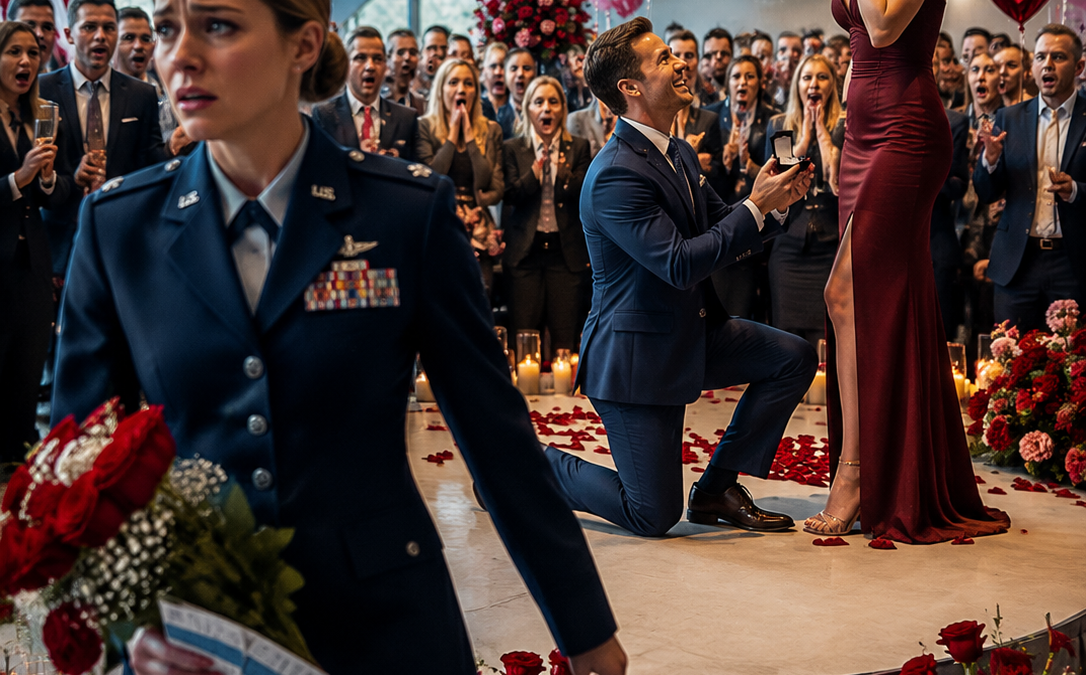
“ They are perfect together,” the employees whispered as I walked into Kestrel Vale Aeronautics holding Paris tickets and roses, only to find my husband kneeling before his COO on a Valentine’s Day stage. I stood frozen in my Air Force uniform while one hundred and fifty people cheered for Nolan Whitaker and Vivian Cole, believing I was just the forgotten military wife who had been left behind. Then I walked away, froze every account connected to my authorization, and called my father’s attorney. Nolan thought he had replaced me. He had no idea I owned the company he was about to lose.
### Part 1
The applause inside the glass lobby sounded almost beautiful at first.
It rose in a shining wave beneath the vaulted ceiling of Kestrel Vale Aeronautics, bouncing off polished marble floors, chrome railings, and the enormous American flag hanging behind the Valentine’s Day stage. Red and white balloons drifted against the second-floor balcony. Someone had arranged roses around the podium. Someone else had dimmed the lobby lights just enough to make the stage glow.
I had walked in carrying two dozen red roses and two first-class tickets to Paris.
I was still in my United States Air Force uniform.
The roses were wrapped in cream paper with a satin ribbon, the kind of ribbon that felt expensive even between gloved fingers. The tickets sat inside my coat pocket, tucked beside a handwritten card I had started three times before I finally got the words right.
Nolan, eight years is still not enough. Let’s remember who we used to be.
That was what I had written.
Then I saw my husband kneeling in front of another woman.
Nolan Whitaker, founder and CEO of Kestrel Vale Aeronautics, had one knee on the stage and a velvet ring box in his hand. His dark suit fit him like it had been cut directly on his body. His hair was perfect. His smile was perfect. His voice cracked with just enough emotion to make the crowd lean closer.
Vivian Cole, his new chief operating officer, stood in front of him with both hands over her mouth. She wore a pale champagne dress and diamond earrings I recognized instantly, because I had seen a corporate charge for something similar three months earlier.
Around them, one hundred and fifty employees clapped, whistled, and cheered like they were watching the ending of a movie.
“They are perfect together,” a woman near the coffee bar whispered.
Another woman laughed softly and said, “Did you hear his wife is just some dry, rigid military woman stuck on base all year? Nolan separated from her two years ago.”
The words sliced through the applause and landed cleanly in my chest.
I stood exactly twenty feet away.
Not hidden. Not sneaking. Not trembling in a corner.
Standing there in a pressed uniform, holding roses like an idiot, while my husband slid a diamond ring onto his COO’s finger.
Vivian whispered, “Yes.”
The lobby erupted.
Nolan stood and kissed her deeply.
It was not a confused kiss. Not a drunken kiss. Not a startled mistake. It was practiced, confident, and public. His left hand cupped the back of her neck like he had done it a hundred times before, and the crowd cheered louder.
Then his eyes drifted over the lobby.
Casual at first.
Proud.
Triumphant.
Until they found mine.
His smile died so fast it looked like someone had pulled the power cord out of his face.
For one long second, nobody else noticed. Vivian was still smiling. Employees were still clapping. Phones were still raised. A banner near the receptionist desk read, Congratulations, Nolan and Vivian, in looping red letters.
I didn’t cry.
Something colder than tears settled over me.
I lowered the roses until the petals brushed against my uniform jacket. My thumb pressed into a thorn through the paper. Pain bloomed in my palm, sharp and clean, and somehow that helped.
Nolan’s mouth opened.
I turned on my heel and walked out.
Behind me, the applause thinned. A few voices dropped. The revolving glass door pushed me into bright winter sunlight, and the cold slapped my face hard enough to wake up every part of me that grief wanted to numb.
My black SUV sat in visitor parking. Visitor parking at a company I had saved from collapse twice. I placed my flight cap carefully on the passenger seat, crown up, insignia untouched. Then I set the roses beside it.
My phone began to buzz before I even started the engine.
Nolan.
Nolan again.
Nolan again.
I watched his name flash once, twice, five times, ten. Each call came faster than the last, like panic learning how to breathe.
I shut the screen off.
When your own perimeter is breached by friendly fire, you do not stand there asking why the shooter raised the weapon.
You isolate the grid.
I pulled onto I-95 with both hands steady on the wheel. The sky was clean and white over Connecticut, the kind of February light that makes every windshield flash like a blade. My heart was beating slowly. Too slowly, maybe. But I trusted it.
I tapped the hands-free system and called the only man alive who knew every wall my father had built around the Whitaker fortune before he died.
The line picked up after half a ring.
“Colonel Mercer speaking.”
“Samuel,” I said. “Initiate the purge protocol.”
There was no gasp. No question. Just a silence so heavy I could hear my own tires humming against the highway.
Then Colonel Samuel Mercer, retired JAG officer and my late father’s most trusted attorney, said, “Confirming, Major. Full freeze?”
“Full freeze,” I said. “Joint accounts. Credit systems. Trust-backed collateral. Equity lockup. Everything connected to my authorization.”
Another pause.
“That will detonate Kestrel Vale before market close.”
“I know.”
“Are you safe?”
I looked at the white road lines rushing under the hood.
“No,” I said. “But I am in control.”
By the time I reached my driveway, Nolan had called forty-three times. By the time I opened my front door, the number had passed eighty.
And by the time I threw the roses into the rusty trash can beside the garage, I knew one thing with absolute clarity.
My husband had not lost me on that stage.
He had lost me years before.
### Part 2
The house was silent when I stepped inside, but not in a peaceful way.
It had the hollow quiet of a place that had been slowly emptied while the owner was still alive. The foyer smelled faintly of lemon polish and expensive candles. Not my candles. Not my polish. Even the rug beneath my boots was new, some gray geometric thing Nolan had bought from a designer in Manhattan who used words like “masculine flow” and “executive softness.”
My father’s grandfather clock was gone.
That was the first thing I noticed, even through the shock.
The clock had stood near that staircase since the day we moved in. Dark walnut. Brass pendulum. A low steady tick that made every room feel anchored. My father had wound it every Sunday when I was a child. After he died, I kept winding it because grief needs rituals or it turns feral.
Nolan had replaced it with a chrome sculpture shaped like a twisted ladder.
I stared at it for a long moment, my duffel strap still cutting into my shoulder, and remembered the first night he told me not to come to his investor dinner.
We had been standing in that same foyer. He was in a tuxedo, adjusting a silk bow tie in the mirror. I was in service dress, my shoes polished until I could see the ceiling lights in them.
He didn’t turn around when he said it.
“Rowan, you’re too rigid for these events.”
My name is Rowan Whitaker. Before marriage, Rowan Delaney. Major Rowan Delaney-Whitaker, United States Air Force.
To Nolan, depending on the room, I was Rowan, Ro, my wife, the service girl, or once, in front of a senator’s wife, “our family’s discipline department.”
That night, I had asked, “What does that mean?”
“It means you don’t understand how networking works.” He smiled at his own reflection. “You make people feel like they’re being inspected.”
“I’m your wife.”
“You’re also intense.” He tightened the knot. “Stay on base where things make sense to you.”
He said it gently, which somehow made it worse.
Like he was doing me a favor.
I had not screamed. I had not thrown the nearest vase. I had picked up my duffel from the hardwood floor, felt the zipper teeth dig into my palm, and left for another tour of duty before sunrise.
That was how he trained me to disappear.
Not all at once. Never dramatically. Nolan was too smart for that. He pushed me back by inches.
At first, he said military obligations made scheduling difficult. Then he said donors felt awkward around uniforms. Then he said defense clients preferred to see civilian leadership. Then my chair at dinners moved farther from his. Then my name stopped appearing beside his in programs. Then the wedding photo vanished from the company website.
Once, at a Thanksgiving fundraiser, he introduced a lobbyist from K Street as “my partner in strategic development.”
He introduced me as “Rowan. She’s Air Force.”
No rank. No last name. No mention of the Delaney Trust. No mention of the $620 million in protected equity that kept his company from dying before its first contract.
I swallowed all of it because duty had taught me endurance. Because my father had loved Nolan at first. Because I kept thinking marriage, like mission work, had bad seasons you survived by staying disciplined.
But endurance can become a cage if you mistake silence for strength.
I walked into the kitchen and placed both palms flat on the marble island. The stone was cold. My left thumb had a thin red cut where the rose thorn had caught me. A small drop of blood touched the counter.
The sight pulled me back to another night, thousands of miles away.
A hangar outside Bagram. Jet fuel in the air. Sand clicking against the tent walls like dry insects. A secure laptop balanced on an ammo crate while mortars thudded somewhere beyond the wire.
I was checking Kestrel Vale’s quarterly reports at two in the morning because Nolan had sent them marked urgent.
That was when I first saw the small bleeds.
Thirty thousand here. Fifty thousand there. Vague charges routed through shell vendors I didn’t recognize. Partner relations. Strategic hospitality. Client acquisition retreat. Words meant to blur the eye.
One charge for $47,000 at a resort in Scottsdale.
Another for $92,000 to a jeweler in SoHo.
A $380,000 entertainment line with no receipts attached.
I emailed Nolan fourteen flagged items and three wire transfers. The answer came back eleven minutes later.
It’s aggressive expansion overhead. Don’t suffocate the company with military paranoia.
He added a smiling emoji.
I stared at that yellow face on my screen while sand blew under the tent flap and a nineteen-year-old medic named Eli Torres slept on a cot beside a blood-stained aid bag. Two days earlier, Torres had held pressure on a sergeant’s torn artery for forty minutes while waiting for medevac. His hands had been red to the wrists, and he had not let go.
That was loyalty.
Nolan used loyalty like a napkin. Something to wipe his mouth with after he was finished eating.
I did not confront him then.
A soldier who tips off the enemy forfeits the advantage.
Instead, I called Samuel Mercer.
Within two months, my father’s trust had been restructured. Every core Delaney asset moved behind biometric approval, dual authorization, and a withdrawal clause so clean it looked harmless unless you understood how money could function as a weapon.
Nolan never read the amended filings.
He read magazine profiles about himself. He read investor praise. He read comments under photos where people called him visionary. He did not read legal architecture unless his own name appeared in large letters.
That arrogance saved me.
Twenty minutes after I threw away the roses, Colonel Mercer’s black sedan pulled into my driveway so sharply gravel spat behind the tires. He walked in carrying the same battered leather briefcase he had brought to my father’s office for thirty years.
He looked older than the last time I had seen him, but not softer. Tall, broad, gray at the temples, with eyes that made weak men confess before anyone asked a question.
He set the briefcase on my dining table.
“Tell me everything,” he said.
So I did.
Not emotionally. Not theatrically. I briefed him the way I would brief a hostile breach.
Valentine’s Day event. Public proposal. False separation claim. COO. Possible misuse of funds. Board exposure. Reputational blast radius. Immediate need to sever Delaney collateral.
Samuel listened without interrupting.
When I finished, he opened his briefcase. The brass latches snapped like rifle bolts.
“Then we execute,” he said.
Outside, tires screamed against pavement.
My head turned before the sound ended.
A white Range Rover fishtailed at my front gate and stopped crooked across the drive.
Nolan’s car.
He threw the door open so hard it bounced back against his leg. He stumbled out, leaving the engine running and the warning chime dinging into the cold afternoon.
Then he ran toward the house.
### Part 3
Nolan fell on the front steps.
I saw it through the narrow window beside the door. One polished shoe caught the edge of the first stone step, and he pitched forward hard, both palms scraping against the porch. The sound was wet and ugly. He shoved himself up on his knees, leaving red smears on the pale stone, and began pounding on the door with both fists.
“Rowan!” he shouted. “Open the door!”
The old oak shook in its frame.
Samuel stood behind me in the hallway, hands clasped behind his back, feet shoulder-width apart. Parade rest. It would have looked almost absurd in a suburban house with a chrome sculpture in the foyer, except nothing about Colonel Mercer was absurd.
He belonged anywhere power was being challenged.
My phone lit up on the kitchen island.
188 missed calls.
The pounding got harder.
“Rowan, please!”
I buttoned the top of my uniform shirt, smoothed the front, and walked to the door. My hand closed around the brass deadbolt. For half a second, I remembered the way Nolan used to come home late from “Washington” trips smelling of unfamiliar cologne.
Sharper than his usual. Sweeter. Expensive in a way that wanted to be noticed.
“I have to lobby for these defense contracts,” he would say, packing Italian suits into his leather duffel. “It takes days. You understand duty.”
And I did.
That was the cruelest part.
He had not lied around my values. He had lied through them.
He knew I respected service. He knew I would not interrupt supposed national-defense work. He knew a woman who had built her entire adult life around chain of command would hesitate before questioning a husband who claimed to be serving that same chain.
I turned the deadbolt.
The click sounded final even before the door opened.
I cracked it no more than eight inches.
Late afternoon sunlight hit Nolan’s face. He was pale, sweating through his collar, pupils blown wide. His hair had fallen across his forehead. Blood marked his knuckles and streaked the white door frame where his fingers gripped it.
“Rowan,” he whispered. “It’s not what you think.”
I stared at him.
He tried again. “You walked in at the worst possible second.”
“That is your opening argument?”
His mouth twitched. “Vivian and I—there are optics involved. Investor confidence. We were making an announcement that got emotional.”
“You put a ring on her finger.”
His eyes darted over my shoulder. He saw Samuel then. Recognition flickered, followed by something closer to fear.
“Why is Mercer here?”
“Pitch it to me,” I said.
“What?”
“Sell me the story. You proposed to your COO in front of one hundred and fifty employees. You kissed her under a company banner. Your staff believes we separated two years ago. Pitch it, Nolan. Make it sound strategic.”
For the first time in our marriage, he had nothing ready.
No speech. No polished correction. No soft laugh followed by, “You’re overreacting.” No elegant little insult disguised as concern.
His phone began vibrating inside his jacket.
Then mine.
Then his again.
A chain reaction of buzzing filled the space between us.
Nolan fumbled for his phone. The color drained from his face as he read the screen.
“No,” he breathed.
Another notification.
Then another.
His hand shook so badly the phone nearly slipped from his bloody fingers.
I watched his expression change from marital panic to financial terror.
That was when I knew Samuel had succeeded.
The freeze had hit.
Kestrel Vale’s credit lines were snapping shut. Trust-backed collateral was gone. Capital commitments frozen. Liquidity ratios collapsing in real time. Every banker, board member, underwriter, and defense contract partner connected to Nolan’s empire was calling at once.
His perfect lobby proposal had lasted less than three hours.
“You can’t do this,” he said.
I said nothing.
His voice rose. “There are active bids in final review. There are payroll obligations. Vendor guarantees. Do you have any idea what you’re doing to my company?”
My company.
Not our company.
Not your father’s money.
Not the company your trust saved.
My company.
Samuel stepped forward into the narrow wedge of doorway light.
Nolan looked up at him like a defendant hearing chains.
Samuel’s expression was calm enough to be merciless.
“Your company?” he said.
Nolan swallowed.
Samuel smiled, but only with his mouth. “Major Delaney-Whitaker owns seventy-eight percent of Kestrel Vale Aeronautics. Your authority exists because she allowed it.”
Nolan’s face seemed to loosen from the bones.
“You don’t understand,” he said, but his voice had lost its spine. “I built this.”
“With her money,” Samuel replied. “Her father’s trust. Her collateral. Her patience.”
Nolan’s eyes snapped back to me. “Rowan, listen to me. We can fix this. I can explain Vivian. I can explain everything.”
I thought of the missing grandfather clock.
The misspelled place cards I once found shoved under takeout menus in the kitchen drawer. Rowan spelled Rowen. My seat placed beside the catering station at a dinner held under my own chandelier.
I thought of the satellite call after a mortar attack, when dust was still in my teeth and my shoulder was bruised from the blast. Nolan had told me he was in the middle of something important and hung up.
Something important had been a wine tasting in the Hamptons.
With Vivian Cole.
“No,” I said. “You can’t.”
Then I closed the door.
The safety chain snapped back against the frame. The deadbolt turned with a heavy dry crack.
On the other side, Nolan hit the wood once with his palm.
Not hard.
Just once.
Then I heard him slide down until he was sitting on the porch, his breath turning into something low and broken.
Samuel looked at me.
I walked past him into the kitchen and poured a glass of ice water. My hand did not shake until the water hit the glass.
Only then did I feel it.
Not grief.
Release.
### Part 4
Three hours later, twelve faces stared at me from my laptop screen.
The emergency board meeting had been arranged so quickly that half of them looked like they had joined from wherever the news had found them. One director sat in the back of a town car, city lights sliding behind his head. Another stood in what looked like an airport lounge. The CFO, Patricia Vale, had no makeup on and a cardigan pulled over a blouse that was buttoned wrong.
Nolan appeared from a Manhattan conference room.
His tie was gone. His collar was open. His hair looked like he had been dragging his hands through it for hours.
Vivian Cole sat three seats away from him on the same screen, still wearing the champagne dress from the proposal. The ring was on her finger, but she kept turning it as if it had become too tight.
The chairman, Harrison Bell, cleared his throat.
“Major Delaney-Whitaker,” he said carefully. “We need verbal confirmation that the Delaney Family Trust has frozen all capital commitments to Kestrel Vale Aeronautics effective immediately.”
I leaned toward my microphone.
“Confirmed.”
The word landed like a dropped blade.
Everyone spoke at once.
Patricia pressed both hands to her temples. One director cursed loudly before muting himself. Harrison’s glasses slid down his nose. Vivian’s hand flew to her mouth.
Nolan slammed his fist on the conference table.
“You are destroying years of work!”
“No,” I said. “I am removing what belonged to me.”
He leaned toward the camera, eyes bright with rage. “You don’t even know what this company does day to day.”
“I know exactly what it does. I have read every report you hoped I would ignore.”
“You read numbers from a base housing desk.”
“I read numbers from a communications tent during mortar drills,” I said. “Careful which version you mock.”
The board went quiet.
Nolan blinked first.
Samuel sat just out of frame beside me, a legal pad on his knee. He had not spoken yet. He did not need to. His presence alone reminded every person on that call that this was no longer a domestic embarrassment. This was governance. Fiduciary duty. Exposure.
Harrison spoke again, slowly this time.
“Major, the board would like to discuss a temporary restoration of partial liquidity while we investigate the circumstances surrounding today’s personal matter.”
I almost laughed.
Personal matter.
That was what powerful men called rot when it leaked into public view.
“This is not a personal matter,” I said. “Your CEO publicly represented himself as separated from the majority shareholder of this company, proposed marriage to his chief operating officer, and created material reputational and governance risk in front of employees. In addition, I have documented concerns regarding unapproved fund movement, shell vendors, and unexplained corporate expenses dating back at least eighteen months.”
Patricia’s face went still.
Nolan whipped his head toward her.
“Don’t react to that,” he snapped.
That was the wrong thing to say.
Everyone saw it.
Vivian stood suddenly. Her chair rolled backward and struck the wall.
“Nolan,” she said, voice thin. “What shell vendors?”
He looked at her like she had betrayed him.
“Sit down.”
“What shell vendors?”
“Vivian, this is not the time.”
She stared at him. Something in her expression shifted, not into anger yet, but into recognition. The first painful crack in a lie she had been living inside.
I filed that away.
After the meeting ended, Samuel stayed at my kitchen island with me. The laptop screen went dark, reflecting both of us in black glass. He removed his glasses and rubbed the bridge of his nose.
“There is more,” he said.
“I know.”
“You have proof?”
“Some. Not enough.”
He tapped the edge of his legal pad. “Then we let panic do what panic does. It creates mistakes.”
By morning, panic had created its first offering.
My phone rang at 5:12 a.m.
I was in the garage gym, one hand chalked for deadlifts, the concrete cold under my shoes. Unknown number. Manhattan area code.
I answered on speaker.
“Major Delaney-Whitaker?”
The voice was rough. Female. Exhausted.
“Speaking.”
“This is Vivian Cole.”
I did not respond.
“I don’t expect you to believe me,” she said. “But I didn’t know he was still married.”
I tightened my grip on the bar.
“He told me the divorce was nearly final. He said you had been separated for two years. He showed me photos of a cabin in Aspen and said he bought it while waiting for the paperwork to clear.”
A cabin in Aspen.
Every other sound in the garage vanished.
The hum of the heater. The faint rattle of wind against the door. My own breathing.
“What cabin?” I asked.
Vivian exhaled shakily. “I thought you knew.”
“No.”
“He said it was personal property. Not corporate. Not marital. He called it a retreat.”
“Who owns it?”
“I don’t know. I saw mail there once. Some company name. Alpine something.”
My chalked hand left a white print on the barbell.
“Send everything you have,” I said.
“I already did. To Colonel Mercer’s office. Photos. Address. A receipt I found in his desk. I’m sorry.”
The apology sat between us, fragile and useless.
I was not ready to forgive her.
But I believed her fear.
“Ms. Cole,” I said, “do not delete anything. Do not warn him. Do not speak to anyone except counsel.”
“I understand.”
“No,” I said. “You don’t yet. But you will.”
I ended the call and stood in the gray morning light, still wearing lifting gloves, staring at the barbell like it had turned into evidence.
The cabin was not just another affair detail.
It was a hidden asset.
And hidden assets leave trails.
### Part 5
Special Agent Mara Ellison arrived that afternoon with a cardboard evidence box under one arm and snow melting on the shoulders of her navy coat.
She was younger than I expected, early thirties maybe, with cropped brown hair and the kind of direct stare that made small talk feel illegal. Her badge hung from her belt. Her shoes were practical. Her face had no interest in sympathy.
I liked her immediately.
Samuel let her in.
She placed the box on my kitchen island and cut the tape with a small folding knife.
“We’ve been watching Kestrel Vale’s discretionary capital fund for six months,” she said.
The words hit harder than I expected.
“You’ve been what?”
“Watching.” She opened the flaps and began laying documents across the marble in neat rows. “Your encrypted audit notes were included in a referral package from a banking compliance officer last fall. We did not contact you because we had not yet established whether you were a victim, a participant, or a compromised signatory.”
I stared at the papers.
Wire records.
Loan approvals.
Property filings.
Email headers.
A Delaware LLC called NV Alpine Holdings.
My stomach tightened.
Agent Ellison slid one document toward me and turned it so the signature line faced my side of the island.
At the bottom, in blue ink, was my name.
Rowan Delaney-Whitaker.
For a moment, the room got very quiet.
The signature was close. Too close for a careless forgery. The R had my angle. The W had the correct compression. Whoever had practiced it had studied me.
But the pressure was wrong.
My signature moves fast. Hard on the first stroke, impatient through the middle, clean on the lift. This one was slow. Pretty. Performed.
Like a man pretending confidence was something you could copy.
“That is not mine,” I said.
“We know.” Agent Ellison tapped the page. “Forensic handwriting agrees. Digital routing confirms this loan package was scanned from Nolan Whitaker’s office workstation. Metadata places the document creation during one of his reported Washington lobbying trips.”
“Where was he actually?”
“Aspen,” she said. “With Ms. Cole.”
I pressed my palm flat against the counter.
There it was.
Not jealousy. Not even betrayal.
Identity.
He had used my name.
He had used my rank.
He had taken the one thing I had earned without him and treated it like a key he could duplicate at a hardware store.
Agent Ellison continued. “The cabin purchase was funded through a $4.2 million internal loan marked as strategic hospitality development. Your forged authorization cleared the internal control requirement because you were listed as majority equity holder.”
Samuel’s jaw hardened.
I looked at the signature again.
My name in another person’s hand.
My father’s trust behind it.
My uniform beside it.
“Is this civil?” I asked.
Agent Ellison’s expression did not change.
“No, Major. Wire fraud. Identity theft. Misappropriation of corporate funds. Fraudulent loan documents connected to a federally insured institution. And because he used the identity of an active-duty military officer, the sentencing exposure becomes significantly worse.”
I stood straight.
The kitchen smelled faintly of coffee and paper dust. Outside, a delivery truck passed on the street, brakes squealing softly. Such ordinary sounds for the moment a marriage became a federal case.
“What do you need from me?” I asked.
“Cooperation. Authentication samples. A sworn statement. And permission to coordinate with Colonel Mercer regarding the trust structure.”
“You have it.”
Agent Ellison nodded once.
The next morning, Kestrel Vale’s board assembled in the main conference room at seven-thirty.
I joined remotely from my kitchen.
This time Nolan was not at the head of the table.
He sat near the corner, trapped between three attorneys who seemed determined not to touch the same air he breathed. His suit was wrinkled. His face looked swollen from no sleep. Vivian sat on the opposite side of the room, ring gone, hands folded tightly on the table.
Agent Ellison took control of the screen without asking permission.
She did not perform outrage. She did not raise her voice. She simply built a cage out of facts.
First slide: the Aspen property deed.
Second: the Delaware LLC formation documents.
Third: the internal loan request.
Fourth: my forged signature beside verified Department of Defense signature samples.
Fifth: metadata from Nolan’s office workstation.
Sixth: IP logs matching his executive credentials.
The room grew colder with every click.
Nolan stood so fast his chair hit the wall.
“I am the CEO,” he shouted. “I had authority over discretionary strategy.”
Agent Ellison looked at him over the top of her laptop.
“Authority does not include forging the majority owner’s signature.”
He pointed at me through the screen. “She is doing this because she is humiliated. This is revenge.”
I leaned toward my laptop camera.
My voice sounded calm even to me.
“Nolan, revenge would require me to become like you. This is accountability.”
His mouth twisted. “You want to watch me drown?”
“No,” I said. “I am cutting the anchor. You can sink yourself.”
That was the moment the board stopped seeing him as a leader under attack and started seeing him as evidence.
Harrison Bell called for a vote.
Immediate termination for cause.
Twelve tablets were passed around the table.
Twelve votes returned.
Unanimous.
Nolan lost his title, unvested stock, corporate housing allowance, executive insurance, company vehicle, and fourteen-million-dollar severance package in less than six minutes.
Security was already outside the room.
As two guards escorted him through the glass lobby, employees gathered along the balconies and behind reception. Some had been there on Valentine’s Day. Some had clapped. Some had filmed.
This time, nobody made a sound.
Nolan carried a cardboard box against his chest. Inside were framed photos, a pen set, and the brass nameplate from his office door.
The same lobby.
The same marble.
No applause.
### Part 6
Vivian asked to meet me two days later.
I almost said no.
Not because I thought she was guilty. Agent Ellison had already cleared her of financial involvement. Vivian had not signed the documents. She had not known about the shell company. She had not known Nolan was still married.
But innocence does not erase impact.
You can be used as a weapon without choosing to be one, and the wound still opens.
We met at a small café four blocks from the financial district. Wooden tables. No music. Low winter light against the windows. The air smelled like espresso and toasted bread.
Vivian arrived without makeup and without the ring. A pale stripe remained on her finger where it had sat. She looked smaller than she had on stage, but not weak. Just stripped of the costume Nolan had dressed her in.
She sat across from me.
“I resigned this morning,” she said.
I studied her face.
“No tears?”
“I cried enough in private.”
“Good.”
She blinked, startled.
“Public tears are usually for witnesses,” I said. “Private ones are more honest.”
Vivian looked down at her hands. “I believed him. I believed every word. He told me you were cold. That your marriage had ended emotionally years ago. That you refused to sign paperwork because of money.”
“That sounds like him.”
“He said you hated the company.”
“I funded the company.”
Her jaw tightened. “I know that now.”
A waitress approached, sensed the temperature of the table, and wisely retreated.
Vivian reached into her bag and placed a folder between us. “These are copies of everything else I found. Travel receipts. Private villa reservations. A second phone bill. I gave digital copies to Agent Ellison, but I thought you should know what existed.”
I did not touch the folder at first.
“What do you want from me?”
She met my eyes. “Nothing.”
“That would make you the first person in this story.”
A faint, sad smile crossed her face and vanished.
“I came because I helped humiliate you in a room full of people,” she said. “Even if I didn’t know, I stood there wearing a ring bought with stolen money and let him tell the world I was his future. You deserved to hear me say that without a lawyer filtering it.”
I believed her.
Not completely. Trust does not return because someone speaks in a quiet café. But I believed that she had been conned by the same man, with a different script.
Nolan had sold me ambition.
He had sold Vivian liberation.
To both of us, he had sold himself.
“The interim board is going to ask you back,” I said.
Her eyes widened. “What?”
“You were a security breach because you trusted the wrong man. That is serious. But you told the truth when lying would have protected you.”
“I can’t go back into that building.”
“You can.”
“I don’t deserve to run it.”
“Deserving is not the question. Competence is. Character under pressure is. You had evidence that could destroy him and embarrass you. You gave it up.”
She looked at me like I had handed her something too heavy to hold.
“I don’t forgive you,” I said.
Her face tightened, but she nodded.
“I understand.”
“I also don’t hate you. Nolan spent years creating rooms where women were supposed to compete for his approval. I am not giving him that satisfaction.”
For the first time, Vivian’s eyes filled. She looked away quickly and forced the tears back.
I respected that.
“The board will send a reinstatement letter,” I continued. “If you accept, run the company like a fortress. Transparent books. Clean audits. No personality cult. No executive worship. No more rooms where one man gets to rewrite reality because everyone is too impressed to question him.”
She sat very still.
Then she reached across the table.
I shook her hand once.
Firm. Dry. No performance.
We left in opposite directions.
That night, long after midnight, Nolan came back to the house.
No Range Rover this time. No pounding. No shouting.
Just one soft creak of the porch floorboard.
I looked through the peephole and saw him standing under the yellow porch light with his hands at his sides. His expensive watch was gone. His shirt was untucked. Stubble darkened his jaw in uneven patches. He looked like a man who had fallen through every version of himself and found nothing underneath.
I opened the door two inches with the chain still engaged.
The smell hit me first.
Cheap bourbon. Cold sweat. Wet wool.
“I lost everything,” he rasped.
I looked at him for a long moment.
This was the face he probably wanted me to remember. Broken. Human. Finally humbled. The face that asked a good woman to confuse pity with love.
But I had seen too many men apologize only after consequences arrived wearing boots.
“You never owned most of it,” I said.
His eyes closed.
“I know.”
“No. You don’t.”
His forehead touched the door frame. “I’m sorry, Rowan.”
I waited for my heart to betray me.
It didn’t.
No ache. No pull. No old reflex to comfort him. No memory strong enough to overcome the facts.
“You forged my name,” I said. “You erased me from rooms my father paid for. You used my service as cover for your affair. You let strangers laugh at me while spending money I protected from a war zone.”
His mouth trembled.
“I was lost.”
“No,” I said. “You were found out.”
He flinched as if I had struck him.
I closed the door.
The deadbolt turned.
Then I switched off the porch light.
### Part 7
The divorce took eleven days.
People imagine divorce as shouting in hallways, lawyers circling like hawks, furniture divided by spite, wedding albums thrown into boxes. Mine was cleaner than that. Brutal, but clean.
Fraud has a way of simplifying emotion.
Judge Miriam Caldwell, a former military prosecutor with silver hair and reading glasses on a chain, reviewed the evidence in a sealed hearing. Forged signature. Hidden Aspen property. Delaware shell company. Wire transfers. False internal loan approvals. Two years of fabricated Washington trips. Public misrepresentation of marital status. Misuse of Delaney Trust-backed capital.
Nolan sat beside a public defender because every private attorney who had once laughed at his jokes had withdrawn representation within forty-eight hours.
His suit did not fit anymore. Or maybe he had simply shrunk inside it.
My father’s prenuptial agreement sat at the center of the table.
Article Eleven, Section C.
Financial fraud or identity forgery by either party triggered total forfeiture of claim to Delaney family assets, trust distributions, marital property acquired through trust-backed funds, and professional use of the Delaney name.
Nolan had hated that clause when we signed.
I remembered the day clearly. My father sat across from him in his study, one hand resting on the carved arm of his chair. Rain tapped against the windows. Samuel Mercer stood near the bookshelves, silent as a locked gate.
Nolan laughed and said, “This feels like paranoid overkill.”
My father did not smile.
“Then it should never trouble you,” he said.
Nolan signed because he wanted the money more than he wanted to win the argument.
Years later, that signature became the trap he had stepped into willingly.
Judge Caldwell ruled in forty minutes.
Nolan left with nothing.
No equity. No property. No alimony. No Aspen cabin. No claim to the Westport house. No access to Delaney accounts. No professional use of the Delaney name. No soft landing.
When the hearing ended, he turned toward me.
For one dangerous second, I thought he might say something that sounded real.
Instead, he whispered, “Was there ever a chance you would forgive me?”
I looked at the man who had mistaken access for love and silence for stupidity.
“No,” I said.
His face folded.
I did not enjoy it.
That surprised me less than it should have.
By then, I understood something Nolan never had. Power is not the pleasure of watching someone crawl. Power is the ability to step over the performance and keep walking.
I returned to base the following week.
The first morning back, I arrived before sunrise. The airfield was still dark, runway lights glowing blue and white in the distance. The smell of fuel and wet asphalt filled my lungs. A young airman at the gate straightened when he saw me.
“Morning, Major.”
“Morning.”
No whispers. No society smiles. No men in tuxedos pretending not to know my rank. Just work. Weather reports. Maintenance delays. Coffee burned too long in the break room. Boots on concrete. People who understood that titles mattered only if responsibility stood behind them.
Kestrel Vale’s board asked me to take over as CEO.
I refused.
I had not survived Nolan’s ego just to move into his corner office and build one of my own.
I accepted executive chair authority instead, enough oversight to protect the company, not enough to become chained to it. Vivian accepted reinstatement as acting CEO after three days of silence and one handwritten note delivered to my office.
I will run it clean.
That was all it said.
Good, I thought.
The first thing Vivian did was remove Nolan’s brass nameplate from the CEO door. A maintenance worker pried it loose with a flathead screwdriver while employees pretended not to watch from their desks. It dropped into a trash bin with a dull metallic clank.
The second thing she did was take down Nolan’s oil portrait from the executive conference room.
In its place, she hung a framed photograph of the engineering team.
Three hundred and forty people in company polos, safety glasses, work boots, and rolled sleeves. The people Nolan used to call “supporting optics” when donors were around.
That photograph told me Vivian had understood the assignment.
The federal case moved slower, but it moved.
Nolan took a plea deal ten months later. Wire fraud. Identity theft. Restitution. A reduced sentence, though not reduced enough to protect him from humiliation.
Two years in a minimum-security federal facility.
Three years supervised release.
Full financial restitution to the Delaney Trust.
The Aspen cabin was seized and sold. I never visited it. I saw one photo in the evidence file: huge windows, snow on pine trees, a stone fireplace, two champagne glasses on a low table.
I closed the folder and gave it back.
Some rooms do not deserve your footsteps.
A year after the Valentine’s Day proposal, Kestrel Vale held its annual gala at a hotel ballroom in Manhattan.
I attended in dress uniform and sat at a back table near the wall.
Not because anyone put me there.
Because I chose it.
Vivian stood at the podium under bright white lights. She wore a navy suit, no jewelry except small pearl earrings. Her voice carried cleanly through the room.
“Tonight, Kestrel Vale launches the Delaney Veterans Innovation Fund, seeded with fifty million dollars to support women veterans building defense technology companies.”
The room applauded.
I stayed seated.
Then Vivian looked toward the back of the ballroom.
“This company stands because Major Rowan Delaney-Whitaker refused to confuse loyalty with silence. We are transparent because she forced us to become transparent. We are stronger because she would not let a liar define the truth.”
Four hundred people stood.
The sound filled the ballroom.
I did not smile for them.
But I let myself breathe.
### Part 8
Nolan’s apology letter arrived in a plain envelope with a Nevada postmark.
No return address.
The paper smelled faintly of dust and industrial cleaner, like it had passed through too many government rooms before reaching my kitchen. I stood at the island where so much of my old life had been dismantled and unfolded the pages.
Three sheets.
Handwritten.
Dear Rowan, I have had time to reflect on the damage I caused.
I read the first line twice.
Then the second.
I never deserved the life you gave me.
That was where I stopped.
Maybe the rest was beautiful. Maybe prison had shaved him down to something honest. Maybe he had found language for remorse, for shame, for the exact shape of what he had broken.
It did not matter.
Some apologies arrive after the door has become a wall.
I fed all three pages into the shredder beside the counter. The machine swallowed them in four seconds, turning his reflection into thin white ribbons.
I poured myself a glass of water and drank it slowly.
Then I went upstairs and opened the hall closet.
At the back, behind winter coats and an old garment bag, sat my father’s grandfather clock pendulum wrapped in brown paper. I had found it in storage after the divorce, separated from the clock body Nolan had shipped to some warehouse without asking me. The clock itself was damaged beyond repair, but the pendulum remained intact.
Brass. Heavy. Honest.
I held it in both hands for a while.
The next week, I had it mounted in a simple walnut frame and hung it in the foyer where the clock used to stand. Not as a replacement. Not as a shrine. As a reminder.
Some things keep moving even after the body around them is gone.
Spring came late that year.
The trees along the driveway filled with small green leaves. The chrome sculpture was removed and donated to a charity auction. I replaced the gray rug with a plain navy runner. I stopped expecting the house to feel like it had before Nolan, because before Nolan was not a place I could return to.
I built something quieter instead.
On a Friday evening in May, Samuel Mercer came over with a bottle of Kentucky bourbon old enough to vote and a stack of final restitution documents. We sat on the back patio as the sun lowered behind the trees.
He poured one glass for himself and one glass of iced tea for me.
“Your father would be proud,” he said.
I watched a cardinal land on the fence.
“He would be angry first.”
Samuel chuckled. “Yes. Very angry.”
“Then proud.”
“Then proud,” he agreed.
For a while, neither of us spoke.
I thought about my father standing in his study, insisting on Article Eleven. I thought about Private Eli Torres holding pressure for forty minutes and not letting go. I thought about Vivian rebuilding a company from the wreckage of one man’s vanity. I thought about the woman in the Kestrel lobby who had called me dry and rigid.
Maybe I was rigid.
Steel is rigid.
So are bridges.
So are runways.
So are the structures people rely on when soft things fail.
Six months later, I boarded a flight to Paris.
Not on Valentine’s Day. Not with Nolan’s name beside mine. Not holding roses chosen as a peace offering for a man who had already built a second life.
One ticket.
First class.
Seat 2A.
I parked my own SUV in long-term parking at JFK and carried one black suitcase through the terminal. No entourage. No assistant. No husband checking his watch and rushing me through security. Just me, my passport, my uniform folded carefully in my luggage, and a navy dress hanging in a garment bag over my arm.
When the plane lifted over the Atlantic, the cabin lights dimmed. The flight attendant offered champagne. I accepted.
Outside the oval window, the sky stretched dark and endless. No porch light. No pounding fists. No fake Washington trips. No forged signature. No charity gala where I was seated near the caterers. No company lobby full of people cheering for my humiliation.
Just altitude.
Just engine hum.
Just the clean distance between who I had been told to be and who I had finally chosen to become.
I raised the glass toward the window.
“To you, Dad,” I whispered.
The champagne was cold and bright on my tongue.
Paris was seven hours away. I had no speech prepared for arrival, no dramatic plan, no desire to prove anything to anyone waiting on the ground. I had spent years being erased from rooms I paid for. Now I was done fighting for a chair at the wrong table.
Nolan once called Vivian and himself the perfect couple.
Maybe he was right.
They had been perfect for the lie he wanted to sell.
But I was never built for his lie.
I was built for the moment after it collapsed.
I leaned back against the seat, closed my eyes, and let the engines carry me forward.
Not away from pain.
Away from the version of me that thought pain was proof of love.
And when morning light finally broke over the wing, pale gold and clean above the clouds, I opened my eyes without regret.
The seat beside me was empty.
For the first time in years, that felt like victory.
THE END!
Disclaimer: Our stories are inspired by real-life events but are carefully rewritten for entertainment. Any resemblance to actual people or situations is purely coincidental.








