My Sister Accused Me of Stealing From Our Parents at Sunday Dinner, and My Own Mother Cut Me Off—So I Let the Bank Answer Her
My Sister Accused Me of Stealing From Our Parents at Sunday Dinner, and My Own Mother Cut Me Off—So I Let the Bank Answer Her
Part 1: The Sunday Dinner Where My Family Decided I Was a Thief
Until last summer, I would have described my family as ordinary in the mildly dysfunctional way most American families are ordinary. We had Sunday dinners twice a month at my parents’ brick ranch house outside Fairview, Ohio, my mother served too much food, my father complained whenever someone bought bottled water, and my older sister Brooke posted photographs afterward about how lucky she was to have “family forever.”
I’m still surprised by how quickly forever can turn into six people staring at you across a dining table as though they’ve just discovered you’ve been stealing from your own parents. The strange part is that by the time Brooke pointed at me and said it, I already knew she was lying, but I also knew arguing with her would be exactly what she wanted.
My name is Daniel Harper, I’m forty-one, divorced, and I work as a senior property-loss investigator for a regional insurance company. Most of my job consists of reading receipts, comparing dates, noticing patterns people assume nobody will notice, and figuring out whether an expensive disaster actually happened the way someone says it happened.
Eleven years of that work has given me one habit that drives everyone around me crazy. I document everything.
My sister Brooke, thirty-seven, has always been better with people than I am, because she can enter a room, remember everyone’s birthday, compliment three outfits and make a stranger feel like an old friend before I’ve decided where to put my coat. She owns a home-decor shop called Juniper Row in a small shopping plaza, and her husband, Aaron, works in commercial sales and has mastered the art of agreeing enthusiastically with whichever person spoke last.
They lived in a large gray house in a newer subdivision, drove expensive vehicles, hosted catered holiday parties and somehow always seemed to be renovating something. Their life looked successful enough that nobody asked whether the math behind it worked.
Then my father, Walter, had a mild stroke in May.
Dad was seventy-two, a retired tool-and-die supervisor who had spent forty-three years believing that paying someone to do something he could theoretically do himself was a personal failure. The stroke weakened his right hand and slowed his speech whenever he became tired, although his mind remained as sharp as it had always been.
My mother, Elaine, had never handled their finances because Dad had always paid the bills, balanced the checkbook and renewed every insurance policy. So when he asked me to help temporarily, we went together to their community bank, completed a limited financial power of attorney and arranged online access so I could keep their household running while he recovered.
Over the next few months, I paid their property taxes, replaced a failing furnace blower, installed grab bars in both bathrooms and hired a contractor to rebuild the uneven back steps. Every expense came from my parents’ account with Dad’s approval, and every invoice went into a folder in my home office.
I did not keep those records because I distrusted my family. I kept them because I am the kind of man who still has the receipt for a coffee maker I bought six years ago.
In August, while reconciling my parents’ checking account, I noticed a $425 electronic transfer with the note household supplies. Two weeks earlier, there had been another for $390, and when I went farther back, I found the same recipient over and over.
Then I noticed debit-card purchases that made even less sense.
There were salon charges, restaurant deliveries, clothing purchases, a home-goods store and several large payments to something listed only as North Valley Properties. My parents didn’t recognize most of them, but I didn’t confront anyone because unusual transactions are not automatically fraudulent transactions.
Instead, I ordered twenty-four months of statements.
On Tuesday, I casually mentioned to Mom that I was cleaning up the finances and requesting older bank records. Mom told Brooke.
Five days later, Brooke ambushed me at Sunday dinner.
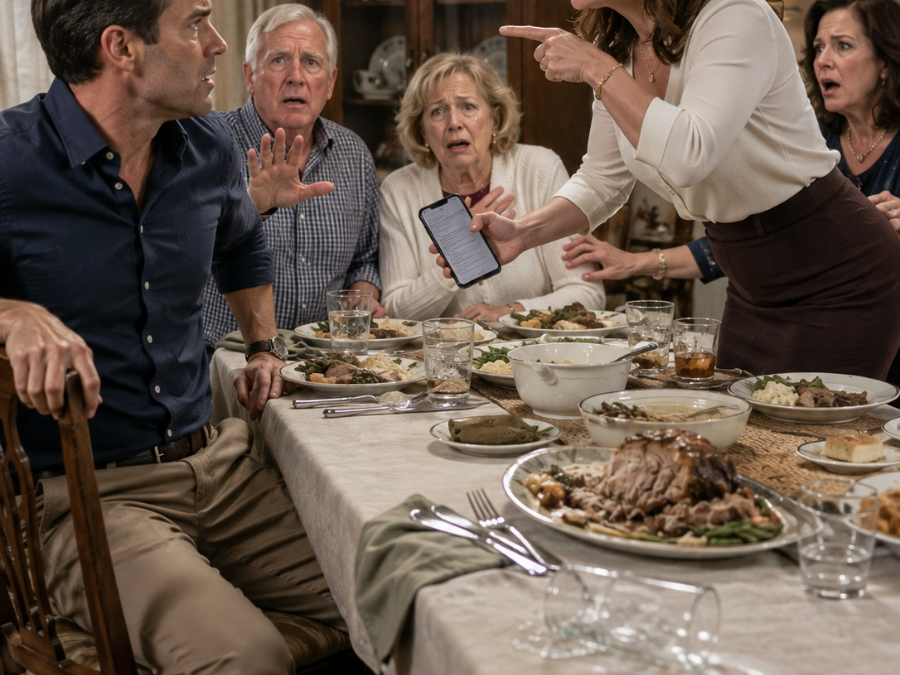
We were halfway through pot roast when she carefully set down her fork and said, “I can’t keep pretending this isn’t happening.”
Everyone stopped eating.
My aunt Marlene was there, along with my cousin Samantha, Brooke, Aaron and my parents. Brooke turned toward Mom and said, “Daniel has been draining your account since Dad got sick.”
Mom’s face changed instantly. “What?”
Brooke lifted her phone.
She had screenshots showing the contractor payment, the furnace repair, the property tax and several utility transfers, all stripped of descriptions and presented as thousands of dollars leaving my parents’ account under my authority.
“He got himself power of attorney right after Dad’s stroke,” she said. “Does nobody else think that’s suspicious?”
Dad tried to interrupt, but his speech was slow from exhaustion.
Brooke spoke over him.
Then she finally looked directly at me.
She smiled.
“Go ahead,” she said. “Tell everyone I’m lying.”
That smile told me more than the screenshots did.
Someone who discovers theft asks questions. Someone who arrives with an audience, selected evidence and a finished story is usually trying to control what everyone believes before the real questions begin.
I looked at Mom.
She was already crying.
Aunt Marlene had reached across the table to hold her hand.
Aaron stared silently at his plate.
And sitting there with all of them judging me, I suddenly remembered what I had seen in the bank statements that had arrived in my email at 6:26 that morning.
Brooke had no idea I already knew.
So I said only, “Okay.”
Then I stood, thanked Mom for dinner and walked out.
Behind me, the room erupted.
By the time I reached my car, my family had decided my silence was a confession.
They had no idea it was strategy.
Part 2: The Records Brooke Never Expected Me to See
By the time I arrived home, the family group chat had become a public trial.
Aunt Marlene posted a long message about financial abuse of elderly parents, Brooke responded with a paragraph about how devastated she was to expose her own brother, and several relatives reacted with hearts as if courage consisted of accusing someone before asking him a single question.
Then Mom removed me from the group.
That hurt more than Brooke’s accusation.
The next morning, Mom called crying and asked why I had done it.
“We would have helped you if you needed money,” she said. “You didn’t have to take ours.”
I could have photographed every receipt and sent it immediately.
Instead, I said, “If removing me from the account makes you feel safer, you should do it.”
She went quiet.
“Brooke already scheduled an appointment at the bank for Wednesday.”
That sentence lodged in my head.
Already scheduled.
Brooke had accused me Sunday evening, yet by eight-thirty Monday morning, she had arranged the next step.
Wednesday afternoon, my financial authority was revoked.
Brooke drove my parents to the bank and sat beside them during the meeting.
That evening Dad called from their landline.
“Danny,” he said slowly, fighting for each word, “something… isn’t right.”
I sat up immediately.
“She did all the talking,” he continued. “I want to see the papers. My papers. Come Thursday. Your mother has book club.”
That night I opened the folder I had been building.
The electronic transfers supposedly reimbursing household expenses stretched back almost twenty months.
At first they were small—$125, $175, maybe $200 once a month.
Then they grew.
During the eight months after Dad’s stroke, they became $350, $450 and occasionally more than $600, sometimes twice in the same week.
The transfers alone totaled nearly $19,000.
Then there was the debit card.
Several years earlier, my parents had given Brooke a secondary card when she was helping Mom with errands. Everyone had forgotten the card existed.
Brooke apparently had not.
The salon visits and restaurant deliveries were irritating but not catastrophic. What mattered were five recurring payments to North Valley Properties.
I searched public business records and discovered the company owned the strip center where Juniper Row operated.
My parents had been paying Brooke’s store rent.
When I added the transfers, card purchases and rent payments together, the total was more than $36,000.
I actually laughed once, sitting alone at my desk with a yellow highlighter in my hand.
Brooke had accused me of stealing roughly $10,000 that had purchased repairs and taxes for our parents while she stood on top of a $36,000 hole.
But I still didn’t confront her.
I called an elder-law attorney named Melissa Grant and explained everything.
Her first question was simple.
“Do your parents knowingly approve those transactions?”
“I don’t believe so.”
“Then stop thinking about your sister for a moment,” she said. “Your father is the account holder. Start with him.”
On Thursday, I sat across from Dad at the same table where my family had condemned me four days earlier.
I placed six pages in front of him.
“You wanted your records,” I said. “Here they are.”
I didn’t tell him what to think.
He put on his reading glasses and slowly worked through every line.
When he reached the payments to North Valley Properties, he stopped.
“She told us,” Dad said carefully, “she was paying that herself.”
I nodded.
“Did any money come back?”
“No.”
His good hand curled into a fist.
Then he lowered his voice.
“Your mother can’t know yet.”
I looked at him.
“She’ll call Brooke,” he said. “Brooke will start moving things.”
Melissa had said almost exactly the same thing.
Then Dad told me something neither of us knew.
Three weeks before Brooke accused me, the bank had called the house because someone had attempted to change access permissions over the phone.
Someone had been trying to remove my authority before I ever mentioned the old statements.
Brooke’s Sunday-night performance had not been spontaneous.
She had been preparing for me to discover something.
Dad reached across the table and grabbed my wrist with his weakened hand.
“Why didn’t you fight Sunday?”
I looked at him.
“Because she wanted me to.”
For the first time since the stroke, Dad smiled.
It wasn’t a happy smile.
It was the smile of a man who had finally realized we were looking at the same problem.
Part 3: For Six Months, I Let Everyone Believe Her
The next several months were some of the loneliest of my life.
I attended Mom’s birthday carrying flowers while conversations stopped whenever I approached, stood at Thanksgiving holding a plate nobody invited me to refill and watched relatives whisper in corners as though I had become dangerous.
Brooke, meanwhile, became the family hero.
She announced that she had taken responsibility for Mom and Dad’s finances “to restore transparency,” and Aunt Marlene praised her for stepping up when things became difficult. Brooke posted sentimental photographs with Mom online and wrote captions about protecting aging parents.
I saved screenshots.
Not because the captions mattered legally.
Because I had started a case file.
At work I called it investigative discipline.
At home I named the folder furnace warranty because nobody voluntarily opens a folder called furnace warranty.
Dad and I met every Tuesday morning while Mom went grocery shopping with Aunt Marlene.
We reviewed statements, account changes and copies of old checks.
Some weeks Dad wanted to stop.
“She’s still my daughter,” he said once. “Maybe I tell her I know and she pays it back.”
I didn’t push.
“You can,” I said.
Two weeks later, Brooke transferred most of my parents’ savings into a new high-yield account that she had opened for them with herself listed for online access.
She told Dad after it happened.
That night he called me.
“Bring Melissa’s number Tuesday.”
In early December, Dad, Melissa and I sat in her office and began doing things officially.
Dad requested three years of full account records, disputed the transfers he had never approved, challenged the commercial rent payments and revoked Brooke’s card privileges.
The bank opened a formal fraud review.
A calm investigator named Mrs. Reynolds interviewed Dad by telephone while I sat beside him.
“Mr. Harper,” she asked, “did you authorize payments from your personal checking account to North Valley Properties?”
Dad leaned toward the phone.
“No, ma’am,” he said slowly. “I did not know my checking account owned part of a gift shop.”
Even Melissa laughed quietly at that.
Then strange things started happening.
Brooke’s secondary card stopped working.
The recurring transfers failed.
Paper statements began arriving at my parents’ house under new security procedures.
Mom assumed the bank had upgraded their protections because of the trouble involving me.
Brooke understood more than she admitted.
Three days before Christmas, Aaron sent me a text.
Hope everyone can move forward next year. No reason to keep hurting the family. Let things go and maybe everything can be normal again.
I had said nothing publicly.
Nobody supposedly knew an investigation existed except Dad, Melissa and the bank.
Aaron’s message told me Brooke had felt something shift.
I replied, Merry Christmas, Aaron.
Then I saved the screenshot.
Christmas dinner was at Brooke’s house.
She had candles everywhere, catered food warming in silver pans and a tree decorated so perfectly it looked rented.
Before dessert, Brooke raised her glass.
“This year tested us,” she said, “but family means protecting the people who matter.”
Then she looked directly at me.
“And everyone who belongs here is here.”
Aunt Marlene murmured, “Absolutely.”
Mom squeezed Brooke’s hand.
I said nothing.
Eleven days earlier, Dad had formally opened a bank investigation into the daughter everyone was praising.
In January, Brooke organized what she called a family planning meeting.
She brought a financial adviser who was a friend of Aaron’s and presented a glossy binder explaining why Mom and Dad should sell their mortgage-free home, move into Brooke’s finished basement suite and place the proceeds into a family trust.
Brooke would manage the trust.
I sat near the window and listened.
Finally, I asked one question.
“Who reviews the trustee?”
Brooke smiled.
“This kind of suspicion is why Mom and Dad removed you from their finances.”
Nobody laughed.
Dad didn’t argue either.
He simply said, “I’ll think.”
Brooke pushed harder.
She said spring would be the best time to list.
She had already spoken to a real estate agent.
That was when Dad’s expression changed.
Later we learned why she needed the sale.
Juniper Row was struggling.
Brooke and Aaron had personally guaranteed a large business loan, and once my parents stopped unknowingly covering the shop’s rent, the entire structure began collapsing.
The trust wasn’t estate planning.
It was a rescue plan.
And Brooke was trying to rescue herself with the proceeds from our parents’ house.
Part 4: The Letter That Did What My Voice Couldn’t
The bank finished its review on a Thursday morning in March.
Dad called me at work.
“Certified letter came,” he said.
My stomach tightened.
“How bad?”
“Forty-three pages.”
I left early and drove to my parents’ house.
The report was brutally simple.
Transaction dates.
Transfer amounts.
Card numbers.
Recipient information.
Five commercial rent payments.
No documented authorization from either account holder.
The bank identified $36,840 in disputed transactions connected to Brooke’s access.
There were no emotional words.
No accusation.
No dramatic language.
Just numbers printed beneath a bank letterhead.
After six months of being called a thief, it was the most beautiful thing I had ever seen.
But before I arrived, Mom had opened it herself.
She sat alone at the kitchen table reading every page.
Dad told me later that she went through the report twice before calling Aunt Marlene.
Mom read the totals over the phone.
For once, Aunt Marlene had nothing to say.
At 5:32 that evening, while I was driving home, my phone began vibrating continuously.
I pulled into a grocery-store parking lot.
Somebody had added me back to the family group chat.
The first message I saw was from Aunt Marlene.
Everyone needs to read this.
Below it was a photograph of the bank’s summary page.
Then came another message.
Brooke, explain the business rent.
Brooke responded quickly.
There has been a misunderstanding. I am working directly with the bank. Please stop discussing private family finances over text.
Six months earlier, that might have worked.
Against forty-three pages of bank records, it sounded ridiculous.
My cousin Samantha, who had remained almost completely silent since the original dinner, finally wrote something.
I was helping at the shop last summer and heard Brooke say, “I just have to survive the review.” I thought she meant taxes. Now I’m not sure.
Then Brooke used the move I knew was coming.
Daniel is behind this. He has been trying to punish me since Mom and Dad removed him. Think about who benefits from making me look guilty.
My fingers hovered over the keyboard.
Before I could respond, Mom did.
Daniel did not request this investigation.
Then another message appeared.
Your father and I did.
I stared at the screen.
Six months earlier, Mom had removed me without asking a single question.
Now she wrote one more message.
You stood in my kitchen and blamed your brother.
The chat went silent.
Aaron finally posted that they would discuss everything privately.
Nobody answered him.
I drove home and slept better than I had since August.
The confrontation happened Saturday at my parents’ house.
Dad insisted on using the same dining table where Brooke had accused me.
No extended family.
No audience.
Just Mom, Dad, Brooke, Aaron and me.
Brooke arrived wearing a navy blazer and carrying a leather folder, looking as polished as she had during the original accusation.
This time, nobody cared about appearances.
She cried.
Some of it was probably genuine.
She said the transfers were reimbursements.
She said Mom had always wanted to support the store.
She said the commercial rent was supposed to be a temporary loan.
Dad pushed the bank summary across the table.
“Show me.”
Brooke looked confused.
“Show you what?”
“The loan.”
Silence.
“A message,” Dad said. “An email. Anything where I said yes.”
Brooke stared at the paper.
Then she looked at me.
“You did this to me.”
For six months I had imagined what I would say when she finally accused me again.
In the end, I didn’t need much.
“You had screenshots and a story,” I said. “I had receipts and time.”
Her jaw tightened.
“You told them I was draining the account.”
I leaned forward.
“There wasn’t much left to drain, Brooke.”
Aaron started talking about business pressure, unexpected expenses and how they had been trapped financially.
Dad placed his good hand flat on the table.
Everyone stopped.
“You sat here,” he said slowly, “and watched this family bury my son.”
Aaron looked down.
Dad continued.
“You knew where the money went.”
Nobody answered.
Mom began crying.
And for the first time, Brooke stopped trying to control the room.
Part 5: Some Truths Have to Arrive in an Envelope
My parents chose not to pursue criminal charges.
Melissa explained every option carefully, including repayment, civil recovery and referral to law enforcement, and after several difficult conversations, Mom and Dad decided they wanted the money restored without spending the remaining years of their lives inside a courtroom.
Brooke signed a formal repayment agreement.
Every disputed transaction was listed.
Every payment date was scheduled.
The agreement required her and Aaron to repay the remaining balance over five years after the bank recovered part of the funds directly.
If they missed two consecutive payments, my parents retained the right to pursue further legal action.
Brooke has not missed one.
Juniper Row closed that summer.
Their expensive SUV disappeared soon afterward.
The plan to sell my parents’ house vanished permanently.
Dad still sits on the same front porch every afternoon, usually complaining that the neighbors hire people to do yard work any healthy person could do with a Saturday and some discipline.
Aunt Marlene apologized to me in person.
She came to my apartment carrying a pie and looked more nervous than I had ever seen her.
“I judged you in one evening,” she said. “It took half a year and a bank investigation to undo it.”
I appreciated that she didn’t make excuses.
“You believed a convincing performance,” I told her. “That performance was designed for people who loved Mom and Dad.”
She nodded.
“We’re okay?”
“Mostly.”
That was the truth.
Mom’s apology was harder.
She cried and asked why I hadn’t defended myself at the original dinner.
There was something underneath the question that hurt—the suggestion that perhaps I had partly caused her to believe Brooke because I hadn’t fought hard enough.
So I told her exactly why.
“If I had pulled out receipts that night, Brooke would have cried and said everything she took was authorized,” I said. “You had already decided who the villain was before dinner ended.”
Mom lowered her eyes.
“I needed something nobody could argue with.”
“The bank.”
“The bank.”
She started crying again.
I hugged her.
We are rebuilding now.
Sunday dinners still happen, although they are smaller and quieter.
Brooke does not attend when I do.
She visits Mom and Dad occasionally, but she has no access to their accounts, cards, passwords or financial decisions.
Mom still talks about wanting her children to reconcile someday.
I let her talk.
I simply don’t promise anything.
People have asked whether I feel like I won.
I don’t.
The money is being repaid, my name is clear and my parents’ house is safe, but I spent six months watching people I loved lower their voices when I entered a room.
There is no reimbursement schedule for that.
Still, peace returned in small ways.
Dad asked me to create a filing system for his paper statements.
We bought three plain binders, labeled them by year and spent an entire Saturday organizing bank records, insurance renewals and utility receipts.
When we finished, he looked at the shelves and said, “Looks excessive.”
I laughed.
“You raised me.”
Last Sunday, we sat on the porch while Mom watered flowers near the driveway.
Dad watched her for a while, then looked at me.
“You knew that night, didn’t you?”
“Knew what?”
“That Brooke was hiding something.”
I nodded.
“Mostly.”
Dad leaned back slowly.
“Longest punch I’ve ever seen.”
I smiled.
“You taught me patience.”
“No,” he said. “I taught you to keep receipts.”
That made me laugh.
The original folder is boxed in my garage now.
Furnace invoices.
Contractor bills.
Bank records.
Screenshots.
Every ugly month of the worst year our family ever had.
I could probably throw it away.
I won’t.
Because Brooke taught me something I already knew professionally but had never expected to learn inside my own family.
The loudest accusation is not always the truth.
Sometimes it is camouflage.
Sometimes the person demanding that everyone look at you is doing it because they are terrified someone might look behind them.
And sometimes defending yourself immediately is less powerful than quietly allowing documents, dates and arithmetic to catch up.
My sister asked me that night, “Go ahead. Tell everyone I’m lying.”
I never did.
The bank eventually did it for me.
The End. This story is entirely fictional and was created for entertainment purposes. All characters, names, locations, events, and situations depicted in this story are imaginary. Any resemblance to actual people, organizations, places, or events is purely coincidental.








