“Ladies Don’t Get Call Signs,” A Colonel Laughed At The O-Club—Then His Admiral’s 4 Words Froze Him
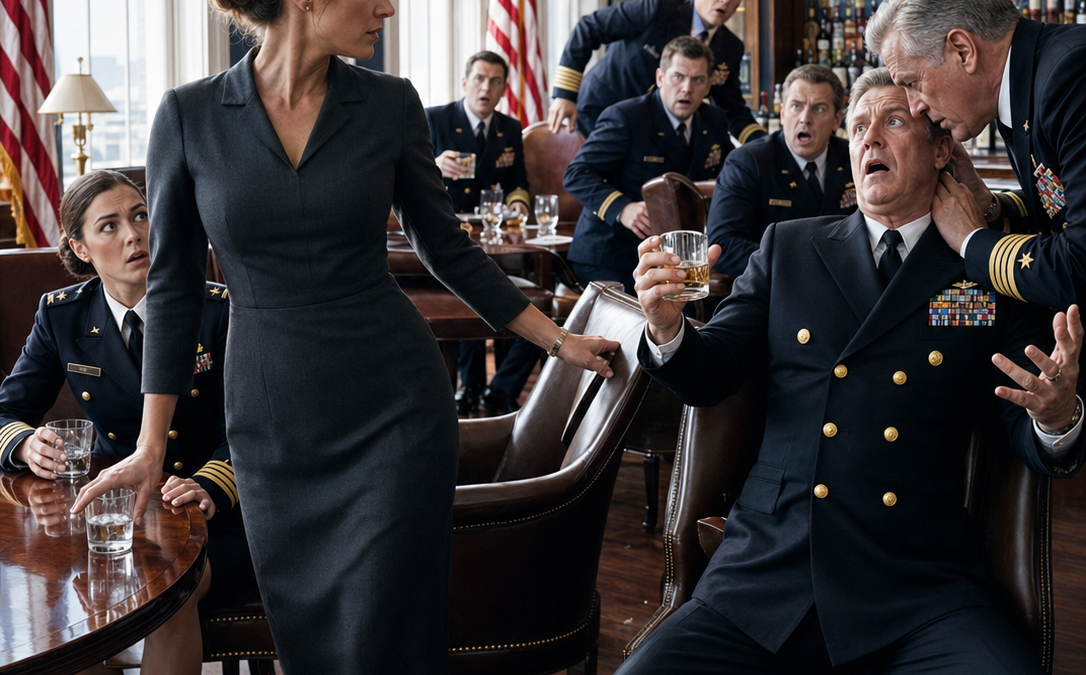
“Ladies don’t fly the hard stuff. They fly desks,” Colonel Derek Marlowe announced across the officer’s club, lifting his whiskey toward me while the lieutenants around him laughed. I was wearing a charcoal dress—no wings, no ribbons, nothing that told them I had spent nineteen years as a naval aviator. I finished my water, told the young officer beside me she’d be fine, and turned to leave. Then Rear Admiral Calder Raines rose from across the room and walked straight toward Marlowe. He leaned close and whispered four words. The colonel went white, and his glass shattered on the floor.
### Part 1
The lieutenant asked me what I did, and I made the mistake of answering like an honest person.
We were standing at the far end of the bar inside the officer’s club, where the lights were too bright, the carpet smelled faintly of spilled beer and floor polish, and everyone laughed one second too late because rank was scattered through the room like loaded furniture.
The symposium reception had been going for almost an hour. Navy. Marines. A few Air Force exchange officers. Contractors in tailored suits who knew how to hover near admirals without looking like they were hovering.
I had come because my office expected me to come. I had stayed because leaving early would have raised more questions than staying quiet.
The young woman beside me introduced herself as Lieutenant Junior Grade Keira Lin, a surface warfare officer with a fresh haircut, nervous hands, and the open face of someone who had not yet learned how many rooms in the military were built to make her feel like a guest.
“What brought you here, ma’am?” she asked.
“Staff work, mostly.”
She nodded as if staff work sounded noble instead of slow death by calendar invite.
“What community are you from?”
I should have said operations. I should have said headquarters. I should have smiled and given one of the bland answers I had spent years perfecting.
Instead, because she had been kind, and because I was tired, and because sometimes the truth slips out of you before the old caution can catch it, I said, “I fly Hornets.”
Keira’s eyes brightened. “Super Hornets?”
“Once upon a time.”
I said it softly. I did not say anything about combat. I did not say anything about the ribbon hanging on the service dress uniform in my hotel closet, pressed and waiting for the next morning’s panels. I did not say anything about the night that still woke me with my hands clenched around invisible throttles.
I just told her the aircraft, the way a woman might tell someone the town where she grew up.
A few feet away, a Marine colonel turned his head.
I had noticed him the moment I walked in. You learn to locate the loudest man in any room. He was broad through the shoulders, heavy at the waist, with a sunburned face and the confident laziness of someone who had been applauded for too long. He held a glass of whiskey in one hand and a cluster of junior officers in the other.
Not literally. But close enough.
His name, I later learned, was Colonel Derek Marlowe.
At that moment, he was simply the man at the center of the laughter.
He looked me over once. Slowly.
I was wearing a charcoal dress. No uniform. No rank. No wings. No ribbons. No hint that I belonged anywhere near a cockpit, a carrier deck, or a conversation he considered his property.
“She’s not aircrew,” he said.
He did not say it to me. He said it to his little court, loud enough for me to hear and quiet enough to pretend he had not meant me to.
His captains grinned.
Marlowe lifted his glass toward me. “Look at her. Ladies don’t fly the hard stuff. They fly desks.”
The laughter came quickly.
A young Marine first lieutenant at his elbow leaned in and murmured, “Sir, maybe don’t.”
Marlowe waved him away without looking, the way a man waves away smoke.
Keira froze beside me. Her face changed from curious to ashamed, as if she had been the one who had invited the insult into the room.
I felt nothing at first.
That surprised me.
Then I felt the old thing open under my ribs. Not anger. Not exactly. Something deeper and more tired. The familiar humiliation of being measured incorrectly by a man who had never imagined the ruler might be broken.
I smiled at Keira.
“You’ll do fine,” I told her. “This room is less frightening than it looks.”
Her eyes flicked toward Marlowe. “Ma’am, I’m sorry.”
“Don’t be.”
I set my glass of water on the bar so carefully it made no sound.
Then I turned toward the door.
I had made a life out of leaving rooms quietly. It was my most practiced skill.
Three steps from the exit, a chair scraped hard behind me.
Not Marlowe’s chair.
A different one.
The room changed before anyone spoke. Conversations folded in on themselves. A laugh died halfway out of someone’s mouth. Even the bartender stopped moving.
I looked back.
Rear Admiral Calder Raines was standing near the windows.
Two stars.
Senior officer at the symposium.
The man everyone in that officer’s club had been orbiting all evening.
His eyes were fixed on me like he had seen a ghost walk through the room in a charcoal dress.
And then he started across the floor.
### Part 2
Before I tell you what Admiral Raines said, you need to know who I was before that room decided I was small.
My name is Mara Ellison. Commander, United States Navy. Naval aviator. Nineteen years in uniform.
I was born in January of 1983 in a house where the heat worked only when it felt like it, in a town small enough that people described you by your parents before they used your name. I got my commission at twenty-two, earned my wings at twenty-four, and trapped my first Super Hornet aboard a carrier when I was young enough to think terror and joy were the same thing if you survived them.
I was good.
That is hard for me to write even now.
Women like me are trained to translate confidence into gratitude. We learn to say “I was lucky.” We learn to say “I had great mentors.” We learn to smooth the sharp edges off competence so no one cuts himself on it.
But the truth is simple.
I was good.
At twenty-eight, I was one of the best section leads in my squadron. My hands knew the aircraft before my mind had to ask. I could read weather in the color of the horizon and trouble in the breathing of a wingman over the radio. I loved the jet in a way that is hard to explain without sounding foolish. It was not romance. It was recognition. The aircraft did not care what I looked like. It did not care whose daughter I was, whether men found me threatening, whether a colonel at a bar thought ladies belonged behind desks.
It only cared whether I could fly.
And I could.
Then came the night that should have made my career and instead became the reason people lowered their voices when they said my name.
In my hotel room, two miles from that officer’s club, my service dress uniform hung inside a garment bag. On the left breast was a ribbon I had stopped mentioning years earlier. Blue, red, white. A small bronze device in the center.
Distinguished Flying Cross with valor.
A beautiful little piece of metal that had cost me almost everything.
For years, men had looked at that ribbon and recalculated me. Some doubted it. Some resented it. Some treated it like an accusation. A woman with a valor award made certain men uncomfortable because it suggested the world was wider than the one they had been promised.
So I stopped pointing at it.
Then I stopped wearing my story at all.
For the last several years, I had lived on staff work. Fourth-floor offices. Parking garage views. Readiness slides. Flight schedules for people who still had the kind of career I used to imagine. I wrote evaluations for officers who would screen for command while my own file sat under a shadow no one wanted to name.
“Messy,” they called it.
There had been an investigation. There had been questions. There had been an after-action report written by a man named Captain Nolan Voss, who had been safe aboard the ship while I was burning fuel over a ridge in the dark.
He wrote that I had disregarded a lawful order.
He was not wrong.
He wrote that my decision was reckless.
That was the lie.
There are lies made from false facts, and there are lies made from incomplete truth. The second kind lasts longer because it can wear a uniform.
I carried that lie for fifteen years.
I carried it through promotions I barely made, billets I did not want, rooms where men called me “solid” when they meant “finished.” I carried it through change-of-command ceremonies where officers I had trained took squadrons I would never be offered. I carried it through every polite smile and every “you’re lucky they kept you flying at all.”
The worst part was not that people believed the lie.
The worst part was that, after a while, I began to live as if it might be true.
I had a folder at home that I had not opened in six years. Inside it were the citation, a photograph of me at twenty-eight with my flight suit half-unzipped and my hair coming loose, a letter from a mother whose son came home because of that night, and the memorial program for my wingman.
Jace Merritt.
Call sign Lantern.
He was twenty-seven years old, newly married, and so cheerful it seemed almost irresponsible. He laughed with his whole body. He taped a picture of his wife inside his kneeboard and showed it to people who had already seen it five times.
He flew like the jet had been born around him.
He died on the last pass.
That sentence has never gotten easier.
People like clean stories. They want sacrifice to come with music, loss to come with meaning, and valor to leave everyone proud.
Real life is not that polite.
Sometimes you do the right thing, and someone still dies.
Sometimes the report that follows makes you sound like the problem.
Sometimes the institution gives you a medal with one hand and buries you with the other.
By the time I walked into that officer’s club in my charcoal dress, I had become very practiced at being buried.
Then Colonel Derek Marlowe laughed and said, “Ladies don’t fly the hard stuff.”
And across the room, a man I had never properly met stood up like a debt had finally found its collector.
### Part 3
The night that made the medal began with stale coffee and bad jokes.
Spring, 2011.
The ready room air was freezing, as always. The ship hummed underneath us with that constant metallic life carriers have, like they are not built so much as breathing. Someone had burned popcorn in the wardroom earlier, and the smell had drifted into every corner of the ship, mixing with coffee, boot leather, and jet fuel until it became the perfume of deployment.
Jace sat backward on a chair while I briefed the route.
“Boss,” he said, tapping his kneeboard, “if we divert, I want it known that I have selected the least tragic option.”
“You selected the one with the best vending machines.”
“Morale matters.”
“You’re a warrior poet.”
“I contain multitudes.”
That was Jace. Always light, never careless.
We launched at last light, two Super Hornets climbing off the carrier into a sky bruised purple at the edges. Our tasking was routine, which is what everyone calls a thing until it stops being routine. Presence patrol. A valley. A reconnaissance team working along a ridge. A nervous area, but not an unusual one.
Then a strike fighter from another squadron went down.
Commander Calder Raines was in that jet then. Not an admiral. Not a flag officer. Just a man in a cockpit who suddenly became a man under a parachute in hostile country.
I heard the change in the radio first.
Controllers have a rhythm when things are normal. Efficient. Almost bored. Then the rhythm snapped. Voices sharpened. Frequencies crowded. Someone called out the beacon. Someone confirmed ejection.
A pilot was alive on the ground.
That was the good news.
The bad news was everything else.
Raines had come down near the ridge where the reconnaissance team was already pinned. Seven Americans, low on options, with enemy fighters moving toward them from higher ground. The people climbing that ridge had seen the jet fall. They knew rescue would come. They knew the downed pilot mattered.
They wanted to reach him first.
We were closest.
We had fuel, but not enough.
There is a number every pilot knows. Bingo fuel. It is not a suggestion. It is math wearing a command voice. At bingo, you leave. You go to the tanker or back to the ship because a jet without fuel is not a weapon. It is a coffin with wings.
Captain Nolan Voss came over the radio from the ship.
“Raven Two-One, return to base.”
My call sign was Raven.
Jace was Raven Two-Two.
I looked at the fuel state. I looked at the ridge on the display. I listened to the JTAC on the ground, young and scared and trying not to sound either.
“Enemy closing from the north slope. Friendlies danger close. We need air now.”
Voss repeated himself.
“Raven Two-One, you are ordered to return to base.”
There are moments in life when everything complicated becomes simple.
Not easy.
Simple.
The book said leave.
The ridge said stay.
I keyed the mic.
“Raven Two-One is rolling in.”
Jace did not hesitate.
“Two-Two’s with you.”
For the next two hours, we held a line in the dark.
We ran gun passes so low the ridge rose up like a wall in the windscreen. Tracers walked across black rock. Muzzle flashes winked and vanished under our fire. The JTAC talked us in, his voice cracking once at the beginning and never again.
When we still had ordnance, we used it.
When we had only guns, we used those.
When the guns ran low, we kept making passes anyway, because sometimes the scream of a jet overhead is enough to make men press their faces into dirt and rethink their courage.
Raines came up on his survival radio now and then. Calm. Precise. Giving what he could see from the wash where he had taken cover.
He never asked if we were leaving.
I respected him for that before I ever knew his face.
The rescue helicopter was delayed. Then delayed again. Weather. Terrain. Fire from the ridge. Every minute stretched. Every pass burned fuel we did not have.
Jace stayed steady.
At one point, he said, “You know, if we get out of this, I’m telling my wife you were the bad influence.”
“You already tell her that.”
“Yeah, but now I’ll have evidence.”
He was smiling. I could hear it.
The helicopter finally checked in, coming low through the dark, searching for the survivors. They could not see the team at first. Everything below looked like shadow and rock and fire.
So we drew them a road.
My tracers marked the ridge. Jace rolled in lower to cover the fighters moving too close to the team’s position.
“Raven Two-One,” he said, voice bright and calm, “I’m staying on the gun. Keep them off the team.”
“Lantern, climb.”
No answer.
“Jace, climb.”
Then the missile warning came.
Then static.
Then nothing.
There are sounds your mind refuses to process because understanding them would split you open.
I kept flying.
That is the part people misunderstand. They imagine grief as stopping. Sometimes grief is the thing that keeps your hands doing what they must because stopping would waste the death that just happened.
The helicopter got in.
They pulled Raines from the wash. They lifted the reconnaissance team off the ridge, all seven alive. We had held the line long enough.
I brought a damaged jet back to the carrier in gray morning light with one side of the sky empty where my wingman should have been.
I trapped on the first pass because I knew I did not have a second one left in me.
When I climbed down, my legs gave out.
A chief caught my elbow and said, “Easy, ma’am.”
I remember thinking how strange that word was.
Easy.
Nothing was ever easy again.
### Part 4
They pinned the medal on me six weeks later in a hangar that smelled of hydraulic fluid and hot metal.
Jace’s wife stood across from me in a black dress that looked too thin for the size of her grief. She accepted his award with both hands, as if someone had given her something breakable. There was a folded flag. There were speeches. There were words like courage, sacrifice, extraordinary heroism.
People cried.
I stood at attention and felt like a fraud.
Not because I had not earned my medal.
Because Jace was not there to roll his eyes at the speeches. Because the ridge had taken him and left me, and survival has a way of disguising itself as guilt.
Even that day, I could feel the story bending.
The official citation said we had saved eight lives.
Captain Nolan Voss’s after-action report said I had ignored a direct order and endangered aircraft, assets, and crew.
Both documents existed.
Guess which one followed me into closed rooms.
The investigation cleared me because facts are stubborn things. The fuel logs. The radio calls. The rescue timeline. The testimony from the ground. No one could say my decision had not saved those men.
But “cleared” is not the same as clean.
After that, every conversation about me had a shadow standing in it.
“Brilliant pilot, but…”
“Decorated, yes, but…”
“Strong under pressure, but…”
That small word did what enemy fire had not. It slowed me down. It narrowed the road. It made senior officers cautious around me in the way people are cautious around a dog they have been told once bit someone.
Nolan Voss moved upward.
I moved sideways.
That was the part no one put in a speech.
Years passed. I stayed current, barely. I took staff billets. I built slide decks. I briefed readiness numbers. I learned the names of other people’s aircraft and other people’s opportunities. I became reliable in the quiet way that makes a woman useful and forgettable at the same time.
And I told myself I was fine.
That lie takes practice.
You start by saying it to other people. Then to the mirror. Then to the part of you that still dreams in afterburner and wakes up reaching for a throttle.
By 2026, I had become so good at being fine that I almost believed it.
The symposium was supposed to be painless. A week of panels, receptions, controlled smiles, and professional small talk. My friend Talia, retired now and living in Arizona, had bullied me into attending.
“You need to be around aviators again,” she said over the phone.
“I am around aviators all the time.”
“No. You’re around spreadsheets with wings.”
“I hate when you’re right.”
“You hate when anyone notices you’re hiding.”
I almost canceled twice.
Then I packed the charcoal dress because it did not look like surrender. I packed my service dress because duty required it. I packed the ribbon because regulation required that too.
And I went.
I did not expect anyone to know me.
That had become comfortable in its own terrible way.
Then Admiral Calder Raines crossed the officer’s club floor.
The room parted for him.
Marlowe turned when the admiral reached him, still wearing the loose smirk of a man expecting to be included in the joke.
Raines leaned close to the colonel’s ear.
He said four words.
“She brought me home.”
The words were not loud.
They did not need to be.
The silence after them was so complete I heard the ice shift in someone’s glass.
Marlowe’s face emptied of color. His hand opened. The whiskey fell, struck the hardwood, and shattered at his feet.
Brown liquid spread through the broken glass like a stain.
For the first time since I had entered the room, Colonel Derek Marlowe looked directly at me.
Not at the dress.
Not at the woman he had invented.
At me.
I wish I could tell you I felt noble.
I did not.
For four seconds, I wanted him ruined.
I wanted the room to turn on him. I wanted every laugh he had collected to become a blade. I wanted fifteen years of swallowed humiliation to land somewhere outside my own body for once.
Then a hand hovered near my elbow.
“Mara,” a smooth voice said, warm and low. “Let’s not make this a thing.”
Captain Nolan Voss stood beside me.
Fifteen years older. Better tailored. Silver at the temples. Still wearing the careful face of a man who had survived every room by knowing exactly which truth to bury.
“He’s had a drink,” Voss murmured. “No harm done. For everyone’s sake.”
For everyone’s sake.
I almost laughed.
Because in my experience, that phrase had never once meant everyone.
It meant the powerful.
It meant the comfortable.
It meant the people who did the harm and preferred not to hear the echo.
The whole room watched me.
Waiting.
Would I explode? Would I cry? Would I vanish politely and make it easier for them to pretend none of it had happened?
I looked at Keira Lin.
She was standing near the bar with tears bright in her eyes, watching me as if the next thing I did might become a rule she would carry for the rest of her career.
That was what broke the old spell.
Not the insult.
Not the admiral.
Not the broken glass.
Her face.
Because I understood that if I let Nolan Voss walk me out of that room, I would not only be disappearing myself.
I would be handing her the map.
I would be teaching her how to fold.
And I was done making my silence look like grace.
### Part 5
“No,” I said.
It was not loud.
True things rarely need volume.
Nolan Voss blinked. His hand stayed in the air near my elbow, touching nothing.
I looked at him fully. For the first time in years, I let myself see his fear. Not fear of me. Not fear of Marlowe. Fear of the silence breaking open and showing his fingerprints inside it.
“We’re going to make this exactly as much of a thing as it is,” I said. “Not more. Not less.”
Then I walked back into the center of the room.
Not toward Marlowe.
Not toward Voss.
Just into the open space beside the bar, where the lights were bright and everyone could see me.
It is difficult to explain how much courage that took. No one was shooting. No one was threatening me. A two-star admiral stood ten feet away. I was physically safe.
But I had spent fifteen years surviving by making myself smaller before anyone could ask me to.
Standing still felt like stepping off a carrier deck into black air.
Admiral Raines watched me with an expression I could not read then. Later, I understood it as recognition.
He knew what it meant to carry a night alone.
“Admiral,” I said, “thank you. But you don’t have to carry it for me.”
Raines nodded once.
Then he faced the room.
“Fifteen years ago,” he said, “I was shot down at night over hostile territory.”
No one moved.
“I ejected near a reconnaissance team of seven that was already pinned on a ridge. Enemy fighters were moving toward us. By every reasonable expectation, I should have died in that wash, and those seven men should have died on that ridge.”
His voice was calm. Plain. He spoke like a man delivering weather.
“A section of two Super Hornets was overhead. They were at bingo fuel. They were ordered back to the ship. Correctly, by the book.”
Across the room, Nolan Voss went very still.
“The section lead chose to stay.”
Raines looked at me then, not dramatically, not for effect. Simply because the sentence belonged to me.
“She and her wingman held that ridge for almost two hours. Danger-close gun runs in the dark. Low passes after their ordnance was gone. They kept the enemy off us until rescue could get in.”
Someone in the back whispered, “Jesus.”
“Every American who came off that ground alive came home because she stayed,” Raines said. “Including me.”
My throat tightened.
I had heard pieces of the story in official language. Citation language. Sterile language. I had never heard it spoken like that in a room full of people who had just been laughing.
“Her call sign is Raven,” Raines said. “Her wingman was Lieutenant Jace Merritt. Call sign Lantern. He stayed on the gun and was killed on his last pass. He was twenty-seven.”
Jace’s name entered the room like a bell.
For a moment, I could smell the ready room coffee again. Could hear his laugh. Could see the photograph taped inside his kneeboard.
Then a chair moved near the back.
An older man stepped forward in dress uniform, a master chief petty officer with a weathered face and eyes that looked like they had seen the underside of too many aircraft in too many seas.
He stopped a respectful distance from me and came to attention.
“Master Chief Owen Hale, ma’am,” he said. “I was crew chief on the rescue bird that night.”
My breath caught.
He held my eyes.
“We couldn’t find them at first. Terrain was bad. Smoke everywhere. We were taking fire. Then we saw your tracers walking the ridge. You drew us a path in.”
His jaw tightened.
“We followed your guns home, ma’am.”
The salute came up sharp.
I returned it.
My hand shook.
His did not.
That salute was not about rank. A master chief with thirty years in uniform does not salute a commander at a reception because he is confused about protocol.
He was closing a circle.
For fifteen years, he had carried the memory of a jet drawing fire through the dark so his helicopter could pull living men out of a place that wanted them dead.
For fifteen years, I had carried the same night as a wound.
Neither of us had known the other was out there.
Keira Lin covered her mouth and cried silently.
Marlowe stood in the broken glass, his face gray.
He did not get yelled at. He did not get a dramatic public punishment. He got something worse.
He got the truth.
Clear.
Specific.
Undeniable.
And not one word of it cared about his comfort.
### Part 6
The room did not erupt.
Real reckonings rarely look like the movies.
People looked down. People looked away. A few stared at me with an expression I had seen before and never trusted, the sudden hunger people get when they realize they have been standing near a story.
Marlowe found me near the hallway twenty minutes later.
He had lost the whiskey, the audience, and the swollen confidence. Without them, he looked older and painfully human.
“Commander Ellison,” he said.
I waited.
He swallowed. “I was wrong in every possible way.”
The hallway smelled of lemon cleaner and wet wool. Somewhere behind us, staff were sweeping up the glass.
Marlowe looked at the floor, then forced himself to look back at me.
“I looked at you and decided I knew what you were. I said it out loud because I wanted young men to laugh. That was cowardice. Not humor. Not tradition. Cowardice.”
Most apologies are designed to ask for absolution without saying so.
This one did not feel like that.
“I’m not asking you to make me feel better,” he said. “I just needed to say it to your face.”
“You’ll report yourself to your chain,” I said.
His eyes flickered.
“Not because I’m demanding it. Because you know you should.”
He nodded once.
“And the next time you see a woman in a room where you think she doesn’t belong,” I said, “you will remember tonight before your mouth gets ahead of your character.”
“I will.”
“That’s all I want from you, Colonel. I’m not interested in your humiliation. I’m interested in the next woman.”
He looked like that landed harder than anger would have.
“Understood, ma’am.”
I never became his friend. I never wanted to. I heard later he self-reported the next morning, received a formal letter, and stayed in his billet with noticeably less appetite for an audience.
That was enough.
Some things do not need to be healed. They need to be corrected.
Nolan Voss was different.
Marlowe had been cruel in a bar.
Voss had been careful in a report.
Careful men do more lasting damage.
The next morning, Admiral Raines asked me to meet him in a conference room before the first panel. I arrived five minutes early and found him already there, standing at the window with coffee untouched beside him.
“Mara,” he said. “I owe you an apology that is fifteen years late.”
I did not know what to do with that, so I stood quietly.
“I knew your name,” he said. “I knew Merritt’s. I read the citation. I asked once or twice what became of you.”
His mouth tightened.
“And I was told there had been complications. That the night had been messy. That your judgment was questioned. You had been cleared, but…” He stopped, disgusted with the word before he spoke it. “But.”
I knew that word well enough to hate it like a person.
“I let that be enough,” he said. “I owed you my life, and I let a vague stain on your file keep me from looking closer.”
The anger I expected did not come.
Maybe because he was not making excuses.
Maybe because there is a difference between a man who builds the silence and a man who fails to challenge it.
Both matter.
Only one is the architect.
“What happens now?” I asked.
“The after-action gets reopened,” he said. “The record gets reviewed. Properly. With testimony from the rescue crew, the ground team, and me.”
I looked at the table.
For fifteen years, I had imagined asking for that. Then I had imagined being denied. Then I had stopped imagining.
“I’m not asking for special treatment,” I said.
“I know.”
“I’m not asking to be given command as some kind of apology.”
His expression sharpened. “Good. Because I wouldn’t insult you with a gift.”
That almost made me smile.
“All I can do,” he said, “is make sure the next board sees the officer who was actually there that night, not the one Nolan Voss wrote into existence.”
That sentence did what sympathy never could.
It gave the wound a name.
Before I left, I asked for one thing.
“There was a Marine lieutenant with Marlowe last night,” I said. “He tried to stop him.”
Raines nodded. “I saw.”
“His name is Ethan Rowe. Someone should remember that.”
The admiral studied me.
“You’re asking me to note the junior officer who challenged his colonel in a room full of seniors?”
“I’m asking you to notice moral courage while it’s still young enough to either be encouraged or crushed.”
Raines’s face softened.
“I’ll make sure it’s noticed.”
That afternoon, during a panel on leadership culture, I sat in the second row beside Keira Lin. She did not say anything at first. Then she leaned slightly toward me.
“Ma’am?”
“Yes?”
“Was it worth it?”
I looked at the stage, where three captains were saying safe things into microphones.
“The flying?” I asked.
“All of it.”
I did not answer right away.
Because she deserved better than a poster.
Finally, I said, “Ask me again when I know how to tell the truth without making it sound pretty.”
### Part 7
That night, I went back to my hotel and opened the folder.
It had traveled with me through four moves and six duty stations. I had kept it in drawers, closets, storage bins, always somewhere safe and always somewhere dark.
My hands hesitated before the clasp.
That embarrassed me.
I had flown through missile warnings. I had trapped a damaged jet at dawn. I had sat across from admirals and briefed failures without blinking.
But a folder on a hotel bed made me afraid.
I opened it anyway.
The citation was on top.
The language was formal, polished clean of smoke and fear. Extraordinary heroism. Complete disregard for personal safety. Highest traditions of naval service.
Under it was the photograph.
Me at twenty-eight.
Flight suit. Tired eyes. Hair escaping regulation. A face still young enough to believe that if you did the work well enough, the work would speak for itself.
I touched the edge of the picture.
“I’m sorry,” I whispered.
Not to Jace.
To her.
I had abandoned that young woman in the drawer with the proof. I had let frightened men convince me that her proudest night was something she should lower her voice to discuss.
There was the letter from the mother of one of the reconnaissance Marines.
She had written it in careful blue ink.
She said her son came home with a tremor in his hands that had not been there before. She said he woke up some nights and sat on the porch until sunrise. She said he had told her there was a pilot overhead who refused to leave them.
She wrote, “I do not know how a mother thanks another woman for giving her child more years. I only know that every birthday he has now belongs partly to you.”
I had read that line once and hidden it away because it hurt too much.
That night, I read it until the words blurred.
At the bottom of the folder was Jace’s memorial program.
His face smiled up at me, young and impossible.
For fifteen years, I had treated his memory like a debt I could only pay with silence. I thought disappearing was a form of respect. I thought if I never claimed the night, I would not be stealing anything from him.
But Jace had not stayed on the gun so I could vanish.
He had stayed so people could live.
There was a difference between carrying the dead and burying yourself beside them.
I cried then.
Not dramatically. Not beautifully.
I sat on the edge of a hotel bed in a room that smelled of detergent and old air-conditioning, and I cried until my chest hurt.
Then I put the photograph of twenty-eight-year-old me on the nightstand.
I left it there while I slept.
For the first time in years, I did not dream of the ridge.
The review took months.
Real correction is slow. It moves through offices, signatures, calendars, legal language, and men who say “process” when they mean discomfort. But Admiral Raines stayed with it. Master Chief Hale gave a statement. So did members of the rescue crew. So did two of the men from the reconnaissance team. One had named his son Jace.
That nearly broke me all over again.
The corrected record did not make the night clean. It did not bring Jace back. It did not return fifteen years.
But it said what happened.
That mattered more than I expected.
Nolan Voss’s original report was annotated. Its conclusions were formally challenged and corrected. He retired quietly not long after, with all the polished dignity a careful man can arrange when the floor beneath him begins to crack.
I did not write him.
I did not call.
The record said enough.
A command track that had been closed to me for years opened again. Not because anyone handed me a consolation prize, but because the board finally saw the truth without Voss’s shadow standing in front of it.
I got considered.
Properly.
That was all I had ever wanted.
Keira wrote to me three weeks after the symposium. Her email was formal enough to make me smile.
She said she had spent her short career learning how to make herself smaller before anyone could ask. She said watching me stand in that room had scared her more than Marlowe’s insult, because it showed her she had a choice.
At the end, she asked again.
Was it worth it?
I stared at the question for a long time.
Then I answered.
I told her the Navy had taken things from me it had no right to take. I told her I was angry and would probably always be angry. I told her service could be noble and unfair at the same time, and anyone who told her otherwise was selling something.
Then I told her about the eight people on that ridge.
Alive.
Older now.
One raising a boy named Jace.
“No report can unsave the people you saved,” I wrote. “No frightened man with a pen can reach back into the dark and take the work from your hands. The work is yours. Hold on to that when the room refuses to look.”
I read it twice before I sent it.
Then I added one more line.
“And when it is your turn, do not teach the next woman how to disappear.”
### Part 8
On a gray morning several weeks after the record was corrected, I put on a flight suit.
It still fit.
That felt like mercy.
The ramp was cold, the kind of cold that makes sound travel sharp. Ground crew moved around the aircraft with practiced hands. The Super Hornet waited beneath the white morning sky, all angles and patience, as if no time had passed at all.
But time had passed.
It had crossed my face, thinned my flight log, stiffened my knees, silvered a few strands of hair I tucked under my helmet. It had taken Jace. It had made Calder Raines an admiral. It had turned Nolan Voss into a retired man with a corrected stain on his record. It had made me smaller, then tired of being small.
I climbed the ladder.
My hand found the same grips it had known for nineteen years.
Muscle memory is a kind of truth.
Inside the cockpit, the world narrowed to instruments, straps, canopy, breath. The old quiet settled around me. Not peace. Focus.
I placed my hands on the throttles and stick.
For a moment, I closed my eyes.
“Lantern,” I said softly, as I had before every flight since the night he died. “Raven’s up. I’ve got it from here.”
The dead did not answer.
They never do.
But something in me answered back.
Competence.
It had been there all along, buried under reports, offices, polite doubts, and my own exhausted agreement with people who had never known what I was.
The aircraft did not care about the officer’s club.
It did not care about Colonel Marlowe’s laughter, Nolan Voss’s report, or the years I had spent behind a desk with a parking garage outside my window.
It cared about inputs.
Judgment.
Hands.
Discipline.
A pilot.
And I was one.
I started the engines.
The jet came alive around me, vibration rising through the seat and into my bones. The sound was not memory. It was present tense.
I taxied out under a wide pale sky.
When cleared, I pushed the throttles forward.
The runway blurred. The nose lifted. Wheels left the earth.
And then there was air.
Cold, clean, indifferent air.
For the length of that climb, no one else’s version of me could reach the cockpit.
Not the colonel’s.
Not Voss’s.
Not even my own old surrender.
There was only the jet and the sky and the work.
The real work.
The thing that had always been mine.
Later, people wanted the story to be simpler than it was. They wanted to say the arrogant colonel got humiliated, the admiral saved me, and I rose from the ashes like something in a movie.
That is not the truth.
Admiral Raines did not save me.
Colonel Marlowe did not destroy me.
Nolan Voss did not create my worth by trying to bury it.
What happened in that officer’s club was smaller and harder than rescue.
A man said something cruel.
Another man said something true.
And for once in my life, I did not leave the room to make the lie more comfortable.
That was the turning point.
Not the medal. Not the review. Not the command board.
The standing still.
So if you are reading this and you know what it is to be made small by people who benefit from your silence, I need you to understand something I learned too late and still in time.
You do not have to explode.
You do not have to vanish.
Those are not the only doors.
There is a third thing.
Stand in the room.
Let the truth be visible.
Say the actual amount. Not more. Not less. Do not decorate it. Do not apologize for it. Do not make it smaller so someone else can swallow it comfortably.
The silence does not protect you.
It protects the people who were wrong.
You are allowed to take up the space you earned.
You are allowed to stop waiting for permission.
You are allowed to say your own name.
Colonel Marlowe said ladies don’t get call signs.
He was wrong.
Mine is Raven.
I held a ridge open in the dark so eight Americans could come home. I lost my wingman doing it. I spent fifteen years letting smaller men convince me the night belonged in a drawer.
It did not.
It happened.
It was mine.
And I am done being quiet.
THE END!
Disclaimer: Our stories are inspired by real-life events but are carefully rewritten for entertainment. Any resemblance to actual people or situations is purely coincidental.








