My Stepdaughter Said She Made Sure I Inherited Nothing—Then the Lawyer Laughed
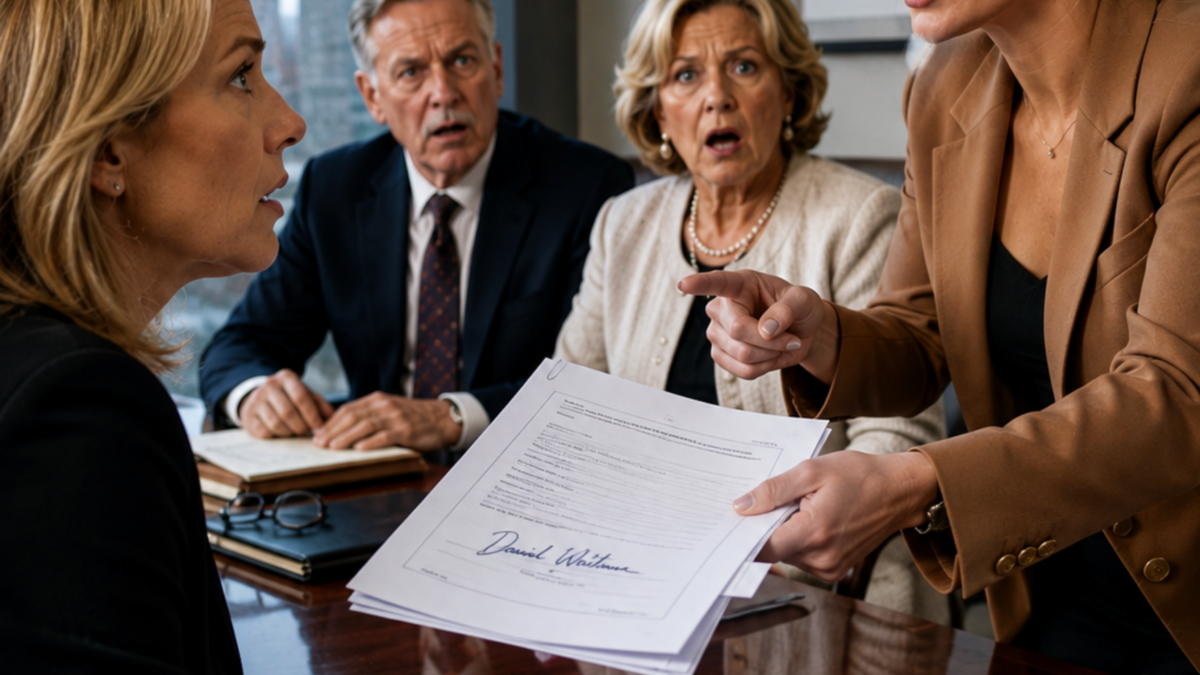

My Stepdaughter Said She Made Sure I Inherited Nothing—Then the Lawyer Laughed
Eleven days after I buried my husband, his daughter looked across a lawyer’s conference table and told me she had made sure I inherited nothing. She believed an estate document proved she had won. Her grandmother believed blood mattered more than eighteen years of marriage. For one terrible moment, I believed my husband had secretly erased me from the life we built together. Then his attorney laughed, opened another folder, and revealed that Daniel had returned weeks later to change everything again. But the new will was only the beginning. Hidden debts, $186,000 in secret payments, a struggling family business, and one unfinished legal detail would force all of us to discover what Daniel had really left behind.
Part 1: My stepdaughter celebrates too early at her father’s will meeting.
It was 10:07 on a rainy Tuesday morning in Columbus, Ohio, eleven days after we buried my husband.
Across the conference table, my stepdaughter Madison smiled at me and said, “I made sure you inherited nothing.”
Then Daniel’s lawyer took off his glasses and laughed.
Not a big laugh. Not a movie laugh. Just one dry little sound that escaped before he could stop it.
And I remember thinking, Well, either I’m about to lose my house, or Madison has made a very expensive mistake.
Thomas Keating’s office sat above a brick building off Henderson Road. Through the window, I could see a CVS parking lot shining beneath the rain. I still wore the black flats from Daniel’s funeral because I had not had the energy to put them away.
Madison sat across from me, thirty-four, perfectly styled, pale pink nails resting beside a leather folder. Beside her was Daniel’s mother, Evelyn, seventy-nine, pearls around her neck and disapproval permanently arranged across her face.
Thomas had barely opened his file when Madison delivered her announcement.
“What are you talking about?” I asked.
“Dad fixed the estate.”
“Fixed?”
“The company stays with his family. The Whitmore assets stay with his family. You get what Dad decided you should get.”
“I was his wife.”
Evelyn answered quietly.
“And Madison was his daughter.”
There are ordinary sentences that become knives depending on who says them.
That was one.
I met Madison when she was sixteen. She had braces, a learner’s permit, and enough attitude to power a small city. I taught her to drive after she nearly destroyed Daniel’s mailbox. I took her to Ohio State orientation when Daniel was stuck on a job in Dayton. When her marriage collapsed, I loaned her money.
When she had a medical emergency at twenty-eight, I sat beside her until nearly four in the morning.
Once, at a cookout, someone asked who I was.
“My second mom, basically,” Madison had said.
Basically.
Funny how one word can survive for years.
Now she opened the leather folder and pushed several pages toward me.
“There.”
Daniel Whitmore.
His signature.
February 12.
My stomach tightened.
The document gave Madison controlling interest in Whitmore Mechanical. I would receive the house and several other assets, but not the role in the company Daniel and I had discussed years before.
I looked at Thomas.
“Is this real?”
“Yes.”
That hurt more than if he had said no.
Because Daniel really had signed it.
For the first time that morning, I stopped being angry at Madison.
I became angry at my dead husband.
Apparently, he had made decisions about our future without telling me.
“Is this his final will?” I asked.
Thomas placed one hand on the folder.
“No.”
Madison’s smile vanished.
“What do you mean, no?”
Thomas tapped the February date.
“Where did you get this copy?”
“Dad gave it to me.”
“When?”
“February.”
Thomas opened a thicker file.
“Daniel came back to see me on March 28.”
Madison froze.
“No, he didn’t.”
Thomas looked straight at her.
“I was here.”
He removed another set of documents.
The room became so quiet I could hear rain tapping the glass.
“Daniel revised his estate plan again.”
Madison leaned forward.
“Because of her?”
She pointed at me.
Thomas did not even look in my direction.
“No. Laura wasn’t here. She wasn’t on the phone. She wasn’t copied on the correspondence. She gave me no instructions.”
I should have felt relieved.
Instead, I felt sick.
My husband had changed everything in February.
Then changed it again in March.
And somehow his wife had been the last person to know.
“What did he change?” I asked.
Thomas turned a page.
“The business. Madison’s distributions. And Laura’s authority regarding what happens next.”
Madison laughed without humor.
“She answered phones.”
I looked at her.
“For twelve years.”
I could have corrected her.
Payroll. Insurance. Collections. Vendor contracts. Customer calls at six in the morning. Christmas Eve emergencies. Employees whose children I knew by name.
I said nothing.
Thomas continued.
Then he reached the part none of us expected.
“Whitmore Mechanical has significant debt.”
“How significant?” I asked.
He gave us the approximate total.
“About $1.2 million.”
Madison stopped breathing for a second.
I stared at Thomas.
“Are you telling me I owe a million dollars?”
“No. You personally do not. But the company is not worth what Madison appears to believe it is worth.”
Madison’s face went white.
Evelyn whispered, “Daniel’s company was successful.”
“It was operating,” Thomas said. “That is not the same thing as being debt-free.”
Loans.
Equipment financing.
A heavily used line of credit.
Open obligations.
And now that Daniel was gone, the bank would review everything.
If financing could not be restructured, the company might have to sell equipment.
Maybe sell entirely.
“Dad never told me,” Madison whispered.
For the first time that morning, we were on the same side of a sentence.
“No,” I said quietly.
“He didn’t.”
Two nights later, at 7:18, Daniel’s bookkeeper called me.
“Laura, before I email you something, promise me you won’t call Madison.”
I sat upright.
“Why would I call Madison?”
There was a long silence.
Then Denise said, “Because every payment has her name on it.”
Part 2: Secret payments expose a deeper betrayal inside Daniel’s business.
The next morning, I arrived at Whitmore Mechanical before eight.
The place looked exactly as Daniel had left it.
Work orders clipped to a board. Invoices beneath a stapler. Furnace filters stacked near the back door. Six service vans outside in crooked rows.
Daniel’s empire.
Eleven employees, one warehouse, and a coffee maker that had probably been leaking since the Obama administration.
Denise Palmer had worked for Daniel almost fourteen years. She was fifty-eight and cleaned things when nervous.
That morning, she wiped her calculator twice.
“Sit down.”
“I hate conversations that start that way.”
“You’ll hate the rest more.”
She turned her monitor toward me.
Rows of transactions filled the screen.
Then I saw the name.
M. Whitmore Consulting LLC.
Madison.
“How much?”
Denise handed me a printed summary.
I read the total twice.
$186,000.
Over roughly eighteen months.
“For what?”
“That’s what I’ve been trying to figure out.”
Consulting advances.
Advisory fees.
Reimbursements.
“What consulting?”
“I never saw her consult on anything.”
My face went hot.
“She took money from her father.”
Denise raised a hand.
“I didn’t say that.”
“You showed me one hundred eighty-six thousand dollars.”
Then she opened another folder.
“Daniel approved every payment.”
That stopped me.
His signature was everywhere.
I called Thomas.
He listened, then said, “Do not accuse Madison of stealing.”
“I didn’t say stealing.”
“You were thinking it loudly.”
The worst part was not the money.
It was the secrecy.
Years earlier, when the company had been $23,000 short for payroll, I sold a condo I owned before marrying Daniel and helped keep his workers paid.
Daniel later repaid me.
But I never forgot how frightened we had been.
Now nearly eight times that amount had quietly gone to his daughter.
Later, Daniel’s nephew Ryan told me Madison had been pushing her father to sell Whitmore Mechanical to Midstate Climate Systems.
“She wanted the check,” he said.
I wanted to believe him.
Then Thomas found the emails.
Madison had not stolen anything.
Daniel had been bailing her out.
Her divorce left her buried in debt. Then a boutique she opened with a friend failed.
Credit cards.
Taxes.
Legal bills.
A business loan.
One email from Daniel made me put down my phone.
This comes out of what you’ll eventually receive. Laura doesn’t need to be dragged into it.
Dragged into it.
I was his wife.
Apparently, I was useful enough to help save his company but not useful enough to know where its money was going.
Then Thomas showed me something else.
Madison had not only wanted Daniel to sell because she wanted money.
She had begged him to slow down.
You’re exhausted, Dad. You can’t keep working sixty-hour weeks. Sell it and enjoy your life.
That was the trouble with real people.
Just when you organize everyone neatly into villains and victims, they do something human and destroy your filing system.
For twenty-four hours, I thought we finally understood everything.
Then Madison’s attorney sent Thomas a letter.
The letter challenged the ownership records for Whitmore Mechanical.
One company document did not line up cleanly with Daniel’s March estate plan.
I drove straight to Thomas’s office.
“Tell me he’s wrong.”
Thomas read the letter again.
Then he removed his glasses.
“I can’t.”
My stomach dropped.
“Can’t what?”
“I can’t tell you he’s wrong, Laura.”
Madison’s attorney had found a real ambiguity.
Daniel may have signed the plan without completing every legal step necessary to move his business interest exactly where he intended.
It did not mean Madison would win.
But now she had something legitimate to fight over.
And while lawyers argued, the real company began bleeding.
A major customer moved half its service work elsewhere.
Two technicians quit.
One stood in my office holding his uniforms inside a grocery bag.
“I’ve got three kids, Laura.”
“I know.”
“I can’t wait six months to find out if I have a job.”
“I know.”
After he left, I closed Daniel’s office door.
For twenty minutes, I considered selling everything.
Then Ryan came in and insisted selling would destroy the company.
Denise casually said, “Ryan still thinks Daniel was going to give him that ownership percentage.”
I turned slowly.
“What ownership percentage?”
Ryan’s face changed.
And suddenly I realized Madison was not the only person in Daniel’s family who had been protecting a secret.
Part 3: Everyone has something to gain from Daniel’s unfinished plans.
Daniel had apparently discussed giving Ryan a small ownership percentage someday.
Nothing had been signed.
Nothing had been valued.
Nothing was official.
But Ryan had spent weeks warning me that Madison would sell the company while never mentioning that he personally had something to gain if it survived.
“So when you said Madison might destroy everyone’s jobs,” I told him, “you weren’t exactly neutral.”
“I didn’t lie.”
“That’s a very specific defense.”
Ryan looked down.
“If Midstate buys us, I could be gone in a month. Half the guys could.”
I understood.
He had children. A mortgage. A life built around Whitmore Mechanical.
He was not evil.
He was scared.
That was Daniel’s real inheritance, I began to think.
Not property.
People protecting their own corners of his unfinished life.
A week later, Thomas called me into his office.
He had Daniel’s estate-planning notes.
No secret recording.
No dramatic letter.
Just correspondence, financial documents, and handwritten notes.
Together, they proved something important.
Daniel knew exactly what he was doing.
By March, he understood how deep Madison’s financial problems were. He did not want to disinherit her.
He wanted to protect her inheritance from her creditors—and from her own worst decisions.
Then Thomas found one handwritten sentence.
He read it aloud.
“Laura understands what this company owes people better than Madison understands what the company is worth.”
I closed my eyes.
“That sounds annoyingly like him.”
“Very much so.”
I wanted to be furious.
Instead, something inside me softened.
Daniel had been disappointed in Madison.
Maybe angry.
But he was still her father.
He had tried to protect her even from herself.
Thomas and the accountant eventually reconstructed most of the company ownership trail.
Madison’s attorney had found a genuine ambiguity.
But not the fatal flaw he hoped for.
Still, litigation could last months.
Maybe years.
It could consume the estate while weakening the company.
Thomas recommended mediation.
“Can I win?”
“Probably.”
“That isn’t comforting.”
“The better question,” Thomas said, “is what winning will cost you.”
That night Madison texted me.
You should take the house and walk away.
Six weeks earlier, I would have answered immediately.
Instead, I turned off my phone.
The next morning, I told Thomas to schedule mediation.
It began on a Thursday morning in downtown Columbus.
Madison arrived in a navy suit with her attorney and Evelyn.
She looked different.
Less smug.
More dangerous.
Prepared.
Their proposal was simple.
Madison received control of Daniel’s business interest and a larger immediate distribution.
I kept the house and other assets.
She dropped her challenge.
“You get security,” Madison said. “I get Dad’s business.”
“Your father’s employees aren’t furniture, Madison.”
“Don’t pretend this is about the employees.”
“Then what is it about?”
She leaned forward.
“You married Dad after he had already built everything.”
There it was.
Not trusts.
Not debt.
Not ownership records.
The real wound.
I put both hands flat on the table.
“When I married your father, Whitmore Mechanical had six employees, two terrible vans, a leaking roof, and a checking account that could ruin your weekend.”
“That isn’t what Dad told me.”
“Then your father edited.”
Madison stared at me.
“You answered phones.”
“Yes. And payroll. Insurance. Collections. Vendors. Benefits. Scheduling.”
Then I told them about the condo.
The $23,000.
The payroll crisis.
Even Evelyn looked stunned.
“You sold your condo?”
“Yes.”
Madison frowned.
“You said you sold because you didn’t want to be a landlord.”
“Partly. But your father needed help.”
Nobody spoke.
I looked directly at Madison.
“I’m not claiming I built the company. I’m telling you I was there.”
Her jaw tightened.
“You always make yourself sound indispensable.”
“No. I spent eighteen years assuming I didn’t have to prove I belonged in my own marriage.”
The room went completely still.
Then the accountant opened the file containing Madison’s payments.
And when Evelyn saw the number, everything changed.
Part 4: Madison’s financial secrets destroy the story she told everyone.
“One hundred eighty-six thousand dollars?” Evelyn said.
Madison stared at the table.
“You told me your father gave you twenty.”
“I said around twenty.”
Evelyn blinked.
“One hundred eighty-six is not around twenty unless you’re landing an airplane.”
I looked down quickly.
So did Thomas.
Even the mediator had to rearrange her face.
Madison flushed.
“Dad knew about every dollar.”
“Yes,” I said.
She looked at me.
“You know?”
“I know.”
“You’ve been telling people I took it.”
“No. I thought that for about an hour. Then I learned something useful.”
“What?”
“Being angry doesn’t make me accurate.”
The accountant confirmed Daniel authorized every payment.
Then Thomas explained why Daniel changed his estate plan in March.
I had not influenced him.
I did not know about Madison’s debts.
I had not attended his meetings.
Daniel had made those decisions himself.
Madison’s voice became quiet.
“So what did he leave me?”
“A substantial inheritance.”
“Then why can’t I access it?”
“You can access portions under the distribution schedule your father created.”
“So he put me on an allowance.”
Thomas adjusted his glasses.
“Your father preferred the phrase distribution schedule.”
Evelyn made a suspicious coughing sound.
Madison looked smaller somehow.
She finally understood.
The February document she had waved in my face was outdated.
The company was not a giant check.
Her father had changed the plan without my involvement.
And part of her inheritance was restricted because he did not trust what she might do with it.
For a moment, I enjoyed her embarrassment.
I wanted her to remember telling me she had made sure I inherited nothing.
Then I looked at her.
And for one strange second, she was sixteen again.
Hands gripping a steering wheel.
Pretending she was not afraid.
I had enough leverage to hurt her.
Instead, I said, “I’m not trying to take back the money your father already gave you.”
She looked up.
“Why not?”
“Because he gave it to you.”
She said nothing.
“And I’m not asking anyone to use the trust to punish you.”
Her face changed.
“But you’re going to stop telling people I stole your father’s life from you.”
“And if I don’t?”
I looked at the folders covering the table.
“Then we stop talking and let the paperwork do it.”
The mediation continued another three hours.
Nobody got everything.
That was probably why the result worked.
Madison withdrew the main challenge.
The ownership dispute was resolved through negotiated estate and business arrangements.
She could not force an immediate sale.
I did not receive absolute control.
The company got time.
The employees got stability.
We all surrendered something.
In the hallway, Madison passed me without speaking.
Then she stopped.
“He really didn’t tell you?”
I knew exactly what she meant.
The money.
The February plan.
The March changes.
All of it.
“No.”
For the first time since Daniel died, there was no accusation in her eyes.
Only surprise.
And perhaps shame.
Six months later, Whitmore Mechanical was still open.
I did not become some glamorous queen of commercial air-conditioning.
I hired Greg Holloway, fifty-seven, thirty years in HVAC, and absolutely no interest in our family drama.
That was his best qualification.
We restructured financing.
Sold equipment.
Negotiated with vendors.
Eventually, we brought in a minority operating partner who supplied capital without swallowing the company.
Ryan stayed.
When he later asked about the ownership Daniel had once discussed, I told him, “If you ever own part of this company, it will be earned, valued, signed, dated, and probably notarized by someone with excellent penmanship.”
He smiled.
“Fair.”
Things with Madison became quieter.
Not better.
Quieter.
Then one Sunday afternoon in October, someone knocked on my front door.
When I opened it, Madison stood there holding a cardboard box.
No makeup.
Jeans.
Hair in a ponytail.
“I found some of Dad’s things.”
And something in her face told me the final truth had not yet been spoken.
Part 5: One quiet conversation finally reveals what inheritance truly meant.
I stepped aside.
Madison carried the box to my kitchen table.
Inside were Daniel’s old Ohio State sweatshirt, photographs, two pocket knives, birthday cards, and one handmade Father’s Day card.
Blue construction paper.
Crooked red letters.
BEST DAD IN OHIO.
I laughed softly.
“You made this.”
Madison picked it up.
“You helped me.”
“You were sixteen.”
“I remember.”
For a while, neither of us spoke.
Then Madison rubbed her thumb along the edge of the card.
“I was awful to you.”
“Yes.”
Her head came up.
Then she laughed despite herself.
“You’re not supposed to agree that fast.”
“I’m fifty-three. I don’t have enough time left to lie for atmosphere.”
She laughed again.
Then her eyes filled.
I made coffee.
“After Mom moved away,” she said, “Dad was basically my whole world.”
“I know.”
“When you came along, I told myself I liked you.”
“That’s encouraging.”
“I did like you.”
Then she looked down.
“But every year, more of his life had nothing to do with me. Your anniversary. Your trips. The company. Your friends. Your house.”
“Our house,” I said.
She nodded.
“Our house.”
That correction mattered.
“When he started getting tired all the time, I got scared,” she said. “I wanted him to sell.”
“And you wanted the money.”
She looked straight at me.
“Yes.”
I respected that she did not decorate the truth.
“I wanted both. I wanted him to retire, and I wanted the money. After he died, I couldn’t separate any of it anymore.”
I placed her coffee in front of her.
“I convinced myself you took him away from me.”
“I didn’t.”
“I know.”
“You know now.”
She nodded.
There was one truth I had never intended to tell her.
But suddenly, I believed she deserved it.
“For a while, I wanted Thomas to find something that left you with nothing.”
Madison stared at me.
“I wanted you hurt,” I said. “After what you said in that office, I wanted the paperwork to punish you.”
“Why didn’t you?”
“Because your father didn’t.”
That was the final twist Daniel had left me.
Not hidden money.
Not another document.
A choice.
Daniel had known Madison’s mistakes better than I did.
He had been angry with her.
Disappointed in her.
But he still protected his daughter.
And I realized that if I used his death to destroy her simply because I could, I would become exactly the woman she had accused me of being.
Madison wiped her cheek.
I did not tell her everything was forgiven.
It wasn’t.
She did not ask me to pretend.
We simply drank coffee.
She stayed until almost six.
That was enough.
I often think about that rainy Tuesday in Thomas’s office.
Madison believed inheritance meant money.
Evelyn believed it meant blood.
Ryan believed it meant the future of the company.
And for a while, I believed Daniel’s will needed to prove that my marriage mattered.
It didn’t.
Paper can divide property.
It cannot measure eighteen years.
Tuesday dinners.
Stupid arguments.
Bills we paid.
People we helped.
Mistakes we made.
The nights I waited for Daniel to come home.
The mornings he left coffee on the counter.
The conversations we should have had earlier.
Madison told me she had made sure I inherited nothing.
She was wrong.
Not because Daniel left me a house.
Not because I kept a role in his company.
Not because I won a legal argument.
I inherited eighteen years with him.
Nobody sitting across a conference table could erase that.
Daniel’s reading glasses are still beside his recliner.
Carol once asked why I had not moved them.
“I will when I do,” I told her.
She nodded.
Some things simply take longer to put away.
And maybe that was the greatest thing Daniel left me.
Not ownership.
Not money.
Not proof that I mattered.
Just the understanding that love does not become more real because a lawyer writes it down.
THE END.
All the characters and events in this story are fictional and created for the purpose of storytelling and entertainment.
If this story brought you a moment of reflection, comfort, or curiosity, then it has truly fulfilled its purpose.
Thank you sincerely for reading. Your feedback and support are always appreciated and inspire me to keep sharing more stories with you.








