You’re Not My Mother—Until You Need My Money
You’re Not My Mother—Until You Need My Money
For thirty-one years, I helped raise my stepdaughter as if love could erase the word “step.” I attended school meetings, paid bills, held her baby, rescued her family during hard years, and promised $85,000 toward her dream home. Then one morning, after I casually mentioned getting older, she left seven words on my bedroom mirror: “You’re not my mother. You’re on your own.” I didn’t scream. I didn’t cry. I folded the note into my purse and called my lawyer. What happened next exposed something far deeper than one cruel sentence—a belief about my late husband’s money that had quietly poisoned our family for years.
Part 1: Seven cruel words turn an ordinary morning into betrayal.
The first thing I noticed was that the note was crooked.
That sounds ridiculous, but when you have lived in the same Ohio house for twenty-six years, you notice things. A picture frame shifted half an inch. A cabinet left open. A yellow square of paper stuck to the bottom corner of your bedroom mirror.
I stepped closer.
Seven words.
“You’re not my mother. You’re on your own.”
I read them twice.
I didn’t cry. I didn’t throw anything. I peeled the note from the mirror, folded it carefully, slipped it into my purse, and called my lawyer.
“Mary Anne, are you in the office?”
“Until five. Diane, what happened?”
I looked through the window. Lauren’s SUV was already gone.
“I need to stop something.”
That morning had begun with coffee and blueberry muffins.
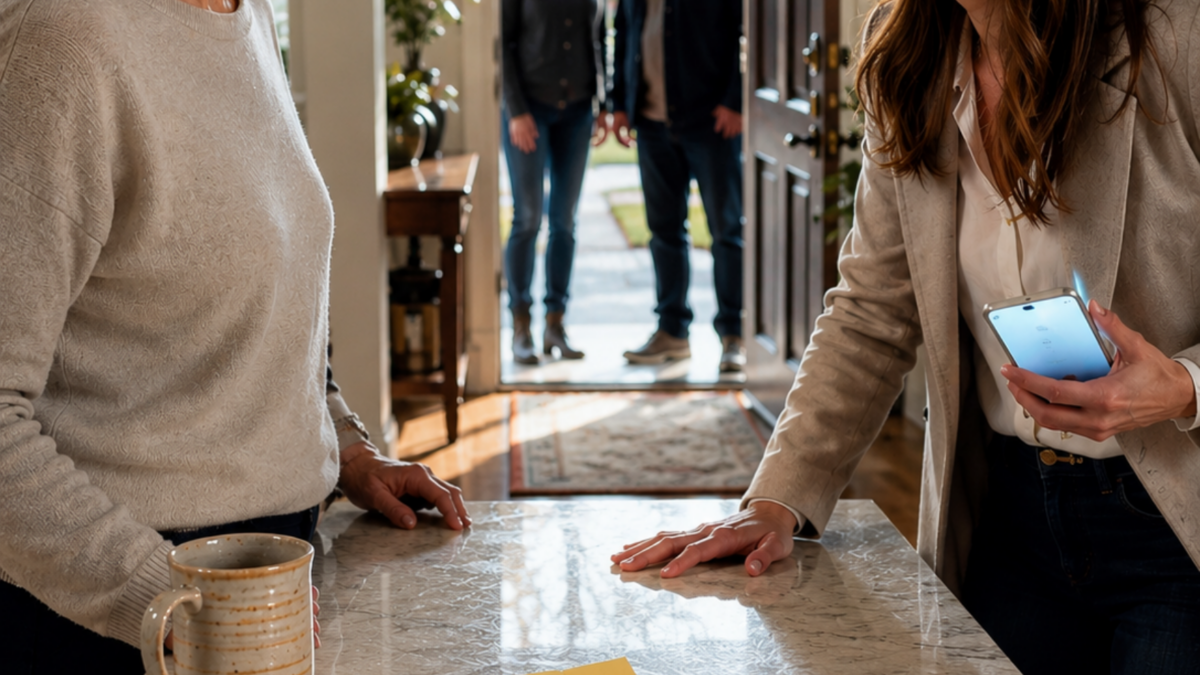
Lauren, my forty-one-year-old stepdaughter, had come over around nine. She and her husband, Mark, were buying a house in Dublin, northwest of Columbus. Better schools. More room for their daughter Sophie. Finished basement. Enormous kitchen.
I had promised them $85,000 toward the down payment.
It was a lot of money, but I could afford it. At the time, helping them made me happy.
Lauren spread listing photographs across my kitchen island.
“Look at this pantry.”
I laughed. “That pantry is bigger than my first apartment.”
Then I noticed the floor plan.
“All the bedrooms are upstairs?”
“Yeah.”
“No guest room downstairs?”
Lauren glanced at me. “Why?”
I shrugged. “Just thinking ahead. If I ever have a knee replaced at seventy-five, I might not enjoy stairs.”
Her expression changed.
“Diane, I need you not to start doing that.”
“Doing what?”
“Planning your future around us.”
I laughed because I thought she was joking.
She wasn’t.
“I watched my mother take care of Grandma,” Lauren said. “It destroyed everything. Her marriage. Her finances. Her whole life. Mark and I can’t be your retirement plan.”
I stared at her.
“I asked about a bedroom.”
“You know what I mean.”
“No. I know what you assumed.”
She gathered the photographs.
“I just think boundaries are important.”
“So do I.”
Ten minutes later, she left.
Then I found the note upstairs.
That was different.
People say ugly things during arguments. Writing them down requires intention.
Lauren had walked upstairs, found a pen, written those words, and placed them on my mirror where she knew I would see them.
I had been in her life since she was ten.
Braces. Parent-teacher conferences. Driver’s education. College applications. Wedding dress fittings. The night Sophie was born.
I never asked Lauren to call me Mom. Her biological mother was alive, and I respected that.
But after thirty-one years, I thought I was something more than the woman who happened to marry her father.
Apparently, that assumption had an expiration date.
Mary Anne read the note in her office without changing expression.
“What exactly are we stopping?”
“The $85,000.”
“Has it transferred?”
“No.”
“Gift letter sent to the lender?”
“Yes.”
She leaned back. “Then we can withdraw the gift before funds transfer.”
“Do it.”
She didn’t move.
I knew that look.
“Don’t change your will today,” she said.
“I didn’t ask to.”
“You were going to.”
I almost smiled. “I was thinking about it.”
“Don’t rewrite thirty years of family history because you’re furious on a Tuesday.”
“I’m not furious.”
“Diane.”
“All right. I’m furious.”
She nodded. “Stop the gift. Review the estate later.”
The next morning, my front door flew open so hard it struck the wall.
Lauren marched into the kitchen holding her phone.
“What did you do?”
“The lender called! Your money is gone.”
“Yes.”
“We close in six days!”
I slowly placed the coffee pot down.
“You can’t just do that.”
I looked directly at her.
Then I repeated the lesson she had given me twenty-four hours earlier.
“I stopped planning your future around me.”
Lauren stared at me as if I had slapped the air out of the room.
And then, for the first time, she made the mistake that changed everything.
“Mom—”
She stopped.
Her face froze.
“Diane,” she corrected. “Put the money back.”
Part 2: A husband’s confession reveals who Lauren believes owns everything.
Lauren stood across the kitchen island, furious.
“We made decisions based on your promise.”
That landed because it was true.
Two months earlier, I had promised the money.
“You’re right,” I said.
Her expression softened instantly. “Then restore it.”
“No.”
Her jaw tightened.
“So you admit you promised us eighty-five thousand dollars, but because I said I won’t care for you when you’re old, you’re taking it away?”
“That isn’t what happened.”
“It’s exactly what happened.”
She called my son Evan on speaker.
“Your mother just pulled $85,000 from our house six days before closing.”
After four rings, Evan answered.
“Good morning to you, too.”
By dinner, he was sitting at my kitchen table eating leftover meatloaf.
He read Lauren’s note twice.
“This is awful.”
“Thank you.”
“But…”
I sighed. “There it is.”
“If you promised the money and they bought the house based on it, pulling everything overnight is rough.”
“You sound like my lawyer.”
“How much does she charge?”
“Enough.”
“Then I’ll send an invoice.”
I nearly laughed.
Then I told him about years of helping Lauren.
Fourteen thousand dollars when Mark lost his job. Sophie’s private-school tuition for two years. A car loan Lauren stopped repaying six payments early. Furnace repairs. Trips. Child care.
Evan listened quietly.
Finally he said, “Dad always bailed her out.”
“I know.”
“And after Dad died, you kept doing it.”
That sentence stayed with me.
Robert had been dead almost three years. Sometimes I still expected to hear the garage door at 5:30.
He adored Lauren. Maybe divorce guilt never left him. She spent childhood moving between houses with a purple overnight bag, and Robert spent adulthood trying to compensate.
Apparently, I had inherited the job.
Two days later, Mark came alone.
We sat on my screened porch with iced tea.
“I owe you an apology.”
“You didn’t write the note.”
“No. But I should’ve told you something.”
He stared into his glass.
“When you offered the eighty-five, I told Lauren we shouldn’t count on it until the money was transferred.”
“That sounds sensible.”
“She said I was ridiculous.”
His eyes lifted reluctantly.
“She said it was basically her dad’s money anyway.”
The August heat suddenly felt colder.
Robert and I had been married thirty-one years.
For twenty-four of them, I worked in hospital administration. My salary paid bills. My retirement accounts were mine. We invested together. We built our life together.
After Robert died, what legally passed to me became mine.
I had never imagined that required explanation.
Mark spoke carefully.
“We can probably still buy the house. Sell investments. Increase the mortgage. Forget the kitchen renovation.”
“So you won’t lose it?”
“Probably not.”
He smiled weakly.
“Lauren may finally discover what cabinets cost.”
After he left, I called Mary Anne.
“I want to see my will.”
“To change it?”
I looked at Robert’s old leather chair.
“Not yet.”
That afternoon, while searching Robert’s desk for financial papers, I found a folder labeled ESTATE NOTES.
Inside was one handwritten sentence.
Talk to Lauren about inheritance assumptions. She keeps talking about what she’ll get someday. I’ve let this go too long.
I sat in Robert’s chair, holding his handwriting.
My husband had seen the problem years before I did.
And he had been too afraid to confront it.
Part 3: An apology collapses when Lauren calls my money her inheritance.
The next day Lauren texted me.
I’m sorry about the note. I shouldn’t have written it.
No excuse followed.
I appreciated that.
She came over the next afternoon, and for once we avoided the kitchen island. We carried coffee into the living room.
Lauren looked exhausted.
She told me more about her grandmother.
Her biological mother had spent years caring for a woman with dementia. Doctors. Medication. Bills. Nighttime wandering. Emergencies.
“I was sixteen when Grandma first walked out of the house at night,” Lauren said. “Mom disappeared into taking care of her.”
“So when I mentioned a downstairs room…”
“I panicked.”
I nodded.
“You were allowed to tell me no, Lauren. You were even allowed to tell me no to something I hadn’t asked for.”
A tiny smile appeared.
For several minutes, I thought we might be okay.
Then she sighed.
“I just don’t understand why what Dad left us suddenly depends on whether you’re mad at me.”
I went still.
“What Dad left us?”
Her eyes dropped.
“I mean eventually.”
Eventually.
As though my life were simply an unusually long waiting period.
“Your father left what he wanted to leave when he died.”
“I know.”
“What I own now is mine.”
“I know that too.”
But she answered too quickly.
Then I understood.
Lauren’s apology could be sincere.
Her affection for me could be real.
And she could still believe that part of my money already belonged to her.
All three things could be true.
That weekend, Robert’s sister Carol called.
“Lauren says you pulled the house money.”
“Hello to you, too.”
“And you’re changing the will?”
“I’m reviewing it.”
“Robert always said the kids would be equal.”
“Robert also said I should spend every dime before I die just to annoy them.”
Carol laughed despite herself.
Then her voice softened.
“Diane, don’t destroy this family over one ugly sentence.”
I wished she had simply said Lauren was wrong.
Instead she said, “Robert would hate seeing everyone split over money.”
That hurt.
So I invited everyone to dinner.
Lauren. Mark. Evan. Carol. Sophie.
I made Robert’s favorite pot roast.
For twenty-five minutes we discussed traffic, school and Carol’s neighbor putting garbage cans out on the wrong day.
Then Lauren put down her fork.
“I don’t understand why we’re doing this.”
“Because I’m tired of hearing different versions of the same argument.”
Silence settled over the table.
Lauren finally spoke about being ten years old when Robert married me. About hoping her parents would reunite. About arriving every weekend with that purple bag and seeing Robert, me and baby Evan looking like a complete family.
“I felt like luggage.”
That hurt to hear.
“I’m sorry I didn’t understand that better.”
Her eyes lifted.
Then Evan asked the question nobody expected.
“If Mom isn’t your mother, why should you inherit from her like a daughter?”
Lauren turned toward him.
“Because Dad built half of it.”
Nobody moved.
Even Lauren seemed shocked by how fast the answer came.
I placed my napkin beside my plate.
And suddenly, the cruel note on my mirror was no longer the biggest problem in the room.
Part 4: A frightened granddaughter forces me to rethink punishment and love.
“I’m not saying Diane didn’t work,” Lauren said quickly.
“Then what are you saying?” I asked.
“That Dad wanted me taken care of.”
I nodded slowly.
“So did I.”
She frowned.
“That’s the part you keep missing.”
Money. Family. Divorce guilt. Old wounds.
They had tangled together until nobody could tell love from obligation anymore.
The dinner ended without screaming.
No one hugged.
Lauren and Mark left with Sophie around 8:30.
I was loading dishes when my phone rang.
Sophie.
“Hey, sweetheart.”
Her voice was small.
“Grandma Diane?”
Something made me shut off the water.
“What is it?”
“If Mom isn’t your daughter anymore… am I still your granddaughter?”
I closed my eyes.
“Oh, honey.”
“I heard some of dinner.”
“You and your mother are two different people.”
“So I can still come over?”
“Try stopping me.”
She laughed softly.
Afterward, I stood in the kitchen holding my phone.
That call changed everything.
Until then, part of me had been doing emotional arithmetic.
Lauren hurt me.
Lauren gets less.
Evan gets more.
But Sophie had done nothing.
I didn’t want my will to become a scoreboard.
The next morning, Mary Anne pulled out a legal pad.
“What do you want?”
“I want to stop confusing inheritance with love.”
Before changing anything, I dealt with the house money.
I called Mark.
“I’ll still give you twenty-five thousand.”
Silence.
“Diane, are you sure?”
“Yes.”
Lauren called forty minutes later.
“Twenty-five?”
“Yes.”
“You promised eighty-five.”
“I know.”
“Then why twenty-five?”
“Because I’m separating my original promise from what happened afterward. Twenty-five feels fair.”
“To you?”
“Yes, Lauren. It’s my money. At some point, what feels fair to me has to matter.”
I heard Mark in the background.
“Lauren, stop. She doesn’t owe us a house.”
They bought the house.
They sold investments, accepted a larger mortgage, and postponed the kitchen renovation.
No disaster.
Just consequences.
Then I signed a new estate plan.
I increased funds reserved for my own retirement and future care. Evan would receive a defined portion. Lauren would receive a smaller but still meaningful amount. A substantial amount would eventually fund trusts for grandchildren, including Sophie.
Neither child would control my estate.
Mary Anne recommended an independent professional executor.
“No popularity contests after my funeral,” I said.
“Not the technical term.”
“It should be.”
Before I signed, she looked at me carefully.
“Are you doing this because you’re angry?”
“I started because I was angry.”
“And now?”
“Now I’m doing it because I finally understand what I want.”
I signed my name.
Blue ink.
No thunder.
No victory.
Just a decision.
But three weeks later, Lauren came to my house alone.
She sat on the edge of my sofa.
“I heard you changed everything.”
“Yes.”
Her eyes narrowed.
“So you punished me.”
Part 5: The final truth turns punishment into the boundary our family needed.
“At first?” I said. “Yes.”
Lauren looked surprised.
“When I stopped the eighty-five thousand overnight, I was furious. You were right about that.”
“Then why didn’t you restore it?”
“Because when I calmed down, I realized the old arrangement wasn’t healthy either.”
She shook her head.
“The will still feels like punishment.”
“I’m sixty years old, Lauren. I may live thirty more years. I need to plan as if I intend to be alive for them.”
“Dad would hate this.”
That hit exactly where she intended.
I let the silence sit.
“Maybe he would.”
Her face changed.
“Your father loved you very much,” I continued. “He also hated disappointing you. Sometimes those became the same thing.”
“You make him sound weak.”
“No. I make him sound human.”
“So I’m some spoiled kid he created?”
“No. You’re forty-one. What happens next belongs to you.”
The hallway clock ticked.
Finally Lauren whispered, “Did you ever really think of me as your daughter?”
The question was so quiet I almost missed it.
“Since you were ten.”
She looked toward the stairs leading to my bedroom.
“That note hurt because you need me to take care of you someday?”
“No.”
I paused.
“I can make plans for myself. It hurt because you believed thirty-one years could be erased in seven words.”
Lauren stared at her hands.
“I shouldn’t have written it.”
“No.”
Her eyes filled.
I said softly, “You shouldn’t have believed it.”
She left without asking about money again.
For months, our relationship was careful.
Then one January Saturday, Lauren dropped Sophie off and lingered in my driveway.
“Do you have coffee?”
“I have coffee. Whether it’s good coffee is between you and God.”
She smiled.
We sat at the kitchen table.
After ten minutes of harmless conversation, Lauren wrapped both hands around her mug.
“I’ve been seeing someone.”
I raised an eyebrow.
“A therapist.”
“Oh.”
“Mark suggested it.”
“That was brave of Mark.”
She laughed.
Then she became serious.
“I think I spent years believing Dad’s money proved I still belonged to him.”
I said nothing.
“And after he died, I transferred that belief to you.”
Her eyes moved toward the living room where Sophie was doing homework.
“I’ve thought about the note.”
“So have I.”
“I knew telling you that you weren’t my mother would hurt.”
“Why?”
She swallowed.
“Because you spent most of my life proving otherwise.”
That nearly broke me.
I lifted my coffee instead.
“You never have to call me your mother.”
“I know.”
She looked directly at me.
“That’s different from you not being one.”
We didn’t hug.
Somehow, that made it feel more honest.
The estate plan remained unchanged.
Lauren never asked about it again.
I met with a financial planner. I arranged long-term care options. Updated powers of attorney. Made plans for downsizing someday.
Neither Lauren nor Evan would be my retirement plan.
And strangely, once that became my decision, it stopped feeling like rejection.
Months later, while changing purses, I found the folded yellow note.
You’re not my mother. You’re on your own.
I carried it into Robert’s old office.
For a moment, I remembered everything those words had touched.
The house.
The will.
My marriage.
Lauren’s childhood.
My own anger.
Then I fed the note into the shredder.
The blades pulled it apart until seven words became meaningless strips of paper.
Lauren had been right about one thing.
No adult child should be another adult’s entire plan for old age.
But family also couldn’t mean, “You’re on your own when you need something from me, but we’re family when I need something from you.”
I didn’t need to disinherit Lauren.
I needed to stop confusing love with rescue.
Today, she is still my stepdaughter.
Sometimes she calls me Diane.
Every once in a while, usually when she is distracted, she calls me Mom.
Neither of us mentions it.
Our relationship is not the one I imagined thirty years ago.
In some ways, it is smaller.
But it is stronger because it is honest.
Nobody has to prove love with a check anymore.
And the final twist was something I never expected when I first found that yellow note:
Setting a boundary didn’t destroy my family.
It finally gave us the chance to become one.
THE END.
All the characters and events in this story are fictional and created for the purpose of storytelling and entertainment.
If this story brought you a moment of reflection, comfort, or curiosity, then it has truly fulfilled its purpose.
Thank you sincerely for reading. Your feedback and support are always appreciated and inspire me to keep sharing more stories with you.








