My Husband Married Me to Steal My Mother’s House for My Brother’s Wife
My Husband Married Me to Steal My Mother’s House for My Brother’s Wife
Three hours after I promised to spend my life with Weston Vale, I found him in a locked winery room with my brother’s wife, her dark red lipstick still on his mouth. But the affair was only the first betrayal. Before the night ended, I learned my wedding had been used to hide stolen charity money, my husband intended to turn my late mother’s home into collateral for a failing business, and he had already prepared documents to declare me mentally unstable if I refused. What Weston didn’t know was that one person had saved the deed, another had saved the evidence—and one unsigned piece of paper could destroy everything he planned.
Part 1: My wedding ended when I found lipstick on my husband.
My husband still had my sister-in-law’s dark red lipstick on his mouth when he told me not to embarrass him at our wedding.
I stood in the doorway of the barrel room at Veil Ridge Winery, clutching the ivory shawl that had belonged to my mother. Three hours earlier, Weston Vale had cried while promising to honor me in front of 180 people.
Now his tuxedo jacket hung open.
Dana—my brother Noah’s wife—had one palm against an oak barrel. Her satin bridesmaid dress was crooked at the shoulder.
“Tell me I’m not seeing this,” I whispered.
Dana turned pale. “Marissa, it was stupid. The champagne. The pressure—”
“My wedding didn’t put my husband’s hands on you.”
Weston came toward me. Not to apologize.
He grabbed my upper arm.
“Keep your voice down,” he said. “My father has investors downstairs. If you make a scene, everyone will think you’re having another episode.”
I stared at him.
“Another episode?”
“You’ve barely slept since your mother died. People understand grief.”
That was when the betrayal changed shape.
He wasn’t afraid he had broken me.
He was afraid important people might see the pieces.
I tore my arm free and ran downstairs. My wedding dress caught on the iron railing and ripped along the skirt just as the band began the song my mother used to hum while sewing after midnight.
Weston reached the courtyard seconds behind me.
Then he took the microphone.
“Family and friends,” he said with that warm, practiced smile, “Marissa is overwhelmed. Losing her mother has made big days difficult. We’re going to give her some space.”
Faces turned toward me.
His aunt whispered that I had always seemed fragile.
His mother, Elaine, looked down.
No one asked me what had happened.
Weston had used my mother’s death to make me an unreliable witness before I could speak.
So I walked onto the dance floor and took the microphone from his hand.
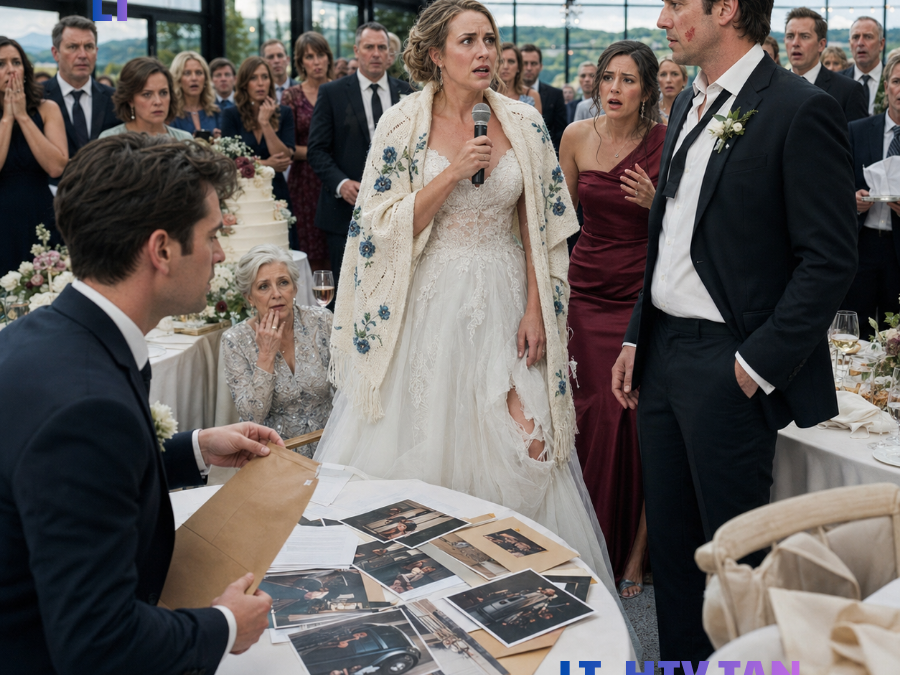
“I found my husband kissing Dana in the barrel room.”
Silence.
Dana appeared on the stairs. “I was trying to calm him down.”
“Did calming him require pulling your dress off your shoulder?”
Someone gasped.
Weston leaned close. “You will regret humiliating this family.”
Then Noah stepped away from the cake table.
He looked at me once.
“You saw them?”
I nodded.
He closed his eyes.
Then my brother reached inside his suit jacket and pulled out a thick brown envelope.
“For two months,” he said, “I’ve been trying to understand why Dana was taking money from our accounts—and why Weston’s name kept appearing.”
Dana stopped breathing.
Noah scattered photographs across a white tablecloth.
Weston and Dana entering a Washington hotel.
Dana getting into his car outside a private poker club.
Hotel bills paid by Bright Path Arts, the nonprofit Dana ran.
And then Noah placed one final document in front of me.
Collateral Authorization.
Magnolia House Heritage Project.
Magnolia House was the red-brick Victorian my mother had spent fifteen years sewing hems, uniforms, and wedding gowns to own.
Below the property description was a space for my signature.
Beside it, in Weston’s handwriting:
Obtain spouse acknowledgement during final reception payments.
I looked at the man I had married three hours earlier.
“You married me for my mother’s house.”
Weston leaned close enough that only I could hear him.
“Sign tomorrow,” he whispered, “or everyone will hear that grief made you paranoid.”
And suddenly I understood.
The affair wasn’t the plan.
I was.
Part 2: Hidden documents revealed a plan to declare me mentally incompetent.
Rachel Pierce, my oldest friend and wedding photographer, pulled me away before Weston could touch me again.
In the bridal suite, my father wrapped Mom’s shaw around my shoulders.
“Your mother paid for Magnolia House one zipper at a time,” Dad said. “No one is turning it into the price of this betrayal.”
Rachel had already requested the hallway security footage.
We watched Dana enter the barrel room.
Twenty minutes later, Weston approached, checked both directions, entered, and deliberately hung a SERVICE CLOSED sign on the door.
“It wasn’t a mistake,” I said.
“They scheduled it.”
My phone vibrated.
Tomorrow. Noon. Family brunch at Veil Ridge. Sign the authorization and I’ll call tonight wedding stress. Refuse and my attorneys will pursue you for defamation.
Noah read it.
“Now we open everything.”
At 1:30 in the morning, I sat at Dad’s kitchen table in my torn wedding dress while Noah downloaded records from Dana’s hidden cloud account.
Bright Path Arts had transferred $214,000 to Ardan Strategy Partners, a company connected to Veil Development’s finance department.
The descriptions made me sick.
Wedding installation.
Heritage acquisition deposit.
Magnolia Advance.
My wedding wasn’t merely the setting for their fraud.
It was one of the invoices.
Then I found an email titled Spousal Capacity Memorandum.
A Veil attorney had prepared language describing me as “emotionally impaired following recent bereavement.” If I refused to cooperate, Weston could portray himself as the concerned husband seeking temporary authority over marital assets.
“He planned for me to say no,” I whispered.
Before sunrise, property attorney Evelyn Brooks was on the phone.
“Do not sign anything. Do not give anyone the deed. And find out whether your marriage license was filed.”
At 5:07 a.m., someone knocked.
Dana stood outside in the rain.
She placed a leather deed book on Dad’s kitchen table.
Magnolia House.
“I stole it from your desk during the bridal shower.”
Noah looked as though she had struck him.
Dana confessed to gambling debts. First $18,000. Then more than $130,000.
Weston had paid people threatening to expose her.
After that, every favor became a debt.
“Did you sleep with him because you owed him?” Noah asked.
Dana finally looked at her husband.
“No. I did that because I was selfish.”
Then she placed her phone on the table.
“I came because Weston is going to blame everything on me.”
She pressed play.
Weston’s voice filled my father’s kitchen.
“Dana was useful, but she’s disposable. Magnolia closes tomorrow. After that, she becomes the thief. Noah becomes the angry husband…”
A pause.
“And Marissa becomes too unstable to understand the transaction.”
Noah slowly sat down.
Dana looked at me.
“Your house secures a $4.8 million credit line. Once the money clears, Weston replaces the nonprofit funds.”
I stared at my mother’s deed.
In less than eleven hours, my husband had betrayed my marriage, weaponized my grief, stolen from a charity, and prepared to erase my legal voice.
But he had made one mistake.
He had invited reporters to watch me sign.
Part 3: I returned to the winery carrying evidence instead of shame.
At 9:20 that morning, the wedding officiant called.
He had taken our signed marriage license home after witnessing the chaos at the reception.
He had not filed it.
“I thought someone should ask Marissa before making anything official,” he said.
For the first time all night, Weston’s plan had a crack in it.
At 10:05, another message arrived.
Wear something appropriate. We can still protect your reputation.
I took a screenshot.
Then Dad brought me a simple ivory linen dress that had belonged to Mom.
Rachel pinned my hair back. I wrapped Mom’s shaw over my shoulders.
At 11:48, we returned to Veil Ridge with Dad, Noah, Rachel, Evelyn, and three binders of evidence.
Forty people waited inside.
Investors.
Lenders.
Preservation officials.
Three reporters.
Behind the head table was an architectural rendering of Magnolia House transformed into a luxury hotel.
A glass addition cut directly through my mother’s sewing room.
Weston approached wearing a navy suit and a peaceful smile.
“I’m glad you’re calmer.”
“I am completely calm.”
He glanced at Evelyn.
“This was supposed to be family.”
“You invited reporters.”
At the head table sat the collateral authorization and a gold pen.
Weston’s father, Malcolm, stood beside it.
“Our family handles disagreements discreetly,” Malcolm said.
“Your son slept with my brother’s wife three hours after marrying me.”
The reporters looked up.
Weston sighed dramatically.
“This is the instability I warned you about.”
I nodded to Rachel.
“Then let’s make the next ten minutes very stable.”
The screen changed.
Hallway footage.
Dana entering.
Weston checking the corridor.
The door closing.
The SERVICE CLOSED sign swinging into place.
Then came the hotel photographs.
The messages.
The Bright Path transfers.
$214,000.
Malcolm slammed his hand against the table.
“Turn that off.”
“You’re right,” I said. “An affair doesn’t invalidate a development agreement.”
I opened another binder.
“That’s why we brought the development agreement.”
Weston tried to tell everyone I had approved the hotel.
I placed the original deed on the table.
“I never gave this to him. It was taken from my home.”
Then the doors opened.
Dana walked inside.
“I took it,” she said. “I approved false invoices. I hid money because of my gambling debts.”
Weston smiled.
“A confessed thief blaming her lover.”
Dana put her phone beside the gold pen.
“Then listen to yourself.”
His recorded voice filled the room.
Dana was useful, but she’s disposable.
Magnolia closes tomorrow.
Marissa becomes too unstable to understand the transaction.
Weston moved toward the phone.
Malcolm caught his wrist.
“Was that me speaking with you?”
“No,” Dana said. “It was Grant Hollis. Your deputy finance director.”
Before Weston could answer, another woman entered carrying a red accordion folder.
Camille Foster.
Bright Path’s treasurer.
“The state investigator asked me to finish my declaration,” she said.
She spread emails across the table.
One had been sent directly by Weston.
Magnolia proceeds next week and everything balances by quarter close.
For months Weston had survived by keeping all of us isolated.
Now every secret was sitting at the same table.
And his own father was reading his name at the bottom of the evidence.
Part 4: Weston’s final defense exposed why he truly needed my house.
Malcolm stared at his son.
“You used my company.”
“I was saving it,” Weston snapped.
The polished husband disappeared.
“The hotel division is bleeding cash. Lenders wanted hard collateral. Magnolia is worth nearly three million dollars and Marissa wasn’t doing anything with it.”
“I was building a studio.”
“You were wasting it so neighborhood artists could sell bowls and scarves.”
There it was.
The oldest betrayal.
Weston had never misunderstood what Magnolia House meant.
He understood perfectly.
He simply believed his idea mattered more.
“My mother spent fifteen years sewing other women’s wedding dresses so she could own one safe place,” I said. “You looked at her life and saw collateral.”
Weston turned toward the lenders.
“This is a domestic dispute.”
Evelyn closed her binder.
“The owner has not signed. The original deed was obtained without permission. Charitable funds are under state review.”
She paused.
“And any suggestion that Mr. Vale is acting as Miss Hart’s legal spouse should account for one additional fact.”
Rachel raised her phone.
Our officiant appeared on video holding the marriage license.
“I have not filed this document.”
Weston’s face went blank.
“What?”
For the first time since I entered that barrel room, he looked frightened.
Malcolm turned to his chief operating officer.
“Stop the Magnolia project. Freeze Grant Hollis’s access. Remove Weston from every management role pending an independent investigation.”
Weston laughed.
“You can’t do that in front of them.”
Malcolm’s answer was quiet.
“You did it in front of them. I am only naming the consequence.”
Then Weston looked at me.
“Marissa, we can still fix this. Think about everything we planned.”
I reached into my pocket.
My wedding ring.
I placed it on the unsigned authorization beside the gold pen.
“You destroyed us last night. Today I’m walking out of the wreckage.”
Noah removed his ring too.
“So am I.”
Dana began crying.
“I’m sick, Noah. Weston used my gambling.”
My brother looked at her for a long time.
“He used your debt,” he said. “You used my love.”
Then he walked away.
Thirty-nine days later, a court confirmed what Weston’s lawyers had finally stopped fighting.
The marriage would not stand.
But the investigation continued.
Bright Path’s accounts were frozen.
Dana entered treatment and cooperated with prosecutors.
Then investigators found something even Dana hadn’t told us.
Of the missing money, $71,000 had never reached Weston or Grant.
Dana had used it herself.
And inside Veil Development’s private forecasts was the final reason Weston had been so desperate to get Magnolia House.
The hotel division wasn’t merely struggling.
It was almost two million dollars underwater.
Weston hadn’t been saving a family legacy.
He had been using my mother’s house to hide his failure.
Part 5: I rebuilt my mother’s house and finally reclaimed my future.
Months later, Weston was charged with conspiracy, wire fraud, and attempted property fraud.
Grant Hollis was arrested in Maryland after using a company card at an airport hotel.
Dana pleaded guilty to financial charges. Her cooperation reduced the penalty, but it did not erase what she had done.
Noah moved into an apartment near Dad.
Some nights we ate barbecue from paper containers and said almost nothing.
He still loved parts of the woman Dana had been.
That was the cruel thing about betrayal.
It didn’t make every good memory false.
It only forced you to accept that kindness and cruelty could have lived inside the same person.
Malcolm resigned from Veil Development.
Investigators found no proof he knew about the stolen charity money before the brunch, but company emails showed he had encouraged Weston to secure “family property” quickly and had ignored questions about consent.
Elaine wrote me a letter.
She apologized for looking down when her son called me unstable.
I answered two months later.
You are not responsible for his choices. You were responsible for what you did when you saw them.
Magnolia House stood empty for fourteen months while I saved for renovations.
Then something unexpected happened.
Craftspeople who had known my mother began showing up.
A carpenter repaired the porch at cost.
A retired electrician rewired the first floor.
Camille introduced me to artists whose Bright Path scholarships had disappeared.
I gave them paid contracts.
I named the place Magnolia Common.
The front parlor became a photography studio filled with northern light. Mom’s old sewing room became a shop for ceramics, textiles, jewelry, and woodwork.
I kept the scar in the floor where her industrial sewing machine once stood.
On opening morning, Dad placed Mom’s ivory shaw inside a glass case.
Beneath it was a brass plaque:
What a woman builds with dignity is not surrendered through fear.
One year after my wedding, we ate dinner in Magnolia House’s courtyard.
Dad.
Noah.
Rachel.
Camille.
The artists.
No white dress.
No winery.
No giant screen announcing someone else’s future for me.
Before dessert, I went upstairs and opened the small wooden box containing my wedding ring.
For months, I had hated that object.
Then one morning it became only metal.
I carried it downstairs and slipped it into a donation envelope for a legal fund helping women protect inherited property from coercive partners.
My marriage had lasted three hours in public and thirty-nine days on paper.
But the shame had belonged to me for less than a minute.
I looked through the courtyard doors.
Mom’s shaw glowed behind glass.
Dad was carrying too many plates.
Rachel was laughing.
Noah had saved me a chair.
And suddenly I understood the final thing Weston had never understood.
Magnolia House was never valuable because someone could mortgage it for three million dollars.
It was valuable because my mother had earned the right to choose what happened inside those walls—and then she had left that choice to me.
I stepped into the courtyard and sat beside the people I still trusted.
For the first time, Magnolia House did not feel like something I had almost lost.
It felt like mine.
THE END.
All the characters and events in this story are fictional and created for the purpose of storytelling and entertainment.
If this story brought you a moment of reflection, comfort, or curiosity, then it has truly fulfilled its purpose.
Thank you sincerely for reading. Your feedback and support are always appreciated and inspire me to keep sharing more stories with you.








