Four Researchers Entered a Louisiana Wetland, but Only One Came Back Wearing His Professor’s Hat—and His Story Tore Three Families Apart
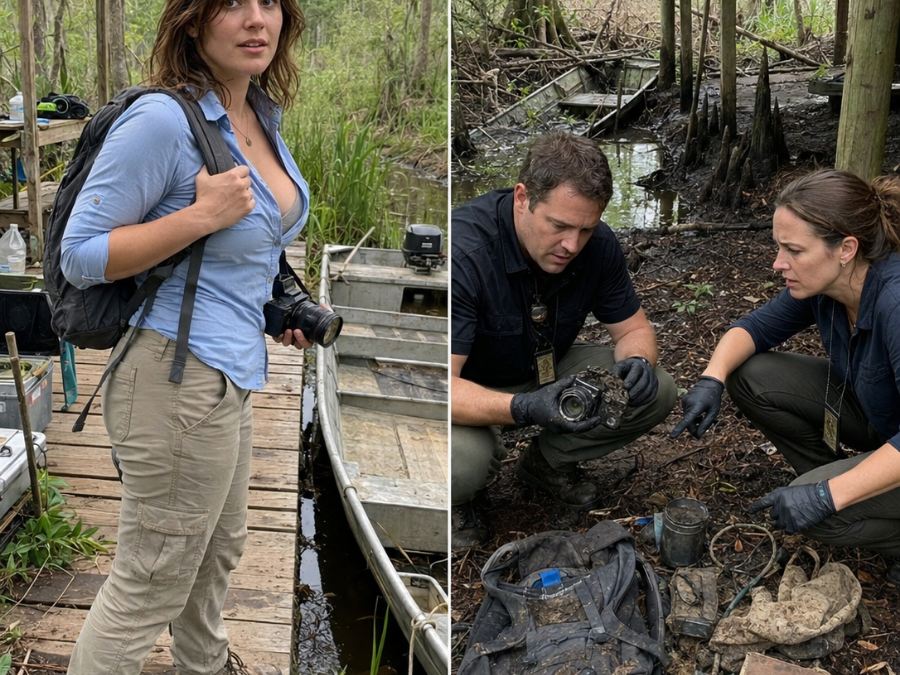
Four Researchers Entered a Louisiana Wetland, but Only One Came Back Wearing His Professor’s Hat—and His Story Tore Three Families Apart
Part 1: The Route Nobody Was Supposed to Take
On the morning of September 6, 2019, four university researchers entered the fictional Blackwater Cypress Preserve in southern Louisiana for what was supposed to be an ordinary two-day environmental survey. Three days later, only one of them came drifting out of the marsh in a damaged aluminum boat, sunburned, dehydrated, shaking so badly he could barely speak, and clutching the battered canvas hat that belonged to the professor who had led them inside.
His name was Tyler Grant, and when rescuers finally reached him, he did not ask for water, food, or his family. He stared past them toward the endless cypress trees and whispered, “Don’t go back the way I came.”
That sentence changed the rescue operation immediately.
Twenty-two-year-old Hannah Mercer had been the youngest member of the team, a senior studying wetland ecology who had spent months preparing for the trip. She lived with her mother, Diane, in the fictional town of Riverbend Parish, and on the morning she left, Diane noticed that her daughter seemed unusually quiet while tightening the straps on a faded charcoal field backpack.
“You’re nervous,” Diane said.
“A little.”
“You’ve done fieldwork before.”
“Not this deep into Blackwater.”
Hannah smiled afterward, trying to make the comment sound lighter than it had.
“I’ll call as soon as we get signal again.”
Diane hugged her.
“No matter how late.”
Hannah promised.
She never made that call.
The expedition leader was Professor Daniel Whitcomb, fifty-three, a respected wetland biologist who had worked in the preserve for more than fifteen years. The other students were nineteen-year-old Ethan Cole, careful and quiet, and twenty-three-year-old Tyler Grant, charming, confident, and usually the person who could make everyone laugh when field conditions became miserable.
Their project was straightforward: collect water samples, document bird movement, measure salinity changes after recent storms, and spend one night at an elevated research shelter before returning the following afternoon.
Blackwater Cypress Preserve looked beautiful from the public dock.
Dark water reflected moss-draped trees.
White herons moved through patches of reeds.
But farther inside, the channels twisted around mud islands, collapsed timber, and dense walls of swamp grass so similar that even experienced boaters sometimes became disoriented.
Locals called one interior section Seven Bends.
The name was not official.
Fishermen used it because several channels curled back toward each other so sharply that someone unfamiliar with the area could spend twenty minutes moving and end up almost exactly where they started.
The group departed in two small unmarked aluminum boats just after eight in the morning.
Daniel and Hannah rode in the first.
Ethan and Tyler followed behind.
At 10:20 a fisherman named Calvin Reese saw them passing a wider channel near an old duck blind.
Daniel lifted his canvas sun hat and waved.
Calvin later remembered that Hannah appeared relaxed.
Ethan had been writing in a notebook.
Tyler, however, kept looking toward a narrow opening in the reeds on the eastern side of the channel.
Calvin thought nothing of it at the time.
By six that evening, nobody had returned.
At seven, Diane called the university coordinator.
At eight, Ethan’s father called too.
The university initially suggested that changing water levels had delayed the team, but when Daniel failed to make his scheduled radio check, concern became panic.
Search crews launched before sunrise.
For two days they found nothing.
No overturned boats.
No floating backpacks.
No abandoned equipment.
It seemed impossible that four people and two boats could simply vanish inside a mapped preserve.
Then, late on the third afternoon, a volunteer spotted aluminum reflecting between cypress knees almost eleven miles from the team’s expected route.
The boat was wedged against mud and tree roots.
At first, it looked empty.
Then a figure slowly raised his head.
Tyler Grant was sitting on the floorboards.
His lips were split.
His forearms were covered with scratches.
Mosquito bites covered his face and neck.
His eyes looked unfocused.
And clutched between both hands was Professor Daniel Whitcomb’s canvas hat.
A rescuer climbed into the boat.
“Tyler, where are the others?”
Tyler stared toward the trees.
His jaw began trembling.
Then he whispered the sentence that Diane Mercer would hear repeated in nightmares for years.
“Don’t go back the way I came.”
Part 2: The Survivor Claimed Someone Was Following Them
Tyler spent his first night in a small regional hospital, receiving fluids while investigators waited for him to become coherent enough to answer questions. Diane arrived before midnight and demanded to see him, but deputies refused because Tyler was physically unstable and had not yet given a full account.
When Diane asked whether Hannah had been found, nobody could answer.
The first formal interview happened the next afternoon.
Detective Caroline Brooks, forty-eight, handled the questioning. She was known for letting silence stretch until people became uncomfortable enough to fill it.
Tyler began calmly.
The first several hours had gone exactly as expected.
They collected samples.
Hannah photographed nesting areas.
Ethan recorded coordinates.
Daniel checked water depth.
Then Tyler said they found an orange marker buoy floating beside a narrow channel.
Daniel supposedly became curious because the marker did not belong to any research group he recognized.
A new nylon line had been tied beneath it.
Daniel followed the line into a side channel.
“Why?” Caroline asked.
“He thought somebody might be operating illegally in the preserve.”
“Operating how?”
“Trapping. Dumping. He didn’t know.”
The line led through several smaller channels until they reached a wooden platform built on pilings beneath the trees.
It was not an official research station.
There was a folding cot.
A plastic water barrel.
Empty food containers.
Several unlabeled storage crates.
Daniel ordered everyone not to touch anything.
Ethan photographed the platform.
Hannah found fresh boot impressions in the mud.
Then they heard an engine somewhere beyond the trees.
Daniel immediately told everyone to return to the boats.
That was when the second boat would not start.
According to Tyler, Ethan checked the fuel tank.
Almost all the gasoline was gone.
“It had been full when we left,” Tyler told Caroline.
“Leak?”
“None that we saw.”
“Could someone have drained it?”
Tyler hesitated.
“I don’t know.”
They crowded into the remaining boat and abandoned several pieces of equipment.
At the first major junction, they found a thick tree trunk lying across the channel.
Daniel examined it.
The wood had been cut recently.
Hannah became frightened.
Ethan said someone might be blocking their route.
For the next hour, they heard distant engines twice but never saw another boat.
At a narrow strip of higher ground, Daniel stopped because he wanted to climb onto land and identify a landmark.
Ethan stepped out to inspect a strange notch carved into a cypress trunk.
Hannah was drinking water.
Tyler was moving equipment.
Then they heard a splash.
When they looked again, Ethan was gone.
No scream.
No struggle.
Only his field notebook lying near the tree.
They searched for almost an hour.
Daniel shouted until his voice became hoarse.
Hannah cried.
Tyler insisted they needed to keep moving before the water rose.
By dusk they found a small patch of dry ground and spent the night there without using flashlights.
That was when Tyler claimed they heard footsteps.
Not splashing.
Footsteps on wood.
Slow.
Measured.
As though someone were walking across a hidden dock nearby.
Hannah whispered, “Maybe it’s Ethan.”
Daniel immediately covered her mouth and motioned for silence.
The footsteps stopped.
At dawn, Ethan’s baseball cap was hanging from a branch ten feet from their boat.
Caroline stared at Tyler.
“You’re certain it was his?”
“Yes.”
“How did it get there?”
“I don’t know.”
Tyler claimed Daniel then wanted to return toward the hidden platform, believing whoever used it might know what had happened to Ethan.
Hannah refused.
She wanted to find the main channel.
They argued.
Eventually Daniel chose a route he believed would lead west.
Hours later, another engine approached.
Tyler said they hid among the cypress roots.
A dark flat-bottomed boat passed through the next channel with two adult men aboard.
He could not describe them clearly.
One wore a pale shirt.
The other wore a dark cap.
Tyler claimed he never saw weapons.
After that, his account became vague.
The engine on their boat began failing.
Hannah slipped while walking through mud and hurt her ankle.
Daniel left to search for fresh water.
He never returned.
Caroline leaned forward.
“And Hannah?”
Tyler squeezed Daniel’s canvas hat.
“She stayed with me.”
“For how long?”
Tyler’s eyes filled.
“Until the last night.”
“What happened?”
He began crying.
“She told me if one of us got out, we had to tell people about the crates.”
That answer gave rescuers a direction.
But it also raised a far more troubling question.
Why did every person disappear while Tyler remained?
Part 3: Evidence Began Tearing His Story Apart
Search crews eventually found the hidden wooden platform.
Tyler had not invented it.
But someone had stripped it almost completely bare.
The cot was gone.
The containers were gone.
The crates were gone.
Fresh rectangular marks remained in the dirt where heavy objects had sat, and a newly cut nylon rope hung from one piling.
Detective Caroline Brooks stood on the platform looking at the empty spaces and said quietly, “Somebody cleaned this place.”
That discovery supported Tyler.
The next ones did not.
Investigators could not find the exact tree where Ethan had supposedly disappeared.
Tyler changed his description of the location twice.
Then he changed his account of the final night with Hannah.
During a second interview, he admitted that he and Hannah had reached an abandoned concrete pump station after Daniel vanished.
The structure stood partly flooded in a forgotten section of the preserve, its roof cracked and vines growing through empty windows.
They spent the night there.
“What happened in the morning?” Caroline asked.
“I went looking for water.”
“And when you returned?”
“She was gone.”
Caroline stared at him.
“Ethan disappeared silently.”
Tyler looked away.
“Daniel disappeared silently.”
He clenched his jaw.
“And now Hannah disappeared silently.”
“I don’t know what happened!”
Tyler stood abruptly.
“I almost died too.”
There was no evidence to arrest him.
But investigators began examining everything again.
Three days later, searchers found the pump station.
Inside were food wrappers from the research team, an empty water bottle, Hannah’s field jacket, her backpack, and a compact camera.
The memory card still worked.
The photographs showed the orange buoy.
The hidden platform.
Several unlabeled crates.
A distant image appeared to show another boat partly concealed behind reeds.
Then investigators found a forty-second video recorded accidentally during an argument.
The image shook wildly.
Faces were mostly outside the frame.
But the voices were clear.
Daniel said, “I told you not to touch the fuel.”
Tyler answered, “I didn’t.”
Then Ethan spoke.
“I saw you beside the tank.”
Hannah could be heard telling them to stop yelling.
The recording ended.
Caroline played it for Tyler.
His face changed.
“Why were you near the fuel?”
“I was moving a bag.”
“Ethan thought otherwise.”
“Ethan didn’t like me.”
Investigators later found a small siphon hose in the boat Tyler had been rescued from.
The university confirmed it did not belong to their equipment.
Tyler insisted he had never seen it.
Then the second missing boat was found.
It had been pushed beneath cut branches in a narrow channel nearly two miles from the platform.
Its engine worked perfectly.
Its fuel tank was full.
Ethan’s notebook lay beneath one seat.
The final page contained three lines that changed the entire investigation.
“Tyler knows more about this area.”
“Daniel wants out.”
And beneath those:
“We are not lost. Someone is closing the exits.”
Diane Mercer was shown copies.
She stared at the handwriting for several minutes.
Then she looked at Caroline.
“Ask him why my daughter was still with him.”
Caroline did.
Tyler continued denying any larger role.
Until investigators recovered messages from his phone.
Three weeks before the expedition, an unknown number had sent Tyler several photographs.
One showed the orange buoy.
Another showed the wooden platform.
A third showed an open storage crate.
Tyler had deleted the thread.
The images remained recoverable.
When Caroline placed them on the table, he finally stopped pretending.
“I was supposed to find the place,” he whispered.
The room became silent.
Tyler had met a man months earlier at a roadside bar outside Riverbend.
The man learned that Tyler studied environmental science and mentioned illegal activity inside Blackwater.
He suggested Tyler could earn money if he documented it.
Tyler assumed it involved illegal trapping or prohibited fishing.
He never told Daniel.
His plan was simple.
Lead the expedition toward the buoy.
Photograph the evidence.
Leave.
Then claim the discovery as his own.
“What was inside the crates?” Caroline asked.
Tyler stared at the table.
“Wild animals.”
Small native animals had been captured and held for illegal sale.
Tyler said he panicked after seeing the scale of the operation.
But he also admitted something worse.
He had drained fuel from the second boat.
Not all of it.
Enough to stop the group from leaving immediately.
He wanted more time to collect evidence before Daniel forced them back toward the dock.
His selfish gamble stranded everyone.
“What happened to Ethan?” Caroline asked.
“I swear I don’t know.”
“What happened to Daniel?”
“I don’t know.”
“And Hannah?”
Tyler began shaking.
Caroline waited.
Finally he whispered, “I left her.”
Part 4: Hannah Had Been Alive After He Abandoned Her
The truth about Hannah came slowly.
Tyler admitted she had never vanished from the pump station.
She had been there when he left at dawn.
Her ankle was swollen.
She was feverish.
She could barely put weight on one leg.
Then they heard an approaching engine.
Tyler panicked.
He told Hannah he would move toward the channel, determine who was coming, and return.
Instead, he found the original boat wedged between roots several hundred yards away.
The engine still worked.
“What did you do?” Caroline asked.
Tyler covered his face.
“I got in.”
“And Hannah?”
“I thought they were behind me.”
“You left her.”
“I was scared.”
“You left an injured woman alone in the swamp.”
Tyler started crying.
“Yes.”
Diane was not allowed inside that interrogation room.
That probably saved Tyler from hearing what a mother sounds like when she learns someone consciously abandoned her injured daughter.
The confession allowed search teams to focus on the pump station again.
This time they looked outward from it rather than assuming Hannah had disappeared there.
Within hours, they found the first clue.
A strip of blue fabric tied to a branch.
Then another.
Then an empty bottle balanced deliberately on a cypress root.
Hannah had been marking her route.
Searchers followed the trail for nearly four miles.
Inside an abandoned hunting shelter, they found her small field notebook.
The final page contained several short entries.
“Tyler left at dawn.”
“He did not come back.”
“I heard a boat.”
Then:
“I am going toward higher ground.”
And finally:
“If Mom finds this, tell her I tried.”
Diane collapsed when Caroline read those words to her.
But Hannah’s trail continued.
Search teams found another scrap of blue fabric almost half a mile farther north.
Then another.
Then nothing.
The official search lasted nearly two months.
No bodies were recovered.
Ethan remained missing.
Daniel remained missing.
Hannah remained missing.
Tyler was eventually charged for lying to investigators and interfering with the expedition through his manipulation of the fuel supply, though there was no evidence proving that he physically harmed anyone.
To Diane, the legal details barely mattered.
During one hearing she finally stood only a few yards from Tyler.
Her face was pale but steady.
“My daughter trusted you,” she said. “You were the last person she had.”
Tyler lowered his eyes.
“When she became too slow to save easily, you decided her life was worth less than yours.”
His attorney started to object.
Diane never looked away.
“I hope you remember hearing her call your name.”
Tyler began crying.
Diane did not.
Years passed.
Authorities investigated the illegal wildlife network connected to the platform.
Several people were questioned.
Two men admitted using parts of the preserve for clandestine animal transport, but nobody admitted encountering the research team.
No one explained the blocked channels.
No one explained who hid the second boat.
No one explained Ethan’s cap appearing near the group’s campsite.
The case remained filled with empty spaces.
Then, almost five years after the disappearance, a commercial fisherman found a waterproof plastic box tangled beneath exposed roots after unusually high water.
Inside was a badly damaged camera.
The memory card belonged to Hannah.
Investigators recovered photographs dated well after Tyler had been rescued.
Diane received the call while washing dishes.
Caroline, now nearing retirement, spoke carefully.
“Hannah survived after Tyler left her.”
Diane stopped breathing.
“What?”
“For weeks.”
The recovered images showed Hannah’s face reflected in a piece of polished metal.
She looked thinner.
Her cheeks were hollow.
Mosquito bites covered her skin.
But she was alive.
Another photograph showed a tiny campfire.
Another showed berries and makeshift water containers.
Then came images of an abandoned observation shack built on tall pilings.
Search crews located it using distant tree lines and roof damage visible in the photos.
Inside were remnants of a camp.
A blanket.
A metal cup.
Cord.
And twenty-nine scratches carved into an interior wall.
Hannah had survived there for nearly a month.
On the rear wall, investigators found words scratched into old wood.
“I heard Ethan.”
Diane stared at the photograph of those words until her hands began trembling.
If Hannah had truly heard Ethan weeks after the expedition vanished, then he had survived too.
Part 5: The Marsh Kept the Last Answers
The discovery of Hannah’s camera reopened everything.
Searchers returned to Blackwater.
Miles north of the observation shack, they found another rough shelter built between cypress trees.
Inside was a torn piece of clothing Ethan’s family identified as his.
Beneath a loose board was a page from his notebook.
The handwriting was weak but recognizable.
“Don’t trust Tyler.”
“Daniel went looking for the main channel.”
“Hannah should be south.”
The entries suggested Ethan had been searching for Hannah.
Whether they ever reunited remained unknown.
Professor Daniel Whitcomb was never found.
Investigators believed he may have tried to reach a larger channel alone, but there was no physical evidence proving where his route ended.
The families lived with probabilities instead of answers.
Diane kept Hannah’s recovered charcoal backpack in a cedar chest in her bedroom.
She refused to refer to Hannah in the past tense for years.
“As long as she left signs,” Diane told people, “I can’t pretend the story ended where everyone stopped looking.”
Tyler disappeared from public life.
He completed his sentence and returned to a small town several counties away.
He declined every interview request for almost a decade.
When he finally agreed to speak with a documentary journalist, he looked dramatically older than his age.
His hair had thinned.
His shoulders stayed hunched.
His voice was barely audible.
The interviewer asked what memory returned most often.
Tyler did not mention the secret platform.
He did not mention Ethan.
He did not mention Daniel’s hat.
He stared at his hands.
“Hannah screamed my name when I left.”
The interviewer waited.
“You heard her?”
“Yes.”
“Why didn’t you go back?”
Tyler swallowed hard.
“Because I was afraid I would die.”
There was no dramatic excuse after that.
No claim that he had made the rational decision.
No attempt to make himself heroic.
Only fear.
By then, Detective Caroline Brooks had retired.
On the tenth anniversary of the expedition, she returned to Blackwater and stood at the same public dock where the four researchers had launched.
The preserve looked almost unchanged.
Dark water.
Cypress trunks.
Walls of green.
A local reporter asked what she believed had happened.
Caroline answered carefully.
“Tyler made a selfish decision before the group became trapped, and he made a cowardly decision when he left Hannah. Those are facts.”
“Did those decisions kill the others?”
“They contributed to the danger.”
“But?”
Caroline looked across the water.
“They don’t explain who cut the tree across the channel.”
The reporter remained quiet.
“They don’t explain who hid a working boat.”
She continued.
“They don’t explain who was moving through the swamp around them.”
“And Hannah hearing Ethan?”
Caroline shook her head.
“We never explained that either.”
New aerial mapping later revealed several old structures deeper inside Blackwater that had never been properly documented.
Most were empty.
One contained faded pieces of blue fabric caught high on an interior beam.
Testing could not establish whether they belonged to Hannah.
That discovery produced another wave of searches.
Nothing conclusive followed.
Eventually the preserve reclaimed most of the places involved.
Storms shifted channels.
Platforms collapsed.
Trees fell.
Routes changed.
The landscape that had confused the original group became even harder to reconstruct.
Diane grew older.
On a small table beside her living-room window, she kept one recovered photograph of Hannah.
It was not the image from before the expedition.
It was one taken during her weeks alone.
Hannah looked exhausted.
Dirty.
Thin.
But there was a faint smile on her face.
That photograph became more important to Diane than any missing-person poster.
People sometimes assumed it hurt her to look at it.
It did.
But it also proved something Tyler’s original account had hidden.
Hannah did not vanish when he abandoned her.
She stood up.
She moved.
She marked trees.
She found shelter.
She made fire.
She searched for water.
She kept photographing landmarks.
She searched for Ethan.
She survived longer than anyone expected.
And she kept leaving a trail because she believed someone would eventually follow it.
Years after the official investigation became inactive, Diane was asked whether she blamed Tyler for everything.
She thought for several seconds.
“I blame him for what he did.”
“Not for all three disappearances?”
“No.”
Her answer surprised the interviewer.
Diane looked toward Hannah’s photograph.
“If I blame him for everything, I stop asking what happened after he left.”
That distinction became the reason she never stopped preserving the evidence.
Tyler’s betrayal was only one part of the mystery.
Somewhere after dawn, Hannah’s story separated from his.
She entered the swamp alone and injured.
She survived twenty-nine days at the observation shack.
She heard something she believed was Ethan.
She eventually left.
Where she went afterward was never established.
Perhaps she followed a wrong channel.
Perhaps she found Ethan.
Perhaps they tried to reach higher ground together.
Perhaps they encountered the people using the hidden platforms.
Nobody knew.
But Diane refused to let uncertainty erase what had been proven.
Her daughter fought to come home.
On the fifteenth anniversary of the expedition, Diane visited Blackwater for the first time.
She did not enter the interior channels.
She stood at the dock while morning fog hovered over the water.
Beside her, Caroline held the old canvas hat that had once belonged to Daniel and had eventually been returned to his family, then loaned for a private memorial.
Diane stared toward the cypress trees.
“I used to imagine her calling for help,” she said.
Caroline said nothing.
“Now I imagine her tying those pieces of cloth.”
Diane’s mouth trembled.
“Still thinking ahead. Still making sure someone could follow.”
Caroline gently touched her shoulder.
The water remained perfectly still.
There was no answer from Blackwater that morning.
No discovery.
No final clue.
But Diane no longer needed the swamp to tell her whether Hannah had been brave.
That part had already been proven.
What happened after the last trail marker remained one of Blackwater’s unanswered mysteries.
Yet for Diane, Hannah’s story was never simply about disappearing.
It was about a daughter who had been betrayed, abandoned, frightened, injured, and left almost completely alone, and still refused to stop trying to find her way home.
The End. This story is entirely fictional and was created for entertainment purposes. All characters, names, locations, events, and situations depicted in this story are imaginary. Any resemblance to actual people, organizations, places, or events is purely coincidental.








