My son vanished in the mountains, then returned a year later tied to a tree repeating one sentence that terrified our entire town
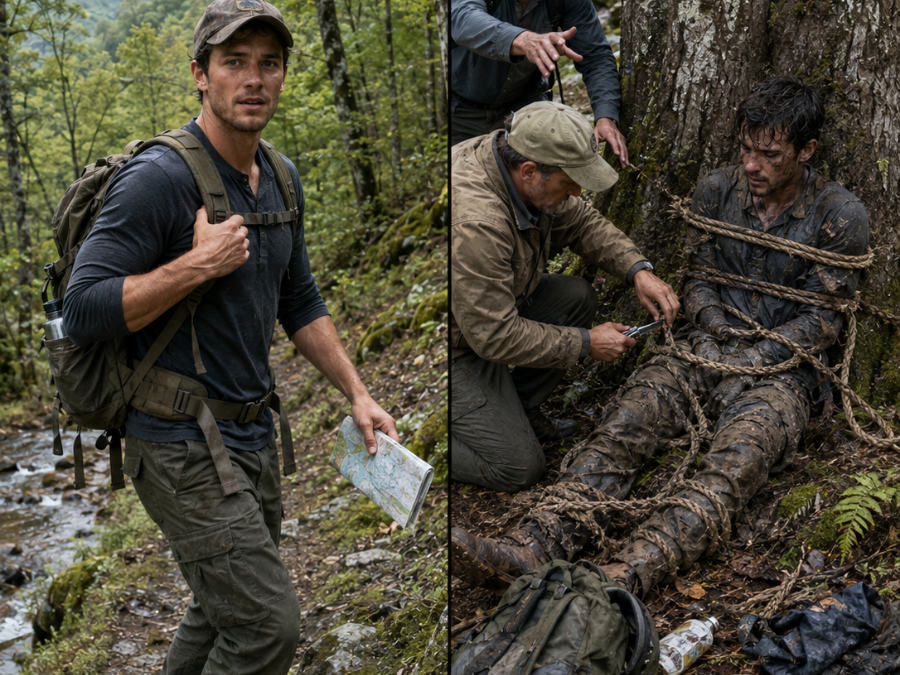
My son vanished in the mountains, then returned a year later tied to a tree repeating one sentence that terrified our entire town
Part 1: The trail he knew better than anyone else
My son, Caleb Warren, disappeared on a Friday morning in the fictional Appalachian town of Pine Hollow, Kentucky, carrying enough food for three days and promising me he would be home before Sunday supper. Eleven months later, two men found him tied to an oak tree miles from any marked trail, barely conscious and whispering the same six words over and over: “The first rule is don’t answer back.”
Before that day, Caleb had been the last person anyone expected to disappear in the mountains.
He was twenty-five, studying forestry management at a small regional college, and had spent most of his teenage years hiking the ridges surrounding Pine Hollow. He knew how to read contour maps, identify creek crossings, follow animal tracks, recognize unstable ground, and find north even when clouds covered the sun.
That Friday, I watched him pack a weather-resistant jacket, a headlamp, a whistle, trail food, a paper map, an old brass compass that had belonged to his grandfather, and a pocket notebook.
“Stay away from Raven Cut,” I warned while handing him two apples.
He smiled.
“Mom, I’m going toward Hawthorn Ridge.”
“The weather report says rain.”
“It always says rain.”
“Caleb.”
He softened immediately.
“I’ll call when I reach the overlook.”
Those were the last ordinary words I heard from my son for almost a year.
At 7:12 that morning, a small security camera outside a rural convenience store captured Caleb purchasing bottled water, crackers, and dried fruit. He wore olive hiking pants, a dark gray thermal shirt, worn leather boots, and a faded canvas cap.
He looked relaxed.
He joked briefly with the cashier, waved toward someone outside, climbed into his old blue pickup, and drove away.
At 8:35, Caleb parked near an old forestry access point called Miller’s Gap, where several cattle paths and maintenance roads disappeared into the hills. A retired farmer named Earl Patterson saw him studying a folded map across the hood.
“You heading up high?” Earl asked.
“To Hawthorn.”
“Storm’s coming.”
“I’ll be down before the worst of it.”
Earl watched him disappear between the trees.
For the next several hours, nothing seemed wrong.
Caleb sent his friend Mason a picture of a fog-covered valley and called me shortly after noon. He said he had found several areas of storm damage, complained that mosquitoes were awful near one creek, and mentioned that he might sleep in an abandoned line shack rather than pitch his tent if rain arrived early.
“Call me tomorrow morning.”
“I will.”
“And eat something.”
He laughed.
“I’m eating right now.”
The call ended at 12:42.
At 5:18 that evening, his phone briefly connected to a tower much farther north than expected.
There was no message.
No call.
Only a digital connection lasting less than a minute.
Nobody noticed until several days later.
Saturday passed without hearing from him.
That wasn’t unusual.
Sunday became different.
By four in the afternoon, the roast I had made was cooling on the counter, Caleb’s chair was empty, and my uneasiness had hardened into fear.
I called Mason.
Then Caleb’s younger sister, Lauren.
Then every friend whose number I had.
By sunset, I was talking to the local sheriff’s office.
Searchers reached Miller’s Gap before dark.
Caleb’s truck was still there.
Locked.
Inside were an extra sweatshirt, a half-empty jug of water, jumper cables, a roadside tool kit, and a paper sack containing two oranges.
Nothing appeared disturbed.
At sunrise, volunteers began searching.
A tracking dog followed Caleb’s scent along the expected route for almost five miles, then suddenly veered away from Hawthorn Ridge and down into a steep, narrow drainage called Black Fern Hollow.
Everyone who knew Caleb found that strange.
Black Fern did not lead toward his stated destination.
It descended toward a complicated network of old logging tracks and a limestone quarry abandoned decades earlier.
On the second day, searchers found one of Caleb’s water bottles.
It lay beside muddy runoff.
Less than fifty yards away was a clean spring Caleb knew perfectly well.
Mason picked up the bottle and stared at it.
“He wouldn’t drink this.”
A volunteer ranger looked toward the trees.
“What do you mean?”
“He knows this area. He knows that spring.”
Later that afternoon, they found a strip of dark fabric caught on a thorn branch.
It matched Caleb’s thermal shirt.
There was no blood.
No torn backpack.
No sign of a fall.
Only fabric.
For nine days, search teams checked ravines, caves, abandoned sheds, old haul roads, and drainage tunnels.
Several dogs lost Caleb’s scent near the abandoned quarry.
Again and again.
Then the trail vanished against bare stone.
The organized search eventually shrank.
Then winter arrived.
Posters faded.
People stopped asking questions so often.
But I never stopped setting my phone on the nightstand at full volume.
Then, almost one year after Caleb disappeared, two men searching for wild honey entered a hollow nobody had seriously examined.
And heard someone speaking.
Part 2: They found him tied beneath an old oak
The men were brothers named Walter and Dean Holloway, both in their fifties, both raised near Pine Hollow, and both familiar with almost every unofficial trail through the area.
That morning, they followed a deer path into a narrow valley below Bell Ridge.
Walter heard the voice first.
He stopped.
“Dean.”
His brother turned.
“What?”
“Listen.”
At first, there was only wind moving through leaves.
Then they heard it.
A human voice.
Weak.
Raspy.
Repeating the same sentence.
Walter dropped his pack.
“Someone’s down there.”
They pushed through ferns until they reached an enormous oak growing beside a moss-covered rock wall.
Dean initially thought he saw old clothing caught against the trunk.
Then the figure moved.
A man was tied to the tree with several loops of weathered rope wrapped around his torso and legs.
Some sections had loosened.
Others remained tight.
His hair reached his shoulders.
His beard covered most of his face.
His clothes hung in torn layers from a body that had become frighteningly thin.
Walter moved slowly toward him.
“Sir?”
The man’s head lifted.
“We’re going to help you.”
No response.
Walter stepped closer.
“Can you hear me?”
The man flinched violently.
Then he whispered:
“The first rule is don’t answer back.”
Dean looked at Walter.
“What did he say?”
Again:
“The first rule is don’t answer back.”
Over.
And over.
Walter used a pocket knife to cut the rope.
The stranger panicked when the blade touched the fibers.
“No answer.”
“It’s okay,” Walter said. “We’re getting you free.”
“No answer.”
When the last rope gave way, the man collapsed.
Walter caught him.
Then Dean saw his face.
Almost everyone around Pine Hollow had seen Caleb Warren’s missing-person photograph.
“Walter.”
“What?”
“That’s him.”
The call reached me before the ambulance reached the hospital.
I remember dropping a glass in the kitchen.
Lauren found me staring at the floor.
“Mom?”
I could barely speak.
“They found Caleb.”
She covered her mouth.
“Alive?”
I nodded.
At the regional hospital, doctors would not let us see him immediately.
He had lost nearly forty pounds.
He was dehydrated, severely malnourished, covered in old scrapes and healing scars, and had deep rope impressions around his wrists and ankles.
When they finally let me enter, he was lying beneath a white blanket.
For a moment, I did not recognize him.
Then his eyes opened.
“Caleb.”
He stared at me.
No reaction.
I sat beside the bed.
“It’s Mom.”
His entire body began trembling.
I reached toward him.
He pulled away.
“Don’t answer back.”
My chest broke open.
“Caleb, sweetheart, you’re safe.”
His eyes squeezed shut.
“The first rule is don’t answer back.”
“You’re home.”
One tear slid down his cheek.
But he repeated it again.
During the next week, Caleb barely spoke.
He slept in short bursts.
He woke whenever doors slammed.
He refused food unless someone else tasted it first.
He panicked if blinds completely covered the windows.
At night, another behavior emerged.
Numbers.
“Three. Seven. Ten.”
Lauren began writing them down.
Every time, the same numbers.
Three.
Seven.
Ten.
Sometimes followed by:
“When they call, stay quiet.”
Doctors believed the repetition could be trauma-related.
Nobody knew whether the numbers meant anything.
Then one afternoon, a maintenance worker entered Caleb’s room carrying a metal tool case.
The latch snapped open.
Caleb launched himself backward against the bed.
“No.”
I hurried toward him.
“Caleb, look at me.”
“No.”
“You’re in the hospital.”
“They’ll come down.”
My heart stopped.
“Who?”
For the first time since his rescue, Caleb said something new.
“The men underground.”
Part 3: Caleb finally remembered what was beneath the quarry
His memory returned in fragments.
We never forced him.
Some days he remembered nothing.
Some days one sound could bring back an entire hour.
Nearly three months after his rescue, we were sitting on our back porch when Caleb suddenly said:
“I didn’t get lost.”
I put down my coffee.
“I know.”
He looked toward the yard.
“I followed markings.”
Red paint marks had appeared on rocks along the trail.
They weren’t forestry markings.
Caleb assumed they belonged to utility crews or land surveyors.
He followed them into Black Fern Hollow.
Then he heard a whistle.
“One long whistle,” he said.
“What did you do?”
“I answered.”
He laughed once, without humor.
“That’s why my brain turned it into a rule.”
He whistled back.
A second whistle came from somewhere ahead.
Then another sounded behind him.
Caleb turned.
Two men stood on the path.
They wore ordinary work clothing.
No uniforms.
Nothing remarkable.
One asked what he was doing there.
Caleb explained that he was documenting storm damage.
The man noticed the GPS device attached to his pack.
“Does that save locations?”
Caleb lied.
“No.”
The man smiled.
Then a third person appeared behind him.
Caleb remembered a hand grabbing his shoulder.
His pack falling.
Fabric pressed over his face.
Then darkness.
When he woke, he was in a room partly carved into rock.
There was a metal door.
One weak light.
A mattress.
And another prisoner.
An older man.
The man never gave his real name.
He only taught Caleb rules.
Don’t ask questions.
Don’t shout.
Don’t answer whistles.
Don’t stare at the men who enter.
Don’t try to count turns in the tunnels.
“What did they want?” I asked.
Caleb shook his head.
“That’s what scared me most.”
The men were using abandoned quarry tunnels to store stolen equipment from farms, warehouses, construction sites, and rural businesses.
Generators.
Pumps.
Copper cable.
Power tools.
Vehicle parts.
Agricultural equipment.
Caleb had accidentally found their access route.
Worse, he carried a device containing coordinates.
They kept him because they thought he knew enough to expose everything.
He expected ransom demands.
None came.
Instead, they forced him to work.
Moving boxes.
Carrying water.
Cleaning sections of tunnel.
Loading stolen equipment.
He tried marking days beneath a wooden shelf.
Eventually, he lost count.
The older prisoner became sick.
One morning, he disappeared.
Months later, another captive arrived, a ranch worker who had discovered a hidden truck while searching for lost cattle.
That man vanished too.
Caleb learned not to ask where anyone went.
The numbers finally made sense.
Three.
Seven.
Ten.
He took a sheet of paper.
“Three steps from my mattress to the door.”
He drew a line.
“Seven steps down the first passage.”
Another line.
“Ten from the junction to the metal gate.”
Lauren stared at him.
“You memorized it.”
“I tried.”
Even though they warned him not to.
Nearly eleven months after Caleb disappeared, heavy rain damaged part of the underground complex.
A tunnel partially collapsed.
Several captors ran toward the damaged section.
For a few minutes, nobody guarded Caleb’s room.
He escaped.
He ran through tunnels using the numbers he had repeated in his head for months.
Three.
Seven.
Ten.
He reached an exterior opening hidden behind brush.
For the first time in nearly a year, he saw open sky.
He ran.
He traveled for almost two days.
He drank creek water.
Ate wild berries.
Slept beneath fallen trees.
Then he saw one of the men.
“They found me.”
His voice broke.
I reached for his hand.
This time he let me hold it.
They did not take him back underground.
The group had apparently decided to abandon the quarry.
Instead, they transported him to Bell Ridge.
They tied him to the oak.
One man told the others it would look like Caleb had escaped and died alone in the woods.
They left.
Hours later, someone returned.
A younger member of the group.
“He cut one rope almost through,” Caleb whispered.
“Why?”
“He said he couldn’t do anything else.”
The man left a bottle of water and food.
He told Caleb to work himself free when he had enough strength.
Caleb tried.
He couldn’t.
Walter and Dean found him the next morning.
Part 4: Investigators finally searched for criminals instead of a hiker
The quarry had already been searched during Caleb’s disappearance.
But search teams had been looking for an injured hiker.
This time, investigators searched for concealed infrastructure.
That changed everything.
Less than three miles from an area volunteers had crossed repeatedly, they found an entrance hidden behind rotting timber, cut brush, rusted fencing, and loose rock arranged to resemble a collapsed hillside.
Inside were several chambers.
Mattresses.
Plastic water containers.
Food packaging.
Tools.
Electrical cables.
Empty crates.
And Caleb’s notebook.
The early pages contained forestry notes and coordinates.
The later pages contained hundreds of small tally marks.
One for every day he had managed to count before losing track.
Three suspects were arrested within weeks.
A fourth had already fled the region.
The younger man who had partially cut Caleb free was found several states away.
His name was Dylan Cross.
He was twenty-eight.
When Caleb saw his photograph, he didn’t become angry.
“He came back,” he said.
That was all.
Dylan eventually cooperated.
He admitted participating in the theft operation but said he had repeatedly objected to holding witnesses.
Fear, money, and dependency had kept him involved.
His information led investigators to stolen machinery, abandoned vehicles, secondary storage sites, and records linking the group to multiple rural thefts.
The mystery of the older prisoner also unraveled.
His name was Harold Benson.
He had disappeared from another county two years earlier.
He had not died underground.
When he became seriously ill, the group had left him near a rural highway.
He was later found wandering hundreds of miles away, confused and unable to describe where he had been held.
The ranch worker survived as well.
He escaped during a transfer and fled to relatives in another state, too frightened to report what happened.
What had seemed incomprehensible became painfully ordinary.
There were no monsters beneath those hills.
Only men who realized isolation, fear, and abandoned tunnels could hide almost anything.
Caleb’s recovery took longer than the investigation.
He spent months learning how to sleep again.
How to enter dark rooms.
How to eat without watching someone else first.
How to hear a whistle without freezing.
The sentence faded slowly.
“The first rule is don’t answer back.”
First, he repeated it every night.
Then several times a week.
Then occasionally.
Eventually, not at all.
One afternoon, Caleb told me something I will never forget.
“For months, I thought you had buried me.”
I stared at him.
“Never.”
“I buried myself.”
His eyes filled.
“I figured if I ever escaped, nobody would know who I was anymore.”
I squeezed his hand.
“You don’t have to become who you were.”
He looked at me.
That sentence seemed to land somewhere deep.
“I know that now.”
Nearly a year after returning home, Caleb asked to visit the oak tree.
I said no immediately.
Lauren objected.
Mason told him to wait.
But Caleb remained calm.
“I don’t want that tree to own the ending.”
Eventually, we agreed.
Part 5: The day Caleb finally answered the sound that haunted him
We returned to Bell Ridge on a cold, bright November morning.
Caleb walked beside me.
Lauren, Mason, and Walter Holloway followed.
He carried no GPS unit.
No old notebook.
No grandfather’s compass.
Those things had disappeared during his captivity.
Instead, he brought a simple walking stick, a canteen, and a lightweight jacket.
When we reached the oak, Caleb stopped.
The ropes were gone.
Only shallow grooves remained in the bark.
Walter stayed back.
I stood beside my son.
Caleb lifted one hand and touched the tree.
For nearly a minute, nobody spoke.
Then Lauren asked:
“You okay?”
Caleb inhaled.
“Yes.”
And suddenly he began crying.
Not loudly.
Not dramatically.
He leaned his forehead against the bark and let tears run down his face.
“I thought I was going to die here.”
I wrapped my arms around him.
“But you didn’t.”
He nodded.
“No.”
We stayed for nearly two hours.
We ate sandwiches.
Drank coffee from thermoses.
Mason complained about forgetting napkins.
Lauren laughed.
And slowly, the place where Caleb had spent one of the worst nights of his life became filled with ordinary family sounds.
Before leaving, Caleb walked away alone for several minutes.
He listened to water moving over stones.
Birds calling.
Leaves shifting overhead.
During captivity, silence had meant danger.
The woods had become part of the fear.
But that morning, I watched my son realize the mountains had never betrayed him.
People had.
Months later, Caleb resumed classes.
Not immediately.
Not because anyone pressured him.
He returned when he was ready.
He stopped hiking alone for a long time and never apologized for it.
Eventually, he began helping a volunteer wilderness group map abandoned mines, unsafe service roads, hidden quarry entrances, and remote emergency access points.
People sometimes called him courageous.
He hated that word.
“I survived,” he would say. “That’s different.”
Three years after his rescue, Caleb decided to finish the hike he had originally planned.
He and Mason drove to Miller’s Gap on a clear morning.
I packed enough food for four people even though there were only two.
Caleb laughed when he opened the bag.
“Mom.”
“You disappeared once. I’ve earned the right to overpack.”
He kissed my forehead.
“Fair.”
They reached Hawthorn Ridge shortly before noon.
From the overlook, Pine Hollow looked tiny beneath miles of green forest.
Mason pulled out two sandwiches.
“Your mother thinks we’re starving.”
“She always thinks I’m starving.”
“That’s because she’s your mother.”
They ate beside a rock ledge.
Later, they reached a fork in the trail.
One route returned directly toward the truck.
The other looped past several springs.
Mason looked at Caleb.
“Which way?”
Caleb studied both paths.
For a moment, memories returned.
Red marks on stone.
The first whistle.
The men.
The metal door.
Three.
Seven.
Ten.
The oak.
Then Mason absentmindedly whistled while adjusting his pack.
Caleb froze.
Only briefly.
Mason noticed.
“Sorry.”
Caleb looked at him.
Then something unexpected happened.
He smiled.
“Mason.”
“Yeah?”
Caleb pointed toward the longer trail.
“Let’s take that one.”
They began walking.
Several minutes later, Mason whistled again without thinking.
This time, Caleb answered.
One sharp whistle.
The sound echoed across the trees.
He stopped walking.
Mason turned.
Neither spoke.
Then Caleb laughed.
For nearly a year, his mind had kept him alive by repeating one instruction.
Don’t answer back.
Don’t answer back.
Don’t answer back.
That day, in bright afternoon sunlight, surrounded by trees instead of tunnels, my son finally understood that the rule had expired.
He had answered.
Nothing happened.
Nobody stepped from the trail.
Nobody grabbed him.
Nobody ordered him underground.
There was only wind, birds, sunlight, and the sound of his own laughter.
Caleb continued down the mountain without turning around.
And for the first time since the morning he disappeared, the trail ahead belonged to him again.
The End. This story is entirely fictional and was created for entertainment purposes. All characters, names, locations, events, and situations depicted in this story are imaginary. Any resemblance to actual people, organizations, places, or events is purely coincidental.








