A massive creature crawled into our barn during a thunderstorm, and when my father went inside alone, our entire family learned a secret we never revealed
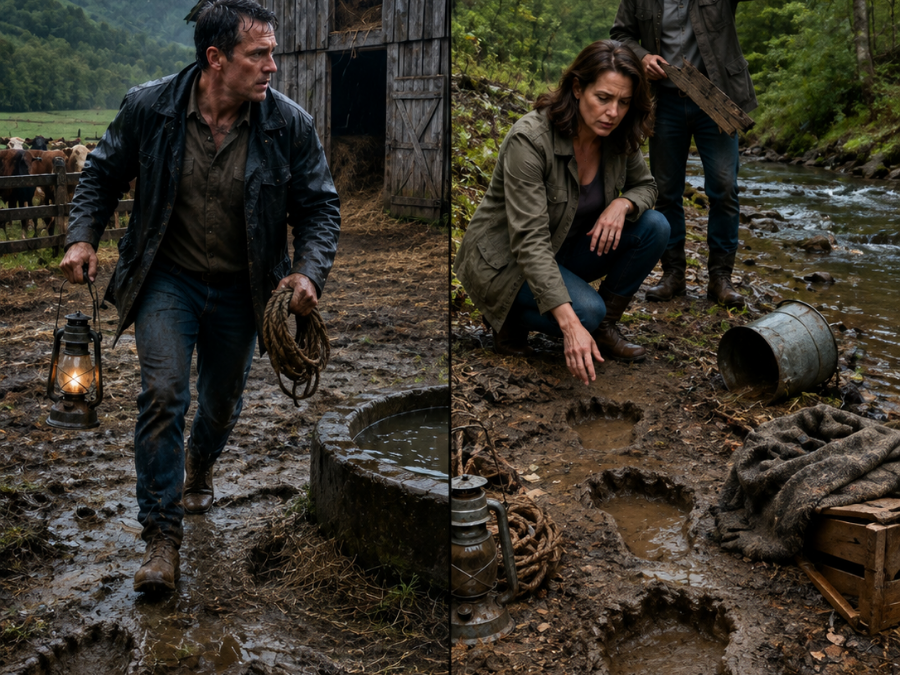
A massive creature crawled into our barn during a thunderstorm, and when my father went inside alone, our entire family learned a secret we never revealed
Part 1: The footprints nobody in Cedar Hollow could explain
I was thirteen years old when something enormous began walking along the tree line behind our family farm, leaving footprints in the mud that looked almost human except no human being could possibly have feet that large. Thirty-six years later, I can still remember the night my father crossed our flooded yard carrying a lantern toward the old hay barn while thunder shook the windows, because when he finally came back out, his hands were trembling.
My name is Emily Mercer, and I grew up on Briarwood Farm outside the fictional mountain town of Cedar Hollow, West Virginia, where my parents raised cattle, kept chickens, planted sweet corn, and maintained a small apple orchard beside the creek. Our farmhouse sat at the end of a gravel road surrounded by hardwood forest, rocky ridges, rhododendron, and steep hollows where morning fog often remained until noon.
My father, Daniel Mercer, was forty-seven then, broad-shouldered, quiet, and almost impossible to frighten. He could identify a fox from its tracks, predict bad weather by watching livestock, and repair nearly anything with wire, patience, and the collection of mismatched tools he kept inside an old wooden chest.
That was why I became frightened when he stopped joking about the strange signs.
It started with our cattle.
Every morning before sunrise, several cows gathered near the same corner of the pasture, facing the forest instead of the feed trough. Nothing had attacked them, nothing was missing, yet they stood shoulder to shoulder with their ears raised as though something beyond the fence was watching them.
“Probably a black bear passing through,” my mother, Susan, suggested over breakfast.
Dad slowly stirred his coffee.
“Bear doesn’t walk like that.”
My seventeen-year-old brother, Luke, looked up.
“You found tracks?”
Dad didn’t answer.
That afternoon, curiosity got the better of me, so I followed him across the pasture until he stopped near a muddy patch beside the creek.
The footprint was unmistakable.
Five toes.
A heel.
A shape almost exactly like a bare human foot.
Except it was nearly twice as long as Dad’s boot.
I crouched beside it.
“What made that?”
Dad spun around.
“Emily, what are you doing out here?”
“Following you.”
His expression hardened.
“Go home.”
“But Dad—”
“Now.”
That night, I heard my parents arguing quietly in the kitchen.
Mom wanted him to call some neighbors and organize a search, while Dad insisted there was no evidence that whatever made the tracks had harmed anything.
“Yet,” Mom whispered.
“If it wanted one of our calves,” Dad replied, “it had plenty of chances.”
More signs appeared during the next two weeks.
Corn vanished from several rows without the stalks being flattened.
Branches were bent high above our heads.
Heavy stones beside the creek had been moved.
Then Luke claimed he saw something crossing between two trees just after sunset.
“It was standing upright,” he whispered to me. “And Em, it was huge.”
I laughed at him.
Two nights later, I stopped laughing.
A violent storm rolled over Cedar Hollow shortly before midnight, turning the yard into mud while wind hammered the barn doors. I was awake listening to the rain when a heavy thump came from inside the hay barn.
Then another.
Something big was moving in there.
Through my bedroom window, I saw Dad crossing the yard in his dark raincoat, carrying a lantern and a coil of rope.
He wasn’t carrying a rifle.
That scared me even more.
He opened the side door and disappeared inside.
Ten minutes passed.
Then twenty.
Then nearly forty.
When Dad finally came out, his shirt was soaked beneath his raincoat and there was straw stuck to his knees.
He walked slowly toward the house.
His hands were shaking.
The next morning he told us a frightened cow had wandered into the barn.
There was only one problem.
Every cow was accounted for in the pasture.
And later that afternoon, I watched my father quietly carry a bucket of water, apples, and three ears of boiled corn toward the barn.
Whatever had arrived during the storm was still inside.
Part 2: Dad finally showed us what was hiding in there
For three days, food disappeared from our kitchen.
Apples.
Corn.
Boiled potatoes.
Carrots.
A container of leftover roast.
Dad carried everything to the barn before sunrise and returned with empty bowls.
Mom finally cornered him beside the sink.
“Daniel, what are you feeding?”
He froze.
“Nothing.”
She pointed toward the metal bucket in his hand.
“Then nothing has a remarkable appetite.”
Luke snorted nervously.
Dad didn’t smile.
He looked at all three of us before saying, “After dinner, I’m taking you out there.”
Mom’s face tightened.
“To see what?”
“You’ll understand when you see it.”
That answer ruined my appetite.
At dusk, Dad led us across the yard.
Before opening the barn, he turned around.
“Nobody runs.”
Luke swallowed.
“Nobody screams either,” Dad added. “There’s a mother in there, and she has two newborns.”
Mom stared at him.
“A mother what?”
Dad opened the door.
The barn smelled of wet hay, dirt, apples, and something musky that did not belong to any animal I knew.
We moved slowly between stacked feed sacks and hay bales.
Dad raised the lantern.
Something enormous shifted against the far wall.
My mind desperately tried to turn it into a bear.
Then it raised one long arm.
The creature was covered in dark brown hair, with massive shoulders, powerful hands, and legs drawn close beneath its body. Its face was partly hidden beneath coarse hair, yet its eyes, nose, and expression seemed disturbingly familiar.
Beside her lay two tiny creatures.
One was curled tightly against her chest.
The other rested beneath an old wool blanket.
Mom grabbed Dad’s sleeve.
“Oh my God.”
“It’s okay,” he whispered.
The creature watched us.
Not wildly.
Carefully.
Her gaze moved from Dad to Mom, then Luke, then me.
She immediately pulled one infant closer.
That one gesture changed something inside me.
She wasn’t watching us like prey.
She was watching us like a mother.
Dad slowly sat on an overturned feed bucket.
“She came in during the storm already in labor.”
Mom looked at him.
“You were in here alone with her?”
Dad nodded.
“When I opened the door, one baby had already been born. She was exhausted, and the second one was stuck.”
Luke’s face went pale.
“What did you do?”
Dad rubbed both palms across his jeans.
“For a minute, I almost left.”
I had never heard my father admit being afraid.
“Then I realized what was happening.”
Dad had helped deliver calves, foals, goats, and puppies his entire life. He didn’t know what kind of creature lay before him, but suffering apparently looked the same in every species.
“I moved closer very slowly,” he continued. “She growled. I stopped. Then I tried again.”
He had spoken calmly to her throughout the delivery, using the same low voice he used with frightened livestock.
Eventually she allowed him close enough to help.
The second infant came out motionless.
Dad wiped its mouth, cleared its airway, wrapped it in burlap, and rubbed its tiny chest.
Nothing happened.
The mother made a low, broken sound.
Dad tried again.
Then the newborn coughed.
It inhaled.
Mom covered her mouth and began crying.
Luke stared toward the baby beneath the blanket.
“And she let you live?”
Dad smiled faintly.
“She did more than that.”
After the birth, the mother slowly extended one enormous hand toward him.
Dad thought she might strike.
Instead, she rested two fingers against his shoulder for several seconds.
Then she withdrew her hand.
The creature made the same low sound now.
Dad looked toward her.
“She remembers.”
For the first time in my life, I saw fear and wonder existing together on my father’s face.
And from that evening forward, our barn no longer belonged entirely to us.
Part 3: For eleven days, our farm sheltered an impossible family
Mom began cooking extra food every morning.
Dad discovered the creature preferred apples, boiled vegetables, berries, corn, and small portions of meat. Luke carried water while I was allowed to leave food just inside the barn entrance, although Dad made one rule absolutely clear.
“Never approach the babies.”
I didn’t argue.
When the mother finally stood upright several days later, she appeared close to seven feet tall, perhaps more, with arms long enough that her fingers almost reached her knees. Even weakened, she moved hay bales that Luke and I struggled to drag together.
Mom began calling her Willow.
It wasn’t because we believed she understood names; Mom simply refused to keep referring to her as “that thing.”
Strangely, after several days, the creature appeared to recognize the sound.
“Willow,” Mom would say softly before entering.
The huge head would rise.
The two infants were different.
The larger baby constantly crawled through the straw, grabbing anything within reach, while the smaller one—the infant Dad had revived—slept longer and remained pressed tightly against its mother.
No one touched them.
Dad insisted helping did not give us ownership.
“You don’t save something so you can put a claim on it,” he told Luke when my brother suggested taking a photograph.
That became the rule for everything.
No cameras.
No neighbors.
No telling friends.
No evidence hunting.
“If word gets out,” Dad said, “people will be climbing these hills before supper.”
I understood.
Some would come because they were curious.
Others would come because they were afraid.
And frightened people often destroyed whatever they could not explain.
Willow became stronger every day.
She learned our routines quickly.
She recognized Dad’s footsteps.
She responded differently to Mom’s voice.
Whenever Luke moved too quickly near the babies, she immediately shifted her entire body between them.
One afternoon, I was placing apples near the wall when the larger infant crawled toward me.
I froze.
Willow extended one arm, gently lifted the baby around its middle, and pulled it back against her chest.
I smiled despite myself.
“My mom does that too.”
Willow tilted her head.
I knew better than to claim she understood me.
But I never forgot the look in her eyes.
Trouble began when our neighbor, Harold Jenkins, stopped by.
He had discovered several enormous tracks near his vegetable field.
“Daniel, something strange is moving through these woods.”
Dad pretended to examine the muddy drawing Harold had made.
“Could be distorted bear tracks.”
Harold frowned.
“Since when does a bear leave five toes shaped like ours?”
Dad shrugged.
“The mud does strange things.”
Harold lowered his voice.
“Some men are talking about searching the ridge Saturday night.”
Dad’s expression changed.
“Don’t.”
“Why?”
“The slopes are wet, and somebody will break his neck.”
Harold studied him suspiciously before leaving.
That evening, I found Dad sitting outside the barn.
“They’re going to find her,” I said.
“If she stays.”
“What are we going to do?”
Dad looked toward the darkening trees.
“Nothing.”
I frowned.
“She’ll decide.”
Two mornings later, Willow stood for almost the entire day.
She no longer rested.
She watched the barn doors.
Dad noticed too.
“She’s leaving tonight.”
Mom’s eyes filled.
After sunset, we opened both doors.
Mist drifted over the pasture while the woods beyond the fence disappeared into darkness.
An hour passed before Willow emerged.
One infant clung to her back.
The other walked unsteadily beside her, gripping the long hair on her leg.
For the first time, we saw her fully upright beneath the open sky.
She was enormous.
She reached the pasture fence, then stopped.
Slowly, she turned around.
Dad stepped forward.
“Go on,” he whispered. “You’re strong enough.”
Willow returned toward him.
Mom caught her breath.
The creature stopped directly in front of Dad.
She raised one hand.
Then she rested it on his shoulder.
Dad didn’t move.
Neither did she.
For several seconds, they simply looked at one another.
Then Willow lowered her hand, turned toward the trees, and disappeared into the forest with both babies following.
Dad remained beside the fence long after we could no longer hear them.
He didn’t look like a farmer watching a wild animal leave.
He looked like a man saying goodbye to someone he knew he would never forget.
Part 4: What happened that summer changed my father forever
After Willow left, giant tracks appeared farther and farther up the ridge.
Then they disappeared.
The cattle relaxed.
The barn returned to storing hay.
Life looked normal again.
But Dad was different.
Before that summer, he had regularly cut mature trees whenever we needed lumber.
Afterward, he collected fallen timber instead.
When a developer offered my parents good money for twenty forested acres above the creek, Dad refused before the man finished explaining the offer.
“You could turn that whole hillside into pasture,” the man argued.
Dad looked toward the trees.
“It’s already being used.”
“For what?”
“Living.”
The man laughed.
Dad didn’t.
Years passed.
Luke married and built a house near Cedar Hollow.
I became a nurse and eventually moved several hours away, although I returned often.
Dad kept walking the same forest edge almost every morning.
Occasionally, something reminded us.
A large print appeared beside the creek.
Three heavy knocks echoed from deep in the woods one night.
A branch was twisted high above the trail.
Luke once suggested following the signs.
Dad shook his head.
“They came to us when they needed help. That doesn’t give us permission to chase them.”
When I was thirty-eight, I walked the ridge with him one rainy morning.
We found a footprint beside a spring.
It was large, but considerably smaller than Willow’s.
Dad crouched beside it.
A slow smile crossed his face.
“What?” I asked.
He pointed.
“It’s smaller.”
I immediately understood what he meant.
One of the babies.
Perhaps.
We never proved it.
Dad didn’t want proof.
He covered the print lightly with leaves so the rain would not erase it immediately, then continued walking.
He lived to eighty-three.
Near the end, lung disease put him in a small hospice facility overlooking wooded hills.
Three days before he died, he asked me to pull my chair closer.
“Emily,” he whispered, “I didn’t tell you everything.”
I knew immediately what he meant.
“The barn?”
Dad nodded.
He told me the smaller newborn hadn’t just stopped breathing.
For several minutes, he believed it was dead.
While he worked on it, Willow began making a sound he never heard before or after.
Not anger.
Not warning.
Grief.
Dad had heard cows calling for dead calves.
He had watched dogs whine over lost puppies.
He understood that sound.
“She thought her baby was gone,” he whispered.
Dad rubbed the infant harder.
Cleared its mouth again.
Breathed air into its tiny lungs.
Nothing.
Then suddenly, the little chest moved.
The infant coughed.
It breathed.
“And Willow grabbed me,” Dad said.
I leaned forward.
“You never told us that.”
“I thought she was going to kill me.”
“What happened?”
His eyes filled with tears.
“She pulled my head toward hers.”
I stared at him.
Dad smiled weakly.
“She pressed her forehead against mine.”
They stayed like that for several seconds, the exhausted creature and the frightened farmer, while her newborn breathed between them.
I reached for Dad’s hand.
“That’s why you protected the woods.”
He squeezed my fingers.
“Yes.”
Part 5: My father’s final request became our family’s promise
Dad died three days later.
His final request wasn’t complicated.
He didn’t ask us to tell newspapers.
He didn’t ask us to convince scientists.
He didn’t want a plaque placed on the barn or a memorial overlooking the forest.
He asked us not to sell the upper woods.
Luke and I agreed.
Today, almost sixty acres behind Briarwood Farm remain untouched except for narrow walking trails. We don’t hunt there, clear timber, or build roads, and although neighbors sometimes joke that the Mercer family protects “a bunch of useless hillside,” neither Luke nor I bother correcting them.
Mom lived another eleven years after Dad.
She rarely discussed Willow.
Some evenings, however, she sat beside the kitchen window watching the trees.
Once I asked what she expected to see.
“Nothing,” she said.
Then she smiled.
“But there’s no harm in looking.”
After Mom died, Luke moved into the farmhouse.
I visit whenever I can.
The barn has been reinforced, the roof replaced, and several beams are new, but one cracked plank along the back wall remains exactly where it was.
Dad refused to replace it.
So do we.
There are no photographs of Willow.
No hair samples.
No footprints preserved in plaster.
Nothing you could carry into a laboratory and place beneath bright lights.
For years, that frustrated me.
Eventually, I understood Dad’s reasoning.
He never believed he had discovered something.
He believed something frightened and desperate had trusted him.
That distinction mattered.
Two winters ago, after a week of heavy rain, Luke called.
“Come home when you can.”
He wouldn’t explain why.
When I arrived, he took me down toward the creek.
Beneath the exposed roots of an old oak were three footprints pressed deeply into the mud.
One was enormous.
Two were smaller.
I stared at them.
“How long?”
“Found them this morning.”
“Did you follow them?”
Luke smiled.
“What would Dad say?”
I laughed.
Rain began falling softly.
The prints slowly filled with water.
We didn’t cover them.
We didn’t photograph them.
We walked home.
That night, I sat beside the same kitchen window where I had watched Dad cross the yard during that thunderstorm decades earlier.
The woods beyond the pasture were nearly black.
For a moment, something large moved between the trees.
Maybe it was a shadow.
Maybe it was a deer passing behind a trunk.
Maybe it was something else.
I no longer need to know.
When I was thirteen, I believed our fence marked the point where our land ended and wilderness began.
Dad taught me something more complicated.
Property lines exist on paper.
Mountains do not read paper.
Whatever lived beyond our pasture may have traveled those ridges generations before my grandparents built the farmhouse, and perhaps the surprising part was never that Willow entered our barn.
Perhaps we built our barn across a path her family had always used.
What matters to me happened during one terrible storm.
My father opened a barn door and found something he could not name.
He could have run.
He could have attacked it.
He could have gathered frightened neighbors and turned mystery into panic.
Instead, he saw an exhausted mother struggling to save her child.
That was enough.
He stayed.
He helped.
And afterward, he protected her secret.
For the remaining decades of his life, Dad treated that forest differently because one impossible night had taught him that land could be home to lives we knew nothing about.
Whenever people asked why he refused to sell those wooded acres, he never told them about Willow.
He simply said, “Not everything needs to belong to us.”
I understand those words now.
Sometimes the most important thing a person can do is recognize suffering without demanding an explanation for it, offer help without expecting possession, and walk away without turning another living creature’s most vulnerable moment into a trophy.
Dad never knew what Willow truly was.
Neither do I.
But I know exactly what he was when she needed him.
He was kind.
And in the end, that mattered more than solving the mystery ever could.
The End. This story is entirely fictional and was created for entertainment purposes. All characters, names, locations, events, and situations depicted in this story are imaginary. Any resemblance to actual people, organizations, places, or events is purely coincidental.








