“She’s Too Pretty To Be Real Military,” The Congressman Laughed At Dinner. Nobody Spoke After His Security Team Whispered My Name In His Ear. He Suddenly Stood Up And Apologized In Front Of Everyone.
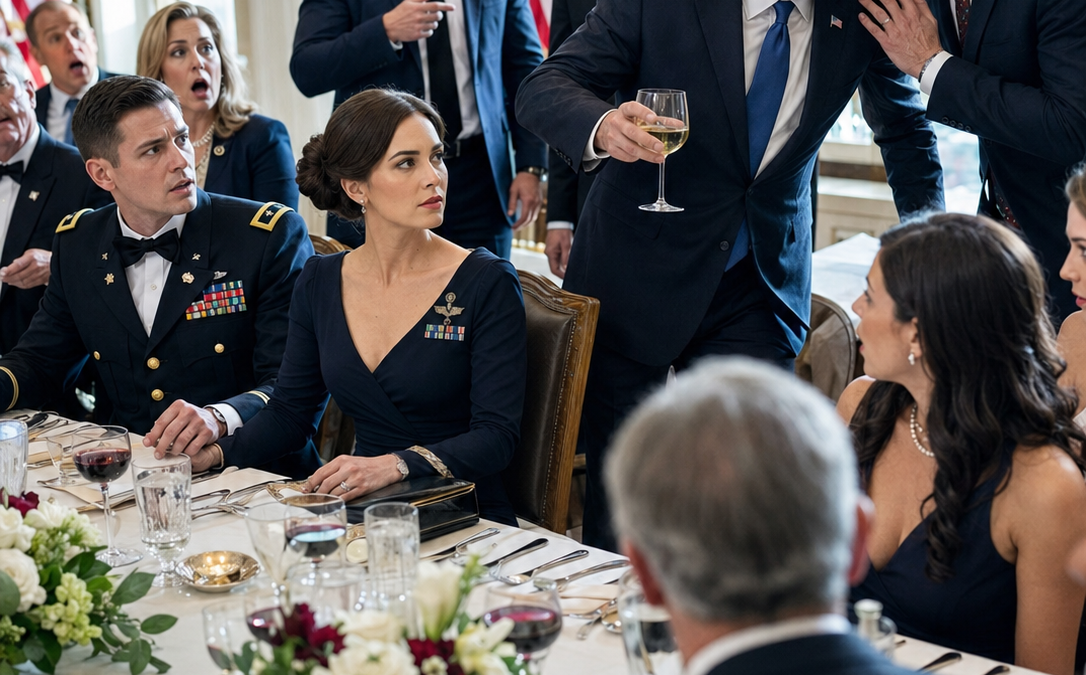
“She’s too pretty to be real military,” the congressman laughed at dinner while everyone around the table followed his lead. I stayed quiet, not because I was embarrassed, but because I had learned some rooms only reveal themselves when you let people talk. Then his security team leaned in and whispered my name. His smile disappeared. Seconds later, he stood up and apologized in front of everyone. But he had no idea the bigger betrayal wasn’t his joke—it was the reason my fiancé’s family wanted me at that dinner in the first place.
### Part 1
The dinner smelled like lemon butter, polished wood, and money.
Not old money, not exactly. More like money that wanted to be seen behaving well. Crystal glasses caught the white glow from the chandeliers. Silverware sat in perfect lines beside plates too large for the tiny portions the waiters kept carrying in. Outside the tall windows, downtown Washington, D.C. blinked in the cold November dark, all headlights and wet pavement after a hard rain.
I sat at the far end of the table in a navy dress I had bought fifteen minutes before the store closed.
It was plain, knee-length, and forgettable. That was the point.
My name was Mara Vale, though that night most people knew me only as “Mara, a friend of the Bellwethers.” That was how Glen Bellwether introduced me when his wife pushed me toward the dining room.
“This is Mara,” he said, one hand pressed to my shoulder like he was placing a decoration. “She served with our nephew, I think. Or works with him. Something like that.”
I smiled because correcting him would have taken more energy than I had.
Across the table, Congressman Alden Rusk laughed at something one of his donors said. His laugh came half a second before everyone else’s, like he had approved the joke and released the room to follow him.
He had a wide politician’s face, silver hair combed so carefully it looked painted, and a wedding ring he kept twisting whenever a younger woman spoke. His district loved him. His staff feared him. His donors treated him like a horse they had bet too much money on to admit he limped.
I had not come for him.
I had come because Liora Bellwether, my almost-fiancée’s mother, had called three times that week and finally said, “Mara, darling, it would mean so much if you showed up. We’re trying to build bridges.”
Build bridges. That was what rich families called it when they wanted you to stand quietly on the bridge while they charged tolls.
My almost-fiancé, Callum, sat three seats away from me. He wore the charcoal suit I had picked out for his last job interview. His hand rested on the back of his chair, close enough to touch mine if he wanted to. He didn’t.
For the first half hour, I listened more than I spoke.
I listened to a lobbyist talk about veterans like we were a weather pattern. I listened to Liora describe “military people” as “so disciplined, almost like monks.” I listened to Glen tell a story about once visiting a base in Texas and being “practically saluted everywhere,” though nobody salutes civilians unless they are confused, threatened, or being very polite.
I cut my chicken slowly.
I counted exits without meaning to.
Two behind me. One through the kitchen. One through the glass doors to the balcony. Congressman Rusk’s security team stood near the hallway, three men in black suits, not eating, not smiling, watching reflections in the windows instead of the people in front of them.
One of them caught my eye.
Not for long. Just enough.
His right hand twitched near his jacket, then relaxed. He looked away first.
I looked down at my plate.
Beside me, Callum’s sister Tessa leaned close and whispered, “You’re doing great.”
I almost laughed.
“At eating chicken?” I whispered back.
“At not looking like you want to disappear.”
“I don’t want to disappear.”
She blinked at me, unsure whether I meant it.
The truth was worse. I didn’t want to disappear. I wanted to be done. With rooms where people wanted my service as a backdrop but not my voice. With men who asked what I did only so they could decide how much respect to subtract. With Callum’s family smiling at me like I was a strange charity project he had brought home.
The waiter poured wine I didn’t drink.
Rusk turned toward me after dessert arrived, his attention landing on me with the lazy confidence of a man who believed every woman at his table had been waiting for it.
“So, Mara,” he said, dragging my name into the center of the room, “Glen tells me you’re connected to the Army somehow.”
Callum looked down at his plate.
That was the first small betrayal of the night. Not the worst. Just the first one I let myself name.
“I’m in the Army,” I said.
Rusk’s eyebrows lifted. A couple of donors turned their heads. Liora smiled too brightly, like she hoped I would make it charming.
“In the Army,” Rusk repeated. “Well, now. Recruiting really has changed.”
A few people chuckled.
I folded my napkin once across my lap. “It has.”
“What do you do there?” he asked.
The room quieted in the way rooms do when they smell entertainment coming.
“I lead people,” I said.
His grin widened. “That’s refreshingly vague.”
“It’s accurate.”
Callum finally glanced at me, his mouth tight.
Rusk leaned back, enjoying himself now. “No offense, sweetheart, but you don’t look like any soldier I’ve ever met.”
The word sweetheart moved across the table like dirty water.
I set my fork down.
“Then you haven’t met enough soldiers,” I said.
For one second, the room could have corrected itself. Someone could have changed the subject. Callum could have touched my hand. Glen could have said, “Alden, don’t.” Even Liora, queen of soft knives, could have laughed it away.
Instead, Rusk raised his glass.
“Come on,” he said. “Look at her. She’s too pretty to be real military.”
The laugh came fast.
Not from everyone. Not loudly. But enough.
A woman near the middle covered her mouth while smiling. A man with a pink tie slapped the table once. Glen exhaled through his nose. Tessa stared at her lap. Callum did not laugh, but he didn’t defend me either, and silence can bruise just as hard as sound.
I felt heat crawl up the back of my neck.
Not shame. Not exactly.
Recognition.
I had heard versions of that sentence in barracks hallways, airport lounges, briefings, hospital corridors, and once beside a burned-out vehicle while my hands still smelled like smoke. Men were always so surprised when a woman did not arrive in the shape their imagination had ordered.
I looked at Congressman Rusk and said nothing.
That bothered him more than anger would have.
His grin faltered, then sharpened. “Don’t look at me like that. It was a compliment.”
Before I could answer, one of his security men moved.
Not quickly. Not dramatically. Just a step away from the wall.
He bent near Rusk’s ear and whispered seven words.
I knew because I read lips when I had to.
“Sir. That is Major Mara Vale.”
Rusk’s face emptied.
The room did not know what had happened yet.
But I did.
And the worst part was, I still didn’t know which version of my name had reached him.
### Part 2
The silence did not fall all at once.
It thinned first.
One conversation at the far end of the table died mid-sentence. A glass touched a plate with a sharp little ring. Somewhere behind me, a server stopped walking so suddenly the ice in his water pitcher clicked against the glass.
Congressman Rusk stared at his security man.
“Say that again,” he said, too quietly for the whole table, but not too quietly for me.
The agent’s face did not change. “Major Mara Vale, sir.”
There it was again.
My name, stripped of all dinner-party softness.
Major.
Not sweetheart. Not Callum’s girlfriend. Not Glen’s vague little military connection. Not the quiet woman in the navy dress who had been placed near the end of the table because nobody knew what else to do with her.
Rusk looked at me.
Really looked this time.
His gaze moved over my face, my shoulders, my hands. It paused on the thin white line at my wrist where the skin had healed badly. I watched him find the scar and pretend he had not.
“Mara,” Callum whispered.
There was warning in it.
Not concern. Warning.
I turned my head slightly. “Yes?”
His jaw flexed. “Maybe don’t.”
“Don’t what?”
He didn’t answer because there was no answer that would make him sound decent.
Liora leaned forward, diamonds flashing at her throat. “Alden, I’m sure Mara understands you meant no harm.”
I looked at her.
She smiled with all her teeth.
I thought of the first time she had met me, two years earlier, in a seafood restaurant in Annapolis. She had looked at my uniform and said, “How admirable. Callum has always been drawn to women with strong survival instincts.”
At the time, I had told myself I misunderstood the insult.
I was tired of doing that.
Rusk stood so fast his chair scraped backward and hit the wall behind him. The sound cut through the room like a snapped bone.
Everyone froze.
He held his napkin in one hand, crumpled into a white fist.
“I owe Major Vale an apology,” he said.
The use of my title landed harder than the insult had.
Faces turned toward me, startled and hungry. People love a public correction almost as much as they love a public humiliation. The difference is, they can pretend one is moral.
Rusk cleared his throat. “That was a careless and disrespectful comment. Major, I’m sorry. Truly.”
His voice had changed. The charm was still there, but now it had panic under it, like rot under paint.
I looked at him for a long second.
“Thank you,” I said.
That was all.
No graceful smile. No warm absolution. No little joke to let him climb back into comfort.
He waited.
I did not help him.
Slowly, he sat down.
The table remained quiet.
Tessa picked up her wine and drank too fast. Glen adjusted his cufflinks. Liora’s eyes flicked between me and Rusk’s security team as if she were trying to calculate my market value in real time.
Callum leaned close, his breath smelling faintly of whiskey.
“What did that man tell him?” he whispered.
I cut into the untouched edge of my dessert. “My name.”
“Just your name?”
“Apparently that was enough.”
His face tightened. “Mara.”
There it was again. The tone he used when I had embarrassed him by being too direct, too quiet, too unwilling to smile through something ugly.
“What?” I asked.
“This is a very important night for my family.”
I almost put my fork down, but I didn’t. I took one bite of the cake. It tasted like sugar, butter, and nothing.
Across the table, Congressman Rusk avoided looking at me. His security man did not.
I remembered him then.
Not fully. Just pieces.
A dark hallway. Flashlights. A child crying behind a locked service door. Smoke thick enough to turn every breath into sandpaper. Someone in a suit shouting into a radio with a bleeding hand pressed to his ribs.
Different country. Different year.
I had been a captain then.
By morning, half the people who saw me walk out of that building had been told not to repeat what they saw.
The agent near the door had been younger then. Less gray at the temples. His left cheek had been cut open. He had kept saying, “My son. My son is still inside.”
And I had gone back in.
I did not say any of that at dinner.
Some truths do not become cleaner because strangers hear them over crème brûlée.
Rusk tried to restart the evening. He praised the city. He complimented the chef. He made a careful joke about traffic, and the room laughed too loudly because everyone wanted permission to breathe again.
But something had shifted.
People now looked at me and looked away. A donor’s wife asked if I wanted more coffee in the gentle voice people use around hospital beds. Glen started calling me “Major” with a greasy little smile, as if he had promoted me himself. Liora touched my arm twice, both times too lightly, both times in front of someone important.
Callum said almost nothing.
By the time dinner ended, my shoulders ached from stillness.
In the hallway outside the private room, I found my coat draped over a chair. The fabric was cold when I pulled it on. My phone buzzed in my clutch.
A message from Callum.
Can you please be normal for ten more minutes?
I stared at it.
Then another came in.
Mom is freaking out. Don’t make this worse.
I looked up.
Callum stood twelve feet away, watching me while pretending not to.
That was when Congressman Rusk’s security man approached.
He stopped at a respectful distance.
“Major Vale,” he said.
I nodded. “Agent.”
His eyes softened just slightly. “I never thanked you properly.”
“You were busy bleeding on marble.”
The corner of his mouth moved, not quite a smile. “My son starts college next fall.”
I swallowed once.
The hallway noise blurred for a second.
“Good,” I said. “That’s good.”
He hesitated, then lowered his voice. “Rusk didn’t know who you were. But he should have known better anyway.”
I looked toward the dining room, where Callum’s mother was now speaking to the congressman with one hand pressed theatrically to her chest.
“That’s the part people keep missing,” I said.
The agent nodded.
Then he glanced over my shoulder, and his expression shut again.
Callum was coming toward us.
His smile was polished and furious.
“Everything all right here?” he asked.
The agent stepped back. “Yes, sir.”
Callum waited until he was gone before turning to me.
“What exactly did you do overseas?” he asked.
Not “Are you okay?”
Not “I’m sorry.”
What did you do?
I looked at the man I had almost married, and for the first time that night, I felt afraid.
Not of him.
Of how long I had been explaining away the empty places where love should have been.
### Part 3
Callum followed me into the coatroom like a man chasing a spill before it stained the rug.
The room was small, overheated, and smelled of wool, perfume, and damp umbrellas. Fur-trimmed coats hung on brass hooks. Someone’s red scarf had slipped onto the floor like a dropped warning flag.
I reached for my gloves.
Callum shut the door behind him.
“That was humiliating,” he said.
I turned slowly. “For whom?”
His mouth opened, then closed. He had always been handsome in a clean, expensive way. Straight nose, neat hair, pale eyes that looked kind in photographs. His face worked well at weddings, funerals, and job interviews.
It did not work well when he was angry.
“For everyone,” he said. “Obviously for you, but also for my family. You have no idea how delicate these relationships are.”
“I was insulted at a dinner table.”
“And he apologized.”
“After his security team told him who I was.”
Callum pushed a hand through his hair. “You’re missing the point.”
“No,” I said. “I’m finally seeing it.”
He lowered his voice. “Mara, my father has been trying to get Rusk’s support for months. The foundation depends on federal access. One wrong story, one awkward rumor, and people start pulling back.”
“The foundation,” I repeated.
That foundation had Liora’s name on the letterhead and veterans on the brochures. It hosted luncheons with folded flags, hired photographers whenever someone in uniform stood near a podium, and spent more on floral arrangements than on direct aid in the quarter I had bothered to check.
Callum hated that I checked things.
He stepped closer. “Mom wants you to come back in and smooth it over.”
I laughed once.
It startled both of us.
“Smooth what over?”
“Just say you weren’t offended.”
“But I was.”
“Then say it anyway.”
There it was. Clean. Simple. Familiar.
A command dressed as a request.
I pulled on one glove finger by finger. “No.”
His eyes hardened. “You can’t just walk into my world and act like consequences don’t matter.”
“Your world?”
“You know what I mean.”
“I really do.”
He looked away, jaw tight. “You’ve never understood how civilians operate.”
I almost smiled at that, because civilians always thought the military was a different species until they needed sacrifice translated into something photogenic.
“Callum,” I said quietly, “I’ve spent most of my adult life understanding rooms before anyone in them understood me.”
“Then understand this room.”
“I do. That’s why I’m leaving.”
He stared at me as if I had spoken in another language.
The door opened before he could answer.
Liora Bellwether stood there in cream silk, lips painted the color of expensive patience.
“Oh good,” she said. “You’re both here.”
Behind her, the hallway glittered with donors and waiters and people pretending not to listen.
“Mara, sweetheart,” she continued, stepping inside without invitation, “Alden feels terrible.”
“I’m sure.”
“He does. And frankly, this could become a lovely moment if handled with maturity.”
I looked at her. “A lovely moment.”
“Yes. A misunderstanding. A lesson. A chance to show grace.” Her smile thinned. “People admire grace in women, especially women with military backgrounds.”
Callum’s gaze dropped.
Mine didn’t.
Liora came closer, lowering her voice into something soft and poisonous. “You may not realize this, but you have influence tonight. People are curious about you now. That can help us, or it can embarrass us.”
“Us,” I said.
“Callum loves you. We’ve welcomed you.”
I thought of every dinner where they had asked me to sit near the widowed uncle because he “liked military stories.” Every family photo where I was placed at the edge. Every joke about how I probably woke up at dawn to scrub floors. Every time Callum squeezed my knee under the table, not in affection, but warning.
“You’ve tolerated me,” I said.
Liora’s face flickered.
Then she recovered. “I’m going to pretend you didn’t say that because you’re upset.”
“I’m not upset.”
That was not entirely true. My heart was beating hard. My skin felt too tight. But I was not breaking. There is a difference.
Callum exhaled. “Mara, please.”
The please hurt more than the anger. It arrived too late, carrying the wrong cargo.
Liora reached into her small gold clutch and pulled out a folded card.
“We prepared remarks for Glen,” she said. “He’s going to say a few words thanking Congressman Rusk for his support. If you simply stand near us when he does, people will see there are no hard feelings.”
I stared at the card.
“You want me to be a prop.”
“No,” Liora said smoothly. “I want you to be strategic.”
I took the card from her hand.
For half a second, hope flashed across her face.
Then I unfolded it.
There, in neat printed lines, was my name.
Major Mara Vale, a decorated servicewoman and dear friend of the Bellwether family, reminds us why Congressman Rusk’s continued advocacy matters.
My stomach went cold.
They had planned to use me before the insult.
Not after.
Before.
I looked at Callum. “Did you know about this?”
He didn’t answer fast enough.
The coatroom seemed to shrink around us.
The wool smell thickened. The brass hooks gleamed. Outside, someone laughed at the exact wrong moment.
I held up the card.
“How long have you had this?”
Liora’s smile vanished.
Callum whispered, “It wasn’t supposed to be a big deal.”
And there it was, the second betrayal of the night.
Not his silence at the table.
Not his anger afterward.
This.
They had brought me to be displayed.
And when I had failed to behave like a decoration, they had decided the problem was me.
### Part 4
I didn’t yell.
That surprised Liora.
People like her understand yelling. They know how to survive it, redirect it, call it instability, dab at their eyes, and make themselves victims by dessert.
Silence scared them more.
I folded the card along its original crease, slowly, carefully, and placed it on the small table beside a bowl of white roses.
“No,” I said.
Liora blinked. “Excuse me?”
“No.”
Callum stepped between us slightly. “Mara, don’t do this.”
“I’m not doing anything.”
“You’re making a scene.”
I looked around the coatroom. “Interesting. I thought a scene required an audience.”
As if summoned by the word, Glen appeared in the doorway with Congressman Rusk behind him.
Glen’s cheeks were flushed. Rusk’s smile was tight. The security agent stood a few feet back, watching everything without looking like he was watching anything.
“Everything all right?” Glen asked.
No one answered.
His eyes dropped to the folded card on the table.
Something like irritation crossed his face. Not guilt. Irritation that I had found the machinery.
“Mara,” he said, switching into his fundraiser voice, “we were hoping you might join us for a quick toast.”
I picked up my coat.
“No.”
The word felt better the second time.
Rusk cleared his throat. “Major, I truly meant my apology.”
“This isn’t about your apology.”
His eyes flicked to Glen.
Glen laughed softly. “Well, let’s not all get dramatic. Mara’s had a long day, I’m sure.”
I had been awake since 4:30 that morning. My boots were still in a bag in the trunk of my car because I had changed in a parking garage between meetings. My left knee throbbed when the weather shifted. I had skipped lunch to answer questions from people who would never see the places their policies reached.
But none of that was why I was leaving.
“I’m not tired,” I said. “I’m done.”
Callum flinched.
Liora’s eyes sharpened. “Done with what, exactly?”
I looked at her, then at Glen, then at Callum.
“Being useful only when I’m quiet.”
The words landed in the room and stayed there.
For the first time all night, Congressman Rusk looked less afraid for himself and more aware of the mess around him.
Glen’s voice lowered. “You need to be careful.”
There it was again.
Not from an enemy. From the father of the man who had told me he wanted to build a life with me.
Careful.
Women like me heard that word constantly. Be careful with your tone. Be careful with your pride. Be careful not to intimidate. Be careful not to embarrass men who embarrassed themselves.
I slipped my arms into my coat.
Callum grabbed my elbow.
Not hard enough to hurt. Just hard enough to assume he could stop me.
I looked down at his hand.
He let go immediately.
The security agent saw it. So did Rusk. So did Liora.
Callum’s face reddened.
“Mara,” he said. “Please don’t walk out like this.”
“Like what?”
“Like you’re proving something.”
I adjusted my sleeve. “I already proved it. You just weren’t listening.”
Liora gave a brittle laugh. “You are making a mistake you’ll regret.”
I thought about that.
Regret had a texture. It felt like standing in a hospital hallway at 2 a.m., wishing you had called someone before they became a folded flag. It felt like signing a condolence letter and knowing every word was too small. It felt like smoke in your hair and a child’s fingers locked around your collar.
This did not feel like regret.
This felt like a door.
I opened it.
The hallway went quiet when I stepped out.
People pretended not to look. Their pretending was worse than staring. I walked past donors holding champagne, past a woman with a pearl bracelet frozen halfway up her wrist, past a waiter who lowered his tray so I could pass.
At the end of the hall, Tessa stood alone near a window.
She looked at my coat, then my face.
“You’re leaving,” she said.
“Yes.”
Her eyes filled quickly, like she had been waiting all night for permission to be ashamed.
“I’m sorry,” she whispered.
I believed her.
That made it harder.
“You laughed,” I said.
She wiped under one eye. “I know.”
“You didn’t laugh loud. But you laughed.”
“I know.”
I waited for an excuse. She didn’t give one.
Behind me, I heard Callum calling my name, closer now.
Tessa glanced over my shoulder. “He’s going to chase you into the lobby.”
“Let him.”
“Mara…” She swallowed. “There’s something else.”
I stopped.
Her fingers tightened around her clutch until the knuckles whitened.
“Mom asked Callum to get you to sign the foundation release next month. The one for the veterans campaign.”
“I said I’d review it.”
Tessa shook her head. “No. Not review. Sign. They already printed ads.”
The air changed.
“What ads?”
She looked miserable.
“Your photo. Your rank. Some line about how the Bellwether Foundation stands with heroes.”
I could hear Callum’s shoes striking the marble behind me.
Tessa whispered, “They were going to announce it tonight if Rusk committed.”
The lobby lights blurred for a second, not from tears, but from the sudden clarity of rage.
They had not brought me to dinner.
They had brought inventory.
### Part 5
The lobby of the hotel was all cream marble and enormous flower arrangements that looked too perfect to have ever touched dirt.
A pianist played near the bar, soft notes floating under the noise of donors leaving early and staff pretending nothing was wrong. Rain tapped against the glass doors. The city outside shone black and silver.
I stood beside a column and opened my phone.
Callum reached me before the screen unlocked.
“Please,” he said. “Can we talk somewhere private?”
“We just did.”
“Not with my mother in the room.”
“You had plenty of chances to speak without her.”
He looked wounded then, and for one dangerous second, I almost softened.
That was the old reflex. The one that made me translate his failures into stress, his silence into conflict avoidance, his family’s cruelty into culture shock. I had spent two years making a shelter out of excuses and calling it patience.
Not anymore.
I opened my email.
There it was.
Sent three weeks earlier from Liora’s assistant to an address I had never seen. Forwarded accidentally, maybe. Or maybe God had a bitter sense of humor.
Subject line: Bellwether Veterans Campaign Assets
My photo was attached.
Not one I had given them.
A cropped image from a memorial ceremony at Arlington. I was in uniform, eyes lowered, gloved hands folded. Behind me, a flag blurred in the wind. They had taken grief and made it marketable.
Under the mockup, a slogan:
Honor. Duty. Bellwether.
I felt something inside me go very still.
Callum saw the screen.
His face changed.
“I can explain,” he said.
That sentence has buried more relationships than infidelity ever could.
“Go ahead.”
He rubbed his forehead. “Mom got excited. It wasn’t final.”
“Was my consent final?”
“We were going to ask.”
“After printing ads?”
“It was just a draft.”
I scrolled.
There were more.
My face beside Glen’s. My rank under the foundation logo. A quote attributed to me that I had never said.
I read it aloud.
“With families like the Bellwethers behind us, service members never stand alone.”
My voice sounded calm enough to belong to someone else.
Callum whispered, “I told them the quote was too much.”
“But not the theft.”
His eyes flashed. “That is not fair.”
“No?”
“I was trying to manage them.”
“By managing me.”
He looked away.
Alden Rusk came out of the hallway then, his security detail behind him. He saw us and slowed.
For one wild moment, I wondered if he would keep walking.
He didn’t.
“Major Vale,” he said. “May I have one minute?”
Callum stiffened. “Congressman, this really isn’t—”
Rusk ignored him.
That almost made me smile.
I looked at the congressman. “One minute.”
He stepped closer, but not too close. His public face was gone. Without the grin, he looked older. Smaller. More tired than powerful.
“I reviewed something with my detail,” he said. “I know now why your name was familiar to them.”
My jaw tightened. “Careful.”
He nodded once. “I won’t say anything I shouldn’t.”
The agent behind him kept his eyes on the lobby.
Rusk swallowed. “I embarrassed myself tonight. I embarrassed you publicly. That was unacceptable.”
“You already apologized.”
“I apologized because I was afraid,” he said.
That made Callum look up.
Rusk continued, “This one is because I’m ashamed.”
The lobby noise faded around the edges.
I did not know what to do with a better apology arriving after I had stopped needing one.
So I said nothing.
Rusk glanced at Callum, then at my phone. The mockup was still visible.
His expression shifted again.
“Is that you?” he asked.
“It is.”
“Did you approve that?”
“No.”
The word came out hard enough that Callum closed his eyes.
Rusk looked toward the hallway where Glen and Liora had stopped at the edge of the crowd.
The congressman understood rooms. He understood scandals. He understood the difference between a bad joke and a campaign using an officer’s image without permission while courting federal support.
His mouth flattened.
“Mr. Bellwether,” he called.
Glen approached with the confidence of a man who had not yet realized the floor was gone.
“Alden,” he said. “Let’s not get tangled in some little family misunderstanding.”
Rusk did not smile.
“Did your foundation use Major Vale’s name, rank, or image in campaign materials?”
Glen’s face twitched.
Liora appeared beside him. “Draft materials only.”
“Without her written consent?”
Liora’s gaze slid to me like a blade.
“We’re practically family.”
“No,” I said.
Everyone looked at me.
The pianist stopped playing.
I don’t know whether he meant to. Maybe his song had ended. Maybe even he wanted to hear what came next.
I turned to Liora.
“We are not practically family.”
Callum inhaled sharply.
“Mara,” he said, the word breaking.
I removed the small ring from my right hand. It wasn’t an engagement ring yet. Not officially. Callum had given it to me in September and said, “Think of it as a promise before the promise.”
I had thought that was romantic.
Now it sounded like a loophole.
I held it out to him.
His face drained.
“Don’t do this here,” he whispered.
“You brought me here.”
He stared at the ring like it was a weapon.
“I love you.”
I believed that he believed it.
That was the saddest part.
I placed the ring on the marble ledge beside the column.
“Not enough to respect me.”
His eyes filled, but I had already turned away.
Behind me, Liora said, “You will regret humiliating this family.”
I looked back once.
“No,” I said. “I’ll regret letting you borrow my silence for so long.”
Then my phone rang.
The name on the screen made everyone near me disappear for half a second.
Colonel Arden Pike.
I answered.
His voice was clipped. “Mara, where are you?”
“Downtown.”
“Good. Stay available. The committee moved tomorrow’s closed session to 0700.”
I looked at Congressman Rusk.
He had gone perfectly still.
Colonel Pike continued, “And Mara? Rusk’s office just requested access to your file.”
I closed my eyes.
Of course they had.
The night was not finished with me yet.
### Part 6
I slept badly for three hours in a room that did not feel like mine.
The apartment was quiet except for the radiator knocking in the wall and the low rush of tires on wet pavement below. My dress lay over a chair. My boots stood by the door, still dusty at the soles from the morning before. On the kitchen counter sat the ring Callum had not picked up. I had carried it home without noticing.
At 5:10 a.m., my phone buzzed.
Not Callum.
Liora.
I let it ring.
Then came a text.
You are making emotional decisions. We can fix this before permanent damage is done.
Another.
Callum is devastated.
Another.
Do not punish a good man for one uncomfortable evening.
I brushed my teeth, pinned my hair, and put on my uniform.
The fabric felt heavier than usual. Not because of medals or rank. Because some mornings, getting dressed is less about clothing and more about remembering who you were before people tried to rename you.
At 6:32, I walked into the federal building through the side entrance.
The lobby smelled like metal detectors and burnt coffee. Men and women in suits moved through security with badges swinging from their necks. I had spent years in buildings where the walls listened, but this one had a special kind of silence. Political silence. The kind that smiles while measuring where to cut.
Colonel Pike met me outside the committee room.
He was tall, gray-haired, and allergic to drama.
“You look like hell,” he said.
“Good morning to you too.”
“Rusk’s staff called twice after midnight.”
“I heard.”
“Do I need to know why?”
I looked toward the closed doors. “He made a joke at dinner. His security detail corrected him.”
Pike studied me.
“What kind of joke?”
“The usual kind.”
His face hardened just enough. “And the file request?”
“Fear, probably.”
“That tracks.”
A staffer opened the door and waved us in.
The room was smaller than people imagine when they hear “closed session.” No cameras. No flags arranged for television. Just a long table, water bottles, microphones, binders, and men who looked more comfortable sending others into danger than sitting with those who returned.
Congressman Rusk was already there.
He looked up when I entered.
For a second, the dinner table flashed between us. The silverware. The laughter. His chair scraping back.
Then he stood.
Not dramatically. Not for the room. Just enough.
“Major,” he said.
I nodded once and took my seat.
The session began.
For two hours, I answered questions about a border evacuation that had become a political football before the last aircraft left the ground. Dates. Timelines. Who authorized what. Which call came from which office. Why certain civilians were moved before certain contractors. Why one convoy changed routes. Why six minutes disappeared between two radio logs.
I gave facts.
Facts are clean until people touch them.
Rusk asked only three questions.
All of them were careful. All of them were fair.
That bothered me more than if he had been cruel.
Near the end, a junior representative from another state leaned into his microphone and said, “Major Vale, some reports suggest your unit acted outside normal command channels.”
Colonel Pike shifted beside me.
I kept my hands folded.
“Which reports?” I asked.
The representative shuffled papers. “I don’t have them in front of me.”
“Then I can’t respond to invisible reports.”
Someone coughed.
Rusk looked down, but I saw the corner of his mouth move.
The representative flushed. “Let me rephrase.”
“Please do.”
He did not enjoy the next ten minutes.
When the session ended, Pike and I stepped into the hall.
“That was restrained,” he said.
“I’m evolving.”
“Terrifying.”
My phone buzzed again.
This time it was an email from an attorney I had contacted before dawn. I opened it and read the first line.
Major Vale, based on the materials you forwarded, we can issue a cease-and-desist immediately regarding unauthorized use of name, image, rank, and implied endorsement.
I felt no triumph.
Only relief so deep it almost made me weak.
Pike glanced at my screen. “Problem?”
“Personal.”
“Want professional advice?”
“From you? No.”
“Good. I wasn’t going to give any.”
But he stayed beside me anyway, pretending to read his own phone.
At the far end of the hall, Rusk emerged from the committee room with his chief of staff.
He saw me, said something to her, and walked over alone.
Pike did not move away.
“Major,” Rusk said. “I want you to know my office won’t be pursuing any personnel file access beyond what was already authorized for the session. The late request was inappropriate.”
“Yes,” I said. “It was.”
He took that without flinching.
Then he lowered his voice. “Bellwether’s foundation contacted my office this morning. They claimed you had approved their campaign and that last night was a private disagreement.”
I laughed once, without humor.
“Of course they did.”
“I thought you should know.”
“Thank you.”
He hesitated. “I also told them my office will not be attending their launch.”
That was new.
For a moment, I had no response.
Rusk looked uncomfortable with sincerity, like a man wearing someone else’s coat.
“I can’t undo what I said,” he continued. “But I don’t intend to profit from pretending I didn’t learn anything.”
I studied him.
An apology did not make him noble. A consequence did not erase the insult. But accountability, even self-interested accountability, was rarer than it should have been.
“That’s a start,” I said.
He nodded. “It is.”
My phone buzzed again.
Callum.
Please come home. Mom is losing it. Dad says the foundation could collapse. I need you.
I stared at those last three words.
I need you.
Not I hurt you.
Not I failed you.
Need was not love. Sometimes it was just hunger with better manners.
I typed back one sentence.
Then I blocked his number.
### Part 7
The cease-and-desist landed like a brick through stained glass.
By noon, my attorney had sent it to the Bellwether Foundation, its board, its printer, its media consultant, and every vendor attached to the campaign. By 12:17, Liora had called from three different numbers. By 12:40, Glen left a voicemail so cold and controlled I listened to it twice just to make sure I understood the threat under the manners.
“Mara, this is Glen. I strongly advise you to consider the broader implications of your actions. Families survive conflict through discretion. Public escalation benefits no one.”
I deleted it.
At 1:05, Tessa texted.
They’re panicking. Mom says you’re vindictive. Dad says you’re unstable. Callum hasn’t left the study. I’m sorry. I should have told you sooner.
I replied.
Thank you for telling me at all.
Then I sat in my car outside a sandwich shop and realized I had not eaten since the cake that tasted like nothing.
The sky had cleared. Sunlight flashed off windshields. A delivery truck hissed at the curb. Two construction workers argued cheerfully over who had stolen whose fries. Ordinary life kept happening with rude confidence.
I bought a turkey sandwich and ate half of it with the wrapper folded neatly in my lap.
At 2:00, my attorney called.
“Do you know a Silas Bellwether?” she asked.
“Callum’s uncle.”
“He just forwarded us an email chain. You should sit down.”
“I’m already sitting.”
“Good. The foundation board discussed using your military service six months ago.”
Six months.
Before Liora’s bridge-building calls. Before the family dinners got warmer. Before Callum started talking about “our future” with sudden urgency. Before the promise ring.
My sandwich turned to cardboard in my mouth.
My attorney continued, “There are messages from Callum.”
I closed my eyes.
“Read one.”
She paused. I heard paper move.
“Callum wrote, ‘Mara won’t like being featured, but she’ll come around if we frame it as helping veterans. She hates disappointing people.’”
I stopped breathing for a moment.
There are betrayals that explode.
And there are betrayals that simply explain the past so perfectly you feel stupid for having lived through it.
I saw every moment differently at once.
Callum asking for stories from deployments, not with tenderness, but interest. Liora wanting photos from ceremonies. Glen asking whether my rank could be used “socially.” The sudden friendliness after months of cool politeness. The promise ring arriving two weeks before the campaign assets were due.
“He knew,” I said.
My attorney’s voice softened. “Yes.”
I looked through the windshield at a woman walking a golden retriever in a red sweater.
“Send me everything.”
“Mara, you don’t have to read it all right now.”
“Yes,” I said. “I do.”
That evening, I returned to Callum’s townhouse to collect the few things I had left there.
I brought Pike with me because he had offered, and because I was finally old enough to stop proving I could walk into painful places alone.
Callum opened the door before I knocked.
He looked wrecked. Shirt untucked. Hair messy. Eyes red.
For one second, memory tried to ambush me.
Callum making pancakes badly on a Sunday morning. Callum asleep on the couch with his hand open beside mine. Callum standing at the airport with flowers after a training rotation, smiling like I was the only person in the terminal.
Then I remembered the email.
Mara won’t like being featured, but she’ll come around.
His face crumpled when he saw Pike behind me.
“You brought backup?”
“I brought a witness.”
That hurt him. I let it.
He stepped aside.
The townhouse smelled like cedar candles and coffee gone stale. My green jacket hung on the hook by the door. A pair of my running shoes sat beneath it. Small evidence of a life I had almost mistaken for shared.
I moved through the rooms quickly.
Books from the guest room. A spare charger. A framed photograph of my brother and me at a lake when we were kids. My grandmother’s quilt from the back of Callum’s couch.
Callum followed at a distance.
“Mara, I made mistakes,” he said.
I folded the quilt into a box. “Yes.”
“I should have told them no.”
“Yes.”
“I should have defended you.”
“Yes.”
He rubbed both hands over his face. “Say something other than yes.”
I looked at him then.
“Why?”
He flinched.
I held up my phone with the email open.
His eyes moved across the words.
Mara won’t like being featured, but she’ll come around.
He sank onto the edge of the bed.
“I was trying to help,” he whispered.
“No. You were trying to make me useful.”
“That’s not fair.”
“It’s accurate.”
He looked up, crying now. “I love you.”
I believed him again.
And again, it did not save him.
“I know,” I said. “But your love still needed me smaller.”
He covered his mouth.
I picked up the box.
At the door, he said, “Is there any way back from this?”
I paused with my hand on the knob.
Outside, Pike waited by the car, giving me privacy without leaving me alone.
I thought about forgiveness. How people ask for it like a receipt. How they want it not because they have repaired the damage, but because they cannot stand seeing the damage named.
“I hope you become better than this,” I said.
Callum stepped toward me. “Then maybe someday—”
“No.”
The word stopped him.
“I hope you become better,” I said, “for someone else. Not for me.”
Then I walked out.
### Part 8
Three weeks later, the Bellwether Veterans Campaign was dead.
Not postponed. Not rebranded. Dead.
The printer destroyed the materials. The media consultant resigned from the contract. Two board members stepped down after the email chain became impossible to explain politely. Glen issued a statement about “administrative miscommunications” that fooled no one with a functioning spine.
Liora sent one handwritten note.
The envelope was thick ivory paper. Her script was elegant enough to make every word look innocent.
Mara,
I hope one day you understand that families sometimes act imperfectly when trying to do good. I am sorry you felt used. Callum misses you terribly. We all do.
There was no apology in it.
Only perfume.
I put it through the shredder.
Congressman Rusk’s office never contacted me again directly. But two months later, I saw a clip from a hearing where he corrected another representative who referred to female service members as “girls in uniform.”
“Women,” Rusk said, flat and immediate. “They are women in uniform.”
It did not make me like him.
But it made me pause.
That was enough.
As for me, I kept working.
Life did not transform into a movie montage. I still woke before dawn. I still drank bad coffee from paper cups in government hallways. My knee still hated cold weather. Men still underestimated me, though fewer did it twice. Some rooms still tried to turn me into a symbol before treating me like a person.
But I changed in one way that mattered.
I stopped making myself easy to misuse.
When someone asked for my story, I asked why.
When someone praised my service too quickly, I watched what they reached for next.
When a man said, “Don’t take this the wrong way,” I no longer helped him find the right one.
In March, I attended a small ceremony at Fort Myer for a group of young officers finishing a leadership program. No donors. No chandeliers. No lemon butter. Just folding chairs, a scratchy microphone, and daylight pouring through tall windows onto a floor that smelled faintly of wax.
Afterward, a lieutenant approached me.
She was maybe twenty-three. Dark curls pinned too tightly. Uniform perfect. Eyes bright with the exhaustion of trying to look unshakable.
“Major Vale?” she asked.
“Yes.”
She swallowed. “I heard you speak last year. At the academy.”
I nodded.
She looked embarrassed by her own courage. “Can I ask you something?”
“Sure.”
“How do you make people take you seriously?”
The question hit me harder than I expected.
Behind her, families took photos. Someone’s little brother ran in circles around a row of chairs. A father cried while pretending to fix his glasses. Ordinary love filled the room in clumsy, beautiful ways.
I could have given her the polished answer.
Work hard. Know your job. Stay disciplined.
All true. All incomplete.
So I told her the truth.
“You don’t make everyone take you seriously,” I said. “Some people are committed to misunderstanding you because it benefits them. Your job is to know who you are before they start explaining who they think you should be.”
She stared at me.
Then she nodded slowly, like I had handed her something heavy but useful.
That evening, I drove home with the windows cracked open.
Spring air moved through the car, carrying the smell of rain, gasoline, and cherry blossoms from somewhere near the river. My phone sat silent in the cup holder. For once, silence did not feel like waiting.
At a red light, I thought of that dinner again.
The table. The laugh. The whisper. Rusk standing too fast. Callum’s hand on my elbow. Liora’s card with my name printed into her plan.
For a long time, I thought the most important moment was when the security agent whispered my name and the congressman finally saw me clearly.
I was wrong.
The important moment came later.
In the coatroom.
When they asked me to turn my humiliation into their opportunity, and I heard my own voice say no.
The light turned green.
I drove forward.
Not forgiven. Not bitter. Not waiting for anyone to understand the cost of what they had done.
Just free.
THE END!
Disclaimer: Our stories are inspired by real-life events but are carefully rewritten for entertainment. Any resemblance to actual people or situations is purely coincidental.








