“You Disgrace Us!” My Mom Screamed At The Gala—Until A Navy SEAL Knelt And Called Me ‘Hades’
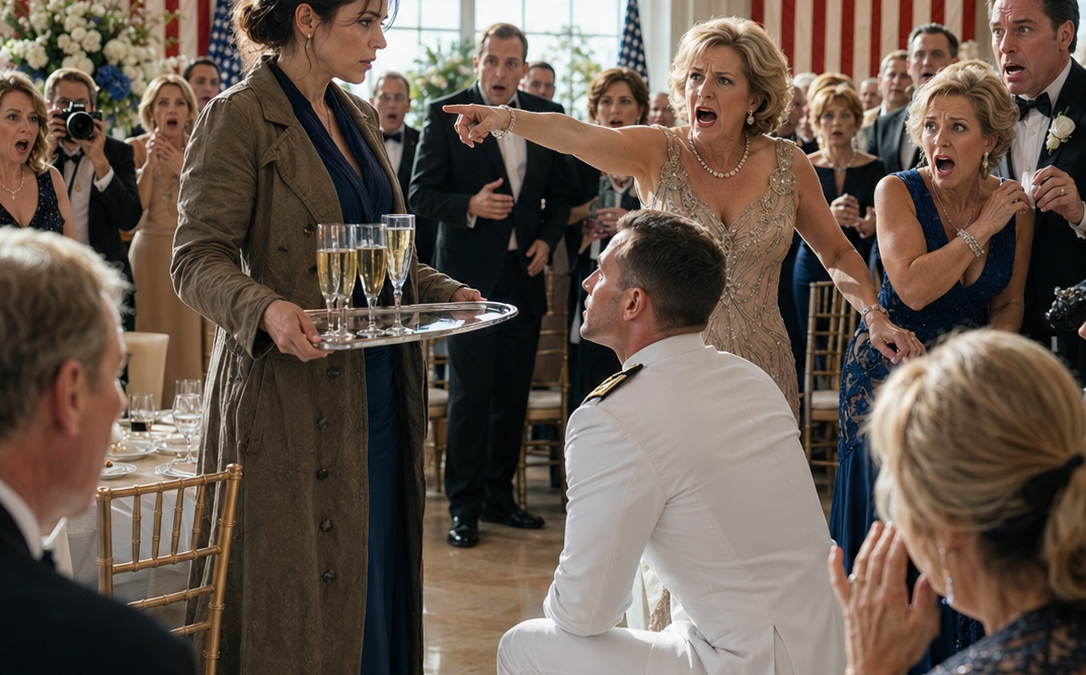
“ You disgrace us! You’re just a government clerk, so stay in the back and serve champagne,” my mother snapped while shoving a silver tray into my hands and ordering me out of the photographs at her charity gala. I stood there with my travel-worn coat, balancing crystal glasses while my family laughed at the woman they thought was invisible. Then a Navy SEAL in dress whites entered, walked past them, and knelt before me. “Hades,” he said. My mother thought she had erased me. She had no idea who she had just humiliated.
### Part 1
“Hold that tray. You’re blocking the donors.”
That was the first sentence anyone said to me after I walked through the side entrance of the Dock Street Theatre with a carry-on bag still bruising my shoulder. I had been awake for nearly thirty hours, moving through military transfers, security delays, and one long gray flight where the cabin lights never seemed to dim enough for sleep. The first thing I smelled when I stepped inside was roasted beef, melted butter, and lemon polish on old wood. The first thing I saw was a catering manager shoving a silver tray of champagne flutes into my hands.
I caught it before it tipped. Thirty-six glasses, cut crystal, sweating cold against polished silver. Heavy, but not difficult. I had carried equipment through heat, dust, rain, and stairwells with no lights. A tray in a Charleston ballroom was not the thing that was going to break me.
The manager barely looked at my face. “Mrs. Bellamy said you’d help wherever needed.”
Of course she had.
I shifted my carry-on strap higher, balanced the tray, and looked past him toward the ballroom. Crystal chandeliers glowed over white tablecloths. Tall windows framed the late afternoon sun, making the room look dipped in clean gold. Orchids spilled from glass vases. A string quartet tuned near the stage. Every corner had been arranged to whisper old money, even though I knew better than anyone that the Bellamy money had been whispering its last breath for years.
Then I heard my mother’s heels.
“Arden.”
She didn’t say my name like a greeting. She snapped it like a leash.
Maribel Bellamy appeared at the corridor entrance in a pearl silk gown that probably cost more than my monthly rent in Virginia. Her silver-blond hair was pinned into a low twist, her diamond earrings trembling as she moved. She took one look at me, at my plain navy dress, at my travel-wrinkled coat over my arm, and her mouth tightened.
“What were you thinking?”
“I came as soon as I landed.”
“I didn’t ask when you landed.”
She grabbed my upper arm and steered me into the narrow hallway beside the kitchen. Her fingers pressed hard enough to leave crescents through the fabric. I could have moved her hand without effort. I didn’t. There are moments when restraint costs more than reaction, but it buys something reaction never can—control.
Her eyes swept over me from my shoes to my hair. “You look exhausted.”
“I am.”
“You couldn’t fix your hair?”
“I tried.”
She laughed once. Not because anything was funny. Because disappointment had become her favorite language.
“Do you have any idea what tonight costs?” she asked.
I glanced toward the ballroom. Fresh flowers. Custom linens. Imported champagne. Historic venue. Private security. Live music. Enough staff to run a small hotel. I noticed expenses the same way I noticed exits, cameras, sightlines, and people who pretended not to watch me.
“No,” I said. “But I can guess.”
“The floral contract alone was over forty thousand dollars.” She stepped closer until I could smell champagne and expensive powder on her breath. “Every important family in Charleston is here. Every donor. Every board member. Every person who matters.”
“I know.”
“No, Arden. You do not know.” Her voice lowered. “You disgrace us.”
The words struck quietly. They always did. My mother never needed volume to make something hurt. She had spent my whole life polishing cruelty until it looked like etiquette.
She pointed toward the ballroom. “Your sister’s engagement gala is not the place for your government-office sadness.”
I almost smiled.
Government office.
If she had known where I had been three days earlier, if she had seen the kind of doors that opened only after fingerprints, badges, retinal scans, and armed verification, she would not have said office like it meant dusty cubicles and bad coffee. But she didn’t know, because she had never cared enough to ask anything beyond what my job made me look like at family dinners.
“What do you need me to do?” I asked.
For half a second, satisfaction softened her face. Not kindness. Possession.
“I need you useful.” She adjusted the tray in my hands as if I didn’t already have it level. “Carry champagne. Stay near the back. Do not wander into photographs. Do not talk about your work unless someone asks, and if someone asks, keep it brief. Nobody came here to hear about paperwork.”
“I thought I was invited.”
“You are.” She smiled. “Just not where people can see you too much.”
Behind her, one young server looked down at the floor. He had the helpless expression of someone witnessing cruelty but needing his paycheck too badly to object. He whispered, “I’m sorry,” as my mother walked away.
I gave him the smallest shake of my head. None of this was his fault.
I stepped into the ballroom with the tray balanced on my left hand and my carry-on tucked beside a service station. Conversations floated around me in soft, expensive fragments. Waterfront property. Summer homes. Private schools. A board election at the country club. Someone complained that maintaining a Gulfstream had become “almost vulgar.” Everyone laughed like that was a real problem.
A woman in emerald earrings took a glass from my tray without meeting my eyes. Another handed me her empty flute with the absent confidence of someone who believed people like me simply appeared when needed.
That part didn’t bother me. Strangers misread uniforms all the time. Tonight, my uniform was invisible.
Near the stage, I saw my younger sister, Lenora. She looked exactly the way my mother wanted every photograph to look. Champagne satin gown. Perfect soft curls. Smile bright enough to win over donors before they realized they had opened their checkbooks. Her engagement ring flashed under the chandelier whenever she lifted her hand.
She saw me.
For one second, her smile faltered.
Then she looked past me as though I were another member of the staff.
I kept walking.
Inside my purse, something small and brass shifted against my phone. My father’s compass. I had carried it across oceans, through barracks, through airports, through places I still couldn’t name. The lid was scratched, the hinge slightly bent, the needle stubbornly reliable. Inside, in letters so faint most people missed them, my father had carved five words.
Stand steady until truth arrives.
He had given it to me before my first deployment, back when he still looked like the strongest man in every room, before illness hollowed his cheeks and hospital bills hollowed the family accounts. Nobody in that ballroom knew about the compass. Nobody knew what it meant. Nobody knew that a man my mother had erased from every version of tonight had left me the only inheritance that mattered.
But as I moved through the glittering room, tray in hand, I had the strangest feeling that someone, before the night ended, would recognize the compass before my own family recognized me.
And when that happened, the room would never look at me the same way again.
### Part 2
The Bellamy family had always known how to make things look effortless.
The chandeliers looked effortless. The orchids looked effortless. Lenora’s laugh looked effortless as she accepted congratulations from women who used air kisses like currency. Even my mother’s grief had once looked effortless at my father’s funeral—black silk dress, steady voice, one gloved hand resting over her heart while people praised her strength.
What no one knew was that strength had been expensive.
After my father died, the Bellamy estate should have collapsed within eighteen months. I knew because I had read the numbers myself in a motel outside Norfolk with a vending-machine dinner on my lap. The Charleston house was valuable, but value is not cash. The roof leaked near the east wing. The property taxes were brutal. The insurance alone looked like a dare. My father’s treatments had drained nearly everything liquid before anyone admitted how bad things were.
Then the Danforth-Bellamy Trust began receiving deposits.
Not from old investments.
From me.
The trust was managed through an attorney in Northern Virginia, filtered through legal structures clean enough to satisfy federal security protocols and anonymous enough that my family never asked questions. Every month, money arrived. Property taxes got paid. Insurance stayed current. Lenora’s King Street boutique stayed open through two bad quarters and one renovation disaster. My mother’s landscaping contract never lapsed. The wine cellar humidity system was repaired. The gala deposit cleared.
Over eight years, I had put more than two hundred forty thousand dollars into a family that called me a low-level clerk.
I didn’t do it for praise. At first, I did it because my father asked me to protect the house if I could. Later, I told myself I was preserving history, preserving peace, preserving the last place where I had heard him laugh before pain made laughter rare.
But peace purchased in silence often becomes a debt nobody else remembers owing.
“Arden.”
Lenora’s voice cut through the music as I paused beside Table Seven.
I turned. “Congratulations.”
She looked at the tray first, then at me. “Thank you.” Her smile widened, but her eyes stayed cool. “Mom said you were helping.”
“She did.”
“That’s sweet of you.” She took a glass without asking. “Try not to look so tired, okay? Bram’s family is here, and they notice everything.”
Bram Whitlock stood across the room with a cluster of investors, laughing too loudly at a joke I couldn’t hear. His tuxedo fit beautifully, but confidence hung on him like a borrowed coat. He checked his phone, slipped it into his pocket, checked it again thirty seconds later.
Interesting.
People waiting for good news watched the room. People waiting for bad news watched their phones.
“I heard Bram’s company is expanding,” I said.
Lenora’s smile sharpened. “Whitlock Coastal is always expanding.”
“That must be stressful.”
“Not for people who understand business.”
I nodded. “Of course.”
She leaned closer, lowering her voice while keeping her public smile intact. “Please don’t do that tonight.”
“Do what?”
“That flat little military tone. It makes people uncomfortable.”
“I didn’t realize.”
“You never do.” She sipped her champagne and made a face. “This should’ve been colder.”
I replaced her glass with another from the tray.
She accepted it like a queen accepting tribute. “See? You can be helpful when you stop trying to be important.”
For a moment, the room thinned around us. The quartet. The glasses. The polite laughter. All of it moved far away.
I saw another room instead.
Concrete walls. Filtered air. No windows. No phones. No jewelry. Forty-eight screens burning in the dark. A digital map of terrain half a world away. Twelve blue icons trapped near a compound wall while hostile signals tried to blind every channel we had.
Nobody in that room had called me Arden.
“Hades, feed is drifting.”
“I’m on it.”
“Hades, we lost primary comms.”
“Switching relay.”
“Hades, they’re pinned.”
“I see them.”
In that room, my voice never rose. Nobody’s did. Real crisis rarely sounds like screaming. It sounds like people lowering their voices because panic wastes oxygen.
I remembered one young analyst whispering, “How do you see that?”
He meant the shadow beneath a damaged overpass, the slight thermal change that suggested a hollow maintenance tunnel. He meant the route nobody else had marked because the satellite pass had been too grainy and the official map too old.
I had pointed at the screen. “The concrete stayed cooler all morning.”
“That’s enough?”
“It has to be.”
Twelve blue icons disappeared underground for thirty-nine seconds. No GPS. No voice. No confirmation. Just belief. When they reappeared on the other side of the enemy line, nobody cheered. They only exhaled. There was still too much left to survive.
My phone had been locked away in a secure locker while all that happened. Later, when I retrieved it, I found fourteen texts from my mother.
Why is this month’s trust transfer late?
Lenora has vendors waiting.
Do not embarrass this family again.
Government clerks don’t get to play financial games with us.
Not one message asked if I was alive.
Lenora snapped her fingers lightly in front of me. “Arden?”
I blinked. The ballroom returned. Champagne. Orchids. Her annoyed face.
“You drifted off,” she said. “That’s exactly what I mean. People can tell when you’re not present.”
“I’m present.”
“Good. Then keep Bram’s investors happy.” She glanced toward him. “Tonight matters.”
“Because of the engagement?”
Her mouth tightened. Too quick. Too small.
“Because everything matters when families like ours are involved,” she said.
There it was again. That polished sentence hiding something underneath.
I looked toward Bram. He was smiling at an older man in a blue bow tie, but his thumb kept moving over his phone screen beneath the table. The older man wasn’t smiling back.
Something was wrong with Whitlock Coastal.
Something urgent.
And for the first time all evening, I began to understand that my mother had not dragged me into the shadows just because she was ashamed of me.
She needed me invisible because invisible people hear things.
And I was hearing the first crack in the room.
### Part 3
My mother found me again near the conservatory.
She didn’t call my name this time. She simply appeared beside me and said, “Come.”
I placed the tray on a service cart. “I’m working.”
“You’re carrying drinks.”
“Because you told me to.”
Her eyes hardened. “Do not start.”
I followed her through French doors into the glass-walled conservatory at the side of the theatre. The room had once been my father’s favorite. He loved old buildings, especially the ones with stubborn bones and imperfect corners. He said every historic house had a heartbeat if you stood still long enough to hear it. The conservatory smelled of citrus trees, damp stone, and orchids warmed by the fading daylight.
Bram was already there.
So was a stack of folders.
That was when my body understood the danger before my mind finished naming it. Not battlefield danger. Family danger. The quiet kind, dressed in legal paper and good manners.
My mother sat at the glass table. She did not offer me a chair.
“Read this,” she said.
I opened the first folder. Real property transfer agreement. My legal name. My father’s historic Charleston property. My fifty-percent ownership interest. Immediate transfer to Lenora Bellamy. No compensation. Permanent and irrevocable.
I closed it.
“No.”
Bram gave a soft laugh, the kind men use when they think a woman has misunderstood something simple. “You haven’t even reviewed the whole packet.”
“I reviewed enough.”
My mother folded her hands. “The estate needs unified ownership.”
“It has two owners.”
“Which is inefficient.”
“For whom?”
Bram’s jaw shifted. A tiny movement, but I caught it. My work had taught me that people lie with language first and bodies second. His body was already negotiating with fear.
I reopened the folder and scanned past the first pages. Legal description. Tax parcels. Notary blocks. Then supporting documents. Preliminary appraisal. Bridge-loan summary. Collateral schedule.
There.
I looked up. “You’re using the house as collateral.”
Bram’s smile faded. “We’re exploring strategic options.”
“No. You’re trying to secure emergency financing.”
“Arden,” my mother warned.
I kept reading. “Whitlock Coastal has a pending refinance request tied to an asset valuation. If Lenora owns the full property, it strengthens Bram’s application. If I don’t sign, the numbers don’t work.”
My mother’s face tightened. “You always make things sound ugly.”
“Numbers are not ugly. They’re honest.”
Bram leaned forward. “This is not your world.”
I looked at him. Really looked. The perfect tuxedo. The sweat at his hairline. The phone face down beside his hand, screen lighting again and again. “No,” I said. “It’s yours. That’s why you’re desperate.”
He stood too quickly. The chair legs scraped stone.
My mother touched his sleeve. “Bram.”
He breathed through his nose, then sat back down.
She slid another folder toward me. This one was thinner.
Inside were photographs.
Me leaving my apartment in Arlington. Me entering a federal facility parking lot. Me at Reagan National Airport. Me walking with a man whose face had been blurred by distance and luck. None of it was classified. None of it was illegal. All of it was invasive.
“You hired someone to follow me,” I said.
My mother did not flinch. “I was concerned.”
“No. You were curious.”
“I was concerned,” she repeated. “Your behavior has become secretive. Withdrawn. Unstable.”
There it was.
Bram spoke carefully. “People in sensitive government positions are evaluated, aren’t they? Mental fitness matters, I assume.”
My mother’s voice softened. That made it worse. “If your refusal to help this family comes from some kind of emotional decline, perhaps your superiors should know.”
I looked from one face to the other.
Threatening my career. Threatening my clearance. Threatening the only identity I had built without them.
All because I would not donate my inheritance to save Bram Whitlock from his own collapsing empire.
For one wild second, I thought of my father’s funeral.
I had flown home after a classified review board, exhausted and still carrying the smell of stale coffee from a secure facility. The house had been full of mourners, porch lights glowing, cars lined down the street. My mother opened the door only wide enough to stand in the gap.
“Oh,” she said. “You’re early.”
“My flight landed early.”
“There’s a small problem.”
She had given away my bedroom for Lenora’s wedding dress storage. Racks of gowns, accessories, imported veils. My father’s funeral, and I had been sent to a harbor inn because silk needed my room more than I did.
I had stood on the porch with my black garment bag in one hand and my father’s compass in the other pocket. Inside, people laughed over memories of a man whose daughter had not been allowed through the front door.
That had been the first time I understood that a house can belong to your family and still not be home.
Now, in the conservatory, my mother pushed a pen toward me.
“Sign,” she said.
I didn’t touch it.
“You know,” I said slowly, “I’ve spent years in rooms where one wrong decision could cost people their lives.”
My mother rolled her eyes. “Please don’t dramatize paperwork.”
“I’m not talking about paperwork.”
Bram’s expression sharpened.
I continued, “They teach you something useful in those rooms. The loudest person is usually not the one in control.”
The conservatory went still.
I gathered the documents, aligned the corners neatly, and slid the folder back across the glass table.
“I will not give away Dad’s land.”
My mother’s lips parted. “If you refuse, you are finished with this family.”
I stood. “I think that happened a long time ago.”
Her face reddened. “You disgrace the Bellamy name.”
“The name came from Dad,” I said. “It doesn’t belong to you.”
For the first time that evening, she looked uncertain.
I turned toward the ballroom doors. Behind me, Bram said, “You’ll regret making enemies tonight.”
I looked back once.
“No,” I said. “I regret rescuing them for so long.”
Then I walked into the music, carrying the first clear truth of the night like a match in my hand.
### Part 4
The engagement announcement began twenty minutes later.
By then, the room had shifted into its most flattering version of itself. Lights dimmed. Candles glowed. Servers cleared plates without making a sound. The string quartet stepped aside while a grand piano recording filled the ballroom with something soft and expensive.
A coordinator in black hurried past me with a headset pressed against one ear. “Family to the stage. Donors seated. Champagne ready.”
My mother intercepted me before I could move toward the front tables.
“Not there.”
I looked down at the tray in my hands. Twelve flutes this time. “Table Nine asked for more.”
“Someone else can handle Table Nine.” She pointed toward the back wall near the service corridor. “Stand there.”
“There are already servers there.”
“I know.”
The look on her face explained everything before she did. Photographers were gathering near the stage. Lenora and Bram were about to pose beneath the floral arch. My mother wanted the disappointing daughter placed exactly where she could be cropped out.
I walked to the back wall.
“Six inches left,” she said.
I moved.
“No. Your other left.”
I moved again.
“There.” She studied the sightline. “Stay exactly there.”
“Am I serving or hiding?”
Her smile did not move. “Tonight is about Lenora’s future. Don’t make this about your feelings.”
Then she returned to the stage.
I stood where she placed me. Not because I accepted it. Because sometimes obedience can become evidence. When people arrange you like furniture, they reveal exactly how little they believe you can move.
The master of ceremonies tapped the microphone. “Ladies and gentlemen, thank you for gathering with us on this extraordinary evening.”
Applause drifted through the room.
My mother stepped onto the stage, radiant under the lights. Lenora stood beside her, glowing in satin. Bram kept his hand at her waist, but his gaze moved often toward his phone on the nearby table.
“My friends,” my mother began, “tonight is not simply about an engagement. It is about legacy.”
That word moved through me like cold water.
Legacy.
My father had once used that word while sanding the banister of our Charleston house. He said legacy was not what you inherited. It was what you refused to ruin. My mother used it like a mirror, something polished enough to reflect only the people she approved of.
She lifted Lenora’s hand. “My youngest daughter has always represented the grace, ambition, and excellence our family values.”
Applause.
Lenora lowered her eyes modestly. Rehearsed. Perfect.
“She has built a business, a reputation, and now a future with a man whose family shares our commitment to Charleston.”
More applause. Bram smiled, but the older man in the blue bow tie at Table Four did not clap.
Then my mother looked toward me.
The moment was brief. Surgical.
“And of course,” she said, “families include all kinds of reminders.”
Heads turned.
I felt the tray grow colder beneath my fingers.
“There, near the back, is my older daughter, Arden. She chose a quieter life shuffling government paperwork.” A soft ripple of laughter moved through the room. My mother smiled as if she had made a charming joke. “We all make different choices. Some reach for excellence. Some settle for usefulness.”
Lenora lifted her champagne flute toward me.
A toast.
Not to honor me. To bury me politely in front of two hundred witnesses.
Heat rose at the base of my throat. Not shame. Not even anger. The body sometimes reacts before the mind can remind it that humiliation is survivable.
So I breathed.
Four counts in.
Hold.
Four counts out.
Hold.
Box breathing. Reliable in windowless operations rooms. Reliable beneath mortar reports and signal failures. Reliable under my mother’s glittering cruelty.
The tray stayed level.
A retired businessman near the front raised his glass with an amused grin. A woman at another table whispered behind her hand. The sound of polite laughter is softer than open cruelty, but it cuts deeper because everyone pretends it isn’t a knife.
My mother continued speaking. “But tonight, we celebrate the child who understood what it means to honor this family’s place in the world.”
I looked at Lenora.
Her smile trembled at the edges.
That surprised me. Triumph should have made her steady. Instead, she looked nervous. Not guilty. Nervous.
Then I noticed Bram again.
His phone lit up.
He checked it.
His face changed.
Not much. Most people would have missed it under the stage lights. But I saw the slight slackening around his mouth, the flicker of panic in his eyes, the way his fingers tightened around Lenora’s waist hard enough that she glanced down.
A new message.
Bad news.
The room applauded as my mother announced their future wedding date.
I stood in the shadow where she had placed me and realized the gala was no longer only a performance. It was a lifeboat. Bram needed donors. My mother needed the property transfer. Lenora needed the fantasy to survive a little longer.
And I was the signature they hadn’t secured.
The applause faded.
Before the quartet could begin again, a sound came from the entrance hall.
A heavy door opened.
Not gently.
Not by accident.
Leather struck marble in slow, even beats.
Boots.
The room sensed it before anyone understood. Conversations died in uneven waves. One violinist lowered her bow. Security looked toward the entrance. My mother froze onstage, one hand still resting on Lenora’s shoulder.
The ballroom doors swung open.
A man in immaculate Navy dress whites stepped inside.
Every ribbon on his chest sat perfectly aligned. Gold service stripes marked his sleeve. His posture was disciplined without stiffness, calm without arrogance. The chandelier light caught the warfare insignia above his pocket, and half the room seemed to inhale at once.
Master Chief Silas Rourke.
The last time I had seen him, dust had been ground into the lines of his face after an extraction no one in that ballroom was cleared to discuss.
Tonight, he looked across the glittering crowd and did not smile.
My mother recovered first. Of course she did.
“Master Chief Rourke!” she called, stepping down from the stage with both hands extended. “What an extraordinary honor.”
Bram moved after her instantly, opportunity replacing panic. Lenora followed, adjusting her expression into patriotic warmth.
Silas did not stop.
He walked past my mother as if she were a decorative column.
Past Bram’s offered handshake.
Past Lenora’s perfect smile.
Whispers broke across the room.
“Is that Silas Rourke?”
“The SEAL from the embassy rescue?”
“What is he doing here?”
Silas walked toward the back wall.
Toward the service corridor.
Toward me.
My mother stopped halfway across the ballroom, confusion stripping the elegance from her face.
Bram’s hand fell slowly to his side.
Lenora’s glass lowered.
I set the tray down before he reached me.
Silas stopped three feet away, brought his heels together with a sharp crack against marble, and raised his right hand in a perfect salute.
Gasps spread through the room.
For one second, nobody moved.
Then I returned the salute.
And every lie my family had told about me began to burn.
### Part 5
Silas held the salute until I lowered mine.
Only then did his hand return to his side.
The ballroom had become so quiet I could hear a refrigeration unit humming behind the service doors and one crystal glass trembling against another on a nearby tray. Two hundred people watched a Navy SEAL stand at attention before the woman they had laughed at less than five minutes earlier.
My mother’s voice cut through the silence. “What is this?”
Silas did not look at her.
He lowered himself onto one knee.
A sound moved through the room that was not quite a gasp and not quite a whisper. There was no regulation requiring a Master Chief to kneel before me. No protocol. No ceremony. He did it anyway, with the deliberate calm of a man choosing respect over appearances.
He looked up.
“Hades.”
The name struck the room like thunder wrapped in one word.
My mother blinked. “Hades?”
Silas’s voice carried without effort. “Your orders, Commander?”
Commander.
Not clerk.
Not failure.
Not disgrace.
Commander.
Bram took a step forward. “I’m sorry, but there has been a misunderstanding. This is Arden Bellamy.”
Silas finally looked at him. The look lasted less than a second, but Bram stepped back as though he had felt it physically.
“There is no misunderstanding,” Silas said. “I know exactly who she is.”
Lenora whispered, “Arden?”
I kept my eyes on Silas. “You weren’t expected.”
“No, ma’am.”
“Why are you here?”
He reached inside his jacket slowly. Several guests stiffened, then relaxed when he removed a sealed military envelope. “Permission was granted this afternoon. Portions of Operation Night Current and related command actions were cleared for limited public release.” He held out the envelope with both hands. “I was asked to deliver this personally.”
I accepted it.
My fingers brushed the thick paper, and for a moment I was back in the operations center with blue icons moving across a digital map and voices coming through broken channels.
Silas rose to his feet.
My mother came closer, her expression wavering between outrage and calculation. “Arden, explain this immediately.”
I turned the envelope over in my hand. “Not everything belongs to you, Mother.”
Her face tightened at the word.
Silas looked at me. “Permission to speak freely, ma’am?”
I knew what that meant. I also knew that once he started, silence would no longer protect anyone.
I thought of the trust. The bedroom given to wedding gowns. The conservatory documents. My mother’s public joke. Lenora’s toast from the stage. The way I had spent years confusing endurance with love.
“Granted,” I said.
Silas turned and walked toward the stage.
Nobody stopped him. The event coordinator stepped aside. The master of ceremonies backed away from the podium. Even security seemed to understand that whatever authority they had been hired to protect had changed owners.
Silas connected a secure device to the projector with a small adapter. The engagement slideshow disappeared from the giant screens. Lenora’s smiling portrait faded to black.
A government seal appeared.
Department of Defense.
Authorized Public Release.
The room leaned forward.
The next slide appeared.
My official portrait filled both screens. Dress uniform. Hair pulled back. Face still. No smile.
Commander Arden Mae Bellamy
United States Navy
Operational Callsign: HADES
The room erupted into whispers.
“She’s Navy?”
“Commander?”
“I thought Maribel said paperwork.”
A retired Marine near Table Three stood slowly. “Hades,” he murmured. “I’ve heard that callsign.”
The man beside him frowned. “From where?”
The Marine shook his head. “Places people don’t talk about at dinner.”
Silas advanced the slide.
The next image showed a citation summary. Not full details. Not locations. Just enough cleared language to make the truth undeniable. Gallantry. Joint operations. Communications failure. Improvised tactical routing. Twelve special operations personnel extracted under hostile conditions after command systems degraded.
Then came the award.
Silver Star.
Someone near the front whispered, “My God.”
My mother stared at the screen as if it were insulting her personally. “No.”
The word was small. Almost childlike.
Silas spoke. “I was one of the twelve.”
The silence that followed was different from before. He had not raised his voice. He did not need to. The whole ballroom understood that the man standing onstage was not praising a rumor. He was alive proof.
He continued, “When every approved channel failed, Commander Bellamy found a way through. When procedure became a wall, she made it a door. Twelve of us came home because she refused to quit.”
I felt every eye turn toward me.
Admiration is heavy when you are used to carrying invisibility. For years, I had worn silence like armor. Now it was being removed in public, piece by piece, and part of me wanted to disappear behind it again.
But then I saw my mother.
Not proud.
Not relieved.
Angry.
She was not watching the medal citation. She was watching the room watch me.
That told me everything.
Silas changed the slide again.
This time, no military document appeared.
The Danforth-Bellamy Trust ledger filled the screen.
My stomach tightened.
He looked toward me. “Still within authorized disclosure, ma’am.”
I gave one small nod.
The numbers appeared clearly. Monthly deposits. Dates. Legal entity transfers. Property expenses. Insurance. Taxes. Preservation fees. Lenora’s boutique lease. Renovation payments. Vehicle coverage. Gala deposit support.
At the top, highlighted in plain text:
Total private contributions over eight years: $247,318.64
Source category: combat hazard pay, retention incentives, classified assignment compensation, personal salary deposits.
The room did not whisper this time.
It went utterly still.
A financial advisor at Table Four adjusted his glasses and read the screen twice. “The trust wasn’t funded by the estate,” he said quietly.
His wife looked at me. “It was funded by her.”
Lenora brought one hand to her mouth.
Bram turned gray.
My mother walked toward the podium. “Turn that off.”
Silas did not move.
“I said turn it off!”
“The documents are accurate,” he said.
“They are private.”
“They were used to pressure a commanding officer into surrendering property under false pretenses.”
That sentence changed the air.
People looked at my mother.
Then at Bram.
Then at the folders still sitting on the conservatory table visible through the glass doors.
Bram shook his head. “This is being taken out of context.”
I said, “Is it?”
He looked at me then, really looked, and for the first time all evening there was no condescension left in his face. Only fear.
I walked to the front of the ballroom. Every step sounded louder than it should have. My plain navy dress brushed my knees. My shoes were not designer. My hair was still imperfect. I was still tired.
But no one looked away.
I stopped beside Silas and faced the room.
“My family believed my silence meant there was nothing to know,” I said. “They were wrong.”
My mother’s lips trembled with rage. “Arden, don’t you dare.”
I looked at her.
“I dared to keep your house standing for eight years.”
The room heard it.
So did she.
And there was no shadow left dark enough to hide inside.
### Part 6
The gala did not recover.
No one knew what to do with their hands. Glasses remained half-raised. Conversations started, failed, and died. The string quartet stood frozen near the stage as if waiting for someone else to tell them whether music was still appropriate.
My mother tried to smile at a trustee from the historical society, but the woman stepped back before the smile landed. That was Charleston’s quietest punishment. Not shouting. Not accusation. Just distance.
Lenora stood near the floral arch with mascara gathering beneath her lower lashes. Bram had disappeared into the conservatory with his phone, speaking in sharp whispers that grew less confident by the minute.
Silas remained beside me like a wall in dress whites.
“You didn’t have to show the trust,” I said quietly.
“Yes, ma’am,” he said. “I did.”
I looked at him.
He kept his gaze forward. “You saved my team and went home to people who made you carry champagne. I can respect your silence. I cannot respect theirs.”
For a moment, my throat tightened. I was used to praise being classified, minimized, or redirected. Hearing simple defense out loud felt stranger than insult.
My mother approached us with the controlled steps of a woman trying not to run.
“We need to speak privately,” she said.
“No.”
The word surprised even me with how easily it came.
Her face stiffened. “This is a family matter.”
“It stopped being private when you mocked me from the stage.”
A few nearby guests looked down at their drinks.
My mother lowered her voice. “You have humiliated your sister.”
“I stood where you placed me.”
“You brought him here.”
“I didn’t.”
She looked at Silas as though he were an inconvenience that might still be managed. “Master Chief, surely you understand that family tensions can be complicated.”
He did not answer.
My mother turned back to me. “Arden, please. We can fix this.”
That was the first please I could remember hearing from her in years.
It almost worked.
Not because I believed her. Because old wounds sometimes reach for old hope before the mind can stop them. For one breath, I saw her as she had been when I was small, sitting beside me during a fever, pressing a cool cloth to my forehead. I saw Lenora at seven years old, asleep with her cheek against my shoulder during a thunderstorm. I saw the house before grief made every room colder.
Then I remembered the conservatory folder.
“What do you want fixed?” I asked.
She blinked. “What?”
“The public shame, or the way you treated me?”
Her silence answered.
Lenora came forward slowly. “Arden.”
I looked at my sister.
She had lost the perfect-gala shine. Without it, she looked younger, frightened, less like a rival and more like someone waking up in a house already on fire.
“I didn’t know,” she whispered.
“I believe you.”
Relief flickered across her face.
Then I added, “But you never asked.”
Her relief vanished.
“I thought the trust came from Dad,” she said.
“You were happy to think that.”
“I was building something. I thought—”
“You thought comfort meant safety. You thought support meant entitlement. You thought I was small because that made it easier to enjoy what I paid for.”
She covered her mouth, crying now.
A year ago, I would have softened. I would have said it was okay. I would have rescued her from the full weight of what she had done by pretending the impact had been smaller than it was.
I didn’t.
Bram returned from the conservatory, face tight. “Arden, this has gone far enough.”
Silas took one step, barely more than a shift of weight.
Bram stopped.
I almost laughed. Not because it was funny. Because Bram had spent all evening trying to intimidate me, and one quiet movement from Silas had done what my patience never could.
Bram raised both hands slightly. “I’m not looking for conflict.”
“You were looking for my signature.”
He swallowed. “The property could help everyone.”
“No. It could help you.”
“The company is going through a temporary liquidity issue.”
A man at Table Four, the one in the blue bow tie, stood. “Bram.”
Bram turned pale.
The man came forward with the tired expression of someone who had been patient too long. “Our firm withdrew from the bridge financing at five forty-two this evening.”
Bram said nothing.
“The collateral package was incomplete, and the debt exposure was materially understated.” The man looked at my mother. “Had Commander Bellamy signed that transfer tonight, it would not have saved Whitlock Coastal. It would only have delayed the inevitable.”
The word inevitable moved through the room like smoke.
Lenora stared at Bram. “You told me it was paperwork.”
He closed his eyes.
My mother gripped the back of a chair.
For years, she had treated me as the embarrassment threatening the family’s image. Now everyone could see that the real threat had been standing beside my sister in a tailored tuxedo, smiling for photographs while drowning in debt.
I reached into my purse and removed my father’s brass compass.
My mother saw it and flinched.
“You still carry that?”
“Everywhere.”
Her eyes softened despite herself. “Your father loved that thing.”
“No,” I said. “He loved what it meant.”
I opened it. The faint scratched words caught the ballroom light.
Stand steady until truth arrives.
Silas saw the inscription and went very still.
“You knew that phrase?” I asked him.
His voice lowered. “Yes, ma’am.”
“How?”
He looked at the compass, then at me. “After the extraction, when my team was still in recovery, one of the operators kept repeating it. He said the voice in his headset said it before the tunnel move.”
I remembered.
A scared young medic. Static breaking his transmission. His breathing too fast. The team pinned down, comms unstable, seconds slipping away.
I had said, “Stand steady until truth arrives.”
My father’s words, spoken through a military channel to men I had never met.
Silas smiled faintly. “That line kept him calm.”
I looked down at the compass.
My father had saved people he never knew, because he had saved me first.
The room blurred for a second, but I did not cry.
My mother whispered, “Calder would have been proud.”
I closed the compass.
“Yes,” I said. “He would have.”
Then I looked at her fully.
“But not of this.”
### Part 7
After midnight, the ballroom looked naked.
Without music and applause, all that remained were wrinkled linens, abandoned champagne flutes, melting ice, crushed petals, and staff moving quietly through the ruins of someone else’s performance. The chandeliers still glowed, but the light had turned harsh. Morning-cleaning light. Truth light.
Most guests had left in silence. A few had shaken my hand. One retired officer saluted me with tears in his eyes. The woman in emerald earrings who had complained about the champagne temperature found me near the coat room and whispered, “I’m sorry.” She didn’t explain for what. She didn’t need to.
Silas brought me black coffee in a paper cup.
“Kitchen staff likes you,” he said.
“I carried trays well.”
He smiled. “Among other things.”
We stood near the side entrance where I had first arrived with my carry-on bag. It felt like another lifetime, though only a few hours had passed. My mother was in the conservatory with Lenora, speaking to attorneys by phone. Bram had left through a back exit after the blue-bow-tie lender refused to speak with him further. Nobody stopped him. Consequences usually know where to find people.
My phone buzzed in my hand.
The attorney from Northern Virginia.
I answered. “Yes?”
“Commander Bellamy,” Mr. Vale said, voice calm and familiar. “I received your signed termination authorization.”
Silas stepped away to give me privacy.
“Is everything in order?” I asked.
“Yes. The anonymous monthly deposits to the Danforth-Bellamy Trust are terminated effective immediately. Outstanding obligations will be satisfied from existing funds. After that, the trust will remain inactive unless separately funded by another party.”
Another party.
My mother. Lenora. Anyone but me.
“And the estate?” I asked.
A pause. “Without continued funding, the Charleston property will require immediate financial restructuring. If no new source appears, foreclosure proceedings are likely within ninety to one hundred twenty days.”
I looked toward the ballroom where my mother had spent forty thousand dollars on flowers for a family that could not afford its own roof.
“I understand.”
“There’s one more thing,” he said. “Your father’s personal clause remains unchanged.”
My hand tightened around the coffee. “Read it.”
He hesitated, then did.
“In the event Arden Mae Bellamy elects to cease voluntary support of the family trust, such action shall not be considered abandonment of family duty, but fulfillment of her right to live free from coerced obligation.”
I closed my eyes.
My father had known.
Not all of it. Maybe not the gala. Not the serving tray. Not the public humiliation. But he had known enough about my mother, enough about the way love could become a bill placed in my hands.
“He put that in writing?” I asked.
“He insisted.”
The ache that moved through me then was not grief exactly. It was relief arriving late, carrying my father’s voice with it.
“Thank you,” I said.
When I ended the call, my mother was standing ten feet away.
She had heard enough.
“The payments are stopping?” she asked.
“Yes.”
Her hand went to her throat. “Arden, the house cannot survive without them.”
“I know.”
“It was your father’s house.”
“Yes.”
“How can you let it go?”
I looked at her for a long time. “I protected Dad’s house. You protected appearances. Those are not the same thing.”
She swallowed. “I didn’t know how much you were giving.”
“You didn’t want to know.”
“That isn’t fair.”
“No,” I said. “It’s accurate.”
Lenora appeared behind her, arms wrapped around herself. She looked smaller without the crowd around her.
“What happens to my boutique?” she asked.
“That depends on whether it can support itself.”
She flinched.
A year ago, I would have offered a softer answer. A loan. A transition. One more rescue dressed up as compassion.
Tonight, I let the truth stand without a cushion.
My mother’s eyes filled. “Are you punishing us?”
“No.”
“Then what is this?”
“A boundary.”
She looked almost offended by the word.
“I gave for eight years,” I said. “I gave quietly. I gave while you mocked me. I gave while Lenora built a brand on money she never questioned. I gave while you threatened my career to take the last thing Dad left me. I am not punishing you by stopping. I am only refusing to continue.”
Lenora began crying silently.
My mother did not. She was too proud, or too frightened, or too unused to consequences to know how.
“I’m sorry,” Lenora whispered.
“I believe you.”
“Can we fix this?”
I thought about that. The question was small, but it carried years inside it.
“No,” I said. “Not tonight. Maybe not ever.”
She nodded as if something inside her had expected that answer.
My mother stepped closer. “Arden, please. Don’t cut us off completely.”
I took out my phone.
For a moment, she looked hopeful.
I opened my contacts. Maribel Bellamy. Lenora Bellamy. Bram Whitlock.
Block.
Confirm.
Block.
Confirm.
Block.
Confirm.
My mother watched each tap like a door closing.
“You would do that to your own family?” she whispered.
I slipped the phone into my purse. “I’m finally doing it for myself.”
Silas returned with my carry-on. He did not speak. He simply stood nearby, present without intruding. I appreciated that more than he knew.
I walked toward the front entrance of the Dock Street Theatre. The humid Charleston night pressed against the glass doors. Outside, the street shone under lamplight from a passing drizzle. Car tires hissed over wet pavement. Somewhere nearby, a carriage horse snorted softly, and late-night voices drifted from a bar on the corner.
Before stepping out, I turned back once.
My mother stood beneath the chandelier, pearls at her throat, face stripped of every mask she had worn that night. Lenora stood beside her, holding her engagement ring hand like it had become heavy. Behind them, staff carried away the flowers that had cost more than some people earned in a year.
For a second, I felt sorrow.
Not regret.
Sorrow.
Those are different.
Silas opened the door for me. “Where to, Commander?”
I reached into my purse and took out my father’s compass. The lid clicked open beneath my thumb. The scratched words caught the light.
Stand steady until truth arrives.
I smiled for the first time all night.
“Somewhere quiet,” I said. “Then home.”
“Virginia?”
“Eventually.”
He nodded. “You want company until the car comes?”
I looked at him, at the man who had crossed a ballroom full of powerful people to kneel before the truth. Not for drama. Not for romance. Not because I needed saving. Because respect, when real, does not wait for permission from the crowd.
“For a minute,” I said.
We stood under the theater awning while the rain softened the street. Neither of us spoke. We didn’t need to. Some silences are empty. Others are full of everything finally understood.
When the car arrived, I placed my carry-on in the back seat myself.
My hands were empty now.
No tray. No transfer papers. No invisible family debt.
Only the compass.
Only the truth.
Only me.
As the car pulled away from the theatre, I did not look back again. The Bellamy name had never been the measure of my worth. My mother’s approval had never been the gate to my dignity. My sister’s ignorance had never been my responsibility to fund. And silence—my long, obedient, disciplined silence—had never meant weakness.
Sometimes the bravest thing you do is bring people home.
Sometimes it is keeping a promise to a father who loved you better than the living did.
And sometimes, after years of saving everyone else, the bravest thing you do is stop rescuing people who would rather let you drown than admit you were the one holding them above water.
THE END!
Disclaimer: Our stories are inspired by real-life events but are carefully rewritten for entertainment. Any resemblance to actual people or situations is purely coincidental.








