Just Doing Paperwork The CEO Smirked—Then A General Helped Me Expose Him To 300 Guests
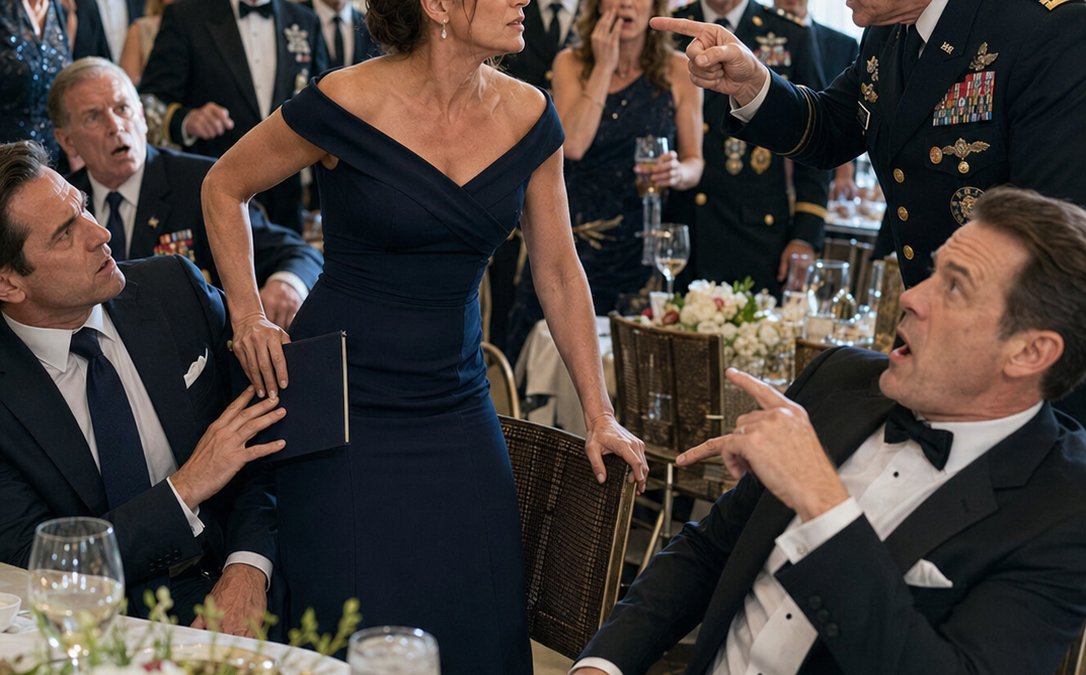
“Your overseas service was just paperwork and counting helmets,” Sterling Cross mocked while leaning back at the awards dinner and humiliating me in front of 300 guests. I sat there with my husband silently watching, my hands steady despite the memories of Kandahar I carried alone. Then General Amos Kade struck his cane against the floor and silenced the ballroom. “Ma’am, I know you from Kandahar.” I looked him in the eyes and revealed the truth. Sterling thought he owned the story. He never realized the woman he mocked was the one who captured it.
### Part 1
“Sterling was just joking, Maren.”
My husband’s whisper crawled across the white linen table like a frightened little thing looking for somewhere to hide. Callum didn’t look at me when he said it. He kept his eyes locked on the stem of his wineglass, turning it between his fingers until the red wine trembled inside the bowl. Around us, the private dining room at the Meridian Club glittered with chandeliers, polished silverware, and seven people wearing suits that cost more than my first car.
Sterling Cross, my husband’s CEO, leaned back in his chair with both hands tucked into the pockets of his tailored pants. His smile had the lazy cruelty of a man who had never been told no in a room full of people who depended on his approval. A minute earlier, he had raised his voice just enough for everyone to hear and asked if my time overseas had mostly involved “doing paperwork and counting helmets.”
Nobody laughed right away. They waited to see what Callum would do. That was the part that stayed with me. The insult itself was cheap. Men like Sterling loved cheap jokes because they could always pretend you were too sensitive for noticing the knife. But my husband sat there, shoulders tight, mouth twitching, silently begging me to make his life easier by accepting the humiliation.
I didn’t explain what I had done. I didn’t tell them about the heat rising off the tarmac, or the weight of emergency packs, or the names I still woke up hearing in the dark. I lifted my water glass, wiped a ring of condensation from the base with my thumb, and placed it back down on the glass table.
The sound was small.
Clack.
But it cut through the smooth jazz, the expensive laughter, and the quiet cowardice like a judge’s gavel.
Sterling’s smirk widened because he mistook my silence for embarrassment. “See?” he said, spreading his hands. “Maren gets it. Some people serve in quieter ways. Not everyone comes home with a war story.”
Callum gave a weak laugh. It was so soft and eager that something inside me went cold. He wasn’t trapped. He wasn’t confused. He was choosing. He was measuring my dignity against his promotion and deciding my dignity was too expensive.
“I trained rapid response units,” I said.
The table went still.
Callum’s head snapped toward me. His face drained so quickly it looked almost gray under the golden dining room lights. “Maren,” he said, his voice sharp now. “Don’t do this.”
Sterling raised one eyebrow. “Do what?”
“Make it awkward,” Callum said, and there it was.
Not defend yourself. Not correct a lie. Not ask for respect.
Make it awkward.
The words landed harder than Sterling’s insult. I looked at the man I had married ten years earlier, the man who slept under the roof my deployment pay had kept standing, the man who wore a silk tie bought with money I earned while pretending my knee didn’t burn every winter. He looked terrified, but not because his wife had been hurt. He was terrified because his boss might be uncomfortable.
A cane struck the marble floor behind me.
Once.
Slowly.
Every head turned.
An older man in a dark suit stood near the entrance of the private room, one hand wrapped around a wooden cane, his shoulders broad despite the years sitting heavily on him. His face was lined, stern, and familiar in a way my body recognized before my mind did. The room seemed to shrink around him.
“Ma’am,” he said, looking straight at me, “I know you from Kandahar.”
Sterling jumped to his feet so fast his chair legs scraped the floor. “General Kade,” he said, suddenly all teeth and respect. “What an honor. I didn’t realize you were dining here tonight.”
General Amos Kade looked through him like he was smoke.
Then he looked at me.
“The people she trained,” he said, voice low and hard, “are the reason my convoy made it home.”
Nobody moved. Forks hovered. Wineglasses hung in the air. Sterling’s smile collapsed at the corners, and Callum stared at his plate as if the steak might open up and swallow him whole.
General Kade gave me one small nod.
I stood, smoothed the front of my navy dress, and pushed my chair in. My heels clicked against the marble as I walked out, steady and unhurried. Behind me, Callum scrambled after me, calling my name like a man chasing a train he had already missed.
And for the first time in my marriage, I did not slow down.
### Part 2
Callum caught me near the coat room, where the air smelled like wet wool, old perfume, and the metallic chill of a Chicago December night pressing against the glass doors. His hand closed around my elbow. Not hard enough to bruise, but hard enough to remind me he still thought my body was something he could steer when his panic required it.
“You didn’t have to let him embarrass Sterling like that,” he hissed.
I looked down at his hand until he let go.
“That’s what you’re worried about?” I asked.
His jaw worked. He glanced over his shoulder toward the dining room, where the men with money and titles were probably whispering over half-finished steaks. “Do you have any idea how much pressure I’m under? Sterling is deciding the VP shortlist this month. One bad impression could ruin everything.”
The winter wind screamed faintly beyond the revolving doors. I noticed a smear of sauce on Callum’s cuff, a tiny red crescent near the button. He had been so focused on protecting his boss that he hadn’t even noticed he looked ridiculous.
“You stopped being proud of me a long time ago,” I said.
His eyes flashed, not with guilt, but irritation. “That’s not fair.”
“No,” I said. “What happened in there wasn’t fair.”
I walked out before he could build another excuse. Snow hit my face in sharp little needles. By the time I reached my SUV, my fingers were stiff and my knee had begun its familiar winter throb. I sat behind the wheel for a moment, hands resting at ten and two, letting the quiet cab hold me. The dashboard lights glowed blue. My phone lit up almost immediately.
Callum: We need to talk when you get home.
Not “I’m sorry.”
Not “Are you okay?”
A summons.
I drove through the dark streets with the windshield wipers dragging sleet across the glass in rough, angry strokes. The suburbs looked expensive and empty, every house glowing behind frosted windows like perfect little lives arranged for display. When I pulled into our driveway, I stared at the house for a long time. The new roof. The stone walkway. The second car in the garage. Every piece of it carried my fingerprints, my paychecks, my exhaustion.
And still, stepping inside felt like entering a stranger’s home.
I kicked off my heels by the door and walked barefoot into the kitchen. The hardwood was cold enough to sting. I filled a glass with tap water and stood in the dark, listening to the refrigerator hum and the furnace cough beneath the floorboards. Twenty minutes later, headlights swept across the wall.
Callum came in with his coat open and his tie loose. He dropped his keys on the granite counter with too much force. “I think tonight got completely out of control.”
“Your boss insulted my service,” I said. “You helped him.”
“I was trying to smooth things over.”
“You were trying to protect your promotion.”
His mouth opened, then closed. That tiny pause told me everything.
I set the glass down carefully. “You calculated it, didn’t you? You sat there and decided whether defending your wife was worth risking a corner office.”
His face flushed dark red. “You always make me feel small.”
The words hung between us, ugly and honest.
I almost laughed, but there was no humor left in me. “No, Callum. You are small. I just stopped bending down to make you feel taller.”
He stepped back like I had struck him. For one second, I saw fear in his eyes, not of me, but of the version of me that no longer wanted to be managed. I walked past him without another word and opened the side door to the garage.
The air outside smelled of concrete, old oil, and winter dust. In the back corner, beneath a canvas tarp, sat the steel lockbox I had brought home after my final deployment. My hands knew the code without thinking. Six numbers. One click. Then the heavy lid lifted.
Inside were letters, photographs, folded commendations, and names Callum had never cared enough to ask about. On top sat a note written in crooked handwriting from a young soldier named Arden Pike.
“Thank you for standing between us and the worst day of our lives.”
I held that letter under the humming fluorescent light until the paper blurred at the edges.
A stranger had understood what my husband refused to see.
That was the moment my grief hardened into something useful.
### Part 3
I slept in the guest room on a mattress that sagged in the middle and smelled faintly of laundry detergent. Dawn came gray and thin through plastic blinds, turning the walls the color of old bone. I woke before my alarm, not because I was rested, but because my body had been trained to treat silence like information.
Callum was gone. The garage door had rumbled shut before sunrise. He had left without coffee, without apology, and without the performance of concern he usually offered when he wanted to seem decent. I made a pot of black coffee and stood in the kitchen while it sputtered and hissed, filling the room with a bitter smell that matched my mouth.
At 7:12, my phone buzzed.
Unknown number.
I answered.
“I want to confirm your status after last night,” a gravelly voice said.
My spine straightened before I could stop it. “General Kade.”
“Still recognize voices. Good.”
“I’m fine, sir.”
“People usually say that while bleeding through their shirt.”
I almost smiled. Almost. “Nothing that serious.”
There was a pause. I could hear faint traffic on his end, then the low clink of a cup being set down. “Sterling Cross,” he said. “How much do you know about him?”
I looked toward the living room, where Callum’s framed company award sat on a floating shelf like a shrine. “I know my husband worships him.”
“That’s unfortunate,” Kade said. “Because the man is dirty.”
He didn’t explain everything on the phone. Men like General Kade didn’t pour gasoline over a live wire unless you were standing far enough back. He asked me to meet him the next morning at a diner under the El tracks, one of those old places on the edge of the city where the coffee was bad and nobody cared who you used to be.
The diner smelled like burnt bacon, wet coats, and bleach that had lost a fight against fifty years of grease. Every few minutes, a train thundered overhead and made the cups tremble on the table. General Kade sat in a cracked red booth with his cane propped against the wall. He looked older in daylight, but not weaker. There was a difference.
He slid a tablet across the sticky table.
On the screen, Sterling Cross stood on a convention stage in Dallas, smiling beneath a wall-sized photograph. I recognized the image before my mind had time to protect me. Dusty ground. Harsh sun. A line of exhausted people near stacked pallets. A crooked shadow in the lower left corner where the camera strap had slipped.
My stomach tightened.
“Where did he get that?” I asked.
“That’s the question.”
I touched the screen with one finger. My hand stayed steady, but I could feel my pulse in my throat. “I took this photograph.”
Kade watched me carefully.
“August,” I said. “Hot enough the air felt solid. That’s Arden on the left. He hated having his picture taken. There was a transport delay, and we had to reorganize movement on the ground before—” I stopped myself.
The diner noise rushed back in around me. Plates clattered. Someone laughed near the register. A waitress called out an order for hash browns. Normal life kept moving, careless and loud.
“Sterling has been using that image for years,” Kade said. “Leadership speeches. Investor decks. Veteran business panels. He tells people he was there.”
I pulled my hand back from the screen and wiped my fingers on a paper napkin, though there was nothing on them.
“He wasn’t,” I said.
“No,” Kade said. “He spent that entire period stateside. Logistics office. Climate control. Fluorescent lights. He has a service record, but not the one he sells.”
That was the red herring I had swallowed without tasting it. Sterling did have a military background. That made his lies smell close enough to truth for civilians who wanted a hero in a suit. He had built a fortune on the gap between what people respected and what they were willing to verify.
“Why tell me?” I asked.
Kade leaned back. “Because next weekend, three hundred guests will watch him receive the Valor in Enterprise Award downtown. Your husband’s company is a major sponsor. Sterling plans to use that photograph again.”
My coffee had gone cold. I stared at the tablet until the reflection of my own face looked back at me, calm and pale and tired.
General Kade lowered his voice. “I can stop him from a distance. Quietly. Paperwork, calls, pressure. But quiet lets men like him rebrand. Quiet lets them survive.”
I understood then. He wasn’t asking for anger. He was asking whether I had enough discipline left to carry truth into a room built to reject it.
I picked up my cold coffee and took one bitter sip.
“Show me what you have,” I said.
### Part 4
By Friday morning, the house felt staged. Callum sat at the dining table in a pressed gray suit, scrolling through emails with the anxious intensity of a man waiting for applause. I stood at the sink rinsing a mug I had already washed twice, watching coffee stains swirl down the drain.
“The VP interviews are moving faster than expected,” he said.
I didn’t answer.
He cleared his throat. “Sterling wants the final slate cleaned up before the awards dinner. The board will be watching everything this weekend.”
The word everything sat heavy in the kitchen.
I turned off the faucet and dried my hands slowly. Callum hated silence now. Before, he had used mine as furniture, something stable and convenient in the room. Now it moved like a living thing, crawling under his collar and making him sweat.
“That’s good for you,” I said.
He looked up sharply, trying to decide whether I meant it. “It could be good for us.”
There it was again. Us. That little word men like Callum used when they meant my sacrifice and his reward. I walked into the home office and shut the door behind me. The lock clicked, and for the first time in years, the sound comforted me.
My next call was to Roan Mercer.
Roan had been many things in his life: convoy mechanic, field improviser, disaster with paperwork, miracle with engines, and the only man I knew who could find a missing file faster than most attorneys. He owned a repair shop outside Joliet now. When he picked up, I heard a pneumatic wrench scream in the background.
“Maren Vale,” he said. “Either your dishwasher exploded or somebody needs burying in documents.”
“Documents,” I said. “Sterling Cross.”
The wrench stopped.
“That name smells expensive and rotten,” Roan said.
“Find public speeches, award materials, old interviews, anything where he mentions overseas operations. I also need proof of where he actually served.”
“You stepping into a corporate swamp?”
“I’m already ankle deep.”
He sighed. “I’ll see what floats.”
That evening, Callum found me sorting mortgage records in the office. I had pulled out bank statements, insurance policies, loan documents, and the thick binder where I kept copies of everything he used to call my “paranoid little habit.” The desk lamp threw a warm circle of light over the papers. Outside, snow tapped softly against the window like fingertips.
Callum leaned in the doorway, arms crossed. His face had shifted into the expression he used when he wanted to seem patient. “Look, I know you’re upset.”
I aligned the edges of a stack of statements. Tap. Tap.
“But you need to think bigger,” he continued. “Once I get this promotion, we can finally move north. Better neighborhood. Better circles. Better future.”
I looked up. “Better for who?”
His patience thinned. “For us.”
“You keep using that word.”
“Because we’re married.”
“No,” I said. “Because it makes theft sound like partnership.”
His face hardened. “Don’t start.”
I closed the binder. “You want me quiet because Sterling signs your future.”
“I want you reasonable because one public scene could destroy everything I’ve worked for.”
The polished mask slipped then. I saw the panic underneath, raw and selfish. He wasn’t afraid of losing me. He was afraid of losing access to the life my strength had financed and his ambition had decorated.
“If you make this personal,” he said, voice low, “I’ll lose everything.”
I leaned back in my chair. “You should have thought about that before you made my dignity a business expense.”
For a second, he looked like he might shout. Then fear won. He swallowed and softened his voice. “Please. Just promise me you won’t make a scene at my company.”
I studied him. His eyes were bright and desperate, searching my face for the wife who used to absorb the damage and call it love.
“Fine,” I said. “I won’t make a scene at your company.”
His shoulders dropped with relief so obvious it was almost embarrassing. He smiled a little, believing he had negotiated peace.
But the award dinner wasn’t at his company.
And I had chosen every word on purpose.
### Part 5
Roan met me Saturday afternoon at a diner wedged between a closed laundromat and a tire shop, where the windows rattled whenever trucks rolled past. The sky was white with snow, flat and heavy, and the parking lot was salted so aggressively it crunched under my boots like broken shells.
He slid into the booth across from me wearing a canvas jacket with a grease stain near the collar. His hair had gone more silver than brown since I last saw him, but his eyes were the same: sharp, tired, and allergic to nonsense. He placed a brown envelope on the table and kept one hand on top of it.
“You sure you want this?” he asked.
“No.”
That made him blink.
“I’m sure I need it,” I said.
He nodded once and pushed the envelope over.
Inside were printed articles, conference flyers, archived webpages, sponsor packets, and screenshots from old speeches. Sterling Cross had turned courage into a product line. He sold resilience workshops to executives who wanted combat metaphors with catered lunches. He charged nonprofits for keynote speeches. He gave interviews about “decisive leadership under fire” while carefully avoiding details that could be pinned down by anyone who had actually been there.
Roan tapped the last page. “That’s the part that made me want to throw my coffee.”
I pulled out a screenshot of Sterling onstage, smiling beneath my photograph. This one was sharper than the video General Kade had shown me. The image behind him filled the screen, huge and bright, with the left edge of my glove visible near the frame.
“He cropped out the identifying marks in some versions,” Roan said. “But not all. Sloppy arrogance. My favorite kind.”
My thumb pressed into the paper.
“I also found his assignment records through channels that will not be discussed over diner coffee,” Roan added. “He served. He just served from Virginia. Not Kandahar. Not field operations. Not anything close to the stories he’s selling.”
The waitress came by and refilled my cup. The coffee smelled burnt and tasted worse, but I drank it anyway because bitterness helped me focus.
“Does Callum know?” Roan asked.
“About Sterling?”
“About you.”
I looked at him.
Roan’s mouth tightened. “I remember how people looked at you when things went sideways. Not because you were loud. Because you were steady. A man living in your house for ten years should know better than to mistake steady for weak.”
I folded the papers back into the envelope. “He knows what benefits him.”
Roan leaned back. “That’s not the same thing.”
No, it wasn’t.
When I got home, Callum was in the living room with two glasses of red wine on the coffee table and a hopeful smile arranged on his face. He had turned on the fireplace, though he hated wasting gas. A jazz playlist floated from the speaker. It looked like an apology if you were the kind of woman who had never learned to inspect a trap.
“I made reservations for next week,” he said. “That Italian place you like. After the awards dinner, things can calm down.”
I stood near the entryway with the envelope inside my tote bag, heavy against my side. “What if I don’t go tonight?”
The smile vanished.
“Maren.”
“What if I decide I’m done helping you pretend?”
He set one glass down too hard. Red wine jumped over the rim and spotted the coaster. “Stop being selfish.”
The word moved through me like a final diagnostic light turning green. There it was. Not angry. Not hurt. Not sorry. Selfish.
“I have put up with your cold, rigid attitude for years,” he snapped. “Sterling made one bad joke. One. And now you’re acting like the world owes you a parade.”
I watched him from across the room, really watched him. The expensive sweater. The soft hands. The house he called ours when bills were due and his when guests complimented it. The man had mistaken my restraint for permission for so long that boundaries felt like betrayal to him.
“You’re right,” I said quietly.
His face shifted with cautious relief.
“We’ll go to the dinner.”
He exhaled and rubbed his forehead. “Thank God.”
I walked past him toward the stairs.
In my tote bag, the envelope pressed against my hip like a loaded verdict.
### Part 6
Sunday evening, the bedroom smelled of dry cleaning plastic and Callum’s cologne. Outside, sleet ticked against the windows while he stood before the full-length mirror adjusting his tie for the fourth time. He had been humming under his breath for ten minutes, a tuneless little sound that told me he was nervous but trying to enjoy it.
I stood at the ironing board, pressing the seam of my dark navy dress. Steam hissed upward. The fabric lay smooth beneath the iron, clean and severe. Callum glanced at me in the mirror and gave a tight smile.
“You’re wearing that?”
I unplugged the iron. “Yes.”
“It’s a little stiff.” He tugged at his cuffs. “But professional. Presentable.”
Presentable. Like I was a folder he could carry into a meeting.
He moved behind me and reached for my waist. I stepped aside before his hands touched me. He froze with his arms half lifted, then laughed weakly like I had made a joke. I hung the dress on the closet door and opened my jewelry box.
“Maren,” he said, voice lowering. “I need tonight to be smooth. Sterling is accepting a major award. The room will be packed with donors, board members, city people, veteran groups. Please don’t bring that cold energy in there.”
I clipped on a pair of small silver earrings. “Trouble doesn’t appear out of nowhere, Callum. Somebody invites it in.”
He stared at me. For the first time all weekend, instinct sharpened through his vanity. He saw something in my face that his ambition could not explain away.
“What does that mean?”
“It means finish getting dressed.”
By seven-thirty, we were driving downtown in near silence. Snow blurred the city lights into long yellow streaks. Callum checked his phone every few seconds, his face glowing blue in the dark car. I watched the towers rise through the storm and thought about how many beautiful buildings were filled with people selling ugly things in clean rooms.
The Hilton ballroom lobby smelled like floor wax, white flowers, and expensive perfume. A woman at registration handed me a name tag that read “Maren Vale” with no title under it. Callum’s badge listed his company and position in bold print. He noticed, smiled, and did not correct mine.
That small choice did not hurt. It informed.
Inside the ballroom, three hundred guests moved beneath amber chandeliers. Champagne glasses flashed. Waiters crossed the carpet with silver trays. Near the front, several families sat quietly with folded hands and careful faces, the kind of faces people wear when grief has been invited to dress nicely for public consumption.
Then I saw General Kade in the first row.
He did not wave. He did not smile. He placed both hands over the top of his cane and gave one slow nod.
Sterling stood near the stage surrounded by executives, laughing with his head tipped back. He wore a tuxedo and a red lapel pin shaped like a ribbon. Every few seconds, someone touched his arm or shook his hand, feeding him admiration like sugar cubes to a horse.
Callum hurried toward him, then stopped and looked back at me. “Stay close,” he said.
“No.”
His face tightened. “Maren, not tonight.”
“Especially tonight.”
He grabbed my wrist and pulled me toward a shadowed alcove near the kitchen doors. The grip was clumsy and damp, all panic and no strength.
“You need to listen to me,” he whispered. “If you do anything tonight, you won’t just ruin Sterling. You’ll ruin me.”
I looked down at his fingers around my wrist. Then I twisted once, clean and sharp, breaking his hold without raising my voice.
“You should have stood beside me when it cost you nothing,” I said.
He went pale.
The ballroom lights dimmed. Music rose through the speakers, polished and triumphant. Guests began taking their seats.
Callum reached for me again, but this time his hand closed around empty air.
I walked toward the center aisle.
### Part 7
Sterling Cross stepped onto the stage to warm applause. He placed both hands on the podium, bowed his head just enough to appear humble, and waited until the room loved the shape of him. Behind him, the massive projector screen glowed white.
“Service taught me everything I know about leadership,” he began.
His voice was smooth. Expensive. Rehearsed until every pause looked natural.
I stood near the back of the center aisle with my black clutch in my left hand. Inside it were Roan’s files on a flash drive, copies of the printed screenshots, and the original photograph metadata General Kade’s people had helped preserve. My heart did not race. That surprised me. I had expected rage, but what moved through me was quieter and heavier.
Sterling spoke about sacrifice. He spoke about pressure. He spoke about the burden of making decisions when people depended on you. Around the room, donors nodded. Executives leaned forward. Callum stood along the wall, a glass of water in his hand, staring at me with wet, pleading eyes.
Then Sterling said, “When we were overseas—”
We.
The projector changed.
My photograph filled the screen.
For a second, the room blurred at the edges. The years folded together. I smelled sun-baked dust instead of floral centerpieces. I heard distant engines beneath applause. I saw Arden Pike turning away from the camera because he hated photographs, alive forever in the left edge of a stolen image.
General Kade rose.
He did it slowly, but the effect was immediate. The front row shifted. Two other retired officers stood with him. The applause faded into scattered claps, then died completely.
Sterling’s smile flickered. “General Kade,” he said into the microphone, trying to sound delighted. “Always an honor.”
Kade’s cane struck the hardwood floor.
The sound cracked through the ballroom.
“Mr. Cross,” he said, voice carrying without a microphone, “are you claiming that photograph represents your overseas service?”
Sterling blinked. “Well, General, as I was saying, during our time in the region—”
“No,” Kade said. “Answer the question.”
The room went so still I could hear ice shift in someone’s glass.
Sterling’s fingers tightened around the podium. “It represents the spirit of the mission.”
I walked forward.
Every step felt measured, not dramatic. The carpet swallowed the sound of my heels, but heads turned anyway. People knew the shape of a reckoning even before they understood the evidence.
I stopped ten feet from the stage and opened my clutch. Sterling’s eyes dropped to my hands. For the first time since I had met him, he looked genuinely afraid.
“My name is Maren Vale,” I said. “I took that photograph.”
A murmur moved through the room.
Sterling laughed once, too loudly. “I’m sure many people took similar—”
“No,” I said.
I held up my phone. On the screen was the original file, timestamped, geotagged, and matched to the uncropped image. “This photograph was taken on August 14, 2011, on the Kandahar tarmac. The man half hidden on the left is Arden Pike. The shadow in the lower corner is my camera strap. The original file has never belonged to Sterling Cross.”
Sterling’s mouth opened. No words came out.
General Kade turned toward the audience. “Mr. Cross did serve his country,” he said. “But not where he claimed. Not in the role he claimed. Not in the moments he sold to you for contracts, applause, and awards.”
The first gasp came from a woman near the sponsor table. Then another. Chairs creaked as board members leaned away from Sterling as if fraud could stain fabric. One man at the front pulled out his phone. A woman in a silver dress covered her mouth and whispered, “Oh my God.”
Sterling gripped the podium. “This is being taken out of context.”
I looked at him then, really looked. Without the smirk, without the room feeding him, he was just a man sweating under hot lights.
“You used the dead and the wounded as decoration,” I said. “Then you laughed at the woman who remembered their names.”
His face collapsed.
From the wall, Callum whispered, “Maren, please.”
I turned my head. His promotion, his new house, his circle of important men, all of it was dissolving in front of him. He was not horrified by the lie. He was horrified by the cost.
That was the last answer I needed.
I slipped my phone back into my clutch and nodded once to General Kade. Then I walked out while the room erupted behind me, not in applause, but in the frantic, ugly noise of powerful people trying to distance themselves from the truth they had just sponsored.
I did not look back.
Explosions are for people who need to see the fire.
I already knew exactly what had burned.
### Part 8
The service hallway behind the ballroom was cold and smelled like metal carts, dish soap, and overworked air vents. I pushed through a side door into the parking lot, where the wind off Lake Michigan hit my face so hard my eyes watered. Snow skittered across the blacktop in thin white sheets.
I reached my SUV before Callum found me.
“Maren!”
His voice cracked across the lot. He stumbled through the side door with his tie loose and his hair ruined by the wind. For once, he did not look polished. He looked exactly like what he was: a man whose borrowed importance had just been repossessed.
“You destroyed me,” he shouted.
I unlocked the SUV but did not get in. “No. I corrected the record.”
He slipped on a patch of ice and caught himself against a parked sedan. His face twisted with rage, humiliation, and fear. “Do you know what they’ll do to me now? Sterling brought me into that room. I vouched for him. I stood beside him.”
“Yes,” I said. “You did.”
“You could have warned me.”
“I did. For ten years. You just didn’t think respect counted as a warning.”
He came closer, lowering his voice when he remembered we were in public. “Please. We can fix this. We can say you got emotional. We can tell them you misunderstood the material. I’ll talk to Sterling, and maybe—”
I laughed then. One short, quiet sound.
He flinched.
“You still think there’s a way back into that room,” I said. “That’s what this is. Not our marriage. Not truth. Not what he stole. You’re standing in freezing weather trying to save your chair at a table that never respected you either.”
His eyes filled, but the tears looked more like frustration than grief. “I gave you ten years.”
“No,” I said. “You spent ten years living beside me and calling it love when I made your life easier.”
“That’s cruel.”
“What you did at that dinner was cruel. What you did every time you shrank me in front of people was cruel. This is just accurate.”
He reached toward my coat. I stepped back before his fingers touched fabric.
“By the way,” I said, “the joint accounts are restricted. My attorney filed the paperwork Friday morning. The house records, mortgage payments, and separate asset documentation are already copied.”
His face went blank.
“You planned this?”
“I assessed damage.”
“Maren, you can’t just cut me out.”
“I can cut out rot.”
For one second, the parking lot was quiet except for the wind pushing snow against the tires. Callum looked past me toward the hotel doors, as if someone might come rescue him. Nobody did. Men like him always believed consequences were negotiable until the bill arrived with their name printed at the top.
My phone buzzed inside my clutch. I checked the screen.
General Kade: The board suspended all contracts with Cross Strategic. Formal investigation begins tomorrow. Go home.
I put the phone away.
Callum saw the message and swallowed hard. “So that’s it? You’re just leaving?”
I opened the driver’s door. Warm air rolled out from the cabin, carrying the faint smell of leather and peppermint gum. “No, Callum. I left at the dinner table when you laughed.”
He stood there with snow gathering on his shoulders, mouth open, finally understanding that apology had an expiration date and his had passed days ago.
I drove home alone.
The house was dark when I arrived, but it no longer felt haunted. I turned the deadbolt behind me and listened to the solid click settle through the hallway. In the kitchen, I made tea and stood barefoot on the warm tile while the furnace hummed beneath the floor. Callum’s texts came in fast at first.
Please talk to me.
Don’t do this.
You’re taking everything.
We can still fix us.
I read the previews without opening them. Then I blocked his number.
It took three seconds.
Ten years reduced to three seconds because the marriage had not ended all at once. It had ended in every small silence he asked me to swallow, every joke he expected me to survive, every room where he chose ambition and called it pressure.
The next morning, my attorney filed the rest. By noon, Sterling Cross had vanished from his company website. By evening, Callum’s name had disappeared from the VP shortlist he had worshiped like scripture. Over the next few weeks, he tried sending messages through mutual friends, relatives, even a neighbor who barely knew us. They all carried the same rotten little package: he was sorry now that being sorry cost less than being exposed.
I did not meet him.
I did not forgive him.
I did not hate him either, not after a while. Hate is still a form of carrying someone, and I had carried enough.
Six months later, I sold the house. I kept the lockbox, the letters, and the photograph Sterling had tried to steal from me. I moved into a smaller place near the lake, where the windows faced east and the morning light came in clean. On quiet Sundays, I drank coffee on the balcony and listened to gulls scream over the water.
Some people called what happened revenge.
They were wrong.
Revenge is when you want someone to suffer.
I only wanted the truth to stop kneeling.
And once it stood up in that ballroom, in front of three hundred people, I finally stood up with it.
THE END!
Disclaimer: Our stories are inspired by real-life events but are carefully rewritten for entertainment. Any resemblance to actual people or situations is purely coincidental.








