Billionaire Pretends to Be Homeless to Find True Love—Then This Happened
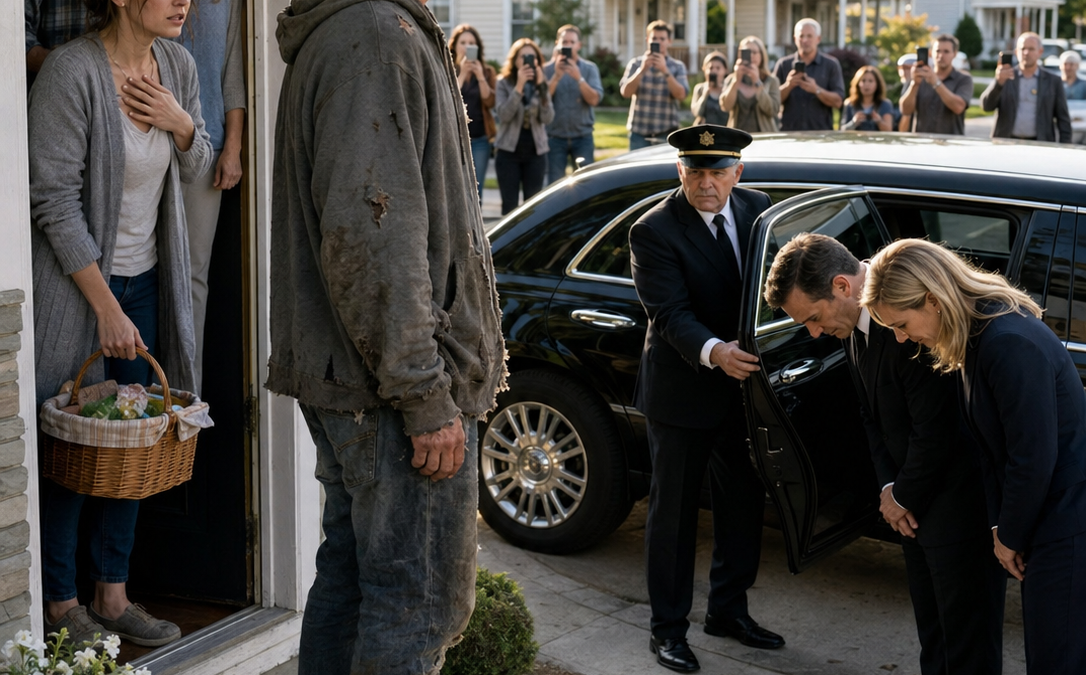
Billionaire Pretends to Be Homeless to Find True Love—Then This Happened
Part 1
The first time I saw Adam Collins, he was sitting beside Route 17 with rain dripping from his hair and one hand wrapped around a crooked wooden cane.
At least, Adam Collins was the name he gave me.
The October sky hung low over Briar Glen, Virginia, turning the road the color of wet charcoal. Cars rushed past him, spraying muddy water across his worn boots. Most drivers did not slow down. One woman looked directly at him, then locked her doors.
I was twenty-nine, late for the Saturday farmers’ market, and carrying exactly eleven dollars in my wallet. My lunch was a turkey sandwich wrapped in wax paper, two apples, and the last oatmeal cookie my father had baked the night before.
I stopped anyway.
“Sir, are you hurt?”
He raised his face. Beneath the dirt, he looked younger than I had expected—maybe thirty-five. His beard was uneven, but his teeth were surprisingly perfect.
“My ankle,” he said. “It’s not serious.”
“You’re soaked.”
“I’ve been worse.”
There was something peculiar about his voice. He spoke carefully, without the local drawl, and his words had the calm precision of someone used to being listened to.
I handed him my lunch and the eleven dollars.
He stared at the money. “You don’t have to do this.”
“I know.”
“What if I’m dangerous?”
“Dangerous people rarely warn you.”
For the first time, he smiled. It lasted only a second, but it changed his entire face.
At the market, the smell of wet canvas and crushed basil clung to the air. I spent four hours selling tomatoes, sweet potatoes, and jars of my father’s apple butter. By closing time, my stomach was growling so loudly that Mrs. Bennett from the honey stall gave me half a biscuit.
When I got home, Dad was on the porch repairing a wooden crate.
George Parker was sixty-four, broad-shouldered, gray-haired, and stubborn enough to argue with thunderstorms. Since my mother’s death, the two of us had kept our small farm alive through long days and creative accounting.
“You didn’t eat,” he said.
“How can you tell?”
“You’re looking at that crate like it’s fried chicken.”
I told him about the stranger.
Dad placed his hammer down. “Is he still there?”
“I don’t know.”
“Then we should find out.”
An hour later, we returned to Route 17. Adam was in the same place, shivering beneath a dark green coat. My empty lunch wrapper had been folded into a perfect square beside him.
Dad rolled down the truck window.
“My daughter says you need somewhere dry.”
Adam looked from him to me. “You don’t know anything about me.”
“No,” Dad replied. “But I know what cold rain does to a man overnight.”
Our farmhouse was small, with peeling white paint and a screen door that complained whenever it opened. The spare room smelled faintly of cedar and the lavender sachets my mother used to make.
Adam stood in the doorway as if we had shown him a palace.
“There are clean towels in the bathroom,” I said. “Dad’s clothes might fit.”
He touched the faded quilt on the bed. His fingers trembled.
“Why are you doing this?”
Dad shrugged. “Everyone deserves one night when they don’t have to be afraid.”
At dinner, Adam ate slowly, almost formally. He knew which fork to use without looking. When Dad mentioned a television report about overseas markets, Adam corrected the reporter’s explanation of a complicated merger, then stopped speaking as though he had revealed too much.
Later, I carried an extra blanket toward his room and found him standing at the front window.
A black SUV was moving past our house at walking speed. Its windows were dark, and its headlights were off.
Adam’s hand tightened around the curtain.
“Do you know that vehicle?” I whispered.
“No.”
The answer came too quickly.
The SUV disappeared around the bend, but Adam did not move. Then, so softly that I nearly missed it, he said, “They weren’t supposed to find me.”
That was when I realized the stranger in our spare room was not merely running from poverty. He was running from someone—and he had brought whatever was chasing him directly to our door.
Part 2
The next morning, I expected Adam to be gone.
Instead, I found him in the kitchen wearing Dad’s faded flannel shirt and attempting to make coffee in our ancient percolator. The room smelled like burned grounds.
“I may have ruined it,” he admitted.
Dad took one sip. “Son, this could strip paint.”
Adam laughed, and some of the tension from the night before dissolved.
I asked about the SUV. He claimed it might have been a driver who had taken the wrong road. Dad accepted that answer more easily than I did.
Adam stayed for another day, then another.
His ankle supposedly hurt, so he continued using the cane. Yet he never complained. He repaired a broken cabinet hinge, replaced a loose porch board, and reorganized the farm receipts that had been overflowing from an old cookie tin.
“You’re good with numbers,” I said.
“I used to work around finance.”
“A bank?”
“Something like that.”
Every answer opened a door just wide enough to reveal another locked door behind it.
On Tuesday, I took Adam to the market. He wanted to earn his meals, and Dad believed work gave a person dignity. I showed him how to stack the pumpkins, weigh beans, and make change from the dented cash box.
Within an hour, Adam had rearranged our display and raised our sales without lowering a single price.
“People don’t buy vegetables first,” he explained. “They buy the story they imagine cooking with them.”
“That sounds suspiciously like advertising.”
“Perhaps I’ve picked up a few things.”
Around noon, Brian Walker appeared in a tailored navy coat.
Brian owned three car dealerships, half the commercial buildings downtown, and an ego large enough to require its own parking space. We had attended the same high school, and for two years he had treated my refusal to date him like an administrative error.
He set a velvet jewelry box beside my tomatoes.
“Emma, marry me.”
Several customers turned to watch.
I did not open the box. “No.”
“You haven’t even looked.”
“I’m rejecting the question, not the jewelry.”
His smile tightened. “I can give you a life where you don’t stand outside selling vegetables in the cold.”
“I’m proud of this farm.”
“You’re proud because you don’t know what better feels like.”
Adam stopped arranging jars.
Brian noticed him for the first time. His eyes traveled over the borrowed shirt, worn coat, and cane.
“Who’s this?”
“A friend,” I said.
Brian laughed. “You’ve always collected broken things.”
Adam’s expression remained calm, but his voice changed.
“You should leave.”
It was not loud. It did not need to be.
Brian stepped closer. “And who are you to tell me what to do?”
“Nobody,” Adam replied. “But she has already answered you.”
Something passed between them—an instant recognition of power, though only one of them appeared to possess any.
Brian picked up the box. Before walking away, he leaned close to me.
“People like him always want something.”
That evening, Dad beat Adam at checkers three times. Rain tapped against the windows while cinnamon and baked apples warmed the kitchen.
For a few hours, we felt like a family.
Just after midnight, a low voice woke me. I followed it to the back porch and found Adam speaking into a slim black phone I had never seen before.
“No,” he said. “The board cannot vote without me. Delay them.”
He turned and saw me.
His face went still. He ended the call, slipped the phone into his pocket, and reached for the cane he had left against the wall.
Only then did he begin limping again.
I looked at the cane, then at the steady footprints he had made across the porch. Adam had not forgotten to act injured—he had forgotten that I was watching.
Part 3
“You can walk normally.”
The accusation sounded harsher in the quiet hallway than it had in my head.
Adam glanced toward Dad’s bedroom. “Keep your voice down.”
“So he won’t discover you’ve been lying?”
“My ankle is healing.”
“Your ankle looked completely healed until you saw me.”
He rubbed a hand over his face. Without the practiced limp and humble smile, he seemed like another person—older, colder, almost commanding.
“I was afraid you would ask me to leave.”
“That depends on what else you’re hiding.”
He looked toward the dark fields. “There are people from my former life searching for me. The cane makes me less recognizable.”
“Former life doing what?”
“I worked for powerful people.”
“And the board?”
“A company I advised.”
His explanation was possible, but it did not feel true. Still, fear can make honest people behave strangely. My mother had hidden overdue bills from Dad during her final illness because she could not bear to give him one more thing to worry about.
I let Adam stay.
That decision changed the rhythm of our days.
He stopped using the cane around the house but carried it in town. At the market, he worked beside me without acting ashamed. His hands grew rough from crates. He listened when old customers repeated stories, and he remembered every child’s name.
Brian returned twice. The second time, he arrived with coffee for me and nothing for Adam.
“You’re wasting your life,” he said.
“Then it’s mine to waste.”
He pointed at Adam. “That man cannot give you anything.”
Adam opened his mouth, but I answered first.
“I’m not choosing a bank account, Brian. I’m choosing who makes me feel respected.”
For once, Brian had no polished response.
That afternoon, Adam and I walked beside the creek. Fallen leaves floated on the water like copper coins. He told me he had grown up in Chicago with a father who believed affection made children weak.
“What happened to your family?” I asked.
“My father died. My mother lives in Europe. We speak when obligation requires it.”
“That sounds lonely.”
“It was.”
He looked at me with an openness that made my chest ache.
“When I’m here, I don’t feel lonely.”
I should have remembered the porch call. Instead, I noticed the warmth of his hand when his fingers brushed mine.
He kissed me beneath a sycamore tree. It was gentle, uncertain, and so unlike the confident man I had glimpsed during his phone call that I wondered which version was real.
When we returned home, a silver sedan was parked near the barn.
A tall man in a charcoal suit stepped out. He looked at Adam with visible relief.
“Sir, we need to talk.”
Adam pulled him behind the barn, but the wind carried pieces of their argument.
“Security risk.”
“Shareholders.”
“Your mother is demanding answers.”
Then Adam said, “I told you not to come here.”
The suited man left five minutes later. As his sedan passed me, he lowered the window.
“You should ask him what happened in New York,” he said.
Adam claimed the man was a former coworker trying to convince him to return. He would not explain the word “shareholders” or why an ordinary adviser required security.
That night, I searched his name online. There were hundreds of Adams and no photograph that matched him. It occurred to me that even his name could be false.
The next morning, every person at the market seemed to be staring at our stall.
Brian stood beside the entrance with his phone raised. On its screen was a photograph of Adam in a black tuxedo, stepping from a limousine beneath a wall of camera flashes.
Below it was a headline.
I could not read every word from where I stood, but I saw the name Collins and one number clearly.
$8.6 billion.
Part 4
The market fell silent around us.
Even the usual sounds—the rustle of paper bags, the scrape of folding tables, the church bell across the square—seemed to fade.
Brian held his phone toward me.
“Your homeless friend is Adam Collins,” he announced. “Founder and chief executive of Collins Global.”
The photograph showed the same gray eyes and slight scar near Adam’s chin. There was no beard, no dirty coat, no cane. He wore a watch worth more than our farm.
I turned toward Adam.
“Tell me he’s wrong.”
Adam placed the crate in his hands on the ground.
“He isn’t.”
The world did not collapse dramatically. The pavement remained beneath my shoes. Customers continued breathing. Somewhere behind us, a jar rolled off a table and shattered.
Yet nothing looked the same.
“You’re a billionaire?”
“Yes.”
“And you let us believe you had nothing?”
“I needed to know whether someone could care about me without knowing what I owned.”
Brian smiled as if he had won something.
I wanted to slap that smile away, but my anger belonged to Adam.
“You needed to test us.”
“That isn’t how it began.”
“You sat beside a road pretending to be hungry.”
“I had not eaten.”
“Because you chose not to eat. That is not the same as having no choice.”
His face tightened.
I remembered giving him my eleven dollars. I remembered Dad offering him my mother’s quilt. I remembered rationing groceries so we could feed another person.
He had watched us sacrifice while knowing he could buy every house in Briar Glen without noticing the cost.
Back at the farm, Dad listened in complete silence as Adam explained.
He had dated women who loved private jets, magazine covers, and diamond bracelets. After his last relationship ended, he disappeared without telling his executives where he was going. He bought old clothes, left his wallet behind, and went searching for proof that genuine love still existed.
Dad’s voice shook. “We treated you like a son.”
“I know.”
“No, you don’t. A son does not turn his family into an experiment.”
Adam looked at me. “What I feel for you is real.”
“Maybe it is. But you built it inside a lie.”
“I wanted to tell you.”
“You wanted the comfort of honesty without paying its price.”
He asked for one chance to make things right.
I told him to leave.
He packed Dad’s borrowed clothes into a grocery bag. A black SUV—the same one I had seen on his first night—arrived before he reached the road. The suited man opened the rear door for him.
Adam looked back at our peeling farmhouse as if leaving hurt him.
Perhaps it did.
That did not make him the victim.
The following afternoon, a courier delivered an envelope. Inside was the deed to our farm, stamped paid in full. Adam had quietly erased our mortgage.
Dad stared at it for a long time.
Then he called the bank, restored the debt, and returned the deed.
“Help without permission can still be control,” he said.
I thought the humiliation was over until Brian arrived with a folder his investigator had obtained from one of Adam’s former contractors.
Most pages concerned Adam’s movements. The final section concerned me.
It listed my age, my income, my mother’s death, Dad’s medical history, and my routine at the Saturday market. There were photographs of me loading the truck and walking along Route 17.
On the last page was a calendar prepared three weeks before Adam appeared beside the road.
The day I found him had been circled in red.
Our meeting had not been chance, and I had not simply fallen for a liar. I had apparently been selected before I ever knew his name.
Part 5
I drove to the Collins Global building in Richmond the next morning.
The tower rose above the river, all silver glass and reflected clouds. Inside, the lobby smelled of polished stone and expensive coffee. I wore muddy work boots because anger had not given me time to change.
The receptionist’s expression shifted when I gave my name.
Within minutes, I was escorted to the top floor.
Adam stood behind a desk large enough to serve dinner for twelve. He wore a charcoal suit, and the transformation was so complete that I stopped near the doorway.
The soft-spoken man from our kitchen had disappeared.
“Emma.”
He dismissed the waiting executives with one glance. They left immediately.
I threw the folder onto his desk.
“Was I chosen?”
He opened it. Confusion crossed his face, then alarm.
“My security team researched several towns.”
“That isn’t what I asked.”
“I saw a local article about your farm donating produce after the flood. Briar Glen was considered a safe place for me to disappear.”
“And the photographs?”
“I didn’t authorize those.”
“But you knew who I was before I stopped.”
His silence answered.
He insisted he had never planned to fall in love. He said the roadside encounter was meant to test whether kindness still existed, not to manipulate me specifically.
That distinction mattered to him.
It did not matter to me.
“You watched me give away food I needed,” I said. “You accepted my father’s home. Every time we trusted you, you gathered more evidence for your little theory.”
“I stopped thinking of it as a test.”
“But you never stopped lying.”
He came around the desk.
I stepped back.
That single movement hurt him more than anything I had said.
Good.
When I returned home, boxes of seeds, tools, fertilizer, and building supplies covered our porch. No card was attached.
I knew who had sent them.
Dad and I donated everything to the county shelter.
Brian came by that evening with champagne. He said Adam’s deception proved that wealthy men could not be trusted, apparently forgetting he was also wealthy.
“At least I never lied to you,” he said.
“You called me ungrateful when I rejected you. You insulted my work. You investigated someone living in my home. Honesty does not turn selfishness into love.”
His smile vanished. “You’ll change your mind.”
“No.”
He gripped the champagne bottle so tightly that his knuckles whitened, then walked back to his car.
Over the next two weeks, Adam continued trying to help from a distance. He bought our produce through intermediaries. He arranged repairs to the community clinic. He paid school lunch balances without announcing his name.
Some neighbors said his actions proved his heart.
Others said a billionaire could purchase good publicity more easily than ordinary people purchased groceries.
I stopped trying to decide whether Adam was good or bad. People were rarely one thing. He could be generous and dishonest, loving and manipulative.
The contradiction did not create an obligation to forgive him.
One windy night, I woke to the sharp smell of smoke.
Orange light pulsed against my bedroom wall.
I ran outside barefoot. Flames were climbing from the barn roof, turning the sky above it black. Chickens scattered across the yard while sparks whipped through the trees.
“Dad!” I screamed.
No answer.
His truck was parked beside the barn.
I grabbed the door handle, but heat drove me backward. A beam crashed inside, sending a shower of sparks across the doorway.
Then an engine roared up the driveway. Adam jumped from a black SUV before it had fully stopped.
“George is inside,” I cried.
He looked once at the burning barn and ran toward it.
By the time I caught his sleeve, he was already pulling away from me.
“If you go in there, you may not come back.”
His eyes met mine through the smoke.
“Then tell him I was finally honest about one thing,” he said. “You both matter more to me than my life.”
Before I could stop him, he disappeared into the fire—and the roof began to collapse behind him.
Part 6
Seconds stretched until they felt cruel.
Neighbors arrived carrying hoses and buckets. Someone called the fire department. I stood in the wet grass, shouting Dad’s name until smoke scraped my throat raw.
Then a section of the side door burst outward.
Adam stumbled through it with Dad’s arm over his shoulders.
Dad was coughing but conscious. Adam’s hair was singed near his temple, and one sleeve of his coat was blackened. They fell together several yards from the barn just as the remaining roof gave way.
I dropped beside them.
“Dad, look at me.”
“I’m all right,” he rasped. “Couldn’t get the back stall open.”
Adam had freed him and the frightened mare trapped inside. He had risked his life without knowing whether I would ever speak to him again.
For one dangerous moment, gratitude tried to disguise itself as forgiveness.
At the hospital, Adam sat across the waiting room with his hands wrapped in clean bandages. Fluorescent lights drained the color from his face. He did not ask me to sit beside him.
Dad had mild smoke exposure and a bruised shoulder. The doctor expected a full recovery.
When I finally approached Adam, he stood.
“Thank you for saving him,” I said.
“I would do it again.”
“I believe you.”
Hope appeared in his eyes.
I did not let it stay there.
“But saving my father does not erase what you did to us.”
His mouth opened, then closed.
“I understand.”
It was the first apology he gave me that did not contain a defense.
Fire investigators found signs that the blaze had been deliberate. A traffic camera recorded an unfamiliar pickup near our farm, and another camera captured the same vehicle outside one of Brian’s dealerships.
Brian was brought in for questioning.
He denied everything until one of the men he had hired agreed to cooperate. Brian had paid them to frighten us and make Adam believe Briar Glen was too dangerous to remain in.
He had not expected Dad to be inside.
When the police arrested Brian, he looked at me across the courthouse parking lot.
“I did this because you wouldn’t listen.”
“No,” I said. “You did it because you believed my answer belonged to you.”
His face hardened as an officer guided him into the patrol car.
The fire destroyed our winter feed, tools, and most of the barn. Adam offered to rebuild everything. Dad declined.
“Let the community help,” he told him. “People need to know they can matter even without billions.”
Neighbors arrived the next morning. Carpenters donated labor. Teenagers cleared debris. Mrs. Bennett organized food. By sunset, the field was crowded with trucks and folding tables.
Adam worked among them without cameras or assistants. He carried lumber, swept ash, and left before dinner.
I almost believed he had finally learned how to give without taking control.
Then Officer Monroe returned a folder recovered from the office of the investigator Brian had hired. It contained copies of communications between Adam and his private security director.
One message had been sent before Adam came to Briar Glen.
The subject line read: KINDNESS CANDIDATE—EMMA PARKER.
Below it were instructions to place Adam along my usual route and observe whether I stopped.
He had not merely recognized me from an article.
He had approved the plan.
Even our first moment—the rain, the cane, the untouched cars rushing past—had been arranged around my habits. My compassion had been turned into an audition, and I had never been told I was performing.
Adam had saved my father from the fire.
But now I knew he had entered our lives with a match of his own.
Part 7
I asked Adam to meet me beside Route 17.
The morning was cold and clear. Dead grass bent beneath the wind, and traffic moved past the place where I had first found him.
He arrived alone.
I handed him the recovered message.
He read it without pretending not to understand.
“You approved this.”
“Yes.”
The word settled between us.
His security director had identified several people known for helping strangers. Adam chose me because of the article about our farm. His team arranged the roadside encounter, monitored nearby traffic, and kept the SUV close in case he faced real danger.
“What about the rain?” I asked.
“That wasn’t planned.”
I laughed once, bitterly. “So one thing was real.”
“My feelings were real.”
“You keep saying that as if feelings excuse choices.”
“They don’t.”
He told me he had become ashamed after meeting Dad. Each day, he planned to confess. Each day, he feared losing the peace he had found.
“So you protected your peace by stealing mine.”
Tears filled his eyes, but he did not look away.
“Yes.”
He offered me money for the farm, the market, and the barn. I refused.
He asked if there was anything he could do.
“Tell the truth about what happened. Then stay out of my life.”
“Will you ever forgive me?”
“No.”
It was not a dramatic answer. I did not shout it. I simply returned the folder and walked to my truck.
Love did not disappear when I closed the door. That would have made leaving easy.
I loved the man who burned coffee in our kitchen, played checkers with Dad, and kissed me beside the creek. I also understood that the man I loved had been presented to me as part of an experiment.
Both truths existed.
Neither required me to return.
The rebuilding took five months. Instead of restoring only our barn, Dad and I created a cooperative where small farmers could share storage, tools, transportation, and a permanent market space.
We called it Open Door Cooperative.
We did not use Adam’s money.
Neighbors purchased memberships. A local credit union approved a modest loan. The county donated an unused warehouse. Every nail, shelf, and painted sign represented help that had been offered openly.
Brian eventually pleaded guilty to several charges. His businesses were sold, and the men he had hired testified against him. He sent me three letters from jail.
I returned all three unopened.
Adam kept his distance. News reports said he had stepped down temporarily from his company and ordered an independent review of how his security staff collected personal information. He funded shelters through anonymous trusts and stopped using charity as a stage for his redemption.
Seven months after our last conversation, a cream envelope arrived.
It contained an invitation to the opening of the Collins Center for Human Dignity in Richmond. The facility would provide housing assistance, job training, and legal support for people living on the streets.
At the bottom of the invitation was a handwritten note.
Everything began with your kindness. I will not contact you again. I only wanted you to know I finally understand that kindness is not something a person proves for an audience.
I intended to throw the invitation away.
Then I saw the proposed dedication printed on the back.
The center was going to be named in honor of Emma Parker and George Parker.
Adam had promised to stay out of my life, yet he was preparing to attach our names to his public redemption.
I placed the invitation in my purse and drove to Richmond, determined to make sure the final version of our story belonged to me.
Part 8
The new center occupied a renovated brick building near the river.
Cameras lined the entrance. Reporters gathered beneath white tents while donors in expensive coats sipped coffee from porcelain cups. Across the front hung a cloth covering the building’s name.
I had not been invited as a speaker, but the moment Adam saw me, he left a group of board members and walked over.
“You came.”
“Remove our names.”
His expression fell. “I wanted to honor you.”
“You wanted to turn what happened into a beautiful story about a billionaire who learned to care. Dad and I are not supporting characters in your redemption.”
“I thought the center might show that something good came from my mistake.”
“Something good did come from it. I learned that my kindness has value even when someone abuses it. Dad learned our community would catch us when we fell. You do not get to claim those lessons.”
The ceremony was due to begin in ten minutes.
Adam looked toward the cameras, then back at me.
“What do you want me to say?”
“The truth.”
When he stepped onto the stage, the crowd applauded. He waited until the sound faded.
Then he abandoned the prepared speech.
He told them he had pretended to be homeless because he believed wealth had made genuine love impossible. He admitted that he had selected a woman with a history of compassion, studied her routine, and allowed her struggling family to care for him under false pretenses.
He did not mention the fire as proof of his heroism.
He did not ask for forgiveness.
“What I did was not romantic,” he said. “It was manipulation disguised as loneliness. This center cannot erase that harm, and the people I hurt do not owe me reconciliation.”
Whispers moved through the audience.
Adam ordered the cloth removed. Behind it, temporary lettering displayed our names.
“Those names will come down today,” he continued. “The center will be called Open Hands, and it will be governed by people who have experienced homelessness—not by me.”
For the first time since I discovered his identity, he gave up control without trying to gain something in return.
After the ceremony, we stood beside the river.
“I meant what I said,” he told me. “I won’t contact you again.”
“I know.”
“I am sorry, Emma.”
“I know that, too.”
He waited, perhaps hoping for one final gift.
I did not give it.
“I don’t forgive you,” I said. “But I hope you become better than the man who met me on that road.”
He nodded. “So do I.”
We walked in opposite directions.
One year later, Open Door Cooperative employed twelve people and supported forty-three farms. Dad managed the tool library and still cheated at checkers. I ran the market, negotiated county contracts, and spent most evenings too tired to wonder what my life might have been inside Adam’s mansion.
Sometimes magazines published photographs of him. He looked thinner, quieter, and less interested in being admired. He never used my name again.
People occasionally asked whether I regretted leaving a billionaire who loved me.
They always emphasized billionaire.
They rarely emphasized lied.
I did not regret it.
Adam’s wealth could have protected me from bills, broken equipment, and winter uncertainty. It could not have protected me from the knowledge that our relationship began with surveillance and deception.
Peace built on self-respect felt richer than luxury built on doubt.
The following spring, a housing counselor named Caleb Morgan began volunteering at the cooperative. He told me on our first day that he hated tomatoes, talked too much when nervous, and had been divorced for three years.
No mystery. No performance.
When he eventually asked me to dinner, I said yes—not because I needed a new love story, but because he had allowed me to meet the real man before deciding whether I wanted one.
We moved slowly.
Dad approved even more slowly.
As for Adam, he entered my life pretending to possess nothing because he wanted proof that someone could love him without wealth. He found that proof, but he destroyed his chance to keep it by refusing to offer the one thing love required from him.
The truth.
I never forgave him, and I never returned.
That was not cruelty.
It was the first promise I made to myself that I refused to break.
You Might Also Enjoy

Dad Told Me To Leave Forever After My Sister’s Kid Threw My Son’s Lunch — By 6AM He Was Begging At M

My Nephew Shut Down My Daughter’s Birthday Party For A BMX Bike — The Venue Owner’s Photo Made My Si

At 11:30 P.M., My Brother Took The Marina Keys. By Sunrise, The $92,000 Speedboat Was Smashed Agains

My Niece Took My Son’s $1,800 Scooter And Dad Called Him A Nobody — By 6AM A Locksmith Blocked My…




