My Brother Mocked Me in Front of Our Family for Wanting to Turn Back, Then the Canyon Water Changed Color and Our Vacation Became a Fight to Survive
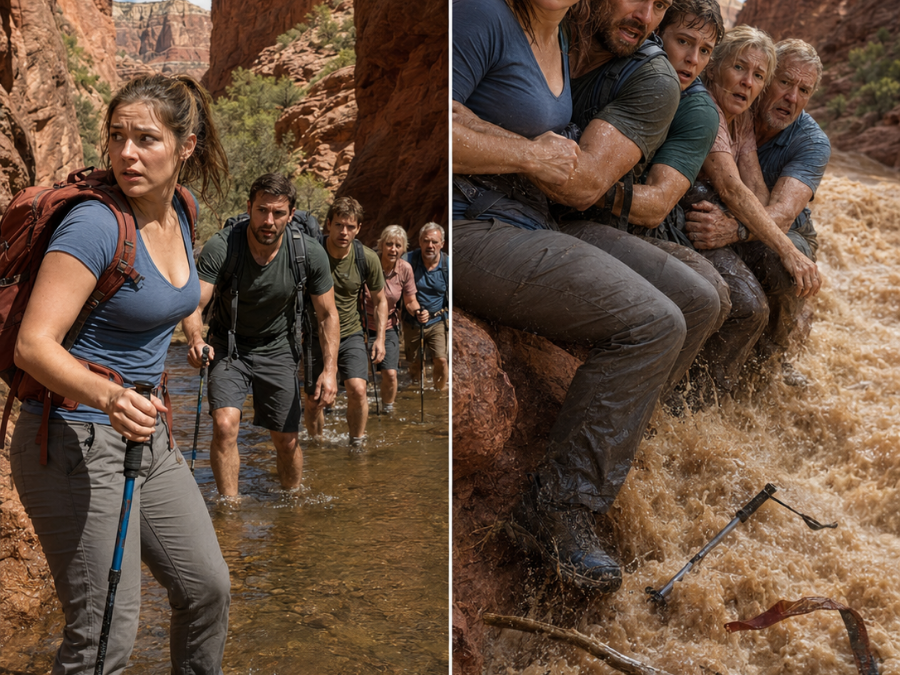
My Brother Mocked Me in Front of Our Family for Wanting to Turn Back, Then the Canyon Water Changed Color and Our Vacation Became a Fight to Survive
Part 1: The Warning Everyone Thought I Was Overreacting About
The sign at the entrance to Red Hollow Canyon did not say CLOSED, and that became the sentence my older brother repeated all morning as if those six letters were the only thing standing between caution and cowardice. It simply said that sudden flooding was possible after afternoon storms, but when I suggested we turn around before entering the narrowest section, Ethan laughed loudly enough for three strangers nearby to hear him.
“Come on, Rachel,” he said, adjusting the straps of his backpack. “You’re thirty-two years old, not eighty.”
My mother’s face tightened immediately.
“Ethan.”
“What? I’m kidding.”
He was not.
My husband, Caleb, stood beside me holding our water bottles while our parents checked their hiking poles beneath a cottonwood tree, and I could feel the familiar heat rising into my face. Ethan had spent most of our lives turning my caution into entertainment, and even at thirty-five, married with a successful contracting business and two children waiting at home with their mother, he could still make me feel twelve years old in front of our parents.
The trip had been his idea.
Our father, Henry Lawson, was retiring after nearly forty years repairing municipal water systems in the fictional town of Cedar Glen, Arizona, and Ethan wanted one final family adventure before Dad became, in Ethan’s words, “the guy who spends every morning arguing with squirrels over birdseed.”
My mother, Susan, loved the idea.
So did Caleb.
I did too, originally.
Red Hollow Canyon was part of the fictional Copper Mesa Wilderness, a maze of rust-red cliffs, cottonwood-lined washes, narrow sandstone passages, and broad desert plateaus in southern Utah. The lower canyon was famous locally because hikers could walk directly through a shallow stream between walls that narrowed dramatically several miles upstream.
Photographs made it look magical.
The water usually reached only the ankles or calves.
Sunlight reflected warm orange and gold across the rock.
Families visited constantly.
That was exactly what made the danger difficult to feel.
We arrived shortly after eight on an August morning under a clean blue sky.
At the ranger kiosk, a young employee reminded everyone that storms were expected somewhere across the plateau after two in the afternoon, though the exact location was uncertain. He pointed toward the warning board.
“Conditions can change quickly in the slot,” he said. “If the water turns muddy or starts carrying debris, leave immediately.”
My father nodded seriously.
Ethan smiled.
“We’ll be out before lunch.”
The ranger looked at him.
“Don’t count on the weather following your schedule.”
I remembered that sentence later.
At the time, we started hiking.
The first mile was easy.
We walked beneath cottonwoods while the stream twisted through open sand, and Ethan kept stopping to take pictures of Mom and Dad together. Dad wore faded tan hiking pants, a light blue sun shirt, and the ridiculous wide-brimmed hat Susan had bought him for retirement.
“You look like a park brochure,” I teased.
He grinned.
“That means your mother dressed me correctly.”
Susan walked ahead laughing.
For almost two hours, everything felt ordinary.
Then the canyon narrowed.
The walls rose higher until only a ribbon of sky remained overhead, while the trail disappeared entirely beneath the stream. We moved through cool water over slippery rounded stones, balancing with trekking poles and occasionally helping Mom across deeper sections.
I kept looking upward.
Caleb noticed.
“You still thinking about the warning?”
“Yes.”
“We can turn around.”
Ethan heard us.
He turned midstream.
“You cannot be serious.”
“I’m looking at the time.”
It was 11:38.
“We’ve still got hours,” he replied.
“We don’t know where the storms are.”
“The sky is blue.”
“That’s not the point.”
Ethan sighed dramatically and looked toward Dad.
“She’s doing the thing again.”
My stomach tightened.
Dad frowned.
“What thing?”
“Planning for a disaster that isn’t happening.”
Caleb’s expression changed.
“Ease up.”
But Ethan had an audience now: our parents, several hikers nearby, and two college-aged men resting against the sandstone wall.
“Rachel once canceled a barbecue because there was a thirty-percent chance of rain,” Ethan announced.
One of the strangers smiled awkwardly.
I felt humiliated.
“Forget it.”
I started walking.
Caleb followed.
Dad called after us.
“Rach, if you want to turn around, we turn around.”
That made everything worse because now everyone would believe the family retreat was mine.
I stopped.
“I don’t want to ruin Dad’s trip.”
“You’re not,” Susan said.
Ethan shook his head.
“No one said she was.”
His voice said exactly that.
We continued.
An hour later, we reached a narrow chamber where the sandstone walls were scarcely twenty feet apart and rose hundreds of feet above us.
Ethan was thrilled.
Dad looked genuinely happy.
Even I had to admit the place was breathtaking.
Sunlight poured through the narrow opening above and turned the canyon walls copper-red, while the stream moved cool and clear around our boots.
Then I noticed something floating past my ankle.
A pine needle.
Then another.
Then a cluster of small leaves.
I stopped.
“Caleb.”
He looked down.
The water had changed slightly.
Not dramatically.
But the clear greenish stream was becoming cloudy.
Dad noticed my expression.
“What is it?”
Before I could answer, a small branch floated around the bend.
Ethan looked upstream.
“It’s probably runoff.”
I stared at him.
“Yes.”
He seemed confused.
“That’s exactly the problem.”
Then we heard it.
A sound so distant at first that it seemed like wind.
A low, continuous roar.
Dad’s face changed completely.
“Turn around.”
Ethan blinked.
“Dad—”
“Now.”
The old water-system mechanic in my father had heard something none of us wanted to understand.
Water moving where it should not be.
And it was coming toward us.
Part 2: The Canyon Changed Faster Than Any of Us Could Run
We started downstream quickly, but hiking through waist-deepening water over unseen stones was nothing like running on pavement. Every step required balance, and within minutes the current pressed hard enough against our calves that Susan had to grip Caleb’s forearm.
“Stay together!” Dad shouted.
The water darkened.
Branches began appearing.
The roar grew louder.
Behind us, people were yelling.
Ethan turned repeatedly toward the sound as if looking hard enough could tell him how much time we had.
Then the first surge reached us.
The water jumped from below my knees to nearly my thighs in seconds.
Susan screamed.
Caleb grabbed her with both hands while Dad braced against the wall.
I lost my footing once and slammed my shoulder against sandstone before Ethan caught the back of my pack.
“Rachel!”
“I’m okay!”
We kept moving.
There was no bank.
No trail above the water.
The walls on either side rose almost vertically, polished smooth by thousands of years of floods.
The canyon that had felt protective fifteen minutes earlier now felt like a hallway with both doors locked.
We reached a slightly wider bend where fallen rocks created a shelf four feet above the stream.
Dad pointed.
“Up there!”
Caleb climbed first and pulled Susan toward him.
I followed.
Ethan stayed below with Dad, helping an older couple who had been hiking behind us.
The water was now brown.
Thick foam collected against the walls.
A log struck a boulder upstream with a cracking sound that echoed through the canyon.
“Ethan!” I screamed.
He pushed the older woman toward Dad.
“Get her up!”
The current hit his legs.
He stumbled.
For one horrifying second, my brother disappeared to his waist.
Dad grabbed his backpack strap.
Together they fought toward the rock ledge.
Caleb reached down.
“Give me your hand!”
Ethan stretched upward.
Their fingers touched.
Then a second surge slammed into the bend.
Ethan was ripped sideways.
Dad caught his wrist.
“Hold on!”
I will never forget Ethan’s face.
All the arrogance was gone.
All the teasing.
He looked suddenly young.
“Dad!”
Dad braced one knee against the rock while the current dragged Ethan downstream.
I dropped flat and reached over the edge.
“Give me your other hand!”
Ethan swung toward me.
I caught two fingers.
Then three.
Caleb grabbed my belt from behind so the river would not take me too.
Ethan’s wet hand slipped.
“No!”
Dad tightened his grip.
The older woman began crying.
For several seconds, the five of us became one chain held together by desperate hands.
Then Caleb managed to hook his arm underneath Ethan’s shoulder.
We pulled.
Ethan collapsed onto the rock shelf gasping.
Dad climbed up after him.
Nobody spoke.
We simply watched the river rise below us.
Within ten minutes, the spot where we had been walking was buried beneath violent brown water carrying branches, brush, and stones.
Ethan sat with both hands shaking.
His face had gone pale.
“I’m sorry.”
No one answered at first.
Then Susan slapped both hands against his shoulders—not violently, but with the furious relief of a mother whose grown son had nearly disappeared in front of her.
“Never,” she cried, “ever make someone ashamed for being careful again.”
Ethan lowered his head.
“I know.”
“No, you don’t.”
“I do now.”
The flood kept rising.
And we were still trapped.
Part 3: The Ledge Saved Us, but Night Brought Another Danger
The shelf was narrow but stable, perhaps eight feet long and six feet deep, with a sloping section above it where several hikers could sit against the canyon wall. Eleven of us eventually gathered there while the flood transformed the stream below into something none of us recognized.
No one had phone service.
Our bags were soaked.
The temperature began dropping.
Dad checked everyone for injuries.
One man had a badly twisted ankle.
I had a bruised shoulder.
Ethan had cuts across both hands from scraping the rock.
Otherwise, somehow, everyone on the ledge was alive.
Hours passed.
The water did not immediately fall.
Darkness arrived early inside the canyon because the high walls blocked the evening light, and wet clothing became cold against our skin. Caleb helped distribute emergency blankets while Dad encouraged people to keep moving their fingers and toes.
Susan leaned against me.
“You were right.”
I stared at the river.
“I don’t want to be right.”
“I know.”
Across the ledge, Ethan heard us.
He looked away.
Later, while the others tried to rest, he sat beside me.
For a while neither of us spoke.
Then he said, “I embarrassed you.”
“Yes.”
“I thought I was being funny.”
“You always think that.”
He absorbed it without arguing.
“That’s fair.”
I looked at him.
The flashlight in Dad’s hand cast weak shadows across Ethan’s face.
“You didn’t almost die because you joked about me.”
“No.”
“You almost died because we all stayed.”
He nodded.
“That was me too.”
“It was all of us.”
“But I made turning around feel like losing.”
That sentence mattered.
For years, Ethan had turned caution into competition.
If someone declined another drink, they were boring.
If someone skipped a risky shortcut, they were scared.
If I double-checked hotel locks or weather reports, I was Rachel doing the thing again.
Now he looked exhausted.
“I don’t know why I do that,” he said.
“Because people laugh.”
He gave a humorless smile.
“Yeah.”
“And that feels good.”
“Not tonight.”
Below us, the flood roared.
Sometime after midnight, we heard voices.
Everyone sat upright.
Flashlights appeared around a distant bend.
Search-and-rescue workers had entered from downstream after families reported overdue hikers and trail employees noticed the sudden rise.
They could not immediately cross the strongest section.
Instead they shouted instructions.
“Stay where you are!”
Dad laughed for the first time in hours.
“Wasn’t planning on sightseeing.”
Even Ethan smiled.
Rescue took most of the night.
Ropes were anchored from a safer position downstream, and people crossed one at a time wearing flotation equipment and harnesses. Susan went before me.
When it was Ethan’s turn, he hesitated.
A rescuer noticed.
“You okay?”
Ethan looked at the flood.
“Not really.”
The man nodded.
“You don’t have to be. Just follow me.”
Ethan did.
By sunrise, all eleven hikers from our ledge were safely outside the canyon.
Others were not as lucky.
One hiker from a separate group remained missing.
Two had been hospitalized after being swept into debris.
What had nearly become our family tragedy had already become someone else’s.
That knowledge followed us home.
Part 4: Surviving Did Not End the Argument Inside Our Family
For several weeks after Red Hollow, none of us talked normally about the trip.
Dad packed away his hiking equipment.
Susan stopped watching weather reports whenever storms appeared on television.
Caleb woke twice from dreams in which he was still holding the back of my belt while I reached for Ethan.
And Ethan disappeared.
Not literally.
He went home to his wife and children, returned to work, answered messages, and showed up for Sunday dinners.
But the loud version of my brother seemed gone.
He no longer made jokes when Dad checked tire pressure before road trips.
He did not mock Mom for carrying extra medication.
When his eight-year-old son refused to climb onto a high rock during a family picnic, Ethan simply said, “That’s okay.”
Three months after the flood, he came to my house alone.
Caleb opened the door.
Ethan stood on the porch holding an old trekking pole.
Mine.
The one I had dropped during the flood.
“A rescue volunteer found it downstream,” he said.
I took it.
The aluminum shaft was bent.
“That thing traveled farther than we did.”
“Apparently.”
We sat in the kitchen.
Ethan stared at his coffee.
“I need to apologize properly.”
“You already did.”
“No. I said I was sorry while I was freezing on a rock and thinking I might die.”
“That usually improves sincerity.”
He almost laughed.
Then his expression tightened.
“I’ve been thinking about what Mom said.”
I waited.
“I made people feel stupid for being afraid.”
“Sometimes.”
“Mostly you.”
“Yes.”
He looked at me.
“I think I liked being the brave one.”
I nodded slowly.
“I know.”
“And if you were careful, then I needed you to be ridiculous, because otherwise maybe I was just reckless.”
That was the most honest thing my brother had ever said to me.
I sat back.
“You don’t need me to forgive your entire personality in one afternoon.”
“I know.”
“But I forgive you for the canyon.”
His eyes filled unexpectedly.
“Thanks.”
“What I don’t forgive is that terrible retirement speech you gave Dad.”
“That speech was excellent.”
“It lasted twenty-seven minutes.”
“He retired once.”
We both laughed.
And for the first time since the canyon, Red Hollow loosened its grip on our family.
Not disappeared.
Loosened.
The missing hiker was found days later several miles downstream.
His family held a memorial that fall.
Dad attended.
So did Ethan.
When we returned, my brother sat in his truck for nearly an hour before driving home.
After that, he began volunteering with a local outdoor-safety group.
He never told strangers that he was an expert.
He told them the opposite.
“I was the guy who thought a blue sky meant we were fine.”
People listened.
Part 5: Years Later, We Finally Walked Back to the Warning Sign
Four years passed before Dad suggested returning to Copper Mesa.
Not to hike Red Hollow.
Just to visit.
Susan refused immediately.
Then she changed her mind the next morning.
“I don’t want my last memory of that place to be cold water,” she said.
So the five of us drove back in early spring, when the desert was cooler and wildflowers dotted the open flats.
Red Hollow looked exactly the same.
That disturbed me.
I had expected the landscape to carry some visible scar from what happened, but nature rarely keeps our memories on display.
The cottonwoods were green.
The creek was shallow.
Families walked along the lower path laughing.
Children threw stones into the water.
Then we reached the warning board.
A new sign had replaced the old one.
Different wood.
Different layout.
Same message.
Flood risk: low that morning.
Ethan stopped.
For a long moment, he simply looked at it.
Then a young couple approached behind us.
The man glanced at the sign and shrugged.
“Low risk. We’re good.”
Ethan almost spoke.
I saw it happen.
The old instinct to instruct, correct, control.
Then he stopped himself.
The couple continued toward the canyon.
Dad looked at him.
“You were going to say something.”
“Yeah.”
“What?”
Ethan smiled faintly.
“Read it again before you go.”
Dad nodded.
“That would’ve been enough.”
We walked only as far as the open section before the canyon narrowed.
No one suggested going farther.
At the water’s edge, Susan sat on a smooth boulder.
Caleb took my hand.
Dad looked up toward the plateau.
Ethan stood beside me.
“Still hate this place?” he asked.
I considered it.
“No.”
“Really?”
“I respect it.”
He nodded.
“That’s probably smarter.”
We watched the water for a while.
Clear.
Shallow.
Harmless-looking.
That was the trick.
Danger did not always arrive wearing the face people expected.
Sometimes it looked like sunlight.
Sometimes it sounded like laughter.
Sometimes it was a brother teasing his sister because admitting she might be right felt harder than making everyone laugh.
And sometimes the bravest decision a person could make was turning around while nothing frightening had happened yet.
Dad eventually clapped his hands.
“All right. Retirement hike officially completed four years late.”
Susan stood.
“That was not a hike.”
“I walked at least half a mile.”
“You walked from the parking lot.”
“At my age, those are synonyms.”
We started back.
Before leaving, Ethan turned once toward the canyon.
I watched him read the warning sign again.
Not because conditions had changed.
Because he had.
We drove home beneath a wide blue sky.
Nobody mistook it for a promise.
The End. This story is entirely fictional and was created for entertainment purposes. All characters, names, locations, events, and situations depicted in this story are imaginary. Any resemblance to actual people, organizations, places, or events is purely coincidental.








