My family begged me to bury my missing daughter, but eleven years later her dead phone rang—and one whispered word reopened everything
My family begged me to bury my missing daughter, but eleven years later her dead phone rang—and one whispered word reopened everything
Part 1 — The Number That Had Been Silent For Eleven Years
When Elaine Caldwell’s phone rang at 7:14 on an October morning, she nearly ignored it because she was pouring coffee and already late for work. Then she saw the number on the screen and dropped the mug so hard that it shattered across her kitchen floor, because the call was coming from the cell phone her daughter Megan had carried when she disappeared eleven years earlier.
Elaine answered with both hands shaking and whispered, “Megan?” but no voice came back, only faint breathing and what sounded like wind moving past an open window. Three seconds later the connection died, leaving Elaine staring at the phone while coffee spread between the broken pieces at her feet.
Megan Caldwell had been twenty-three when she vanished from the fictional Colorado city of Bellmere on September 6, 2002. She was five-foot-four, brunette, quick to smile, halfway through a respiratory-therapy program, and known for calling her parents whenever she was going to be more than fifteen minutes late.
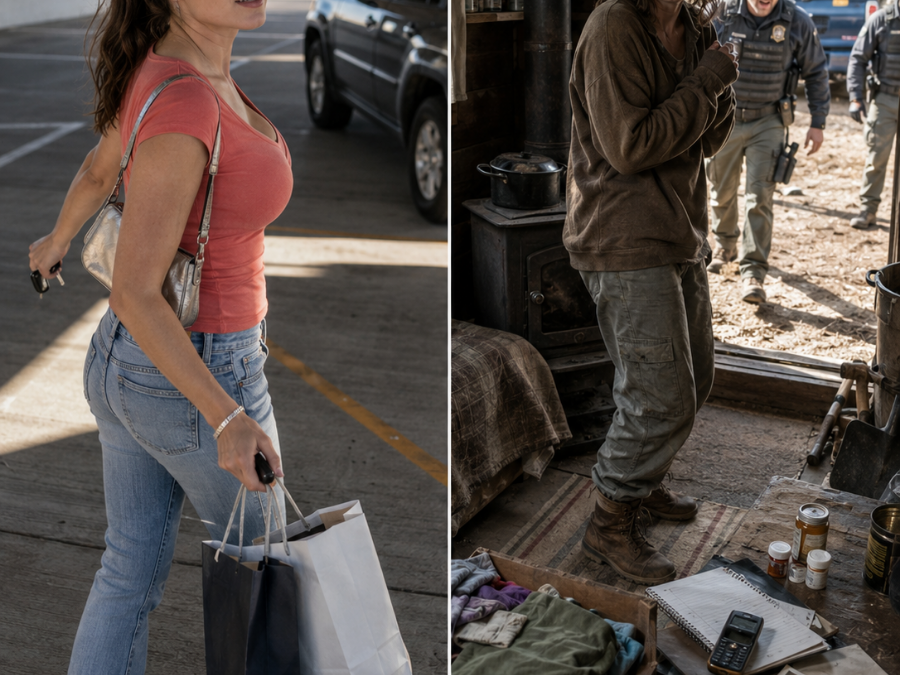
That Friday, she had eaten breakfast with Elaine and her father, Thomas, before announcing she needed to pick up shoes and a birthday present at Juniper Square Center. She drove away in her faded blue sedan wearing a coral blouse, light jeans, canvas shoes, and the small silver watch Thomas had given her after graduation.
Security cameras showed Megan arriving shortly after two in the afternoon, browsing several stores, ordering lemonade, and walking through the indoor courtyard alone. At 6:18, she exited toward the west parking structure carrying two shopping bags while checking her phone.
The final camera covered only part of the parking level.
Megan appeared beside her car, then turned toward a dark utility vehicle that pulled into the space across from her. A concrete support column blocked most of the interaction, but footage showed Megan speaking calmly to someone for almost two minutes before entering the other vehicle voluntarily.
Her own car remained behind.
The shopping bags were on the back seat.
Her keys were later found beneath the driver’s seat.
Nothing about the scene explained why Megan would leave without telling anyone.
Elaine began calling at nine that evening, then contacted Thomas at the auto-body shop he managed when Megan still had not responded by ten. They drove to Juniper Square themselves, found her car, and filed a missing-person report shortly before midnight.
Detective Harold Wynn took the case.
The first major clue came from Megan’s phone records, which showed repeated short calls from an unregistered prepaid number during the month before she disappeared. Whoever used it called from different towers around Bellmere and several rural communities farther north.
Friends knew nothing about the caller.
Megan’s occasional boyfriend, Aaron Fields, had a solid alibi and seemed genuinely devastated.
Teachers remembered no threats.
Coworkers remembered no strange customers.
The case expanded quickly, then slowly began collapsing beneath its own lack of evidence.
Elaine printed thousands of flyers.
Thomas spent weekends searching abandoned roads, drainage channels, empty warehouses, campgrounds, and wooded areas. Their savings disappeared into reward money, private searches, gasoline, printing costs, and trips prompted by sightings that never turned out to be Megan.
The first anniversary brought hundreds of people to a candlelight gathering.
The fifth brought fewer than seventy.
By the eighth year, even relatives began suggesting Elaine needed to “accept reality.”
Her sister Patricia finally said it aloud at Thanksgiving dinner.
“You’re keeping everyone trapped, Elaine.”
The room became painfully quiet.
Elaine stared at her.
Patricia lowered her voice, but not enough.
“Megan wouldn’t want you destroying your life forever. At some point, you have to let her go.”
Elaine stood so abruptly that her chair scraped across the dining-room floor.
“My daughter did not become inconvenient because time passed.”
Thomas followed her outside without saying goodbye.
That night became the last Caldwell family Thanksgiving for years.
Elaine refused to hold a memorial without evidence that Megan was dead.
Instead, she helped establish a volunteer network called Open Door Families, connecting parents of missing adults across Colorado and neighboring states. She learned how to request archived reports, track evidence transfers, challenge forgotten files, and keep cold cases visible after media attention disappeared.
Thomas found his own quieter purpose.
He repaired vehicles free for families traveling to searches and vigils, and although his marriage to Elaine survived, grief reshaped both of them. They became partners in endurance more than the carefree couple they had once been.
Megan’s bedroom remained untouched.
Her college notebooks sat beside a small lamp.
A denim jacket still hung behind the door.
Elaine changed the sheets every month even though nobody slept there.
Then, eleven years and thirty-six days after Megan disappeared, the dead phone number called.
Detective Wynn had retired, but Elaine still had his private number.
He arrived at her house less than an hour later.
The telecommunications company confirmed something almost unbelievable: Megan’s original number had been reactivated that same morning using her old subscriber information and a prepaid service card purchased for cash.
The call originated from a tower almost three hours north of Bellmere.
Near the fictional mountain community of Pine Hollow.
The next call came four days later.
This time Thomas was sitting beside Elaine.
They both heard breathing.
Then something metallic in the background.
The call lasted eleven seconds.
When it ended, Elaine grabbed Thomas’s arm so tightly her fingernails left crescents in his skin.
“That was someone breathing.”
Thomas nodded.
He looked frightened to say what they were both thinking.
Their daughter’s phone was not buried in a box.
Someone was carrying it.
Part 2 — Every Call Pulled Them Deeper Into The Mountains
State investigators reopened Megan’s disappearance as an active priority and established a small command office in Pine Hollow, a region of steep forest roads, isolated cattle properties, shuttered sawmills, and mountain cabins scattered so widely that some neighbors lived miles apart. The first prepaid activation had occurred at a roadside market, but the clerk remembered only a tall, thin man in a work coat who paid cash and seemed unusually anxious to avoid conversation.
Calls began arriving every three or four days.
One came from a highway corridor.
Another came from near an abandoned quarry.
A third originated close to a cluster of ranch properties.
The caller never stayed connected long enough for investigators to pinpoint an exact location.
Elaine stopped sleeping properly.
She carried her phone into the shower inside a plastic bag.
She brought two portable chargers everywhere.
She refused to silence it even during support-group meetings.
Then the seventh call came.
Elaine answered in the Open Door Families office while Thomas and two volunteers watched her face.
For several seconds there was only breathing.
Then a woman whispered one word.
“Mom.”
Elaine’s knees buckled.
Thomas caught her before she hit the floor.
The call ended immediately.
Audio specialists could not initially confirm whether the voice belonged to Megan because the sample was too short, but Elaine did not care what the report said. A mother could forget dates, addresses, even parts of her own past, but she had not forgotten the sound of her daughter saying that word.
Media attention exploded.
Reporters crowded outside Elaine and Thomas’s house.
Old relatives suddenly called offering support.
Patricia appeared at their front door crying, but Elaine would not let her turn eleven years of dismissal into a sentimental reunion because cameras had returned.
“I told you to bury her,” Elaine said quietly through the screen door.
Patricia covered her mouth.
“I was trying to help.”
“No. You were trying to make grief more comfortable for everybody watching it.”
Elaine closed the door.
The eighth call contained another clue.
Heavy machinery could be heard behind the breathing, followed by a low repeating clang investigators believed might come from an industrial pump, processing mill, or agricultural operation. Search teams began checking abandoned work sites throughout Pine Hollow County.
At an old stone-processing facility, investigators discovered blankets, canned food, plastic water containers, and signs that someone had recently slept inside a maintenance room. A forensic technician recovered female hair from one blanket, but laboratory testing would take time.
Then came the ninth call.
Elaine answered before the first full ring.
“Mom, I’m okay.”
Elaine stopped breathing.
Megan continued, her voice flat and strangely careful.
“Please don’t look for me anymore.”
The connection remained open for twenty-eight seconds.
Enough.
Voice comparison confirmed with overwhelming probability that the speaker was Megan Caldwell.
She was alive.
Elaine screamed so loudly that Thomas came running from the garage, and when she managed to tell him, he sank to the kitchen floor beside her.
But investigators were disturbed by the wording.
Megan had contacted her parents repeatedly after eleven silent years only to ask them to stop searching.
A forensic psychologist named Dr. Rebecca Sloan listened to the recording several times.
“She sounds coached,” Rebecca said.
Elaine stared at her.
“What does that mean?”
“It means someone may be controlling what she believes she’s allowed to say.”
The case officially changed from a long-term disappearance to a suspected unlawful confinement investigation.
The tenth call confirmed that fear.
A man spoke.
“She’s safe with me.”
His voice was low, older, controlled.
“Stop searching. You’re upsetting her.”
A trained negotiator tried to keep him talking, but the man disconnected after twenty seconds.
Investigators now had a psychological profile.
He likely believed he was protecting Megan.
He knew intimate details about her family.
He appeared comfortable moving around the mountain region.
And keeping someone hidden for eleven years required money, property access, isolation, and extraordinary control.
Detectives began rebuilding Megan’s life before the disappearance from scratch.
Teachers.
Neighbors.
Former employers.
Family acquaintances.
Doctors.
School staff.
Volunteer organizations.
One name finally emerged from an old yearbook interview.
Calvin Mercer.
Calvin had been a guidance counselor at Megan’s high school and later taught adult education courses in Bellmere. Several former students remembered him as intensely attentive toward young women he considered “lost” or “misunderstood,” and complaints about inappropriate boundaries had eventually forced him from education, though no criminal charges were filed.
After losing his job, Calvin inherited a small ranch outside Pine Hollow.
Records described the property as largely unused.
Drone surveillance told a different story.
Lights appeared after midnight.
A utility truck moved between barns.
Fresh tracks crossed roads after snow.
Smoke rose from a chimney on mornings when nobody was supposedly living there.
The eleventh call lasted nearly five minutes.
Negotiators let Calvin speak.
He described Megan’s abandoned dream of working in respiratory care, her childhood fear of thunderstorms, even the name of the dog she had owned as a teenager.
“You people only remember who she was,” Calvin said. “I know who she became.”
The negotiator asked whether Megan could speak.
Calvin paused.
“She chose this life.”
That sentence changed the emotional temperature inside the command center.
Elaine heard it later and whispered, “No.”
But Dr. Sloan warned everyone not to underestimate what eleven years of isolation could do.
“A person can adapt to survive something unbearable,” she explained. “Dependence can feel like safety when every other source of reality has been removed.”
Elaine shook her head.
“My daughter knows I love her.”
Rebecca answered gently.
“She may know it underneath everything. But we don’t yet know what she’s been taught to believe.”
Part 3 — Megan Was Alive, But She No Longer Thought Like Before
Investigators found the first direct witness in a seventy-two-year-old rancher named Judith Lane who lived fifteen miles from Calvin’s property. Judith remembered seeing him years earlier at a feed store with a thin brunette woman sitting motionless inside his truck.
At the time, Judith assumed the woman was sick.
“She looked sleepy,” Judith said. “Not drunk exactly. Just… disconnected.”
When shown Megan’s photographs, Judith started crying.
“That’s her.”
Search teams narrowed their focus to Calvin’s ranch and surrounding public land.
Before they could act, another call arrived.
This time the negotiator deliberately used Calvin’s first name.
Silence followed.
Then Calvin hung up.
Within hours, surveillance showed increased movement around the ranch.
Boxes were loaded into the utility truck.
A generator disappeared.
A horse trailer was moved.
Investigators feared he was preparing to relocate Megan.
They obtained warrants and assembled a tactical rescue team before dawn.
Elaine and Thomas waited thirty miles away in a command trailer while officers entered the property.
At 4:48 a.m., the first radio message arrived.
Main house clear.
Second structure clear.
Barn clear.
Then came the sentence nobody wanted.
“They’re gone.”
Inside the main building, investigators found proof Megan had lived there for years.
Women’s clothing.
Medication bottles.
Handwritten notebooks.
Books with notes in the margins.
A small bedroom fitted with interior locks.
Boxes containing photographs of Megan secretly taken before her disappearance.
Some showed her leaving classes.
Others showed her working at a coffee shop.
One showed the Caldwell home photographed from across the street.
Calvin had watched her for months.
Megan’s journals were even more disturbing.
The earliest pages were frantic.
I want my mom.
I want Dad.
I don’t understand why he’s doing this.
Later entries became quieter.
Calvin says my parents stopped searching.
Calvin says nobody believed I was worth waiting for.
Years passed.
The handwriting changed.
The language changed.
Eventually came sentences investigators found difficult to read.
Calvin understands me better than they did.
Maybe he did save me.
Dr. Sloan closed the journal after reading those lines.
“This is what prolonged coercion can do.”
Elaine wanted to tear every page apart.
Instead, she pressed both hands over her mouth and cried silently.
The notebooks also mentioned a “winter cabin” and a “canyon house.”
Maps revealed several remote hunting properties Calvin had leased or maintained over the years.
Teams searched continuously.
Then Calvin called again.
His voice sounded sharper.
“You frightened her.”
The negotiator remained calm.
“We want to know she’s safe.”
“She doesn’t want you.”
Elaine, listening nearby, closed her eyes.
Calvin continued.
“You keep dragging her backward.”
Eventually, he allowed Megan to speak.
Elaine took the phone.
“Megan?”
A long silence.
Then her daughter answered.
“Hi, Mom.”
Elaine nearly collapsed from hearing her voice clearly for the first time since 2002.
“I love you,” Elaine said. “Your dad loves you. Nobody stopped looking.”
Megan began breathing faster.
Calvin could be heard murmuring nearby.
Then Megan said something Elaine had feared.
“Robert—”
She stopped herself.
“Calvin took care of me.”
Elaine closed her eyes.
“You don’t have to protect him.”
“He kept me safe.”
“Megan, sweetheart, you disappeared. We searched every day.”
Another pause.
“He said you eventually moved on.”
Thomas took the phone.
“Megan, your room is still there.”
His voice broke.
“I fixed the loose drawer on your desk last winter because your mother said it bothered you.”
Megan made a sound between a sob and a gasp.
Calvin immediately ended the call.
Investigators believed Thomas had accidentally broken through part of the narrative Calvin built.
For eleven years, Megan had been told she was forgotten.
A tiny detail about a desk drawer proved otherwise.
That evening, the final location narrowed dramatically when technicians isolated background sounds from repeated calls: cattle, an old water pump, and a church bell ringing from miles away. Only four remote properties matched the timing and geography.
One was an abandoned hunting cabin deep in Black Alder Canyon.
Fresh tire tracks led toward it.
The road ended miles before the cabin.
Officers would have to approach on foot.
Part 4 — Her Mother Reached For Her And Megan Stepped Back
The rescue began before sunrise on November 30.
Officers moved quietly through freezing timber while Calvin participated in a scheduled phone call from inside the cabin. Once the perimeter was secure, the negotiator told him police were nearby and nobody needed to be hurt.
Calvin surrendered without a fight.
His first words were not about himself.
“Don’t scare Megan.”
Officers entered.
Megan was sitting beside a woodstove wearing an oversized brown sweater, loose work pants, and boots several sizes too large. Her dark hair, once worn long, had been cut unevenly around her shoulders.
She looked older than thirty-four.
Not physically old.
Emotionally exhausted.
An officer told her she was safe.
Megan immediately looked toward the door where Calvin had been taken.
“Where is he?”
The officer crouched several feet away.
“He’s in custody.”
Megan stood abruptly.
“You can’t hurt him.”
Nobody had expected those to be her first words after eleven years.
When Elaine and Thomas were finally allowed to see their daughter several hours later at a secure medical facility, Elaine had rehearsed the moment countless times. She imagined Megan running toward her.
Instead, Megan froze.
Elaine stopped herself from rushing forward.
“Megan.”
Her daughter stared at her face.
“You look different.”
Elaine smiled through tears.
“So do you.”
Thomas started crying openly.
Megan looked frightened by his emotion.
When Elaine slowly opened her arms, Megan stepped backward.
The movement shattered something inside her mother.
But Elaine remembered what Dr. Sloan had warned.
Do not demand the reunion you imagined.
Meet the person who survived.
Elaine lowered her arms.
“You don’t have to hug me.”
Megan’s chin trembled.
“I don’t know what I’m supposed to feel.”
“You don’t have to feel anything for me today.”
Megan stared at her.
Elaine continued.
“You just have to know we never stopped loving you.”
That night Megan asked repeatedly whether Calvin was safe.
She insisted he had rescued her from a shallow, meaningless life.
She said he taught her gardening, first aid, herbal remedies, philosophy, and practical skills.
She described years in which there were no locks on her doors.
To outsiders, that sounded like freedom.
Therapists understood differently.
By then, Megan had internalized the boundaries Calvin created so completely that physical restraints were unnecessary.
He controlled mail.
News.
Money.
Transportation.
Outside contact.
He told her her parents had abandoned the search.
He said the world considered her irresponsible and selfish.
He alternated approval with withdrawal, kindness with warnings that she would be alone if she ever betrayed him.
Survival required becoming the person who kept him calm.
The first months home were brutal.
Megan could not sleep in her childhood bedroom because it felt too large.
Crowded stores triggered panic attacks.
Television overwhelmed her.
Even several people talking simultaneously made her cover her ears.
Elaine occasionally heard relatives complain that Megan seemed “ungrateful” for being rescued.
She ended those conversations immediately.
At one family gathering, Patricia whispered that Megan should be happier after everything they had done to find her.
Elaine slammed her palm onto the kitchen counter.
“My daughter spent eleven years surviving something you cannot imagine.”
Patricia recoiled.
“She’s home now.”
“That does not erase what happened.”
“I only meant—”
“No.”
Elaine’s voice shook.
“Nobody in this family gets to tell her how rescue is supposed to look.”
Megan stood silently in the hallway.
Later that evening, she entered the kitchen where Elaine was washing dishes.
For several seconds, neither woman spoke.
Then Megan whispered, “Thank you.”
Elaine turned.
“For what?”
“For not making me perform being okay.”
It was the first moment Elaine understood that getting Megan back would not mean recovering the daughter she lost in 2002.
It meant learning to love the woman who returned.
Part 5 — Coming Home Became A Journey Instead Of A Moment
Calvin Mercer went to trial the following spring.
Prosecutors presented surveillance photographs, Megan’s early journals, prepaid-phone records, property documents, evidence of planned isolation, and testimony from former students who described his obsessive interest in women he believed needed “saving.”
Calvin insisted Megan had stayed voluntarily.
He claimed he had offered her a simpler life.
He described himself as a protector rather than a captor.
Megan did not testify publicly during the main proceedings because her treatment team believed the pressure could seriously disrupt her recovery.
Her earliest journals spoke for her.
The jury convicted Calvin on multiple charges related to abduction, unlawful confinement, coercion, and long-term psychological abuse.
He received a sentence that ensured he would spend decades in prison.
When reporters asked Elaine whether justice made her happy, she shook her head.
“Justice and happiness are not the same thing.”
Recovery remained complicated.
Megan began intensive trauma therapy and initially resisted almost everything therapists suggested.
She missed the canyon.
She missed the quiet.
Sometimes she even missed Calvin.
Those feelings horrified her.
Dr. Sloan explained that emotions formed during captivity did not make Megan responsible for what happened.
Her mind had built a survival system.
Dismantling it required patience.
Four months after the rescue, Megan hugged Elaine voluntarily for the first time.
Elaine had been folding laundry when Megan walked into the room and simply wrapped both arms around her.
Neither spoke.
They stood together until both were crying.
Six months later, Megan visited a community college.
She had once been two semesters from completing her respiratory-care training.
The building felt impossibly loud.
Students hurried through hallways.
Doors slammed.
Phones rang.
Megan lasted fifteen minutes before asking to leave.
Elaine expected disappointment.
Megan surprised her.
“Can we come back next week?”
They did.
Eventually, Megan enrolled in one evening class.
Then two.
She no longer believed she could return to exactly the future she imagined at twenty-three, but she began building another.
Thomas created a small garden behind the house.
Megan helped him plant herbs, tomatoes, and sunflowers.
Working with soil felt familiar without belonging exclusively to Calvin’s world.
Slowly, ordinary routines developed.
Sunday dinner.
Tuesday movie nights.
Friday morning walks with Elaine.
Therapy on Wednesday afternoons.
There were nightmares.
There were setbacks.
There were days when Megan closed every curtain and refused to leave the house.
There were also days when she laughed so hard that Thomas went into another room and cried because he had almost forgotten the sound.
Open Door Families continued its work.
Elaine no longer spoke as the mother of a missing daughter.
She spoke as the mother of a recovered daughter whose recovery had taught her that finding someone was not the end of a disappearance case.
Sometimes it was the beginning of another difficult journey.
A year after Megan came home, Patricia asked whether Elaine would ever forgive her for those Thanksgiving words.
Elaine considered the question.
“I forgave you a long time ago.”
Patricia looked relieved.
“But I didn’t forget what they taught me.”
“What did they teach you?”
“That grief makes people uncomfortable, and sometimes they’ll ask you to abandon hope just so they can stop witnessing it.”
Patricia looked down.
Elaine continued.
“I’m glad I didn’t.”
Megan eventually moved into a small apartment ten minutes from her parents.
The first night frightened everyone.
Elaine wanted to call constantly.
Thomas wanted to sleep in his truck outside.
Megan laughed when they admitted it.
“I’ll call if I need you.”
At eleven-thirty that night, Elaine’s phone rang.
For one terrible second, eleven years collapsed into a single heartbeat.
Then Megan’s name appeared.
Elaine answered.
“Everything okay?”
Megan laughed softly.
“Yes.”
“Are you sure?”
“I just wanted to say goodnight.”
Elaine closed her eyes.
“Goodnight, sweetheart.”
“Love you, Mom.”
The call lasted forty-two seconds.
There was no frantic tracing.
No negotiator.
No hidden tower in the mountains.
No stranger deciding what Megan was allowed to say.
Just a daughter calling her mother because she wanted to.
Years earlier, a three-second silent phone call had reopened the worst wound of Elaine’s life.
Now a simple goodnight call showed her something she had once believed impossible.
Megan’s voice belonged to Megan again.
Her choices belonged to her.
Her future belonged to her.
She would never recover the eleven missing years.
No sentence could return them.
No therapy could erase every memory.
No family reunion could restore the person who walked into Juniper Square at twenty-three.
But healing had never required pretending nothing happened.
It meant allowing what happened to stop controlling everything that came afterward.
On the twelfth anniversary of Megan’s disappearance, Elaine woke expecting the familiar weight in her chest.
Instead, she smelled coffee.
Megan was standing in the kitchen wearing sweatpants and one of Thomas’s old college shirts, complaining that her father had bought terrible coffee again.
Thomas walked in from the backyard.
“You two criticize it every morning and still drink it.”
Megan smiled.
“Tradition.”
Elaine looked at them both.
For eleven years, August had represented the day her family disappeared even though two people remained in the house.
Now the calendar contained other dates.
The rescue.
The first hug.
The first class.
The first apartment.
The first ordinary phone call.
Their family had not returned to what it was.
It had become something new.
Something scarred.
Something careful.
Something real.
Elaine once believed finding Megan would be the miracle.
Eventually, she understood that the greater miracle was watching Megan slowly discover that being found did not mean she belonged to her parents, the police, therapists, reporters, or even the version of herself she had been before.
She belonged to herself.
And after eleven years of someone else deciding what she should believe, where she should live, who she should trust, and whether she was allowed to leave, that ordinary truth became the most extraordinary freedom of all.
The End. This story is entirely fictional and was created for entertainment purposes. All characters, names, locations, events, and situations depicted in this story are imaginary. Any resemblance to actual people, organizations, places, or events is purely coincidental.








