I mocked my students for fearing the thing beneath their desks—until it followed me home, offered me one wish, and demanded a terrible price
I mocked my students for fearing the thing beneath their desks—until it followed me home, offered me one wish, and demanded a terrible price
Part 1: The children knew why nobody should sit beside them
For twenty-three years, I taught elementary school and believed I understood the difference between childish imagination and genuine fear, which was exactly why I dismissed the strange behavior in my fifth-grade classroom for far too long. My name is Graham Whitaker, and at fifty-one I had become the kind of teacher who could recognize a fake stomachache from across the room, predict which parents would blame me for missing homework, and quiet twenty-seven children with one look.
I worked at Cedar Ridge Elementary in the fictional town of Bellweather, West Virginia, a former mining community surrounded by wooded hills, abandoned access roads, narrow creeks, and old houses built so close to the mountains that afternoon shadows reached the porches before dinner. The school itself was a squat brick building from the 1960s with humming fluorescent lights, scuffed tile floors, ancient radiators, and a playground bordered by a chain-link fence beyond which the forest rose almost immediately.
My students were ten and eleven, old enough to understand embarrassment but young enough to believe adults could fix almost anything. That belief made what happened in my classroom even harder to accept, because they never came to me for help.
Every Monday morning, one student became untouchable.
Nobody announced it or voted on it, yet the entire class somehow knew who had been chosen. Desks would shift several inches away, lunch seats would mysteriously fill before the child arrived, and during recess everyone would remain close enough to supervise but never close enough to touch.
The isolation lasted seven days.
Then everything returned to normal.
A boy named Caleb would spend a week pale, exhausted, and alone, only to rejoin his friends the following Monday as though nothing had happened. Then the class would suddenly avoid Nora, or Eli, or a quiet girl named Sadie Morgan.
At first I assumed bullying.
I lectured them.
Assigned consequences.
Called parents.
Nothing changed.
The children who were being excluded never complained about the others, which frustrated me more than anything. When I asked Sadie why nobody would sit beside her, she merely stared at her folded hands.
“Because it’s my week,” she whispered.
“Your week for what?”
Her eyes moved toward the dark gap beneath my supply cabinet.
“To keep him interested.”
I nearly laughed.
“Him who?”
Sadie’s face changed instantly.
“Don’t ask that loud.”
That should have been the moment I listened.
Instead, I told her she was too old for imaginary monsters.
During the following months, I noticed another pattern. Children sometimes arrived with things their parents swore they had never purchased: an expensive-looking baseball glove with no manufacturer’s mark, a polished wooden chess set, a new bicycle, a portable music player, even a jar filled with old coins.
Whenever I asked where the objects came from, the answer was always the same.
“A friend gave it to me.”
“What friend?”
They would look away.
Then came Jonah Price.
Jonah was a bright, nervous boy who lived with his mother above a laundromat near the railroad tracks, and during his week he barely slept. He startled whenever something rolled beneath a desk and kept checking the shadows around the coat hooks.
One afternoon I found him behind the gym crying over a silver pocket watch.
“Who gave you that?”
Jonah wiped his eyes.
“The Hollow Friend.”
Every child within hearing distance went silent.
I crossed my arms.
“That’s enough. There is no Hollow Friend.”
Jonah looked at me with such genuine fear that I still remember every detail of his face.
“You shouldn’t have said that.”
Three nights later, something touched my ankle while I slept.
I lived alone in a two-bedroom rental at the edge of town, and my bed sat beneath a window overlooking an empty hillside. At 2:13 in the morning, I woke because something cold was tapping the sole of my foot.
Tap.
Tap.
Tap.
I opened my eyes.
A pale hand rested on the blanket.
It had six impossibly long fingers.
The wrist disappeared beneath my bed.
I froze.
The fingers slowly curled around my ankle.
I kicked hard and reached for the bedside lamp.
The instant the room filled with light, the arm slid beneath the bed with the speed of a rope being pulled through a hole.
I searched everywhere.
Nothing.
I convinced myself exhaustion had caused a nightmare until I sat in the living room and heard scratching underneath the couch.
A finger appeared between the cushions.
Then another.
Then four more.
The couch began creaking beneath me as if something huge were folding itself into the narrow space below.
I ran into the kitchen.
Cabinet doors opened by themselves.
A spoon slid across the counter.
The refrigerator light flickered while something giggled behind me in a voice that sounded like several children whispering at once.
The game lasted until sunrise.
When I entered my classroom the next morning, every student stopped talking.
Twenty-seven chairs scraped backward.
Away from me.
Jonah swallowed hard.
“Mr. Whitaker,” he whispered, “now it picked you.”
That was when I finally understood.
My students had never been abandoning one another.
They had been staying out of its reach.
Part 2: Seven nights earned one perfectly dangerous reward
The children explained the rules during lunch with the classroom door locked, blinds lowered, and their voices barely above whispers. The Hollow Friend chose one person for seven days, and anyone who became too physically close to that person risked being included in its games.
“It doesn’t like sharing,” Sadie said.
“What exactly does it do?”
“Whatever makes you react.”
That answer proved painfully accurate.
The creature hid my keys inside the refrigerator, tied my shoelaces together beneath my desk, rearranged every framed photograph in my house, pulled blankets from my bed, and sometimes stretched its pale fingers around a doorway just far enough for me to notice. Whenever I shouted, it laughed.
The children insisted I must never refuse to play directly.
“You can ignore it for a little while,” Caleb explained, “but don’t tell it no.”
“What happens?”
He looked toward the floor.
“It thinks you want a harder game.”
At the end of seven days, the Hollow Friend gave the chosen person a reward.
Not exactly a gift.
A wish.
The students had learned to request objects rather than changes involving people.
One girl asked for her father to stop gambling.
The next morning, he suffered a severe injury to his dominant hand at work and could no longer comfortably hold playing cards, casino chips, or even a pen.
Another child wished his parents would stop fighting.
His father abruptly moved across the country after receiving a job offer nobody remembered him applying for.
The fighting stopped.
So did the marriage.
“You have to be careful,” Jonah told me. “It gives you what you say, not what you mean.”
On the sixth night, I made my first serious mistake.
I had slept perhaps eight hours total that entire week, and while driving home from school I heard giggling beneath the passenger seat. A pale hand suddenly reached through the gap under my steering wheel and twisted one of the dashboard knobs.
I slapped at it.
“Leave me alone!”
The hand vanished.
Thirty seconds later, red and blue lights appeared in my rearview mirror.
Deputy Marcus Hale pulled me over after watching my car drift across the center line. He was a broad-shouldered man in his early forties who knew me from school events and immediately noticed how exhausted I looked.
“You need sleep, Graham.”
“I’m fine.”
“You nearly drove into oncoming traffic.”
Something scratched beneath my seat.
I clenched my jaw.
Marcus leaned closer.
“You hearing something?”
“No.”
“You sure?”
“Yes.”
He made me step out, checked that I was sober, then sent me home with a warning.
I muttered something ugly after he drove away.
The Hollow Friend listened.
That evening I opened my front door and found a wooden crate sitting in the middle of my living room.
My stomach dropped.
The lid lifted by itself.
Inside were Marcus Hale’s badge, flashlight, belt, boots, and jacket.
Then his face rose from the darkness.
He was alive.
Somehow.
His body had been folded into the crate at angles no human body should tolerate, but there was no blood and no visible wound. His eyes found mine.
“Help me.”
I staggered backward.
The pale hands appeared.
Dozens of them.
They began rearranging Marcus like a child repositioning a doll.
“No!”
The hands stopped.
“I didn’t ask for this!”
A soft giggle came from beneath the floorboards.
Then I understood.
My anger beside the road had been interpreted as a wish.
I dropped to my knees.
“Put him back exactly as he was before tonight. Alive. Safe.”
The room went silent.
The hands wrapped around Marcus.
The crate collapsed inward as though swallowed by its own shadow.
By morning, the police found Marcus unconscious beside his patrol vehicle several miles outside town. He recovered physically, but refused to discuss what had happened during the missing hours.
My first reward had been spent undoing something I never intended to request.
Seven months later, the Hollow Friend chose me again.
This time I prepared.
I bought puzzles, cards, wooden blocks, marbles, old board games, and anything else that might satisfy its need for attention. I covered every dark space with lamps, though I quickly discovered darkness was not where it lived.
Darkness was simply where it opened the door.
At the end of my second week, I asked for money.
Not much.
“Give me enough legal money to pay every bill due this month.”
The following afternoon, I received an unexpected refund from an insurance overpayment made years earlier.
It covered the bills exactly.
Not one dollar more.
I laughed when I realized what had happened.
For the first time, I thought I understood how to control it.
That arrogance lasted until one of my former students died.
Part 3: I asked it to return someone death had taken
Ethan Lawson had been thirteen when he died in an accident at his uncle’s repair shop. His younger sister, Mia, was still in my classroom, and for ten days after the funeral her desk remained empty.
I knew Ethan.
I had taught him two years earlier.
He was sarcastic, funny, obsessed with engines, and forever taking apart mechanical pencils to see how they worked.
His death was senseless.
No monster caused it.
No curse.
A support stand failed while he was helping move equipment, and one ordinary afternoon destroyed an entire family.
My next turn with the Hollow Friend was approaching.
I began thinking about Ethan.
The students had warned me never to make wishes involving people, but Ethan was already dead. In my grief and arrogance, I convinced myself there could be no worse consequence.
I spent days constructing the exact wording.
On the seventh night, pale hands emerged from beneath the dining table and arranged themselves in a circle.
The room became cold.
I spoke carefully.
“I want Ethan Lawson restored to life, appearing safely inside this house.”
Every hand stopped moving.
For several seconds nothing happened.
Then came a scraping noise from the hallway.
I turned.
Ethan was there.
He wore the dark suit in which his family had buried him.
Soil clung to his sleeves.
One leg dragged uselessly behind him.
The wish had returned him to life.
It had not repaired what death had done.
“Mr. Whitaker,” he whispered.
I nearly collapsed.
“Ethan.”
He crawled toward me.
“Don’t send me back.”
I knelt beside him.
“I’ll fix this.”
His hand clamped around my wrist.
His skin was freezing.
“You don’t understand where I was.”
He described darkness without distance, voices without mouths, and enormous things moving behind what he called “the thin places.” He said the Hollow Friend crossed between those places because it belonged to neither one.
Then he looked behind me.
His expression changed.
“It likes you.”
I turned.
Two pale hands were resting on my shoulders.
Ethan panicked.
He grabbed a heavy fireplace tool lying beside the hearth and swung it toward me.
I stumbled backward.
“What are you doing?”
“If you’re dead,” he gasped, “maybe it lets me stay.”
He swung again.
I blocked with a chair.
There was no hatred in his face.
Only terror.
He was a child desperate not to return to something worse than death.
“Hollow Friend!” I shouted. “Take Ethan back where he belongs.”
The floor beneath him turned black.
Hands emerged.
Ethan screamed and grabbed my legs.
The shadows opened wider.
We both fell.
For perhaps three seconds, I saw the place behind the world.
There was no ground.
No sky.
Only endless layers of darkness pierced by distant lights and enormous shapes moving impossibly far away.
And there, suspended among them, was the Hollow Friend.
It had no single body.
It resembled a knot made from pale arms, empty sleeves, tangled roots, and smiling masks, with hundreds of fingers moving constantly as if trying to play games with the darkness itself.
Ethan was pulled away from me.
I reached toward him.
He looked suddenly calm.
“Tell Mia I wasn’t afraid at the end.”
Then he disappeared.
A hand shoved me upward.
I woke on my living-room floor.
My hair had turned gray at the temples overnight.
When Mia eventually returned to school, she asked why I looked at her differently.
I lied.
I never told her that her brother had returned for several minutes.
I never told her he had begged me not to send him back.
And I never forgot what the children had understood from the beginning.
The Hollow Friend did not grant miracles.
It obeyed language.
Part 4: I planned the perfect wish and chose something else
After Ethan, I stopped believing intelligence could protect me from consequences. I should have abandoned every future wish, but the Hollow Friend continued returning, and with each cycle I found myself thinking about what careful wording might accomplish.
I was tired.
Tired of teaching.
Tired of bills.
Tired of an old house that needed repairs.
Tired of spending my life being responsible for everyone else.
So I wrote a wish that filled six pages.
It specified an exact sum of money.
Legal ownership.
No injuries.
No theft.
No debt.
No disappearance of the funds.
No harm to myself or anyone else.
No hidden obligation.
I thought I had closed every loophole.
Meanwhile, something changed in my classroom.
Graduation from elementary school approached.
The children were frightened because nobody knew whether the Hollow Friend would remain with them after they moved to middle school or simply choose new students.
“What if it starts over?” Sadie asked.
“With next year’s fifth graders?”
She nodded.
I looked around the classroom.
Twenty-seven desks.
Twenty-seven children who had spent years learning how to survive something no adult believed existed.
I remembered how often I had accused them of bullying.
How many times I told them they were imagining things.
How confidently I had insisted fear could be corrected with discipline.
The shame was unbearable.
My next week began on a Sunday night.
The Hollow Friend was unusually playful.
It hid every shoe I owned, arranged canned food into towers, tapped rhythms inside the walls, pulled my chair backward while I ate, and spent hours sliding objects beneath doors only to pull them away when I reached for them.
For the first time, I stopped seeing only cruelty.
I began seeing loneliness.
The creature seemed incapable of understanding that fear was unpleasant.
It reacted to screams the same way a toddler reacts to laughter.
It wanted attention.
Children provided it naturally.
On the seventh evening, every lamp in my house went out at once.
The pale hands appeared around me.
I unfolded my six-page wish.
The amount written at the top would have changed my life forever.
I read the first paragraph.
Then stopped.
I thought of Jonah’s exhausted face.
Mia sleeping at her desk.
Sadie whispering that it was her week.
The next class arriving in August.
I tore the pages in half.
The fingers froze.
“I want you to leave every student at Cedar Ridge Elementary alone,” I said. “Current students, former students, future students. Never choose another child from that school.”
The room became silent.
A voice came from beneath my chair.
It sounded young.
Confused.
“Then who plays?”
I closed my eyes.
I already knew the answer.
“I do.”
The walls creaked.
Every pale hand turned toward me.
“You?”
“Yes.”
The creature giggled.
Then every shadow in the room disappeared.
My agreement had been accepted.
Part 5: The children slept, and I became its final game
The school year ended three weeks later beneath bright June sunlight, with parents crowding the gymnasium, teachers passing out certificates, and children screaming as though summer vacation were a national holiday. Nobody had been chosen since the night I made my final wish.
Sadie figured it out first.
She waited until the classroom was almost empty.
“You took our turns.”
I slowly stacked papers on my desk.
“Yes.”
Her eyes filled.
“You can’t do that.”
“Apparently I can.”
“It’s going to stay with you forever.”
“I know.”
She started crying.
I walked around the desk and crouched beside her.
“You kids carried something no kid should have had to carry.”
“What about you?”
I smiled.
“I’m old and grumpy. Maybe I’ll bore it.”
She laughed through her tears.
I retired at the end of that summer.
Officially, I cited exhaustion.
Unofficially, I could no longer safely remain around children.
The Hollow Friend’s visits became more frequent, and I worried that its obsession with me might accidentally affect anyone nearby.
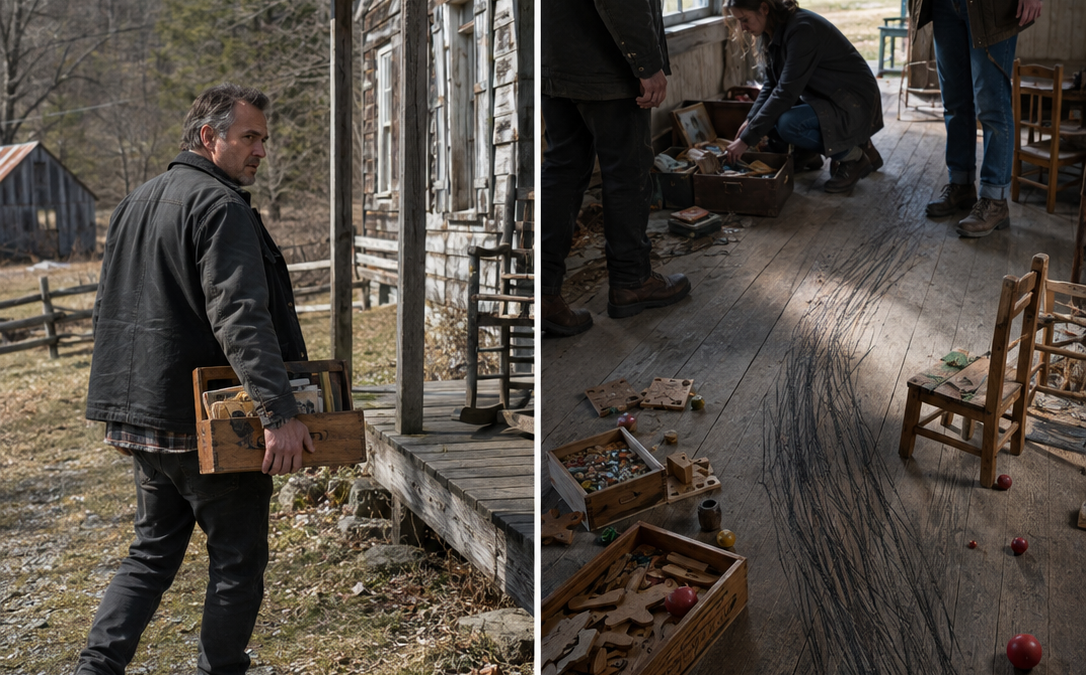
I bought a neglected farmhouse twelve miles outside Bellweather, surrounded by forty acres of woods and abandoned pasture. The house had a wide porch, a stone fireplace, a basement, and more dark corners than any sensible person would want.
For the Hollow Friend, it was perfect.
I converted an old dining room into a playroom.
Shelves filled with puzzles, wooden trains, balls, cards, blocks, string games, mechanical toys, and boxes within boxes.
The creature loved doors.
So I built miniature doors into walls.
Some opened into cabinets.
Some into empty compartments.
One opened onto nothing but another smaller door.
That became its favorite.
I never became rich.
Occasionally I used a carefully worded reward for something practical: enough money to repair the roof, a healthy vegetable harvest, a broken furnace restored without harming anyone.
I stopped asking for anything extravagant.
Experience had taught me that every unnecessary desire created another opportunity for disaster.
Years passed.
The children grew up.
Caleb became a physical therapist.
Sadie became an attorney.
Jonah opened a small woodworking shop.
Mia Lawson became an elementary teacher.
She visited me when she was twenty-nine.
By then my hair was completely gray and the Hollow Friend appeared almost every night.
We sat on the porch while something moved furniture inside.
Mia listened for several minutes.
“You knew something about Ethan,” she said.
I did not answer.
“I always knew.”
After all those years, I finally told her.
Not every detail.
Enough.
I told her Ethan had returned briefly because of my selfish wish, that he had been terrified, and that I sent him back because keeping him would have caused more suffering.
Mia cried quietly.
Then she asked the question I had feared for sixteen years.
“Was he scared when he left?”
I remembered his face.
“Not at the very end.”
I told her what he had asked me to say.
Mia covered her eyes.
“Thank you.”
“For what?”
“For telling me now instead of when I was eleven.”
From inside came a crash.
A pale hand slid beneath the front door and rolled a red rubber ball onto the porch.
Mia stared.
“So that’s it.”
“Yes.”
The hand waited.
Mia picked up the ball.
“You’re not supposed to refuse, right?”
“Usually.”
She rolled it back.
The hand caught it.
A strange delighted laugh echoed inside the house.
Mia smiled despite herself.
“It’s awful.”
“Yes.”
“And lonely.”
I looked at her.
That was exactly what I had eventually concluded.
The Hollow Friend was dangerous because it possessed extraordinary power without understanding compassion, mortality, grief, or the difference between pleasure and pain. It did not hate children.
It simply loved them in the way a child might love a fragile toy too much.
That did not make it innocent.
But it made the problem understandable.
As I grew older, former students began leaving boxes at my gate every Christmas.
Puzzles.
Balls.
Model kits.
Card games.
Wooden figures.
Nobody stayed after sunset.
Their children never knew why.
They only knew an old teacher lived in the woods and liked toys.
Cedar Ridge Elementary was eventually renovated.
Workers tore out my old supply cabinet and found dozens of drawings hidden behind it.
Long fingers.
Dark doorways.
A smiling shape beneath desks.
And children sitting far apart.
The construction crew assumed they were drawings from some old classroom game.
My students knew better.
I am seventy-three now.
The Hollow Friend has not aged.
Its fingers remain pale and smooth.
Its laughter still sounds like children whispering through heating vents.
Some nights I wonder what will happen when I die.
I never ask aloud.
Perhaps it will follow me through the thin place.
Perhaps it will finally choose somebody else.
Perhaps it will discover that even monsters can learn loneliness.
Tonight, I am sitting beside the fireplace while snow gathers against the windows.
A half-finished puzzle rests on the coffee table.
There are exactly three pieces missing.
I know I placed them there this morning.
Something scratches beneath my chair.
A pale hand appears, holding one of the missing pieces.
It places the piece confidently into the wrong space.
I stare at it.
“That doesn’t go there.”
The fingers freeze.
I immediately regret the sentence.
Then the hand steals three more pieces and disappears under the couch.
A giggle fills the room.
I laugh.
The Hollow Friend laughs louder.
And thirty miles away, in homes scattered across Bellweather and beyond, the children who once sat apart from one another tuck their own sons and daughters into bed without checking beneath the mattress.
They do not hear scratching.
They do not wake to pale fingers.
They do not learn rules for surviving seven terrible nights.
Whatever happens to me next, that was the bargain.
And I would make it again.
The End. This story is entirely fictional and was created for entertainment purposes. All characters, names, locations, events, and situations depicted in this story are imaginary. Any resemblance to actual people, organizations, places, or events is purely coincidental.








