For Forty Years Mom Left Food by the Woods, but When My Brothers Tried Selling Her Farm, Something Huge Appeared Outside Her Window
For Forty Years Mom Left Food by the Woods, but When My Brothers Tried Selling Her Farm, Something Huge Appeared Outside Her Window
Part 1: The Plate Beneath the Hemlock
For forty-one years, my mother carried a plate of food to the same old hemlock tree at the edge of our family farm every evening, and for forty-one years nobody ever saw her bring that plate back with anything left on it. By sunrise it would be empty, sitting neatly beside the roots as if whoever came during the night understood that even mysteries should leave a kitchen dish where they found it.
My mother’s name was Eleanor Whitaker, and at seventy-seven she still lived alone at Cedar Hollow Farm, a weathered 112-acre property tucked against the wooded ridges of western Virginia. The farmhouse had a stone chimney, a wide porch worn smooth by four generations, a red barn leaning slightly toward the creek, and a view of dark mountain timber that became almost black after sunset.
My father, Henry, bought the place with Eleanor in 1969, when neither of them had enough money to buy new furniture but somehow believed one hundred acres of neglected land was a sensible beginning. They raised cattle, planted sweet corn, repaired fences with whatever wire was available, and eventually raised four children who all learned that nothing on a farm stays fixed simply because you fixed it yesterday.
I was the youngest.
My name is Rebecca Whitaker, and by the time this happened I was forty-six, divorced, and working as a registered nurse at a small hospital thirty miles away. I lived close enough to check on Mom several times a week, while my siblings had all moved far enough away to describe the farm as sentimental until somebody mentioned what the timber might be worth.
The plate had been part of my childhood for as long as I could remember.
Every evening Mom put leftovers on it, usually biscuits, potatoes, vegetables, sometimes venison stew, and on Sundays a thick slice of whatever pie she had baked. She carried it past the chicken run, crossed the lower field, and placed it beneath the massive hemlock roughly sixty yards inside the tree line.
When we were children, we assumed she was feeding a stray dog.
Later my brother Travis insisted it was probably a raccoon that had somehow trained our mother.
By adulthood, he called it “Mom’s woodland pension plan.”
“You know she has probably fed six generations of possums by now,” he would say at Thanksgiving, making everyone laugh while Mom calmly spooned gravy onto her plate.
She never defended herself.
That silence made the ritual stranger.
One autumn night when I was fourteen, curiosity finally defeated fear, and I waited behind the upstairs curtains until Mom returned from the woods. Around midnight, after the moon had disappeared behind low clouds, the chickens became suddenly quiet.
Then came three heavy knocks from the woods.
Not gunshots.
Not branches breaking.
Three deliberate impacts against wood, spaced several seconds apart.
I crept downstairs and looked through the kitchen window.
Something was standing beneath the hemlock.
At first I thought it was a bear, but then it straightened.
The figure was taller than any man I had ever seen, with shoulders wide enough to make the tree trunk behind it look narrow and arms hanging unusually low beside its body. Thick dark hair covered most of it, silver showing faintly around the upper chest, and one enormous hand was holding Mom’s plate.
It looked toward the house.
I ducked so fast I hit my chin against the windowsill.
The next morning I told Mom.
She was frying eggs.
She did not drop the spatula, laugh, or ask whether I had dreamed it.
Instead, she turned off the burner.
“Did it come toward the house?”
“No.”
“Did it hurt anything?”
“No.”
“Then leave it alone.”
I stared at her.
“What is it?”
Mom looked toward the woods.
“I don’t know what it calls itself.”
That sentence stayed with me for thirty years.
After Dad died from a heart attack while repairing the hay baler, Mom refused every suggestion that she move into town. Travis went into real estate development outside Richmond, my sister Carolyn married an accountant and moved north, and my brother Dean settled several states away after taking a management job.
I remained the closest.
Something changed after Dad’s death.
The visitor began leaving things behind.
Wild blackberries appeared beside the empty plate in summer.
Morel mushrooms rested on broad leaves in spring.
Once there were polished stones arranged in a circle.
Another time Mom found a small deer antler beside a cluster of mountain laurel blossoms, and she carried those flowers to Dad’s grave without explaining where they came from.
The arrangement seemed almost absurd until you saw her face.
She was not feeding a pet.
She was maintaining a friendship whose rules had been established long before any of us children were old enough to understand them.
Everything remained peaceful until Travis learned that a timber company had been purchasing logging rights throughout the county.
He arrived one Friday afternoon in an expensive SUV with a forestry consultant named Russell Pike.
They walked the upper ridge for two hours.
When they returned, Travis looked happier than he had looked at our farm in twenty years.
“There’s at least seven hundred thousand dollars standing up there,” he announced over dinner.
Mom stopped cutting her chicken.
“No.”
Travis laughed.
“You didn’t even hear the proposal.”
“You said timber.”
“We thin the upper acreage, keep the farmhouse and pasture, and everybody gets something before the property becomes impossible to maintain.”
“It isn’t yours to sell.”
“Dad left it to the family.”
“Your father’s will gave me lifetime control.”
Travis leaned back.
“You’re seventy-seven.”
Mom looked directly at him.
“I noticed.”
Carolyn, who had joined the meeting after Travis promised everyone a potentially large payout, folded her arms.
“Mom, nobody is saying you have to leave.”
“You’re talking about cutting the ridge.”
“Trees grow back.”
Mom’s voice hardened.
“Not everything living there does.”
Travis gave a tired smile.
“Oh, please don’t tell me this is about your nighttime visitor.”
He stood, walked toward the kitchen counter, and picked up the blue enamel plate Mom had prepared.
I knew what he was going to do before he moved.
“Travis, don’t.”
He ignored me.
He carried the plate outside, crossed the yard, and threw it against the stone retaining wall.
The enamel chipped and the plate bent nearly in half.
“There,” he said. “Maybe now we can stop letting a fairy tale dictate what happens to a valuable piece of property.”
Mom stared at the damaged plate.
Then she looked at her oldest son.
Her expression contained no anger.
That made it worse.
“You didn’t break a habit,” she said quietly. “You broke a promise you were never important enough to hear.”
Part 2: The Winter Nobody Came to Help
Two weeks later, Mom developed pneumonia.
I found her sitting near the woodstove wrapped in Dad’s old wool blanket, coughing so hard she could barely speak. Her fever was high, her breathing was shallow, and for the first time in my life she did not argue when I called the doctor.
He wanted her hospitalized.
She refused.
“Travis is trying to get paperwork signed,” she whispered after he left. “I’m not leaving this house empty.”
I called my siblings.
Dean said he was buried at work.
Carolyn said she could come the following weekend.
Travis said Mom was being dramatic because the timber discussion had upset her.
“She needs someone here overnight,” I told him.
“Then hire somebody.”
“She is your mother.”
“She’s the one who insists on living in the middle of nowhere.”
I closed my eyes.
“She could get worse.”
His answer arrived after a long pause.
“If she trusts the woods so much, maybe the woods can take care of her.”
I hung up.
For three days I drove between work and Cedar Hollow, sleeping on Mom’s couch whenever I could and arranging medications in labeled containers on the kitchen table. She became too weak to walk farther than the bathroom.
For the first time in forty-one years, no plate went beneath the hemlock.
On the fourth morning, Mom woke to a scraping sound outside the kitchen.
A light snow had fallen overnight.
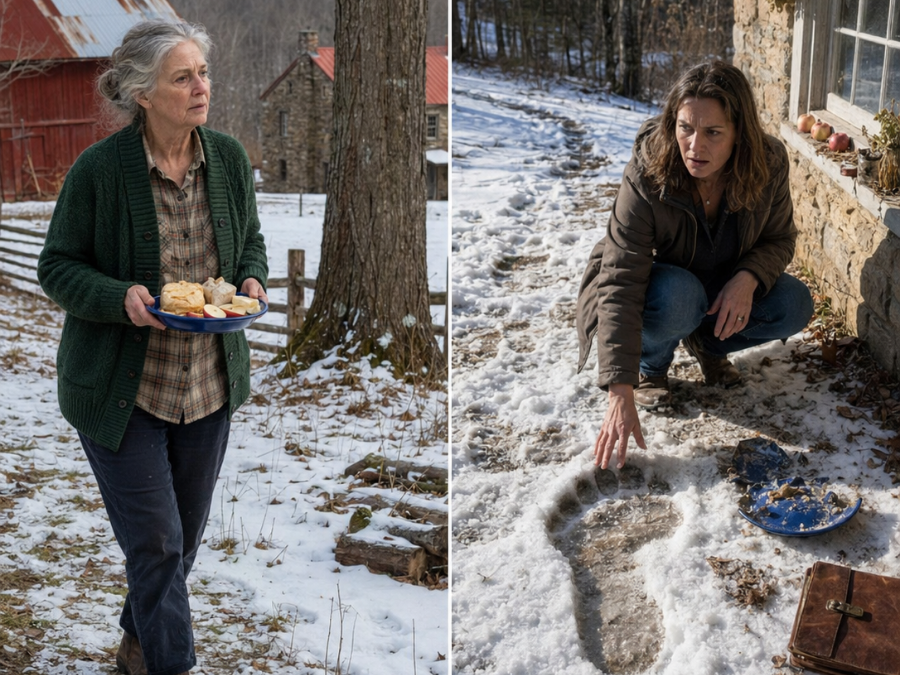
When she reached the window, she found apples, roots, black walnuts, and a bundle of dried herbs arranged carefully across the outside sill.
Beneath the window were two enormous footprints.
They crossed the entire snowy yard from the forest.
Each print was nearly eighteen inches long.
Five distinct toes pressed deep into the snow.
Nothing had ever crossed the field before.
The hemlock had always been the boundary.
I arrived that afternoon and found Mom sitting beside the window staring at the tracks.
“He came looking for you,” I whispered.
She smiled weakly.
“He noticed.”
The thought shattered something in me.
Three adult children had been told she was sick and found reasons not to come.
Something in the forest noticed because one plate failed to appear.
The herbs turned out to be familiar mountain plants used traditionally for soothing coughs, though I made sure Mom continued every medication prescribed by her physician. She drank a mild tea from one bundle and slept six uninterrupted hours for the first time that week.
Travis arrived the following morning.
He carried a leather document folder.
Not groceries.
Not medicine.
Documents.
“I need you to sign something while we get the preliminary survey underway.”
Mom remained seated.
“No.”
“It isn’t a sale.”
“No.”
“It just authorizes evaluation.”
“No.”
His face tightened.
“You could die this winter.”
Mom looked at him.
“And that makes today convenient?”
Travis looked toward me.
“What have you been telling her?”
I took the folder from the table.
“She’s sick. Leave her alone.”
“You don’t control this family.”
“Neither do you.”
Carolyn arrived fifteen minutes later and immediately began crying because Travis had promised her enough money to erase two years of debt. She sat beside Mom and begged her to “think about everyone’s future.”
Mom pointed toward the window.
“Something came through that snow because I missed three nights.”
Travis followed her gesture.
He stared at the footprints.
For one second his face changed.
Then contempt returned.
“Rebecca made those.”
“I worked twelve hours yesterday.”
“Then some neighbor did.”
Mom coughed violently.
I moved toward her.
Travis picked up one of the apples from the sill.
He rolled it in his palm.
Then he tossed it into the stove.
Mom tried to stand.
Her legs failed.
I caught her.
She looked at Travis from my arms.
“Get out.”
He laughed nervously.
“Mom—”
“Get out of my house.”
Carolyn began sobbing.
“You’re choosing some animal over your own children?”
Mom’s answer came quietly.
“No. I’m choosing the one who came because I was weak over the ones who came because they thought weakness meant I might sign something.”
That was the day Travis stopped trying to persuade her.
And started trying to prove she was mentally incompetent.
Part 3: My Brother Decided the Secret Was Worth More Alive
Travis contacted attorneys, doctors, and eventually a private evaluator, claiming Mom’s stories about a creature in the woods proved cognitive decline. Every professional who actually interviewed her found the same thing: Eleanor Whitaker was physically frail, sharp-minded, stubborn, and perfectly capable of deciding what happened to her property.
Then Travis changed strategies.
If the creature existed, he wanted to monetize it.
I found the first trail camera strapped to an oak near the hemlock.
The second was hidden behind brush.
The third disappeared before I could locate it.
Dean finally admitted Travis had been talking to a streaming production company about selling exclusive footage.
“He says if it’s real, the story is worth more than the timber,” Dean told me.
I nearly dropped the phone.
“He spent his whole life calling Mom crazy.”
“He doesn’t anymore.”
That was somehow worse.
Three nights later, dogs began barking from neighboring farms.
I stepped outside with a flashlight and saw vehicles parked near our lower gate.
Travis was there.
So was Russell Pike.
Two other men were unloading floodlights, bait containers, a reinforced cage trap, and several heavy cables.
“What are you doing?”
Travis turned.
“Go inside.”
“This is Mom’s property.”
“It’s family property.”
“She told you no.”
Russell lifted both palms.
“We aren’t hurting anything. We just want a clear image.”
I looked at the trap.
“That isn’t a camera.”
Nobody answered.
Then a branch snapped behind them.
The men froze.
A smell drifted through the cold air, damp bark, soil, wet fur.
Something moved beyond the hemlock.
Travis raised his phone.
The floodlight clicked on.
The figure stood there.
It was enormous.
Nearly eight feet tall, covered in dark brown hair, streaked silver across one shoulder, with a face that was neither human nor anything I could comfortably name. Its eyes moved first to the cage.
Then to Travis.
Then toward Mom’s bedroom window.
Nobody breathed.
Travis whispered, “I have it.”
The creature bent.
It lifted a stone large enough that Russell took an involuntary step backward.
Instead of throwing it, the creature placed the stone on top of the empty cage.
Metal groaned.
The upper bars bent.
One of the hired men dropped a cable.
The other ran.
Russell followed him.
Travis remained frozen, still holding the phone.
The creature struck its chest once.
The sound rolled through the ground.
Travis finally ran.
I did not.
I could not.
The creature walked to the hemlock.
Beside the roots were the broken remains of Mom’s old enamel plate, which she had refused to throw away.
It placed a bundle of mushrooms beside them.
Then it looked at me.
One long arm lifted.
It pointed toward the house.
Mom.
I ran.
She was on the bedroom floor.
Conscious.
Barely.
I called an ambulance while she clutched my sleeve.
Behind the farmhouse, three knocks echoed through the trees.
Mom spent six nights in the hospital.
Travis arrived the next morning.
He did not ask how she was.
He showed me the video.
Even on the small screen, the creature was unmistakable.
“This changes everything,” he whispered. “People would pay thousands just to visit this place.”
“Delete it.”
He stared at me.
“You’re insane.”
“Delete it.”
“We could make millions.”
“That’s exactly why Mom protected it.”
He smiled coldly.
“You don’t get to decide.”
I learned later that he had already emailed still frames to a production company and signed a preliminary agreement promising access to Cedar Hollow Farm.
There was only one problem.
He had claimed to be the property’s legal owner.
Mom was furious when she learned.
Not frightened.
Not surprised.
Furious.
From her hospital bed, she called an estate attorney named Patricia Lang.
“If Travis wants the whole family involved,” Mom said, “then let’s make sure the whole family hears exactly what he tried to sell.”
Part 4: The Dinner When the Woods Answered for Her
Mom returned home thirteen days later.
She was thinner and moved slowly, but she insisted on holding Dad’s annual memorial supper, something we had done every October since his death. She invited all four children, several grandchildren, two neighbors, Patricia, and, without my knowledge, Russell Pike.
Travis arrived believing the gathering would become his final negotiation.
He brought contracts.
Projected earnings.
Maps.
He wore a new quilted jacket and the satisfied expression of a man who thought money had finally made every objection irrelevant.
Dinner was served on the screened back porch because the evening was unusually mild.
There was roast chicken, mashed potatoes, green beans, biscuits, apple cobbler, and sweet tea in a heavy glass pitcher Dad had bought before any of us were born.
When everyone finished eating, Travis stood.
“It’s time we stop avoiding reality.”
Patricia opened her briefcase.
“I agree.”
Travis smiled.
She removed several documents.
“Mr. Whitaker, you signed a commercial access agreement representing yourself as sole owner and authorized manager of Cedar Hollow Farm.”
His smile faded.
“I’m an heir.”
“You are neither current owner nor administrator.”
Russell shifted in his chair.
“You told us everything was cleared.”
Travis looked at Mom.
“She isn’t capable of handling this anymore.”
Mom slowly stood.
I reached toward her.
She waved me away.
“For months,” she said, “you called me crazy because I said something lived beyond that hemlock.”
Travis’s jaw tightened.
“Then you saw it.”
Nobody moved.
“And instead of admitting I had protected something for a reason, you decided your mother’s secret was another asset you could sell.”
“It could change our lives.”
“It already changed mine.”
Travis slapped one palm against the table.
“You fed an animal for forty years. That doesn’t make it sacred.”
Mom looked at him.
“You still think the food was payment.”
“What else was it?”
“Kindness.”
He scoffed.
Mom’s eyes filled with sadness.
“That’s why you never understood.”
Patricia placed another document on the table.
Mom had created a conservation trust.
After her death, more than seventy acres of forest would remain permanently protected from commercial logging, hunting leases, development, filming operations, organized tours, or wildlife capture. The farmhouse and pasture would remain available to family members willing to maintain the land under those conditions.
Travis stared at her.
“You’re giving away our inheritance.”
“I’m protecting it from becoming something ugly.”
“You’re doing this because of a monster.”
The chickens stopped making noise.
Every person on the porch noticed.
Then came three knocks.
Slow.
Heavy.
From the woods.
Russell stood.
Carolyn grabbed Dean’s wrist.
Travis turned toward the tree line.
The creature stepped from behind the hemlock.
Late sunlight touched the silver hair across its chest.
It remained at the edge of the forest.
Visible to everyone.
Nobody screamed.
Mom picked up a new blue enamel plate.
I had bought it for her after she came home.
On it were two biscuits, sliced apples, cheese, and a piece of cobbler.
She started walking.
“Mom,” Carolyn whispered.
Mom continued.
The creature watched her approach.
She set the plate beneath the hemlock.
Then it placed something on the ground.
A bundle wrapped in large leaves.
Mom opened it.
Inside were wildflowers and a smooth gray stone streaked with white quartz.
Dad used to collect stones exactly like that from the creek.
Mom covered her mouth.
She began to cry.
The creature lowered its head.
Travis raised his phone.
I took it from his hand.
“Give that back.”
“No.”
He reached toward me.
Dean stepped between us.
“That’s enough.”
Travis stared at his brother.
“You too?”
Dean’s voice was quiet.
“She almost died, Trav. You cared more about the deed.”
Carolyn stood.
“So did I.”
Her face crumpled.
“I’m ashamed of that.”
Russell gathered his documents.
“Our company is withdrawing.”
Travis spun toward him.
“You already paid me.”
“For access you didn’t legally control.”
The creature stepped forward once.
Travis stopped talking.
For the first time in my life, my oldest brother looked powerless.
Not because the creature threatened him.
Because nothing he had built his identity around could control what stood before him.
Not money.
Not paperwork.
Not intimidation.
Mom returned to the porch.
The creature lifted the plate.
Then it disappeared into the trees.
Mom sat down.
She looked at her children.
“When I was too sick to cross the field, that creature walked all the way to my window because it noticed I was missing.”
Nobody spoke.
“You were all waiting to see what my illness meant for the farm.”
Her voice broke slightly.
“It came because it wondered what my illness meant for me.”
That was the moment the argument ended.
Part 5: What Stayed After Mom Was Gone
Travis spent the next year untangling the contract he had signed.
He returned the advance and paid legal fees from his own savings, while Patricia amended the trust so nobody could commercialize the location, images, or identifying landmarks connected to whatever lived beyond the hemlock.
Carolyn came back first.
She brought groceries.
Then curtains.
Then nothing at all except time.
Dean began driving up once a month to repair fencing and handle heavier chores.
Nobody became suddenly perfect.
That would have been easier than what actually happened.
They became embarrassed adults trying to behave better than they had behaved before.
Travis stayed away.
Almost eleven months passed.
Then one rainy morning he appeared carrying a new enamel plate.
Mom was seated beside the kitchen stove.
He placed it on the table.
“I deleted everything.”
She looked at him.
“Everything you had?”
“Yes.”
“Why?”
He sat down.
“The production people wanted to bring drones.”
Mom’s expression hardened.
“And tracking dogs.”
She closed her eyes.
“They said if they cornered it, they could get better footage.”
The silence stretched.
Travis stared at his hands.
“I finally understood what I was helping them do.”
Mom did not comfort him.
Good mothers sometimes understand that comfort can arrive too early.
“I thought if I could make enough money,” Travis continued, “everyone would stop seeing me as the son who never built anything as good as Dad did.”
Mom looked almost surprised.
“Your father never asked you to become him.”
“I did.”
His voice broke.
Then he said the hardest thing.
“When you were sick, part of me thought if you died, the property problem would be solved.”
I watched Mom absorb the confession.
No yelling.
No dramatic forgiveness.
Only truth.
“That was a terrible thing to think.”
“I know.”
“I don’t trust you yet.”
“I know.”
He touched the new plate.
“Can I put this under the tree?”
Mom shook her head.
“Not yet.”
Travis swallowed.
“Okay.”
“You still think bringing food means you deserve something back.”
He looked down.
“What do I do?”
“Help because help is needed.”
So he did.
For months Travis repaired fences, cleaned gutters, hauled feed, and drove Mom to appointments.
He never mentioned the trust.
One evening she finally handed him the plate.
“Walk out there.”
His eyes widened.
“What do I do if I see it?”
“Nothing.”
“What if it comes toward me?”
“It won’t if you behave.”
He almost smiled.
He placed biscuits, apples, and cheese beneath the hemlock.
Then he walked back without hiding behind a tree or setting up a camera.
The next morning the plate was empty.
A pinecone rested in its center.
Travis brought it inside.
He did not say a word.
Mom smiled.
Two winters later, her health failed again.
This time none of us told ourselves someone else would handle it.
We created a schedule.
Carolyn stayed weekends.
Dean took Fridays.
Travis handled appointments and groceries.
I managed medications.
Mom remained at Cedar Hollow because that was what she wanted.
On some nights, something large walked along the edge of the yard.
We never followed.
During the last week Mom could still walk outside, she asked me to help her reach the hemlock.
She carried the plate herself.
Her hands shook badly.
Two biscuits.
Potatoes.
Cheese.
An oversized slice of apple pie.
“You’re spoiling him,” I said.
Mom smiled.
“I’m old enough.”
She placed the plate beneath the tree.
Then she rested one palm against the bark.
“I might not make it tomorrow,” she said toward the woods.
My throat tightened.
“But someone will keep bringing supper.”
Nothing moved.
Then the familiar earthy smell drifted through the trees.
The creature appeared.
It looked older.
There was more gray across its shoulders.
Its movements were slower.
Mom raised one hand.
The creature raised its hand too.
They remained separated by several yards.
They never touched.
They did not need to.
Mom died three weeks later with all four children beside her.
Her final request was simple.
“Don’t turn the woods into a cage.”
We didn’t.
Cedar Hollow still belongs to the family trust.
The upper ridge has never been logged.
No cameras are permitted near the hemlock.
No tours.
No traps.
No invitations to strangers looking for proof.
Travis carries the plate most evenings now.
Sometimes it remains untouched.
Sometimes it is empty before dawn.
Occasionally something is left behind: walnuts, mushrooms, polished stones, flowers.
On the first anniversary of Mom’s death, I arrived at Cedar Hollow shortly after sunrise.
Wildflowers were resting on the kitchen windowsill.
The same kind the creature had brought her during the family dinner.
In the damp earth below the window were two enormous footprints.
They came from the woods.
And returned to them.
I carried the flowers to Mom’s grave.
Carolyn was already there.
Dean arrived next.
Then Travis walked up carrying the old blue plate.
Nobody asked where the flowers came from.
We had finally learned the lesson our mother spent forty-one years trying to live rather than explain.
Not everything must be possessed to matter.
Not everything extraordinary needs an audience.
And not every relationship is valuable because of what it can produce.
For years, we thought Mom was feeding something that lived in the forest.
Only after losing her did we understand that the exchange had never been about food.
After Dad died, it gave her companionship.
During sickness, it gave her reassurance.
During the ugliest fight our family ever had, it reminded her that loyalty can come from unexpected places.
We were her children.
But there was a winter when three of us waited to see what her weakness might give us.
Something beyond the hemlock noticed only that she was missing.
That difference changed all of us.
And every winter morning when fresh tracks appear near the old kitchen window, we remember the promise that began before any of us understood it.
Leave the plate.
Respect the woods.
And when someone you love cannot make the walk they have always made, do not wait for them to ask.
Cross the snow.
The End. This story is entirely fictional and was created for entertainment purposes. All characters, names, locations, events, and situations depicted in this story are imaginary. Any resemblance to actual people, organizations, places, or events is purely coincidental.








