My Sister Barred Me From Her Husband’s Promotion, Not Knowing Why The Admiral Kept Glancing At Me
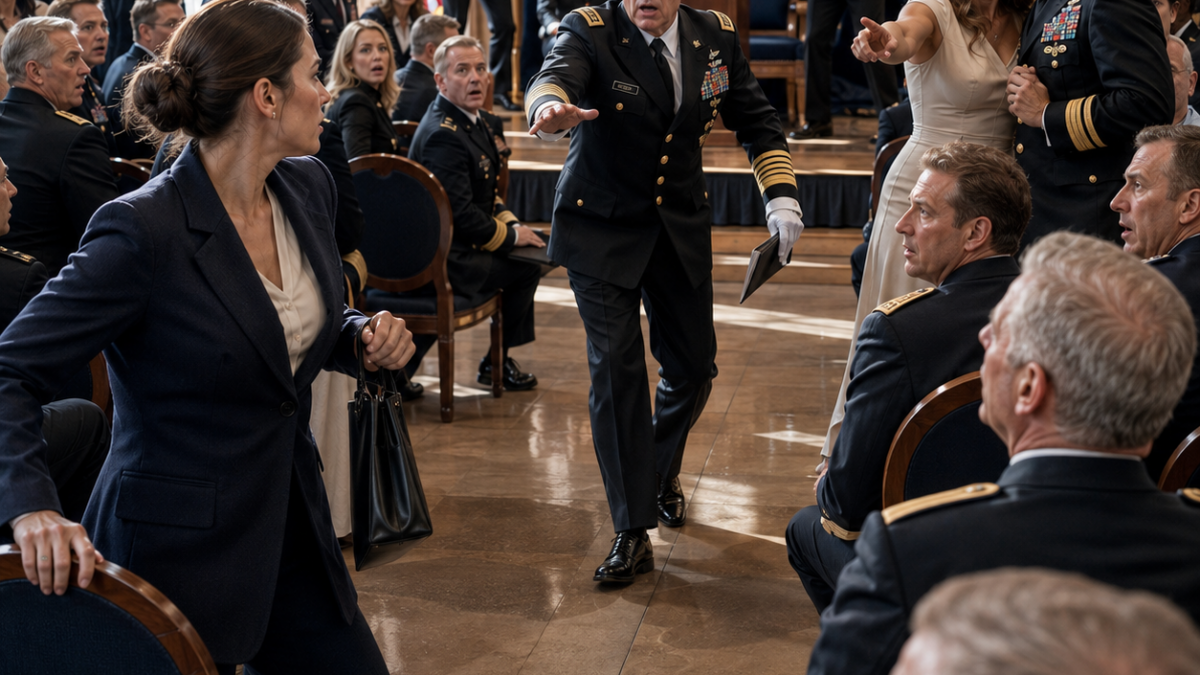
My Sister Barred Me From The Family Row At The Promotion. “You Embarrass Him. Sit Where No One Has To See You.” Thirty Officers Filled The Hall. I Sat At The Back. On The Dais, The Admiral Kept Losing His Place, Glancing At Me Between Every Line. Then He Stepped Down To Me.
### Part 1
My sister leaned close enough that I could smell the sharp floral perfume she always wore to important events.
“You embarrass Grant,” Melissa whispered. “Sit in the back where no one has to see you.”
Her fingers were wrapped around my forearm.
Not hard enough to hurt.
Hard enough to make the message clear.
Behind her, our parents were already settling into the reserved family row inside the Navy ceremonial hall. Officers in dress uniforms filled the room beneath high white ceilings. American flags stood beside the dais, brass fixtures caught the afternoon light, and polished shoes made soft taps across the floor.
My brother-in-law, Grant Holloway, stood near the front waiting to be promoted to commander.
And I stood beside my younger sister like an unwanted delivery she needed removed before the photographs started.
I was forty-five years old.
I had served twenty-three years in the United States Navy.
Melissa knew the first fact.
She had somehow convinced herself the second barely counted.
I looked down at her hand on my arm.
“Melissa.”
“What?”
“Let go.”
She released me immediately, but her smile stayed in place because people were watching.
“I’m just trying to make today about Grant.”
“So am I.”
“Then please don’t make this difficult.”
There it was.
The sentence that had controlled most of my relationship with my family.
Don’t make this difficult.
When Melissa broke a lamp as a child, I explained it to Dad.
When she was afraid during thunderstorms, she crawled into my bed.
When our father lost his job and the house became so quiet that every cabinet closing sounded too loud, I made breakfast for Melissa before school and told her everything would be fine.
I was twelve.
She was nine.
I was terrified too.
I simply decided there wasn’t room in the house for both of us to show it.
That became my role.
Claire Dawson, the strong one.
Claire didn’t need attention.
Claire didn’t need reassurance.
Claire could handle herself.
At twenty-two, I joined the Navy.
My mother cried.
My father shook my hand.
Melissa stood near the driveway with her arms folded and an expression I spent decades calling contempt.
During the years that followed, I learned how comfortable invisibility could become.
At sea, nobody cared whether I was charming.
Nobody cared whether my shoes were fashionable or whether I remembered birthdays.
They cared whether I knew my job.
I did.
I learned ships by sound—the change in a generator’s hum, the wrong vibration under a deck plate, the difference between ordinary metal strain and something that should make you move now and ask questions later.
I learned people the same way.
Fear had a sound.
Panic had a smell.
Leadership sometimes meant giving an order.
More often, it meant being the person whose voice did not change when everyone else’s did.
I became very good at that.
Back home, though, Melissa built a completely different version of me.
“My sister’s in the Navy too,” she told people after marrying Grant. “Sort of.”
At their wedding, she laughed while introducing me to his relatives.
“Grant has the real career.”
I had already commanded people at sea.
I had held responsibilities Grant had not reached yet.
I said nothing.
Not because I was ashamed.
Because correcting Melissa in front of everyone felt like taking something away from her.
That was how I justified it.
Humility.
Family peace.
Maturity.
What I did not call it was fear.
The fear that if I took up my proper amount of space, my little sister would somehow lose hers.
So when she sent me to the back of the promotion hall, I did what I had done since I was twelve.
I went.
I chose a chair near the doors.
Alone.
The ceremony began.
A chaplain spoke. Orders were read. Grant stood straight beneath the bright lights while Melissa watched him with both hands folded proudly in her lap.
Then I looked toward the officer presiding over the ceremony.
Vice Admiral Thomas Hale.
Three stars.
Silver hair.
A face eleven years older than the last time I had seen it.
My stomach tightened.
For one second, I smelled something that wasn’t in the hall at all.
Salt water.
Fuel.
Burned electrical insulation.
And I heard metal scream in the dark.
Admiral Hale looked down at his notes.
Then up.
His eyes moved across the audience.
Past the family row.
Past Melissa.
Past my parents.
All the way to the back.
To me.
His expression changed.
I lowered my eyes.
When I looked up again, he was still staring.
And for the first time that afternoon, I realized my sister had made one terrible mistake.
She had worried about who might notice me.
She had never considered who might already know exactly who I was.
### Part 2
Vice Admiral Hale missed a line.
Most civilians would not have noticed.
Every officer in that hall did.
Ceremonies run on rhythm. Everyone knows where to stand, when to speak, when to move. The structure is part tradition, part discipline.
Hale had probably presided over more promotions than I could count.
Yet he stopped halfway through a sentence and looked toward the back again.
Toward me.
His aide shifted slightly.
Grant’s eyes flicked up.
Melissa still didn’t notice.
She was smiling at her husband.
I wished Hale would look away.
That probably sounds ridiculous.
A three-star admiral recognized me after eleven years, and my first instinct was to hope he would forget.
But I had spent decades making myself smaller around my family.
Being suddenly dragged into focus felt less like victory than exposure.
Eleven years earlier, I had been aboard a Navy vessel operating in dark water when another ship suffered a catastrophic collision.
I still remembered the sound before anything else.
Steel striking steel produces a noise too large for your ears. You feel it inside your teeth.
Then came alarms.
Boots pounding.
Voices over communications.
The deck shifting just enough beneath my feet to tell me something was badly wrong.
The damaged ship was taking water fast.
Men were trapped below.
Conditions deteriorated by the minute.
People have called what happened afterward heroic.
It never felt heroic.
It felt like arithmetic.
If we waited, people died.
If we moved immediately, some might not.
I was the senior person in position to act.
So I acted.
I organized boats.
Redirected personnel.
Went where I needed to go.
Made decisions I had no time to be frightened about.
At one point, water was coming into a compartment where it had no business being, rising dark around equipment and loose objects.
Vice Admiral Hale wasn’t an admiral then.
He was the senior officer aboard that stricken vessel.
And for one terrible stretch of time, I thought we were going to lose him along with everyone still trapped below.
We didn’t.
Everyone we could reach came out.
Hale came out.
The ship did not.
Later there were reports.
Investigations.
Statements.
A medal arrived in a box.
I put the box in a drawer.
When I came home, my mother asked how deployment had gone.
“Fine,” I said.
Melissa asked whether anything exciting had happened.
“Not really.”
Then we ate dinner.
For eleven years, nobody in my family knew.
I told myself I was protecting them.
Maybe partly I was.
But sitting at the back of that hall while Admiral Hale stared at me, I began to suspect another reason.
Telling them would have required allowing myself to become important in a room where I had spent my life making sure Melissa felt important.
At the front, Hale reached the end of a paragraph.
Stopped.
Set his notes on the lectern.
My spine went rigid.
No.
He stepped away from the microphone.
His aide looked confused.
Grant turned slightly.
Melissa finally noticed.
Vice Admiral Hale walked down from the dais.
The hall became so quiet I could hear the faint hum of the ventilation system.
He started up the center aisle.
One measured step after another.
Heads turned.
People followed him with their eyes.
My mother looked over her shoulder.
Dad did too.
Melissa’s smile disappeared.
I remained seated until Hale was perhaps ten feet away.
Then training took over.
I stood.
He stopped directly in front of me.
For a moment neither of us said anything.
Eleven years passed between us without needing explanation.
Then his mouth tightened as if he were trying not to show too much emotion.
“Captain Dawson.”
The title seemed to hit the room physically.
Somebody behind Hale inhaled sharply.
My mother stared at me.
Grant looked as though someone had changed the language everyone was speaking.
Melissa went completely still.
Hale extended his hand.
I took it.
“I wondered if it was you,” he said quietly.
“Yes, sir.”
“I’ve been looking for an opportunity to say something to you for eleven years.”
“You don’t owe me anything.”
His grip tightened.
“That is where you have always been wrong.”
Then he turned.
Not toward me.
Toward the entire hall.
And suddenly I knew what he was about to do.
For the first time in a very long career, standing in front of a superior officer, I almost wanted to disobey.
I wanted to tell him not to say it.
Not here.
Not in front of Melissa.
But Hale was already facing the room.
“Before we continue,” he said, “there is an officer in this hall whose presence requires acknowledgment.”
Melissa’s face drained of color.
And the secret I had protected for eleven years was no longer mine to keep.
### Part 3
Vice Admiral Hale did not raise his voice.
He didn’t need to.
“Eleven years ago,” he said, “I was aboard a vessel that suffered a collision at sea.”
No one moved.
“The flooding exceeded our ability to control it. Several sailors were trapped. We were losing the ship.”
He turned slightly toward me.
“Captain Claire Dawson was serving aboard the vessel that responded.”
My mother covered her mouth.
I kept my arms at my sides.
“She did not wait for someone else to solve the problem. She organized the rescue under conditions that would have justified hesitation from almost anyone.”
I could feel Melissa watching me.
I refused to look at her.
“She brought sailors out of spaces we believed we would lose. She coordinated the evacuation while the situation continued to deteriorate.”
Hale paused.
“I was one of the men who came off that ship alive.”
A strange pressure filled my chest.
Not pride.
Not exactly.
Memory.
Black water reflecting emergency lights.
A sailor coughing against my shoulder.
Hands slick with seawater.
Someone yelling that we had another man still inside.
The awful weight of responsibility when nobody above you can reach the problem fast enough and you realize that, for these few minutes, you are the answer whether you feel ready or not.
Hale continued.
“I have entered hundreds of rooms since that night. I have looked for her in more of them than she probably realizes.”
Then he smiled faintly.
“Apparently, Captain Dawson prefers the back row.”
A few people laughed softly.
I did not.
Neither did Melissa.
“I am alive because she did her job when doing that job demanded extraordinary courage.”
He looked directly at me again.
“I have wanted to thank you for eleven years.”
I swallowed.
“You’re welcome, sir.”
Those were the only words I could manage.
He returned to the dais.
The ceremony continued.
Technically.
Emotionally, it was over.
Everything afterward felt like people acting out a script while thinking about something else.
Grant received his new rank.
Melissa helped with the insignia.
Photographs were taken.
Applause filled the hall.
But every few moments, someone looked toward the back.
Toward me.
The irony wasn’t lost on anyone.
My sister had sent me there because she wanted me unseen.
Instead, she had created the most visible seat in the building.
When the formal ceremony ended, I moved toward a side corridor before anyone could stop me.
I needed air.
What I got was Grant.
He followed me out and shut the door behind him.
For several seconds he just stared.
Then he said, “Captain?”
“Yes.”
“You’re a captain.”
“Yes.”
“Melissa told me you handled administrative support.”
I almost laughed.
Not because it was funny.
Because the lie was so absurd when spoken plainly.
“I have handled administrative work.”
“Claire.”
“I never asked her what she told you.”
He rubbed a hand over his face.
“You outrank me.”
“This isn’t about rank.”
“To everyone else in that room, maybe. To me right now? It matters.”
He looked genuinely sick.
“You saved Admiral Hale?”
“I participated in a rescue.”
“He said he’s alive because of you.”
“That’s his version.”
“And yours?”
“My version is that people needed to come off a sinking ship and we got them off.”
Grant stared at me.
Then came the question I had expected.
“Why didn’t you correct her?”
I looked through the corridor window toward the bright afternoon beyond the building.
Because she was my little sister.
Because she used to fall asleep against my shoulder.
Because every time I imagined telling the whole truth, I imagined her shrinking.
Because somewhere inside me, being misunderstood had become easier than risking conflict.
“Because I didn’t want to make her smaller in order to make myself accurate.”
Grant’s jaw tightened.
“She didn’t give you the same consideration.”
“No.”
That answer mattered.
I didn’t defend her.
Not this time.
Grant straightened.
Then he came briefly to attention.
“It was an honor I didn’t know I had, ma’am.”
I nodded.
When I returned to the hall, Melissa was waiting.
She approached quickly, wearing the bright expression she used whenever reality threatened the picture she wanted people to see.
“Oh my God, Claire,” she said loudly. “You should have told us! I always say the real heroes never talk about themselves.”
Dad’s eyes closed.
Mom looked away.
Melissa reached for me.
I stepped backward.
Her hand stopped in the air.
“Don’t,” I said.
The brightness cracked.
“What?”
“You don’t get to rewrite what happened thirty minutes ago.”
Her face hardened.
“I was trying to protect Grant’s day.”
“No. You told me I embarrassed him.”
“I didn’t mean—”
“You told me to sit where nobody had to see me.”
People nearby had become very interested in their conversations.
I lowered my voice.
“You don’t have to be proud of me, Melissa. You don’t even have to like me. But you will never use me as the thing you stand on to make yourself look taller again.”
Her lips parted.
Nothing came out.
“That part is finished.”
For once, I did not soften the sentence after saying it.
And judging by the look on my sister’s face, she finally understood that something between us had ended.
I just didn’t yet know what.
### Part 4
I called Mara Keene from my car.
Mara and I had served together for years.
She had been there the night of the collision, and unlike my family, she knew exactly who I was because she had seen me at my best and worst.
She answered immediately.
“Well?”
“How do you know something happened?”
“You’re calling me after your brother-in-law’s promotion. Either your sister behaved herself and hell froze over, or something exploded.”
“Admiral Hale was there.”
Silence.
Then, “Oh.”
“He recognized me.”
A longer silence.
“Oh.”
“He walked off the dais.”
Mara started laughing.
Not politely.
The kind of laugh that makes breathing difficult.
“This isn’t funny.”
“He crossed the whole room?”
“Yes.”
“Please tell me Melissa put you in the back.”
“She did.”
Mara made a sound somewhere between a cough and a scream.
“The sea finally came into your family’s living room and slapped the furniture around.”
I rubbed my forehead.
“She’s humiliated.”
“Claire, she humiliated herself.”
“I know.”
“Do you?”
That stopped me.
Mara’s voice softened.
“You’ve spent years protecting everyone from consequences. Maybe stop.”
After we hung up, I stayed in the parked car.
The sunset reflected orange against the windshield.
People passed carrying flower arrangements and garment bags.
Inside the hall, my family was probably beginning the cleanup from a disaster none of them had planned for.
I thought about the collision.
Not the public version.
The real one.
The deck vibrating beneath my boots.
The smell of saltwater entering machinery spaces.
The faces of sailors trying not to show fear because I was watching them.
I remembered making decisions before I had time to wonder whether they were correct.
Strangely, those decisions had been easier than one I was facing now.
What did I do with Melissa?
The answer became more complicated two days later when my mother asked me to come over.
Dad was there.
Melissa wasn’t.
Mom made coffee and didn’t drink hers.
Finally she said, “There’s something you never understood about your sister.”
My back tightened.
“Please don’t excuse what she did.”
“I’m not.”
“Because everybody has spent my entire life explaining Melissa to me.”
“I know.”
Mom looked older than she had at the ceremony.
“She didn’t spend her life thinking she was better than you, Claire.”
I said nothing.
“She spent it believing she could never compete with you.”
I almost laughed.
“Compete with what? She barely knows what I do.”
“That was the point.”
Mom stared into her coffee.
“When you were children, your father and I called you the strong one.”
“I remember.”
“We called Melissa the pretty one.”
Dad flinched.
“We thought they were compliments,” Mom continued. “But children listen to what you praise. You could fix things. You got good grades. You handled problems. When Dad lost his job, you practically ran the house for months.”
“I was twelve.”
“I know.”
Her voice broke.
“And Melissa watched everybody rely on you.”
I remembered my sister climbing into my bed.
Her fingers clutching my pajama sleeve.
Me telling her not to worry.
Mom looked at me.
“You left for the Navy and she thought you were escaping into some bigger life. Every time you came home quieter, more capable, more certain of yourself, she felt smaller.”
“She treated me like I was nothing.”
“Because she was terrified everybody would discover she felt like nothing.”
I stood and walked toward the kitchen window.
Outside, Dad’s maple tree moved in the wind.
Understanding arrived slowly and against my will.
Melissa’s obsession with appearances.
Her need to redirect every conversation.
Her wedding.
The perfect house.
Grant’s career.
Her habit of turning my Navy service into a joke.
Not contempt.
Fear.
Maybe.
Mom touched my arm.
“She has been terrified her whole life that someone would put the two of you side by side.”
“And that makes what she did acceptable?”
“No.”
I turned.
Mom’s eyes were wet.
“Understanding is not forgiveness, Claire.”
That sentence was the first useful thing anyone said to me that day.
Because I suddenly understood something else too.
If Melissa had been trapped inside an old family wound for thirty years, so had I.
I had called silence kindness.
I had called erasing myself humility.
I had handed my family a false version of me and then resented them for believing it.
That part was mine.
But Melissa’s cruelty belonged to her.
For the first time, I could see both truths without needing one to cancel the other.
And that made what I had to do next much clearer.
### Part 5
The family meeting happened the following Sunday.
I almost didn’t go.
Mara thought I shouldn’t.
“You already said what needed saying.”
“My parents asked.”
“That’s how they always get you.”
She wasn’t wrong.
Still, I went.
The living room looked almost exactly as it had when Melissa and I were kids. Same fireplace. Same heavy bookcase. Different sofa.
Four coffee mugs sat untouched on the table.
Dad spoke first.
“We failed both of you.”
Melissa looked at him sharply.
Dad kept going.
“We decided who you were too early.”
He pointed toward me.
“Claire was strong.”
Then toward Melissa.
“Melissa was charming.”
Melissa’s mouth tightened.
“We kept praising those things until neither of you thought you were allowed to be anything else.”
The room went quiet.
“I taught you to stand at opposite ends of every room,” Dad said. “I’m sorry.”
It was the most honest apology I had ever heard from him.
I accepted it.
Melissa said nothing.
Eventually Mom asked her, “Do you want to say anything?”
Melissa stared at me.
I watched several versions of an answer cross her face.
Anger.
Defensiveness.
Shame.
Finally she whispered, “I hated you.”
Mom inhaled.
Melissa shook her head.
“No. That’s not right.”
She pressed her fingers against her temples.
“I hated what happened to me when you walked into a room.”
I stayed silent.
“Everybody trusted you. Everybody believed you. You never seemed nervous. You never seemed to need anything.”
“I needed plenty.”
“I didn’t know that!”
Her voice broke.
“That was the problem. You never showed it.”
There it was.
My part.
I let her continue.
“When Grant and I got together, I finally had something that felt like mine. The Navy world was his. I learned it. I learned every tradition and every rank and every stupid seating rule because I wanted one place where I knew more than you.”
The honesty was ugly.
That made me trust it.
“And then every time you were around, I kept thinking someone would ask you one question too many and realize you belonged there more than I did.”
“You’re his wife,” I said. “You belonged there because he wanted you there.”
“That wasn’t enough.”
“No.”
She looked at me.
“No,” she agreed.
Then she started crying.
“I put you in the back because I knew.”
That surprised me.
“Knew what?”
“Not everything. I didn’t know your rank. I didn’t know about Admiral Hale.”
She wiped her face.
“But I knew you were more accomplished than I told people. I knew I was lying.”
The room seemed to contract around us.
That changed something.
Fear explained the cruelty.
But this?
This was choice.
“You knew.”
“Yes.”
“And when you told Grant I mostly did administrative work?”
“I knew that wasn’t fair.”
“When you introduced me at your wedding?”
“Yes.”
“When you redirected conversations?”
“Yes.”
I nodded.
Not angrily.
I simply needed to hear it all.
Melissa reached toward me.
“I’m sorry.”
I looked at her hand.
Years earlier, I would have taken it immediately.
I would have rescued her from the discomfort.
I didn’t.
“I believe you’re sorry.”
Hope appeared in her face.
I continued.
“But I don’t forgive you.”
Mom closed her eyes.
Melissa froze.
“You just said you understood.”
“I do.”
“Then how can you—”
“Because understanding why someone hurt you does not require giving them permission to keep a place in your life.”
Her face crumpled.
I felt terrible.
And I said it anyway.
“You were afraid of my shadow, Melissa. So you spent years making me smaller. You did it knowingly. You taught your husband to dismiss me. You taught people around you to laugh at my career.”
“I can change.”
“I hope you do.”
“We’re sisters.”
“Yes.”
The word hurt more than I expected.
“But being sisters did not stop you.”
She looked down.
I leaned forward.
“I’m not going to punish you. I’m not going to tell stories about you. I’m not going to enjoy what happened at that ceremony.”
“Then what are you saying?”
“I’m saying I’m done being your shield.”
The frightened nine-year-old inside her was no longer mine to protect.
Neither was the adult who had used me to manage that fear.
I stood.
Melissa began crying harder.
For once, I didn’t cross the room to make it smaller.
### Part 6
Life after a family boundary is quieter than people expect.
There was no dramatic explosion.
Melissa didn’t become a villain.
I didn’t become a triumphant heroine.
We simply stopped pretending.
I returned to command.
The first morning back at sea, gray water stretched to the horizon beneath a pale sky. Coffee tasted burned in the wardroom. A ventilation fan rattled somewhere overhead.
Everything was wonderfully ordinary.
Then we received word that a merchant sailor aboard a nearby freighter had suffered a serious injury.
We were the closest vessel with the ability to help.
So we altered course.
For the next several hours, my world became simple again.
Distance.
Weather.
Ship handling.
Medical transfer.
Keeping two moving vessels close enough to move a man safely without letting the ocean decide differently.
Nobody involved knew about Melissa.
Nobody cared that Admiral Hale had recognized me.
The injured sailor didn’t know I had a medal in a drawer.
The sea had never cared about any of it.
That had always been its mercy.
Out there, I was not my parents’ strong daughter.
I was not Melissa’s embarrassing sister.
I was not Admiral Hale’s rescuer.
I was simply the person responsible for doing the job correctly.
We got the sailor transferred.
Later, I stood at the rail watching the freighter shrink behind us.
Cold wind pushed against my face.
For the first time since the promotion, I felt completely settled.
The ceremony had not made me valuable.
It had only exposed how little my family knew about a value that had existed without their permission.
That difference mattered.
For years I had believed I was being humble by not correcting them.
But genuine humility does not require lying about yourself.
It does not require cooperating when someone erases you.
That was not humility.
That was avoidance.
I started changing small things.
When Mom called and asked about work, I answered honestly.
Not dramatically.
Honestly.
When Dad asked about a deployment, I didn’t say, “Nothing interesting.”
I told him.
When a cousin joked that I spent my Navy career behind a desk, I said, “Actually, I’ve commanded at sea.”
Then I changed the subject.
No performance.
No apology.
Just truth.
Melissa sent me three messages during those months.
The first was long and desperate.
I replied with two sentences.
“I read this. I hope you mean it.”
The second asked whether we could have lunch.
I declined.
The third came weeks later.
“I’m trying to become someone who would never do that to you again. I understand that you don’t have to be there while I learn.”
That one stayed with me.
I replied.
“Thank you for understanding.”
Nothing more.
Grant and I developed a strange, respectful relationship independent of her.
He called once to ask about a leadership problem at his command.
Before asking, he said, “If this puts you in an awkward position, tell me.”
“It doesn’t.”
We talked for twenty minutes.
He listened.
At the end he said, “Melissa gave me a version of you that I should have questioned.”
“Yes.”
“I’m sorry.”
“I appreciate that.”
I forgave Grant more easily because his offense had been believing his wife.
Melissa’s had been constructing the lie.
Those were not the same thing.
My parents also changed.
Mom asked me one evening to tell her about the collision.
The real version.
We sat at my kitchen table.
I told her about the impact.
The alarms.
The flooding.
The sailors.
The decisions.
The moment I thought we were going to lose people.
Mom cried quietly.
Then she said, “I wish you had told me.”
“I know.”
“Why didn’t you?”
I looked at her.
“Because I thought my job was to keep you from worrying.”
She reached across the table.
“You were my daughter. That was never your job.”
I held her hand.
That was an apology I could accept because Mom wasn’t asking me to erase the cost.
She was willing to look at it.
Melissa was changing too, according to my parents.
I was glad.
But I no longer confused wishing someone well with giving them access to me.
That distinction became one of the most peaceful discoveries of my adult life.
### Part 7
Months later, my father asked if he could read my medal citation at a family dinner.
My first instinct was no.
Old habits.
Old discomfort.
Then I asked myself a different question.
Was I refusing because I genuinely disliked the idea?
Or because some twelve-year-old part of me still believed being visible took something away from Melissa?
So I said yes.
Melissa attended.
We had seen each other twice since the family meeting.
Both encounters were polite.
Neither was intimate.
That evening, she sat across the table from me rather than beside me.
I noticed.
Dad stood after dinner holding a folded sheet of paper.
His hands trembled slightly.
He read the official citation without embellishment.
The language was dry because official language often is.
Heroism.
Grave danger.
Rescue efforts.
Extreme personal risk.
The words sounded almost detached from the night I remembered.
When Dad finished, he folded the paper.
“I spent eleven years not knowing this happened,” he said.
He looked directly at me.
“My daughter believed she had to protect me from being afraid for her.”
His eyes became wet.
“I wish I had been the kind of father she could have frightened.”
Nobody moved.
Then Dad added, “I got her wrong.”
That was enough.
He sat.
Melissa had tears on her face.
She did not reach for my hand.
I respected her for that.
She had finally learned that remorse does not create entitlement.
After dinner, she found me alone on the porch.
Night insects buzzed beyond the screen.
For a while we stood without speaking.
Then she said, “Dad reading that used to be my nightmare.”
“I know.”
“I thought if everybody saw you clearly, there’d be nothing left to see in me.”
I turned toward her.
“And now?”
She gave a small, embarrassed laugh.
“Now I think I wasted half my life competing in a contest nobody entered.”
That sounded like Melissa.
Not polished.
Not perfect.
Just true.
“I’m sorry, Claire.”
“I know.”
She breathed in slowly.
“Do you think we’ll ever be close again?”
There are questions people ask because they want comfort.
And there are questions that deserve truth.
I had finally learned not to confuse the two.
“I don’t know.”
Her eyes dropped.
Then I corrected myself.
“Actually, I do know.”
She looked up.
“We’re not going back.”
She swallowed.
“Okay.”
“I remember you falling asleep on my shoulder in the car. I remember making you breakfast when Dad lost his job. I remember loving you before either of us knew how to compete.”
“I remember too.”
“That girl matters to me.”
Her mouth trembled.
“But I can’t build an adult relationship on the memory of who you were at nine.”
She nodded slowly.
“What can we build?”
“Maybe respect.”
It clearly wasn’t the answer she wanted.
But she accepted it.
“Maybe that’s more than I deserve.”
“This isn’t about deserving.”
I looked through the screen toward Dad’s yard.
“It’s about what I can give without abandoning myself again.”
Melissa wiped her eyes.
“I understand.”
And this time, I believed she might.
We did not hug.
That was important.
The old Claire would have hugged her because leaving a crying sister unhugged would have felt cruel.
But sometimes an embrace says something you do not mean.
I was no longer willing to communicate forgiveness simply because the other person wanted relief.
We returned inside separately.
A few months later, my change-of-command and retirement ceremony arrived.
Twenty-three years.
I had spent nearly half my life in uniform.
Mara came.
My parents came.
Grant attended.
Melissa asked if she should.
I told her she was welcome as a guest.
Nothing more.
She accepted that.
Vice Admiral Hale came too.
He found me before the ceremony and shook my hand.
“I hope this seat is better than the last one.”
I laughed.
“Much.”
His expression softened.
“I worried afterward that I embarrassed you.”
“You did.”
“I’m sorry.”
“I’m not.”
He raised an eyebrow.
“You forced a truth into a room where I had spent thirty years keeping it out.”
“Sounds painful.”
“It was.”
“Worth it?”
I looked across the room.
At my parents.
At Mara.
At Grant.
At Melissa standing quietly among the guests without trying to control where anyone sat.
“Yes,” I said.
“But not for the reason you think.”
Then the ceremony began.
And for once, I did not sit at the back.
### Part 8
Retirement felt stranger than promotion ever had.
There is a particular sound a room makes when people who have served beside you stand.
Chairs scrape.
Uniform fabric shifts.
Someone clears a throat because they are trying not to get emotional.
At my change of command, I heard all of it.
I stood at the front.
Not because an admiral had pulled me there.
Because it was my place.
That difference mattered more than the applause.
Mara spoke.
A few sailors told stories I wished they had forgotten.
Dad cried without pretending he had dust in his eye.
Mom squeezed my arm afterward and said, “I’m learning how much I missed.”
Melissa remained quiet.
She didn’t ask to speak.
She didn’t create a toast.
She didn’t try to make my ceremony part of her redemption story.
That may have been the kindest thing she had done for me in years.
Later, Admiral Hale and I stepped outside.
The evening air smelled faintly of salt.
For a while we watched the water.
“I spent eleven years wanting to thank you,” he said.
“You did.”
“Was it worth the wait?”
I smiled.
“You thanked me for a rescue.”
“That’s what I intended.”
“You did something else.”
He waited.
“You made my family see how much of myself I had hidden from them.”
“That sounds like their mistake.”
“Partly.”
He glanced at me.
“And partly yours?”
“Yes.”
I had learned to say that without shame.
Silence had been my choice.
Melissa’s cruelty had been hers.
My parents’ labels had been theirs.
Healing did not require mixing those responsibilities together until nobody was accountable.
It required separating them correctly.
A few minutes later, Melissa came outside.
She stopped when she saw Hale.
“Sir.”
He nodded.
“Mrs. Holloway.”
There was no dramatic confrontation.
Life rarely supplies two perfect scenes.
Hale excused himself.
Melissa stood beside me.
“I wanted to say goodbye.”
“I’m not leaving the country.”
“You know what I mean.”
I did.
Retirement was another border.
The old version of our family had been organized around things nobody admitted.
My rank.
Her jealousy.
My silence.
Our parents’ comparisons.
The promotion ceremony had destroyed that arrangement.
We could not rebuild it.
We shouldn’t.
Melissa looked toward the water.
“Are you happy?”
It was such a simple question that I almost gave the old automatic answer.
Fine.
Instead I thought about it.
“Yes.”
“Even with us like this?”
Especially because of that would have been cruel.
So I told her the fuller truth.
“I’m sad about what we lost. And I’m peaceful about what I stopped carrying.”
She nodded.
“I miss you.”
“I know.”
“I understand that saying it doesn’t change anything.”
“No.”
Another silence.
Then she smiled faintly.
“You still hate strawberry shampoo?”
The memory hit me so unexpectedly I laughed.
“You used half the bottle every time.”
“I was nine.”
“You were a menace.”
Her smile widened.
For several seconds, we were almost the girls in the back seat again.
Almost.
That word matters.
Because nostalgia can be another kind of lie if you let it.
A beautiful memory does not erase thirty ugly years.
I cared about Melissa.
I probably always would.
But I no longer believed love meant unlimited access.
I did not forgive what she had done merely because I understood why she had done it.
I did not punish her either.
We became relatives who could speak honestly.
Sometimes she called.
Sometimes I answered.
Sometimes I didn’t.
She learned not to take that as an insult.
Grant eventually made captain himself.
I attended the ceremony.
Melissa gave me a seat with the family.
I thanked her.
Then I chose a chair several rows away beside Mara because that was where I wanted to sit.
Melissa saw me make the choice.
For one brief second, hurt crossed her face.
Then she nodded.
That nod told me more about her growth than any apology ever could.
She finally understood that giving me a place did not mean I had to take it.
That was the difference between respect and possession.
After retirement, I built a life that belonged entirely to me.
I consulted occasionally.
I traveled without orders.
I learned how odd grocery shopping felt on weekdays.
I discovered that silence could be peaceful when I chose it rather than hid inside it.
My parents came to know me better in their later years than they had through most of my adulthood.
Dad asked questions.
Mom listened to answers she once would have found frightening.
Melissa became someone I no longer needed to manage.
That may have been the greatest gift distance gave both of us.
Years earlier, I would have told you my sister thought I was beneath her.
I was wrong.
She was terrified she was beneath me.
That explained nearly everything.
It excused almost nothing.
There is a difference people learn too late.
Understanding someone’s wound does not require volunteering to keep being cut by it.
You can see the frightened child inside an adult and still hold the adult responsible for what they choose.
You can love the person they once were.
You can hope sincerely for the person they may become.
And you can keep the door only partly open.
That was where Melissa and I ended up.
Not enemies.
Not best friends.
Not restored sisters pretending thirty years vanished because one admiral crossed a room.
We became two women who finally understood what had happened between them and accepted that understanding arrived too late to restore what had been broken.
I am at peace with that.
On my final night near the base, I walked alone to the pier.
Black water moved beneath the lights.
For a moment I remembered another night eleven years earlier when the water had been full of alarms, fuel, shouting, and fear.
Back then, I had known exactly what to do.
Move toward the people who needed saving.
It took me much longer to learn the second half of that lesson.
Not everyone you love is yours to rescue forever.
Sometimes the person you need to stop abandoning is yourself.
For most of my life, I stood at the back of every room and called it humility.
Now I know better.
Humility is knowing you do not need to be the center.
Self-respect is knowing you are allowed to exist fully wherever you stand.
I no longer need an admiral to cross a room and find me.
I no longer need my sister to make space.
I know how much space I occupy.
And I finally stopped apologizing for taking it.
THE END!
Disclaimer: Our stories are inspired by real-life events but are carefully rewritten for entertainment. Any resemblance to actual people or situations is purely coincidental.








