At My Graduation Party, My Mom Announced, “Time For The Truth — We Adopted You To Cash In On You.” My Sister Laughed, My Dad Just Sat There Smirking. I Stood Up Calmly, Pulled An Envelope From My Jacket. Funny… I Brought Some Truth Too. What I Revealed Next Turned Their Celebration Into Silence…
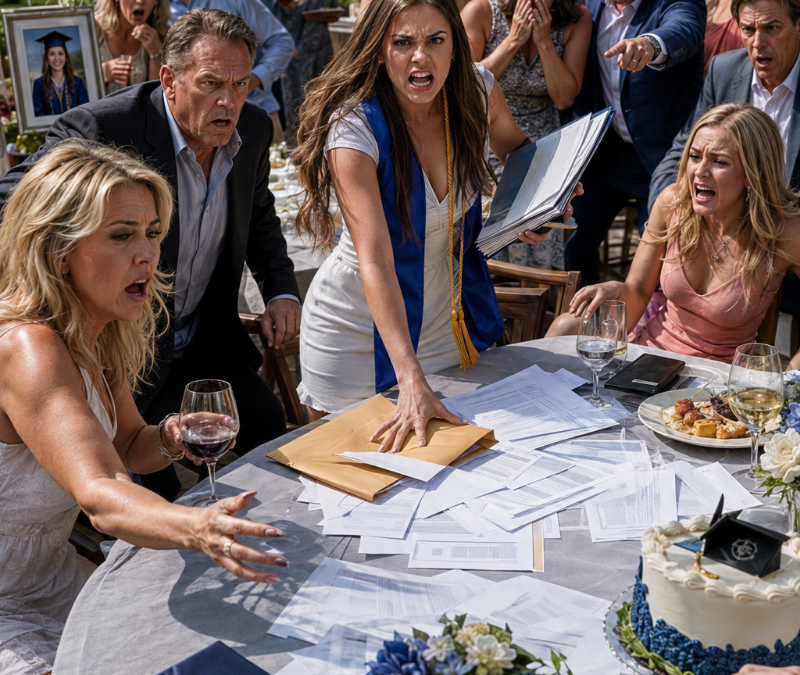
“We adopted you to cash in on you,” my mother announced into a wineglass at my graduation party while my sister laughed and my father smirked in front of everyone. They expected the adopted daughter they had spent years calling “expensive” to cry or stay grateful. Instead, I stood up, pulled a thick envelope from my jacket, and said, “Funny. I brought some truth too.” Inside were adoption subsidy records, education grants tied to my name, and proof that money meant for me had paid their mortgage and my sister’s expenses. Then I said four words that wiped every smile away: “I already spoke to an attorney.”
Part 1
My mom always loved a microphone, even when there wasn’t one.
She could turn a backyard into a stage with nothing but a glass in her hand and that bright, practiced smile that made strangers feel like they’d been invited into something special. The kind of smile that said, Look how good we are. Look what we built.
So when she tapped her wineglass with a spoon at my graduation party, everyone turned the way they always did when my mother decided she had something important to say.
The banner behind her still hung crooked between two maple trees: Congrats, Delaney, in glittering gold letters that caught the late afternoon sun. My aunt had helped hang it earlier, laughing as the tape refused to cooperate. My friends from campus were clustered near the patio, plates balanced on their hands, still wearing the soft stunned look of people who’d finished finals and were finally exhaling. A few neighbors stood by the fence, smiling politely in their clean summer clothes.
My sister, Paige, sat with one leg folded under her on a lawn chair like she was at a show she’d paid to see. She didn’t even look at me. She just looked at my mother, waiting.
“Time for the truth,” my mom announced, tapping again for emphasis.
A ripple of laughter rolled through the backyard, the nervous kind you hear before a toast. Someone raised a phone, thinking maybe this was a sentimental speech worth recording. My dad leaned back in his chair, arms crossed over his chest, a slow smirk settling on his face like he’d been waiting all day for this moment.
I felt every eye shift toward me. Heat climbed my neck, not embarrassment exactly, more like a familiar warning: something sharp is coming.
“Delaney,” my mom said, stretching my name like it was the title of a story she owned. “Everyone here thinks this party is about you.”
More laughter, a few claps.
“But we should be honest,” she continued, voice light, almost playful. “We adopted her to cash in on her.”
The words didn’t land like a joke. They landed like a dropped dish, heavy and ugly.
A couple of guests laughed anyway, the reflexive kind that happens when you don’t want to believe someone just said what they said. My mom smiled wider, as if she’d delivered the punchline of the year. Paige let out an open, delighted laugh, the kind she never gave me when I did something worth celebrating.
My dad’s smirk deepened.
“We got scholarships, donations, sympathy,” my mom went on, gesturing vaguely with her glass like she was listing holiday sales. “Best investment we ever made.”
This time the laughter stuttered. Some people shifted their weight. My professor, Dr. Haynes, looked like she’d just tasted something bitter. My friend Tori’s mouth fell open. Someone near the grill cleared their throat too loudly.
I stood slowly.
Not because I was shocked. Not because I was about to cry.
Because I’d been expecting this.
My mother had been hinting for weeks, making little comments in front of relatives, letting her voice slide into that teasing cruelty she called honesty. Paige had been especially smug since I got my final scholarship award letter. My dad had been unusually cheerful, the way he got when he thought he was holding something over someone.
And I’d learned, a long time ago, that my parents liked to choose the moment they thought you were most vulnerable. They liked an audience. They liked control.
What they didn’t like was paperwork.
I reached into the inside pocket of my graduation jacket and pulled out a sealed envelope. Thick. Cream-colored. Neat label on the front. Not a dramatic prop, just an object that belonged in a world where words had consequences.
A few heads tilted. Paige rolled her eyes like she could already predict how I’d embarrass myself.
My dad’s smirk didn’t move. Yet.
“Funny,” I said, voice even, louder than I thought it would be. “I brought some truth, too.”
The backyard went quiet in that sudden way a crowd does when it realizes the entertainment isn’t over.
My mom’s smile flickered, just slightly. “Honey,” she said, still sweet. “Don’t do this.”
I broke the seal carefully, like I was opening a letter in an office, not on a lawn. The paper inside was crisp, printed, organized. I held the top sheet steady.
“I’d like to thank my parents,” I began, and my voice sounded strangely calm even to me, “for teaching me the value of documentation.”
A few people gasped, softly. Someone’s plastic fork clinked against a plate.
My mom let out a quick laugh that sounded fake even to the neighbor’s dog. “Oh my God, Delaney.”
I lifted the first page. “This,” I continued, “is a copy of the adoption subsidy agreement you signed seventeen years ago.”
Paige’s laugh vanished like someone had cut the sound.
A man I barely knew, one of my father’s old work friends, shifted in his chair. My aunt’s eyes widened. Dr. Haynes straightened, suddenly alert.
My dad’s posture changed. He sat up a little, like he’d heard the word lawsuit.
“That’s private,” he muttered.
I ignored him.
“It outlines the monthly payments you received for my care,” I said, scanning the sheet like I’d rehearsed it, because I had. “Federal support. Education stipends. Health care credits.”
My mom’s fingers tightened around her glass. “Delaney, stop,” she said, her brightness cracking around the edges.
I kept going. “It also includes a clause requiring those funds be used directly for the child’s benefit.”
The banner behind me fluttered in a light breeze.
I pulled out another document. “And this,” I said, holding it up, “is a record of where that money actually went.”
My mom stood abruptly, heels digging into the grass. “Enough.”
But the word didn’t stop me because it never had, not when it mattered. It had only trained me. It had taught me how to survive in a house where love was conditional and silence was the price of staying.
I read the highlights, not every detail, but enough.
“Mortgage payments.” I lifted my eyes. “Vacation deposits. Paige’s private school tuition.”
A murmur spread through the yard, low and uneasy. People glanced at each other like they didn’t know where to put their faces.
Paige’s arms crossed tight. “So what?” she snapped. “They raised you.”
I folded the first paper carefully, as if respect belonged to the document, not the people who’d violated it.
“I didn’t come here to embarrass you,” I said, and that was true in a way that surprised me. “I came here to correct you.”
My dad’s smirk was gone now. In its place was something colder, the expression he wore when a situation slipped out of his grip.
My mom stepped closer, lowering her voice like she could contain the damage if she made it intimate. “You’re twisting numbers,” she hissed. “We gave you a home.”
I held her gaze. “You gave me a receipt,” I said.
The silence thickened. Guests stared at their drinks. Someone pretended to check their phone. My aunt’s hands hovered near her mouth like she didn’t know if she should pray or apologize.
I reached back into the envelope.
“I also brought something else,” I said.
This time, I didn’t read immediately. I let the anticipation sit there, hanging between us like a held breath. My father took a step forward.
“Sit down, Delaney,” he said, voice low.
“No,” I replied, soft but solid.
The second document wasn’t government-issued. It was from my university’s legal clinic. Three months earlier, I’d requested a review of financial filings attached to my name. I’d been careful about how I asked, careful about who I spoke to. I didn’t want drama. I wanted clarity.
The results were precise.
Funds misallocated. Reporting discrepancies. Potential fraud.
“I already spoke to an attorney,” I said calmly.
The backyard didn’t just go quiet.
It went still.
My mother’s face drained of color. Paige’s eyes darted from my parents to the paper and back again, confusion replacing her arrogance.
“Put that away,” my dad said, the control in his voice tightening like a rope.
I didn’t move.
“The filings tied to my name were audited,” I continued. “They show education grants that were never applied to my tuition.”
Paige’s mouth opened. “What is she talking about?”
My mother’s hands trembled slightly. “You’re misunderstanding how these programs work,” she said, too fast.
“I’m not,” I replied evenly. “I had the numbers reviewed.”
Someone set a glass down too hard somewhere behind us. The sound rang out like a bell.
“You would report your own parents?” my dad asked quietly, as if the concept itself offended him.
I met his eyes. “You reported my existence as income,” I said.
That line landed heavier than I expected. I felt it go through the crowd, through the air, through the space where my party had been, moments earlier, a celebration.
My mom’s voice cracked. “This was supposed to be a celebration,” she snapped, desperation creeping in. “You’re ruining it.”
“No,” I said softly. “You did.”
I pulled out the final page from the envelope. “This is a notice of inquiry,” I explained. “It hasn’t been filed yet.”
Relief flickered across my mother’s face for a heartbeat.
“I wanted you to hear it from me first,” I added, and watched that relief curdle into fear.
Because they understood, finally, that I wasn’t reacting. I was choosing.
My dad took a step toward me, lowering his voice so only I could hear. “You wouldn’t survive without us.”
It wasn’t a threat. It was habit.
I held the envelope against my chest. “I already did,” I whispered back.
Around us, guests began standing in slow clusters, polite smiles stretched thin over curiosity. My professor approached me and squeezed my arm gently as she passed.
“I’m proud of you,” she whispered. “Not for graduating. For standing.”
When the yard finally emptied, only the four of us remained beneath the crooked banner, gold letters catching the fading light like a cruel joke.
“Congrats, Delaney,” the banner read.
My mother sank into her chair, the fight draining from her face. She looked older suddenly, the way people look when their performance collapses and the mirror shows them what they’ve been avoiding.
“What do you want?” she asked.
It was the first honest question of the day.
I looked at the envelope in my hands, then at the house behind them—the house subsidized in my name.
“I want my life back,” I said.
And that was only the beginning.
Part 2
People assume adoption is one story.
They imagine a grateful child, a saved child, a family built out of love and destiny. They imagine a scrapbook and a heartfelt speech. They imagine belonging.
I learned early that adoption can also be a business arrangement wearing a family’s face.
I don’t remember the day my parents brought me home. I was two, maybe three. I remember flashes: the smell of cigarette smoke on my father’s coat, my mother’s perfume sweet and sharp, Paige’s small hands yanking a toy away and my mother’s laugh—Oh, Paige, share.
But I remember paperwork.
Not the documents themselves, obviously, but the energy of them. The way my parents talked in that careful adult tone when mail arrived. The way my mother kept a folder in her bedside drawer that I wasn’t allowed to touch. The way my father’s moods shifted with words like reimbursement and renewal.
By the time I was old enough to understand that other kids had baby photos from hospitals and stories about their mothers’ cravings, I had a different kind of origin myth: You were chosen.
My mother loved that phrase. She said it at church. She said it to neighbors. She said it when teachers complimented me.
“You were chosen,” she’d tell me, smiling, like it was proof I should be extra good.
Paige had her own version.
“You were bought,” she’d say when my parents weren’t listening, voice low and gleeful. “My mom said you came with money.”
The first time she said it, I punched her in the arm, because I was nine and didn’t know what else to do with shame. She screamed, and my parents punished me, and Paige smiled through tears.
I learned that in our house, pain was negotiable. Narrative wasn’t.
I became excellent quietly.
Not because I believed excellence guaranteed love, but because excellence created options. I got top grades, not for praise—praise rarely came—but for scholarships, for doors that didn’t require my parents’ permission. I joined clubs that looked good on applications. I worked part-time jobs starting at fifteen because it felt safer to have my own money.
My parents were oddly supportive of my ambition as long as it benefited them in some way. My mother posted about my achievements online with captions like Proud mama and Blessed, and people commented with hearts and admiration. My father liked telling coworkers about “my girl,” as if he’d personally built my brain with his own hands.
But when I asked for something that cost them—new shoes, a college visit, a laptop—my father would sigh dramatically and say, “Do you know how expensive you are?”
I used to feel guilty, like my existence had a price tag I hadn’t agreed to.
Now I know I wasn’t expensive.
I was profitable.
The first time I realized it clearly was my senior year of high school, when I won a local scholarship. It wasn’t huge, but it was mine—an award for academic performance and community service. The check was made out to me.
My mother insisted on holding it “for safekeeping.”
“It’s just easier,” she said. “We’ll deposit it.”
I believed her. Because I wanted to. Because the alternative—believing my own parents would steal from me—felt like standing on a bridge and looking down.
A week later, I asked about it. My mother’s smile tightened. “We used it for your graduation gown,” she said.
My gown had cost eighty dollars.
The scholarship had been two thousand.
When I asked where the rest went, my father’s voice turned hard. “Don’t be ungrateful,” he snapped. “We’ve spent plenty on you.”
Paige smirked from the doorway, eating chips.
That was the year I started keeping copies.
Not dramatic copies. Quiet ones. Photos of checks. Screenshots of bank deposits. A folder on my laptop labeled boring name: documents.
I didn’t know what I would do with them. I just knew I couldn’t afford ignorance anymore.
College made everything sharper.
I got into a good state university with scholarships and grants. I worked two jobs. I took summer classes. I did internships. I built a resume the way some people build a raft: plank by plank, with urgency.
My parents liked the identity of having a college-bound daughter, especially one with awards.
They didn’t like the reality of losing control.
Every time a financial aid letter came, my mother insisted on seeing it. “Just to understand,” she’d say, but her eyes would go straight to the numbers. Paige would hover, listening.
My father loved to talk about how he and my mother “sacrificed” for me, but when tuition bills arrived, he always had a reason they couldn’t contribute. Somehow, though, Paige’s expenses never seemed optional.
Paige went to a private college for one semester, dropped out, and my parents paid her tuition anyway. Paige got a new car. Paige got “help” with rent. Paige got forgiven.
I got told I was “lucky” they took me in.
What I didn’t know—what I wouldn’t know until I went to the legal clinic—was how much money had been attached to my name, how long it had flowed, and how intentionally it had been diverted.
Subsidy payments. Education credits. Reimbursements. Grants routed through guardianship accounts.
I had assumed, naïvely, that whatever programs existed were modest, background support. I pictured grocery money. A little help.
Instead, it was a stream.
And my parents had been dipping cups into it for years.
They were careful enough to keep me fed and clothed. Not well clothed, not consistently, but enough to pass for competent parents. They did what was required, not what was loving. They kept the investment alive.
And I kept thinking if I achieved enough, I would convert their contract into something real.
Achievement doesn’t do that.
It just makes you more valuable to people who measure love in returns.
My graduation party was supposed to be the moment I finally belonged. My mother insisted we host it at home because “family should celebrate together.” She invited people I barely knew: neighbors, church friends, my father’s colleagues. She ordered a cake with my name in gold icing. She hung the banner.
On the surface, it looked like pride.
Underneath, it felt like a transaction closing.
The week before the party, my father cornered me in the kitchen while my mother was on the phone and Paige was upstairs.
“You’re going to thank us,” he said, voice low.
“I already did,” I replied automatically.
He shook his head. “No. In front of people,” he said. “You’re going to say we made you.”
I looked at him, and something in my chest went still. “Why?” I asked, though I could guess.
His eyes narrowed. “Because we deserve credit,” he said.
Credit. The word sat there, ugly and perfect.
Not love. Not pride. Credit.
That night, I opened my laptop and pulled up the folder labeled documents. I stared at the neat stack of evidence and realized I needed more than suspicion.
I needed clarity.
The next morning, I walked into the university legal clinic with a folder and a quiet, focused kind of anger.
And three months later, when my mother tapped her glass and declared I was their best investment, I was ready to show exactly what kind of investors they’d been.
Not with yelling.
With paper.
Part 3
The university legal clinic was tucked into an old brick building near the edge of campus, the kind of place students passed without noticing unless they needed something specific. I’d walked by it dozens of times and never thought it would become the most important door I opened in college.
Inside, the waiting area smelled like printer ink and stale air-conditioning. A few students sat filling out forms—landlord disputes, immigration questions, small claims. Life problems in paper form.
I checked in at the desk and waited until a second-year law student named Mira called my name.
Mira had tired eyes and a calm, practiced voice. She led me into a small office, closed the door, and asked, “How can we help you today?”
I stared at the folder in my hands, suddenly aware of how strange it sounded to say, I think my parents are committing fraud using my name.
But I said it anyway.
Mira didn’t look shocked. She didn’t laugh. She just nodded slowly and asked the kind of questions that made me feel less crazy.
“What programs are you referring to?” she asked.
“I don’t know,” I admitted. “That’s part of the problem. I know there was adoption assistance when I was little. I know my parents had access to my financial aid information. And I’ve noticed… gaps. Money that should have gone to tuition that didn’t.”
Mira took notes. “Do you have documentation?”
That word—documentation—felt like a life raft. I slid the folder across the desk. Inside were copies of scholarship checks, screenshots of financial aid portals, emails, anything I’d quietly saved over the years.
Mira flipped through it carefully. “This is a good start,” she said. “We’ll need to request records. Some may require your authorization. Some may be protected, but if it’s tied to your name and social security number, you have rights.”
Rights. Another word that felt like oxygen.
Over the next few weeks, I met with Mira and the supervising attorney, Ms. Reilly, a woman in her fifties with sharp eyes and a voice that didn’t waste syllables. Ms. Reilly didn’t soften reality for comfort. She laid out possibilities.
“Misuse of subsidy funds can be a civil issue or a criminal one depending on the facts,” she said. “Misreporting educational grants tied to your identity can trigger audits. Forging signatures, falsifying reports—those cross lines.”
I listened, heart pounding, as if she were describing someone else’s life. Part of me still wanted to believe I’d misunderstood.
But my memories lined up too neatly with what she described: my mother insisting on controlling paperwork, my father’s obsession with “credit,” Paige’s smirk whenever money came up.
Then Ms. Reilly asked a question that made my stomach drop.
“Are you certain you’re adopted through a subsidized program?” she asked.
“I… yes,” I said. “They’ve always said it.”
Ms. Reilly nodded. “We’ll verify it,” she said. “Sometimes families exaggerate. Sometimes the documents say more than the story.”
The documents did say more.
When the records came back, they arrived in a neat stack with official seals and bureaucratic language that didn’t care about feelings. There it was: the adoption subsidy agreement, signed by my parents, listing monthly payments and specific clauses about required use. There were annual review forms. There were reported expenses.
And there were discrepancies so obvious I felt sick.
Amounts claimed for “child educational enrichment” that aligned perfectly with Paige’s private tutoring invoices. Reported “medical equipment” that matched my father’s new home gym purchase. “Housing support” funds that went straight into mortgage payments.
The most damning part wasn’t that they spent money. It was that they spent it with such casual entitlement that they didn’t even hide the pattern.
“They treated the clauses like suggestions,” Ms. Reilly said, tapping the page. “And they attached filings to your identity.”
Mira pulled up another spreadsheet. “We also requested tuition payment records,” she said. “There are education grants listed as received, but they weren’t applied to your university account.”
My throat tightened. “Where did they go?” I whispered.
Mira’s eyes lifted. “Some went into a custodial account tied to your parents,” she said. “Some were redirected through a bank transfer system. And some… we can’t see yet. That’s where an inquiry comes in.”
Ms. Reilly leaned forward. “Delaney,” she said, using my name carefully, “you can file a notice of inquiry with the oversight agency. That triggers an investigation. It won’t be quick. It won’t be quiet. But it creates a record that isn’t controlled by your parents.”
I stared at the paper in front of me, the neat columns of numbers, the evidence of my childhood turned into financial transactions. Anger rose hot in my chest, but underneath it was something steadier.
Relief.
Because I wasn’t imagining it.
Because the truth existed outside my head.
Mira watched me closely. “Are you safe at home?” she asked.
The question surprised me, and my answer surprised me too. “Physically, yes,” I said. “Emotionally… no.”
Ms. Reilly nodded. “This kind of exploitation is often paired with control,” she said. “If you move forward, you need a plan. Where you’ll go. Who you’ll tell. How you’ll protect your documents.”
I already had an offer out of state. I hadn’t told my parents yet. Not because I wanted to shock them, but because I didn’t trust them not to sabotage it.
I left the clinic that day with a sealed envelope in my bag and a strange calm in my body.
The envelope contained copies: the subsidy agreement, the ledger of misallocated funds, the audit summary, and the notice of inquiry—unsigned, ready.
It wasn’t revenge. It wasn’t a weapon. It was a boundary made of paper.
I didn’t plan to confront my parents immediately. I could have filed quietly, moved away, let the investigation unfold without drama. But part of me wanted one thing I’d never gotten from them: to be seen.
Not as an investment. Not as a project. Not as a prop in their public story.
As a person who knew what they’d done.
And when my mother insisted on hosting a graduation party, insisting on making my achievement their stage, I realized I could choose my moment.
Not out of spite.
Out of timing.
If they wanted an audience, fine.
They would get one.
But this time, the story wouldn’t be theirs alone.
By the morning of my graduation party, the envelope sat inside my jacket like a steady weight. The papers were clean, organized, labeled. I’d practiced reading key lines without trembling. I’d rehearsed how to keep my voice calm even if my mother cried and my father threatened and Paige laughed.
I didn’t want chaos. I wanted clarity.
The thing about people who live on control is that they underestimate calm. They expect tears. They expect shouting. They expect you to make a scene that can be dismissed as emotional.
They don’t expect you to sound like an accountant.
Or a lawyer.
Or someone who finally understands that their life isn’t owed to anyone who exploited it.
When my mother tapped her glass and called me their best investment, I stood up and opened the envelope.
And for the first time, the entire yard belonged to the truth.
Part 4
After the guests left and the sunlight softened into evening, the backyard looked like the aftermath of a storm that had pretended to be a party.
Paper plates sagged in the humidity. Half-empty cups sat abandoned on the patio table. The cake had been cut but barely eaten, the frosting smeared where someone had taken a slice and then lost appetite halfway through. The banner still hung crooked, glittering gold letters now feeling less like celebration and more like accusation.
My mother’s chair creaked when she leaned forward. “You humiliated us,” she said, voice hoarse.
My father stood near the grill, hands braced on the counter like he might crack it in half. Paige sat on the edge of the patio step, phone in hand, scrolling aggressively like she could swipe away the day.
I set the envelope on the table and took a slow breath. I wasn’t shaking anymore. That surprised me.
“I didn’t humiliate you,” I said. “I told the truth.”
My mother let out a sharp laugh. “The truth?” She pointed at the papers. “Those are numbers. You don’t understand what it cost to raise you.”
I looked at her, and I felt something quiet and sad settle in my chest. Not guilt. Recognition.
She was going to try to make this about sacrifice. She always did.
“You were reimbursed,” I said, keeping my voice steady. “That’s not sacrifice. That’s a contract.”
My father’s jaw tightened. “We gave you opportunities,” he snapped.
“You monetized them,” I replied.
Paige finally looked up, eyes narrowed. “So what now?” she said. “You going to call the cops like you’re some hero?”
I didn’t answer right away. I let the question sit, because it deserved weight.
“I’m not filing anything tonight,” I said.
Relief flickered across my mother’s face, quick and desperate. My father’s shoulders loosened by a fraction.
“But,” I continued, “I’m not protecting you either.”
That relief died. My father’s eyes sharpened.
“What does that mean?” he asked.
“It means,” I said evenly, “I already requested a review. The audit exists. The clinic has records. The bank has records. The agency can decide what to do with it. I’m not retracting anything. I’m not signing any statements to ‘clarify’ or ‘correct’ your story.”
My mother’s voice rose. “You’re destroying this family.”
I looked at the house, the one that had always felt like a stage I was forced to stand on. “You destroyed the idea of it first,” I said.
Paige scoffed. “You’re acting like we beat you.”
My father snapped, “Paige.”
The word came out like warning, but it was too late. Paige’s mouth twisted.
“You weren’t starving,” she said, eyes bright with resentment. “You had a room. You had clothes. You had food. So stop acting like you were abused.”
The word abused hung in the air, heavy.
I didn’t argue with it. I didn’t need to. There were different kinds of harm, and Paige had always been the kind of person who believed harm only counted if it left bruises.
“I’m not here to win a suffering contest,” I said. “I’m here to stop you from using me.”
My father stepped closer, his voice dropping low. “You think you’re independent,” he said. “But you’re not. You wouldn’t have gotten into college without us. You wouldn’t have survived without us.”
I stared at him. The old Delaney would have folded. The old Delaney would have tried to prove herself, to plead her worth, to earn permission.
The new Delaney felt something else: the clarity of an exit already mapped.
“I accepted a job out of state,” I said.
My mother froze. Paige’s eyes widened. My father blinked like he hadn’t heard correctly.
“You’re leaving?” Paige repeated, voice sharp with disbelief. “That’s dramatic.”
“No,” I said. “It’s strategic.”
My father’s face hardened. “When?”
“In two weeks,” I said. “I signed the offer the day I printed those audit results.”
My mother’s mouth opened, then closed. “You planned this,” she whispered, like planning was a betrayal.
“Yes,” I said. “Because you taught me I had to.”
Silence stretched across the yard. A cricket chirped somewhere near the fence. The neighbor’s porch light flicked on across the street.
My father exhaled sharply. “If you leave, don’t come crawling back.”
I nodded once. “I won’t.”
My mother’s eyes filled with tears, and for a moment, I almost felt the old tug—the instinct to comfort, to smooth, to patch. Then I remembered the way she’d smiled while telling strangers I was their best investment. I remembered her tapping the glass like she was proud to admit she’d adopted me for profit.
Her tears weren’t about me. They were about losing control of the narrative.
“What do you want from us?” my mother asked, voice trembling.
It was an odd question. Like she still believed the only way this ended was through negotiation, as if I was a customer returning a product.
“I want you to stop using my name,” I said. “I want you to stop accessing anything tied to my identity. And I want you to understand that your version of me is over.”
My father’s eyes narrowed. “And if we don’t?”
I glanced at the envelope. “Then the inquiry proceeds,” I said simply.
Paige laughed, but it came out thin. “You won’t do it,” she said.
I looked at her. “You already did it to yourselves,” I replied. “I’m just not hiding it anymore.”
That was the moment my father finally looked afraid. Not terrified, not panicked, but afraid in the way people get when they realize they can’t bully paperwork.
“You can’t just walk away from family,” my mother whispered, as if the word family still meant safety.
I breathed in slowly. “You are my guardians,” I said, and watched her flinch. “Not my owners.”
Paige’s face twisted. “So you’re going to pretend we never mattered?”
I shook my head. “No,” I said. “I’m going to remember exactly what mattered.”
I picked up my bag, the envelope now lighter because it had done its job. My parents watched me like I was stepping off the edge of something they couldn’t follow.
At the gate, my mother called my name.
“Delaney,” she said, voice smaller. “We did love you.”
I paused, but I didn’t turn around.
Maybe she believed it. Maybe she believed love was whatever feeling she had when she thought she’d made a good investment. Maybe love, to her, was ownership with a smile.
I let the words hang for a beat, then answered quietly.
“Maybe,” I said. “But you loved what I provided more.”
No one argued. Not my dad. Not Paige. Because they knew the difference too.
I walked out of the yard, and the gravel under my shoes sounded like a new beginning.
Not a dramatic one.
A deliberate one.
Part 5
Leaving a house is easy.
Leaving a story is harder.
For two weeks, I lived in a strange in-between. My parents didn’t apologize. They didn’t rage constantly either. They moved around me like I was a loose wire in the wall—dangerous if touched, inconvenient if ignored.
My father avoided me entirely, except for the occasional pointed comment tossed into the air like a dart.
“Hope your little job is worth it,” he’d say to no one in particular.
My mother tried a softer approach. She’d knock on my bedroom door with a plate of food I didn’t ask for, her voice gentle.
“Can we talk?” she’d say.
I’d keep my answer calm. “No.”
Paige oscillated between pretending I didn’t exist and making snide remarks whenever she got bored.
“You’re so dramatic,” she’d mutter if I walked past.
I didn’t engage. I didn’t argue. I didn’t try to win.
I packed.
I packed like someone preparing for a storm: systematically, carefully, with attention to what mattered. I pulled my documents folder from my laptop and backed it up to two encrypted drives. I scanned my birth certificate, my adoption papers, my transcripts, my job offer. I changed passwords on every account I could think of, put two-factor authentication on everything, froze my credit.
The legal clinic had advised me to do all of it, and for once, I followed advice without feeling guilty.
The night before I left, my mother found me in the kitchen labeling a box.
“You’re really doing this,” she said.
I didn’t look up. “Yes.”
She swallowed. “We didn’t know you felt this way,” she whispered.
I laughed once, quiet and tired. “You announced it into a microphone,” I said.
My mother’s cheeks flushed. “That was… a joke.”
“It wasn’t funny,” I said, still calm.
She moved closer, hands twisting. “We were stressed,” she said. “Money was tight. We thought… we thought you’d understand.”
I finally looked at her. “You made my existence a line item,” I said. “That’s not stress. That’s choice.”
Her eyes filled again. “So you’re just going to let them investigate us?”
I set the marker down. “I’m not making them,” I said. “I’m just not stopping them.”
My mother’s face tightened. “If this gets out—”
“It already did,” I said. “In front of your friends.”
She flinched. “You did that.”
I shook my head. “You started it,” I said. “I finished it.”
The next morning, I loaded my car before sunrise. The street was quiet, the world still half-asleep. I moved boxes gently, as if loud noise might wake the old version of me that still believed leaving required permission.
Paige appeared at the front door in pajamas, arms crossed. “You’re really leaving,” she said, like she couldn’t decide if she was offended or bored.
“Yes,” I replied.
She scoffed. “Good luck out there,” she said. “You won’t last.”
I looked at her for a moment and felt something like pity. Paige had grown up in the same house, but she’d learned different lessons. She’d learned that worth came from taking, not building. She’d learned that cruelty was entertainment. She’d learned that my parents’ approval was earned by echoing their contempt.
“I already lasted,” I said, and it was the truth.
My mother came out last, hair messy, eyes swollen. My father didn’t appear at all.
She stood at the end of the driveway, voice shaking. “If you go, you’re choosing strangers over family.”
I closed my car door gently. “I’m choosing myself,” I said.
Her mouth opened, then closed. She looked like she wanted to say something tender, something that might pull me back. But the only language she knew was guilt.
I got in the car.
As I drove away, the house shrank in my rearview mirror, and with it, the version of me that had spent years trying to earn belonging through achievement.
The new state felt like a blank page.
My job was with a compliance and risk team for a mid-size financial services company, the kind of work my parents would have called boring. I loved it immediately. Not because spreadsheets were thrilling, but because the work was built on something my life had lacked: accountability. Rules. Systems. Evidence. Consequences.
No one there knew my adoption story. No one cared about my parents’ church reputation. They cared that I showed up on time, did good work, asked smart questions.
For the first time, my value wasn’t a narrative someone else could cash in on.
It was mine.
Three months after I moved, a letter arrived in my mailbox with an official seal.
Notice of inquiry result: repayment agreements and penalties.
Not prison. Not dramatic destruction. Accountability.
My parents were required to repay misused funds. They were barred from certain programs. They faced fines. Their names were in a system now, flagged, watched.
I sat at my kitchen table—my kitchen table—and read the letter twice. Then I folded it carefully and placed it into the same envelope I’d opened at my graduation party.
Proof.
Not of revenge.
Of reality.
That night, I didn’t post about it. I didn’t call anyone to gloat. I didn’t make a speech online.
I made tea. I watched a mindless show. I went to bed.
Because the real victory wasn’t that my parents got punished.
The real victory was that I didn’t need them anymore to feel real.
In the months that followed, I built something quiet and solid. Friendships that didn’t come with invoices. A routine. A therapist who helped me untangle the guilt knots my mother had tied for years. A savings account in my name alone.
And on the day I walked into my office and saw my name on my own doorplate, I paused for a moment and let myself feel it.
Delaney.
Not an asset.
Not an investment.
Not a story someone else controlled.
Just me.
Part 6
A year after I left, my mother sent a letter.
Not an email. Not a text. A physical letter, mailed like it belonged to a time when words had weight because they couldn’t be edited after sending.
I stared at it on my counter for three days before opening it.
Her handwriting was the same—rounded, careful, trying to look gentle even when the message wasn’t.
Delaney, she wrote, we miss you. Your father misses you too, even if he won’t admit it. We didn’t realize how much you were hurting. We never meant to make you feel like an investment.
I stopped there and exhaled slowly.
Never meant to.
My therapist would later call that phrase intent laundering. A way of scrubbing consequence by claiming the heart was pure.
I kept reading anyway.
Your father says the investigation was unfair. He says we’re being punished for trying to survive. Paige is struggling. The penalties are difficult. We need help.
There it was.
Not apology. Not accountability. Need.
My stomach tightened, but this time, the guilt didn’t hook in the way it used to. It floated there, trying, and I watched it like a stranger.
I folded the letter and set it aside.
Two hours later, my phone rang. Unknown number. Then again. Then again.
I blocked it.
The next week, Paige left a voicemail from a different number. Her voice was sharp and resentful.
“You think you won,” she spat. “You ruined Mom. You ruined Dad. Grandpa would be ashamed if he knew you turned on us.”
I listened once, then deleted it.
The old Delaney would have argued with that voice in her head for days. Would have tried to prove she wasn’t cruel. Would have tried to justify.
The new Delaney wrote down three sentences in her journal instead:
They want me back because I was useful. I am not responsible for their consequences. I can choose peace.
I didn’t respond to any of them.
Instead, I did something I didn’t expect: I applied to graduate school.
Not because I needed to prove anything, but because I wanted to. I wanted a future that didn’t feel like a reaction to my past. I wanted to specialize in forensic accounting and compliance investigation, the kind of work that untangles fraud and holds systems accountable.
The first time I sat in a classroom again, older than some of the students, I felt a strange thrill.
I was learning in a way that was mine.
Not to impress my parents. Not to earn belonging.
To build a skill that could protect people who didn’t know they were being exploited until it was too late.
Sometimes, in group discussions, my classmates would talk about “bad actors” like they were abstract villains. I listened and took notes and kept my face neutral.
I knew bad actors could look like dads in polo shirts and moms with bright smiles. Bad actors could bring casseroles to church and clap at graduation ceremonies while quietly siphoning money from a child’s name.
Bad actors could call it love.
I graduated again two years later—this time with a certificate and a job offer at a regulatory agency.
When the offer came, I sat on my couch and laughed until tears came. Not because it was funny, but because the universe had a dark sense of symmetry.
My parents had used bureaucracy to exploit me.
Now I was using bureaucracy to stop people like them.
On my first day at the agency, my supervisor—a blunt woman named Renee—handed me a stack of files and said, “We’re here to follow the money and the truth. You okay with ugly?”
I nodded. “Yes,” I said. “Very.”
My parents tried again when they heard about my new job.
A cousin I barely spoke to messaged me: Aunt and Uncle are struggling. Maybe you could soften. Maybe you could help.
I stared at the message for a long moment, then wrote back one sentence:
They should ask the agency how to make amends.
Then I muted the conversation.
That winter, I got a new letter from my mother. Shorter this time. Less polished.
We lost the house, she wrote. Paige moved out. Your father says it’s your fault. I don’t know what to believe anymore.
I read it twice and felt a strange ache. Not sympathy exactly. Not satisfaction. Just the reality of consequences rippling outward.
I wrote back one letter. One.
I didn’t attack. I didn’t comfort. I didn’t negotiate.
I wrote:
I’m sorry you’re hurting. I will not send money. I will not be involved in repairing what you broke. If you ever want a relationship with me, it starts with accountability, not need.
Then I mailed it and let that be the boundary.
A month later, my mother replied with two words:
I understand.
I didn’t know if she really did.
But for the first time, she didn’t ask for anything.
That was the beginning of something new. Not reunion. Not forgiveness. Just a tiny shift away from extraction.
My life kept expanding. I made friends who didn’t know my history and friends I told later. I learned how to celebrate my own achievements without feeling like I was stealing credit from someone else. I learned how to say no without apologizing.
And one evening, after a long day tracing a fraud case that involved foster care funds being diverted by a contractor, I sat in my car and stared at my steering wheel, suddenly overwhelmed by the familiar rage.
I wasn’t angry just for the child in the file.
I was angry for me.
I took a breath and reminded myself: anger isn’t poison if you use it for protection. It’s only poison when you swallow it and pretend it isn’t there.
I went home, made dinner, and opened my journal.
I wrote one sentence:
I turned their lesson into my career.
Because that was the truth.
They taught me documentation by trying to erase it.
They taught me timing by trying to control it.
They taught me survival by forcing me to choose it.
And in the end, the story they wanted to tell about me—the grateful adoptee, the best investment—became irrelevant.
I wasn’t anyone’s return.
I was my own.
Part 7
The first time my mother visited me, it wasn’t planned.
She showed up at the agency building’s public lobby on a rainy Thursday, hair damp, coat too thin for the weather. She looked smaller than I remembered, as if the years without performance had shrunk her.
Security called my extension.
“There’s a woman here asking for Delaney,” the guard said. “Says she’s your mother.”
My stomach tightened. My mind ran through options: say no, send her away, keep the boundary intact.
Then I remembered my own letter: If you ever want a relationship, it starts with accountability.
I didn’t know what she brought, but I could at least see if she’d stepped through that door.
“I’ll come down,” I said.
When I reached the lobby, she stood near a potted plant, hands clasped, eyes scanning the room like she expected to be reprimanded for existing there.
“Delaney,” she said softly when she saw me.
I stopped a few feet away. “Mom.”
She flinched at the word, like she didn’t know if she deserved it. “I’m not here for money,” she said quickly. “I’m not. I know you won’t.”
I didn’t respond.
She took a breath. “I’m here because I saw your name,” she said. “On a report. Your department was mentioned in the news, something about investigations into misuse of child welfare funds.”
I felt my shoulders tense. “I can’t discuss cases,” I said.
“I know,” she said. “I’m not asking. I just… I didn’t know what you did. I didn’t know you became this.”
This.
A person with agency.
She swallowed. “I’m proud of you,” she whispered.
The words landed strangely. Pride from my mother used to feel like ownership. Like branding. Now it sounded almost like grief.
I studied her face, searching for the familiar manipulation. I didn’t see it. I saw exhaustion.
“Why are you here?” I asked.
My mother’s eyes filled. “Because I can’t sleep,” she said. “I can’t stop hearing myself at your party. Saying those words like it was funny. Like it was normal. And I keep thinking… how did I become someone who could say that?”
Her voice cracked. “We did adopt you for the money,” she admitted, and the bluntness made my throat tighten. “At first. Your father wanted it. Paige was expensive. We were drowning. And then you were there, and you were smart, and people praised us, and it felt like… like we finally had something to show for our lives.”
She wiped at her cheek with shaking fingers. “And then it became habit. Taking. Justifying. Pretending.”
I didn’t soften. I didn’t rush to comfort. But something in me unclenched.
Accountability.
Real accountability didn’t sound like excuses.
It sounded like this: I did it.
“What do you want?” I asked quietly.
She shook her head. “Nothing,” she said. “I know how that sounds coming from me. But I mean it. I’m in counseling now. Court-required at first, then… I kept going. They asked me to write down what I’d done. And I realized I’d never once asked what you needed.”
She took a small envelope from her purse and held it out. “This is not money,” she said quickly. “It’s… documents. Copies. Things your father kept. I thought you should have them.”
I hesitated, then took the envelope.
Inside were old forms I’d never seen. Annual review reports. A spreadsheet my father kept that literally labeled me as “subsidy” and “edu credits.” Notes in my father’s handwriting about timelines and renewals.
My stomach turned, but I didn’t look away.
My mother whispered, “I don’t want to hide it anymore.”
The rain tapped against the lobby windows. People walked past us with umbrellas, their lives moving normally around this moment.
I folded the envelope carefully. “Thank you,” I said, not because it made things better, but because it was the first time she’d given me truth without a demand.
She nodded, tears slipping down. “I don’t expect forgiveness,” she said. “I don’t expect you to come home. I just… I want you to know I see it now. And I’m sorry.”
I held her gaze. The old Delaney would have begged for these words and then tried to turn them into a family again. The new Delaney let them be what they were: an acknowledgment, late but real.
“I believe you,” I said. “But believing you doesn’t change my boundaries.”
“I know,” she whispered. “I know.”
We stood there for a moment, and then she said, “Your father still blames you.”
I shrugged slightly. “That’s his choice.”
My mother nodded, as if she finally understood choice as something other than an inconvenience. “Paige… Paige isn’t doing well,” she said. “She says you stole her life.”
I felt a familiar bitterness rise, then settle. “Paige always thought life was something you could steal,” I said.
My mother’s mouth trembled. “I wanted to be better,” she whispered. “I just… I wasn’t.”
I looked at her carefully. “You can be now,” I said.
She nodded, tears still falling, but her shoulders straightened a fraction. “I’m trying.”
That was all we had, really. Not reunion. Not a clean ending. Just a truth spoken without performance.
My mother left after that, walking back into the rain without asking me to follow.
I went back upstairs and sat at my desk with the envelope open, my father’s handwriting staring up at me like a confession.
I added the documents to my secure folder.
Not out of obsession.
Out of clarity.
Because even when people apologize, the truth matters. The record matters. The difference between story and fact matters.
And because my life now was built on that difference.
Later that week, Renee called me into her office and slid a case file across her desk.
“We’re expanding a task force,” she said. “Misuse of guardianship-related funds. Adoption subsidies. Education credits. People cashing in on kids.”
My throat tightened.
“You want in?” she asked.
I looked at the file, then at the agency seal, then at my own name on my badge.
“Yes,” I said. “I do.”
That night, at home, I opened the envelope from my mother one more time and looked at my father’s spreadsheet.
Investment.
Return.
Renewal.
I closed it and set it aside.
They tried to reduce me to a number.
Now I was the person who made sure the numbers didn’t hide the harm.
And that felt like the clearest ending I could give myself: not closure, but purpose.
Part 8
On the morning I testified at a legislative hearing about subsidy oversight, I wore the same kind of calm I’d worn at my graduation party.
Not because I felt calm.
Because I’d learned that calm is a strategy.
The hearing room wasn’t fancy, but it carried authority: wood desks, microphones, a row of officials with tired faces, a small audience of advocates and journalists. I sat at the witness table with a folder in front of me, the kind of folder that used to make my parents feel powerful.
Now it made me feel steady.
When it was my turn, I spoke about systems, not my family. I spoke about how funds intended for children can be diverted when oversight is weak. How reporting requirements are treated like paperwork instead of protection. How kids grow up believing they’re expensive when really, they’re being exploited.
I didn’t name my parents.
I didn’t need to.
After the hearing, a woman approached me in the hallway. She wore a badge from a nonprofit and her eyes looked haunted in a familiar way.
“My niece is adopted,” she said softly. “And I think… I think my brother’s using the money wrong. But I don’t have proof.”
I nodded. “Start with records,” I said. “Paper trails. Dates. Ask for transparency. And if you can, talk to the child like they’re a person, not a problem.”
The woman’s throat tightened. “Do they ever… recover?” she asked.
I thought about that.
About the way I’d stopped flinching at my phone. About the way my name felt like mine now. About my mother standing in a lobby, finally saying the quiet part out loud. About my father, still blaming, still stuck in the fantasy that control equals love.
“I did,” I said. “But not by going back. By building forward.”
That evening, I went home and opened the same cream-colored envelope I’d used at my graduation party. It had become my strange little time capsule: the inquiry letter, the repayment notice, my mother’s documents, and a copy of my own first signed lease out of state.
Proof of the life I’d chosen.
I added one more thing: the printed transcript of my testimony.
Not because I needed reminders of pain.
Because I wanted reminders of transformation.
A week later, Paige emailed me for the first time in years.
Her message was short and sharp, like she couldn’t stand to spend too long being vulnerable.
Mom says she visited you. Don’t think that means I forgive you. But… how do you sleep at night?
I stared at the email for a long time.
There was a version of me that wanted to reply with a detailed explanation. With facts. With moral reasoning. With anger.
Instead, I wrote one sentence.
I sleep because I stopped lying to protect people who didn’t protect me.
Then I hit send and closed my laptop.
I didn’t know if Paige would ever understand. Maybe she would. Maybe she wouldn’t. Paige had built her identity on the belief that she was entitled to whatever she could take. If she ever changed, it would have to come from discomfort she couldn’t dodge.
That wasn’t my job anymore.
A year later, my mother sent one more letter. This one didn’t ask for help. It didn’t mention money. It simply said:
I started volunteering with a youth program. I’m learning what care is supposed to look like. I wish I had learned sooner.
I read it and felt something soften, not into forgiveness exactly, but into release.
I wasn’t carrying her guilt anymore.
I wasn’t carrying my father’s blame.
I wasn’t carrying Paige’s resentment.
I was carrying my own life.
On my thirtieth birthday, I hosted my own small celebration in my apartment. No banner. No speeches. Just a few close friends, takeout food, a cheap cake, and laughter that didn’t feel like performance.
At one point, my friend Tori raised her glass and said, “To Delaney, who turned survival into a skill.”
Everyone clinked glasses. I smiled, feeling something warm in my chest.
Later that night, when the guests left and my apartment went quiet, I stood in front of my bathroom mirror and looked at my own face.
I didn’t look like an investment.
I didn’t look like a product.
I looked like a woman who had learned the hard way that family is not defined by paperwork, and neither is love.
The next morning, I went to work. I reviewed files. I followed money trails. I wrote reports that would trigger oversight and audits and consequences for people who treated children like revenue streams.
It wasn’t glamorous.
It was effective.
And when I finished my day, I walked home under a wide sky and felt the simplest kind of peace: the peace of being unowned.
My parents had announced they adopted me to cash in on me.
What I revealed wasn’t just their fraud.
It was my independence.
And that was the ending they never planned for: I stopped being their story, and started being mine.
Part 9
The call came three weeks after my birthday, right as I was wrapping up a long day at work. My phone buzzed on my desk, a number I didn’t recognize flashing on the screen. I hesitated before answering, not because I didn’t want to pick up, but because the last thing I wanted was another reminder of my family’s drama.
I swiped the screen. “Hello?”
The voice on the other end was shaky, almost breathless. “Delaney, it’s Maya.”
My heart skipped a beat. Maya? The woman who had been the key to unraveling everything, the woman who had helped me piece together the documents that had changed the course of my life?
“Is everything okay?” I asked, suddenly on edge.
“Something’s wrong,” she said. “I—I didn’t know who else to call, but… I need you to come down here. It’s about your parents. They’ve been trying to make this go away. And it’s… it’s not over. Not by a long shot.”
I stood up from my desk, already gathering my things. “What’s going on? What happened?”
Maya paused for a moment. I could hear the hesitation in her voice. “I think they’re trying to bury the investigation. Someone’s been in contact with the DA’s office, offering a settlement. A very generous one. But the thing is, they want to keep it quiet. And they want to make sure you don’t get involved anymore.”
My blood ran cold. I wasn’t naive enough to think the investigation would be a straightforward process, but I also wasn’t prepared for this. My parents had always been good at buying their way out of trouble, manipulating situations, and covering their tracks.
“You have to come down here, Delaney,” Maya continued, urgency creeping into her voice. “They’re asking for you to drop everything. To retract your statements, to walk away from this entire mess. But you don’t have to do that.”
My hands gripped the edge of my desk as I processed the weight of what she was saying. “Of course I’m not retracting anything,” I said, my voice steady. “But I need to know everything. Where are you?”
“I’ll text you the address,” Maya replied. “I think it’s time you made some decisions. This is bigger than just your parents. It’s bigger than anything we’ve uncovered so far.”
I didn’t hesitate again. “I’ll be there in twenty minutes.”
I left the office without a second thought, the air outside seeming colder than it had when I arrived that morning. The drive to Maya’s office felt like an eternity. I kept thinking about the way my parents had reacted when they found out I wasn’t just a pawn in their game. When they saw that I was capable of standing up for myself, of choosing to fight for something that wasn’t just about money, their reactions had been calculated but empty.
They didn’t realize that I was no longer afraid of them. That I was no longer bound by the version of me they had tried to create. I had finally learned to see myself for what I was—a person who could decide her own future, even if it meant walking away from the people who had tried to shape her with their expectations and deceit.
When I arrived at Maya’s office, she met me outside, her expression tense, her eyes darting around like she expected someone to jump out at any second. She led me into a small, cluttered room in the back, away from prying eyes.
“I don’t know if this will help you, but I think it’s something you need to see,” she said, gesturing toward a stack of files on the desk. She reached for one and handed it to me. I took it, opening it cautiously. Inside were court documents—pages and pages of legalese, names, and dates I couldn’t immediately place.
“This is a settlement agreement,” Maya explained. “Your parents offered it to the DA’s office. They’re trying to pay for silence, to avoid the public fallout of everything coming to light. They want this to end. They’re not just paying for the mistakes they made with you. They’re paying to make the whole thing disappear.”
I felt a strange mixture of fury and disbelief rise in me. “They think they can just buy their way out of this?”
Maya nodded. “Yes, and they’ve been doing it for years. They’ve hidden money, manipulated records, and when things started to unravel, they went straight to the source—your name. Your identity.”
I clenched my jaw, feeling my muscles tighten. “This isn’t just about me anymore,” I said quietly. “It’s about everything they’ve done to everyone else.”
Maya watched me carefully, waiting for me to process the weight of the situation. “They think if they make this go away quickly enough, it will be forgotten. But if you want to take them down, you need to act now.”
I stared down at the settlement papers, each page more damning than the last. It was clear that my parents had been trying to erase their entire involvement. They wanted to make it seem like nothing had happened—like they hadn’t been the ones pulling the strings behind a fraudulent adoption scheme that spanned decades.
I handed the papers back to Maya, my resolve hardening with each passing second. “I’m not walking away. I’m not going to let them erase this. Not this time.”
Maya smiled faintly, but there was a knowing in her eyes. “I knew you’d say that. You’re stronger than they ever thought you were.”
I took a deep breath. “I’m not doing this alone.”
Maya’s eyes softened. “I know. I’ve got your back. But there are people who will try to stop you, people who’ve been involved in this scheme for years. And your parents—they won’t go down quietly.”
“Let them try,” I said firmly. “They may have tried to erase me, but I’ve learned how to make my voice heard.”
Maya nodded. “Then let’s make sure it’s heard loud and clear.”
The next few days were a whirlwind. Maya and I worked tirelessly, digging into the evidence we had, cross-referencing financial records, and speaking with anyone who might have information about the long-standing web of deceit my parents had spun. We weren’t just fighting to expose their manipulation of me; we were fighting to bring the truth to light about their exploitation of other children, their use of public funds to line their pockets.
I knew it wasn’t going to be easy. I knew the fight would be long. But I was ready. I was prepared to stand firm, to make sure my parents’ actions weren’t swept under the rug again.
And as we prepared for the next step, a deep sense of clarity washed over me. This wasn’t just about getting justice for myself. This was about making sure no one else had to live under the weight of lies and manipulation like I had. I had the chance to make a real difference—something I could look back on without regret.
The day the inquiry was filed, I stood in front of the courthouse, feeling the weight of every decision I’d made up until that point. The envelope with the documents in my hand felt heavier than I expected, like it was carrying the weight of my entire past.
I didn’t look back at my parents. I didn’t have to.
This time, the truth was on my side.
The next several weeks were a blur of legal filings, court appearances, and interviews. The news outlets started picking up the story, and the public was both shocked and intrigued by the details that slowly emerged. The adoption scheme my parents had orchestrated became a headline, and people started asking questions.
The settlement offer they had tried to use to silence everyone was rejected outright. The DA’s office took on the case, and soon enough, my parents were facing charges not just for the fraudulent adoption scheme, but for a host of other financial crimes tied to their illegal activity.
For the first time in my life, I felt the weight of accountability bear down on them.
Through it all, I stayed focused on what mattered. I worked with investigators, spoke with lawyers, and made sure the truth was never buried again. I wasn’t just fighting for myself anymore. I was fighting for all the kids who had been used and discarded, like I had been. I wasn’t going to let them think they could get away with this.
And as my parents were taken to court to face the consequences of their actions, I finally realized something crucial:
I wasn’t defined by their betrayal.
I was defined by the truth I chose to stand for.
And that truth? It was mine.
The moment the verdict came down, and the judge declared my parents guilty of the charges they’d tried so hard to hide, I felt a weight lift from my shoulders. It wasn’t just justice for me—it was justice for every child they’d exploited and every lie they’d told.
As the years passed, my life continued to unfold. I moved forward with my career, with my relationships, and with a newfound sense of purpose. I helped others who were in situations like mine, working with legal teams to provide resources for those caught in exploitative systems.
I didn’t need to be vindicated anymore. I didn’t need to prove anything to my family. The truth was now part of my story, a story that I would continue to write.
The final message my mother sent me came years later, long after the investigation and the fallout had settled. It was short. Simple.
“I hope you found peace.”
And maybe I did.
But I found something more important: the strength to walk away from a family that never really loved me.
And in its place, I found the family I built for myself—one that respected me, valued me, and never tried to erase me.
That was the truth I could live with.
The truth that mattered.
THE END!
Disclaimer: Our stories are inspired by real-life events but are carefully rewritten for entertainment. Any resemblance to actual people or situations is purely coincidental.








