The Wedding Photo List That Erased My Daughter
The Wedding Photo List That Erased My Daughter
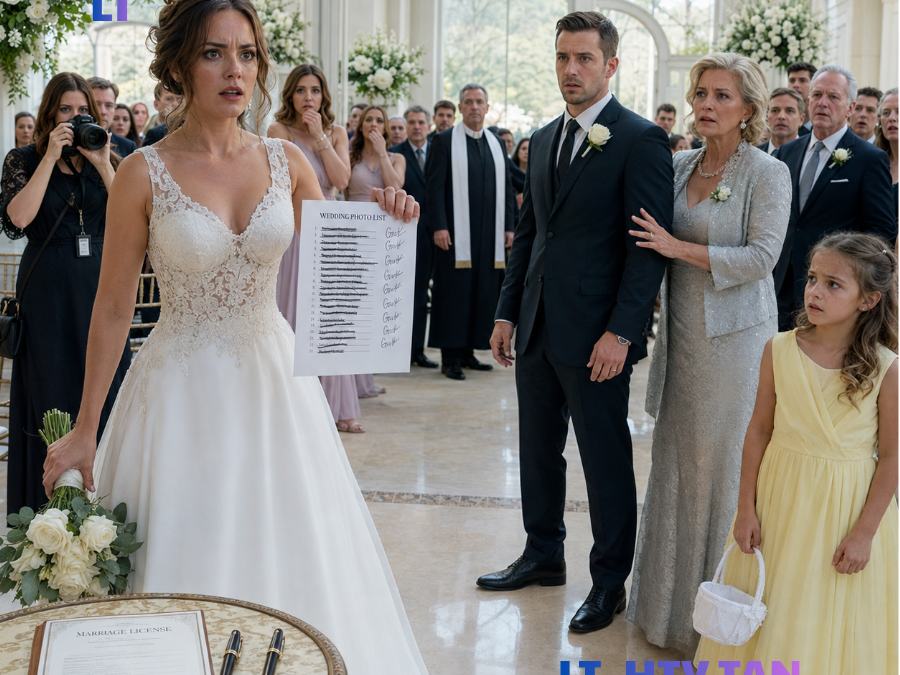
Twenty-six minutes before I was supposed to marry Grant Mercer in front of 170 guests, my photographer quietly showed me a page that changed everything. Every official family photograph including my eight-year-old daughter, Elsie, had been crossed out—and Grant’s initials were beside the changes. Then I learned his mother had removed Elsie from the flower-girl entrance, warned her not to “need so much attention,” and already discussed sending her away for longer weekends after our marriage. Grant called them scheduling adjustments. But beside an unsigned marriage license, he finally admitted the truth: he expected me to understand after the vows, when leaving him would be harder.
Part 1: My fiancé erased my daughter hours before our wedding.
“Brielle, did you know Grant removed your daughter from every Mercer family photograph?”
Dana Whitlock, our wedding photographer, turned the final shot list toward me.
Grant’s initials appeared beside six crossed-out lines.
Beyond the ballroom doors, my eight-year-old daughter stood alone in her pale yellow dress, holding the flower basket she had just been told she could no longer carry.
For one suspended second, I heard nothing except the soft crush of my bouquet stems beneath my fingers.
Then the world returned.
A violin tested the same bright note. Chairs scraped across the terrace. Someone dropped a metal tray in the kitchen.
“When was this changed?” I asked.
“Eight fourteen this morning,” Dana said. “It contradicted the version you approved, so I called Grant.”
My stomach tightened.
“And?”
“He confirmed every change.”
I read the crossed-out photographs one by one.
Bride, groom, and Elsie beneath the garden arch.
The new family beside the fountain.
Grant helping Elsie fasten the silver locket he had given her at Christmas.
Me, Grant, Elsie, and both sets of grandparents.
Even the photograph of Elsie holding a framed picture of Daniel—my late husband, her father—was gone.
Only one line remained beside my daughter’s name.
Bride with daughter. Three minutes. East window.
Below it, someone had added:
Mercer immediate family. Grant, Brielle, Darlene. Future legacy album.
“Photograph this page,” I told Dana. “Send it to me. Preserve the original email and every version.”
Dana didn’t ask why.
I removed my phone from the satin bag attached to my bouquet and sent two messages.
The first went to Kendra Ruiz, my maid of honor.
Bring Elsie to the blue dressing room. Stay with her.
The second went to Reverend Collins.
Do not begin the ceremony or sign anything until I speak with you.
Then Grant appeared.
His charcoal suit fit perfectly. A white rose rested against his lapel. He saw the paper in Dana’s hand, and something in his stride changed.
Not faster.
More careful.
“Brielle.”
He reminded me we were supposed to stay on opposite sides of the building.
Elsie turned toward him.
Hope appeared automatically in her face.
Then disappeared when he looked past her.
I crossed the corridor.
A young coordinator reached for Elsie’s flower basket. “Mrs. Mercer reassigned the flower entrance to Nora.”
Nora was Grant’s five-year-old niece.
I looked at Elsie. “Did anyone explain this?”
She shrugged.
Too calmly.
Too practiced.
“Grandma Darlene said the ceremony was getting crowded.”
Grant reached us.
“It’s a timing adjustment,” he said. “We’ll discuss it after the vows.”
I held up the shot list.
“Did you approve this?”
His eyes moved from me to Dana, then toward the guests gathering beyond the doors.
“This isn’t the place.”
“Yes or no fits anywhere.”
Grant lowered his voice. “My mother was worried about the schedule.”
Dana spoke quietly.
“Grant, I read every change to you on the phone. You confirmed the revised list exactly as written.”
Color climbed his neck.
Then Kendra arrived.
I pointed toward the blue dressing room. “Take Elsie. Don’t let anyone move her somewhere else.”
Kendra offered her hand.
Elsie looked at Grant again.
“Am I still allowed at the wedding?”
The question went through me cleaner than a knife.
Grant opened his mouth.
I answered first.
“You are not the person who needs permission.”
Inside the dressing room, Elsie sat beneath a gilt mirror while Kendra fixed the ribbon on her shoe.
I asked Kendra for one minute alone with her.
When the door closed, I sat beside my daughter.
“What happened this morning?”
Elsie stared at the silver ribbon around the basket.
“Mrs. Talbot said Nora looked more like a flower girl.”
“What did Grant say?”
“He said I should be helpful today.”
“What does helpful mean?”
Her thumbnail pressed into the ribbon.
“Not asking questions.”
I felt something inside me crack.
Then she whispered, “Grandma Darlene said big girls know when not to need so much attention.”
I stayed still.
Elsie’s eyes filled.
“She said someday you and Grant might have babies who carry his name. She asked if I wanted you to lose Grant because I couldn’t let you have one day.”
I took her hand.
“No adult gets to make you responsible for whether another adult stays. Not Grant. Not Darlene. Not me.”
She looked frightened.
“Is the wedding going to stop because of me?”
“No. Whatever happens next is my decision.”
I remembered the wedding program two weeks earlier.
Elsie’s name had mysteriously disappeared from the flower-girl line.
Grant blamed the printer.
Then Darlene removed Elsie and Daniel from the first version of the “Mercer Legacy Portraits.”
Grant apologized and restored them.
That night, I made him promise me something.
“Elsie is not a guest in our marriage.”
He looked directly into my eyes.
“She’s part of the commitment I’m making to you.”
I had saved that message.
I had also quietly kept my townhouse through August instead of ending the lease after the honeymoon.
And that morning, without telling Grant, I had packed an overnight bag for Elsie and me and placed it in Kendra’s car.
At the time, I had felt disloyal.
Now I understood.
Some part of me had already known I might need an exit.
Then Grant knocked on the dressing-room door.
“Brielle, guests are seated. We have twenty-six minutes.”
I sent Elsie with Kendra to the car.
At the end of the corridor, Elsie turned back.
I pressed two fingers to my lips, then to my heart—our private signal from the years after Daniel died.
She returned it.
Only after the garden door closed did I turn toward the man I was supposed to marry.
“Now,” I said, “tell me which lie you’re planning to keep.”
Part 2: An unsigned license exposes the future Grant planned secretly.
Grant led me into the small library where our marriage license waited beside two fountain pens.
Neither signature line had been touched.
He loosened one cuff.
“A few photographs changed. My mother is paying for the album. Nora’s substitution was about timing.”
I unfolded Dana’s list.
“Your initials.”
“I approved it while distracted.”
“Dana read every change aloud.”
He went silent.
“Restore them,” I said.
Three seconds.
That was all.
But it was enough.
“We can take extra pictures later.”
I stared at him.
“Why does Elsie get one photograph with me and none with you?”
“I didn’t study every line.”
“Dana read them to you.”
Grant looked toward the window.
Then I told him what Darlene had said to Elsie.
I waited for shock.
None came.
His eyes closed briefly.
“My mother’s phrasing was bad.”
“You knew?”
“She told me about the conversation.”
My voice dropped.
“She told an eight-year-old she needed less of her mother because future babies would carry your name.”
“That’s not what she meant.”
“What did she mean?”
Grant exhaled.
“That marriage changes a household.”
There it was.
Not confusion.
A plan.
For three years, I had translated Grant’s words into their kindest possible meaning.
I stopped.
“You wanted Elsie prepared for less of me.”
“No.”
“Then explain.”
He walked to the window.
“You and I have never had a normal beginning. Every plan included school, grief counseling, Daniel’s parents, or whether Elsie felt excluded.”
Those words hurt because some of them were true.
There had been canceled dinners when Elsie was sick.
A vacation shortened after she woke crying for her father.
Our anniversary spent beneath paper stars at her school concert.
But Grant had met me as a mother.
He knew.
He remembered Elsie’s cereal. Sat through rainy soccer games. Let her draw Father’s Day cards for him.
Yet whenever loving her became difficult, his affection became conditional.
During her pneumonia, he brought soup and a stuffed penguin, then left because her coughing disturbed his sleep.
When Daniel’s parents visited, Grant later needed hours of reassurance that nobody considered him a replacement.
“You were wonderful when loving Elsie was easy,” I said.
Pain flashed across his face.
Then I asked the only question that mattered.
“Would Elsie be an equal member of the family we build? Equal to any biological child we might have?”
Grant looked toward the desk.
“It isn’t a fair comparison.”
The room changed.
Quietly.
Completely.
“I would be our child’s biological father,” he said. “Elsie already has a father.”
“I never asked you to replace Daniel. I asked you not to rank a living child below a hypothetical one.”
“Different bonds don’t mean mistreatment.”
I thought of Elsie asking whether she was still allowed at the wedding.
“You already mistreated her.”
The library door opened.
Darlene entered wearing silver.
She didn’t apologize.
She complained that the quartet had already played the seating music twice.
I asked her directly.
“Did you tell Elsie to need less attention so I wouldn’t lose Grant?”
“I reassured an anxious child.”
“You removed her from the ceremony.”
“She was overwhelmed.”
“No. You removed her.”
Grant stepped between us.
“This is exactly why I wanted this discussion postponed.”
I looked at him.
“Until after the vows?”
Silence.
Darlene began talking about tradition. About Grant entering a family “built around another man.” About elderly relatives being confused by blended families.
“If we marry, Elsie is his family,” I said.
“Legally,” Darlene replied. “Emotionally, that takes time.”
I looked at Grant.
He stared at the carpet.
Then another memory returned.
Grant had promised his upstairs study would become Elsie’s bedroom.
But no paint had been ordered.
Her furniture had been delayed.
Recently, Grant suggested she use the downstairs guest room instead—the small room beside the laundry area.
“We first need to know what arrangement works,” he said.
“For whom?”
Darlene suddenly mentioned Daniel’s parents.
“They want more time with Elsie anyway.”
“That isn’t true.”
Grant finally spoke.
“Maybe occasional longer weekends. So we can establish our marriage.”
My skin went cold.
“You already discussed sending her away?”
“We hadn’t decided anything.”
“Because you never asked me.”
“I knew you would hear rejection instead of compromise.”
He said it softly.
And suddenly I understood why he had hidden everything.
Grant wasn’t uncertain about his plan.
He simply believed marriage would make it harder for me to say no.
Part 3: I canceled the ceremony when love became leverage.
Outside the library, footsteps hurried through the corridor.
Darlene opened the door a few inches, told the planner there would be a short delay, and closed it again.
Then she turned toward me.
“One hundred seventy guests are waiting. Walk down the aisle. Take whatever photographs you want. Discuss bedrooms tomorrow.”
For one terrible moment, I saw how easy that would be.
Restore Elsie as flower girl.
Smile.
Eat dinner.
Handle the disaster privately later.
That was how I survived after Daniel died.
One practical problem at a time.
But marriage wasn’t another crisis to finish for everyone else’s convenience.
The vows would not make today’s truth smaller.
They would bind me to it.
“I’m not walking down the aisle.”
Grant stopped moving.
Darlene stared at me.
“You’re canceling a wedding over photographs?”
“No. I’m canceling because Grant believes loving me gives him permission to reduce my daughter’s place in our life. The photographs only proved he had started.”
“Take ten minutes,” Grant said.
“I gave you three years.”
“You know me better than this.”
“I knew the version of you who loved Elsie when loving her cost very little. Today, including her cost your mother’s approval and a perfect album.”
His face hardened.
“That’s vicious.”
“It’s specific.”
Darlene reached toward the marriage license.
“This will create a legal mess.”
“Nothing has been signed.”
I picked up both fountain pens and placed them inside the desk drawer.
That tiny sound felt louder than the orchestra outside.
Grant watched me.
Then he tried one final argument.
“Think about what this will do to Elsie. She’ll believe the wedding stopped because of her. She could carry that guilt for years.”
I turned slowly.
There it was again.
The same fear Darlene had already used against my daughter.
“You’re asking me to marry you so Elsie won’t blame herself?”
“I’m trying to protect her.”
“No. You’re using her guilt to protect yourself.”
Grant went pale.
“She’ll miss me.”
“I know.”
My anger cracked, and grief came through.
Because Elsie would miss him.
So would I.
Leaving the wrong person doesn’t erase every good memory.
It simply refuses to build a future around a condition that never should have existed.
“A child cannot destroy a family that never made room for her,” I said. “If Elsie grieves you, I’ll help her. I will not teach her to purchase your presence by becoming smaller.”
Grant finally looked afraid.
“What do you want?”
“I want you to accept my answer.”
“I’ll restore the list. I’ll clear the study tonight.”
“A bedroom prepared under threat isn’t belonging.”
I opened the library door.
The planner, Reverend Collins, and Grant’s best man stood outside.
Beyond them, guests were turning toward the disturbance.
“Reverend,” I said, “the ceremony is canceled. Please call it a private family matter. Do not mention Elsie.”
He nodded.
Grant followed me into the corridor.
“You owe me another private conversation before you humiliate me publicly.”
Nearby guests heard him.
I didn’t raise my voice.
“We just had one. You didn’t like the answer.”
Then I walked away.
I crossed the East Garden and ran toward Kendra’s car.
Elsie sat in the backseat with the flower basket on her lap.
When I opened the door, she looked at me.
“Is it over?”
“Yes.”
Her face collapsed.
“I’m sorry. I could have stayed out of the pictures.”
I climbed beside her and took the basket away.
“No. Listen to me. This decision is mine.”
“Grant’s going to blame me.”
“He knew what he promised me. He changed it because he thought I would be too embarrassed to stop the wedding.”
Elsie looked down.
“Did he say he didn’t want me?”
I refused to comfort her with a lie.
“He wanted to decide when you counted as family. I will never let another person make that decision.”
Her voice was barely audible.
“I still like him.”
I swallowed.
“You’re allowed to. I still love him.”
She looked surprised.
“Love doesn’t make every choice someone makes safe.”
Then Elsie leaned against my arm.
Halfway home, I removed my engagement ring.
A pale circle remained beneath it.
I zipped the ring into my satin bouquet bag.
I thought the worst truth had already been revealed.
The next morning, Daniel’s parents arrived—and told me Darlene had contacted them weeks before the wedding.
Part 4: The secret plan began long before the wedding morning.
Margaret Sutton hugged Elsie first.
Peter filled our refrigerator before asking a single question.
When I finally explained what had happened, Margaret closed her eyes.
“Darlene called us last month.”
I put down my coffee.
“About what?”
“She asked whether we could take Elsie for more weekends after the wedding. She said you and Grant would need privacy.”
My heartbeat slowed.
Not from calm.
From certainty.
Margaret had refused to change anything without speaking to me.
She thought Darlene was asking about honeymoon arrangements.
But now the final piece settled into place.
Grant and Darlene had tested their plan before the wedding.
When Daniel’s parents didn’t volunteer, Grant simply planned to introduce the idea after I moved into his house.
After I ended my lease.
After I signed the marriage license.
Elsie believed the cancellation was her fault for days.
She woke from dreams where guests waited while she searched for her missing flower basket.
Sometimes she asked whether Grant sounded sad.
“Yes,” I told her. “He is sad.”
“Should I call him?”
“No. Adults can be sad about consequences they created. You don’t have to make his sadness disappear.”
Other days, her guilt turned to anger.
“He promised to teach me to ride the big bike!”
She kicked a kitchen chair.
“Now I can’t learn because you canceled everything.”
It hurt.
But I didn’t defend myself.
“You lost something too. You’re allowed to be angry with me and still be safe with me.”
She burst into tears.
I sat on the floor until she crawled into my arms.
Our family counselor helped Elsie separate three truths.
Grant had sometimes cared for her.
Grant had also hurt her.
And my decision belonged to me alone.
When the counselor asked what belonging felt like, Elsie thought for several seconds.
“Not having to be helpful all the time.”
I wrote that sentence in the notebook beside my bed.
Nine days after the wedding, Grant appeared at my townhouse carrying a thick folder.
He had restored every photograph.
He booked Dana for another session.
He promised a smaller ceremony.
No guests.
No Darlene.
No interference.
I left the folder unopened.
“What changed about the way you see Elsie?”
“I understand the pictures hurt her.”
“That isn’t what I asked.”
His grip tightened.
“I love her.”
“Would she belong in our home as fully as a biological child?”
He still couldn’t answer.
“I can’t manufacture a feeling to satisfy a test.”
“Then don’t ask me to manufacture trust.”
Grant blamed his mother.
“She pushed the album. She changed the flower entrance. She called Daniel’s parents.”
“But you approved the list. You kept the study. You hid the weekends.”
Silence.
Finally, he admitted it.
“I thought once we were married, we’d have time to work through everything.”
Meaning after leaving became harder.
“I didn’t think you would stop everything.”
“I know.”
He asked to see Elsie.
“Not tonight. If she wants a supervised goodbye later, we’ll decide with her counselor.”
I removed the satin bag from my cardigan pocket.
The engagement ring dropped into his palm with a soft metallic tap.
He stared at it.
Then at my townhouse.
“You kept this place because you never believed in us.”
“No. I kept it because part of me noticed you felt safest when Elsie and I had fewer choices.”
Grant left.
The restored photography plan remained on my porch rail.
I put it in the recycling bin.
But the silver locket he had given Elsie stayed on my mantel.
Months later, she would decide what to do with it herself.
And what she eventually said to Grant was something neither he nor I would ever forget.
Part 5: One final photograph revealed the family I truly chose.
Darlene never created a public scandal.
She used phone calls instead.
Relatives began repeating that Elsie’s anxiety and my unresolved grief had destroyed a patient man’s wedding.
An aunt messaged me while Elsie and I were choosing cereal.
Did you really sacrifice a loyal husband over one traditional photograph?
I locked my phone.
That night, I drafted three explanations.
Each required exposing Elsie’s private pain.
I deleted them all.
Instead, I answered everyone the same way.
The wedding ended because of decisions made by the adults involved. Elsie is not responsible, and I will not discuss her private experience.
Some people apologized.
Others preferred Darlene’s version.
I discovered I didn’t need every witness to understand.
Dana preserved the photography records.
Mrs. Talbot emailed confirmation that Darlene requested the flower-girl substitution and Grant approved it.
I saved the documents.
Then I stopped collecting proof.
I already knew what happened.
Two weeks later, Kendra and I retrieved my boxes from Grant’s house.
The upstairs room promised to Elsie was still his study.
No paint.
No furniture.
Under a stack of mail, I found the paint card Elsie had chosen.
Lavender.
Pale green.
Tiny stars drawn beside both colors.
Kendra lifted it.
“Want this?”
“Yes. It belongs to Elsie, not this room.”
Back at the townhouse, Elsie taped it above her desk.
“Can we paint my room green?”
“It’s a rental.”
She frowned.
I smiled for the first time that day.
“Removable wallpaper exists.”
Margaret arrived with tools.
Peter measured everything badly.
Kendra brought pizza.
Elsie got adhesive on her hands and talked too loudly.
Nobody told her she was taking up too much space.
Months later, Elsie asked for one supervised goodbye with Grant.
They met at her counselor’s office.
Grant arrived without gifts.
“I’m sorry I made you feel unwelcome,” he told her.
Elsie held the silver locket he had given her.
“You didn’t make me feel it,” she said. “You did it.”
Grant’s eyes filled.
“You’re right.”
She placed the locket on the table.
“I don’t want this anymore.”
He didn’t ask her to keep it.
The meeting lasted twelve minutes.
On the drive home, Elsie cried.
Then she asked for grilled cheese.
Both things were allowed to be true.
Six months later, she had one spoken line in her school music program.
I arrived early enough for the first row.
Margaret, Peter, and Kendra sat beside me.
When Elsie stepped onto the stage, her eyes searched the audience.
They found me.
Her shoulders relaxed.
She delivered her line so loudly several parents laughed and smiled.
Afterward, she ran toward me.
“Was I too loud?”
I hugged her.
“Not even close.”
That night, Dana emailed me.
She had finally completed the private gallery from the canceled wedding.
Most photographs showed flowers, empty chairs, and arriving guests.
Then one image stopped me.
It had been taken through the half-open ballroom doors minutes before Dana showed me the altered shot list.
Elsie stood alone in the East Hall.
Flower basket against her yellow dress.
Her face frightened.
Across the corridor, I was walking toward her.
My bouquet was lowered.
My eyes were fixed completely on my daughter.
Grant appeared behind us.
Blurred.
Almost irrelevant.
The file was titled:
East Hall, 11:22 a.m.
I called Elsie over.
She studied the image.
“I look scared.”
“You were.”
She pointed at me.
“You look angry.”
“I was that too.”
Then she stared at the distance between us.
“You were coming to get me.”
“Yes.”
We printed the photograph and hung it beside our front door.
It became the only wedding photograph I kept.
Not because it showed the day my marriage failed.
Because it showed the exact moment the truth became impossible to ignore.
There was no bride walking toward a groom.
There was a mother crossing a room toward her daughter before anyone could teach that child she had to disappear to be loved.
And years later, whenever I passed that photograph, I remembered the final truth Grant had never understood.
Family is not the person who asks you to become smaller so they can stay.
Family is the person who crosses the distance when they see you disappearing.
THE END.
All the characters and events in this story are fictional and created for the purpose of storytelling and entertainment.
If this story brought you a moment of reflection, comfort, or curiosity, then it has truly fulfilled its purpose.
Thank you sincerely for reading. Your feedback and support are always appreciated and inspire me to keep sharing more stories with you.








