My Fiancé Removed My Daughter From Our Wedding Photos—So I Removed Myself From the Ceremony
My Fiancé Removed My Daughter From Our Wedding Photos—So I Removed Myself From the Ceremony
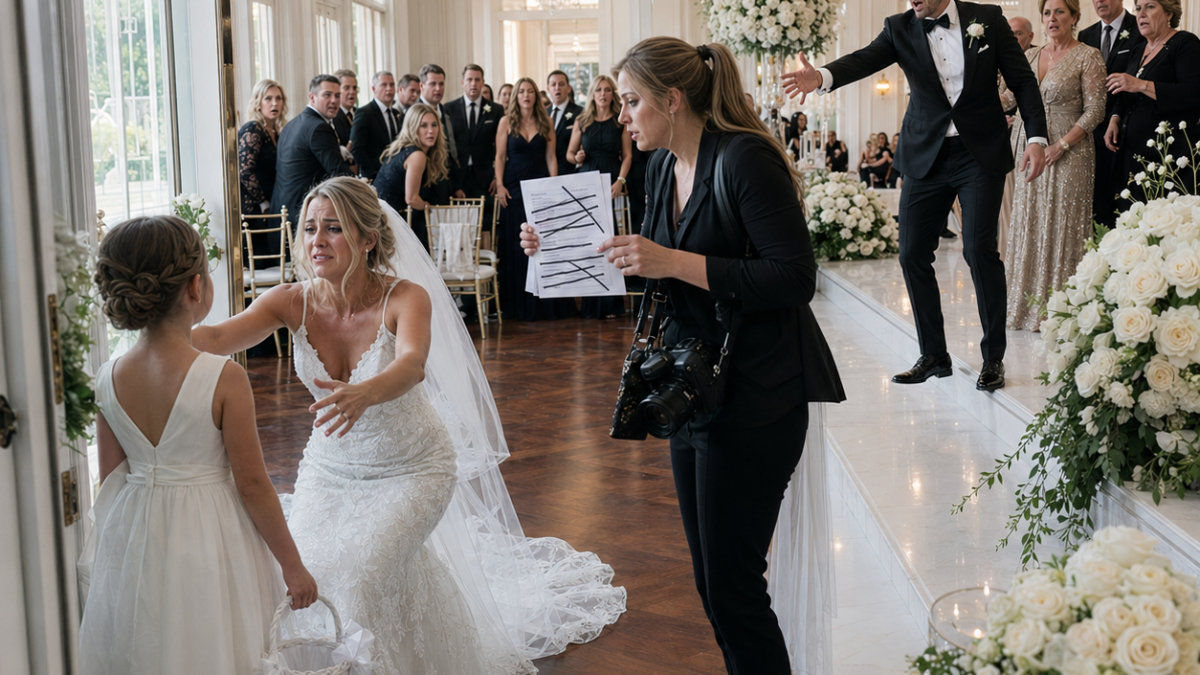
Brielle, did you know Grant removed your daughter from every Mercer family photograph? Dana Whitlock, the wedding photographer, turned the final shot list toward Brielle Sutton. Grant Mercer’s initials appeared beside six crossed-out lines in the revised file he had returned. Beyond the ballroom doors, 8-year-old Elsie stood alone with the flower basket she had been told not to carry.
For one suspended second, Brielle heard nothing except the soft crush of her own bouquet stems beneath her fingers. Then the room returned all at once. A violin tested the same bright note beyond the glass doors. Chairs scraped across the terrace. Someone in the kitchen dropped a metal tray, and the sharp sound traveled through the old conservatory.
Brielle lowered the bouquet and asked when the list had changed. Dana named 8:14 that morning. The revised version contradicted Brielle’s approved plan, so Dana had called Grant. He confirmed every change. The paper smelled faintly of warm toner. Brielle read the crossed-out photographs one by one. Bride, groom, and Elsie beneath the garden arch.
The new family beside the fountain. Grant helping Elsie fasten the silver locket he had given her at Christmas. Brielle and Grant with Elsie and both sets of grandparents. Even the photograph of Elsie holding the framed picture of her late father had been removed. Only one line remained beside her daughter’s name.
Bride with daughter, 3 minutes, east window. Below that, a new group had been added. Mercer immediate family. Grant, Brielle, Darlene, future legacy album. Brielle asked Dana to photograph the page, send it immediately, and preserve the original email with every version. Dana did not ask why. She lifted her camera phone.
Brielle opened the small satin bag attached to her bouquet and removed her own phone. Her hands were cold, but they did not shake. She sent two messages. The first went to Kendra Ruiz, her maid of honor. Bring Elsie to the blue dressing room. Stay with her. The second went to the officiant. Do not begin the ceremony or sign anything until I speak with you.
Grant appeared at the far end of the corridor before either reply arrived. His charcoal suit fit him with the precision of a promise. A white rose sat against his lapel. He saw the page between Brielle and Dana and his stride changed. Not faster, more careful. Grant called Brielle’s name and reminded her that they were supposed to remain on opposite sides of the building. Elsie turned toward him.
Hope rose automatically in her face, then faded when he looked past her. Brielle crossed the corridor and held out her hand to Elsie. Elsie lifted the flower basket. A young coordinator blocked her path. The coordinator explained that Darlene had reassigned the flower entrance to her granddaughter and reached for the basket.
Brielle kept her eyes on Elsie and asked whether anyone had explained the decision. Her daughter gave a small shrug. The movement was too practiced for a child in a pale yellow dress. Grandma Darlene said the ceremony was getting crowded, Elsie murmured. Grant reached them and called the substitution a timing adjustment they could discuss after the vows.
Brielle asked whether he had approved the photography changes. His gaze touched Dana, the printed page, and the guests gathering beyond the doors. He refused to answer in the corridor. Brielle insisted that a yes or no would fit anywhere. Grant lowered his voice and blamed his mother’s concern about the schedule.
Dana stood very still and clarified that Grant had confirmed the revised list exactly as sent. Color climbed Grant’s neck. Kendra came around the corner in a deep green dress, moving quickly without running. She had been Brielle’s closest friend since nursing school. Back when both women had lived on vending machine coffee and 4 hours of sleep.
Her eyes swept over Elsie, then Brielle indicated the blue room. Brielle asked Kendra not to let anyone take Elsie anywhere else. Kendra offered Elsie her hand. The child looked at Grant again. “Am I still allowed at the wedding?” she asked. The question cut through Brielle more cleanly than any accusation could have done. Grant opened his mouth, but Brielle answered first.
“You are not the person who needs permission,” she said. “Go with Aunt Kendra. I will be there in 1 minute.” Elsie obeyed. She always obeyed when adults made a room feel dangerous. Brielle watched until the blue door closed behind her daughter. Then she gave Grant 60 seconds to explain. He denied removing Elsie from the wedding.
Brielle pointed to the flower entrance and every deleted family photograph. Grant answered that Elsie still had a private portrait with her mother. The answer was so revealing that Grant seemed to hear it only after it left him. Dana looked down at the camera hanging from her neck. Brielle folded the shot list and told him she would speak with her daughter before returning for the truth.
Grant reached toward her elbow. She stepped away before he touched her. Grant warned her not to turn a scheduling problem into a public disaster. Brielle told him to use the time to decide which lie he intended to keep. She walked into the blue dressing room and locked the door behind her. Elsie sat on a velvet bench beneath a gilt mirror.
Kendra knelt before her repairing a loose ribbon on one shoe. The flower basket rested on the carpet between them. Without the music and staff radios, the room felt unnaturally quiet. It smelled of face powder, old wood, and the lavender water Kendra had sprayed over the bridesmaids dresses that morning.
Brielle set her bouquet on the dressing table. Three white petals fell beside a row of untouched champagne glasses. She asked Kendra to give them a moment. Her friend squeezed Elsie’s ankle, then rose and promised to wait outside. When they were alone, Brielle sat beside her daughter and gently asked what had happened that morning.
Elsie examined the silver ribbon around the basket handle. Mrs. Talbot had said Nora would go first because she was five and looked more like a flower girl. Mrs. Talbot was the coordinator who had blocked her in the corridor. Nora was Darlene’s granddaughter through Grant’s older sister.
Grant had not been present then. When Brielle asked what he said later, Elsie pressed one thumbnail into the ribbon. He said I should be helpful today. Brielle felt the old instinct rise inside her. Explain it gently. Find the harmless interpretation. Preserve the day until everyone is calmer. That instinct had carried her through three years with Grant.
It had also brought Elsie to a wedding where she was asking whether she was allowed to exist. Brielle asked what helpful meant. Elsie said it meant not asking questions. There it was. Brielle placed her hand palm up between them. Elsie looked at it for several seconds before laying her smaller hand inside. Brielle asked whether anyone had discussed the photographs before that morning.
Elsie’s fingers curled. Elsie admitted that Darlene had described them as grown-up photographs. She claimed Brielle deserved one day that belonged only to her and Grant. When Brielle asked what else had been said, Elsie first insisted there was nothing. The word came too quickly. Brielle waited. She had learned as a mother that silence could make room without becoming punishment.
Outside the door, someone rolled a garment rack down the corridor. Its wheels clicked over the floorboards like a slow clock. Elsie swallowed. She said big girls know when not to need so much attention. Brielle kept breathing. Elsie then revealed that Darlene had mentioned future babies carrying Grant’s name.
Darlene had not directly demanded secrecy, but her meaning had been clear. Elsie’s eyes filled, but she did not let the tears fall. She said you had been alone for a long time. She asked if I wanted you to lose Grant because I couldn’t let you have one day. The music outside changed. The violinist began the first bars of the processional, then stopped when someone corrected him.
Brielle stared at her daughter’s hand. A faint blue mark crossed one knuckle where she had gripped the flower basket too tightly. No adult gets to make you responsible for whether another adult stays. Brielle said, Not Grant. Not Darlene. Not me. Elsie worried that the wedding might stop because of the pictures.
Brielle explained that any cancellation would be her own decision after she learned what the changes proved. Elsie did not have to solve the situation or manage Grant’s anger. The sentence sounded simple. Brielle wished she had believed it months earlier. Two weeks before the wedding, the first printed program had arrived at their townhouse.
Brielle had opened the box on the kitchen floor while Elsie practiced tying ribbons around chair backs. Elsie’s name was missing beneath the flower girl line. Grant blamed the printer. He kissed the top of Elsie’s head, called it a ridiculous mistake, and emailed the planner while Brielle watched. A corrected proof arrived that evening.
Three days later, Dana asked about the phrase Mercer Legacy Portraits. Her original list included Brielle, Grant, Elsie, Darlene, and a framed photograph of Daniel Sutton, Brielle’s late husband. Darlene’s revision removed both Elsie and Daniel. Grant had sighed when Brielle confronted him. He said his mother wanted one traditional album for elderly relatives who found blended families confusing.
Brielle told him there would be no family photograph that treated Elsie as an embarrassing footnote. He apologized. He restored every photograph and sent Brielle the final confirmation himself. That night, Brielle had made Grant state clearly that Elsie was not a guest in their marriage. He promised that she was part of the commitment he intended to make.
Brielle had saved that message. She had also kept her townhouse through the end of summer, though Grant wanted her to end the lease after the honeymoon. She said the overlap would make moving easier. The truth was harder to admit. Grant’s promises had begun to feel strongest immediately after Brielle caught him breaking one.
She had packed an overnight bag for herself and Elsie that morning. It sat in Kendra’s car beside their medications, spare clothes, and Elsie’s favorite stuffed rabbit. Brielle had felt disloyal while packing it. Now she felt grateful to the frightened part of herself that had refused to arrive without an exit. Someone knocked three times.
Grant called through the door that guests were being seated and demanded a conversation. Elsie tensed. Brielle told Elsie to go with Kendra to the car. Elsie wanted to know whether her mother was coming and what would happen if Grant apologized. Brielle crouched until their eyes were level. An apology matters only when the person understands what they chose.
I need to find out what Grant chose. She opened the door. Kendra waited with her arms folded. Grant stood several feet behind her, his jaw tight. Brielle handed Kendra the car key from her satin bag. She instructed Kendra to use the east garden, wait in the locked car, and call if anyone followed. Kendra offered to stay for the confrontation, but Brielle wanted Elsie away from it.
Grant complained that sending Elsie away made the situation look worse. Brielle met his eyes. You already taught her that her presence makes things worse. You will not do it again. Elsie took Kendra’s hand. At the end of the corridor, she turned back. Brielle pressed two fingers to her lips and then to her heart, their private signal from the years after Daniel died.
Elsie returned it. Only after the garden door closed did Brielle face the man she had planned to marry. Grant glanced toward the ballroom and reminded Brielle that only 26 minutes remained. She refused to waste them discussing the clock. He led her into a small library used for signing the marriage license.
The document waited on a leather desk beside two fountain pens. Neither signature line had been touched. Brielle remained near the door. Grant loosened one cuff as if a tight sleeve were the problem. He described the changes as a few traditional photographs requested by the woman paying for the album. He blamed Nora’s substitution on timing and Darlene’s management of morning details.
Brielle unfolded Dana’s list and pointed to his initials. Grant claimed he had approved the schedule while distracted, not a statement about Elsie’s place in his life. For years, Brielle had translated Grant’s words into their kindest possible meaning. She did not do it now. Brielle asked why Elsie had one photograph with her and none with Grant.
He insisted he had not studied every line. When she noted that Dana read the changes aloud, he claimed distraction. Brielle told him to restore them. Grant’s silence lasted less than 3 seconds. It was still long enough. Grant proposed taking extra pictures later and accused Brielle of frightening a child over a schedule.
She stressed that Elsie was already afraid before she learned anything was wrong. Brielle told him what Darlene had said at the rehearsal. She watched his face for surprise. None came. His eyes closed briefly. Rather than showing surprise, Grant criticized his mother’s phrasing and blamed Elsie’s literal understanding.
Darlene had told him about the conversation. They both thought Elsie needed to understand that marriage would change the household. The room seemed to tilt without moving. Brielle heard the meaning clearly. They wanted an 8-year-old to prepare for less of her mother. Grant denied it, so she made him explain himself. Grant walked to the window.
Guests in summer dresses crossed the lower garden, guided by ushers who had no idea the bride was 20 ft away deciding whether their work mattered. “You and I have never had a normal beginning,” Grant said. “Every plan included school, grief counseling, Daniel’s parents, or whether Elsie felt excluded.” He claimed to love her, yet wanted a relationship that was not always measured against what she needed.
His complaint brushed against real memories, which made it more dangerous. There had been canceled dinners when Elsie was sick and a shortened vacation after she woke crying for her father. Their second anniversary ended beneath paper stars at a school concert because Elsie had been given a solo. Parenthood shaped every day of Brielle’s life.
Grant had known that from the fall festival where they met, when Elsie spilled cider on his shoes and he made her laugh by blaming the cup. He remembered her favorite cereal and sat through soccer games in cold rain. He never asked her to call him dad. Those acts had mattered, and Brielle would not erase every good day simply because she could finally see its limit.
The limit appeared whenever affection became inconvenient. During Elsie’s pneumonia, Grant brought soup and a stuffed penguin, then left after 40 minutes because her coughing disturbed his sleep. When Daniel’s parents visited, he later demanded hours of reassurance that no one considered him a substitute. He enjoyed Father’s Day cards and school drawings that included him.
He was less willing to share exhaustion, grief, or space with the child who made them. Brielle reminded him that she had been a mother when they met. Grant said knowing that differed from living it. She answered that he often went home when the difficult parts began. Hurt flashed across his face, but he did not deny it. Only weeks earlier, Elsie had asked whether Daniel’s photograph could stand near Brielle at the wedding.
Grant agreed in front of her, then called the request morbid after she went to bed. Brielle had named each moment an adjustment problem. She had believed patience could turn affection into commitment. Now Grant stood beside an unsigned marriage license and asked her to formalize the difference. Brielle acknowledged that the photographs and flower entrance could be restored.
Then she asked whether Elsie was an equal member of the family Grant expected them to build. When she compared Elsie with any future child they might have, Grant looked toward the desk. It is not a fair comparison. The answer entered quietly. It still changed the room. Grant explained that he would be the biological father of their child, while Elsie already had a father.
Brielle had never asked him to replace Daniel. She had asked him not to rank a living child below a hypothetical one. Grant defended the distinction as honest and claimed different bonds did not mean mistreatment. Brielle thought of Elsie waiting behind the ballroom doors, afraid to carry a basket. You already did, Brielle said.
Grant accused her of using one confused morning to judge everything he had done. Brielle asked what any of those acts gave him the right to erase today. He flinched. The library door opened without a knock. Darlene Mercer entered in a silver dress with a corsage pinned high on one shoulder. She carried herself with the controlled urgency of someone arriving to correct a social error.
Darlene announced that the quartet had played the seating music twice and guests were noticing. Brielle asked whether Darlene had told Elsie to need less attention so her mother would not lose Grant. Darlene called it reassurance for an anxious child. She believed children needed to learn that some days were not centered on them. Brielle noted that Elsie’s role required only a brief walk in family photographs.
Darlene falsely claimed she had become overwhelmed while Brielle named what happened. Darlene removed her. Grant stepped between them and complained that this was why he wanted the discussion postponed. The sentence exposed more than he intended. Breille looked at him. Breille asked whether he meant after the vows, when she was already his wife.
Grant offered no answer. He did not answer. Darlene argued that Grant had bent over backward to fit into a family built around another man. A few photographs belonging to his side did not seem cruel to her. Elsie would be his side if we married, Breille replied. Darlene distinguished legal family from emotional family and said the latter took time.
Breille looked at Grant again. He stared at the carpet. Breille turned to the study Grant had promised as Elsie’s bedroom. His desk and full closet remained there. No paint had been ordered and he had delayed her furniture until August. Grant now said she could use the downstairs guest room after the honeymoon.
The guest room sat beside the laundry area. It had no desk and its narrow window faced a retaining wall. Grant’s study was upstairs beside the primary bedroom with morning light and space for Elsie’s books. Breille reminded him that Elsie had chosen a wall color. Grant said they first needed to know what arrangement worked. Darlene then claimed Daniel’s parents wanted more time with their granddaughter.
Breille felt something cold settle beneath her ribs. Margaret and Peter Sutton adored their granddaughter. They took Elsie for one weekend each month and several days during summer. They had never requested a larger arrangement. Breille corrected the lie. Daniel’s parents had offered to help during the honeymoon, not requested a new schedule.
Grant carefully proposed occasional longer weekends so the newlyweds could establish their marriage. He had never decided how many because he had never discussed the plan with Breille. “I knew you would hear rejection instead of compromise.” he admitted. The admission was almost soft. Breille understood then that Grant had not hidden his thoughts because he doubted them.
He hid them because he expected marriage to reduce her ability to refuse. Brielle understood that he planned to introduce the idea after she moved into his house. Grant called it a calm conversation after the wedding pressure. She called it a conversation delayed until after she surrendered her home and signed the license. Grant glanced at the document as though he had only now noticed it.
Darlene accused Brielle of distrusting the marriage by keeping her rental. Brielle answered that keeping it was the first honest thing her fear had told her to do. Darlene called fear selfish and Brielle named entitlement as another form of selfishness. The hallway outside filled with hurried footsteps. Someone knocked and called Grant’s name.
Darlene opened the door a few inches, told the planner there would be a short delay, and closed it again. When she turned, her composure had thinned. Darlene invoked the 170 waiting guests. She urged Brielle to walk down the aisle, take any photographs she wanted, and postpone the bedroom discussion until tomorrow.
Brielle looked at the untouched pens. For a moment, she saw the easiest path. Restore Elsie as flower girl. Smile through the ceremony. Let the guests eat the meal. Deal with Grant in private after everyone left. That was how Brielle had survived the first year after Daniel died. She postponed her own collapse until Elsie slept.
She solved one practical problem at a time. She taught herself that a crisis could be carried if she divided it into smaller pieces. But marriage was not an event she could finish for other people’s convenience. The vows would not make today’s truth smaller. They would bind her to it. “I am not walking down the aisle,” she said.
Grant went motionless. Darlene insisted that photographs could not justify canceling a wedding. Brielle explained that Grant believed loving her allowed him to reduce her daughter’s place. The photographs merely showed that he had begun. Grant urged her to take 10 minutes, but Brielle had already given him 3 years.
He claimed she knew him better than this. I knew the version of you that loved Elsie when loving her cost very little, Brielle said. Today, including her cost your mother’s approval and a perfect album. You chose the album. His face hardened. Grant called the accusation vicious. Brielle called it specific. Darlene reached for the marriage license and warned of a legal mess.
Brielle observed that nothing had been signed. Brielle picked up both fountain pens and placed them inside the desk drawer. It was a small action, but it quieted the last part of her that still expected the ceremony to resume. Grant watched the door close. Grant warned that Elsie would believe the cancellation happened because of her. Brielle turned slowly.
Believing he had found the argument that would reach her, he described the guilt Elsie might carry for years. Finishing the ceremony, he claimed, would protect her. Brielle answered that the same fear had already been used to keep Elsie quiet. Grant denied speaking to the child himself, but he had approved the result and now presented his fatherly role as something Elsie would lose.
There was the final claim. Not love offered freely, but affection presented as leverage. Brielle felt grief rise through her anger. Elsie would miss him. So would she. Leaving the wrong person did not erase every good memory or protect them from pain. It protected them from building a future around a condition that should never have existed.
A child cannot destroy a family that never made room for her, Brielle said. If Elsie grieves you, I will help her. I will not teach her to purchase your presence by becoming less visible. Grant’s expression changed. For the first time, he looked afraid rather than offended. Grant asked what she wanted.
Brielle wanted him to accept her answer. He offered to fix the list and clear the study that night, but the list no longer controlled her decision. A bedroom prepared under threat was not belonging. Darlene made a low sound of disbelief and accused Brielle of leaving no solution. Brielle answered that a solution had existed. Grant could have meant his earlier promise.
Brielle opened the library door. The planner, the officiant, and Grant’s best man stood in the hallway. Behind them, the first rows of guests had begun turning toward the disturbance. Brielle told Reverend Collins that the insincere ceremony was canceled. She asked him to cite a private family matter, never mention Elsie, and allow guests to stay for the meal if the venue agreed.
The officiant recovered from his surprise and accepted the task. The planner nodded quickly, already shifting into practical motion. Grant came into the corridor behind Brielle and insisted she owed him a private conversation before any announcement. Several nearby guests heard him. Heads turned.
Brielle did not raise her voice. “We just had one. You did not like the answer.” She handed Dana the folded shot list and requested that every photograph and message remain private. Dana gave her word. Brielle walked toward the East Garden without looking into the ballroom. The processional music stopped behind her. Outside, summer heat pressed against Brielle’s bare shoulders.
The garden path curved behind a hedge of white roses, hiding her from the terrace. Gravel caught beneath her satin shoes. She did not realize she was running until she reached the parking lot. Kendra’s blue sedan waited beneath a maple tree. Elsie sat in the backseat with the basket on her lap. Kendra lowered the window as Brielle approached.
Elsie asked whether it was over. Brielle opened the rear door and climbed in beside her. The skirt of her wedding dress filled the footwell and trapped warm air around them. Brielle confirmed that the wedding was cancelled. Elsie’s face emptied. Elsie apologized and said she could have stayed out of the pictures. Brielle took the basket from her and rejected the apology.
The decision belonged to Brielle and the conflict had never been only about photographs. Elsie still feared Grant would blame her. Brielle glanced at Kendra. Her friend turned the air conditioning higher and looked away giving them privacy inside a car barely large enough to hold it. Brielle explained that Grant knew what he had promised.
He changed it because he expected embarrassment to keep her from stopping the wedding. Elsie picked at one loose petal and asked whether Grant had said he did not want her. The question demanded care, not comfort purchased with a lie. Brielle carefully explained that Grant wanted to decide when Elsie counted as family. She would never allow anyone else to make that decision. Elsie looked down.
“I still like him.” she whispered. Brielle assured her that affection was still allowed. Tears burned behind her eyes as she admitted that she still loved him, too. Love did not make every choice a person made safe. For several moments, Elsie said nothing. Then she leaned sideways and pressed her head against Brielle’s arm.
The conservatory bell rang once behind the trees. It should have marked the beginning of the ceremony. Instead, Reverend Collins stepped before the guests and announced that the wedding would not proceed because of a private family matter. He asked everyone to respect the couple’s privacy. Catering would remain available while transportation was rearranged.
Brielle heard none of it. Kendra drove them home by the river road, avoiding the venue entrance and the guests checking their phones. Halfway there, Brielle removed her engagement ring. A pale band circled the skin beneath it. She placed the ring inside the satin bouquet bag and zipped it shut. At the townhouse, Kendra helped her free the back of the dress.
Tiny covered buttons resisted one after another. By the time the gown loosened, Brielle’s shoulders ached from holding themselves rigid. Elsie changed into shorts and one of Daniel’s old college shirts, which reached her knees. She carried the flower basket into the kitchen and asked to keep only its ribbon. Together, they untied it.
Brielle folded the ribbon and placed it in the drawer where they kept birthday candles and takeout menus. The flowers went into the compost bin behind the townhouse. It was not dramatic. That made it feel final. Brielle’s phone had accumulated 43 notifications. Grant had called 11 times. Darlene had called six. Unknown numbers belonged to guests, vendors, and relatives who wanted an explanation before Brielle could form one for herself.
She turned off previews and sent one message to Grant. Elsie is safe. Do not contact her directly. Your ring will be returned after we arrange it by email. Necessary matters can be handled there as well. His answer arrived before she set the phone down. You are punishing me without letting me fix this. Brielle did not reply.
Another message appeared. At least tell me what you told Elsie. I deserve to know whether she hates me. Even now, he wanted Brielle to manage the child’s feelings about him. She blocked his number for the night. The practical wreckage waited until morning. Deposits were lost. Gifts had to be returned. The planned move was canceled.
Brielle handled each task in short calls while Kendra made pancakes with Elsie. Butter hissed in the skillet, and Elsie laughed when the first pancake folded over itself. That ordinary sound studied Brielle more than any public victory could have done. The life she needed to protect was already inside her home.
Her lease remained valid through August. Her paycheck covered it without Grant. The overlap she once felt guilty about it bought them time. Margaret and Peter Sutton arrived before noon. Daniel’s mother hugged Elsie first, then Brielle. Peter carried groceries and did not ask for details until the refrigerator was full.
When Brielle explained what had happened, Margaret’s eyes closed. “Darlene called us last month,” she said. Brielle set down her coffee. “About what?” Margaret explained that Darlene had asked about more weekends after the wedding and cited the newlyweds’ need for privacy. Margaret refused to change the existing arrangement without Brielle’s approval.
She had mistaken the call for a question about the honeymoon and now regretted not mentioning it. Brielle felt no anger toward Margaret, only another piece settling into place. Grant and Darlene had tested the idea before the wedding. When the Suttons did not volunteer, they decided Brielle could be persuaded later. Peter sat opposite her.
“What does Elsie believe happened?” “She believes she caused it.” “Then that is the first thing we fix.” They did not fix it in one conversation. For the first week, Elsie woke twice from dreams in which everyone waited while she searched for the missing flower basket. She asked whether Grant had called. When Brielle said yes, Elsie wanted to know if he sounded sad.
Brielle answered honestly without turning the child into a messenger. Grant was sad. Adults could be sad about consequences they created. Elsie did not have to make that sadness disappear. At other moments, anger broke through the guilt. “He said he would teach me to ride the big bike,” Elsie snapped one evening.
“Now I can’t learn because you canceled everything.” The words hurt, but Brielle did not defend herself. “You lost something, too,” she said. “You can be angry with me and still be safe with me.” Elsie kicked the leg of a kitchen chair, then burst into tears. Brielle sat on the floor nearby until her daughter crawled into her arms.
Their family counselor, whom Elsie had seen after Daniel’s death, offered them an appointment the following Tuesday. She helped Elsie separate three truths that felt tangled together. Grant had sometimes cared for her, had also harmed her, and Brielle’s final decision belonged to Brielle alone. The counselor did not ask Elsie to forgive anyone.
She asked what belonging felt like. “Not having to be helpful all the time.” Elsie answered. Brielle wrote the sentence in the notebook she kept beside her bed. Grant came to the townhouse nine days after the wedding. He arrived at 7:00 in the evening carrying a thick folder and the silver locket Elsie had left in his guest room.
Brielle saw him through the front window and stepped onto the porch before he could ring the bell. Kendra was inside with Elsie. She had agreed to stay because Grant’s emails had shifted from apology to urgency, each one proposing a new ceremony date. He looked thinner. The polished groom from the conservatory had vanished beneath an open collar and several nights without enough sleep.
“I am not here to argue.” he said. “Then respect the boundary I gave you.” Grant held out the folder. He had restored the entire photography plan, placed Elsie in every family group, and booked Dana for a private session. Brielle kept her hands at her sides. “There is no wedding to photograph.” “Not yet.” “We can choose another date.
” “Small ceremony.” “No guests.” “No input from my mother.” The porch light drew a pale line across his face. He sounded prepared because he had solved every visible problem except the one she had asked him to face. “What changed about the way you see Elsie?” Brielle asked. His grip tightened around the folder.
“I understand that the pictures hurt her.” “That is not what I asked.” Through the living room curtain, Elsie’s shadow crossed the wall and disappeared. Grant watched it, then said he loved her. He still would not say that she belonged in their home as fully as a biological child would.
“I cannot manufacture a feeling to satisfy a test,” he said. “Then do not ask me to manufacture trust.” He set the folder on the porch rail and called her standard impossible. Many step parents, he argued, form different bonds with different children. “Different bonds are not the problem,” Brielle said. “A child still has the right to a room, a voice, and an undisputed place in her own home.
” Grant rubbed one hand across his jaw. “The room, the photographs, and the weekends were separate mistakes during a stressful month. They all moved in the same direction,” she said. The lawn sprinkler clicked across the neighboring yard. Water darkened the sidewalk in patient arcs while he searched for another version of the story.
He blamed Arlene at last. “My mother pushed the album, supervised the flower entrance, and called Daniel’s parents. She controlled the entire morning.” Brielle looked at him without answering. Arlene had influenced the plan, but she had not initialed it for him. She had not occupied the study he promised Elsie or concealed the proposed weekends until after the vows.
Grant saw the answer in her silence. “I thought once we were married, we would have time to work through it,” he said. “I thought you would trust that I was trying.” There it was again. He had expected marriage to buy time because it would make leaving harder. He called that conclusion unfair, yet could not call it untrue.
His eyes dropped to the porch boards. “I didn’t think you would stop everything,” he admitted. “I know.” The quiet brought Brielle no satisfaction. She only saw the man she had loved discovering that honesty would cost him the kinder story he told about himself. “Can I say goodbye to Elsie?” Grant asked. “Not tonight,” she said.
“If she later wants a supervised goodbye, her counselor and I will decide how to support it. You will not ask her to forgive you or speak to me for you.” He insisted he would never manipulate her. She reminded him that he had urged her to finish the ceremony so Elsie would not blame herself. His mouth tightened and the denial never came.
She removed the satin bag from her cardigan pocket. She had kept it since the wedding day. The engagement ring settled into Grant’s palm with a soft metallic tap. Do not come here again without arranging it by email. For a moment, he appeared close to offering the apology she had once needed. Instead, he looked at the townhouse and accused her of keeping it because she never believed in them.
The words landed on the porch without entering her. I kept it because part of me noticed you only felt secure when Elsie and I had fewer choices. He closed his fingers around the ring and walked back to his car. The restored plan remained on the rail beside Elsie’s locket. After he drove away, Brielle placed the folder in the recycling bin.
She carried the locket inside and set it on the mantel till Elsie decided what she wanted to do with it. Darlene never created a public scandal. She used phone calls instead. By the following weekend, relatives were repeating that Elsie’s anxiety and Brielle’s unresolved grief had destroyed a patient man’s wedding.
The first message arrived while Brielle and Elsie stood in a grocery aisle choosing cereal. An aunt asked whether she had sacrificed a loyal husband over one traditional photograph. Brielle locked the screen before Elsie could read it. That night, she drafted three explanations. Each version required exposing the words Darlene had used against her daughter.
She deleted them all. Instead, Brielle sent the same brief response whenever someone pressed. The wedding ended because of decisions made by the adults involved. Elsie is not responsible and I will not discuss her private experience. Some relatives apologized. Others preferred Darlene’s version because it asked nothing uncomfortable of them.
Brielle could protect her dignity without controlling every witness. Dana kept every photograph private. When an acquaintance offered money for details, she forwarded the request to Brielle and blocked the sender. Mrs. Talbot also emailed a short account confirming that Darlene requested the flower girl substitution and Grant approved it.
Brielle saved the note, closed the folder, and took Elsie outside for a walk. Her daughter skipped over cracks in the sidewalk and argued that clouds could resemble animals even when adults could not see them. Brielle listened. She no longer needed another document to understand what had happened.
Two weeks later, Brielle and Kendra collected the few boxes already stored at Grant’s house. Grant arranged to be absent. The promised bedroom remained a study. A folded paint card sat beneath a stack of mail. Its colors still marked with the stars Elsie had drawn beside lavender and pale green. Kendra picked it up. Do you want this? Brielle considered the tiny stars.
Yes. It belongs to Elsie, not this room. They carried out clothes, books, and the framed photograph of Daniel that Grant had once agreed to place near the wedding aisle. Brielle left the house key on the kitchen counter. Nothing in the room proved a secret conspiracy. That was what made it painful.
Grant had not built a hidden plan in one dramatic night. He had simply postponed every promise involving Elsie until Brielle became too committed to challenge him. Back at the townhouse, Elsie taped the paint card above her desk. “Can we paint my room green?” she asked. “It is a rental.” Elsie frowned.
Brielle finally smiled that day. “But removable wallpaper exists, and your grandmother owns too many tools.” They chose a pattern of pale leaves. Peter measured badly, Margaret corrected him, and Kendra brought pizza. The work took an entire Saturday. Elsie made mistakes with the adhesive. No one told her she was drawing too much attention.
By autumn, the canceled wedding no longer occupied every conversation. Grief changed shape when life stopped feeding it fresh emergencies. Brielle returned the unused gifts and paid the remaining balance on the dress. She did not sell it immediately. For several months, it stayed boxed in the closet while she decided whether looking at it felt like shame.
Eventually, she donated the fabric to a local sewing group that made formal outfits for students who could not afford them. She did not attach her name or the story. Grant requested one supervised goodbye with Elsie. After discussing it with the counselor, Brielle asked Elsie what she wanted. “Will he ask me to make you marry him?” Elsie asked. “He is not allowed to.
” Brielle said. “Then I want to tell him something.” Elsie said. They met in the counselor’s office. Grant arrived without gifts. He looked at Elsie for a long moment before sitting in the chair across from her. “I am sorry I made you feel unwelcome.” he said. Elsie held the silver locket in both hands. “You didn’t make me feel it.
You did it.” Grant’s eyes filled. “You are right.” he said. She placed the locket on the table. “I don’t want this anymore.” He did not ask her to keep it. The meeting lasted 12 minutes. On the drive home, Elsie cried then asked for grilled cheese. Both things were allowed to be true. Six months later, Elsie performed in her school music program.
She had one spoken line and had practiced it for 3 weeks. Brielle arrived early enough to claim a seat in the first row. Margaret, Peter, and Kendra filled the chairs beside her. When Elsie stepped onto the stage, her eyes searched the audience. They found her mother immediately and her shoulders relaxed.
She delivered the line so loudly that several parents smiled. Brielle clapped until her palms stung. Afterward, families crowded the hallway with flowers and raised phones. Elsie ran toward Brielle without lowering her voice or checking whether someone else deserved the moment more. Brielle caught her and nearly lost her balance.
“Was I too loud?” Elsie asked against her shoulder. “Not even close.” Outside, the cold evening air smelled of wet pavement and the first cut grass of spring. Elsie walked between the people who had shown up for her, talking with both hands. When they reached home, an email from Dana waited in Brielle’s inbox.
The photographer had finished a private gallery containing flowers, empty chairs, and guests arriving before the cancellation. One image stopped Brielle. Dana had taken it through the half-open ballroom doors moments before approaching her. Elsie stood holding the flower basket against her dress. Brielle was crossing the corridor toward her, bouquet lowered, attention fixed entirely on her daughter.
Grant appeared blurred in the background. The file was titled East Hall, 11:22 a.m. Brielle called Elsie over before ordering a print. Her daughter studied the picture with the concentration she once gave the altered wedding plans. “I look scared,” Elsie said. “You were.” Elsie traced the empty space between their figures without touching the screen. “You look angry.
” “I was that, too.” Her finger moved toward Brielle’s lowered bouquet. “You were coming to get me.” “Yes.” They hung the print beside the front door. It became the only wedding photograph Brielle kept because it showed the family she had chosen clearly. It did not show a bride walking toward a groom. It showed a mother crossing the distance to her daughter before the child had to disappear.
You Might Also Enjoy

Dad Told Me To Leave Forever After My Sister’s Kid Threw My Son’s Lunch — By 6AM He Was Begging At M

My Nephew Shut Down My Daughter’s Birthday Party For A BMX Bike — The Venue Owner’s Photo Made My Si

At 11:30 P.M., My Brother Took The Marina Keys. By Sunrise, The $92,000 Speedboat Was Smashed Agains

My Niece Took My Son’s $1,800 Scooter And Dad Called Him A Nobody — By 6AM A Locksmith Blocked My…




