For Four Years, My Parents Told Everyone I “Disappeared” After I Stopped Sending Money Home. Then My Brother Found My House. He Looked Past Me At My 3-Year-Old Daughter And Went White. “Tori… Whose Child Is That?” I Said, “Mine.” He Saw My Dead Fiancé’s Picture On The Wall, Backed Onto The Porch, And Called Mom. “You Need To See This. She Never Told Us…” I Had. Mom Just Never Let Me Finish.
For Four Years, My Parents Told Everyone I “Disappeared” After I Stopped Sending Money Home. Then My Brother Found My House. He Looked Past Me At My 3-Year-Old Daughter And Went White. “Tori… Whose Child Is That?” I Said, “Mine.” He Saw My Dead Fiancé’s Picture On The Wall, Backed Onto The Porch, And Called Mom. “You Need To See This. She Never Told Us…” I Had. Mom Just Never Let Me Finish.
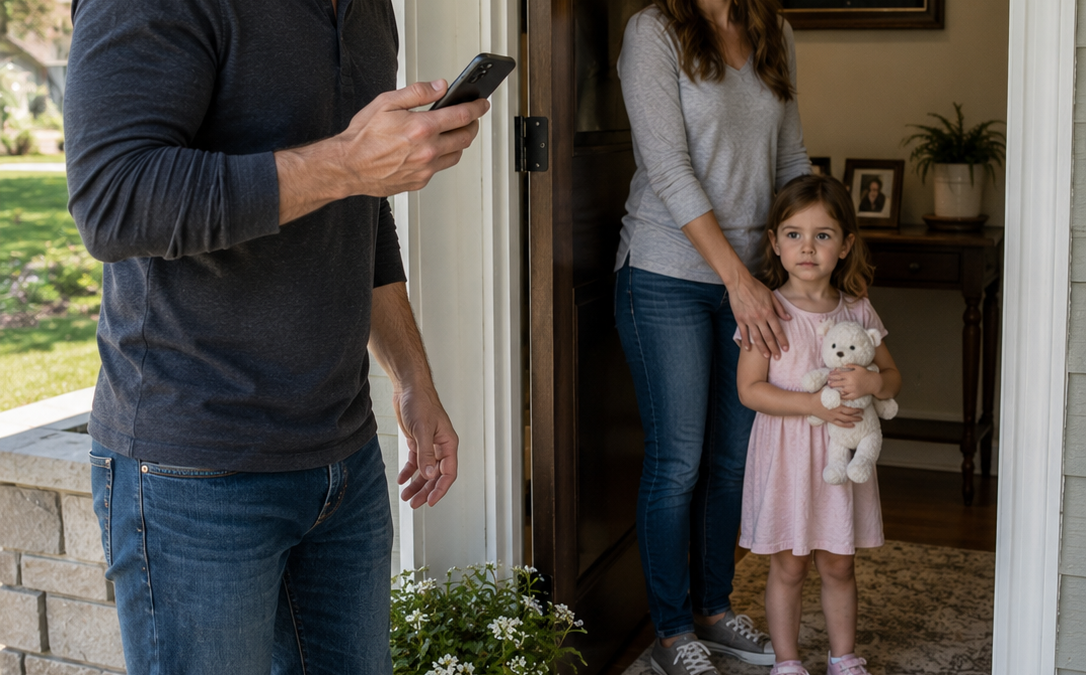
The knock came while I was cutting apples.
Tuesday afternoon.
September.
My daughter Marin sat at the kitchen table wearing dinosaur socks and arguing with a stuffed rabbit about whether the red slices tasted better than the green ones.
“They do,” she informed me.
“They’re the same apple.”
“No.”
“That’s scientifically devastating.”
She narrowed her eyes.
Three and a half years old.
Already unwilling to accept bad data.
I was reaching for the peanut butter when someone knocked again.
Softly.
Not Amazon.
Not my neighbor.
Not Dina, who would have walked in while yelling that she brought coffee.
I wiped my hands on a dish towel and crossed the hallway.
Sunlight came through the little window beside the front door.
Blue paint glowed around the frame.
Robin’s-egg blue.
Three coats.
I had painted that door myself the week Marin and I moved into the house.
Cheap brush.
Old jeans.
Eight months pregnant.
Every wall inside had been some practical neutral color.
White.
Cream.
Soft gray.
But I had spent two days choosing the blue.
I didn’t understand why at the time.
I do now.
That door was the first thing in my adult life I chose without asking whether my mother would approve.
I looked through the glass.
And stopped.
My little brother stood on my porch.
Danny.
Four years older around the eyes.
Delivery-company polo.
Phone in one hand.
Weight shifting from one foot to the other like the porch might decide whether he was allowed to stay.
I hadn’t seen anyone from my immediate family in four years.
Not my mother.
Not my father.
Not Danny.
My hand stayed on the latch.
One second.
I could pretend I wasn’t home.
Two.
I could open the door six inches.
Give him nothing.
Send him back to Ohio.
Three.
Then something inside me became very clear.
I hadn’t done anything wrong.
I hadn’t run away.
I hadn’t stolen anything.
I hadn’t abandoned a child.
I had worked.
Grieved.
Given birth.
Bought a house.
Built a life.
I was tired of behaving like those things needed to be hidden.
So I opened the door all the way.
“Hi, Danny.”
He stared at me.
“Tori.”
My name sounded strange in his mouth.
Like something he’d been told not to use.
For several seconds, neither of us moved.
Then he looked at the house behind me.
Hardwood floors.
A basket of tiny shoes by the stairs.
Finger paintings taped to the wall.
One purple backpack hanging from a hook.
His eyebrows drew together.
“Tori…”
Then Marin came running.
Bare feet thumping against wood.
The entire hidden four years of my life arriving at the front door at full speed.
“Mommy, who is it?”
Danny looked past me.
Saw her.
Stopped breathing.
Marin skidded to a halt.
Black hair sticking out of one braid.
Dinosaur socks.
Apple slice in one fist.
She looked up at Danny.
Danny looked down at her.
Then his eyes moved to me.
Back to her.
“Tori.”
His voice changed.
“Who…”
He couldn’t finish.
I rested one hand on Marin’s shoulder.
“This is Marin.”
He stared.
“My daughter.”
Every drop of color left his face.
Marin frowned.
“Why is he looking funny?”
“Because he’s surprised.”
“Why?”
I looked at Danny.
“That’s a complicated answer.”
Then his eyes moved past us.
Down the hallway.
To the wall.
Caleb’s photograph was there.
Not intentionally displayed for anyone.
It had been there so long I barely noticed it anymore.
Caleb in a gray work shirt.
Sawdust in his hair.
Smiling at whoever had taken the picture like life had never given him a reason not to.
A black funeral ribbon still folded over one corner of the frame.
Beside it was the ultrasound picture.
And beside that—
me.
Eight months pregnant.
Standing in front of a half-painted blue door with a roller in my hand.
Danny saw them in that order.
Caleb.
Ultrasound.
Pregnant Tori.
Marin.
I watched four years of family mythology collapse behind his eyes.
He stepped backward.
One porch step.
Then another.
His phone was already in his hand.
“Tori…”
He looked sick.
Then dialed.
“Danny.”
He didn’t seem to hear me.
Someone answered.
I knew who before he spoke.
“Mom?”
Pause.
His eyes stayed on Marin.
“Mom, you need to see this.”
Silence.
“She…”
He looked at me.
Then Caleb’s photograph.
Then stopped.
“She never told us.”
The sentence died halfway out.
Because there was no ending to it that didn’t require deciding who had failed whom.
And for the first time in four years, my brother was close enough to see the answer.
He lowered the phone.
Then sat down on my porch steps.
Covered his face.
And cried.
My name is Tori Ives.
I was thirty-four years old when my family finally found the woman they’d spent four years telling everyone had disappeared.
The truth was simpler.
I stopped sending them money.
And apparently, once I stopped paying to exist in my family, they stopped seeing me.
The money started ten years earlier.
My nursing-school graduation.
I was twenty-four.
First person in my family to finish college.
My mother threw dinner at our house in Dayton.
Pot roast.
Mashed potatoes.
Green beans.
Sheet cake from the grocery store.
My diploma propped against the gravy boat like another guest.
Dad said grace.
Danny ate enough cake for three people.
For two hours, I was the pride of the Ives family.
I remember that feeling because it explains a lot of what came afterward.
Mom kept saying:
“Our nurse.”
Dad told a neighbor I’d always been determined.
Aunt Sharon hugged me twice.
Everybody wanted photographs.
I wanted that evening to last forever.
After dinner, Mom cleared the plates.
Then came back carrying a cream-colored envelope.
My name was written across the front in her neat church-bulletin handwriting.
She slid it toward me.
I smiled.
“What’s this?”
“For the house.”
I opened it.
Empty.
I looked up.
Mom patted my hand.
“You’re the one who made it out.”
Nobody reacted.
Dad studied his coffee.
Danny scraped icing from the cake tray.
I laughed a little.
Because I thought I understood.
One favor.
Furnace.
Groceries.
Maybe an overdue bill.
New nurses made decent money.
My parents had helped raise me.
Of course I’d help.
I filled the envelope from my first paycheck.
Sent it back.
The next month, another arrived.
Same handwriting.
Same cream paper.
No note.
Third month.
Another.
Nobody ever formally asked again.
They didn’t need to.
The request had been made once.
Publicly.
At my celebration.
Wrapped in family pride.
By the second year, I moved the arrangement online.
Fourteen hundred most months.
Sometimes two thousand.
There was always a reason.
Furnace.
Dad’s truck.
Roof damage.
Insurance.
Danny needed a used Honda for work.
Christmas.
Easter.
Birthdays.
Something was always broken, late, urgent or unfair.
On my side, the money came from somewhere too.
Night differential.
Weekend shifts.
Holiday pay.
Overtime.
Christmas paid double.
So I worked Christmas.
Six years in a row.
My coworkers thought I was building savings.
Technically, I was.
Just not mine.
I kept a notebook.
Every transfer.
Date.
Amount.
Reason Mom gave me.
Numbers were comforting.
Numbers didn’t tell me I was selfish.
Numbers didn’t cry.
Numbers didn’t say:
Just this once.
Numbers held still.
By the sixth year, the total had crossed six figures.
I almost never said that number aloud.
Even to myself.
Because once a sacrifice gets large enough, admitting the total forces you to ask whether it was actually love.
And I wasn’t ready for the answer.
The first crack came with a roof.
Hailstorm.
Mom called crying.
Insurance wasn’t enough.
Contractors wanted ridiculous money.
Could I help?
I sent it.
Months later, Danny texted me a Thanksgiving photo.
Dad outside the house.
Turkey smoker in the driveway.
In the corner of the picture, I saw the roof.
Blue tarp.
Still there.
Almost a year later.
I stared at it.
Then explained it away.
Contractors were slow.
Maybe another section had been damaged.
Maybe the photo was old.
Back then, I could build excuses faster than Mom could build reasons for needing money.
Then I met Caleb Brand.
Hospital east entrance.
Rotten awning.
He was the contractor hired to rebuild it.
I was leaving after a night shift when he stopped me.
Sawdust in his hair.
Blueprints under one arm.
“You work rehab?”
“ICU.”
“You know anyone in rehab?”
“Half the hospital.”
He pointed toward the railing.
“What height works best for patients relearning stairs?”
I gave him the measurements.
From memory.
He wrote them down.
Then asked another question.
Then another.
The awning was finished three weeks later.
Better than the plans required.
Caleb asked me to breakfast.
“Breakfast?”
“You work nights.”
“So?”
“So dinner would be the middle of your night.”
I liked him immediately.
That annoyed me.
Three years later, he proposed.
No diamond.
He tied a brass house key to a ribbon.
We were standing outside a sagging little fixer-upper he’d made an offer on.
Peeling porch.
Crooked gutter.
Half-dead maple tree.
He held up the key.
“I’m planning to drink coffee on that porch until I’m ninety.”
I laughed.
“That’s your proposal?”
“I’m a builder, not a poet.”
I took the key.
“Yes.”
I brought him to Dayton once.
Mom liked him.
Mostly.
She asked what he earned before she asked his middle name.
Asked whether builders had retirement plans.
Health insurance.
Union benefits.
Who would carry family coverage if we married.
Caleb answered everything politely.
On the drive home, he said:
“Your mom sure loves numbers.”
I laughed.
Didn’t tell him mine.
That night, while Caleb slept, Mom texted.
He seems steady, honey.
Then:
Also, could you help a little extra this month? Don’t mention it to your father.
I sent the money.
That’s important.
I wasn’t dragged.
I participated.
For six years, every time the machine asked for fuel, I supplied it.
Then came the fourth of the month.
Flu season.
Half the unit sick.
The other half working impossible hours.
I finished sixteen hours, got home, sat on the edge of my bed—
and apparently fell asleep before taking off my shoes.
I woke the morning of the fourth.
Transfer.
Three days late.
I sent it immediately.
Mom called the next morning.
Seven sharp.
“Tori.”
“Mom.”
“The mortgage was due.”
“I know. I’m sorry.”
“I had to move money around.”
“I said I’m sorry.”
“Your father noticed.”
I closed my eyes.
“I worked sixteen hours.”
Silence.
Then she said:
“You don’t get to be tired.”
I opened my eyes.
“What?”
“You’re the one who made it.”
There are sentences that reveal an entire relationship in seven words.
I stood in my kitchen wearing scrubs that smelled like antiseptic.
Feet swollen.
Hair still tied from the previous shift.
“You don’t get to be tired. You’re the one who made it.”
I apologized.
Twice.
Mom accepted once.
Then I set up automatic transfers.
That is the part I am most embarrassed to admit.
Not what she said.
What I did afterward.
I heard contempt and responded by improving the payment system.
I was twenty-nine years old and convinced exhaustion was a moral failure if it inconvenienced my family.
Then life taught me what tired actually meant.
Caleb died on a Tuesday.
Scaffold failure.
Commercial job downtown.
Inspection paperwork said the equipment was fine.
It wasn’t.
A nurse came looking for me during my shift.
I knew from her face before she spoke.
I’ve been that face.
The one walking toward a family with news that will divide time.
Before.
After.
Caleb was gone before the ambulance made it through traffic.
Thirty-one years old.
The man who packed my lunches.
Labeled them by shift.
The man who proposed with a key because he wanted to build our life with his hands.
Gone.
His crew carried the casket.
Eight men in borrowed ties.
Men who worked with concrete and steel crying openly.
My family didn’t come.
Seven hours was too far.
Mom sent flowers.
Carnations.
Four days after the funeral, she texted:
So sorry about everything, honey. Will this month’s transfer be late with all this going on?
I was standing in Caleb’s closet.
Holding one of his flannel shirts.
It still smelled faintly like wood dust.
I read her message.
Then sent the money on time.
Grief made me obedient before it made me angry.
Two weeks later, I fainted at work.
Dina found me.
Dina was another ICU nurse.
Five feet nothing.
Terrifying.
The kind of woman who could convince a surgeon to reconsider his own birthday if she thought the chart disagreed.
She dragged me to a pharmacy.
Pregnancy test.
Hospital bathroom.
Two pink lines.
I stared at them.
“No.”
Dina looked over my shoulder.
“That’s usually considered a yes.”
I was sixteen weeks pregnant.
Night shift had wrecked my cycle badly enough that I’d blamed every symptom on stress.
The ultrasound showed a baby.
Moving.
Healthy.
I lay there with cold gel on my stomach and did the arithmetic.
Caleb was dead.
I was pregnant.
My blood pressure was climbing.
One income.
One baby.
One mortgage payment I’d been sending north that wasn’t mine.
Something had to stop.
My maternal-fetal specialist used the words preterm risk.
Stress.
Rest.
Reduce what you can.
I knew exactly what I had to reduce.
I planned the phone call to Mom like a medication pass.
Facts.
Order.
No wasted language.
Mom, Caleb died.
Mom, I’m pregnant.
Mom, my blood pressure is dangerous.
Mom, I can’t send money anymore.
I rehearsed it in the shower.
I chose the wrong order.
I called Sunday.
She answered.
“Hi, honey.”
“Mom, I have to stop sending money.”
That was as far as I got.
Her voice changed instantly.
“What?”
“I can’t keep—”
“After everything we’ve done for you?”
“Mom—”
“Your father’s heart cannot handle this.”
“I need you to listen.”
“The mortgage doesn’t disappear because your life got busy.”
“My life didn’t get busy.”
“You’ve changed.”
“Mom.”
“So this is who you are now?”
I closed my eyes.
She kept going.
Ungrateful.
Selfish.
Family.
Sacrifice.
Who paid for my ambition?
Who supported me?
How could I abandon them now?
I tried twice to speak.
She talked through both attempts.
Then hung up.
I stared at the phone.
Caleb.
Baby.
Blood pressure.
All three facts still inside me.
I called back.
Voicemail.
Again.
Voicemail.
I sat on the bathroom floor.
One hand over my stomach.
And realized my mother had ended a relationship without ever knowing what had happened in it.
I called Dad later that week.
Garage radio playing in the background.
“Dad, please. Something happened.”
He was quiet.
Then:
“Don’t upset your mother.”
Not:
Are you okay?
Not:
What happened?
Don’t upset your mother.
Every road in our family led through Carol Ives.
Carol had closed the road.
So I stopped knocking.
That was the moment they later called disappearing.
I called it surviving.
I took extra precautions.
Stopped sending money.
Saved instead.
The amount that used to vanish every month became prenatal bills.
Car seat.
Crib.
A small financial cushion.
Then a down payment on a brick house in West Asheville.
At first, watching my own money remain in my own bank account felt wrong.
Dirty.
Like theft.
Six years of envelopes had rewired my arithmetic.
I moved into the Asheville house eight months pregnant.
Dina carried everything heavier than a lamp.
I painted the front door.
Blue.
Then I wrote one letter.
Grandma June.
My father’s mother.
Seventy-eight.
The only person in my family who had always preferred ugly truth to pretty fiction.
I told her everything.
Caleb.
Baby.
Money.
Mom hanging up.
New address.
I asked for nothing.
Mailed it.
Then waited.
Nothing.
Two weeks.
Six.
The mailbox remained empty.
I decided June believed them too.
That hurt.
Then Marin came three weeks early.
Six pounds.
Black hair.
Furious.
Dina stood beside me during delivery.
Where a mother should have been.
Where a fiancé should have been.
Where family usually stands.
She held my hand.
Made terrible jokes.
Cut the cord.
When they placed Marin on my chest, I cried harder than I had at Caleb’s funeral.
I’m not proud of that comparison.
Grief doesn’t follow etiquette.
Marin.
Caleb had chosen the name months before he died.
We’d been sitting on the porch of the fixer-upper.
Trying names aloud.
He said:
“Marin.”
Then smiled.
“Her. Someday.”
So she was Marin.
His name went on her birth certificate after paperwork and lawyers and patience.
The brass key he used to propose hangs in a small frame beside my blue door.
Then I did the thing my family called disappearing.
I lived.
Marin learned to walk.
Then run.
Then argue.
The little brick house became ours.
I worked ICU.
Eventually moved from nights to days.
Dina became godmother.
Family.
The kind you choose deliberately.
I paid my mortgage.
Raised my daughter.
Touched up the blue paint every spring.
And every Christmas, I sent Grandma June one card.
School picture.
Return address.
No demands.
No phone number.
One road left open.
I never knew whether she read them.
Then Danny knocked.
After he stopped crying on my porch, I brought him inside.
What else could I do?
Marin climbed onto her booster seat.
Studied him.
“Are you family?”
Danny flinched.
I answered for him.
“He’s my brother.”
She looked impressed.
“I don’t have one.”
“Lucky,” I said.
Danny laughed once.
Then cried again.
We sat at my kitchen table for two hours.
He asked the first question anyone from Dayton had asked me in four years.
“How did Caleb die?”
I told him.
Everything.
The scaffold.
Funeral.
Flowers.
Mom’s text.
Pregnancy.
Hospital.
Marin.
Danny listened.
Didn’t defend anyone.
Didn’t interrupt.
At one point he whispered:
“We thought…”
I waited.
He couldn’t finish.
Finally:
“Mom said you just stopped answering everyone.”
“I did.”
“Why didn’t you tell me?”
“I tried to tell Mom.”
“You could’ve called me.”
I looked at him.
“You were twenty-five and living in their basement.”
His face reddened.
“You’re right.”
That surprised me.
No argument.
Just:
“You’re right.”
Before he left, Danny placed an envelope on the porch railing.
Cream.
My name.
Mom’s handwriting.
My stomach tightened.
Inside was a church invitation.
First Grace.
Homecoming Sunday.
ALL ARE WELCOME HOME.
“She wants you there,” Danny said.
“Why?”
“To fix things.”
“Fix what?”
He looked at the porch boards.
“I don’t know.”
I did.
Danny’s car hadn’t been gone ten minutes before my phone started buzzing.
Cousins.
Aunts.
Numbers I hadn’t saved.
Then someone added me back to the family group chat.
Ives Family 🏠
As if I’d missed a few messages.
Not four years.
At two in the morning, there were forty-one.
I read all of them.
First:
She’s alive.
Danny found her.
She has a house?
Then:
She has a daughter.
That changed the tone.
By midnight, the new story had arrived.
She hid a child from us.
Four years!
How could she do that to her mother?
Aunt Sharon:
CAROL MISSED HER OWN GRANDDAUGHTER’S WHOLE BABYHOOD.
Same jury.
New charge.
Yesterday I was the daughter who vanished.
Today I was the daughter who deceived.
I read every message twice.
Not one asked about Caleb.
Not one asked about the funeral photograph Danny had seen.
Not one asked why I had been pregnant alone.
My grief didn’t fit their accounting system.
So it disappeared.
The next evening, Mom called.
Almost four years.
My hand shook when I answered.
“Hello?”
She was already crying.
“My baby.”
I closed my eyes.
“Tori, my baby had a baby.”
I stood at my kitchen window watching Marin collect acorns.
“You could have known her from the day she was born.”
Mom went silent.
“All you had to do was let me finish one sentence.”
Then something changed.
Her crying stopped.
Not gradually.
Strategically.
“Come to homecoming.”
I frowned.
“What?”
“Sunday.”
“No.”
“Sweetheart, listen. We can fix this.”
“How?”
“You stand with me.”
My stomach turned cold.
“I’ll tell everybody you were sick.”
I said nothing.
“You were sick, weren’t you? With your blood pressure?”
“Mom.”
“It explains everything.”
“No.”
“A young widow. Pregnant. Sick. Overwhelmed. You couldn’t reach out.”
I stared through the window.
Marin held up an acorn and waved.
Mom continued:
“No one ever needs to know about the money.”
There it was.
The entire offer.
Four years of erasure re-edited into a church testimony.
My mother as grieving rescuer.
Me as sick prodigal daughter.
The money buried.
Her reputation intact.
She wasn’t apologizing.
She was offering me a better-produced lie.
“I’ll think about it.”
I hung up.
Two nights later, an Ohio number called.
I almost didn’t answer.
Then:
“Tori Ives.”
My grandmother.
June.
Eighty-two now.
Voice like gravel wrapped in lace.
I sat down on my kitchen floor.
“Grandma?”
“You planning to make me die before I meet this child I’m told has stolen my face?”
I started crying.
Instantly.
“Why didn’t you answer my letter?”
“Because my hands shake.”
I laughed through tears.
“You could’ve called.”
“And have your mother listening through three walls?”
Silence.
Then her voice changed.
“I got your letter.”
I stopped breathing.
“Every page.”
My hand covered my mouth.
“And the Christmas cards.”
“All of them?”
“Every one.”
“Then why…”
“I never believed you disappeared.”
My eyes closed.
“Not one day.”
Four years.
I had survived by telling myself I didn’t need anyone in Ohio to believe me.
Then one person did.
And suddenly I understood how heavy not needing anyone had been.
June continued.
“People don’t disappear, child.”
Her voice was steady.
“They get erased.”
I cried harder.
Then she became June again.
Dry.
Practical.
“Bring that girl to see me.”
“When?”
“Before I’m dead would be convenient.”
I laughed.
We planned Saturday.
Not church.
Not homecoming.
Just Grandma.
Marin.
Me.
Thirty-six hours in Ohio.
In.
Out.
Motel.
No family spectacle.
It almost worked.
June’s house looked smaller than I remembered.
She was on the porch when we arrived.
Oxygen line.
Sunday pearls even though it was Saturday.
Standing when standing clearly cost her.
Marin got out.
Walked up the steps.
June took her little face between shaking hands.
Looked.
“There you are.”
Three words.
Marin smiled.
“Hi.”
June cried.
So did I.
Inside, we ate soup beans and cornbread.
Watched television.
June taught Marin how to wind yarn.
Normal family things.
Then she asked Marin to bring her sewing box.
Old metal tin.
Buttons.
Thread.
Needles.
Marin dug underneath.
Pulled out a bundle.
Christmas cards.
Mine.
Every year.
Rubber band around them.
Marin’s school pictures.
Edges worn.
Read.
Kept.
I stared.
“Why were they hidden?”
June looked at me.
“Your mother found them.”
My body went cold.
“When?”
“Last Christmas.”
Ten months earlier.
“She read every one.”
I stared at her.
“What?”
“Had them spread across my kitchen table looking for scissors.”
I couldn’t speak.
June continued.
“She put everything back.”
“Did she say anything?”
“No.”
Ten months.
My mother had my address for ten months.
While the church prayed for her missing daughter.
While she cried during coffee hour.
While relatives whispered drugs.
Controlling boyfriend.
Abandonment.
She knew exactly where I lived.
She didn’t need me found.
She needed me missing.
I was more useful that way.
At four that afternoon, Aunt Sharon arrived with a casserole dish she’d apparently needed six months to return.
She saw me.
Saw Marin.
Hugged us.
Left.
By dinner, everyone knew.
That evening, Danny texted.
Mom announced at the Homecoming Eve potluck that God brought her lost lamb home and you’re coming tomorrow.
I read it twice.
Then:
People applauded.
I was sitting on a motel bed.
Marin asleep eight feet away.
My mother had cast me in a show I’d explicitly refused.
Then someone knocked.
Danny.
Tie loose.
Face pale.
Spiral notebook under his arm.
He came inside.
Set it on the motel desk.
“What’s that?”
“Mom’s ledger.”
I stared.
I’d seen that notebook my entire childhood.
Neat columns.
Every dollar.
Every debt.
Every person who owed Carol Ives something.
Danny opened it.
“Look.”
The roof.
The one I’d sent money for.
Actual repair:
Materials.
Three hundred forty dollars.
Labor:
Ray and Danny.
I looked at him.
“You fixed it yourselves?”
Danny nodded.
“What happened to the rest?”
He turned pages.
Church building fund.
Donation in Mom’s name.
Women’s retreat.
Mom’s name.
Fellowship hall ovens.
Mom’s name.
Youth van repair.
Mom’s name.
Loans to relatives.
Security deposit for a cousin.
Transmission for Aunt Sharon’s son.
All from the same pool.
My money.
I sat down.
“My money wasn’t paying the bills.”
“Some.”
Danny swallowed.
“But not the way she told you.”
She had converted my overtime into influence.
Generosity.
Status.
Carol Ives.
The woman who always gave.
Always helped.
Always saved somebody.
With money from a daughter working Christmas in an ICU.
Anger finally arrived.
Then Danny turned to an older page.
One line.
Wedding ring pawned.
Mom’s back rent.
Small amount.
Tiny by today’s standards.
Huge when you’re twenty-four.
Danny touched it.
“She did it too.”
I looked at him.
“Grandma and Grandpa?”
He nodded.
“Mom spent years paying their debts.”
Something inside the anger changed.
Not disappeared.
Changed.
I could suddenly see my mother at twenty-four.
Young.
Married.
Sliding her wedding ring across a pawn-shop counter because someone had taught her daughters pay.
Nobody paid her back.
So she built a religion out of the debt.
Understanding her did not excuse her.
It did something harder.
It made revenge feel pointless.
Danny closed the ledger.
“The Honda was your money.”
“I figured.”
“I’m paying you back.”
“No.”
He frowned.
“Tori.”
“It was a gift.”
“I didn’t know.”
“I know.”
That mattered.
“The gift wasn’t the problem.”
He looked at me.
“What was?”
I thought about Mom’s first envelope.
The fourth of the month.
Caleb’s funeral.
Forty-one messages.
“Being required to keep giving so I’d still count as family.”
Danny nodded.
Then left.
I didn’t sleep.
At some point after midnight, Marin spoke from the other bed.
Half dreaming.
“Mommy?”
“Yeah?”
“Do I have a grandma?”
I stared at the motel ceiling.
Water stain.
Yellow streetlight.
I didn’t answer.
And in that silence, I finally understood the danger.
For four years, silence had protected me.
But now Marin existed inside it.
If I stayed silent, Mom would fill the space again.
One day my daughter might hear that I disappeared.
That I hid her.
That I was too ashamed to come home.
Silence had stopped being shelter.
It had become material.
At two in the morning, I took the cream envelope from my bag.
Homecoming Sunday.
All are welcome home.
I whispered:
“Fine.”
Morning came.
I ironed my navy dress with the motel iron.
It fought me.
Braided Marin’s hair.
She chose an orange ribbon.
I put Caleb’s brass key in my pocket.
Not visible.
Just there.
Weight.
Proof.
Then I texted Danny.
Front pew for Grandma. Aisle seat near the fan. Marin and I behind her.
He answered immediately.
Done.
Then:
I’m glad you’re coming.
I wasn’t bringing bank statements.
No copies of transfers.
No six-inch binder.
No screenshots.
Paper was my mother’s language.
Ledgers.
Envelopes.
Debts.
Receipts.
I was finished speaking it.
I brought myself.
First Grace held about two hundred people.
That Sunday, it held more.
Folding chairs lined the walls.
Youth-group banner over the doors.
WELCOME HOME.
We entered during the second hymn.
June first.
Oxygen.
Pearls.
Marin behind her.
Me.
Half the church turned.
I recognized faces.
Sunday-school teachers.
Neighbors.
Choir women.
People who had prayed for the missing daughter my mother invented.
Dad stood against the back wall.
Hat in his hands.
He saw me.
Looked down.
Mom wore lavender.
Handkerchief.
Microphone.
After the offering, she took the pulpit.
She was good.
I want that understood.
My mother knew how to hold a room.
“God brings seasons of sorrow to an end.”
Soft murmurs.
Amen.
“We have prayed for four long years.”
Tissue to her eye.
“My lost lamb has come home.”
She looked at me.
Smile trembling beautifully.
Then extended one hand.
“Tori, baby.”
Two hundred faces turned.
“Come up here and give thanks with me.”
I looked at June.
Grandma gave one tiny nod.
Barely visible.
Enough.
I stood.
Marin reached for my dress.
“Mommy?”
“Stay with Great-Grandma.”
I walked forward.
Mom held out the microphone.
I didn’t take it.
First Grace had been built before microphones.
My voice carried fine.
“I didn’t disappear.”
Silence.
Mom’s smile froze.
I looked at the congregation.
“I stopped paying.”
A ceiling fan turned overhead.
One bulletin slipped from someone’s lap.
Nobody picked it up.
“For six years in my family, those became the same thing.”
Mom whispered:
“Tori.”
I continued.
“More than one hundred thousand dollars.”
The number hit the room physically.
Faces changed.
I recognized some of them.
People whose car repairs I’d unknowingly helped fund.
People whose security deposits came through Mom.
I didn’t point.
Didn’t name them.
They weren’t why I was there.
“I worked nights.”
My voice stayed calm.
“Weekends.”
“Christmas.”
“Double shifts.”
“I was told the money kept my parents afloat.”
Somebody in the middle rows looked down.
“The year I stopped sending it, the man I was going to marry died.”
Mom’s face changed.
A sound moved through the room.
“I was pregnant.”
More faces turned toward Marin.
“My blood pressure was dangerous.”
I swallowed.
“I had one income.”
“One baby coming.”
“And no one left to split the world with.”
June closed her eyes.
“Nobody asked.”
Silence.
“One question would have found me.”
Mom stepped forward.
“You never told us—”
I turned toward her.
“I tried.”
Her mouth closed.
“You hung up.”
She stared.
“I called Dad.”
My eyes moved to the back wall.
Dad looked like he’d been struck.
“He told me not to upset you.”
People turned.
Dad lowered his head.
Then I said the sentence I’d carried for five years.
“You told me I didn’t get to be tired because I was the one who made it.”
Mom’s handkerchief lowered.
“I—”
“I was allowed to be tired, Mom.”
My voice almost broke.
I let it.
“Just never there.”
The microphone in her hand trembled.
“How dare you?”
The word cracked through the speakers.
Too loud.
Electric.
The entire room flinched.
Mom was shaking.
I wasn’t.
Not because I was braver.
Because I’d spent ten years in intensive care learning what an emergency actually looked like.
A patient losing an airway was an emergency.
A heart stopping was an emergency.
A child crashing while her mother screamed was an emergency.
This?
This was truth in a room with good acoustics.
Mom lifted the microphone.
“You have no right to come into this church and humiliate your family—”
“I didn’t come for you.”
That stopped her.
I stepped backward.
Then returned to our pew.
Took Marin’s hand.
Led her forward.
The entire church watched.
“Marin.”
My daughter looked up.
“This is your great-grandmother June.”
June was crying.
“She is the reason I still believe family can mean something good.”
June reached for her.
Marin went willingly.
Two small hands.
Two shaking old ones.
Same chin.
Same eyes.
Four generations separated by one woman controlling the story.
For a few seconds, nobody cared about the argument.
They watched an eighty-two-year-old woman touch the face of a great-granddaughter she’d almost died without meeting.
Some things outrank narrative.
Not many.
That did.
I picked Marin up.
Danny helped June.
Then I walked down the center aisle.
No applause.
Better.
People choosing.
Some faces softened.
Others hardened.
That was fine.
The truth doesn’t convince everybody.
It just stops the lie from being unanimous.
Near the doors, Mom stepped away from the pulpit.
We passed close enough that nobody else needed to hear.
Her microphone was lowered.
For the first time all morning, there was no performance in her voice.
“Everything I did, I did for this family.”
I stopped.
Looked at her.
And believed her.
That was the saddest part.
She believed every word.
I could suddenly see twenty-four-year-old Carol at a pawn-shop counter.
Wedding ring.
Parents’ debt.
Learning that being a daughter meant being currency.
Then teaching me the same lesson because nobody had ever taught her another.
I held Marin tighter.
“Being needed isn’t the same as being loved, Mom.”
Her face changed.
I continued quietly:
“I hope somebody loves you for free someday.”
Then I walked out.
The church doors opened.
October sunlight poured in.
Cold.
Clean.
Gold.
Marin squinted from my hip.
“Is church over?”
I looked back once.
At the building where two hundred people had spent four years praying for someone who had never been lost.
“Ours is.”
We made it halfway to the car before Danny came running.
Tie loose.
Out of breath.
He stopped in front of me.
Hands open.
No defense.
No:
You know how Mom is.
No:
She meant well.
No:
Family is family.
He looked at Marin, already falling asleep against my shoulder.
Then at me.
“Can I come see her?”
I waited.
“No envelopes.”
He nodded immediately.
“None.”
“No messages from Mom.”
“Okay.”
“No showing up unannounced.”
“Okay.”
“You come because you’re her uncle.”
His eyes filled.
“Just her uncle.”
That sentence saved something.
Not everything.
Something.
“Sundays.”
He smiled.
“Sundays.”
Six weeks later, June sat on my Asheville porch.
Danny had driven her seven hours.
She complained about his music the entire way.
Her sewing box rested in her lap.
Marin sat beside her trying to thread a needle.
Four hands.
Two shaking because of age.
Two because she was three.
When the thread finally passed through, both of them cheered.
I stood inside the blue doorway watching.
Mom’s letter was in the kitchen drawer.
Three pages.
Scripture.
Grief.
Explanations.
Not one real apology.
I had read it once.
Put it away.
For the first time, something from her hurt less than expected.
Not because I’d stopped loving her.
Because the wound had stopped carrying my weight.
Dad sent a card later.
One line.
Pencil.
I’m sorry I looked away.
I kept it.
Didn’t answer.
Not yet.
I’m allowed to take my time.
That’s something I know now.
Danny calls every Sunday.
Marin shows him pancakes shaped like animals that do not resemble animals.
June keeps my Christmas cards on her own shelf now.
No hiding.
A few relatives have quietly started repaying old “loans” to her because nobody knows what else to do with their guilt.
Mom stepped down from the church treasurer role.
Aunt Sharon still talks.
Some machines survive even after you stop being one of their parts.
That’s fine.
My goal was never to shut down the entire family.
It was to stop letting it run on me.
Every spring, Marin and I repaint the blue door.
Last year she got paint on her hair.
The porch.
One shoe.
The dogwood.
Almost nothing on the actual door.
She calls the color ours.
She’s right.
Sometimes people ask whether I regret standing up in church.
No.
I regret that it had to happen there.
I regret Caleb never met his daughter.
I regret my mother learned love as debt and handed me the bill.
I regret wasting six years believing exhaustion was selfish.
But I don’t regret telling the truth.
Because disappearing was never what happened to me.
Fog disappears.
Keys disappear.
People like me get erased when their truth becomes inconvenient.
And for a long time, I helped.
Every month I filled the envelope.
Every time I apologized.
Every time I let Mom tell the cleaner version because correcting her seemed harder than carrying it.
Then I had a daughter.
And one night in an Ohio motel, she asked whether she had a grandmother.
That question did what anger couldn’t.
It made me understand that silence never stays empty.
Someone always fills it.
So I finally filled mine myself.
With Caleb.
With Marin.
With the six years.
With the hundred thousand dollars.
With the funeral nobody attended.
With the pregnancy nobody asked about.
With one exhausted nurse who was told she wasn’t allowed to be tired because she was the one who made it.
My mother thought homecoming meant returning to the role she’d saved for me.
She was wrong.
I had already gone home.
Home was seven hours south.
A little brick house.
A blue door.
Apple slices on the kitchen counter.
A brass key by the entrance.
A little girl in dinosaur socks.
And people who could walk through that door without paying an admission fee.
It took me thirty years to learn the difference between being needed and being loved.
Marin gets to learn it for free.
That’s the inheritance I’m giving her.
No envelopes.
No ledgers.
No debt disguised as devotion.
Just a blue door that opens because you’re loved—
and closes when you aren’t safe.
You Might Also Enjoy

Dad Told Me To Leave Forever After My Sister’s Kid Threw My Son’s Lunch — By 6AM He Was Begging At M

My Nephew Shut Down My Daughter’s Birthday Party For A BMX Bike — The Venue Owner’s Photo Made My Si

At 11:30 P.M., My Brother Took The Marina Keys. By Sunrise, The $92,000 Speedboat Was Smashed Agains

My Niece Took My Son’s $1,800 Scooter And Dad Called Him A Nobody — By 6AM A Locksmith Blocked My…




