My Father Called Me a Failure for Joining the Army—Then I Exposed My Sister’s Husband
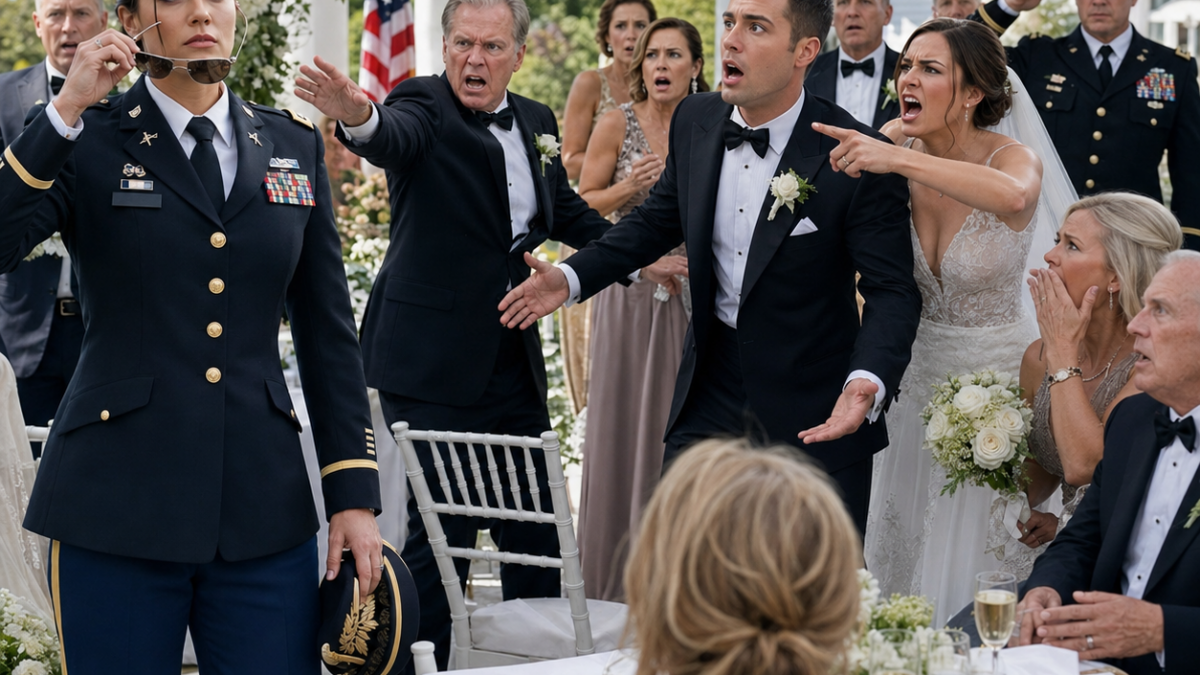
My Sister Was Starting Medical School, And I Was Enlisting. My Father Said, “Only Failures Join The Military. Don’t Ever Come Back Here.” Ten Years Later, At My Sister’s Wedding, My Father Asked, “What Are You Doing Here?” My Sister Said, “She Wasn’t Invited.” Her Husband Shouted, “How Dare You Come Here!” I Smiled And Said, “You Don’t Know Anything, Do You?” His Face Went Pale.
### Part 1
“You don’t know anything, do you?”
The words had barely left my mouth when my sister’s new husband went white.
Not pale. White.
Evan Pierce stood in the middle of his own wedding reception with one hand still wrapped around a champagne glass, staring at the slim blue folder tucked against my side as if it were a loaded weapon.
Around us, the reception kept pretending everything was normal.
Silverware clicked against china. A waiter drifted past carrying champagne. Warm string lights glowed above the dance floor. Somewhere near the DJ booth, someone laughed too loudly.
My younger sister, Natalie, stood beside Evan in her ivory wedding dress, looking between us.
Then my father’s voice cut through the music.
“What are you doing here?”
Dr. Richard Morgan hadn’t said my name.
Ten years had passed, and my father could still make four ordinary words sound like a locked door.
Natalie’s mouth tightened.
“Claire wasn’t invited.”
I knew.
The invitation had never come.
I had driven three hours anyway.
Evan recovered first and stepped toward me.
“How dare you come here and cause a scene?”
“I didn’t come to cause one.”
I held his gaze.
His eyes dropped to the folder again.
That was the detail that mattered.
He wasn’t looking at the guests watching us.
He wasn’t looking at Natalie.
He was looking at the folder.
Three days earlier, I had been leaving an administrative building at Fort Belvoir when my phone rang.
“Staff Sergeant Morgan?”
“Speaking.”
“My name is Samuel Brooks. I handled your grandmother’s estate.”
I stopped beside my truck.
Cold wind pushed leaves across the pavement while soldiers crossed the lot behind me.
“I remember you.”
“I’m calling because a document was delivered to your father’s medical office for your signature. I think you need to review it before anyone asks you to sign.”
“My father’s office?”
“Yes. The sender indicated that you were unavailable because you were overseas.”
I looked toward the American flag snapping above the building.
“I’m standing in Virginia.”
“I suspected there might be a problem.”
He emailed the document.
At first glance, it looked painfully ordinary.
Family Property Confirmation.
Most of it was dense legal language about inherited property, ownership interests, consent, and financing.
Then I reached a paragraph Mr. Brooks had highlighted.
By signing, I would confirm and approve any previous action taken to secure financing against a lake house my grandmother had left jointly to Natalie and me.
I read the paragraph again.
Then again.
The next morning, I showed it to an independent real estate attorney.
She didn’t soften her explanation.
“Do not sign this.”
“What exactly am I approving?”
“Potentially a prior loan transaction involving your ownership interest.”
“I never agreed to a loan.”
“Then somebody has a serious problem.”
That was why I was standing at Natalie’s wedding.
Not jealousy.
Not revenge.
Not because I wanted to punish a sister who hadn’t spoken to me in ten years.
I wanted to know why someone was trying to use my share of our grandmother’s property as collateral.
Our grandmother had died fourteen months earlier.
The lake house had been left to Natalie and me equally.
Fifty percent each.
It wasn’t some sprawling mansion. It was an aging cedar house with a sagging porch, a stone fireplace, and a dock our grandfather had built himself.
When Natalie and I were children, we caught tadpoles in jars there and came inside smelling like lake water and smoke.
It was one of the few places in my childhood where I had never felt compared to her.
That changed when we turned twenty.
Natalie entered medical school.
I enlisted in the Army.
The night I told my family, Dad stared at me across the kitchen table.
“Your sister is going to medical school, and you’re doing this?”
“I want to serve.”
“You could go to college.”
“I know.”
“You could build a real career.”
“This is a real career.”
He laughed.
Not because anything was funny.
“Only failures join the military because they have nowhere else to go.”
Natalie stood near the counter crying silently.
I looked at her.
Just once.
I wanted one sentence.
“That’s not fair.”
“Don’t talk to her like that.”
Anything.
She said nothing.
Then Dad pointed toward the front door.
“If you walk out to do this, don’t come crawling back when it doesn’t work.”
So I walked out.
And I never crawled back.
The Army didn’t magically heal me. It didn’t erase lonely Christmases or birthdays when I checked my phone knowing nobody from home would call.
But it gave me something my father never had.
People who cared less about how impressive I looked and more about whether I showed up when somebody needed me.
At thirty, I was a staff sergeant.
I trained younger soldiers.
I managed responsibilities my father would never understand.
I had built a life.
Yet standing in that wedding reception, facing him again, part of me still felt twenty years old.
Evan pointed at the folder.
“What is that?”
Before I could answer, Natalie asked the same question.
Evan immediately put his hand on her arm.
“It’s nothing.”
I looked at him.
“Then you won’t mind if I explain it.”
His jaw hardened.
“Claire.”
I opened the folder.
“Natalie, I think you should ask your husband why somebody needs my signature on paperwork approving a loan against Grandma’s lake house.”
The music seemed to disappear.
Natalie’s champagne flute stopped halfway to her mouth.
“A loan?”
Evan tightened his grip on her arm.
“It’s routine paperwork.”
“For what?”
“A business opportunity.”
Natalie stared at him.
“What business opportunity?”
He looked at me instead.
And that told me more than any answer could have.
Dad stepped between us.
“If you have concerns, this is neither the time nor the place.”
There it was.
The family rule.
Appearances first.
Truth later.
Maybe never.
I nodded.
“You’re right.”
I closed the folder.
“I’ll leave.”
Dad visibly relaxed.
Then I added, “But nobody signs anything in my name again.”
Evan’s face changed.
Only for an instant.
Fear.
I turned toward the exit.
Behind me, I heard him pull Natalie closer.
His whisper was low, frantic.
“Your sister is lying. If she talks to a lawyer, everything we’ve worked for is gone.”
I didn’t turn around.
I didn’t need to.
Evan had just confirmed the one thing I had come there to learn.
There really was something to lose.
And somehow, my name was attached to it.
### Part 2
Natalie called me later that night.
I was sitting on the edge of a motel bed twenty minutes from the wedding venue, still wearing the navy dress I’d bought for the reception.
Her name lit my phone.
Natalie.
For several seconds, I just watched it ring.
Ten years of silence could turn your own sister’s name into something strange.
Finally, I answered.
“Hello.”
Her breath caught.
“Claire?”
“Yes.”
“I don’t know what to believe.”
She sounded exhausted.
Not like Dr. Natalie Morgan, the physician my father bragged about to everyone who would listen.
She sounded like the girl who had stood in our kitchen ten years earlier.
“Evan says it was ordinary paperwork,” she said. “He says you hate him. He says you came because you’re angry I didn’t invite you.”
I looked through the motel window at an empty parking lot glowing under harsh yellow lights.
“I didn’t come to punish you.”
“Then why didn’t you call me?”
That hurt because it was a fair question.
“I tried.”
Silence.
“When?”
“After Grandma died. I called your old number. I mailed a card to Dad’s house. I asked the estate attorney for your contact information.”
Natalie’s breathing changed.
“You sent a card?”
“Yes.”
“Dad told me you wanted nothing to do with the property.”
I closed my eyes.
Of course he had.
My father rarely told dramatic lies.
He preferred omissions.
They were cleaner.
He could remove one piece of a story and let everybody else build the wrong conclusion.
“I never said that.”
“He told me you instructed the lawyer to handle everything through him.”
“I asked Mr. Brooks to send documents directly to me because I was stationed in North Carolina.”
Natalie said nothing.
Then I heard a quiet sob.
“I thought you hated me.”
“I didn’t.”
“I thought you left because I didn’t defend you.”
“I was hurt because you didn’t defend me.”
Another silence.
“But I never hated you.”
Her voice cracked.
“I should have called.”
“Yes.”
I didn’t tell her it was okay.
It hadn’t been.
Ten years mattered.
But I also didn’t see any point in making her bleed for something she was finally brave enough to face.
“Natalie, listen carefully. I don’t know everything yet, but the document Evan wanted me to sign wasn’t routine. It could make it look like I approved financing secured by the lake house.”
“For his company?”
“What company?”
She hesitated.
“He wants to start a medical billing business. He told me he had investors interested.”
“Did he tell you he planned to use the lake house?”
“No.”
“Did he tell you he needed my signature?”
“No.”
The silence after that felt different.
Fear had entered it.
I asked her to meet me the next morning at a diner on Route 7.
“Just you and me.”
“Evan will be angry.”
“That’s not a reason not to come.”
The sentence came out harder than I intended.
But I didn’t apologize.
Our entire family had spent too many years treating male anger like weather—something everybody else had to arrange their lives around.
Eventually Natalie agreed.
Before meeting her, I stopped at Samuel Brooks’s office.
He had silver hair, gentle eyes, and towers of carefully labeled files covering half his desk.
He spread several documents in front of me.
“Here’s what we know.”
The first was a consent form.
I stared at the signature near the bottom.
Claire Morgan.
My name.
Not my handwriting.
I felt cold.
“This was submitted?”
“Yes.”
“To whom?”
“A lender evaluating financing secured by the property.”
I leaned closer.
“So someone already claimed I approved it.”
“That appears to be the concern.”
He handed me the second document.
The one sent to Dad’s office.
“If you had signed this ratification form, it could have been used to argue that you approved the earlier transaction.”
My stomach turned.
This wasn’t somebody forgetting to explain a form.
Someone had signed my name first.
Then tried to get me to legitimize it afterward.
“Was the loan completed?”
“No. The title company raised questions before closing.”
I exhaled.
“Does my father know?”
Mr. Brooks’s expression became careful.
“I cannot tell you what your father knew. I can only tell you that the document requesting your signature was delivered to his office.”
“And nobody there called me.”
“No.”
At the diner, Natalie was already sitting in a red vinyl booth.
Her elaborate wedding hairstyle was gone. Her hair was tied into a loose knot. She wore a gray sweatshirt, jeans, and no makeup.
When I sat down, she noticed an old photo clipped inside my folder.
Me in uniform.
She touched the corner of it.
“You really made staff sergeant.”
“Yeah.”
“Dad said you kept reenlisting because you didn’t know what else to do.”
I almost laughed.
“That sounds like Dad.”
She looked embarrassed.
Then I slid the forged consent across the table.
“Is that your signature?” she asked.
“No.”
Her face went still.
I gave her the second document.
Then the loan paperwork.
She read each page slowly.
“Evan said the company was for us,” she whispered. “He said he wanted to build something before we had kids.”
“Maybe he believes that.”
She looked up.
“But?”
“An honest future doesn’t start with forging your wife’s sister’s signature.”
Her eyes filled.
“I thought marrying him meant I finally did something right.”
That sentence nearly broke me.
Because suddenly I understood.
I had spent ten years proving Dad was wrong about me.
Natalie had spent those same ten years proving he was right about her.
Different lives.
Same prison.
“Becoming a doctor wasn’t the problem,” I said. “You wanted that.”
She nodded.
“The problem was Dad teaching us that love had to be earned.”
Her phone began vibrating on the table.
Evan.
Natalie watched it.
Then answered.
She put him on speaker.
His voice came through immediately.
“The lender froze the closing.”
Natalie looked at me.
“What happened?” she asked.
“They found an issue with the title. I need Claire to tell them she approves the loan.”
“No.”
Silence.
“What?”
Natalie’s hand stopped shaking.
“I said no.”
His voice went cold.
“Your sister has always been jealous of you.”
Natalie stared at the forged signature.
And for the first time in ten years, my sister did something she hadn’t done in our father’s kitchen.
She chose not to stay silent.
### Part 3
“You used Grandma’s house for your loan?”
Natalie’s voice was quiet.
Evan tried to laugh.
“It’s not that simple.”
“Then make it simple.”
He sighed dramatically through the speaker.
“I was creating something for us.”
“You said you had investors.”
“I was talking to investors.”
“That’s different.”
“This was faster.”
Natalie looked at me.
“And Claire’s signature?”
Silence.
I didn’t move.
Neither did she.
Finally, Natalie asked, “Did you sign her name?”
“Nat, listen—”
“Did you?”
“The lender needed both owners on board.”
“That’s not what I asked.”
His frustration came through the phone.
“I knew Claire would eventually agree.”
I almost admired the arrogance required to say something that ridiculous.
Natalie’s eyes hardened.
“You haven’t spoken to her in ten years.”
“That doesn’t matter.”
“Apparently it does.”
“I was going to explain everything after the wedding.”
“You submitted her signature before asking her.”
“I was under pressure.”
“That doesn’t give you permission.”
His voice softened immediately.
A different tactic.
“Honey, please. The company could change our lives. I didn’t want to dump every stressful detail on you while you were planning the wedding.”
Natalie stared at the diamond on her finger.
“You didn’t protect me.”
“Of course I did.”
“You excluded me.”
“You’re emotional right now.”
Her expression changed.
Not dramatically.
Just enough that I recognized something breaking.
“No,” she said. “I’m informed now.”
He was quiet.
Then he tried the weapon that had worked in our family for years.
Me.
“Claire wants this. She can’t stand that you became a doctor while she threw her future away.”
My jaw tightened.
But I said nothing.
This needed to be Natalie’s moment.
“You don’t get to talk about my sister that way.”
I looked at her.
She continued.
“Not after you used her name.”
“Natalie—”
“I’m not calling her to fix this for you.”
“You’re my wife.”
“I know.”
“Then act like it.”
My sister’s face drained of color.
Ten years earlier, our father had asked for her silence.
Now her husband was asking for obedience.
She had finally learned what both sounded like.
“Do not come to the diner,” she said. “And don’t call me again until I decide I’m ready.”
She ended the call.
For a while, neither of us spoke.
Finally she whispered, “I married him yesterday.”
“I know.”
“He cried during the vows.”
I reached across the table but stopped before touching her hand.
“He may have meant what he said in that moment.”
She looked at me.
“How can you say that?”
“Because people don’t have to be pretending every second to betray you. Someone can love you and still choose themselves when it matters.”
Her mouth trembled.
“That almost sounds worse.”
“It usually is.”
Natalie wanted to go home.
Alone.
I didn’t like the idea, but I respected it.
Before she left, I gave her the numbers for my attorney and Mr. Brooks.
“Save anything Evan sends you.”
She nodded.
“And don’t sign anything.”
“I won’t.”
I spent the afternoon back at the motel trying to answer work emails.
I made it through two.
Then I read the same sentence in the third message six times without understanding it.
When Natalie called again, I answered immediately.
“Can you come over?”
Her voice was low.
“Are you safe?”
“Yes. Evan left.”
“I’ll come.”
Their townhouse sat in a neat row of brick homes with tiny lawns and identical black mailboxes.
Evan’s silver SUV was gone.
Natalie stood inside the open front door wearing the same gray sweatshirt.
“What happened?”
“I went through his office.”
She led me upstairs.
Wedding envelopes covered one corner of the desk. Business brochures were stacked beside them. Printed spreadsheets lay underneath a silver pen engraved with Evan’s initials.
Two computer screens were still glowing.
Natalie pointed at the laptop.
“I was looking for the loan paperwork.”
A document was open.
I stepped closer.
Draft Deed.
Grantors: Natalie Morgan Pierce and Claire Morgan.
Grantee: Pierce Medical Solutions LLC.
Evan’s company.
The proposed date was shortly after the wedding.
My heartbeat slowed in the way it always did when something was serious enough to require absolute focus.
“He planned to transfer the house into his company.”
Natalie swallowed.
“Could he?”
“Not legally without both of us agreeing.”
“Then why draft this?”
“To make the transaction look ready. Maybe he expected to pressure us later. Maybe he thought he could get enough signatures to push it through.”
Natalie clicked another folder.
Projected revenue.
Client lists.
Funding schedules.
Then debt.
Credit cards.
Personal loans.
An earlier failed business.
The numbers were far larger than anything Natalie had known about.
“He told me he had no debt.”
On another balance sheet, the lake house appeared under company assets.
My grandmother’s porch.
Our grandfather’s dock.
Our childhood.
Listed like something Evan already owned.
Natalie sank into the desk chair.
“He wasn’t borrowing against the house.”
Her voice became a whisper.
“He was trying to take control of it.”
I didn’t answer.
She looked up suddenly.
“Dad knew something.”
“What makes you think that?”
“Last month Evan said Dad had been helping him understand the property documents.”
My father’s cautious expression at the wedding flashed through my mind.
“That doesn’t prove he knew about the forged signature.”
“No.”
Natalie looked toward the window.
“But Dad never asks questions when the answers might embarrass him.”
That sentence sat between us.
Then headlights swept across the wall.
A vehicle turned into the driveway.
Evan’s SUV.
Natalie stood.
“I want to confront him.”
“I’ll stay with you.”
She shook her head.
“I need to do this.”
Every instinct I had screamed at me not to let her face him alone.
But she wasn’t twenty anymore.
And protecting her did not mean taking away her right to speak for herself.
“I’ll be downstairs.”
Evan entered minutes later.
His footsteps climbed the stairs.
Then Natalie’s voice came through the ceiling.
“What is Pierce Medical Solutions?”
Silence.
Then Evan answered.
“Honey, let me explain.”
I closed my eyes.
There it was again.
The sentence people used when the truth had finally caught up with them.
### Part 4
At first, Evan sounded calm.
Too calm.
He used the same patient voice people use when they’re trying to convince you that what you’re seeing isn’t really there.
Then Natalie said, “Don’t tell me I’m overreacting.”
I stood near the bottom of the staircase.
Wedding gifts were stacked along the living room wall.
Crystal glasses.
A silver serving tray.
A framed engagement photo showing Evan kissing Natalie’s temple while she laughed.
Everything looked expensive, polished and secure.
Upstairs, their marriage was coming apart.
“The deed was a draft,” Evan said.
“A draft with our names on it.”
“It wasn’t filed.”
“You listed the lake house as a company asset.”
“For planning purposes.”
“You listed an asset you don’t own.”
“Our family owns it.”
“No. Claire and I own it.”
I heard a drawer slam.
Then his voice sharpened.
“Your sister would have signed.”
“She didn’t.”
“She should have.”
I started toward the stairs, then stopped.
Natalie answered before I could move.
“You don’t get to decide what she should do with her property.”
There was another silence.
Then she said the words I knew Evan had been desperately avoiding.
“You forged her signature.”
“I filled out paperwork based on an agreement I believed we’d reach.”
“That is the most dishonest sentence I’ve ever heard.”
His footsteps crossed the upstairs floor.
“I was trying to build a company for us.”
“No. You were gambling with property that wasn’t yours.”
“You have no idea how business works.”
“I’m a physician, Evan, not an idiot.”
“You don’t understand financing.”
“I understand consent.”
That ended the argument more effectively than shouting ever could.
A few minutes later, Evan came downstairs.
His tie was gone. His shirt collar was open. Sweat darkened the fabric beneath his arms.
He saw me.
“This is private.”
I looked at him.
“Then you should’ve kept my name out of it.”
Natalie followed him down holding a folder.
Her wedding ring was still on her finger.
But she kept twisting it absentmindedly.
Evan turned toward her.
“We can fix this.”
“How?”
“Your father can speak with the lender. Claire can sign the ratification. They can reopen the closing.”
I watched Natalie’s face.
He still wasn’t apologizing.
He wasn’t asking how much pain he’d caused.
He wasn’t promising to tell the truth.
He was asking us to rescue his deal.
“So your solution,” Natalie said, “is for Claire to approve something you already did without her permission.”
“I’m asking both of you to think rationally.”
“I’m being extremely rational.”
“This company is our future.”
Natalie slowly removed her wedding ring.
Evan froze.
She set it on the coffee table.
“I think you stopped being part of my future when you decided my family was collateral.”
His face reddened.
“You’re throwing away a marriage because of paperwork.”
“No.”
She looked directly at him.
“I’m reconsidering my marriage because my husband lied about his debt, hid a loan, forged my sister’s signature, and prepared documents to move property into his company.”
“You are letting Claire poison you.”
“No.”
Natalie shook her head.
“Claire showed me documents. You’re the one who created them.”
For the first time, the anger disappeared from Evan’s face.
What replaced it was fear.
Not fear that Natalie didn’t love him anymore.
Fear that she had stopped believing him.
He grabbed his keys.
“I need time.”
“You need an attorney,” Natalie said.
His hand froze on the doorknob.
“So do I.”
He left.
The SUV reversed hard enough to scatter gravel across the curb.
Natalie watched until the taillights disappeared.
Then she sat on the lowest stair.
“I feel so stupid.”
I sat beside her.
“You trusted someone you loved.”
“I should’ve seen it.”
“People who deceive you usually work pretty hard to make sure you don’t.”
She leaned her head against the wall.
“I keep thinking about how much Dad loved him.”
I understood.
Dad had praised Evan from their first meeting.
Ambitious.
Focused.
A builder.
A man with a plan.
Exactly the kind of person he respected.
“He said Evan understood how the world worked,” Natalie whispered.
“Apparently Dad’s definition of understanding the world hasn’t improved.”
She almost smiled.
The next morning, Natalie met with an attorney recommended by another doctor at the hospital.
She opened a bank account Evan couldn’t access.
She changed passwords.
She copied emails and text messages.
She arranged to stay with a colleague.
I didn’t tell her what to do about the marriage.
I had spent too much of my life resenting people who believed they knew what was best for me.
Meanwhile, my attorney contacted the lender and title company.
The most important news came first.
No mortgage had been recorded.
The closing had been stopped.
Our lake house was still ours.
But that didn’t erase what had happened.
Two days later, my phone rang.
Dad.
I answered.
“What?”
He sighed.
“Your sister is very upset.”
I stared at the wall.
“Your sister?”
“What?”
“You mean your daughter?”
“Claire, this isn’t the time.”
I laughed.
For ten years, it was never the time.
“Did you know Evan was using the lake house?”
“I knew he was exploring financing.”
“Did you know he sent paperwork to your office for me?”
A pause.
“Yes.”
“Did you read it?”
“It looked routine.”
“Did you call me?”
“No.”
“Why?”
“Evan told me you already knew.”
“And you believed him.”
“I had no reason not to.”
I walked toward the motel window.
“You had my phone number.”
Silence.
“You knew I wasn’t invited to Natalie’s wedding. You knew someone wanted my signature on a document involving property I owned. And you decided calling me was too inconvenient.”
“I didn’t know your signature had been forged.”
“No.”
My voice became quieter.
“But you knew enough to ask questions.”
He breathed out.
I could see him in my mind, sitting behind his expensive desk, irritated that reality had forced its way into his carefully organized life.
“I think,” I said, “you wanted Natalie’s wedding to look perfect. You wanted Evan’s business to succeed. And once again, you decided appearances mattered more than one of your daughters.”
He ended the call without saying goodbye.
I should have been surprised.
I wasn’t.
What surprised me was what happened the following day.
There was a knock on my motel door.
When I opened it, my father was standing there alone.
### Part 5
Dad looked older than he had at the wedding.
Not dramatically older.
Just tired in a way expensive clothes couldn’t hide.
His gray hair was perfectly combed, but the skin beneath his eyes looked loose and shadowed.
“I was wrong,” he said.
I kept one hand on the door.
“About which part?”
His mouth tightened.
The old Dad would have taken offense.
This version looked down.
“I should have called.”
“Yes.”
“I should have read the paperwork.”
“Yes.”
“And I shouldn’t have trusted Evan just because he seemed successful.”
“Yes.”
He looked past me.
My Army duffel bag sat near the wall.
My uniform was folded over the chair.
For years he had treated my military career like an embarrassing phase that had lasted too long.
Now it was impossible for him to pretend it wasn’t a life.
“I thought I was helping Natalie,” he said.
“You were helping the version of Natalie you wanted everyone to see.”
He flinched.
“That’s not fair.”
“It’s exactly fair.”
The words didn’t come out angry.
I had imagined this confrontation many times over the years.
In my imagination I shouted.
He apologized.
I said something brilliant.
He finally understood everything he’d done.
Real life was quieter.
“I don’t want to discuss ten years ago tonight,” I said.
He studied me.
“Why not?”
“Because I’ve already spent ten years living with it. Natalie has a crisis happening now.”
His shoulders lowered.
“What can I do?”
That question mattered more than an apology.
“Don’t pressure her to meet Evan.”
He nodded.
“Don’t tell her she owes him another chance.”
Another nod.
“Don’t call this one mistake.”
He looked uncomfortable.
“And if you really want to help, cover the legal expenses required to protect the lake house.”
“I can do that.”
“Then do it.”
He waited.
Maybe for gratitude.
Maybe for forgiveness.
I gave him neither.
“And don’t expect us to thank you for cleaning up part of a mess you helped ignore.”
He swallowed.
“All right.”
Then he left.
The weeks that followed were nothing like television.
Nobody burst through Evan’s door with sirens.
There was no dramatic courtroom speech.
Instead, there were emails.
Documents.
Bank statements.
Phone calls.
Copies of forms.
Questions repeated three different ways by three different professionals.
The lender’s fraud department reviewed the loan application.
The title company confirmed that no mortgage had been recorded against the lake house.
My attorney worked with Natalie’s attorney and Samuel Brooks to secure our ownership interests.
Evan hired counsel.
And then his messages began.
Natalie showed me some of them.
At first:
“I am so sorry. I panicked. I love you.”
Then:
“You know I would never intentionally hurt you.”
Then:
“Claire is destroying our marriage because she’s jealous.”
Then:
“We could lose everything because you refuse to be reasonable.”
Finally:
“You are ruining my life over documents that could have been corrected.”
Natalie didn’t respond.
Not directly.
Her attorney handled anything important.
She stayed with a physician friend near the hospital.
She kept working.
That impressed me more than almost anything.
Her marriage had collapsed days after the wedding, yet every morning she tied back her hair, drove to the hospital, and cared for people who had no idea what was happening in her life.
Some evenings she called me.
Sometimes we talked about Evan.
Sometimes we talked about nothing important.
One night she asked, “Do you remember the blue canoe at Grandma’s?”
“The one that leaked?”
“Grandpa said it didn’t leak.”
“Grandpa lied.”
She laughed.
It was the first natural laugh I’d heard from her since the reception.
Then her voice became serious.
“Why didn’t you come back?”
I knew what she meant.
After Dad threw me out.
After basic training.
After my first promotion.
After all those birthdays.
“I thought you didn’t want me.”
“I thought you didn’t want me.”
We sat in that terrible symmetry for a while.
Finally she said, “I failed you.”
I didn’t rescue her from the sentence.
“You did.”
She inhaled sharply.
“But you were twenty,” I continued. “You were scared of Dad. And then we both let years pass.”
“I should have been braver.”
“Yes.”
“Can you forgive me?”
That was the question I’d known would eventually come.
I looked at the wall of my apartment back at Fort Belvoir. By then I’d returned to duty and was driving down on weekends when Natalie needed me.
“I don’t know yet.”
She was silent.
I continued.
“I love you. I want a relationship with you. But I can’t pretend those ten years didn’t happen just because we’re talking again.”
“I understand.”
And I believed she did.
That was the difference between her and Dad.
Natalie wasn’t asking me to erase the past so she could feel better.
She was willing to live with the consequences while building something different.
Her marriage moved toward an end.
She grieved it.
That surprised people.
They expected anger.
But Natalie had loved Evan.
She had imagined children with him. Christmas mornings. Vacations. A home filled with the small routines married people build without noticing.
Knowing he’d betrayed her didn’t make those dreams disappear overnight.
One afternoon, she called after meeting her attorney.
“It’s over.”
“You filed?”
“Yes.”
I waited.
Then she began to cry.
“I hate that I’m sad.”
“You don’t have to hate him every second for leaving to be the right decision.”
“I feel like I wasted years.”
“No.”
I thought about my own life.
“The years happened. What you do with the next ones is what belongs to you.”
She cried quietly.
Then she said something I hadn’t expected.
“I want to go to the lake house.”
I looked toward the calendar.
“When?”
“This weekend.”
“Okay.”
“There is one more thing.”
“What?”
“Dad wants to come.”
My hand tightened around the phone.
“Why?”
“He says there’s something at the house we both need to see.”
I didn’t trust my father.
Not yet.
But I agreed.
And when we reached our grandmother’s lake house that Saturday, I discovered he had been keeping one last piece of the past from both of us.
### Part 6
The lake smelled exactly the way I remembered.
Wet wood.
Pine needles.
Mud along the shoreline.
The cedar siding had faded, and one porch step dipped under my boot when I climbed it.
Natalie stood beside me holding the old brass key.
For a few seconds neither of us moved.
Then she unlocked the door.
The house smelled faintly of dust and cinnamon.
Grandma used to burn cinnamon candles every fall.
I hadn’t thought about that smell in years.
Natalie noticed it too.
“She would’ve hated what Evan tried to do.”
“Grandma hated people borrowing her gardening tools.”
Natalie laughed.
“She would’ve buried him under the hydrangeas.”
That earned a real laugh from me.
Dad arrived later carrying a small cardboard box.
He looked uncomfortable inside the house.
Maybe because Grandma had never been intimidated by him.
She had loved her son, but she had also been the only person in the family who regularly told him when he was being unbearable.
He placed the box on the kitchen table.
“I found these when I went through some papers.”
Inside were envelopes.
Letters.
Some addressed to Natalie.
Some addressed to me.
My name was written in Grandma’s shaky handwriting.
I picked one up.
It was dated three years earlier.
“Why do you have these?”
Dad’s face changed.
“She gave some of them to me to mail.”
The room went cold.
“And?”
“I didn’t.”
Natalie stared at him.
“What?”
Dad lowered himself into a chair.
“Your grandmother kept trying to bring the two of you back together.”
I opened the first letter.
Grandma wrote about the lake.
About Natalie’s residency.
About how proud she was of my Army career.
Then one sentence stopped me.
I know your father still believes he can decide what kind of life counts as successful. He is wrong.
My eyes burned.
I looked at Dad.
“You kept this.”
He nodded.
“Why?”
“I thought she was interfering.”
Natalie made a sound somewhere between a laugh and disbelief.
“Interfering with what? Your ten-year punishment?”
Dad looked down.
“I convinced myself Claire needed to make the first move.”
“I did make moves.”
I tossed the card I’d mailed after Grandma’s death onto the table.
“You hid those too.”
“I didn’t hide your card from Natalie intentionally.”
Natalie stared at him.
“You told me she didn’t care.”
“I said she had chosen a different life.”
“You let me believe she didn’t care.”
Dad’s face sagged.
There was no clever defense left.
This wasn’t about Evan anymore.
Evan had exposed something older.
A family culture Dad had built where information flowed through him.
Where approval was currency.
Where silence could be shaped into whatever story suited him.
I held Grandma’s letter.
“You didn’t just call me a failure.”
My voice shook despite everything I’d learned about controlling it.
“You made sure I stayed gone.”
“I thought you’d eventually come home.”
“You told me not to.”
“I was angry.”
“For ten years?”
Dad closed his eyes.
“I was proud.”
“No.”
I shook my head.
“You were controlling.”
The word seemed to strike him harder than anything else.
Natalie stood beside me.
“You did it to me too.”
He looked at her.
“I supported everything you wanted.”
“No. You supported everything I wanted when it matched what you wanted.”
Her voice trembled.
“I became terrified of disappointing you. That’s why I stayed silent when Claire left. That’s why I ignored things about Evan. He sounded like you.”
Dad looked stunned.
Natalie continued.
“He always knew what was best. He always had a reason I didn’t need every detail. He always made disagreement sound like disloyalty.”
Dad’s eyes filled.
I didn’t enjoy seeing him hurt.
But I didn’t save him from it either.
Sometimes pain is simply what truth feels like when it finally reaches someone.
“I can’t undo it,” he said.
“No,” I replied. “You can’t.”
“I’m sorry.”
This time the apology landed differently.
Not because I suddenly forgave him.
I didn’t.
But because he wasn’t asking me to make him feel better afterward.
He just sat there.
We spent the afternoon opening Grandma’s letters.
There was one from shortly before her death.
She had written separately to both of us but included nearly the same sentence.
The lake house belongs to both of you because I hope one day it will remind you that before anyone taught you to compete, you were sisters.
Natalie cried when she read it.
So did I.
Dad went outside.
He knew that moment didn’t belong to him.
Near sunset, Natalie and I walked down to the dock.
Several boards needed replacing.
The water reflected streaks of orange and pink.
“Do you think we can fix this place?” she asked.
“The dock?”
She looked at me.
“Us.”
I considered lying.
It would have been easy to say yes.
Instead I said, “I think we can build something new.”
She nodded.
“That’s fair.”
Behind us, Dad stood alone on the porch.
He didn’t come down.
Months earlier, I would have seen that as cowardice.
Now I understood something else.
For once, he was respecting a boundary without being told.
It wasn’t redemption.
It wasn’t forgiveness.
It was simply the first decent choice in a very long line of bad ones.
Then my phone vibrated.
A message from my attorney.
I opened it.
The investigation into Evan’s paperwork had uncovered another document.
And this one didn’t contain my forged signature.
It contained Natalie’s.
### Part 7
I didn’t show Natalie the message on the dock.
Not immediately.
For ten years, people had made decisions about what she should and shouldn’t know.
I refused to become another one.
So I handed her the phone.
She read the message.
Her face tightened.
“What document?”
“I don’t know.”
We called the attorney together.
She explained that investigators reviewing Evan’s business records had identified another authorization form submitted during the financing process.
This one appeared to authorize a transfer of Natalie’s interest in the property.
Natalie shook her head.
“I never signed anything like that.”
“Then don’t speculate,” the attorney said. “We’ll compare it against verified signatures and follow the process.”
After we hung up, Natalie stood absolutely still.
“I thought the worst part was what he did to you.”
I looked at the lake.
“He wasn’t choosing between us.”
“No.”
“He was using both of us.”
That realization hurt her in a new way.
Evan hadn’t merely betrayed his wife’s estranged sister because he thought I was disposable.
He had treated Natalie as disposable too.
The following weeks confirmed enough that the civil case against him became very serious.
I avoided pretending I knew what criminal consequences would follow. That wasn’t mine to decide.
What mattered to me was simpler.
The lake house remained protected.
Evan’s company never obtained ownership.
The attempted financing collapsed.
His business plans unraveled under the weight of the false information he’d used to support them.
His marriage ended.
Natalie never met him privately.
She ignored flowers.
She ignored handwritten letters.
She ignored messages in which he claimed he had finally understood what he’d done.
When important communication was necessary, it went through attorneys.
One evening she showed me a final message.
“I’ve changed. Please don’t let one terrible period erase everything good we had.”
She looked at me.
“What do you think?”
“I think late understanding doesn’t create an obligation.”
She nodded slowly.
Then deleted the message.
Dad paid every legal bill connected to protecting the property.
He didn’t attach conditions.
He didn’t ask us to call more.
He didn’t tell Natalie to reconcile with Evan.
He didn’t tell me I had misunderstood my childhood.
That mattered.
But it did not erase anything.
Several months later, my unit held a family support event at Fort Belvoir.
It wasn’t a grand ceremony.
No medals.
No dress uniforms.
Just folding chairs, paper cups of coffee, store-bought cookies, families, soldiers, and kids running between tables.
I had spent the previous month helping one of my younger soldiers arrange support at home while her husband recovered from surgery.
Her mother attended.
After the event, she found me.
“Staff Sergeant Morgan?”
“Yes, ma’am.”
She hugged me before I could react.
“Thank you for looking after my daughter.”
“She’s a good soldier.”
“She says you’re the reason she didn’t give up.”
I felt embarrassed.
“I’m one person. She did the hard part.”
The woman squeezed my arm.
“Good leaders always say that.”
After she left, I noticed Dad standing near the back of the room.
He had come because I’d allowed Natalie to give him the details.
Not invited.
Allowed.
There was a difference.
He walked toward me.
“You’re respected here.”
“Yes.”
His gaze moved around the room.
Soldiers greeted me as they passed.
One asked a question about Monday’s training.
Another handed me paperwork I’d promised to review.
Dad watched all of it.
“I didn’t understand what you were building.”
“I know.”
“I thought you were wasting your potential.”
“I know.”
He swallowed.
“I was too proud to see who you were.”
I looked at him for a long moment.
Ten years ago, I would have given almost anything to hear that.
But ten years changed the value of certain words.
“The Army didn’t make me worthy.”
His eyes lifted to mine.
“I was worthy before I enlisted.”
He nodded.
“I know that now.”
“Good.”
He waited.
Maybe he expected forgiveness.
Maybe he hoped for it.
I didn’t offer it.
Some relationships don’t end with a dramatic door slam.
Sometimes the boundary is quieter.
You simply stop giving someone access to the parts of you they once treated carelessly.
Dad and I drank coffee near the back of the room.
We talked about ordinary things.
The lake house repairs.
Natalie’s work.
The weather.
When he left, he hugged me.
I let him.
But forgiveness wasn’t what happened that afternoon.
Recognition was.
And I had learned they were not the same thing.
Later that week, Natalie called.
“I found something in Grandma’s attic.”
“What?”
“You need to come down here.”
“Is it another legal document?”
“No.”
She laughed.
“Much worse.”
I heard something metallic crash behind her.
“What was that?”
“The old canoe.”
I started laughing.
“You touched it?”
“I was trying to move it.”
“Grandpa said that thing was indestructible.”
“Grandpa was a liar.”
For the first time in ten years, I packed a bag to visit my sister without wondering whether I was wanted.
That felt bigger than forgiveness.
It felt like coming home on my own terms.
### Part 8
By the following fall, the lake house looked alive again.
Natalie and I sanded the porch.
A local carpenter replaced rotten boards on the dock.
We repainted the kitchen cabinets and discovered three different wallpaper patterns beneath the old paint.
The blue canoe still leaked.
We kept it anyway.
One Saturday morning, while cleaning a closet near the fireplace, Natalie found a photograph.
We were about eight years old.
Both covered in mud.
Both grinning.
I was holding a glass jar full of tadpoles while Natalie pointed proudly at something outside the frame.
We laughed so hard we had to sit on the floor.
Then the laughter faded.
“I miss that,” she said.
“What?”
“Before everything became a competition.”
I understood.
Before medical school.
Before the Army.
Before Dad started describing one daughter’s accomplishments as proof of the other’s failure.
“We can’t go back.”
“I know.”
She placed the photograph on the mantel.
“But maybe we don’t need to.”
That became the truth of our relationship.
Natalie and I did not recover ten lost years in one emotional conversation.
Some subjects still hurt.
Sometimes she remembered a family holiday I’d spent alone.
Sometimes I heard her repeat one of Dad’s old opinions and felt myself become twenty again.
Sometimes she apologized.
Sometimes I told her I didn’t want another apology.
I never gave her a grand declaration of forgiveness.
I didn’t need to.
What mattered was that she stopped asking for the old relationship back and started showing up for the new one.
She called.
She visited.
She learned about my soldiers.
I learned about the patients she worried about after long shifts.
We disagreed.
We argued.
Neither of us disappeared.
That was new.
Evan eventually became something we rarely mentioned.
The civil consequences of his actions were significant, and the evidence surrounding the disputed documents was handed to the proper authorities.
Whatever official decisions followed belonged to them.
Natalie’s decision belonged to her.
She never went back.
Not when he apologized.
Not when he said he’d changed.
Not when mutual acquaintances told her that marriage required forgiveness.
Natalie told one of them, “Forgiveness doesn’t require me to volunteer for the same betrayal twice.”
I liked that.
Dad remained on the edge of our lives.
That was where I wanted him.
He visited occasionally.
He asked instead of assumed.
When Natalie made a decision he disliked, he kept his opinion to himself unless she requested it.
When I was promoted again, he sent a simple message.
Proud of you.
I stared at it for a while.
Then answered:
Thank you.
Nothing more.
He had finally learned that my life didn’t exist to prove him wrong.
And I had finally learned I didn’t need his approval to prove myself right.
One afternoon, Dad joined us at the lake house to help replace part of the porch railing.
He worked quietly for several hours.
At sunset, the three of us sat outside.
Natalie brought coffee.
Nobody made a speech about healing.
Nobody announced that the family was whole again.
Because it wasn’t.
There were cracks that remained visible.
Some things should remain visible.
They remind you where the structure failed.
Dad looked toward the lake.
“I wish I’d done things differently.”
I rested my arms on my knees.
“So do I.”
“I don’t expect you to forgive me.”
That was probably the first thing he’d said about forgiveness that made me believe he finally understood it.
“Good.”
He gave a faint smile.
“I deserved that.”
“This isn’t about what you deserve.”
I looked at him.
“It’s about what I need.”
He nodded.
“I understand.”
Maybe he did.
Maybe understanding was something he’d have to practice for the rest of his life.
Either way, it wasn’t my job to supervise his redemption.
Later, after Dad left, Natalie and I sat on the dock.
The air smelled like cold water and wood smoke.
Lights from houses across the lake trembled on the surface.
“Do you ever think about the night you left?” Natalie asked.
“Sometimes.”
“What would you tell yourself if you could go back?”
I didn’t have to think long.
“I’d tell that twenty-year-old girl to keep walking.”
Natalie looked surprised.
“You wouldn’t tell her Dad would eventually apologize?”
“No.”
“You wouldn’t tell her we’d find each other again?”
“No.”
“Why?”
“Because she needed to know she could survive even if none of that happened.”
Natalie looked down at the water.
Then she smiled.
“That’s annoyingly wise.”
“Staff sergeant.”
“Right.”
“Professional wisdom.”
She bumped my shoulder.
For a moment we sat there like we were eight again.
Not because the past had disappeared.
Because it had finally lost control of the present.
My father had once told me that joining the Army made me a failure.
For years, I thought my greatest victory would be forcing him to admit he was wrong.
It wasn’t.
My victory was building a life so solid that his opinion stopped deciding how I felt about it.
Evan had believed my absence made me weak.
He assumed a daughter cut off from her family would be easy to ignore.
He assumed Natalie would protect her marriage before questioning him.
He assumed Dad would protect appearances.
For a while, he was right about two of those things.
Then one forged signature pulled on a loose thread.
And the entire story unraveled.
I didn’t save my sister.
Information did.
Truth did.
And eventually, Natalie saved herself.
As for me, I kept serving.
I kept leading soldiers.
I kept the lake house with my sister.
I kept my distance from the father who had spent too many years confusing control with love.
And I stopped waiting for people who had hurt me to become better before giving myself permission to be happy.
One morning the following spring, I arrived at the lake house before sunrise.
Natalie was already there.
Two mugs of coffee sat on the porch railing.
Mist floated above the water.
The repaired dock stretched toward the lake.
She handed me a mug.
“No leaking canoe today?”
“Absolutely not.”
“Coward.”
“Doctor.”
“Failure.”
She froze.
So did I.
Then I saw the horror on her face and started laughing.
Natalie slapped a hand over her mouth.
“Oh my God. Claire, I didn’t mean—”
“I know.”
She stared at me.
Then slowly started laughing too.
And something strange happened.
That word didn’t hurt.
Failure.
For ten years, my father’s voice had owned it.
Now it was just a ridiculous word between two sisters standing beside a lake.
I lifted my coffee.
“For the record, I’m still not getting in that canoe.”
Natalie raised hers.
“Neither am I.”
The sun began to climb through the trees.
Nothing about our family had become perfect.
Dad wasn’t forgiven simply because he regretted what he’d done.
Natalie’s silence hadn’t vanished simply because she finally found her voice.
And Evan’s apologies meant nothing compared with the choices that made those apologies necessary.
But the lake house was still ours.
My career was still mine.
My future belonged to me.
And for the first time, I understood that I had never needed the people who rejected me to welcome me back.
I had already built a home in myself.
THE END!
Disclaimer: Our stories are inspired by real-life events but are carefully rewritten for entertainment. Any resemblance to actual people or situations is purely coincidental.








