“We Need Someone Who Can Fly This Beast” — The SEAL Leader Was Shocked When She Said “I Can”
### Part 1
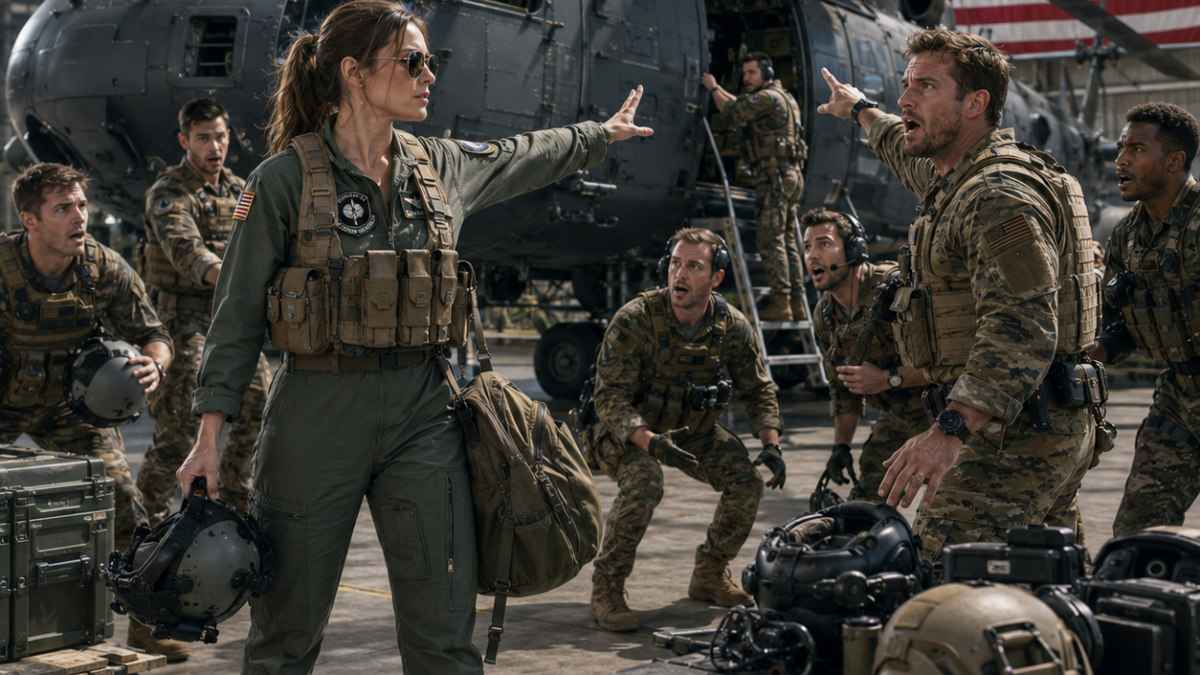
The first time Commander Grant Hale looked at me that night, he didn’t see a pilot.
He saw a twenty-eight-year-old captain standing beside the logistics desk with a clipboard tucked under one arm.
That mistake almost cost six men their lives.
The tactical operations center at Forward Operating Base Kodiak felt smaller every time another burst of gunfire came through the speakers. Wind hammered the reinforced walls hard enough to make the light fixtures tremble. Snow hissed against the narrow blast windows like handfuls of gravel.
On the main tactical display, six blue markers were trapped inside an expanding ring of red.
Then the radio cracked alive.
“Kodiak, this is Viper Actual. We have the package. Two operators are seriously wounded. We are taking sustained fire from the north ridge. We need extraction now.”
Everybody in the room stopped moving.
Commander Hale planted both hands on the map table.
He was broad-shouldered, gray beginning to show at his temples, and carried the exhausted look of a man who had spent most of his adult life sending people into places nobody was supposed to know existed.
“Where is my aircraft?”
General Victor Sloane stood across from him.
“The weather has closed every conventional option.”
“Then open one.”
“Black Hawks won’t survive the crosswinds. A Chinook is too visible. Fixed-wing aircraft can’t put your people down on that terrain.”
Another transmission burst through.
Gunfire.
Someone shouting.
Then static.
Hale’s face changed.
Not dramatically.
That was what made it worse.
“What about Hangar Four?”
Nobody answered.
I looked up from the logistics terminal.
General Sloane slowly folded his arms.
“The Manticore is grounded.”
The room seemed to get quieter.
The X-44 Manticore was officially described in paperwork as an experimental heavy-lift aircraft.
That description was like calling a hurricane a strong breeze.
The Manticore was a massive hybrid tilt-rotor gunship designed to fly low, fast, and unseen through terrain that would destroy ordinary aircraft. It had armored skin, oversized engines, terrain-following sensors, and enough power to make experienced test pilots nervous.
It had also been sitting in Hangar Four since its lead pilot, Major Derek Rowan, was rushed into surgery earlier that afternoon.
Hale’s jaw tightened.
“Get another pilot.”
“The backup is overseas.”
“Then put your best transport pilot in it.”
“It doesn’t work that way.”
Hale slammed his fist against the table.
“I have men bleeding on a mountain, General. I don’t care how it works.”
I should have stayed silent.
For the previous month, silence had served me well.
I filed manifests. I reviewed flight plans. I occasionally flew routine cargo missions through calm air corridors. I sat in the corner during classified briefings with the kind of expression that encouraged people to forget I was there.
That was exactly how certain people wanted it.
But then Viper Actual came through again.
“Kodiak… they’re closing.”
I knew the voice.
Not personally.
But I knew what it sounded like when somebody understood that rescue might not be coming.
Hale leaned toward Sloane.
“We need someone who can fly this beast.”
“I can.”
Every head in the room turned.
Hale stared at me.
I put the clipboard down.
“I can fly it.”
For half a second he looked confused.
Then irritated.
“Captain, this is not the time.”
“I agree.”
“You coordinate supply flights.”
“That’s what my current file says.”
His eyes narrowed.
“My current file?”
I stepped closer to the tactical table.
“The Manticore uses a neural-assisted control architecture built around predictive rotor balancing. Its transition envelope becomes unstable between thirty-eight and forty-four degrees of nacelle rotation if the port sensor array falls more than one-point-two percent behind the starboard processor.”
Nobody spoke.
Hale’s expression changed slightly.
I continued.
“The manual says the system corrects automatically. It doesn’t. Not always.”
General Sloane turned toward me.
“How do you know that?”
“Because I wrote the correction.”
Hale stared at me.
“You wrote it?”
“I spent three years inside the experimental flight program at Edwards. More than four hundred simulator hours. Sixty live-flight hours in the Manticore airframe.”
Sloane immediately moved to a classified terminal.
His fingers struck the keyboard.
I watched recognition spread across his face as my restricted record opened.
He glanced at Hale.
“She’s telling the truth.”
Hale looked from him to me.
“Then why are you standing behind a logistics desk?”
That question had followed me for almost a year.
Because I had refused an order during a demonstration flight.
A senior officer wanted the aircraft pushed beyond limits we had already proven unsafe. Cameras were present. Contractors were present. Careers were attached to the demonstration.
I refused.
The Manticore survived.
So did everyone aboard.
The general responsible for the demonstration never forgave me for embarrassing him.
“My reassignment was administrative,” I said.
Hale gave a bitter laugh.
“That’s a polite word for it.”
“Yes.”
He walked toward me until only a few feet separated us.
“Can you get my men?”
I looked at the blue icons.
Then at the storm data.
Then at the route conventional pilots would have considered impossible.
“I can try.”
“That isn’t what I asked.”
I met his stare.
“Yes. I can get them.”
He held my eyes for another second.
Then he grabbed his rifle from the table.
“Suit up.”
General Sloane stepped forward.
“Commander—”
Hale ignored him.
“If she crashes that aircraft, we lose the only platform capable of reaching the team.”
“If we leave it here,” Hale said, “I lose my team anyway.”
He looked at me.
“If you’re lying about what you can do, Captain, this is going to be a very short flight.”
I picked up my helmet.
“I’m not lying.”
Five minutes later, I entered Hangar Four.
And the moment I saw the warning lights flashing across the Manticore’s maintenance console, I realized flying into the storm might not be our biggest problem.
Someone had been inside its systems.
And they had not been trying to repair them.
### Part 2
The Manticore filled Hangar Four like something too large to have been built indoors.
Matte-black panels swallowed the overhead light. Its wings stretched almost from wall to wall. At the ends of them, enormous rotors waited in the vertical position, each blade longer than some aircraft I had flown.
I had missed that machine.
I had not expected to.
Chief engineer Owen Beckett was standing beneath the nose with a diagnostic tablet when he saw me approaching with Hale and four SEALs.
His face went white.
“Mara?”
“Open the aircraft.”
He didn’t move.
“You’re flying?”
“Yes.”
“In this?”
“Yes.”
He stared at Hale.
“Commander, has everyone on this base lost their mind?”
“Probably.”
Owen looked back at me.
“The avionics update wasn’t completed before Rowan went down.”
“I’ll bypass it.”
“The flight-control matrix has been throwing synchronization faults.”
“I’ll isolate them.”
“The terrain database is still—”
“Owen.”
He stopped.
I had worked with him during the test program. He knew exactly what my voice meant when I spoke that way.
His shoulders dropped.
“There’s something else.”
That got my attention.
We climbed the rear ramp.
Inside, the Manticore smelled exactly as I remembered: heated circuitry, hydraulic fluid, cold metal and canvas restraints.
Owen followed me toward the cockpit.
“I ran a launch diagnostic when the extraction request came through.”
“And?”
“The radar-scattering system failed authentication.”
I sat in the pilot’s seat.
“That shouldn’t be possible.”
“I know.”
“Hardware?”
“No.”
“Software corruption?”
He shook his head.
“The encrypted handshake protocols are gone.”
My hands stopped over the ignition panel.
Not corrupted.
Gone.
Someone had deliberately removed the software that allowed the aircraft’s defensive systems to communicate with one another.
Hale had heard enough.
“Sabotage?”
Owen swallowed.
“I can’t prove intent.”
“You don’t accidentally erase encrypted combat protocols.”
I looked at the display.
A red message blinked across it.
SIGNATURE VERIFICATION FAILURE.
The Manticore could still fly.
But without its full defensive suite, every hostile radar station between us and the extraction site would have a much better chance of seeing us.
Hale leaned between the seats.
“Can we make the trip?”
“Yes.”
Owen almost shouted.
“Mara.”
I looked over my shoulder.
“If we stay below the radar horizon, we can reduce exposure.”
Hale studied the map.
“How low?”
“Low enough that you’ll wish you hadn’t asked.”
A young lieutenant hurried into the cockpit and dropped into the seat beside me.
“Lieutenant Eli Turner. Weapons systems.”
He looked about twenty-three.
His face was doing a poor job hiding the fact that he had never expected his first Manticore flight to happen in a blizzard under combat conditions.
I handed him a checklist.
“You know the targeting interface?”
“Yes, ma’am.”
“Forget half the training procedure. If something fails, tell me what failed. Don’t read me every warning the computer spits out.”
He blinked.
“Yes, ma’am.”
I looked at Owen.
“Manual flight-control severance armed?”
His expression hardened.
“You’re planning to disconnect the computer?”
“If it starts fighting me.”
“You’ll lose predictive stabilization.”
“I know.”
“No human being can balance this airframe manually for long.”
“I know that too.”
The engines began turning.
At first the noise was a low mechanical rumble.
Then the enormous turbines caught.
The hangar floor vibrated beneath us.
The cockpit displays illuminated one after another, bathing my gloves in green and white light.
My heart should have been racing.
Instead, I felt something I had not felt behind the logistics desk.
Clarity.
The Manticore had never cared who outranked me.
It didn’t care who disliked me.
It didn’t care that someone had buried my flight record.
It only cared whether I understood what it was asking for.
“Kodiak Tower, Manticore One requesting immediate departure.”
The hangar doors began opening.
Snow exploded inward.
The storm beyond them was almost completely white.
“Manticore One, cleared for departure. Godspeed.”
I increased collective.
The aircraft became light on its wheels.
Three feet.
Four.
Then the controls kicked violently.
A warning tone filled the cockpit.
PITCH DISAGREEMENT.
The nose dropped.
Turner grabbed his controls.
“Ma’am!”
“Hands off!”
The Manticore rolled left.
One rotor swept dangerously close to a structural beam.
The computer believed the aircraft was inverted.
It was feeding the wrong corrections into the rotor servos.
If I tried to pull the nose up normally, the system would increase the error.
So I did the thing every instinct told me not to do.
I pushed forward.
Behind me, somebody shouted.
The floor rushed toward us.
I pushed farther.
The computer committed to its false correction.
Then I slammed the guarded severance switch.
The cockpit lights flickered.
Several displays went dark.
A panel beside Turner sparked.
And suddenly the Manticore became heavy.
Very heavy.
Without computer assistance, every imbalance pushed back through the controls.
I hauled on the yoke.
My shoulders screamed.
My boots drove against the pedals.
Ten feet from the concrete.
Seven.
Five.
The nose started rising.
Three.
Then we stopped.
Hovering.
Dead center in the open hangar doors.
Nobody spoke.
I could hear Turner breathing beside me.
Hale’s voice came quietly from behind.
“What the hell did you just do?”
“Turned it off.”
“You turned off the computer?”
“The part trying to kill us.”
Before he could answer, I shoved the throttles forward.
The Manticore surged through the doors and vanished into the snow.
For the first few minutes, there was nothing outside the glass except white.
Then Turner leaned toward his radar screen.
His face tightened.
“Captain.”
“What?”
“I’m getting a search pulse.”
“From where?”
He studied the display.
“Across the border.”
The pulse disappeared.
Then returned.
Stronger.
Someone out there knew exactly what frequency to search.
And judging by how quickly they found us, someone had told them we were coming.
### Part 3
Flying through the Kestrel Gorge felt less like aviation and more like threading a needle while someone shook the table.
I held the Manticore roughly sixty feet above the frozen river.
Sometimes less.
The canyon walls rose on either side of us, dark shapes appearing through the infrared display only seconds before we reached them.
With the stabilization computer gone, every gust traveled directly into my arms.
The aircraft pulled.
I corrected.
The wind rolled off one ridge.
I anticipated it.
The Manticore settled.
Turner stopped looking at me after a while.
He had enough to do.
“Crossing hostile radar coverage.”
“I know.”
“Search frequency changing.”
“They’re trying to isolate us from terrain clutter.”
Hale leaned forward.
“Meaning?”
“They know something big is in the canyon.”
“Can they see us?”
“Not cleanly.”
Yet.
The Manticore shook through another pocket of turbulence.
I rolled right.
Rock flashed past the windshield.
Turner swore under his breath.
“Thirty feet clearance.”
“Twenty-six.”
“You’re correcting me?”
“Habit.”
Despite himself, he smiled.
It lasted two seconds.
Then the radar warning receiver screamed.
A solid tone.
Turner went rigid.
“We’re locked.”
Hale twisted toward him.
“By what?”
“Surface battery on the eastern ridge.”
A new symbol appeared.
Then another.
“They’ve launched.”
The air inside the cockpit changed.
Everyone knew what that meant.
The weapon moving toward us was faster than anything our aircraft could do.
Turner’s hand moved toward countermeasures.
“Deploying—”
“No.”
He looked at me.
“No?”
“It’s radar-guided. Standard flares won’t solve this.”
“What will?”
I looked ahead at the terrain map.
A limestone formation split the gorge roughly half a mile ahead.
Two narrow passages curved around it.
I had seen the formation during simulation runs years earlier.
In the simulator, we had avoided it.
Tonight, it was the only thing that might save us.
“Time?”
“Eight seconds.”
I pushed the nose down.
Hale shouted from behind me.
“Why are we descending?”
“Because the missile expects us to climb.”
The river rushed closer.
The ground-warning alarm began shouting through the cockpit.
Turner stared at the altimeter.
“Fifty feet.”
I kept descending.
“Thirty.”
I kept descending.
“Captain!”
“Trust me.”
“I met you fifteen minutes ago!”
“Then trust physics.”
The limestone pillar appeared through the snow.
“Missile closing!”
I waited.
Every instinct in my body wanted to turn.
Not yet.
Not yet.
The missile needed to commit.
“Now.”
I slammed one pedal down, hauled the controls across my body, and forced the Manticore into a brutal lateral turn.
The aircraft groaned.
My harness dug into my shoulders.
The starboard rotor swept so close to the canyon wall that snow exploded from the rock.
Behind us, the missile tried to follow.
It couldn’t.
An explosion turned the gorge white.
The shock wave hit us from behind.
The Manticore lurched sideways.
Circuit breakers snapped.
Turner ducked instinctively.
I caught the roll and leveled us.
Nobody spoke for several seconds.
Finally Turner looked at his display.
“Lock gone.”
Hale exhaled.
“I’ve flown with some insane pilots.”
“That wasn’t insane.”
“What do you call it?”
“Geometry.”
He actually laughed.
One sharp laugh.
Then his expression hardened again.
“Distance to Viper?”
“Under three miles.”
The blizzard thinned just enough for the infrared system to begin showing heat signatures ahead.
Too many.
A cluster of friendly signals lay inside a shallow depression on a mountain slope.
Hostile positions had nearly surrounded them.
Viper Actual came over the radio.
“Manticore One, if that’s you, you’re the prettiest thing I’ve ever seen.”
“This is Manticore One,” I replied. “Stay low.”
Turner armed the weapons package.
The display in front of him became crowded with targeting symbols.
I moved us out of the gorge and into the wider valley.
The wind caught the fuselage immediately.
I corrected hard.
Ahead, muzzle flashes flickered from the ridge.
They saw us.
Rounds began striking the armored underside.
Small metallic impacts rattled through the cargo bay.
Turner looked at me.
“Permission?”
“Clear the approach. Keep fire away from the friendly position.”
He went to work.
The Manticore’s weapon systems answered the ridge.
I kept us steady while Turner broke the hostile firing positions around the extraction zone. Snow, dirt and shattered branches erupted along the upper slope, forcing the attackers away from Viper’s position.
“North ridge suppressed.”
“Check west.”
“Movement.”
“Suppress it.”
Another burst.
The pressure on the SEAL position began collapsing.
Then a larger vehicle appeared through the thermal system, moving along a ridge road toward us.
Turner’s voice tightened.
“Mounted weapon.”
“Take the vehicle.”
A heavier strike followed.
The truck disappeared behind a plume of snow and debris.
For the first time since we entered the valley, hostile fire thinned.
Hale grabbed his radio.
“Viper Actual, prepare for extraction.”
The answer came immediately.
“We can’t reach a landing zone.”
“Explain.”
“Two men can’t walk. Civilian package is injured. We’re halfway up the slope.”
Turner looked at the mountain.
“No chance.”
I studied it.
A narrow stone outcropping jutted from the slope above Viper’s position.
It was barely wider than our forward landing gear.
I began moving toward it.
Turner noticed.
“What are you doing?”
“Landing.”
“That isn’t a landing zone.”
“I’m aware.”
Hale looked over my shoulder.
“What’s the plan?”
“Front gear on the ledge. Rear stays airborne.”
He stared at me.
“You want to balance this thing on two wheels?”
“Yes.”
“In seventy-knot winds?”
“Yes.”
“How long?”
“Not long.”
I lowered the aircraft.
The rotors blasted snow off the mountainside.
The ledge disappeared inside a white cloud.
I had only instruments and memory now.
Six feet.
Four.
Two.
The forward wheels hit stone.
The entire Manticore pitched.
I compensated.
The rear of the aircraft hung over darkness.
“Ramp down,” I ordered.
Hale ran into the cargo bay.
Through the cockpit camera I watched figures emerge from the storm.
Two stretchers.
Three walking SEALs.
Another man between them.
A civilian.
The civilian stumbled onto the ramp and collapsed.
Then a radio on his vest transmitted an unfamiliar voice.
Clear.
Local.
“Extraction underway. Move remaining batteries to the southern exit.”
I froze.
Then came the words that turned the cold in my cockpit into something much worse.
“Authorization confirmed. Kodiak command.”
Someone at our own base had just ordered the enemy to close our escape route.
### Part 4
“Thirty seconds!” I shouted.
The Manticore was beginning to complain.
Temperature warnings glowed across two auxiliary displays.
Balancing the aircraft on the narrow ledge forced the rear stabilizers to work far beyond their preferred range, and without automated compensation, I was making hundreds of tiny corrections every minute.
A gust hit us from the left.
The nose wheel slipped an inch.
Turner grabbed the edge of his seat.
“Captain.”
“I felt it.”
The rear ramp camera showed Hale dragging one wounded SEAL inside.
“Twenty seconds!”
The civilian was on the deck now.
Thin face.
Gray coat torn at one shoulder.
He clutched his ribs while a medic leaned over him.
“Last man aboard!” Hale shouted.
I increased collective.
The forward wheels lifted from the ledge.
At almost the same instant, flashes appeared among the trees.
Something streaked toward us.
“Break!”
I rolled away.
The projectile passed below the ramp and vanished into the storm.
Hale slammed the ramp control.
The cargo door began rising.
“Get us home.”
Turner pointed at the tactical display.
“We can’t use the gorge.”
Three threat zones now overlapped the southern exit.
“They repositioned exactly where that transmission said.”
Hale returned to the cockpit.
His face was different.
The anger had gone beyond shouting.
“Civilian’s name is Dr. Simon Vale.”
I knew it.
Anyone who had worked near advanced aviation knew it.
Vale was a defense systems engineer specializing in orbital targeting and remote sensor integration.
He had disappeared weeks earlier.
Officially, nothing had been said.
“Why was a SEAL team sent after him?”
“Because he was taken with classified material.”
“Who knew the mission?”
“Very few people.”
I looked at him.
“How few?”
“General Sloane. My team. Two intelligence officers. Communications.”
Turner spoke carefully.
“That doesn’t mean the transmission came from the base.”
“No,” Hale said. “But somebody knew our route.”
And somebody had erased the Manticore’s defensive software.
And our lead pilot had suddenly become unavailable.
Separately, each fact could be coincidence.
Together, they formed a pattern I did not like.
A medic called from the rear.
“Commander, Vale is conscious.”
Hale moved back.
I kept the aircraft low while studying the terrain.
“Captain,” Turner said, “if those batteries control the gorge, what’s our alternate?”
“There isn’t one.”
He glanced toward the peaks.
“There’s always another route.”
“Not for this aircraft.”
The mountains around us climbed higher than the Manticore’s rated ceiling.
In calm conditions, we might have approached the limit carefully.
Tonight, carrying extra personnel with icing on one engine?
Not a chance.
Behind me, I heard Vale coughing.
Then his voice.
“Hale.”
The commander crouched beside him.
“What?”
“They knew.”
“Who?”
Vale struggled upright.
“The people holding me knew exactly when your team would reach the compound. They knew your extraction window. They knew the alternate communications frequency.”
Hale’s voice became quiet.
“Who gave it to them?”
Vale looked toward the cockpit.
He hesitated.
That hesitation bothered me more than an immediate answer would have.
“I heard them using a military authorization phrase.”
“What phrase?”
“Kodiak command.”
Turner and I exchanged a glance.
Vale continued.
“I stole one of their radios during the firefight. That was the transmission you heard.”
“Did they name anyone?”
“No.”
Hale rose.
I could see the calculation happening behind his eyes.
He wanted a traitor.
He wanted a name.
But wanting something badly enough could make a person see proof where none existed.
“Commander,” I said, “we need to survive before we accuse anyone.”
He turned toward me.
“You heard the transmission.”
“I did.”
“You saw the sabotage.”
“I saw deleted software.”
“You think those are unrelated?”
“I think I’d rather bring everyone home before deciding who deserves a firing squad.”
His eyes hardened.
Then he nodded once.
“Fair.”
Turner pointed to the mountain.
“Still need a way out.”
I studied the elevation.
The Manticore’s maximum operating ceiling glowed on the display.
Above it, a saddle between two peaks offered a route directly back toward Kodiak.
We would have to climb almost two thousand feet beyond the recommended operating limit.
I remembered the demonstration flight that ended my test career.
The senior general had demanded I exceed structural redline because he wanted footage of the Manticore doing something spectacular in front of visiting officials.
I refused because there was no reason to risk lives for a camera.
Now there were six wounded or exhausted men behind me.
A kidnapped engineer.
A compromised route.
A storm.
Different situation.
Different calculation.
“I can get over the ridge.”
Turner looked at the elevation numbers.
“No, we can’t.”
“We can.”
“The manual says—”
“I helped write the manual.”
Hale returned to the jump seat.
“What does it cost?”
“Possibly the engines.”
He looked back toward his wounded men.
“Can they survive the climb?”
“Better than they’ll survive a missile.”
He strapped in.
“Do it.”
I advanced the throttles.
The turbines rose into a deep roar.
The mountain filled the windshield.
We began climbing.
Twelve thousand feet.
The Manticore shook.
Twelve-five.
Engine temperature climbed.
Thirteen thousand.
A warning appeared.
OVERTEMP.
I ignored it.
Turner stared at the gauges.
“We’re cooking the port turbine.”
“Watching it.”
Thirteen-five.
The controls became sluggish in the thin air.
A vibration moved through the airframe.
Something metallic snapped in the cargo bay.
Turner looked ahead.
The ridge was still above us.
“We’re not going to clear it.”
“Yes, we are.”
“Mara.”
It was the first time he used my first name.
“We’re not going to clear it.”
I pulled harder.
The Manticore climbed another hundred feet.
The ridge rushed toward us.
Then two hundred.
Snow and rock filled the windshield.
I waited until I saw the far side.
“Now.”
I reduced power and pushed the nose down.
The Manticore skimmed over the ridge with almost no room to spare.
For one weightless second, there was nothing beneath us.
Then we dropped down the western face of the mountain.
Turner shouted something halfway between a laugh and a prayer.
Behind us, the hostile batteries remained trapped on the wrong side of the peaks.
We had escaped.
But as we turned toward Kodiak, Hale received a secure transmission from the base.
He listened without speaking.
Then removed the headset.
“What is it?” I asked.
His face had gone pale.
“General Sloane just ordered the operations center to log our aircraft as missing.”
I stared at him.
“We’re still transmitting.”
“I know.”
“He can see our beacon.”
“I know.”
A cold feeling settled beneath my ribs.
Hale looked at me.
“He isn’t expecting us to come back.”
### Part 5
We shut off our identification beacon thirty miles from Kodiak.
It was Hale’s decision.
I agreed immediately.
If General Sloane had already decided we were lost, there was no reason to announce our survival before we understood what we were flying into.
The Manticore limped through the storm.
The port engine temperature had stabilized, but smoke appeared occasionally near the intake.
Turner watched the gauges like they were an injured friend.
“Please don’t explode.”
“Talking to machines helps?”
“No.”
“Then stop distracting mine.”
He looked offended.
“You called it yours?”
“For tonight.”
From the rear compartment came the low voices of medics working on the wounded.
Hale sat beside Dr. Vale.
I could hear fragments.
Documents.
Transfer.
Buyers.
Sloane.
Then silence.
Eventually Hale returned.
He stood behind my seat.
“Vale says Sloane was involved.”
I kept my eyes ahead.
“Directly?”
“Vale worked on a classified sensor platform. Six weeks ago, he discovered somebody had been copying portions of the development package and routing access through a Kodiak command credential.”
“Sloane’s?”
“He couldn’t prove that. Not then.”
“What changed?”
“He confronted Sloane privately.”
I looked back.
“That was a mistake.”
“Vale agrees.”
According to Hale, two days later Dr. Vale had disappeared during a transfer between secure facilities.
The extraction mission had been assembled quickly.
Sloane personally approved it.
Sloane also selected the approach route.
And now the aircraft assigned as emergency backup had been electronically crippled before departure.
Still, something bothered me.
“Why let you launch at all?”
Hale understood immediately.
“If he wanted us dead?”
“Yes.”
He looked toward the storm.
“Maybe he never expected anyone to fly the Manticore.”
Exactly.
Major Rowan had been unavailable.
The backup pilot was overseas.
No conventional crew could operate the aircraft safely.
And I was supposed to be invisible behind a logistics desk.
Sloane may have assumed Hangar Four was effectively locked.
My existence had ruined the plan.
Turner removed one hand from his console.
“I have Kodiak on passive radar.”
“How much activity?”
“Normal.”
“No intercept aircraft?”
“None.”
That made sense too.
Sloane couldn’t openly order our destruction over friendly territory without creating witnesses.
He needed us to disappear in hostile airspace.
The weather and enemy defenses were supposed to do the work.
Instead, we were bringing his problem home.
Hale checked his rifle.
“What happens when we land?”
“You don’t storm into the TOC and shoot a general.”
He looked at me.
“I wasn’t planning to shoot him.”
“You were thinking creatively.”
He said nothing.
“Commander.”
“Fine.”
“We need him alive. We need the digital logs preserved.”
He looked almost disappointed.
“I hate pilots who make sense.”
“Most people do.”
Kodiak appeared through the storm as a faint cluster of lights.
I contacted tower using a secondary frequency.
“Kodiak Tower, unidentified heavy aircraft approaching from the east. Emergency recovery requested.”
The controller answered immediately.
“Unidentified aircraft, state type.”
I looked at Hale.
He nodded.
“Manticore One.”
Silence.
Then:
“Manticore One, repeat identification.”
“Manticore One. Seven rescued personnel aboard. Medical emergency. Request immediate landing.”
Someone in the tower swore before releasing the microphone.
“Manticore One, runway clear. Proceed direct.”
The response was too fast for Sloane to stop it.
Good.
We descended through the clouds.
The base appeared below us.
Floodlights illuminated blowing snow.
Ground crews began running toward the landing area.
I lowered the Manticore carefully.
The landing gear touched hard.
One damaged engine coughed.
The rotors slowed.
For several seconds, nobody moved.
We were home.
Hale unbuckled.
“Stay with the aircraft.”
“No.”
He stopped.
“I know its maintenance system. If someone sabotaged it, the record may still be buried inside the local memory.”
Turner looked at me.
“She’s right.”
Hale exhaled through his nose.
“Fine. You two pull everything.”
He grabbed his rifle.
“Commander.”
He looked back.
“Alive.”
“I heard you the first time.”
The rear ramp opened.
Cold air flooded the aircraft.
Medics rushed forward.
Hale and four of his men disappeared toward the tactical center.
Turner and I started copying the Manticore’s internal logs.
At first, all I saw were errors.
Then I found a maintenance authorization.
The deleted defensive protocols had not been removed through an anonymous intrusion.
Someone had used an authenticated command-level credential.
Turner leaned closer.
“Can you identify the user?”
“Not directly.”
I opened the access chain.
A routing number appeared.
I knew that system.
Every command office on Kodiak had a distinct hardware terminal signature.
Turner read the code aloud.
Then looked at me.
“That’s the general’s office.”
Before I could answer, the hangar lights went out.
Darkness swallowed the cockpit.
A second later, the rear ramp began closing by itself.
Turner reached for his sidearm.
And somewhere below us, inside the hangar, I heard footsteps running toward the aircraft.
### Part 6
“Battery power.”
Turner hit the emergency switch.
Red lights flickered through the cockpit.
The footsteps were getting closer.
I copied the log file onto the removable flight cartridge and pulled it from the console.
“Take this.”
Turner slipped it inside his vest.
The rear ramp was almost closed.
I opened the side access hatch.
Wind and snow blew inside.
“Out.”
“You first.”
“I know this aircraft better than you. Move.”
He hesitated.
Then climbed through.
I followed.
We dropped onto the wing-root maintenance platform, then down a ladder to the hangar floor.
Emergency lighting cast long red shadows beneath the Manticore.
A figure entered through the service door.
Then another.
Base security.
Turner raised his weapon.
“Identify yourselves.”
“Captain Vance?”
“Yes.”
“General Sloane wants you detained for unauthorized removal of classified equipment.”
Of course he did.
I kept my hands visible.
“Commander Hale authorized the mission.”
“Commander Hale is currently under review.”
“For rescuing his team?”
The security officer’s jaw tightened.
“Ma’am, I have orders.”
Turner stepped beside me.
“Ask who issued them.”
“We know who issued them.”
“So do we.”
The officer looked uncomfortable.
That mattered.
He wasn’t corrupt.
He was following the chain of command.
I lowered my voice.
“Sergeant, there are wounded Americans being unloaded outside. Dr. Simon Vale is among them. Before you place me in restraints, call the operations center and ask whether Dr. Vale exists.”
His eyes shifted.
That hesitation bought us seconds.
Then a voice shouted from the hangar entrance.
“Stand down!”
Hale appeared with two SEALs and the base provost marshal behind him.
General Sloane was not with them.
The security officer lowered his weapon.
Hale walked toward us.
“Sloane ran.”
I stared at him.
“Ran where?”
“Communications building.”
“Why?”
“He tried deleting mission logs. When the duty officer refused, Sloane pulled rank, then left.”
Turner tapped his vest.
“We have the Manticore access record.”
“Good.”
Hale looked at the security officer.
“Sergeant, General Sloane is now suspected of compromising an active rescue operation. Until relieved by higher command, the provost marshal has authority to secure him.”
The sergeant nodded.
We moved quickly.
The storm had begun weakening, but snow still swept across the base in hard white sheets.
The communications building sat less than two hundred yards from Hangar Four.
Halfway there, the power failed across half the installation.
Floodlights went dark.
Backup generators started.
Sirens followed.
Hale stopped.
“He’s wiping the servers.”
We ran.
Inside the communications building, personnel were shouting over one another.
A technician pointed toward the secure network room.
“He locked himself inside.”
Hale reached the reinforced door.
“Sloane!”
No answer.
The provost marshal entered a code.
Access denied.
Again.
Denied.
I looked through the narrow reinforced window.
Inside, Sloane stood over a terminal.
A progress bar glowed on the screen.
He was erasing something.
“How long to override the door?”
“Several minutes.”
“We don’t have several minutes.”
I looked at the wall.
Then at the emergency electrical diagram beside the door.
The secure room required uninterrupted climate control because of the server racks.
It had an independent emergency cutout.
I pointed toward a panel.
“Kill cooling.”
The technician stared at me.
“That room will overheat.”
“That’s the idea.”
He pulled the emergency disconnect.
A warning alarm immediately sounded inside the secure room.
The terminal changed.
AUTOMATIC DATA-PROTECTION SHUTDOWN.
The deletion progress stopped.
Sloane turned toward the glass.
His face twisted.
For the first time that night, I saw him clearly.
Not stern.
Not commanding.
Afraid.
Hale leaned toward the window.
“It’s over.”
Sloane shouted something we couldn’t hear.
Then he reached beneath the desk.
Hale stepped back.
“Weapon!”
The door suddenly opened from inside.
Sloane emerged holding a sidearm.
Every rifle in the hallway came up.
“Put it down!” Hale shouted.
Sloane pointed the pistol at him.
“You have no idea what you’ve interfered with.”
“Put it down.”
“You think this is about money?”
Nobody moved.
Sloane’s eyes swept across us until they reached me.
“You.”
His expression changed.
Something almost like disbelief.
“You were supposed to stay buried.”
There it was.
Not surprise that I had flown the Manticore.
Recognition.
I stared at him.
“You knew who I was.”
He laughed once.
“I knew exactly who you were.”
A cold realization moved through me.
My reassignment to Kodiak had never been random.
Someone had intentionally placed me here.
The question was whether Sloane had wanted me hidden—
or close enough to control.
### Part 7
General Sloane lowered the pistol only when the provost marshal moved beside Hale and gave him one final order.
“Sir. Drop the weapon.”
The word “sir” sounded almost ceremonial.
Sloane looked around the hallway.
No allies.
No exit.
His pistol hit the floor.
The provost marshal kicked it away.
Hale moved first.
He grabbed Sloane by the front of his uniform and drove him against the wall.
“You sent my men into an ambush.”
Sloane smiled.
It was the wrong expression.
“Your men volunteered for dangerous work.”
Hale’s grip tightened.
I stepped forward.
“Grant.”
He looked at me.
“Alive.”
His jaw flexed.
Then he released Sloane.
The provost marshal placed him in custody.
Hours later, the storm had weakened enough for an outside investigative team to reach Kodiak.
By then, Turner and I had reconstructed most of the Manticore’s sabotage record.
The evidence was worse than I expected.
Sloane’s command terminal had authorized the removal of the radar-defense handshake protocols.
But another file caught my attention.
A transfer order.
Mine.
I opened it.
My assignment to Kodiak had been approved through Sloane’s office six months earlier.
I stared at the screen.
Hale stood behind me.
“What?”
“He requested me.”
“You said your reassignment was punishment.”
“It was.”
“Then why would Sloane request you?”
I didn’t have an answer.
Not until investigators searched his office.
Inside a locked cabinet they found archived correspondence tied to the old Manticore demonstration program.
Including messages between Sloane and Lieutenant General Marcus Danner, the officer whose order I had refused.
Danner had wanted me out of experimental aviation.
Sloane had agreed to take me.
Not because he needed a logistics coordinator.
Because Kodiak was remote.
Quiet.
And far away from anyone likely to care what happened to one grounded test pilot’s career.
I had spent months believing I had simply lost a political fight.
Instead, I had been deliberately placed somewhere my skills would disappear.
The irony was almost funny.
They had hidden the one person capable of destroying Sloane’s plan on the exact base where he needed the Manticore grounded.
Hale read the messages.
“So his own arrogance did this.”
“Partly.”
“Meaning?”
I pointed at another file.
“Sloane assumed Major Rowan would be the only person capable of flying the aircraft.”
Turner looked over my shoulder.
“Are you saying Rowan’s medical emergency wasn’t planned?”
“No evidence of that.”
And I refused to invent evidence merely because Sloane was guilty of other things.
The investigation eventually reconstructed the plan.
Vale had discovered unauthorized access to classified engineering material.
Sloane had been facilitating the transfer through intermediaries.
When Vale became a threat, hostile forces were given enough information to capture him.
Then Sloane approved Hale’s rescue mission.
Why?
Because he needed the incident to look legitimate.
The team was supposed to locate Vale and then die during extraction.
An enemy ambush would erase witnesses.
The blizzard would explain missing aircraft.
The Manticore’s sabotage ensured the only platform capable of surviving the mission remained on the ground.
It was calculated.
Almost elegant.
Except for one thing.
Me.
At dawn, I finally walked outside.
The Manticore sat on the tarmac.
It looked terrible.
Scorched panel near the cockpit.
Damage beneath the fuselage.
One nacelle streaked with smoke.
Snow had collected along the wings.
Owen Beckett stood under the nose.
He had both hands on his hips.
“You murdered my aircraft.”
“It’s alive.”
“Barely.”
“You’re welcome.”
He looked at me.
Then smiled.
“I thought I’d never see you fly one again.”
Neither had I.
Hale approached from the medical building.
He had changed clothes.
There was dried blood on one sleeve that wasn’t his.
“All six are alive.”
That mattered more than anything else.
“The two serious casualties?”
“Stable.”
“Vale?”
“Talking.”
“Good.”
Hale stood beside me and looked at the Manticore.
“I owe you an apology.”
“For what?”
“The logistics comment.”
“You made several.”
“For all of them.”
I glanced at him.
“That might take a while.”
He smiled.
Then became serious.
“When you said, ‘I can fly it,’ I thought you were out of your mind.”
“A reasonable conclusion.”
“No. It wasn’t.”
He looked toward the damaged aircraft.
“I read a file and decided I knew what you were capable of.”
I understood the apology beneath the words.
“I’ve had worse evaluations.”
“Not anymore.”
He raised his hand and saluted.
Not theatrically.
Not for anyone watching.
Just one service member recognizing another.
I returned it.
Then he said something that made Owen grin.
“Captain Vance, if I ever see you behind a logistics desk again, I’m filing a complaint.”
I looked at the Manticore.
“I might file one first.”
But our night wasn’t quite finished.
An investigator approached carrying a sealed folder.
“Captain?”
“Yes?”
“We found something in General Sloane’s archived correspondence.”
I expected another transfer document.
Another authorization.
Instead, he handed me a copy of a message written before I had ever been sent to Kodiak.
The subject line contained my name.
And the first sentence explained why they had been so determined to keep me away from experimental aviation.
It had nothing to do with the demonstration flight.
### Part 8
I read the message twice.
Then a third time.
General Sloane and Lieutenant General Danner had not merely been angry because I refused to push the Manticore beyond safe limits during that demonstration.
They had been afraid of what I discovered afterward.
During post-flight review, I had flagged irregularities in a contractor-supplied control module.
At the time, I thought it was a quality-control problem.
Several components were sending encrypted diagnostic packets through channels that did not exist in the official design.
I wrote a report.
The report disappeared.
Then my career did too.
The message in my hand proved Sloane had asked Danner to contain the issue.
One line stood out.
Vance remains unaware of the larger procurement exposure. Reassignment recommended before she gains further access.
I looked at the investigator.
“What procurement exposure?”
He shook his head.
“Still classified.”
Hale snorted.
“After tonight, I think she deserves the short version.”
The investigator hesitated.
Then explained.
The compromised components were connected to the same contracting network later used to move restricted information from Dr. Vale’s program.
I had stumbled near Sloane’s operation years before he ever came to Kodiak.
That was why he remembered me.
That was why he wanted me buried.
I folded the paper slowly.
For years, I had carried quiet anger over my reassignment.
I had wondered whether refusing that order had been worth it.
Some mornings, behind the logistics desk, I had almost convinced myself that maybe I should have played the game.
Maybe I should have obeyed.
Maybe I had destroyed my own career for nothing.
Now I knew the truth.
The refusal had never been the real offense.
Looking too closely had been.
The next several weeks passed in interviews, medical evaluations, engineering reviews and enough paperwork to bury the Manticore itself.
General Victor Sloane was formally removed from command and transferred into military custody while investigators expanded the case.
Others were implicated.
Some were contractors.
Some were officers.
Not everyone whose name appeared in the investigation was guilty, and I learned quickly not to assume otherwise.
That mattered to me.
Sloane had built his operation on the belief that truth could be adjusted until it became useful.
I refused to become like him just because I had been one of his targets.
Lieutenant General Danner was also placed under investigation over the suppression of my earlier report and his relationship with the contracting network.
Commander Hale’s team recovered.
Two of the men required months of rehabilitation.
Both eventually walked again.
Dr. Simon Vale returned stateside under heavy protection and became an important witness.
Lieutenant Eli Turner told everyone who would listen that he had remained completely calm during the missile attack.
Nobody believed him.
Especially me.
“I was tactical,” he insisted one afternoon.
“You screamed.”
“I issued a high-volume situational warning.”
“You screamed my first name.”
“Enhanced crew communication.”
Owen nearly fell out of his chair laughing.
The Manticore took four months to rebuild.
Parts of the airframe had warped during our climb over the ridge. The port turbine required complete replacement. Multiple defensive systems had to be rewritten from clean software.
I spent most of those four months in meetings.
But not behind the logistics desk.
My experimental rating was restored.
Then expanded.
The official order placed me back inside the Manticore program as a senior flight-test pilot.
When the colonel handing me the document asked whether I had any concerns, I told him I had one.
“Which is?”
“No public-relations demonstrations beyond structural limits.”
He stared at me.
I stared back.
Then he laughed.
“Understood.”
I also received a promotion recommendation.
That meant less to me than people expected.
Rank mattered.
Recognition mattered.
But after everything that had happened, the thing I wanted most was simple.
I wanted the truth written into the record.
Not a legend.
Not a story about some fearless woman who magically flew an impossible aircraft.
I had been afraid.
When the Manticore dropped toward the hangar floor, I was afraid.
When the missile chased us through the canyon, I was afraid.
When we balanced over that mountainside with wounded men running toward the ramp, my hands shook inside my gloves.
Courage was never the absence of those feelings.
It was deciding they did not get to choose what I did next.
Four months after the rescue, I walked back into Hangar Four.
The repaired Manticore waited beneath the lights.
Fresh black panels covered the scars.
Its rotors were folded.
The cockpit windows reflected the hangar ceiling.
Owen stood beside the boarding ramp.
Turner was already inside.
Hale leaned against a maintenance cart drinking terrible coffee.
“What are you doing here?” I asked him.
“Observing.”
“You’re a SEAL.”
“I’m versatile.”
“You hate flying.”
“I hate flying with sane people. Apparently I’ve developed standards.”
I climbed the ramp.
The cockpit smelled new again.
I settled into the pilot’s seat.
Turner looked over.
“Computer functioning this time?”
“So they claim.”
“That sounds encouraging.”
I ran through the startup sequence.
Displays illuminated.
Hydraulics came online.
The engines began turning.
Outside, the hangar doors opened.
There was no blizzard this time.
Morning sunlight spilled across the concrete.
The mountains beyond the base were sharp against a clear blue sky.
Hale’s voice came through my headset from the jump seat.
“Captain Vance?”
“Yes?”
“Just checking.”
“What?”
“You can still fly this beast?”
I smiled.
Months earlier, that question had been shouted across a room filled with panic.
Now the answer felt different.
Not because I had anything left to prove.
Because I finally understood that I never should have needed permission to know what I was capable of.
I wrapped my hand around the controls.
“I can.”
I lifted the collective.
The Manticore rose smoothly from the floor.
No alarms.
No violent roll.
No corrupted computer trying to force us into the ground.
We hovered in the center of the open hangar doors.
Then I pushed forward.
The aircraft accelerated into the sunlight.
Below us, Kodiak became smaller.
Ahead, the mountains opened into a wide horizon.
For years, powerful men had tried to reduce my world to a desk because they believed keeping me invisible would keep them safe.
They were wrong.
I never forgave Danner for what he did to my career, and I certainly never forgave Sloane for sending good men into an ambush to protect himself.
I didn’t need revenge either.
Their careers, reputations and freedom were now problems for investigators and military courts.
My life no longer revolved around them.
That was the freedom I had actually wanted.
Grant Hale remained a friend.
Eli Turner became one of the best weapons officers I ever flew with.
Owen continued complaining every time I brought his aircraft home with a new scratch.
And me?
I kept flying.
Not because anyone finally admitted I deserved the seat.
Not because a commander saluted me.
Not because classified reports eventually restored the record.
I kept flying because the cockpit had always been where I belonged.
Sometimes people will look at your uniform, your job title, your age, your quietness, or the place somebody else assigned you and decide they already know the limits of your ability.
Let them.
You do not have to argue with every person who underestimates you.
Sometimes you simply wait until the door opens.
Then, when the moment comes and everyone else is staring at the impossible, you step forward.
You put your hand on the controls.
And when somebody asks who can fly the beast, you answer.
“I can.”
THE END!
Disclaimer: Our stories are inspired by real-life events but are carefully rewritten for entertainment. Any resemblance to actual people or situations is purely coincidental.








